REVIEW 4 major objections 6 minor 45 references
LDM-Morph: Latent diffusion model guided deformable image registration
T0 review · 4 major / 6 minor · reviewed 2026-08-12 · deepseek-v4-flash
Pith's one-line read LDM-Morph claims that injecting latent diffusion features into a dual-stream encoder with cross-attention and a pixel-plus-latent similarity loss outperforms existing CNN- and Transformer-based deformable registration methods on four…
desk verdict Solid LDM-based registration recipe, but the accuracy claim over Transformers is statistically shaky; the folding gains are the stronger result. read the letter →
The pith
A machine-rendered reading of the paper's core claim, the machinery that carries it, and where it could break.
The reading
What carries the argument
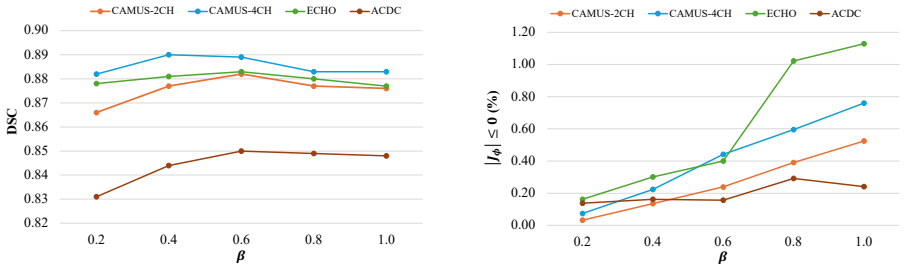
The key machinery is the LDM-based latent feature extraction module, which uses a frozen pre-trained latent diffusion model to encode moving and fixed images into latent variables via DDIM inversion and then extracts features from four convolutional layers of the denoising U-Net. These latent features are fed into the upper stream of a dual-stream encoder, while a lower stream computes Swin-style windowed self-attention; the LGCA module then performs window-based multi-head cross-attention by swapping queries between the two streams. The loss combines pixel-space MSE with latent-space MSE computed through the LDM encoder, weighted by beta = 0.6, plus a gradient regularizer.
What would settle it
A reader could retrain the LDM on only the training splits of the four datasets, or use an LDM pre-trained on a completely unrelated image collection, and then rerun the registration experiments; if the Dice advantage over TransMatch disappears or the folding rate rises, the central claim is falsified.
Extended reading notes
Core claim
The central claim is that LDM-Morph outperformed existing state-of-the-art CNN- and Transformer-based registration methods in accuracy and topology preservation on the CAMUS-2CH, CAMUS-4CH, EchoNet-Dynamic, and ACDC datasets. The paper reports average Dice values of 0.882, 0.889, 0.883, and 0.850 respectively, with lower percentages of non-positive Jacobian determinants than most learned baselines, and better cross-dataset generalization when trained on EchoNet and tested on CAMUS. The authors attribute this to the LDM features enriching semantic information, the LGCA module enhancing interaction between latent and global features, and the latent-space similarity term reducing folding.
Load-bearing premise
The load-bearing premise is that the pre-trained LDM encoder provides meaningful and generalizable semantic features for cardiac images, which is only true if the LDM was not effectively trained on the same images used for evaluation.
Editorial extensions
If this is right
- Using semantic features from a pre-trained latent diffusion model can improve deformable registration accuracy over CNN- and Transformer-only encoders.
- Adding a latent-space similarity term to the loss reduces deformation folding, as measured by non-positive Jacobian determinants.
- The framework generalizes across cardiac datasets when trained on one dataset and tested on another.
- The improvements are incremental but consistent: roughly 1–3% higher Dice than Transformer baselines and larger margins over CNN and diffusion baselines.
- The ablation study suggests that each added component—LDM features, LGCA, and the latent loss—contributes a measurable gain.
Reading between the lines
- The paper does not specify which images were used to pre-train the LDM; if the same cardiac datasets were used, including test pairs, the reported gains may partly reflect memorization rather than generalizable semantic features.
- The hierarchical loss behaves like a perceptual regularizer, so a similar benefit might appear in other modalities with low contrast or high noise, such as ultrasound or low-dose CT.
- The method could likely be made end-to-end trainable by fine-tuning the LDM encoder, which the authors list as a limitation; this might yield larger gains but would also change the unsupervised setup.
- A direct 3D extension is nontrivial because the LDM features are extracted from a 2D architecture, but applying the same idea with a 3D autoencoder is a plausible testable direction.
Signed reviews
Editorial analysis
A structured set of objections, weighed in public.
Referee Report
Summary. The paper proposes LDM-Morph, an unsupervised deformable registration method that combines features from a frozen latent diffusion model (LDM) with a Swin-style global feature stream through a latent-global cross-attention (LGCA) module, and trains with a hierarchical similarity loss evaluated in both pixel space and LDM latent space. The method is evaluated on four public 2D cardiac datasets (CAMUS-2CH, CAMUS-4CH, EchoNet-Dynamic, ACDC) against two classical algorithms and five deep-learning baselines, reporting Dice similarity coefficients, percentages of non-positive Jacobian determinants, and runtime. The authors claim state-of-the-art accuracy and topology preservation with comparable computational cost, and they include an ablation study plus a cross-dataset generalization experiment.
Significance. If the claims are substantiated, the paper would make a useful contribution: it shows that semantic features from a pretrained LDM can be injected into a registration network and used in a dual-space loss, with public code and experiments across multiple cardiac datasets. The strengths are the breadth of the evaluation, the inclusion of topology metrics, the cross-dataset generalization test, and the ablation isolating the three proposed components. However, the central 'outperformed' claim currently rests on mean DSC differences of about 1 percentage point over the strongest Transformer baselines, and the paper lacks significance testing; the method description also contains a concrete loss-formula inconsistency and leaves the LDM pretraining data unspecified. These issues are fixable, but they are load-bearing for the paper's headline claims.
major comments (4)
- [Sec. 5.1, Table 1] The abstract and Section 5.1 claim that LDM-Morph 'outperformed' the Transformer-based baselines in registration accuracy, but the reported mean DSC advantages over TransMorph/TransMatch are 0.011 on CAMUS-2CH (0.882 vs 0.871), 0.013 on CAMUS-4CH (0.889 vs 0.876), and 0.008 on ACDC (0.850 vs 0.842), with standard deviations around 0.05–0.08 and test sizes of 80, 80, and 50. No significance tests are reported, and on these three datasets the gaps are of the same order as the sampling noise; only the ECHO comparison (0.883 vs 0.874, n=1,276) is clearly beyond noise. Please provide paired significance tests, with multiple-comparison correction, for both DSC and the |Jφ|≤0 metric, or soften the accuracy claim to a 'comparable accuracy with improved topology preservation' claim. As it stands, the accuracy half of the headline claim is not established by the reported statistics.
- [Sec. 5.3, Fig. 7 and Sec. 4.2] The balance weight β in Eq. (13) is selected using the test sets. Figure 7 plots DSC and |Jφ|≤0 on the four testing datasets for β from 0.2 to 1.0, and Section 4.2 then fixes β=0.6 'for all the experiments.' This means the final test-set numbers in Table 1 are the product of test-set hyperparameter tuning, which biases the comparison in favor of LDM-Morph. Select β on the validation folds (or via nested cross-validation), report the chosen value separately for each dataset, and freeze it before evaluating on the test sets. The observation that CAMUS-4CH has its best DSC at β=0.4 while 0.6 is used globally further highlights the need for a principled selection procedure.
- [Secs. 3.2 and 4.2] The pretraining data for the LDM are never specified. Section 3.2 states that 'an LDM was pretrained based on the image pairs as described below,' and Section 4.2 only gives the architecture (VQGAN plus a U-Net with channel size 64). If the LDM was trained on the same four datasets, including their test folds, then the hierarchical loss and the cross-dataset generalization experiment in Section 5.2 are not independent, and the reported gains could partly reflect the LDM having memorized the test distribution. Please disclose the exact pretraining dataset(s), the train/validation/test split used for the LDM, and confirm that the LDM training data do not overlap the test sets used in Tables 1 and 2.
- [Sec. 3.4, Eqs. (13)–(15)] The hierarchical similarity loss is double-weighted as written. Eq. (14) defines L_org as (1/|Ω|) Σ_p β [M∘φ^{-1}(p)−F(p)]^2, and Eq. (15) defines L_lat as (1/|Ω|) Σ_p (1−β) [E(M∘φ^{-1}(p))−E(F(p))]^2, while Eq. (13) then forms β L_org + (1−β) L_lat. The result is β^2 times the pixel MSE plus (1−β)^2 times the latent MSE, not the stated convex combination. This changes the interpretation of β in Figure 7 and Section 4.2. Please remove the inner β and (1−β) factors (or redefine L_org and L_lat as unweighted means), and state explicitly which form was actually implemented in the experiments.
minor comments (6)
- [Sec. 3.2, Eq. (5)] The posterior mean formula is inconsistent with the notation: α_t is defined in Eq. (2) as the cumulative product ∏_{s=1}^t (1−β_s), whereas the standard DDPM mean uses 1/√α_t with α_t = 1−β_t. Please correct the formula or align the notation with the standard DDPM expression.
- [Sec. 3.4, Eq. (16)] The smoothness term is an ordinary L2 gradient penalty on the deformation field; describing it as a 'diffusion-based regularizer' is misleading because no diffusion process is involved in that term.
- [Sec. 3.2] The feature-set notation '{ f i M L fF i|i = 1, 2,..., n }' is malformed and should be written as {f^i_{M_L}, f^i_F}; in the same passage, 'Marhov Chain' should be 'Markov chain.'
- [Table 3] The ablation rows are identified only by check marks, leaving the first row's configuration (the baseline without any of the three modules) implicit. Add explicit configuration labels to each row.
- [Sec. 5.1] The statement that LDM-Morph achieved the 'lowest standard deviation in DSC values' is true from Table 1, but the differences in standard deviations are very small (0.001–0.003); please avoid overinterpreting these differences without a formal variance comparison.
- [Eq. (8) and surrounding text] In the sentence defining self-attention, 'matrics' should be 'matrices.'
Circularity Check
No significant circularity: the registration pipeline is trained and evaluated against external public datasets and reimplemented baselines, and the frozen LDM feature extractor and hierarchical loss do not reduce the reported gains to the training objective by construction.
full rationale
The paper's central claim is an empirical comparison rather than a first-principles derivation, and none of the load-bearing components reduces to its own inputs. The LDM-FE module is a frozen encoder: equations (1)-(6) describe the standard latent diffusion pretraining, and Section 3.2 states that after training the parameters of the encoder and U-Net are frozen, so the extracted features are not fitted to the registration loss or to the reported Dice/Jacobian metrics. The LGCA module is a cross-attention fusion defined by equations (9)-(11) that mixes latent and global features without presupposing the outcome. The hierarchical loss in equations (13)-(15) is a weighted sum of pixel-space MSE and latent-space MSE using the same frozen encoder E, but that is a deliberate architectural choice rather than a definitional equivalence between the loss and the evaluation metrics. The ablations in Table 3 show incremental gains from LDM-FE, LGCA, and Llat, and the comparisons in Tables 1-2 are against public datasets and reimplemented external baselines, so the evaluation is self-contained. The self-citations to Wu et al. and Gong et al. appear only in related-work contexts and are not load-bearing. The only ambiguity is that Section 3.2 says 'an LDM was pretrained based on the image pairs' while Section 4.2 specifies only the LDM architecture as in Rombach et al. without stating the pretraining corpus; if the LDM had seen the test images, the latent-similarity term would be a weaker independent measure. That is an unstated data-hygiene detail, not a circularity demonstrated by the paper's own equations, so the circularity score is 0.
Assumptions & free parameters
free parameters (3)
- beta (loss weight between pixel and latent terms) =
0.6
- lambda (smoothness weight) =
0.01
- Diffusion timestep t for feature extraction =
1
assumptions (3)
- domain assumption A pre-trained LDM (VQGAN plus U-Net) provides semantically meaningful latent features and a suitable similarity space for cardiac images.
- domain assumption The LDM used for feature extraction is trained on data that do not include the test images, or if it does, the effect on evaluation is negligible.
- domain assumption DDIM inversion with t=1 steps yields latent codes that preserve the spatial structure needed for registration.
Cite this review
Pith. "Pith review of LDM-Morph: Latent diffusion model guided deformable image registration." pith.science (2026). https://pith.science/paper/NV6XSNUS
@misc{pith2026241115426,
  author       = {Pith},
  title        = {Pith review of: LDM-Morph: Latent diffusion model guided deformable image registration},
  year         = {2026},
  howpublished = {\url{https://pith.science/paper/NV6XSNUS}},
  note         = {Machine review of arXiv:2411.15426}
}
read the original abstract
Deformable image registration plays an essential role in various medical image tasks. Existing deep learning-based deformable registration frameworks primarily utilize convolutional neural networks (CNNs) or Transformers to learn features to predict the deformations. However, the lack of semantic information in the learned features limits the registration performance. Furthermore, the similarity metric of the loss function is often evaluated only in the pixel space, which ignores the matching of high-level anatomical features and can lead to deformation folding. To address these issues, in this work, we proposed LDM-Morph, an unsupervised deformable registration algorithm for medical image registration. LDM-Morph integrated features extracted from the latent diffusion model (LDM) to enrich the semantic information. Additionally, a latent and global feature-based cross-attention module (LGCA) was designed to enhance the interaction of semantic information from LDM and global information from multi-head self-attention operations. Finally, a hierarchical metric was proposed to evaluate the similarity of image pairs in both the original pixel space and latent-feature space, enhancing topology preservation while improving registration accuracy. Extensive experiments on four public 2D cardiac image datasets show that the proposed LDM-Morph framework outperformed existing state-of-the-art CNNs- and Transformers-based registration methods regarding accuracy and topology preservation with comparable computational efficiency. Our code is publicly available at https://github.com/wujiong-hub/LDM-Morph.
Figures


Figures from the paper (4 more)


Reference graph
Works this paper leans on
-
[1]
author Alam, F. , author Rahman, S.U. , author Ullah, S. , author Gulati, K. , year 2018 . title Medical image registration in image guided surgery: Issues, challenges and research opportunities . journal Biocybernetics and Biomedical Engineering volume 38 , pages 71--89
work page 2018
-
[2]
author Avants, B.B. , author Epstein, C.L. , author Grossman, M. , author Gee, J.C. , year 2008 . title Symmetric diffeomorphic image registration with cross-correlation: evaluating automated labeling of elderly and neurodegenerative brain . journal Medical image analysis volume 12 , pages 26--41
work page 2008
-
[3]
author Balakrishnan, G. , author Zhao, A. , author Sabuncu, M.R. , author Guttag, J. , author Dalca, A.V. , year 2019 . title Voxelmorph: a learning framework for deformable medical image registration . journal IEEE transactions on medical imaging volume 38 , pages 1788--1800
work page 2019
-
[4]
author Beg, M.F. , author Miller, M.I. , author Trouv \'e , A. , author Younes, L. , year 2005 . title Computing large deformation metric mappings via geodesic flows of diffeomorphisms . journal International journal of computer vision volume 61 , pages 139--157
work page 2005
-
[5]
, author Lalande, A
author Bernard, O. , author Lalande, A. , author Zotti, C. , author Cervenansky, F. , author Yang, X. , author Heng, P.A. , author Cetin, I. , author Lekadir, K. , author Camara, O. , author Ballester, M.A.G. , et al., year 2018 . title Deep learning techniques for automatic mri cardiac multi-structures segmentation and diagnosis: is the problem solved? j...
2018
-
[6]
author Chen, C.F.R. , author Fan, Q. , author Panda, R. , year 2021 . title Crossvit: Cross-attention multi-scale vision transformer for image classification , in: booktitle Proceedings of the IEEE/CVF international conference on computer vision , pp. pages 357--366
work page 2021
-
[7]
author Chen, J. , author Frey, E.C. , author He, Y. , author Segars, W.P. , author Li, Y. , author Du, Y. , year 2022 . title Transmorph: Transformer for unsupervised medical image registration . journal Medical image analysis volume 82 , pages 102615
work page 2022
-
[8]
author Chen, Z. , author Zheng, Y. , author Gee, J.C. , year 2023 . title Transmatch: A transformer-based multilevel dual-stream feature matching network for unsupervised deformable image registration . journal IEEE transactions on medical imaging volume 43 , pages 15--27
work page 2023
Show all 45 references
-
[9]
, author Yang, H
author Cui, C. , author Yang, H. , author Wang, Y. , author Zhao, S. , author Asad, Z. , author Coburn, L.A. , author Wilson, K.T. , author Landman, B.A. , author Huo, Y. , year 2023 . title Deep multimodal fusion of image and non-image data in disease diagnosis and prognosis:...
2023
-
[10]
, author Berendsen, F.F
author De Vos, B.D. , author Berendsen, F.F. , author Viergever, M.A. , author Sokooti, H. , author Staring, M. , author I s gum, I. , year 2019 . title A deep learning framework for unsupervised affine and deformable image registration . journal Medical image analysis volume ...
2019
-
[11]
, author Bu, J
author Ding, Y. , author Bu, J. , author Qin, Z. , author You, L. , author Cao, M. , author Qin, Z. , author Pang, M. , year 2024 . title C2fresmorph: A high-performance framework for unsupervised 2d medical image registration . journal Pattern Recognition volume 154 , pages 110615
2024
-
[12]
, author Gong, K
author Dong, Y. , author Gong, K. , year 2024 . title Head and neck tumor segmentation from [18f] f-fdg pet/ct images based on 3d diffusion model . journal Physics in Medicine and Biology
2024
-
[13]
, author Rombach, R
author Esser, P. , author Rombach, R. , author Ommer, B. , year 2021 . title Taming transformers for high-resolution image synthesis , in: booktitle Proceedings of the IEEE/CVF conference on computer vision and pattern recognition , pp. pages 12873--12883
2021
-
[14]
, author Khateri, M
author Ghahremani, M. , author Khateri, M. , author Jian, B. , author Wiestler, B. , author Adeli, E. , author Wachinger, C. , year 2024 . title H-vit: A hierarchical vision transformer for deformable image registration , in: booktitle Proceedings of the IEEE/CVF Conference on...
2024
-
[15]
, author Johnson, K
author Gong, K. , author Johnson, K. , author El Fakhri, G. , author Li, Q. , author Pan, T. , year 2024 . title Pet image denoising based on denoising diffusion probabilistic model . journal European Journal of Nuclear Medicine and Molecular Imaging volume 51 , pages 358--368
2024
-
[16]
, author Dey, N
author Gopalakrishnan, V. , author Dey, N. , author Golland, P. , year 2024 . title Intraoperative 2d/3d image registration via differentiable x-ray rendering , in: booktitle Proceedings of the IEEE/CVF Conference on Computer Vision and Pattern Recognition , pp. pages 11662--11672
2024
-
[17]
, author Hansen, L
author Hering, A. , author Hansen, L. , author Mok, T.C. , author Chung, A.C. , author Siebert, H. , author H \"a ger, S. , author Lange, A. , author Kuckertz, S. , author Heldmann, S. , author Shao, W. , et al., year 2022 . title Learn2reg: comprehensive multi-task medical im...
2022
-
[18]
, author Jain, A
author Ho, J. , author Jain, A. , author Abbeel, P. , year 2020 . title Denoising diffusion probabilistic models . journal Advances in neural information processing systems volume 33 , pages 6840--6851
2020
-
[19]
, author Sun, G
author Huo, X. , author Sun, G. , author Tian, S. , author Wang, Y. , author Yu, L. , author Long, J. , author Zhang, W. , author Li, A. , year 2024 . title Hifuse: Hierarchical multi-scale feature fusion network for medical image classification . journal Biomedical Signal Pro...
2024
-
[20]
, author Lois, C
author Jang, S.I. , author Lois, C. , author Thibault, E. , author Becker, J.A. , author Dong, Y. , author Normandin, M.D. , author Price, J.C. , author Johnson, K.A. , author Fakhri, G.E. , author Gong, K. , year 2023 . title Taupetgen: Text-conditional tau pet image synthesi...
2023 arXiv
-
[21]
, author Bartlett, J
author Jia, X. , author Bartlett, J. , author Zhang, T. , author Lu, W. , author Qiu, Z. , author Duan, J. , year 2022 . title U-net vs transformer: Is u-net outdated in medical image registration? , in: booktitle International Workshop on Machine Learning in Medical Imaging ,...
2022
-
[22]
, author Imran, M
author Jiang, H. , author Imran, M. , author Ma, L. , author Zhang, T. , author Zhou, Y. , author Liang, M. , author Gong, K. , author Shao, W. , year 2024 . title Fast denoising diffusion probabilistic models for medical image-to-image generation . journal arXiv preprint arXi...
2024 arXiv
-
[23]
, author Han, I
author Kim, B. , author Han, I. , author Ye, J.C. , year 2022 . title Diffusemorph: Unsupervised deformable image registration using diffusion model , in: booktitle European conference on computer vision , organization Springer . pp. pages 347--364
2022
-
[24]
, author Kim, D.H
author Kim, B. , author Kim, D.H. , author Park, S.H. , author Kim, J. , author Lee, J.G. , author Ye, J.C. , year 2021 . title Cyclemorph: cycle consistent unsupervised deformable image registration . journal Medical image analysis volume 71 , pages 102036
2021
-
[25]
, author Banda, S
author Kuppala, K. , author Banda, S. , author Barige, T.R. , year 2020 . title An overview of deep learning methods for image registration with focus on feature-based approaches . journal International Journal of Image and Data Fusion volume 11 , pages 113--135
2020
-
[26]
, author Smistad, E
author Leclerc, S. , author Smistad, E. , author Pedrosa, J. , author stvik, A. , author Cervenansky, F. , author Espinosa, F. , author Espeland, T. , author Berg, E.A.R. , author Jodoin, P.M. , author Grenier, T. , et al., year 2019 . title Deep learning for segmentation usin...
2019
-
[27]
, author Kooi, T
author Litjens, G. , author Kooi, T. , author Bejnordi, B.E. , author Setio, A.A.A. , author Ciompi, F. , author Ghafoorian, M. , author Van Der Laak, J.A. , author Van Ginneken, B. , author S \'a nchez, C.I. , year 2017 . title A survey on deep learning in medical image analy...
2017
-
[28]
, author Lin, Y
author Liu, Z. , author Lin, Y. , author Cao, Y. , author Hu, H. , author Wei, Y. , author Zhang, Z. , author Lin, S. , author Guo, B. , year 2021 . title Swin transformer: Hierarchical vision transformer using shifted windows , in: booktitle Proceedings of the IEEE/CVF intern...
2021
-
[29]
, author Xu, Y
author Ma, M. , author Xu, Y. , author Song, L. , author Liu, G. , year 2022 . title Symmetric transformer-based network for unsupervised image registration . journal Knowledge-Based Systems volume 257 , pages 109959
2022
-
[30]
, author Feng, D
author Meng, M. , author Feng, D. , author Bi, L. , author Kim, J. , year 2024 . title Correlation-aware coarse-to-fine mlps for deformable medical image registration , in: booktitle Proceedings of the IEEE/CVF Conference on Computer Vision and Pattern Recognition , pp. pages ...
2024
-
[31]
, author Chung, A.C
author Mok, T.C. , author Chung, A.C. , year 2020 . title Large deformation diffeomorphic image registration with laplacian pyramid networks , in: booktitle Medical Image Computing and Computer Assisted Intervention--MICCAI 2020: 23rd International Conference, Lima, Peru, Octo...
2020
-
[32]
, author He, B
author Ouyang, D. , author He, B. , author Ghorbani, A. , author Yuan, N. , author Ebinger, J. , author Langlotz, C.P. , author Heidenreich, P.A. , author Harrington, R.A. , author Liang, D.H. , author Ashley, E.A. , et al., year 2020 . title Video-based ai for beat-to-beat as...
2020
-
[33]
, author Singh, B
author Pnvr, K. , author Singh, B. , author Ghosh, P. , author Siddiquie, B. , author Jacobs, D. , year 2023 . title Ld-znet: A latent diffusion approach for text-based image segmentation , in: booktitle Proceedings of the IEEE/CVF International Conference on Computer Vision ,...
2023
-
[34]
, author Li, X
author Qin, Y. , author Li, X. , year 2023 . title Fsdiffreg: Feature-wise and score-wise diffusion-guided unsupervised deformable image registration for cardiac images , in: booktitle International Conference on Medical Image Computing and Computer-Assisted Intervention , org...
2023
-
[35]
, author Wang, Z
author Rawat, W. , author Wang, Z. , year 2017 . title Deep convolutional neural networks for image classification: A comprehensive review . journal Neural computation volume 29 , pages 2352--2449
2017
-
[36]
, author Blattmann, A
author Rombach, R. , author Blattmann, A. , author Lorenz, D. , author Esser, P. , author Ommer, B. , year 2022 . title High-resolution image synthesis with latent diffusion models , in: booktitle Proceedings of the IEEE/CVF conference on computer vision and pattern recognitio...
2022
-
[37]
, author Yang, D
author Tang, Y. , author Yang, D. , author Li, W. , author Roth, H.R. , author Landman, B. , author Xu, D. , author Nath, V. , author Hatamizadeh, A. , year 2022 . title Self-supervised pre-training of swin transformers for 3d medical image analysis , in: booktitle Proceedings...
2022
-
[38]
, author Velec, M
author Torchia, J. , author Velec, M. , year 2024 . title Deformable image registration for composite planned doses during adaptive radiation therapy . journal Journal of Medical Imaging and Radiation Sciences volume 55 , pages 82--90
2024
-
[39]
, author Pennec, X
author Vercauteren, T. , author Pennec, X. , author Perchant, A. , author Ayache, N. , year 2009 . title Diffeomorphic demons: Efficient non-parametric image registration . journal NeuroImage volume 45 , pages S61--S72
2009
-
[40]
, author Li, H
author Wu, J. , author Li, H. , author Fan, Y. , year 2024 . title Diffeomorphic image registration with bijective consistency , in: booktitle Medical Imaging 2024: Image Processing , organization SPIE . pp. pages 700--706
2024
-
[41]
, author Tang, X
author Wu, J. , author Tang, X. , year 2020 . title A large deformation diffeomorphic framework for fast brain image registration via parallel computing and optimization . journal Neuroinformatics volume 18 , pages 251--266
2020
-
[42]
, author Jiang, P
author Xu, L. , author Jiang, P. , author Tsui, T. , author Liu, J. , author Zhang, X. , author Yu, L. , author Niu, T. , year 2023 . title 4d-ct deformable image registration using unsupervised recursive cascaded full-resolution residual networks . journal Bioengineering & tr...
2023
-
[43]
, author Fletcher, P.T
author Zhang, M. , author Fletcher, P.T. , year 2015 . title Finite-dimensional lie algebras for fast diffeomorphic image registration , in: booktitle Information Processing in Medical Imaging: 24th International Conference, IPMI 2015, Sabhal Mor Ostaig, Isle of Skye, UK, June...
2015
-
[44]
, author Stendahl, J.C
author Zhang, X. , author Stendahl, J.C. , author Staib, L. , author Sinusas, A.J. , author Wong, A. , author Duncan, J.S. , year 2023 . title An adaptive correspondence scoring framework for unsupervised image registration of medical images . journal arXiv preprint arXiv:2312.00837
2023 arXiv
-
[45]
write newline
" write newline "" before.all 'output.state := FUNCTION n.dashify 't := "" t empty not t #1 #1 substring "-" = t #1 #2 substring "--" = not "--" * t #2 global.max substring 't := t #1 #1 substring "-" = "-" * t #2 global.max substring 't := while if t #1 #1 substring * t #2 gl...
Reviewed August 12, 2026 · model on record in the stance chip above.
Discussion (0). Continue with ORCID to comment.