REVIEW 3 major objections 6 minor 148 references
Stellar feedback strength alone shifts supermassive black hole merger delays from ~30 to ~500 Myr in sub-Milky Way galaxies, a tenfold-plus spread driven by central stellar density.
Reviewed by Pith at T0; open to challenge. T0 means a machine referee read the full paper against a public rubric. the ladder, T0–T4 →
T0 review · deepseek-v4-flash
2026-08-02 03:42 UTC pith:NWCA2BOF
load-bearing objection New and credible evidence that stellar feedback strength alone can shift LISA-relevant SMBH merger delays by an order of magnitude in low-mass galaxies; the causal chain has one loose knot at t_hard, but the paper deserves a real referee. the 3 major comments →
RABBITS IV: Stellar feedback and SMBH merging time-scales in the sub-Milky Way mass regime
The pith
A machine-rendered reading of the paper's core claim, the machinery that carries it, and where it could break.
Core claim
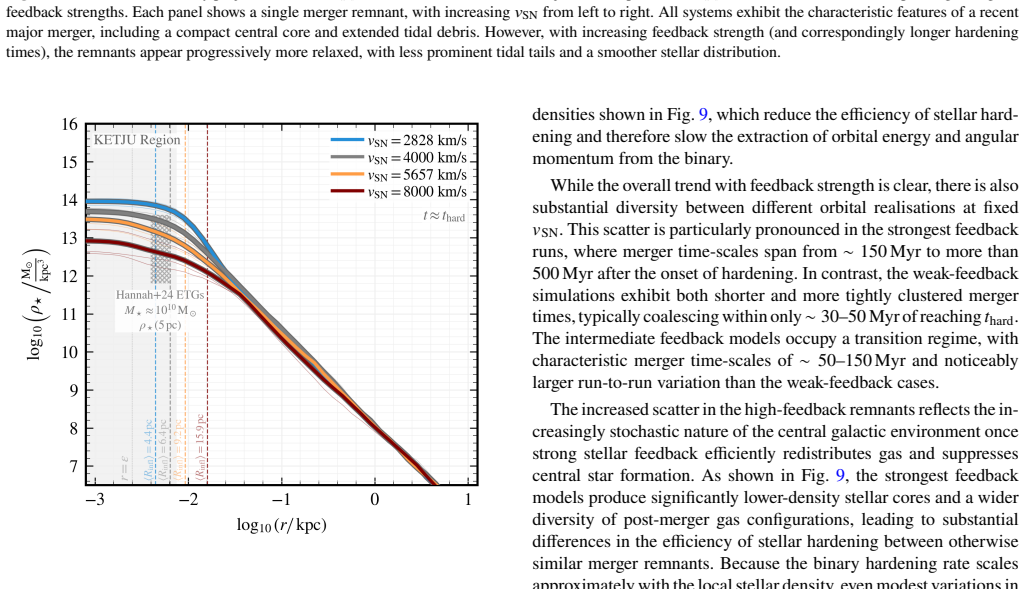
Using the KETJU code, the authors run sixteen idealized equal-mass mergers of gas-rich disc galaxies below 10^10 M_sun, each hosting a non-accreting ~7.5x10^6 M_sun black hole. They vary only the supernova outflow velocity (2828, 4000, 5657, 8000 km/s), spanning a factor of four in energy while keeping galaxies within observed scaling relations. The central finding is a systematic progression: average post-hardening merger time-scales grow from ~31 Myr in the weakest-feedback runs to ~357 Myr in the strongest, with individual realizations from ~20 to ~530 Myr. The physical chain is that stronger feedback vents merger-driven gas from the nucleus and suppresses central star formation, lowering
What carries the argument
The load-bearing object is the KETJU software extension of the GADGET-3 code: it replaces softened SMBH dynamics with the algorithmically regularized MSTAR integrator, so the binary interacts with individual stars without softening and includes post-Newtonian corrections to 3.5PN order. The analytic machinery is the stellar-dynamical hardening law, which states that the binary's hardening rate s = d/dt(1/a) equals H G rho_star / sigma_star, with H ~ 14.55 in an efficiently replenished loss cone. Combined with Peters' gravitational-wave inspiral term, this yields an explicit merger time T_m that scales as rho(R_infl)^(-4/5) sigma(R_infl)^(4/5) M_bin^(-3/5) F(e)^(-1/5), where R_infl is the inf
Load-bearing premise
The trend and the extrapolation accuracy both rest on the assumption that the four chosen supernova outflow velocities faithfully bracket the true range of stellar feedback, and that the unresolved inner density profile is adequately represented by a softened power law with a fixed core radius of 0.25 times the influence radius.
What would settle it
Run the same merger suite with an independent stellar feedback implementation and check whether the central stellar density at the influence radius—and the resulting 30–500 Myr spread—is reproduced; or, observationally, if high-resolution nuclear density measurements of post-merger galaxies at M_star ~ 10^10 M_sun show no scatter correlated with feedback proxies, the proposed mechanism would be in doubt.
If this is right
- SMBH merger-delay distributions inherit a >10x spread purely from plausible stellar-feedback uncertainty; LISA population forecasts that fix one feedback model are likely overconfident.
- In these low-mass, gas-rich remnants, the post-hardening environment is stellar-dominated, so stellar-only hardening prescriptions are adequate once the nuclear stellar density is known.
- Cosmological simulations with ~100 pc resolution, where the sphere of influence is unresolved, can recover SMBH merger times to ~0.2 dex by extrapolating fitted outer density profiles inward.
- The quantity that sets the delay is the central stellar density at hardening, which is imprinted by feedback during the merger itself—so galaxy-formation physics and SMBH binary dynamics cannot be treated independently.
Where Pith is reading between the lines
- One testable extension is to repeat the extrapolation exercise with a physically motivated core radius calibrated to observed nuclear profiles, rather than the fixed 0.25 R_infl—this would show how much of the quoted ~0.2 dex accuracy is assumption.
- If the feedback-delay trend persists for unequal-mass mergers, the LISA-detectable population could skew to even longer delays, pushing more events to lower redshift than current catalogs assume.
- Feedback-regulated delays should also shape the nanohertz stochastic gravitational-wave background: longer delays mean fewer actively inspiralling binaries, raising the expected sky anisotropy—a signature the next round of pulsar-timing-array anisotropy searches could confront.
- The strong correlation between merger time and extrapolated central density suggests a practical subgrid calibration recipe: train delay prescriptions on resolved KETJU mergers across feedback strengths instead of adopting a constant post-coalescence delay.
Editorial analysis
A structured set of objections, weighed in public.
Referee Report
Summary. This paper presents 16 idealised equal-mass galaxy merger simulations with the KETJU code, varying supernova feedback strength via the SN outflow velocity (2828–8000 km/s, four values × four realisations), for low-mass galaxies (M* < 10^10 Msun). The authors track SMBH binary evolution from kpc scales through dynamical friction, stellar hardening, and GW-driven inspiral with post-Newtonian terms. They report post-hardening merger time-scales of ~30–500 Myr, increasing systematically with feedback strength, and attribute this to feedback suppressing nuclear star formation and lowering central stellar densities. They further test the Sesana & Khan (2015) analytic merger-time prescription against their simulations, finding good agreement with no adjusted parameters, and show that merger times can be recovered to ~0.2 dex accuracy when central stellar properties are extrapolated from scales up to ~100 R_infl. The paper concludes that stellar feedback uncertainty alone can cause order-of-magnitude variations in SMBH merger delays, with implications for LISA and PTA predictions.
Significance. If the central causal claim holds, this is an important result: it demonstrates that a plausible variation in sub-grid stellar feedback—within a range that still yields galaxies consistent with observed scaling relations—changes post-hardening SMBH merger delays by more than an order of magnitude in the low-mass regime most relevant to LISA. The strength of the paper is its systematic approach: four feedback strengths, four realisations each, a direct KETJU treatment of the binary, and a parameter-free comparison to the Sesana & Khan (2015) and Sesana et al. (2006) analytic frameworks. The quantitative agreement with those frameworks over two orders of magnitude in T_m is a strong, falsifiable test. The extrapolation experiment in Section 4.4 is also a constructive step toward sub-grid prescriptions in cosmological simulations. However, the causal interpretation (feedback → lower density → longer T_m) is the load-bearing part of the abstract, and it is currently supported by density profiles measured only at feedback-dependent epochs; this needs a direct fixed-epoch test to rule out a partly reversed causal arrow.
major comments (3)
- [§4.2, Fig. 9] The central claim—'stronger stellar feedback produces longer merger delays through its impact on the central stellar density'—is supported by Fig. 9, which compares density profiles at t≈t_hard. But t_hard increases systematically with feedback strength (Fig. 8, Table 4), so strong-feedback binaries have had substantially more time to scatter and eject stars before the density is measured. The influence radii in these remnants are only ~6–10 pc, comparable to the KETJU regularized region, so binary back-reaction could plausibly lower the density at exactly the radius used in the analysis. The statement in §4.3 that the divergence is 'imprinted prior to the SMBH binary phase' is not directly demonstrated; Fig. 7 shows gas/SFR evolution, not stellar density at a fixed epoch. Please provide a direct fixed-epoch stellar density comparison (e.g., at a common time after coalescence, or at t=2.
- [§4.4, Fig. 14, footnote 7] The extrapolation experiment assumes a universal core radius R_core = 0.25 R_infl for all simulated remnants. The claim that T_m is recovered to ~0.2 dex at ~100 R_infl (Fig. 14, top panel) may be sensitive to this ad hoc choice; no sensitivity test is shown. Since this section is presented as a practical route for cosmological simulations, please either (i) vary the core factor (e.g., 0.1–0.5 R_infl) and show the effect on the recovered T_m, or (ii) provide a physical justification for the universality of R_core = 0.25 R_infl based on the simulated profiles. Without this, the robustness of the extrapolation claim is unclear.
- [§4.3/§5.4] The analytic comparison in Figs. 12 and 13 uses stellar properties measured at the same time as the hardening rate. The good agreement with Sesana & Khan (2015) may be partly self-consistent: if the binary modifies the density at R_infl while hardening, then measuring both the hardening rate and the density at the same epoch could yield an apparent correlation that does not fully validate the predictive use of the framework. The authors note this concern indirectly in §5.4 (and the framework is not claimed universal), but a quantitative check—e.g., comparing hardening rates at early times against initial densities, or using densities measured before hardening—would strengthen the predictive claim.
minor comments (6)
- [§2.1.3] The phrase 'AGB feedback is implemented using the same temporal framework as SNIa feedback' may confuse AGB mass loss with supernova events; consider clarifying that only the temporal sampling is analogous.
- [§4.1, Table 3] Table 3 lists mean/min/max dynamical-friction delays, but the text says 'the duration of time spent in the dynamical friction phase is presented'; consider indicating that only summary statistics are shown.
- [§4.3, end of first paragraph] Typo: 'increases by approximately an of magnitude' should read 'an order of magnitude'.
- [§4.3, Eq. (17) region] 'dynamical ou bli ette' appears to be a typo for 'dynamical oubliette'.
- [§4.4, Fig. 14] The eccentricity at t_hard is taken directly from the simulation, which is not available in a purely cosmological context. This is acknowledged in the text, but it should be explicitly restated in the caption of Fig. 14 and in the conclusions, since it is a key input to the extrapolation framework.
- [§5.2] The discussion of PTA anisotropy is somewhat tangential; the connection between merger-delay distributions and SGWB anisotropy could be tightened, but it is not a blocking issue.
Circularity Check
Central analytic comparison is independent; mild oracle-input contamination in the Section 4.4 extrapolation experiment.
specific steps
-
fitted input called prediction
[Section 4.4 and footnote 7 (Fig. 14, Fig. A1)]
"The choice to add a core avoids a slight overestimation of ρ(R_infl) from extrapolation of average 0.05−0.1 dex due to the inner flattening of the density profiles in our sample of remnants – this is shown in Fig. A1. ... The notable exception to this is the eccentricity of the binary, which we directly take from the simulation at t≈t_hard."
The extrapolation experiment's 'recovery' of merger times from scales up to ~100 R_infl is partially aided by inputs taken directly from the same KETJU simulations: R_core is set to 0.25 R_infl based on the inner flattening measured in the same remnant sample, R_infl itself is a measured simulation quantity, and e_hard is taken directly from the simulated binary. The core prescription is thus calibrated to the very nuclear structure being predicted, so the quoted ~0.2 dex accuracy is a calibrated interpolation rather than a fully out-of-sample prediction. This does not affect the main analytic comparison (Figs. 12–13), where H=14.55 and the Sesana & Khan (2015) framework are external and no T_m value is fitted.
full rationale
The paper's principal derivation chain is not circular. The post-hardening merger times in Table 4 are measured directly from KETJU simulations, and the comparison with stellar-dynamical predictions uses the externally calibrated Sesana et al. (2006) hardening coefficient H=14.55 and the Sesana & Khan (2015) two-regime formula, with no parameter fit to the simulated T_m values. The stellar density and velocity dispersion are measured from the same simulations, but that is a consistency test, not a constructional reduction of the prediction to its inputs. The causal feedback-to-density-to-delay chain is supported by independent SFR and gas-evolution evidence (Fig. 7) and by direct density profiles (Fig. 9). The only mild contamination is the Section 4.4 extrapolation experiment, where the fixed core radius R_core=0.25 R_infl is chosen to correct for the known inner flattening of the same remnant sample, and R_infl plus e_hard are taken from the simulations; this makes the extrapolated 'recovery' partly calibrated to the target systems. However, T_m,KETJU is not used as a fit target, and the extrapolation result is clearly labeled as a benchmark test rather than a stand-alone prediction. The self-citations (Liao et al. 2023, 2024a,b; Keitaanranta et al. 2026) provide code and prior context but do not carry the central derivation. Overall circularity is low: score 2 reflects only the mild oracle-input aspect of the extrapolation experiment, not the main results.
Axiom & Free-Parameter Ledger
free parameters (3)
- Supernova outflow velocity v_SN =
2828, 4000, 5657, 8000 km/s
- Extrapolation core radius factor =
R_core = 0.25 R_infl
- Initial SMBH seed mass =
7.53e6 M_sun
axioms (6)
- standard math Binary hardening rate s = H G rho/sigma with H=14.55, and the Sesana & Khan (2015) two-phase inspiral formula
- domain assumption Equal-mass, gas-rich disc mergers on the G5 retrograde orbit with local-universe initial conditions and no cosmological gas replenishment
- domain assumption SMBH accretion and AGN feedback are negligible in this mass regime
- domain assumption The Nunez et al. (2017) subgrid stellar feedback implementation and the chosen v_SN variation faithfully represent the feedback physics relevant to nuclear star formation
- domain assumption KETJU's regularized integration and post-Newtonian terms resolve SMBH binary evolution without significant numerical artifacts from the 2.5 pc stellar softening
- ad hoc to paper R_core = 0.25 R_infl is an acceptable universal core prescription for extrapolating unresolved density profiles
read the original abstract
Merging supermassive black holes (SMBHs) in low- and intermediate-mass galaxies are important sources for future millihertz gravitational-wave observatories such as LISA. Predicting the delay between galaxy coalescence and SMBH merger is therefore critical for modelling the observable SMBH merger population. Using the KETJU code, we perform 16 equal-mass galaxy merger simulations as part of the Resolving supermAssive Black hole Binaries In galacTic hydrodynamical Simulations (RABBITS) series to investigate SMBH binary evolution in galaxies with stellar masses below $M_{\star}\lesssim10^{10}\,{\rm M}_{\odot}$. We systematically vary the strength of stellar feedback by altering the supernova outflow velocity by a factor of $\sim4$, while still producing galaxies consistent with observed scaling relations. We find post-hardening SMBH merger time-scales spanning $\sim30$-$500\,{\rm Myr}$, with stronger stellar feedback producing systematically longer merger delays through its impact on the central stellar density of the merger remnants. Across our suite, merging time-scales vary by more than an order of magnitude, demonstrating that uncertainties in stellar feedback alone can translate into large uncertainties in SMBH merger delays. At the onset of hardening, the binary evolution remains consistent with stellar-dynamical hardening models based on the local stellar density and velocity dispersion near the binary sphere of influence. Using KETJU as a benchmark, we show that merging time-scales can be recovered with useful accuracy when these nuclear stellar properties are extrapolated from scales up to $\sim 100\,R_{\rm infl}$. These results provide a promising route for modelling SMBH mergers in cosmological simulations.
Figures




Reference graph
Works this paper leans on
-
[1]
Core condensation in heavy halos: a two-stage theory for galaxy formation and clustering. , keywords =. doi:10.1093/mnras/183.3.341 , adsurl =
-
[2]
Merger rates in hierarchical models of galaxy formation. , keywords =. doi:10.1093/mnras/262.3.627 , adsurl =
-
[3]
Massive black hole binaries in active galactic nuclei. , keywords =. doi:10.1038/287307a0 , adsurl =
-
[4]
Dynamical Friction. I. General Considerations: the Coefficient of Dynamical Friction. , year = 1943, month = mar, volume =. doi:10.1086/144517 , adsurl =
doi:10.1086/144517 1943
-
[5]
Dynamical Friction in a Gaseous Medium. , keywords =. doi:10.1086/306858 , archivePrefix =. astro-ph/9810324 , primaryClass =
-
[6]
Evolution of binaries in the field of light particles and the problem of two black holes. , keywords =. doi:10.1093/mnras/259.1.115 , adsurl =
-
[7]
The time-scale for core collapse in spherical star clusters. , keywords =. doi:10.1016/S1384-1076(96)00018-8 , archivePrefix =. astro-ph/9606182 , primaryClass =
-
[8]
The APOSTLE simulations: solutions to the Local Group's cosmic puzzles. , keywords =. doi:10.1093/mnras/stw145 , archivePrefix =. 1511.01098 , primaryClass =
-
[9]
The Auriga Project: the properties and formation mechanisms of disc galaxies across cosmic time. , keywords =. doi:10.1093/mnras/stx071 , archivePrefix =. 1610.01159 , primaryClass =
-
[10]
Interaction of Massive Black Hole Binaries with Their Stellar Environment. I. Ejection of Hypervelocity Stars. , keywords =. doi:10.1086/507596 , archivePrefix =. astro-ph/0604299 , primaryClass =
-
[11]
Apostle-Auriga: effects of different subgrid models on the baryon cycle around Milky Way-mass galaxies. , keywords =. doi:10.1093/mnras/stac1019 , archivePrefix =. 2106.08618 , primaryClass =
-
[12]
Bulge n and B/T in High-Mass Galaxies: Constraints on the Origin of Bulges in Hierarchical Models. , keywords =. doi:10.1088/0004-637X/696/1/411 , archivePrefix =. 0807.0040 , primaryClass =
-
[13]
A New Parallel N-Body Gravity Solver: TPM. , keywords =. doi:10.1086/192166 , archivePrefix =. astro-ph/9409021 , primaryClass =
-
[14]
Circumbinary Accretion: From Binary Stars to Massive Binary Black Holes. , keywords =. doi:10.1146/annurev-astro-052622-022933 , archivePrefix =. 2211.00028 , primaryClass =
-
[15]
Physical Review , year = 1963, month = jul, volume =
Gravitational Radiation from Point Masses in a Keplerian Orbit. Physical Review , year = 1963, month = jul, volume =. doi:10.1103/PhysRev.131.435 , adsurl =
-
[16]
Physical Review , year = 1964, month = nov, volume =
Gravitational Radiation and the Motion of Two Point Masses. Physical Review , year = 1964, month = nov, volume =. doi:10.1103/PhysRev.136.B1224 , adsurl =
-
[17]
The NANOGrav 15 yr Data Set: Constraints on Supermassive Black Hole Binaries from the Gravitational-wave Background. , keywords =. doi:10.3847/2041-8213/ace18b , archivePrefix =. 2306.16220 , primaryClass =
Pith/arXiv arXiv 2041
-
[18]
Laser Interferometer Space Antenna. arXiv e-prints , keywords =. doi:10.48550/arXiv.1702.00786 , archivePrefix =. 1702.00786 , primaryClass =
-
[19]
SPHGal: smoothed particle hydrodynamics with improved accuracy for galaxy simulations. , keywords =. doi:10.1093/mnras/stu1187 , archivePrefix =. 1402.1788 , primaryClass =
-
[21]
Inviscid smoothed particle hydrodynamics. , keywords =. doi:10.1111/j.1365-2966.2010.17158.x , archivePrefix =. 1006.1524 , primaryClass =
arXiv 2010
-
[23]
A Necessary Condition for Individual Time Steps in SPH Simulations. , keywords =. doi:10.1088/0004-637X/697/2/L99 , archivePrefix =. 0808.0773 , primaryClass =
-
[24]
The dark nemesis of galaxy formation: why hot haloes trigger black hole growth and bring star formation to an end. , keywords =. doi:10.1093/mnras/stw2735 , archivePrefix =. 1607.07445 , primaryClass =
-
[25]
Living Reviews in Relativity , keywords =
Astrophysics with the Laser Interferometer Space Antenna. Living Reviews in Relativity , keywords =. doi:10.1007/s41114-022-00041-y , archivePrefix =. 2203.06016 , primaryClass =
-
[27]
A multiphase model with supernova energy feedback
Feedback and metal enrichment in cosmological SPH simulations - II. A multiphase model with supernova energy feedback. , keywords =. doi:10.1111/j.1365-2966.2006.10785.x , archivePrefix =. astro-ph/0604524 , primaryClass =
arXiv 2006
-
[28]
Classical and Quantum Gravity , keywords =
TianQin: a space-borne gravitational wave detector. Classical and Quantum Gravity , keywords =. doi:10.1088/0264-9381/33/3/035010 , archivePrefix =. 1512.02076 , primaryClass =
-
[29]
International Journal of Modern Physics A , keywords =
Taiji program: Gravitational-wave sources. International Journal of Modern Physics A , keywords =. doi:10.1142/S0217751X2050075X , adsurl =
-
[30]
Massive Black Hole Merger Rates: The Effect of Kiloparsec Separation Wandering and Supernova Feedback. , keywords =. doi:10.3847/1538-4357/abba7f , archivePrefix =. 2006.03065 , primaryClass =
Pith/arXiv arXiv 2006
-
[31]
High-precision timing of 42 millisecond pulsars with the European Pulsar Timing Array. , keywords =. doi:10.1093/mnras/stw483 , archivePrefix =. 1602.08511 , primaryClass =
-
[32]
Living Reviews in Relativity , keywords =
Massive Black Hole Binary Evolution. Living Reviews in Relativity , keywords =. doi:10.12942/lrr-2005-8 , archivePrefix =. astro-ph/0410364 , primaryClass =
Pith/arXiv arXiv 2005
-
[33]
Off the beaten path: a new approach to realistically model the orbital decay of supermassive black holes in galaxy formation simulations. , keywords =. doi:10.1093/mnras/stv1060 , archivePrefix =. 1501.07609 , primaryClass =
-
[34]
Modelling the accretion and feedback of supermassive black hole binaries in gas-rich galaxy mergers. , keywords =. doi:10.1093/mnras/stad412 , archivePrefix =. 2211.11788 , primaryClass =
-
[35]
RABBITS - I. The crucial role of nuclear star formation in driving the coalescence of supermassive black hole binaries. , keywords =. doi:10.1093/mnras/stae360 , archivePrefix =. 2311.01499 , primaryClass =
-
[36]
H II Regions and the Abundance Properties of Spiral Galaxies. , keywords =. doi:10.1086/173544 , adsurl =
-
[37]
RABBITS - II. The impact of AGN feedback on coalescing supermassive black holes in disc and elliptical galaxy mergers. , keywords =. doi:10.1093/mnras/stae1123 , archivePrefix =. 2311.01493 , primaryClass =
-
[38]
Dancing to CHANGA: a self-consistent prediction for close SMBH pair formation time-scales following galaxy mergers. , keywords =. doi:10.1093/mnras/sty139 , archivePrefix =. 1708.07126 , primaryClass =
-
[39]
Swift Coalescence of Supermassive Black Holes in Cosmological Mergers of Massive Galaxies. , keywords =. doi:10.3847/0004-637X/828/2/73 , archivePrefix =. 1604.00015 , primaryClass =
-
[40]
Reviving stochasticity: uncertainty in SMBH binary eccentricity is unavoidable. , keywords =. doi:10.1093/mnras/stad2891 , archivePrefix =. 2307.08756 , primaryClass =
-
[41]
The Population of Viscosity- and Gravitational Wave-driven Supermassive Black Hole Binaries Among Luminous Active Galactic Nuclei. , keywords =. doi:10.1088/0004-637X/700/2/1952 , archivePrefix =. 0904.1383 , primaryClass =
Pith/arXiv arXiv 1952
-
[42]
Computer simulations of close encounters between single stars and hard binaries. , keywords =. doi:10.1086/112798 , adsurl =
-
[43]
Interaction of Massive Black Hole Binaries with Their Stellar Environment. II. Loss Cone Depletion and Binary Orbital Decay. , keywords =. doi:10.1086/513016 , archivePrefix =. astro-ph/0612265 , primaryClass =
-
[44]
Low-Frequency Gravitational Radiation from Coalescing Massive Black Hole Binaries in Hierarchical Cosmologies. , keywords =. doi:10.1086/422185 , archivePrefix =. astro-ph/0401543 , primaryClass =
-
[45]
Blossoms from black hole seeds: properties and early growth regulated by supernova feedback. , keywords =. doi:10.1093/mnras/stx666 , archivePrefix =. 1605.09394 , primaryClass =
-
[46]
Linking the Spin Evolution of Massive Black Holes to Galaxy Kinematics. , keywords =. doi:10.1088/0004-637X/794/2/104 , archivePrefix =. 1402.7088 , primaryClass =
-
[47]
The evolution of massive black holes and their spins in their galactic hosts. , keywords =. doi:10.1111/j.1365-2966.2012.21057.x , archivePrefix =. 1201.5888 , primaryClass =
arXiv 2012
-
[48]
Post-Newtonian Dynamical Modeling of Supermassive Black Holes in Galactic-scale Simulations. , keywords =. doi:10.3847/1538-4357/aa6d65 , archivePrefix =. 1611.07028 , primaryClass =
-
[49]
The Formation of Extremely Diffuse Galaxy Cores by Merging Supermassive Black Holes. , keywords =. doi:10.3847/1538-4357/aada47 , archivePrefix =. 1805.10295 , primaryClass =
-
[50]
Comparing galaxy formation in semi-analytic models and hydrodynamical simulations. , keywords =. doi:10.1093/mnras/stx2770 , archivePrefix =. 1709.08647 , primaryClass =
-
[51]
The baryon cycle in modern cosmological hydrodynamical simulations. , keywords =. doi:10.1093/mnras/stae1688 , archivePrefix =. 2402.08408 , primaryClass =
-
[53]
The difficult path to coalescence: massive black hole dynamics in merging low-mass dark matter haloes and galaxies. , keywords =. doi:10.1093/mnras/stae1712 , archivePrefix =. 2310.08079 , primaryClass =
-
[54]
Physical Models of Galaxy Formation in a Cosmological Framework. , keywords =. doi:10.1146/annurev-astro-082812-140951 , archivePrefix =. 1412.2712 , primaryClass =
-
[55]
Towards a more realistic population of bright spiral galaxies in cosmological simulations. , keywords =. doi:10.1093/mnras/stt1230 , archivePrefix =. 1304.1559 , primaryClass =
-
[56]
Modeling for Stellar Feedback in Galaxy Formation Simulations. , keywords =. doi:10.3847/1538-4357/836/2/204 , archivePrefix =. 1701.01082 , primaryClass =
-
[57]
Active galactic nuclei feedback, quiescence and circumgalactic medium metal enrichment in early-type galaxies. , keywords =. doi:10.1093/mnras/stx473 , archivePrefix =. 1702.06965 , primaryClass =
-
[58]
The fate of the Antennae galaxies. , keywords =. doi:10.1093/mnras/sty060- , archivePrefix =. 1709.00010 , primaryClass =
-
[59]
Resolving the Complex Evolution of a Supermassive Black Hole Triplet in a Cosmological Simulation. , keywords =. doi:10.3847/2041-8213/abf9a5 , archivePrefix =. 2103.16254 , primaryClass =
Pith/arXiv arXiv 2041
-
[60]
Signatures of the Many Supermassive Black Hole Mergers in a Cosmologically Forming Massive Early-type Galaxy. , keywords =. doi:10.3847/1538-4357/ac5f0b , archivePrefix =. 2112.03576 , primaryClass =
-
[61]
Chemical enrichment in cosmological, smoothed particle hydrodynamics simulations. , keywords =. doi:10.1111/j.1365-2966.2009.15331.x , archivePrefix =. 0902.1535 , primaryClass =
arXiv 2009
-
[62]
The Evolution of Black Hole Scaling Relations in Galaxy Mergers. , keywords =. doi:10.1088/0004-637X/707/2/L184 , archivePrefix =. 0910.2232 , primaryClass =
-
[63]
The EAGLE project: simulating the evolution and assembly of galaxies and their environments. , keywords =. doi:10.1093/mnras/stu2058 , archivePrefix =. 1407.7040 , primaryClass =
-
[64]
Clusters of Galaxies and the High Redshift Universe Observed in X-rays , year = 2001, editor =
Modelling the UV/X-ray cosmic background with CUBA. Clusters of Galaxies and the High Redshift Universe Observed in X-rays , year = 2001, editor =. doi:10.48550/arXiv.astro-ph/0106018 , archivePrefix =. astro-ph/0106018 , primaryClass =
-
[65]
KETJU - resolving small-scale supermassive black hole dynamics in GADGET-4. , keywords =. doi:10.1093/mnras/stad2139 , archivePrefix =. 2306.04963 , primaryClass =
-
[66]
Simulating galaxy formation with the IllustrisTNG model. , keywords =. doi:10.1093/mnras/stx2656 , archivePrefix =. 1703.02970 , primaryClass =
-
[67]
MSTAR - a fast parallelized algorithmically regularized integrator with minimum spanning tree coordinates. , keywords =. doi:10.1093/mnras/staa084 , archivePrefix =. 2001.03180 , primaryClass =
Pith/arXiv arXiv 2001
-
[68]
SciPy 1.0: fundamental algorithms for scientific computing in Python. Nature Methods , keywords =. doi:10.1038/s41592-019-0686-2 , archivePrefix =. 1907.10121 , primaryClass =
Pith/arXiv arXiv 1907
-
[69]
Computing in Science and Engineering , keywords =
Matplotlib: A 2D Graphics Environment. Computing in Science and Engineering , keywords =. doi:10.1109/MCSE.2007.55 , adsurl =
-
[70]
Unification of the fundamental plane and Super Massive Black Hole Masses. , keywords =. doi:10.3847/0004-637X/831/2/134 , archivePrefix =. 1606.01246 , primaryClass =
-
[71]
JADES: The diverse population of infant black holes at 4 < z < 11: Merging, tiny, poor, but mighty. , keywords =. doi:10.1051/0004-6361/202347640 , archivePrefix =. 2308.01230 , primaryClass =
-
[72]
Galactic wind properties using background quasars
MusE GAs FLOw and Wind (MEGAFLOW) - III. Galactic wind properties using background quasars. , keywords =. doi:10.1093/mnras/stz2822 , archivePrefix =. 1907.09967 , primaryClass =
Pith/arXiv arXiv 1907
-
[73]
Galaxy And Mass Assembly (GAMA): mass-size relations of z < 0.1 galaxies subdivided by S \'e rsic index, colour and morphology. , keywords =. doi:10.1093/mnras/stu2467 , archivePrefix =. 1411.6355 , primaryClass =
-
[74]
xGASS: characterizing the slope and scatter of the stellar mass-angular momentum relation for nearby galaxies. , keywords =. doi:10.1093/mnras/stab3261 , archivePrefix =. 2111.15048 , primaryClass =
-
[75]
xGASS: total cold gas scaling relations and molecular-to-atomic gas ratios of galaxies in the local Universe. , keywords =. doi:10.1093/mnras/sty089 , archivePrefix =. 1802.02373 , primaryClass =
-
[76]
Stellar Masses and Star Formation Rates for 1M Galaxies from SDSS+WISE. , keywords =. doi:10.1088/0067-0049/219/1/8 , archivePrefix =. 1506.00648 , primaryClass =
-
[77]
EMERGE - an empirical model for the formation of galaxies since z 10. , keywords =. doi:10.1093/mnras/sty655 , archivePrefix =. 1705.05373 , primaryClass =
-
[78]
Revealing Hidden Substructures in the M _ BH - Diagram, and Refining the Bend in the L- Relation. , keywords =. doi:10.3847/1538-4357/ab50b7 , archivePrefix =. 1908.06838 , primaryClass =
Pith/arXiv arXiv 1908
-
[79]
Appreciating mergers for understanding the non-linear M _ bh -M _ *,spheroid and M _ bh -M _ *, galaxy relations, updated herein, and the implications for the (reduced) role of AGN feedback. , keywords =. doi:10.1093/mnras/stac2019 , archivePrefix =. 2209.14526 , primaryClass =
-
[80]
1995 , address=
Python tutorial , author =. 1995 , address=
1995
-
[81]
Array programming with NumPy. , keywords =. doi:10.1038/s41586-020-2649-2 , archivePrefix =. 2006.10256 , primaryClass =
Pith/arXiv arXiv 2006
-
[82]
Post-Newtonian diagnostic of quasiequilibrium binary configurations of compact objects. , keywords =. doi:10.1103/PhysRevD.69.104021 , archivePrefix =. gr-qc/0312082 , primaryClass =
-
[83]
Reports on Progress in Physics , keywords =
Gravitational wave astronomy with TianQin. Reports on Progress in Physics , keywords =. doi:10.1088/1361-6633/adc9be , archivePrefix =. 2409.19665 , primaryClass =
-
[84]
Hydrodynamical Simulations of the Galaxy Population: Enduring Successes and Outstanding Challenges. , keywords =. doi:10.1146/annurev-astro-041923-043618 , archivePrefix =. 2309.17075 , primaryClass =
discussion (0)
Sign in with ORCID, Apple, or X to comment. Anyone can read and Pith papers without signing in.