REVIEW 2 major objections 7 minor 264 references
A Random Forest trained on eROSITA X-ray and Gaia optical properties, plus spectroscopy, yields 156 cataclysmic variables from eRASS1 and outperforms other counterpart-selection methods.
Reviewed by Pith at T0; open to challenge. T0 means a machine referee read the full paper against a public rubric. the ladder, T0–T4 →
T0 review · grok-4.5
2026-07-31 18:52 UTC pith:NWFF3YLD
load-bearing objection Solid eRASS1 CV haul: 156 spectroscopically confirmed systems plus a practical RF+Gaia selection recipe that beats several published cuts; subtypes stay preliminary but the identification result holds. the 2 major comments →
Cataclysmic variables from SRG/eROSITA: new systems from eRASS1
The pith
A machine-rendered reading of the paper's core claim, the machinery that carries it, and where it could break.
Core claim
A Random Forest classifier that maps joint X-ray and Gaia properties into a CV likelihood, followed by secure spectroscopic identification, recovers 156 CVs from eRASS1—mostly new—across subtypes, periods from the CV minimum (~79 min) to almost a day, and X-ray luminosities up to log LX ~ 33.3. The same sample shows the method beats several literature counterpart and CV-selection recipes in completeness and purity for building large CV samples from eROSITA.
What carries the argument
The Random Forest CV classifier: trained on known CVs using X-ray flux, Gaia BP−RP, G magnitude, proper motion, distance, and variability, then used as a prior in Bayesian cross-matching to rank Gaia counterparts of eRASS1 point sources for spectroscopic follow-up.
Load-bearing premise
That subtype labels drawn from single-epoch spectra, line ratios, diagnostic diagrams, and incomplete photometry are solid enough to count magnetic systems and call the brightest objects strong intermediate-polar candidates for the ridge emission.
What would settle it
Dedicated time-resolved optical and X-ray follow-up of the luminous IP candidates and soft sources that fails to recover white-dwarf spin periods, magnetic signatures, or soft blackbody components would undermine the population and GRXE claims tied to those subtypes.
If this is right
- eROSITA plus Gaia can support volume-limited CV samples out to a few hundred parsecs once spectroscopic follow-up is complete.
- X-ray-luminous new systems enlarge the pool of intermediate-polar candidates thought to dominate the Galactic Ridge X-ray Emission.
- The confirmed sample can retrain selection for deeper southern surveys and stacked eROSITA catalogs.
- Eclipsing systems, cyclotron/Zeeman objects, and soft X-ray sources become concrete targets for field-strength and accretion-geometry studies.
- Snapshot flux-limited CV catalogs must account for strong state changes when deriving space densities and luminosity functions.
Where Pith is reading between the lines
- If the RF-plus-spectroscopy pipeline scales cleanly to fainter stacked surveys, the historical gap between magnetic and non-magnetic orbital-period distributions can be tested with less selection bias than optical-only samples.
- Contamination by AGN that Gaia distances misplace as Galactic objects remains a systematic floor that pure X-ray/optical color cuts will not remove without spectra.
- The soft X-ray sources labeled magnetic but not yet uniquely typed are a high-leverage test of whether some high-state nova-likes can show boundary-layer soft excesses after all.
Editorial analysis
A structured set of objections, weighed in public.
Referee Report
Summary. The manuscript reports a Random Forest selection of CV candidates from eRASS1 (combined eROSITA X-ray and Gaia properties), followed by low-resolution spectroscopic confirmation of 156 CVs (mostly new), plus supporting photometry and archival light curves. Periods are reported for 40 objects (79.2 min to ~22 h), seven eclipsing systems, five with cyclotron/Zeeman field constraints, and 14 soft X-ray sources interpreted as magnetic. Subtypes are assigned from line ratios, diagnostic diagrams, and variability; the sample is used to compare the selection method against Freund et al., Salvato et al., Rodriguez et al., and Gaia variability catalogs, arguing superiority for building comprehensive CV samples relevant to binary evolution and the GRXE.
Significance. This is a substantial observational contribution: a large, spectroscopically confirmed eROSITA CV haul with public diagnostic products, explicit contaminant reporting, and quantitative head-to-head checks against independent counterpart methods. The confirmation rate (~156/162) and the method comparison in §6.1 are the load-bearing results and will be useful for 4MOST/SDSS-V target selection and future volume-limited CV work. Periods, eclipses, and magnetic spectral features add immediate follow-up value. Strengths include external spectroscopic gold-standard confirmation (not RF self-labeling), tabulated match statistics, and open graphical products. Population and GRXE statements are appropriately scoped as exploratory given the flux cut and candidate subtypes.
major comments (2)
- [Table 2 / §5.1] Table 2 subtype totals do not add: NL 19 + DN 67 + MCV 63 + CV 6 + WD pulsar 1 = 156, yet the table footer lists Total 158 (and the <1 kpc column 79). The abstract and §5.1 also use 156. Please correct the arithmetic and any dependent percentages so the breakdown is internally consistent before publication.
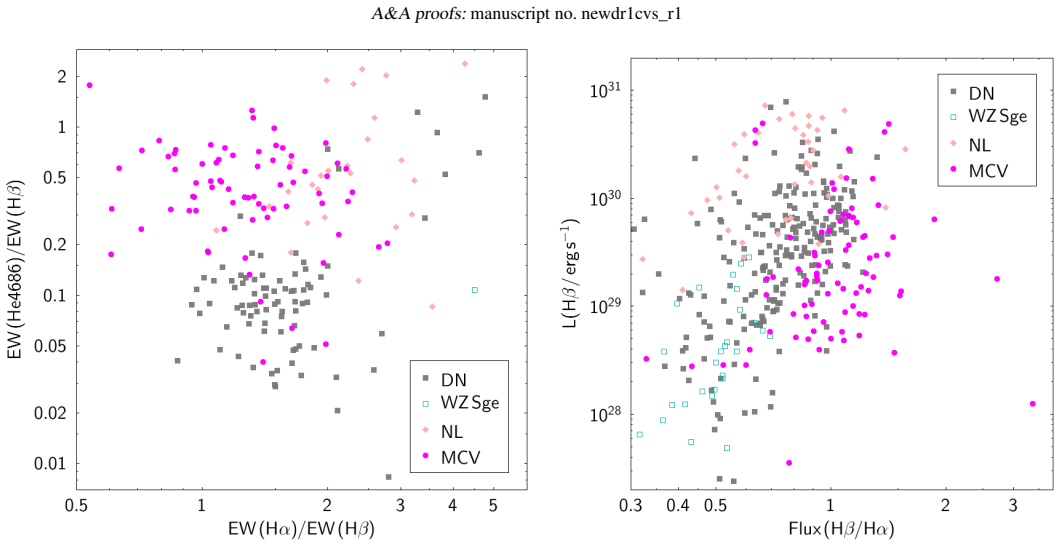
- [§4.5, Table 2, §5–6] §4.5 and Table 2 assign many objects as IP/polar/DN/NL (often with 'cand'), and §5–6 then use those labels for sample fractions and for calling X-ray-luminous systems 'excellent' new IP/GRXE candidates (e.g. LX > 10^32 erg s^-1 cut). The identification-and-method claim is solid, but any quantitative subtype mix or GRXE implication should be more clearly limited to secure subsets (spin detections, soft HR1+HeII, eclipses) versus single-epoch line-ratio candidates. A short explicit statement of which population statements survive if all 'cand' labels are dropped would strengthen the discussion without new data.
minor comments (7)
- [Abstract / §4.3] Abstract and elsewhere: 'securly' → 'securely'; also check 'J1515−-53' double hyphen and similar name typos in §4.3.
- [Abstract / §5.2] Abstract quotes log LX = 29.6–33.3 while §5.2 text gives 30.1–33.3; align the reported range with the table/catalog values.
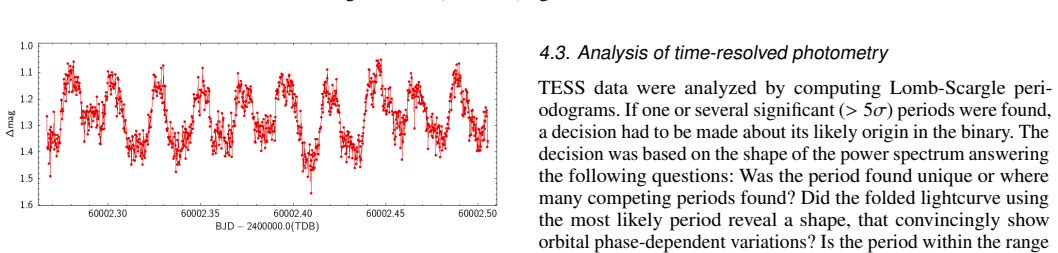
- [Abstract / §4.3] §4.3 states 44 objects with stable periods and 40 orbital; abstract says 40 periods. Keep wording consistent (orbital vs all periodic signals).
- [Fig. 9] Fig. 9 and related panels use non-ASCII minus signs and fx=fopt-style labels in the text dump; ensure journal-ready axis labels (log(fX/fopt), GBP−GRP) in the production figures.
- [§2 / §6.1] §2: training used 642 known CVs and a preliminary c946 catalog; a one-sentence note on whether any of the 156 later entered the refined 4MOST training set (and how leakage was avoided for the superiority tests) would help reproducibility.
- [Table B.2] Table B.2 / online table: several Notes are terse (e.g. 'soft X', 'UG'); a key in the caption for subclass abbreviations would help non-CV specialists.
- [References] References include several 'subm.' / 2026 items; verify status and update or mark as in press as appropriate at acceptance.
Circularity Check
No significant circularity: RF selection is validated by independent spectroscopy; mild self-use of the haul only for future 4MOST training.
specific steps
-
self citation load bearing
[Abstract Results; Sect. 6.2 Summary and outlook]
"The new method of selecting CVs from eRASS1 was found to be superior to other methods described in the literature and the new CVs were used to further refine the method. ... The sample generated in this work was used to further train the machine-learning algorithm to select targets for spectroscopic follow-up with 4MOST"
The confirmed haul is fed back into the same class of RF selector for a future survey. That is a mild closed loop for subsequent target lists, but it is not load-bearing for the paper’s central claim (spectroscopic identification of 156 CVs and superiority checks against independent catalogs). Flagged only as minor self-use, not as a forced prediction.
full rationale
This is an observational identification paper, not a first-principles derivation. The load-bearing chain is: (1) train an RF on a compiled list of known CVs with eROSITA/Gaia features; (2) rank eRASS1 counterparts; (3) confirm candidates with new low-resolution spectra and photometry; (4) compare recovery against independent catalogs (Freund, Salvato, Rodriguez, Eyer Gaia variables, Gentile Fusillo WDs). Step (3) is external empirical confirmation, not a tautology of the training labels. Step (4) uses other groups’ published selections. Subtype tags are explicitly preliminary and candidate-tagged; they are not presented as forced predictions from fitted parameters. The only mild loop is that the newly confirmed sample is said to further train selection for 4MOST—an outlook, not a premise of the 156-CV haul or the superiority statistics. Self-citations (e.g. Schwope et al. 2024b diagnostic diagrams, completeness radii) supply context and tools but do not uniquely force the identification claim. Score 1 for that non-load-bearing feedback mention only.
Axiom & Free-Parameter Ledger
free parameters (3)
- eRASS1 flux cut fx(0.5-2 keV) > 1e-13 erg cm^-2 s^-1 =
1e-13 erg cm^-2 s^-1
- RF CV likelihood threshold / follow-up prior (PCV and NWAY match cuts) =
PCV prior; match likelihood >~50%
- Subtype decision boundaries (e.g. EW(HeII)/EW(Hβ), LX>1e32 IP cut, HR1 soft/hard split) =
e.g. EW(HeII)/EW(Hβ)>0.2; LX>1e32; HR1=0.3
axioms (4)
- domain assumption Gaia DR3 astrometry/photometry and Bailer-Jones r_geo distances are adequate to place counterparts in CMD, luminosity, and variability diagrams.
- domain assumption Broad Balmer/He emission-line spectra plus continuum shape reliably identify CVs against stars and AGN at the resolution of EFOSC2/OSMOS/etc.
- ad hoc to paper A Random Forest trained on 642 known CVs with X-ray+Gaia features generalizes to new eRASS1 sources sufficiently for efficient candidate ranking.
- domain assumption Hardness ratio HR1<0.3 indicates an extra soft blackbody-like component and supports a magnetic classification.
read the original abstract
(abridged) Aims. We aim to generate large samples of CVs selected from the SRG/eROSITA surveys to address fundamental questions about binary evolution, the role of magnetic fields in CV evolution and their contribution to the Galactic Ridge X-ray Emission (GRXE). Methods. We have trained a Random Forest (RF) classifier based on combined X-ray and optical properties to select CV candidates from the first eROSITA X-ray all-sky survey (eRASS1). Follow-up spectroscopy to securly identify the objects was performed on a subset of the selected candidates using telescopes at the Northern and the Southern hemisphere. Newly identified CVs were further analyzed to determine their likely subtype with the help of dedicated follow-up photometry, spectroscopy and archival resources. Results. We have identified 156 CVs of almost all subtypes covering a wide range of distances (between 170 pc and several kpc), absolute magnitudes (G= 4.5-12) and X-ray luminosities (log LX (0.2-2.3 keV)= 29.6-33.3 erg/s). For most objects, the nature as a CV is reported here for the first time. For 40 objects periods were determined, which were regarded as their likely orbital periods. These range from 79.2 min, at the CV minimum period, to almost 22 hours. Seven objects were found to be eclipsing, a lower limit to the actual number due to the current lack of dedicated follow-up observations. A further five objects show cyclotron or Zeeman features, that allowed to determine their field strengths. A soft component was found in 14 CVs, all were regarded being magnetic. The sample comprises X-ray luminous objects, excellent candidates for being new Intermediate Polars, that are thought to be main contributors to the GRXE. The new method of selecting CVs from eRASS1 was found to be superior to other methods described in the literature ...
Figures






Reference graph
Works this paper leans on
-
[1]
2025, Experimental Astronomy, 60, 6
Avakyan , A., Zainab , A., Doroshenko , V., et al. 2025, Experimental Astronomy, 60, 6
2025
-
[2]
Bailer-Jones , C. A. L., Rybizki , J., Fouesneau , M., Demleitner , M., & Andrae , R. 2021, , 161, 147
2021
-
[3]
2024, , 684, A190
Balman , S ., Khamitov , I., Kolbin , A., et al. 2024, , 684, A190
2024
-
[4]
& Schreiber , M
Belloni , D. & Schreiber , M. R. 2023, in Handbook of X-ray and Gamma-ray Astrophysics, 129
2023
-
[5]
V., Zharikov , S
Bobakov , A. V., Zharikov , S. V., Karpova , A. V., et al. 2025, , 541, 3468
2025
-
[6]
Brink , J. & et al. 2026, , subm
2026
-
[7]
2022, , 661, A1
Brunner , H., Liu , T., Lamer , G., et al. 2022, , 661, A1
2022
-
[8]
2019, The Messenger, 175, 30
Chiappini , C., Minchev , I., Starkenburg , E., et al. 2019, The Messenger, 175, 30
2019
-
[9]
Coppejans , R., Gulbis , A. A. S., Kotze , M. M., et al. 2013, , 125, 976
2013
-
[10]
2022, , 662, A40
Culpan , R., Geier , S., Reindl , N., et al. 2022, , 662, A40
2022
-
[11]
A., Schwope , A
C \'u neo , V. A., Schwope , A. D., Kurpas , J., et al. 2026, , 705, A71
2026
-
[12]
S., Agertz , O., Berbel , A
de Jong , R. S., Agertz , O., Berbel , A. A., et al. 2019, The Messenger, 175, 3
2019
-
[13]
2018, in Society of Photo-Optical Instrumentation Engineers (SPIE) Conference Series, Vol
Delrez , L., Gillon , M., Queloz , D., et al. 2018, in Society of Photo-Optical Instrumentation Engineers (SPIE) Conference Series, Vol. 10700, Ground-based and Airborne Telescopes VII, ed. H. K. Marshall & J. Spyromilio , 107001I
2018
-
[14]
J., Djorgovski , S
Drake , A. J., Djorgovski , S. G., Mahabal , A., et al. 2009, , 696, 870
2009
-
[15]
A., Piascik , A
Erasmus , N., Steele , I. A., Piascik , A. S., et al. 2024, Journal of Astronomical Telescopes, Instruments, and Systems, 10, 025005
2024
-
[16]
2023, , 674, A13
Eyer , L., Audard , M., Holl , B., et al. 2023, , 674, A13
2023
-
[17]
2024, , 684, A121
Freund , S., Czesla , S., Predehl , P., et al. 2024, , 684, A121
2024
-
[18]
G \"a nsicke , B. T. 2005, in Astronomical Society of the Pacific Conference Series, Vol. 330, The Astrophysics of Cataclysmic Variables and Related Objects, ed. J. M. Hameury & J. P. Lasota , 3
2005
-
[19]
P., Tremblay , P
Gentile Fusillo , N. P., Tremblay , P. E., Cukanovaite , E., et al. 2021, , 508, 3877
2021
-
[20]
P., Tremblay , P.-E., G \"a nsicke , B
Gentile Fusillo , N. P., Tremblay , P.-E., G \"a nsicke , B. T., et al. 2019, , 482, 4570
2019
-
[21]
2025, , 0000, A00
Hernandez , S., Stelzer , B., Munoz-Giraldo , D., & Schwope , A. 2025, , 0000, A00
2025
-
[22]
Hernandez-Diaz , S. & et al. 2026, , subm
2026
-
[23]
2026, , 282, 26
Hou , W., Lin , J.-M., Luo , A.-L., et al. 2026, , 282, 26
2026
-
[24]
T., Breedt , E., et al
Inight , K., G \"a nsicke , B. T., Breedt , E., et al. 2023 a , , 524, 4867
2023
-
[25]
T., Breedt , E., et al
Inight , K., G \"a nsicke , B. T., Breedt , E., et al. 2021, , 504, 2420
2021
-
[26]
T., Schwope , A., et al
Inight , K., G \"a nsicke , B. T., Schwope , A., et al. 2023 b , , 525, 3597
2023
-
[27]
T., Schwope , A., et al
Inight , K., G \"a nsicke , B. T., Schwope , A., et al. 2025, , 536, 1057
2025
-
[28]
Y., West , A
Kesseli , A. Y., West , A. A., Veyette , M., et al. 2017, , 230, 16
2017
-
[29]
2011, , 194, 28
Knigge , C., Baraffe , I., & Patterson , J. 2011, , 194, 28
2011
-
[30]
I., Karpova , A
Kolbin , A. I., Karpova , A. V., Suslikov , M. V., et al. 2024, Astronomy Letters, 50, 351
2024
-
[31]
A., Rix , H.-W., Aerts , C., et al
Kollmeier , J. A., Rix , H.-W., Aerts , C., et al. 2026, , 171, 52
2026
-
[32]
Lightkurve Collaboration , Cardoso , J. V. d. M., Hedges , C., et al. 2018, Lightkurve: Kepler and TESS time series analysis in Python , Astrophysics Source Code Library
2018
-
[33]
Lomb , N. R. 1976, , 39, 447
1976
-
[34]
J., Laher , R
Masci , F. J., Laher , R. R., Rusholme , B., et al. 2019, , 131, 018003
2019
-
[35]
P., Parsons , S
McAllister , M., Littlefair , S. P., Parsons , S. G., et al. 2019, , 486, 5535
2019
-
[36]
2024, , 682, A34
Merloni , A., Lamer , G., Liu , T., et al. 2024, , 682, A34
2024
-
[37]
2023, , 674, A16
Mowlavi , N., Holl , B., Lecoeur-Ta \" bi , I., et al. 2023, , 674, A16
2023
-
[38]
2024, , 687, A305
Mu \ n oz-Giraldo , D., Stelzer , B., & Schwope , A. 2024, , 687, A305
2024
-
[39]
2026, , 707, A62
Mu \ n oz-Giraldo , D., Stelzer , B., Schwope , A., et al. 2026, , 707, A62
2026
-
[40]
Ok , S., Schwope , A., Buckley , D. A. H., & Brink , J. 2024, , 686, A175
2024
-
[41]
F., G \"a nsicke , B
Pala , A. F., G \"a nsicke , B. T., Breedt , E., et al. 2020, , 494, 3799
2020
-
[42]
R., Buckley , D
Pelisoli , I., Marsh , T. R., Buckley , D. A. H., et al. 2023, Nature Astronomy, 7, 931
2023
-
[43]
2021, , 647, A1
Predehl , P., Andritschke , R., Arefiev , V., et al. 2021, , 647, A1
2021
-
[44]
Ramos-Ceja , J. & et al. 2026, , subm
2026
-
[45]
R., Winn , J
Ricker , G. R., Winn , J. N., Vanderspek , R., et al. 2015, Journal of Astronomical Telescopes, Instruments, and Systems, 1, 014003
2015
-
[46]
& Kolb , U
Ritter , H. & Kolb , U. 2003, , 404, 301
2003
-
[47]
C., El-Badry , K., Suleimanov , V., et al
Rodriguez , A. C., El-Badry , K., Suleimanov , V., et al. 2025, , 137, 014201
2025
-
[48]
2018, , 473, 4937
Salvato , M., Buchner , J., Budav \'a ri , T., et al. 2018, , 473, 4937
2018
-
[49]
2025, , 704, A344
Salvato , M., Wolf , J., Dwelly , T., et al. 2025, , 704, A344
2025
-
[50]
Scargle , J. D. 1982, , 263, 835
1982
-
[51]
R., Belloni , D., G \"a nsicke , B
Schreiber , M. R., Belloni , D., G \"a nsicke , B. T., Parsons , S. G., & Zorotovic , M. 2021, Nature Astronomy, 5, 648
2021
-
[52]
R., Belloni , D., & Schwope , A
Schreiber , M. R., Belloni , D., & Schwope , A. D. 2024, , 682, L7
2024
-
[53]
Schwope , A., Buckley , D. A. H., Kawka , A., et al. 2022 a , , 661, A42
2022
-
[54]
Schwope , A., Buckley , D. A. H., Malyali , A., et al. 2022 b , , 661, A43
2022
-
[55]
2024 a , , 686, A110
Schwope , A., Kurpas , J., Baecke , P., et al. 2024 a , , 686, A110
2024
-
[56]
R., Standke , A., et al
Schwope , A., Marsh , T. R., Standke , A., et al. 2023, , 674, L9
2023
-
[57]
Schwope , A. D. & Beuermann , K. 1990, , 238, 173
1990
-
[58]
D., Beuermann , K., Jordan , S., & Thomas , H.-C
Schwope , A. D., Beuermann , K., Jordan , S., & Thomas , H.-C. 1993, , 278, 487
1993
-
[59]
D., Brunner , H., Buckley , D., et al
Schwope , A. D., Brunner , H., Buckley , D., et al. 2002 a , , 396, 895
2002
-
[60]
D., Brunner , H., Hambaryan , V., & Schwarz , R
Schwope , A. D., Brunner , H., Hambaryan , V., & Schwarz , R. 2002 b , in Astronomical Society of the Pacific Conference Series, Vol. 261, The Physics of Cataclysmic Variables and Related Objects, ed. B. T. G \"a nsicke , K. Beuermann , & K. Reinsch , 102
2002
-
[61]
D., Knauff , K., Kurpas , J., et al
Schwope , A. D., Knauff , K., Kurpas , J., et al. 2024 b , , 690, A243
2024
-
[62]
D., Mackebrandt , F., Thinius , B
Schwope , A. D., Mackebrandt , F., Thinius , B. D., et al. 2015, Astronomische Nachrichten, 336, 115
2015
-
[63]
F., Doroshenko , V., & Werner , K
Suleimanov , V. F., Doroshenko , V., & Werner , K. 2022, , 511, 4937
2022
-
[64]
2021, , 656, A132
Sunyaev , R., Arefiev , V., Babyshkin , V., et al. 2021, , 656, A132
2021
-
[65]
2021, , 162, 94
Szkody , P., Olde Loohuis , C., Koplitz , B., et al. 2021, , 162, 94
2021
-
[66]
L., Denneau , L., Heinze , A
Tonry , J. L., Denneau , L., Heinze , A. N., et al. 2018, , 130, 064505
2018
-
[67]
A., Jordan , S., et al
Vincent , O., Barstow , M. A., Jordan , S., et al. 2024, , 682, A5
2024
-
[68]
1995, Cataclysmic variable stars (Cambridge Astroph
Warner , B. 1995, Cataclysmic variable stars (Cambridge Astroph. Series, Vol. 28)
1995
-
[69]
M., Marshall , F
Worrall , D. M., Marshall , F. E., Boldt , E. A., & Swank , J. H. 1982, , 255, 111
1982
-
[70]
Least-Squares Frequency Analysis of Unequally Spaced Data. , keywords =. doi:10.1007/BF00648343 , adsurl =
-
[71]
Studies in astronomical time series analysis. II. Statistical aspects of spectral analysis of unevenly spaced data. , keywords =. doi:10.1086/160554 , adsurl =
-
[72]
The origin and evolution of magnetic white dwarfs in close binary stars. Nature Astronomy , keywords =. doi:10.1038/s41550-021-01346-8 , archivePrefix =. 2104.14607 , primaryClass =
-
[75]
BHM-SPIDERS Survey in SDSS-V: from X-ray targets to the DR20 spectroscopic samples. , keywords =. doi:10.1051/0000-0000/000000000 , archivePrefix =. 2607.00000 , primaryClass =
-
[76]
The Seventeenth Data Release of the Sloan Digital Sky Surveys: Complete Release of MaNGA, MaStar, and APOGEE-2 Data. , keywords =. doi:10.3847/1538-4365/ac4414 , archivePrefix =. 2112.02026 , primaryClass =
-
[77]
Disentangling cataclysmic variables in Gaia's HR diagram. , keywords =. doi:10.1093/mnrasl/slz181 , archivePrefix =. 1912.01531 , primaryClass =
Pith/arXiv arXiv 1912
-
[78]
A Census of Symbiotic Stars in the 2MASS, WISE, and Gaia Surveys. , keywords =. doi:10.3847/1538-4365/aaf88c , archivePrefix =. 1902.01451 , primaryClass =
Pith/arXiv arXiv 1902
-
[79]
The Eighteenth Data Release of the Sloan Digital Sky Surveys: Targeting and First Spectra from SDSS-V. arXiv e-prints , keywords =. doi:10.48550/arXiv.2301.07688 , archivePrefix =. 2301.07688 , primaryClass =
-
[80]
Photo-astrometric distances, extinctions, and astrophysical parameters for Gaia EDR3 stars brighter than G = 18.5. , keywords =. doi:10.1051/0004-6361/202142369 , archivePrefix =. 2111.01860 , primaryClass =
-
[81]
Two new intermediate polars with a soft X-ray component. , keywords =. doi:10.1051/0004-6361:200810402 , archivePrefix =. 0808.1499 , primaryClass =
-
[82]
Astronomical Data Analysis Software and Systems V , year = 1996, editor =
XSPEC: The First Ten Years. Astronomical Data Analysis Software and Systems V , year = 1996, editor =
1996
discussion (0)
Sign in with ORCID, Apple, or X to comment. Anyone can read and Pith papers without signing in.