REVIEW 5 minor 2 cited by
Interference rewrites the shapes of new-scalar resonance signals
Reviewed by Pith at T0; open to challenge. T0 means a machine referee read the full paper against a public rubric. the ladder, T0–T4 →
T0 review · deepseek-v4-flash
2026-08-03 06:06 UTC pith:NZ7USMS5
load-bearing objection A competent, openly self-described review of interference effects in resonant scalar searches; no new result, but the case is real and the examples are well chosen.
Interference effects in new physics searches
The pith
A machine-rendered reading of the paper's core claim, the machinery that carries it, and where it could break.
Core claim
The paper's central claim is that interference effects between a new scalar resonance and the Standard Model continuum, or among multiple nearly degenerate resonances, cannot be a priori neglected in LHC searches. Using the decomposition of the full matrix element into resonance, other contributions, and their cross term, the review shows through collected examples that the interference term modifies invariant mass distributions around the resonance peak and in off-shell tails, and also affects transverse momenta and cut variables. The narrow width approximation only justifies factorizing production times decay when the width is small; it does not remove the need to add the interference with
What carries the argument
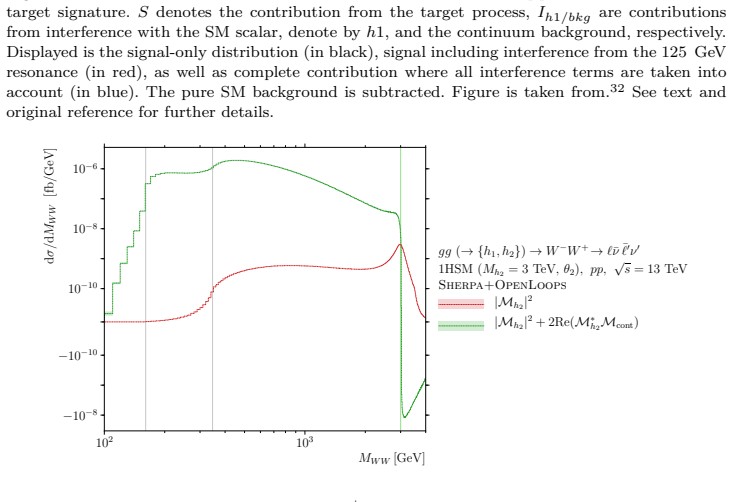
The load-bearing object is the interference term 2 Re[M_S M*_rest] in the squared matrix element, where M_S is the target s-channel resonance amplitude and M_rest collects all other diagrams. The paper contrasts this with the narrow-width approximation, which factorizes the cross section into on-shell production times branching ratio and drops the cross term. The review uses this decomposition to reinterpret published figures showing signal-only versus full distributions, making the case that the dropped term controls the shape of the final-state mass spectrum.
Load-bearing premise
The load-bearing premise is that the specific published studies the review reproduces are correct, representative of realistic models, and accurately interpreted, since the review itself performs no new calculation; any error or bias in those examples would weaken the blanket conclusion that interference cannot be a priori neglected.
What would settle it
A broad parameter scan in a single UV-complete model, varying the heavy scalar mass, mixing angle, and width, that found the interference term changes the relevant invariant mass distributions by only a few percent in most of the space would contradict the review's blanket claim that interference cannot be a priori neglected.
If this is right
- Exclusion bounds on heavy scalars derived from signal-only templates can be over- or under-estimated, depending on the sign and size of the interference term.
- Discovery reach projections, especially those using machine-learning classifiers, are compromised if the training samples omit interference, since the network learns a distorted distribution.
- Multi-resonance scenarios with destructive interference can produce a flat invariant mass shape even when two resonances are present, making the resonances effectively invisible to a peak search.
- Detector smearing can turn interference effects into fake secondary mass peaks, so reconstructed distributions must be interpreted with the full description in mind.
- Including interference does not require new theoretical input: available leading-order event generators can produce the full coherent sum now, with next-to-leading-order correction still an open approximation.
Where Pith is reading between the lines
- A testable extension is a systematic reappraisal of published 95% confidence limits on scalar resonances using interference-inclusive templates for a single benchmark; the review's examples suggest some limits could shift by tens of percent.
- The same reasoning likely applies to searches for non-scalar resonances (e.g., spin-1 or spin-2) and to any differential distribution used for cut optimization, not just invariant mass, although the paper only explicitly demonstrates scalar cases.
- If interference is this pervasive, simplified signal-plus-background counting experiments should be supplemented with a coherent template fit before claiming a discovery or an exclusion.
- The review's reliance on leading-order tools suggests that a dedicated next-to-leading-order calculation for one of the showcased channels would be valuable; until then, the practical implementation is limited to leading-order approximations.
Editorial analysis
A structured set of objections, weighed in public.
Referee Report
Summary. This invited review argues that interference between a heavy scalar resonance and other SM or new-physics amplitudes in resonant searches cannot be routinely neglected. It recalls the finite-width propagator, the narrow-width approximation and its formal O(Gamma/m) error, and the interference decomposition of the squared matrix element. It then surveys published calculations in diboson, di-Higgs, triple-Higgs, and top-antitop final states, several of which show large distortions of invariant-mass distributions relative to signal-only Breit-Wigner templates. The paper's central message is that interference effects must be assessed case by case, that leading-order tools including them are generally available, and that NLO treatment remains an open issue.
Significance. The qualitative claim is sound and appropriately hedged. The standard derivations in Sec. 2 are correct; the review explicitly avoids universal quantitative statements and is honest about the open NLO problem. The examples are drawn from multiple independent published calculations, not only from the author's own work, and the second-hand nature of the evidence base is normal for a review. The paper is a useful, current reminder for both phenomenologists and experimental collaborations, and its actionable conclusion is supported by the existence of these documented effects. I found no circularity or internal inconsistency that would undermine the central claim.
minor comments (5)
- [Abstract / Introduction] The abstract states that 'many current theoretical descriptions as well as experimental searches neglect such effects', but the body provides a curated set of examples rather than a systematic survey. The conclusion is more careful ('For most of the examples shown here...'). I suggest softening 'many' to 'some' or 'a number of', or adding a sentence clarifying that the statement is based on selected published studies.
- [Sec. 3.2, Yukawa types] The description of the flipped 2HDM Yukawa assignment appears reversed relative to standard nomenclature (e.g. Ref. 28). In the usual convention, flipped means up-type quarks and charged leptons couple to Phi_2 and down-type quarks to Phi_1, not the opposite. Please correct this statement.
- [Sec. 2.1, Eq. (5)] The factorization formula is correct, but the notation is compressed. It should be stated explicitly that sigma_ab->S is the on-shell production cross section and that the p^2 integral is the standard phase-space convolution with the finite-width squared propagator. As written, a casual reader may misread the expression as having a dimension mismatch.
- [Fig. 4 caption, Sec. 4.2] The caption refers to the 'invariant diboson mass distribution' for M_hh, but the final state in Fig. 4 is di-Higgs, not diboson. Please correct the wording.
- [Throughout] There are numerous typos and formatting slips: 'inital', 'expection', 'assued', 'colums', 'highlightened', 'mimick', and missing spaces before references (e.g., 'found in. 30'). A thorough language pass is needed.
Circularity Check
No significant circularity: the review's qualitative claim is supported by external, independently published calculations; self-citations are descriptive and not load-bearing.
full rationale
The paper is a review rather than an original derivation. Its central claim — that interference effects can materially distort resonant scalar signals and cannot be neglected a priori — is an existence claim supported by figures and tables reproduced from multiple independent groups. The only formula introduced from scratch, Eq. (8), is the trivial matrix-element decomposition |M_tot|^2 = |M_S|^2 + |M_rest|^2 + 2 Re[M_S M_rest*]; this is a definitional expansion, not a fitted prediction, and it is not used to claim a quantitative novelty. The load-bearing examples are Refs. 32, 33, 36, 39, 40, 52, 53, 54 and 55, most with no author overlap; Ref. 11, from the author's own group, is one example among many and is not the unique support for the conclusion. Self-citations such as Refs. 24–27, 30 and 50–51 are used only to specify benchmark or model conventions, not to justify the interference claim. The paper also explicitly flags the open NLO issue, which limits precision but does not undermine the existence claim. No equation is fitted to data and then renamed a prediction, and no uniqueness theorem is imported from the authors' prior work. At most, there is minor self-citation that is not load-bearing, hence score 2 and no circular steps.
Axiom & Free-Parameter Ledger
axioms (5)
- standard math Only stable particles can be asymptotic states of S-matrix elements; unstable particles are intermediate states.
- standard math The optical theorem relates the imaginary part of the renormalized self-energy to the total width: Im Sigma(p^2=m^2) = Gamma m.
- domain assumption The narrow-width approximation requires Gamma/m << 1 and a slowly varying function F; it can fail near kinematic thresholds.
- domain assumption The reproduced external results are accurate and are correctly interpreted.
- domain assumption Leading-order tools including interference terms are readily available for most scenarios.
read the original abstract
Interference effects are an important consequence of a correct description in physics theories within and beyond the Standard Model (SM) of particle physics. However, many current theoretical descriptions as well as experimental searches neglect such effects, which can, among others, lead to an incorrect description of e.g. kinematical distributions, at least within the context of UV-complete models. In this review, I briefly discuss the current status and most common descriptions as well as existing studies of such effects, where I focus on models with extended scalar searches.
Figures



Forward citations
Cited by 2 Pith papers
-
Big Dipper, Help Me Find A Way -- Dip-hunting at hadron colliders
Parametric neural networks learn likelihood ratios to infer top-philic scalar resonances from dip patterns caused by signal-background interference in hadron collider data.
-
Search for Invisibly Decaying Light Scalars at the FCC-ee
An FCC-ee search for e+e−→Z+invisible scalar could reach σ×BR sensitivities of ~10^-2–10^-1 fb below the Z mass and claims discovery reach up to 80 GeV in a simplified singlet+DM model.
Reference graph
Works this paper leans on
-
[1]
Lance J. Dixon and M. Stewart Siu. Resonance continuum interference in the diphoton Higgs signal at the LHC. Phys. Rev. Lett., 90:252001, 2003, hep-ph/0302233
Pith/arXiv arXiv 2003
-
[2]
Inadequacy of zero-width approximation for a light Higgs boson signal
Nikolas Kauer and Giampiero Passarino. Inadequacy of zero-width approximation for a light Higgs boson signal. JHEP, 08:116, 2012, 1206.4803
Pith/arXiv arXiv 2012
-
[3]
Stephen P. Martin. Shift in the LHC Higgs Diphoton Mass Peak from Interference with Background. Phys. Rev. D, 86:073016, 2012, 1208.1533
Pith/arXiv arXiv 2012
-
[4]
Stephen P. Martin. Interference of Higgs Diphoton Signal and Background in Produc- tion with a Jet at the LHC. Phys. Rev. D, 88(1):013004, 2013, 1303.3342
Pith/arXiv arXiv 2013
-
[5]
F. Coradeschi, D. de Florian, L. J. Dixon, N. Fidanza, S. Höche, H. Ita, Y. Li, and J. Mazzitelli. Interference effects in the H(→ γγ ) + 2 jets channel at the LHC. Phys. Rev. D, 92(1):013004, 2015, 1504.05215
Pith/arXiv arXiv 2015
-
[6]
Itzykson and J
C. Itzykson and J. B. Zuber. Quantum Field Theory. International Series In Pure and Applied Physics. McGraw-Hill, New York, 1980
1980
-
[7]
Peskin and Daniel V
Michael E. Peskin and Daniel V. Schroeder. An Introduction to quantum field theory. Addison-Wesley, Reading, USA, 1995
1995
-
[8]
Electroweak Radiative Corrections for Collider Physics
Ansgar Denner and Stefan Dittmaier. Electroweak Radiative Corrections for Collider Physics. Phys. Rept., 864:1–163, 2020, 1912.06823
Pith/arXiv arXiv 2020
-
[9]
H.M. Pilkuhn. The Interactions of Hadrons. North-Holland Publishing Company, 1967
1967
-
[10]
Dicus, E
Duane A. Dicus, E. C. G. Sudarshan, and Xerxes Tata. Factorization Theorem for Decaying Spinning Particles. Phys. Lett. B, 154:79–85, 1985
1985
-
[11]
Interference effects in resonant di-Higgs production at the LHC in the Higgs singlet extension
Finn Feuerstake, Elina Fuchs, Tania Robens, and Daniel Winterbottom. Interference effects in resonant di-Higgs production at the LHC in the Higgs singlet extension. JHEP, 04:094, 2025, 2409.06651. February 9, 2026 11:15 interf Interference effects in new physics searches 17
Pith/arXiv arXiv 2025
-
[12]
Ansgar Denner, S. Dittmaier, M. Roth, and D. Wackeroth. Predictions for all processes e+ e- → 4 fermions + gamma. Nucl. Phys. B, 560:33–65, 1999, hep-ph/9904472
Pith/arXiv arXiv 1999
-
[13]
Ansgar Denner, S. Dittmaier, M. Roth, and L. H. Wieders. Electroweak corrections to charged-current e+ e- → 4 fermion processes: Technical details and further results. Nucl. Phys. B, 724:247–294, 2005, hep-ph/0505042. [Erratum: Nucl.Phys.B 854, 504– 507 (2012)]
Pith/arXiv arXiv 2005
- [14]
-
[15]
The Complex-Mass Scheme and Unitarity in perturbative Quantum Field Theory
Ansgar Denner and Jean-Nicolas Lang. The Complex-Mass Scheme and Unitarity in perturbative Quantum Field Theory. Eur. Phys. J. C, 75(8):377, 2015, 1406.6280
Pith/arXiv arXiv 2015
-
[16]
D. Berdine, N. Kauer, and D. Rainwater. Breakdown of the Narrow Width Approxi- mation for New Physics. Phys. Rev. Lett., 99:111601, 2007, hep-ph/0703058
Pith/arXiv arXiv 2007
-
[17]
Narrow-width approximation in the Minimal Supersymmetric Standard Model
Christoph Uhlemann. Narrow-width approximation in the Minimal Supersymmetric Standard Model. Diploma thesis, Wuerzburg , 2007
2007
-
[18]
C. F. Uhlemann and N. Kauer. Narrow-width approximation accuracy. Nucl. Phys. B, 814:195–211, 2009, 0807.4112
Pith/arXiv arXiv 2009
-
[19]
Nearby resonances beyond the Breit-Wigner approximation
Giacomo Cacciapaglia, Aldo Deandrea, and Stefania De Curtis. Nearby resonances beyond the Breit-Wigner approximation. Phys. Lett. B, 682:43–49, 2009, 0906.3417
Pith/arXiv arXiv 2009
-
[20]
Interference effects in new physics processes at the LHC
Elina Fuchs. Interference effects in new physics processes at the LHC. PhD Thesis, U. Hamburg 2015, DESY-THESIS-2015-037 , 2015
2015
-
[21]
Impact of CP-violating interference effects on MSSM Higgs searches
Elina Fuchs and Georg Weiglein. Impact of CP-violating interference effects on MSSM Higgs searches. Eur. Phys. J. C, 78(2):87, 2018, 1705.05757
Pith/arXiv arXiv 2018
-
[22]
MSSM Higgs Boson Searches at the LHC: Benchmark Scenarios for Run 2 and Beyond
Emanuele Bagnaschi et al. MSSM Higgs Boson Searches at the LHC: Benchmark Scenarios for Run 2 and Beyond. Eur. Phys. J. C, 79(7):617, 2019, 1808.07542
Pith/arXiv arXiv 2019
-
[23]
Hoang, Simon Plätzer, Christoph Regner, and Ines Ruffa
André H. Hoang, Simon Plätzer, Christoph Regner, and Ines Ruffa. Beyond the Narrow-Width Limit for Off-Shell and Boosted Differential Top Quark Decays. In 16th International Workshop on Top Quark Physics, 1 2024, 2401.05035
Pith/arXiv arXiv 2024
-
[24]
Higgs singlet extension parameter space in the light of the LHC discovery
Giovanni Marco Pruna and Tania Robens. Higgs singlet extension parameter space in the light of the LHC discovery. Phys. Rev. D, 88(11):115012, 2013, 1303.1150
Pith/arXiv arXiv 2013
-
[25]
Status of the Higgs Singlet Extension of the Stan- dard Model after LHC Run 1
Tania Robens and Tim Stefaniak. Status of the Higgs Singlet Extension of the Stan- dard Model after LHC Run 1. Eur. Phys. J. C, 75:104, 2015, 1501.02234
Pith/arXiv arXiv 2015
-
[26]
LHC Benchmark Scenarios for the Real Higgs Sin- glet Extension of the Standard Model
Tania Robens and Tim Stefaniak. LHC Benchmark Scenarios for the Real Higgs Sin- glet Extension of the Standard Model. Eur. Phys. J. C, 76(5):268, 2016, 1601.07880
Pith/arXiv arXiv 2016
-
[27]
Constraining Extended Scalar Sectors at the LHC and beyond
Agnieszka Ilnicka, Tania Robens, and Tim Stefaniak. Constraining Extended Scalar Sectors at the LHC and beyond. Mod. Phys. Lett. A, 33(10n11):1830007, 2018, 1803.03594
Pith/arXiv arXiv 2018
-
[28]
G. C. Branco, P. M. Ferreira, L. Lavoura, M. N. Rebelo, Marc Sher, and Joao P. Silva. Theory and phenomenology of two-Higgs-doublet models. Phys. Rept., 516:1– 102, 2012, 1106.0034
Pith/arXiv arXiv 2012
-
[29]
Sacha Davidson and Howard E. Haber. Basis-independent methods for the two- Higgs-doublet model. Phys. Rev. D, 72:035004, 2005, hep-ph/0504050. [Erratum: Phys.Rev.D 72, 099902 (2005)]
Pith/arXiv arXiv 2005
-
[30]
Tania Robens and Rui Santos. BSM: Extended Scalar Sectors. 7 2025, 2507.21910
Pith/arXiv arXiv 2025
-
[31]
J. F. Gunion, H. E. Haber, and J. Wudka. Sum rules for Higgs bosons. Phys. Rev. D, 43:904–912, 1991
1991
-
[32]
Heavy Higgs signal–background interference in gg → V V in the Standard Model plus real singlet
Nikolas Kauer and Claire O’Brien. Heavy Higgs signal–background interference in gg → V V in the Standard Model plus real singlet. Eur. Phys. J. C, 75:374, 2015, 1502.04113
Pith/arXiv arXiv 2015
-
[33]
Nikolas Kauer, Alexander Lind, Philipp Maierhöfer, and Weimin Song. Higgs inter- February 9, 2026 11:15 interf 18 Tania Robens ference effects at the one-loop level in the 1-Higgs-Singlet extension of the Standard Model. JHEP, 07:108, 2019, 1905.03296
Pith/arXiv arXiv 2026
-
[34]
Lindert, Philipp Maierhöfer, Ste- fano Pozzorini, Hantian Zhang, and Max F
Federico Buccioni, Jean-Nicolas Lang, Jonas M. Lindert, Philipp Maierhöfer, Ste- fano Pozzorini, Hantian Zhang, and Max F. Zoller. OpenLoops 2. Eur. Phys. J. C, 79(10):866, 2019, 1907.13071
Pith/arXiv arXiv 2019
-
[35]
Event generation with Sherpa 3
Enrico Bothmann et al. Event generation with Sherpa 3. JHEP, 12:156, 2024, 2410.22148
Pith/arXiv arXiv 2024
-
[36]
Interference effect on a heavy Higgs resonance signal in the γγ and ZZ channels
Sunghoon Jung, Yeo Woong Yoon, and Jeonghyeon Song. Interference effect on a heavy Higgs resonance signal in the γγ and ZZ channels. Phys. Rev. D, 93(5):055035, 2016, 1510.03450
Pith/arXiv arXiv 2016
-
[37]
Lindert, and Javier Mazzitelli
Massimiliano Grazzini, Gudrun Heinrich, Stephen Jones, Stefan Kallweit, Matthias Kerner, Jonas M. Lindert, and Javier Mazzitelli. Higgs boson pair production at NNLO with top quark mass effects. JHEP, 05:059, 2018, 1803.02463
Pith/arXiv arXiv 2018
-
[38]
J. Baglio, F. Campanario, S. Glaus, M. Mühlleitner, J. Ronca, and M. Spira. gg → HH : Combined uncertainties. Phys. Rev. D, 103(5):056002, 2021, 2008.11626
Pith/arXiv arXiv 2021
-
[39]
S. Dawson and I. M. Lewis. NLO corrections to double Higgs boson production in the Higgs singlet model. Phys. Rev. D, 92(9):094023, 2015, 1508.05397
Pith/arXiv arXiv 2015
-
[40]
Probing the electroweak phase tran- sition via enhanced di-Higgs boson production
Marcela Carena, Zhen Liu, and Marc Riembau. Probing the electroweak phase tran- sition via enhanced di-Higgs boson production. Phys. Rev. D, 97(9):095032, 2018, 1801.00794
Pith/arXiv arXiv 2018
-
[41]
J. Alison et al. Higgs boson potential at colliders: Status and perspectives. Rev. Phys., 5:100045, 2020, 1910.00012
Pith/arXiv arXiv 2020
-
[42]
F. Arco, S. Heinemeyer, M. Mühlleitner, A. Parra Arnay, N. Rivero González, and A. Verduras Schaeidt. Sensitivity to triple Higgs couplings via di-Higgs production in the RxSM at the (HL-)LHC and future e +e− colliders. JHEP, 06:211, 2025, 2502.03878
Pith/arXiv arXiv 2025
-
[43]
Stefano Moretti, Luca Panizzi, Jörgen Sjölin, and Harri Waltari. Deconstructing res- onant Higgs boson pair production at the LHC: Effects of colored and neutral scalars in the NMSSM test case. Phys. Rev. D, 112(5):055005, 2025, 2506.09006
Pith/arXiv arXiv 2025
-
[44]
Johannes Braathen, Sven Heinemeyer, Carlos Pulido Boatella, and Alain Ver- duras Schaeidt. Complementarity of gravitational wave analyses and di-Higgs produc- tion in the exploration of the Electroweak Phase Transition dynamics in the RxSM. 10 2025, 2510.12569
Pith/arXiv arXiv 2025
- [45]
-
[46]
Searches for Higgs boson production through decays of heavy resonances
Aram Hayrapetyan et al. Searches for Higgs boson production through decays of heavy resonances. Phys. Rept., 1115:368–447, 2025, 2403.16926
Pith/arXiv arXiv 2025
-
[47]
Georges Aad et al. Search for triple Higgs boson production in the 6b final state using pp collisions at s=13 TeV with the ATLAS detector. Phys. Rev. D, 111(3):032006, 2025, 2411.02040
Pith/arXiv arXiv 2025
-
[48]
Search for a resonance decaying into a scalar particle and a Higgs boson in the final state with two bottom quarks and two photons with 199 fb−1 of data collected at√s=13 TeV and √s=13.6 TeV with the ATLAS detector. 2025. ATLAS-CONF-2025- 0090
2025
-
[49]
Technical report, CERN, Geneva, 2025
Search for nonresonant triple Higgs boson production in the six b-quark final state in proton-proton collisions at 13 TeV. Technical report, CERN, Geneva, 2025. CMS- PAS-HIG-24-012
2025
-
[50]
Two-real-scalar-singlet extension of the SM: LHC phenomenology and benchmark scenarios
Tania Robens, Tim Stefaniak, and Jonas Wittbrodt. Two-real-scalar-singlet extension of the SM: LHC phenomenology and benchmark scenarios. Eur. Phys. J. C, 80(2):151, February 9, 2026 11:15 interf Interference effects in new physics searches 19 2020, 1908.08554
Pith/arXiv arXiv 2026
-
[51]
Two-Real-Singlet-Model Benchmark Planes
Tania Robens. Two-Real-Singlet-Model Benchmark Planes. Symmetry, 15:27, 2023, 2209.10996
Pith/arXiv arXiv 2023
-
[52]
Hamza Abouabid et al. HHH whitepaper. Eur. Phys. J. C, 84:1183, 2024, 2407.03015
Pith/arXiv arXiv 2024
-
[53]
Di-Higgs boson peaks and top valleys: Interference effects in Higgs sector extensions
Philipp Basler, Sally Dawson, Christoph Englert, and Margarete Mühlleitner. Di-Higgs boson peaks and top valleys: Interference effects in Higgs sector extensions. Phys. Rev. D, 101(1):015019, 2020, 1909.09987
Pith/arXiv arXiv 2020
-
[54]
Interference effects in tt production at the LHC as a window on new physics
Abdelhak Djouadi, John Ellis, Andrey Popov, and Jérémie Quevillon. Interference effects in tt production at the LHC as a window on new physics. JHEP, 03:119, 2019, 1901.03417
Pith/arXiv arXiv 2019
-
[55]
Impact of interference effects on Higgs-boson searches in the di-top final state at the LHC
Henning Bahl, Romal Kumar, and Georg Weiglein. Impact of interference effects on Higgs-boson searches in the di-top final state at the LHC. JHEP, 05:098, 2025, 2503.02705
Pith/arXiv arXiv 2025
discussion (0)
Sign in with ORCID, Apple, or X to comment. Anyone can read and Pith papers without signing in.