REVIEW 2 major objections 1 minor 13 references
Dimension lower bounds in random geometry via Lipschitz functions
T0 review · 2 major / 1 minor · reviewed 2026-06-27 · grok-4.3
Pith's one-line read The set of 3-star points has Hausdorff dimension at least two in the LQG metric.
desk verdict The paper gives new lower bounds of 2 on Hausdorff dimension for 3-star points and related sets in LQG and other planar length metrics by rewriting them as non-constancy sets of Lipschitz functions. read the letter →
The pith
A machine-rendered reading of the paper's core claim, the machinery that carries it, and where it could break.
The reading
What carries the argument
Non-constancy sets of Lipschitz functions, which preserve Hausdorff dimension lower bounds for the sets of interest under planar length metrics.
What would settle it
An explicit construction or numerical realization of the LQG metric in which the 3-star points have Hausdorff dimension strictly less than two would disprove the lower bound.
Extended reading notes
Core claim
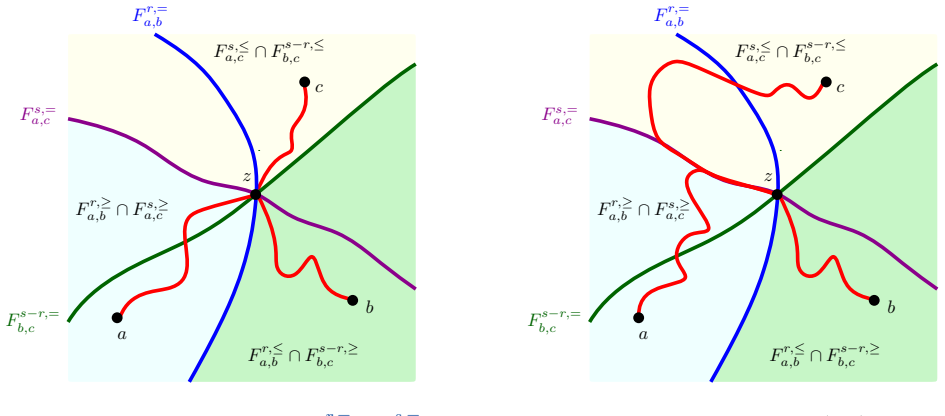
We prove that the set of 3-star points has Hausdorff dimension at least two with respect to the LQG metric, which is conjectured to be optimal. Our proof works for a general class of planar length metrics which also includes, e.g., Kendall's Poisson roads metric. We additionally prove a dimension lower bound of one for the set of 2-star points intersected with the boundary and for the metric net intersected with the boundary, as well as a dimension lower bound of two for the intersection of two metric nets. In the particular setting of LQG, we obtain sharper lower bounds for the Hausdorff dimensions of the set of 2-star points and the LQG metric net, with respect to both the Euclidean metric
Load-bearing premise
The sets of interest can be expressed as non-constancy sets of Lipschitz functions in a way that preserves the Hausdorff dimension lower bounds under the given planar length metrics.
Editorial extensions
If this is right
- The conjectured optimal dimension of two for 3-star points holds as a lower bound in the LQG metric.
- The dimension results apply to a general class of planar length metrics including Kendall's Poisson roads metric.
- The sets of 2-star points on the boundary and the metric net on the boundary each have Hausdorff dimension at least one.
- The intersection of two metric nets has Hausdorff dimension at least two.
- Sharper lower bounds hold in LQG for the 2-star points and the metric net under both the Euclidean and LQG metrics.
Reading between the lines
- The lower bounds imply that 3-star points are large enough in the metric to affect the branching structure of geodesics throughout the plane.
- The Lipschitz-function representation may allow similar dimension results for other geodesic-defined sets in the same class of metrics.
- These bounds could inform models of percolation or connectivity that depend on the size of star-point sets.
- The topological approach suggests the bounds remain stable under small changes to the underlying length metric.
Editorial analysis
A structured set of objections, weighed in public.
Referee Report
Summary. The manuscript proves lower bounds on Hausdorff dimensions (w.r.t. the LQG metric and Euclidean metric) for several sets in Liouville quantum gravity and more generally in planar length metrics: the set of 3-star points has dimension at least 2 (conjectured optimal), the set of 2-star points intersected with the boundary and the metric net intersected with the boundary each have dimension at least 1, and the intersection of two metric nets has dimension at least 2. Sharper bounds are obtained in the LQG case. The proofs are primarily topological and proceed by expressing the sets of interest as non-constancy sets of Lipschitz functions.
Significance. If the central claims hold, the results supply concrete dimension lower bounds for geometrically natural sets in random planar geometry, with the 3-star bound conjectured to be sharp and the framework applying beyond LQG to metrics such as Kendall's Poisson roads. The topological approach via Lipschitz functions is a methodological strength that avoids heavy analytic estimates.
major comments (2)
- [Abstract and introduction] Abstract and introduction (key idea paragraph): the reduction of the 3-star set (and analogs) to non-constancy sets of Lipschitz functions is asserted to deliver the Hausdorff dimension lower bound of 2 in the LQG metric. However, the non-constancy set of a Lipschitz function on a length space can have Hausdorff dimension 0 (e.g., a countable dense set), so an explicit argument is required showing how the planar length metric and the Lipschitz property force dimension at least 2; this step is load-bearing for all stated dimension claims.
- [Main proof section on 3-star points] Main proof (the section containing the topological argument for 3-star points): the manuscript must supply a covering or modulus-of-continuity estimate that transfers the non-constancy property into a positive lower bound on 2-dimensional Hausdorff measure in the LQG metric; without it the topological reduction alone does not establish the claimed dimension.
minor comments (1)
- The abstract states that sharper bounds are obtained for the LQG metric net and 2-star points with respect to both metrics; a brief comparison table or explicit numerical statements of the Euclidean versus LQG bounds would improve readability.
Simulated Author's Rebuttal
We thank the referee for the careful reading and insightful comments. We agree that the dimension lower bound step requires more explicit justification and will revise accordingly.
read point-by-point responses
-
Referee: [Abstract and introduction] Abstract and introduction (key idea paragraph): the reduction of the 3-star set (and analogs) to non-constancy sets of Lipschitz functions is asserted to deliver the Hausdorff dimension lower bound of 2 in the LQG metric. However, the non-constancy set of a Lipschitz function on a length space can have Hausdorff dimension 0 (e.g., a countable dense set), so an explicit argument is required showing how the planar length metric and the Lipschitz property force dimension at least 2; this step is load-bearing for all stated dimension claims.
Authors: We agree that an explicit argument bridging non-constancy of the Lipschitz function to the dimension lower bound is required, as the general fact alone does not suffice. In the revised manuscript we will expand the key idea paragraph in the abstract and introduction to include a modulus-of-continuity argument specific to planar length metrics: around points of non-constancy the Lipschitz function varies by a definite amount on a set of positive 2-dimensional measure because the underlying space is a length metric on the plane. This will be made load-bearing for all claims. revision: yes
-
Referee: [Main proof section on 3-star points] Main proof (the section containing the topological argument for 3-star points): the manuscript must supply a covering or modulus-of-continuity estimate that transfers the non-constancy property into a positive lower bound on 2-dimensional Hausdorff measure in the LQG metric; without it the topological reduction alone does not establish the claimed dimension.
Authors: We agree that the main proof section must supply an explicit covering or modulus-of-continuity estimate. In the revision we will add, immediately after the topological reduction, a covering argument that uses the Lipschitz constant together with the length-space property to produce a Vitali-type cover of the non-constancy set by balls on which the function varies by a fixed positive amount; the resulting lower bound on 2-dimensional Hausdorff measure in the LQG metric follows directly. This completes the dimension claim while preserving the primarily topological character of the argument. revision: yes
Circularity Check
No circularity; topological reduction to non-constancy sets is independent of the target dimension bounds.
full rationale
The paper derives Hausdorff dimension lower bounds by expressing 3-star points and related sets as non-constancy loci of Lipschitz functions on planar length metrics, then invoking topological arguments to obtain the dimension estimates. No step reduces the claimed lower bound to a fitted parameter, a self-referential definition, or a load-bearing self-citation whose content is itself unverified. The argument is presented as self-contained within standard metric topology and does not invoke prior author results to force uniqueness or import an ansatz. This is the normal case of an independent derivation.
Assumptions & free parameters
Cite this review
Pith. "Pith review of Dimension lower bounds in random geometry via Lipschitz functions." pith.science (2026). https://pith.science/paper/NZNYH4EC
@misc{pith2026260610496,
  author       = {Pith},
  title        = {Pith review of: Dimension lower bounds in random geometry via Lipschitz functions},
  year         = {2026},
  howpublished = {\url{https://pith.science/paper/NZNYH4EC}},
  note         = {Machine review of arXiv:2606.10496}
}
read the original abstract
We prove lower bounds for the Hausdorff dimensions of various natural sets associated with the Liouville quantum gravity (LQG) metric. We prove that the set of 3-star points (i.e., starting points of three disjoint geodesics) has Hausdorff dimension at least two with respect to the LQG metric, which is conjectured to be optimal. Our proof works for a general class of planar length metrics which also includes, e.g., Kendall's Poisson roads metric. We additionally prove a dimension lower bound of one for the set of 2-star points intersected with the boundary and for the metric net intersected with the boundary, as well as a dimension lower bound of two for the intersection of two metric nets. In the particular setting of LQG, we obtain sharper lower bounds for the Hausdorff dimensions of the set of 2-star points and the LQG metric net, with respect to both the Euclidean metric and the LQG metric. Our proofs are primarily topological. The key idea is to express the sets of interest in terms of non-constancy sets of Lipschitz functions.
Figures


Figures from the paper (7 more)




Reference graph
Works this paper leans on
-
[1]
[AFS20] M. Ang, H. Falconet, and X. Sun. Volume of metric balls in Liouville quantum gravity. Electron. J. Probab., 25:Paper No. 160, 50, 2020, 2001.11467. MR4193901 [BBI01] D. Burago, Y. Burago, and S. Ivanov. A course in metric geometry , volume 33 of Graduate Studies in Mathematics . American Mathematical Society, Providence, RI,
-
[2]
MR1835418 [BCK25] G. Blanc, N. Curien, and J. Kahn. Geodesics in planar poisson road random metric. Proceedings of the London Mathematical Society , 131(1):e70070, 2025, https://londmathsoc.onlinelibrary.wiley.com/doi/pdf/10.1112/plms.70070. [BGH21] R. Basu, S. Ganguly, and A. Hammond. Fractal geometry of Airy 2 processes coupled via the Airy sheet. Ann. ...
- [3]
-
[4]
[BK25] M. Bhatia and K. Kavvadias. Strong confluence of geodesics in Liouville quantum gravity, 2025, 2512.09219. [BP26] N. Berestycki and E. Powell. Gaussian free field and Liouville quantum gravity , volume 220 of Camb. Stud. Adv. Math. Cambridge: Cambridge University Press,
-
[5]
[DDDF20] J. Ding, J. Dub´ edat, A. Dunlap, and H. Falconet. Tightness of Liouville first passage percolation for γ ∈ (0, 2). Publ. Math. Inst. Hautes ´Etudes Sci. , 132:353–403, 2020, 1904.08021. MR4179836 [DDG23] J. Ding, J. Dub´ edat, and E. Gwynne. Introduction to the Liouville quantum gravity metric. In ICM—International Congress of Mathematicians. Vol
-
[6]
©2023, 2109.01252. MR4680401 [DEP24] B. Dembin, D. Elboim, and R. Peled. Coalescence of geodesics and the BKS midpoint problem in planar first-passage percolation. Geom. Funct. Anal., 34(3):733–797,
-
[7]
[DFG+20] J. Dub´ edat, H. Falconet, E. Gwynne, J. Pfeffer, and X. Sun. Weak LQG metrics and Liouville first passage percolation. Probab. Theory Related Fields , 178(1-2):369–436, 2020, 1905.00380. MR4146541 [DG20] J. Ding and E. Gwynne. The fractal dimension of Liouville quantum gravity: univer- sality, monotonicity, and bounds. Commun. Math. Phys. , 374(...
-
[8]
51 [DG24] J. Ding and E. Gwynne. Regularity and confluence of geodesics for the supercritical Liouville quantum gravity metric. Probab. Math. Phys. , 5(1):1–54, 2024, 2104.06502. MR4696081 [DMS21] B. Duplantier, J. Miller, and S. Sheffield. Liouville quantum gravity as a mating of trees , volume 427 of Ast´ erisque. Paris: Soci´ et´ e Math´ ematique de Fr...
Show all 13 references
-
[9]
Dauvergne, J
[DOV22] D. Dauvergne, J. Ortmann, and B. Vir´ ag. The directed landscape. Acta Math. , 229(2):201–285, 2022, 1812.00309. MR4554223 [DS11] B. Duplantier and S. Sheffield. Liouville quantum gravity and KPZ. Invent. Math. , 185(2):333–393, 2011, 1206.0212. MR2819163 (2012f:81251)...
2022
-
[10]
[Gwy21] E. Gwynne. Geodesic networks in Liouville quantum gravity surfaces. Probab. Math. Phys., 2(3):643–684, 2021, 2010.11260. MR4408022 [HM25] L. Hughes and J. Miller. Equivalence of metric gluing and conformal welding in γ- Liouville quantum gravity for γ ∈ (0, 2). Annales...
2021
-
[11]
[Le 10] J.-F. Le Gall. Geodesics in large planar maps and in the Brownian map. Acta Math., 205(2):287–360, 2010, 0804.3012. MR2746349 (2012b:60272) [Le 22] J.-F. Le Gall. Geodesic stars in random geometry. Ann. Probab., 50(3):1013–1058, 2022, 2102.00489. MR4413211 [Mie13] G. M...
2010 arXiv
-
[12]
metric. Invent. Math., 219(1):75–152, 2020, 1507.00719. MR4050102 [MS21] J. Miller and S. Sheffield. An axiomatic characterization of the Brownian map. J. ´Ec. polytech. Math., 8:609–731, 2021, 1506.03806. MR4225028 [RV11] R. Rhodes and V. Vargas. KPZ formula for log-infinitel...
2020 arXiv
-
[13]
Rhodes and V
[RV14] R. Rhodes and V. Vargas. Gaussian multiplicative chaos and applications: A review. Probab. Surv., 11:315–392, 2014, 1305.6221. MR3274356 [She07] S. Sheffield. Gaussian free fields for mathematicians. Probab. Theory Related Fields , 139(3-4):521–541, 2007, math/0312099. ...
2014 arXiv
Reviewed June 27, 2026 · model on record in the stance chip above.
Discussion (0). Continue with ORCID to comment.