REVIEW 3 major objections 4 minor 35 references
X-ray illicit object detection using hybrid CNN-transformer neural network architectures
T0 review · 3 major / 4 minor · reviewed 2026-08-16 · deepseek-v4-flash
Pith's one-line read This paper finds that when X-ray images come from different scanners, hybrid CNN-transformer detectors outperform a pure CNN baseline, while the CNN remains best on single-scanner datasets.
desk verdict A useful empirical benchmark for X-ray object detection, but the headline robustness claim rests on single-run gaps that need error bars before it is established. read the letter →
The pith
A machine-rendered reading of the paper's core claim, the machinery that carries it, and where it could break.
The reading
What carries the argument
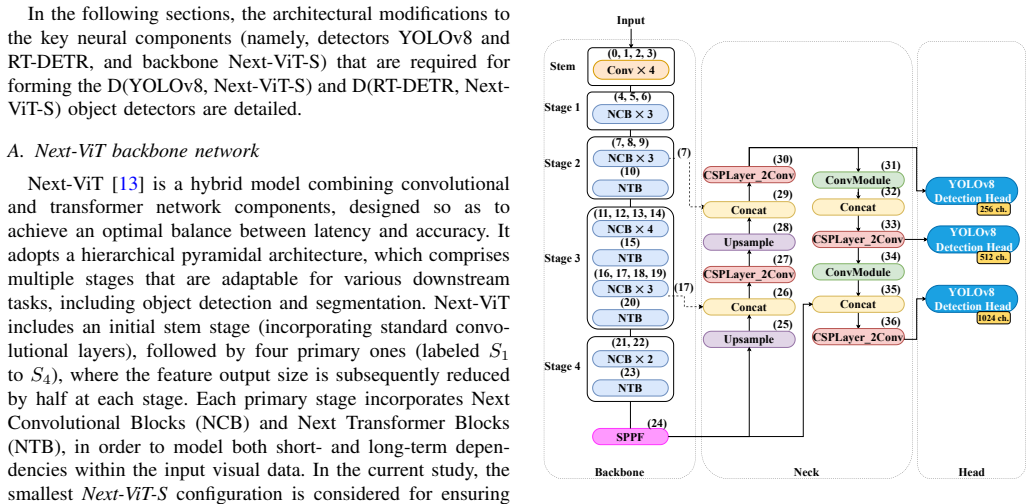
The key object is the hybrid CNN-transformer backbone Next-ViT-S, which alternates Next Convolutional Blocks (local detail) with Next Transformer Blocks (global attention) in a pyramidal architecture, and is joined either to the YOLOv8 head or the RT-DETR head. Integrating it requires selecting which backbone layers feed the neck via skip connections; the paper tries C(10,20), C(9,19), and C(7,17), choosing C(7,17) for YOLOv8 and C(9,19) for RT-DETR. The EDS benchmark supplies the load-bearing condition: six train-on-one-scanner/test-on-another sessions that turn the architecture comparison into a robustness comparison.
What would settle it
Retrain all four detectors on EDS under identical optimizer, learning-rate schedule, and training length, then rerun the six cross-scanner sessions; if the pure CNN baseline then matches or beats the hybrids, the claimed robustness advantage is not caused by transformer components.
Extended reading notes
Core claim
The paper's central claim is that hybrid CNN-transformer detectors exhibit increased robustness to domain distribution shift in X-ray images. The evidence is a four-way comparison: a pure CNN baseline (YOLOv8 with CSP-DarkNet53), a hybrid backbone in YOLOv8 (D(YOLOv8, Next-ViT-S)), and two RT-DETR variants (with HGNetV2 and Next-ViT-S). On HiXray and PIDray, which each come from a single scanner, the CNN baseline performs best. On EDS, whose images were captured by three different scanners and whose protocol trains on one scanner and tests on another, the hybrid detectors outperform the CNN baseline. The paper attributes the difference to transformer components' ability to incorporate global contextual information, while cautioning that swapping in a hybrid backbone does not always improve results.
Load-bearing premise
The robustness conclusion assumes the four detectors were trained fairly, and the most exposed point is that on EDS one hybrid (D(RT-DETR, Next-ViT-S)) used SGD while the others used AdamW, so optimizer choice rather than transformer components could explain part of the gap.
Editorial extensions
If this is right
- On single-scanner X-ray benchmarks, a well-tuned pure CNN detector remains a strong default; replacing the backbone with a hybrid one does not automatically improve accuracy.
- When deployment spans multiple scanner types, the paper's results make hybrid detectors, especially D(YOLOv8, Next-ViT-S) and D(RT-DETR, HGNetV2), the safer choice.
- YOLOv8-based detectors with the Next-ViT-S backbone consistently outperform their RT-DETR-based counterparts, suggesting the transformer-based detection head is not what drives the robustness gain.
- On the hidden-object subset of PIDray, the hybrid D(YOLOv8, Next-ViT-S) slightly outperforms the CNN baseline, hinting that global context helps when objects are deliberately concealed.
- The hybrids' EDS advantage is most visible on medium-sized objects, which is a useful detail for designing screening systems that must handle varied object scales.
Reading between the lines
- If the EDS advantage persists under matched optimizers, it would suggest that global context from self-attention is what buys robustness to scanner-induced appearance shifts, making multi-scanner evaluation a standard part of X-ray detector benchmarking.
- A natural testable extension is to measure how the hybrid advantage scales with the severity of the shift, for example by adding more scanners, varied wear levels, or simulated color and contrast perturbations to single-scanner datasets.
- The paper's skip-connection search implies that how a hybrid backbone is wired to the detection neck can matter as much as the backbone itself, so a systematic study of those connection choices across datasets could turn a heuristic into a design rule.
Signed reviews
Editorial analysis
A structured set of objections, weighed in public.
Referee Report
Summary. The paper compares four object detectors on three public X-ray benchmarks: a pure CNN baseline D(YOLOv8, CSP-DarkNet53), a hybrid backbone D(YOLOv8, Next-ViT-S), a CNN backbone with transformer head D(RT-DETR, HGNetV2), and a fully hybrid D(RT-DETR, Next-ViT-S). The authors report that the CNN baseline is best on HiXray and PIDray (single-scanner datasets), while two of the hybrid architectures achieve higher mAP on EDS, which contains images from three scanners and is used with a cross-domain evaluation protocol. The paper interprets this as evidence that transformer components confer increased robustness to domain shift. Tables I–III provide mAP50 and mAP50:95 for all datasets and for the EDS domain pairs and PIDray subsets.
Significance. If the central claim is substantiated, the result is practically useful: multi-scanner X-ray deployments are common, and a detector class that is systematically more robust under domain shift would be a valuable design guideline. The paper also provides a reproducible benchmark setup, with public datasets, source code, and network weights released, and it reports per-class and per-scale breakdowns that are useful for future work. The tables are internally consistent, and the EDS session averages in Table II reproduce the aggregate numbers in Table I. However, the headline interaction claim—that hybrid CNN-transformer architectures are more robust under domain shift—is currently supported only by single-run point estimates with no variance or significance assessment, which is the central weakness of the study.
major comments (3)
- [Section IV-B, Tables I and II] The central robustness interaction is derived from single training runs. The EDS advantage of D(YOLOv8, Next-ViT-S) over the baseline is 0.041 mAP50 and 0.022 mAP50:95, and that of D(RT-DETR, HGNetV2) is 0.026 mAP50 and 0.024 mAP50:95. These gaps are comparable to typical seed-to-seed variation in object detection experiments, yet the paper reports no standard deviations, confidence intervals, or significance tests. The six EDS sessions are different source-target domain pairs, not repeated runs of the same training procedure, so they do not estimate seed sensitivity. Without repeated seeds, the claim that transformer components increase robustness under domain shift is not empirically established. Please provide results averaged over at least three seeds (with standard deviations), or a formal significance test, for all detectors and datasets.
- [Abstract and Section V] The abstract and conclusion state that 'hybrid CNN-transformer architectures exhibit increased robustness' on EDS, but Table I shows that the hybrid D(RT-DETR, Next-ViT-S) is substantially worse than the CNN baseline on EDS (0.504 vs 0.547 mAP50; 0.322 vs 0.386 mAP50:95). Section IV-B correctly hedges with 'most hybrid CNN-transformer detectors', but the broader claim is contradicted by this counterexample. Please qualify the conclusion to name the specific architectures that show the effect, or provide an explanation for why one hybrid fails while the other two succeed.
- [Section III-B, Section III-C, and Section IV-A3] The skip-connection configurations C(7,17) for D(YOLOv8, Next-ViT-S) and C(9,19) for D(RT-DETR, Next-ViT-S) are described as selected after 'extensive experimental evaluation' and 'thorough experimental assessment', but no validation procedure is reported. If these configurations were chosen using the test sets or the same EDS sessions as the final evaluation, the reported numbers are the best of several tested variants and the hybrid advantage could be inflated by selection. Please specify the hyperparameter/model-selection protocol: which data splits were used for configuration selection, and were the chosen configurations frozen before the final evaluation on the test sets?
minor comments (4)
- [Section IV-A3] The optimizer choice is inconsistent: on EDS, D(RT-DETR, Next-ViT-S) is trained with SGD while all other detectors use AdamW, and on HiXray/PIDray all detectors use SGD. The main EDS comparison for the two supporting hybrids is unaffected, but the cross-dataset comparison and the comparison involving D(RT-DETR, Next-ViT-S) are confounded. Please justify or unify the optimizer settings.
- [Section IV-B] The sentence 'the various subsets in the PID dataset' appears to contain a typo; it should read 'PIDray dataset'.
- [Section III-B and III-C] The layer numbering for the Next-ViT-S backbone (C(10,20), C(9,19), C(7,17)) is used without a list of which layer indices correspond to NCB versus NTB blocks in the main text; a small table or figure callout would improve reproducibility.
- [Section IV-B, Figure 4] The discussion of object-scale results states that the scale effect differs on EDS but does not describe the HiXray and PIDray scale results in the same detail; adding one or two sentences would make the figure interpretation self-contained.
Circularity Check
No significant circularity: the paper reports an empirical benchmark against external public datasets, and its central claim is an observation from those results, not a constructed prediction.
full rationale
The central claim, that hybrid CNN-transformer detectors exhibit increased robustness under domain shift on EDS, is an empirical observation from Tables I and II, which report mAP values on the external public EDS, HiXray, and PIDray benchmarks. No parameter is fitted to a subset of data and then relabeled as a prediction; all four detectors are trained with standard public implementations and evaluated on fixed public test protocols. The selected skip-connection configurations C(7,17) and C(9,19) are architecture variants chosen by experimentation, which is model selection rather than circular reasoning, and the claim is also supported by D(RT-DETR, HGNetV2), which does not depend on those skip connections. The paper's self-citations (e.g., [6], [10], [15], [31]) appear only as background context and do not carry the load of the empirical comparison. The absence of repeated-seed variance or significance testing is an evidence-strength concern, not a circularity concern, so it does not affect the circularity score.
Assumptions & free parameters
free parameters (1)
- Skip-connection configuration for Next-ViT-S hybrids =
C(7,17) for YOLOv8 head, C(9,19) for RT-DETR head
assumptions (3)
- domain assumption ImageNet-pretrained weights for Next-ViT-S transfer to X-ray imagery
- domain assumption COCO small/medium/large object scale thresholds apply to X-ray images
- ad hoc to paper EDS domain-shift protocol is a valid proxy for real-world distribution shift
Cite this review
Pith. "Pith review of X-ray illicit object detection using hybrid CNN-transformer neural network architectures." pith.science (2026). https://pith.science/paper/NZYZJK5P
@misc{pith2026250500564,
  author       = {Pith},
  title        = {Pith review of: X-ray illicit object detection using hybrid CNN-transformer neural network architectures},
  year         = {2026},
  howpublished = {\url{https://pith.science/paper/NZYZJK5P}},
  note         = {Machine review of arXiv:2505.00564}
}
read the original abstract
In the field of X-ray security applications, even the smallest details can significantly impact outcomes. Objects that are heavily occluded or intentionally concealed pose a great challenge for detection, whether by human observation or through advanced technological applications. While certain Deep Learning (DL) architectures demonstrate strong performance in processing local information, such as Convolutional Neural Networks (CNNs), others excel in handling distant information, e.g., transformers. In X-ray security imaging the literature has been dominated by the use of CNN-based methods, while the integration of the two aforementioned leading architectures has not been sufficiently explored. In this paper, various hybrid CNN-transformer architectures are evaluated against a common CNN object detection baseline, namely YOLOv8. In particular, a CNN (HGNetV2) and a hybrid CNN-transformer (Next-ViT-S) backbone are combined with different CNN/transformer detection heads (YOLOv8 and RT-DETR). The resulting architectures are comparatively evaluated on three challenging public X-ray inspection datasets, namely EDS, HiXray, and PIDray. Interestingly, while the YOLOv8 detector with its default backbone (CSP-DarkNet53) is generally shown to be advantageous on the HiXray and PIDray datasets, when a domain distribution shift is incorporated in the X-ray images (as happens in the EDS datasets), hybrid CNN-transformer architectures exhibit increased robustness. Detailed comparative evaluation results, including object-level detection performance and object-size error analysis, demonstrate the strengths and weaknesses of each architectural combination and suggest guidelines for future research. The source code and network weights of the models employed in this study are available at https://github.com/jgenc/xray-comparative-evaluation.
Figures


Figures from the paper (1 more)

Reference graph
Works this paper leans on
-
[1]
Pidray: A large-scale x- ray benchmark for real-world prohibited item detection,
L. Zhang, L. Jiang, R. Ji, and H. Fan, “Pidray: A large-scale x- ray benchmark for real-world prohibited item detection,” International Journal of Computer Vision , vol. 131, no. 12, pp. 3170–3192, 2023
work page 2023
-
[2]
Illicit item detection in x-ray images for security applications,
G. Batsis, I. Mademlis, and G. T. Papadopoulos, “Illicit item detection in x-ray images for security applications,” in 2023 IEEE Ninth Inter- national Conference on Big Data Computing Service and Applications (BigDataService), pp. 63–70, IEEE, 2023
work page 2023
-
[3]
M. Rafiei, J. Raitoharju, and A. Iosifidis, “Computer vision on x-ray data in industrial production and security applications: A comprehensive survey,” Ieee Access, vol. 11, pp. 2445–2477, 2023
work page 2023
-
[4]
Visual inspection for illicit items in x-ray images using deep learn- ing,
I. Mademlis, G. Batsis, A. A. R. Chrysochoou, and G. T. Papadopoulos, “Visual inspection for illicit items in x-ray images using deep learn- ing,” in 2023 IEEE International Conference on Big Data (BigData) , pp. 4081–4089, IEEE, 2023
work page 2023
-
[5]
An image is worth 16x16 words: Transformers for image recognition at scale,
A. Dosovitskiy, L. Beyer, A. Kolesnikov, D. Weissenborn, X. Zhai, T. Unterthiner, M. Dehghani, M. Minderer, G. Heigold, S. Gelly, et al., “An image is worth 16x16 words: Transformers for image recognition at scale,” arXiv preprint arXiv:2010.11929 , 2020
arXiv 2010
-
[6]
Illicit object detection in x-ray images using vision transformers,
J. Cani, I. Mademlis, A. A. R. Chrysochoou, and G. T. Papadopoulos, “Illicit object detection in x-ray images using vision transformers,” in 2024 5th International Conference in Electronic Engineering, Informa- tion Technology & Education (EEITE) , pp. 1–6, IEEE, 2024
work page 2024
-
[7]
End-to-end object detection with transformers,
N. Carion, F. Massa, G. Synnaeve, N. Usunier, A. Kirillov, and S. Zagoruyko, “End-to-end object detection with transformers,” in European conference on computer vision , pp. 213–229, Springer, 2020
2020
-
[8]
Sparse detr: Efficient end-to-end object detection with learnable sparsity,
B. Roh, J. Shin, W. Shin, and S. Kim, “Sparse detr: Efficient end-to-end object detection with learnable sparsity,” arXiv preprint arXiv:2111.14330, 2021
arXiv 2021
Show all 35 references
-
[9]
Dino: Detr with improved denoising anchor boxes for end-to- end object detection,
H. Zhang, F. Li, S. Liu, L. Zhang, H. Su, J. Zhu, L. M. Ni, and H.-Y . Shum, “Dino: Detr with improved denoising anchor boxes for end-to- end object detection,” arXiv preprint arXiv:2203.03605 , 2022
2022 arXiv
-
[10]
Advances in diffusion models for image data augmentation: A review of methods, models, evaluation metrics and future research directions,
P. Alimisis, I. Mademlis, P. Radoglou-Grammatikis, P. Sarigiannidis, and G. T. Papadopoulos, “Advances in diffusion models for image data augmentation: A review of methods, models, evaluation metrics and future research directions,” Artificial Intelligence Review, vol. 58, no....
2025
-
[11]
A survey of the vision transformers and their cnn-transformer based variants,
A. Khan, Z. Rauf, A. Sohail, A. R. Khan, H. Asif, A. Asif, and U. Fa- rooq, “A survey of the vision transformers and their cnn-transformer based variants,” Artificial Intelligence Review , vol. 56, no. Suppl 3, pp. 2917–2970, 2023
2023
-
[12]
Combining transformer and cnn for object detection in uav imagery,
W. F. Hendria, Q. T. Phan, F. Adzaka, and C. Jeong, “Combining transformer and cnn for object detection in uav imagery,” ICT Express, vol. 9, no. 2, pp. 258–263, 2023
2023
-
[13]
Next-ViT: Next generation vision transformer for ef- ficient deployment in realistic industrial scenarios,
J. Li, X. Xia, W. Li, H. Li, X. Wang, X. Xiao, R. Wang, M. Zheng, and X. Pan, “Next-ViT: Next generation vision transformer for ef- ficient deployment in realistic industrial scenarios,” arXiv preprint arXiv:2207.05501, 2022
2022 arXiv
-
[14]
Object detection and x-ray security imaging: A survey,
J. Wu, X. Xu, and J. Yang, “Object detection and x-ray security imaging: A survey,” IEEE Access, vol. 11, pp. 45416–45441, 2023
2023
-
[15]
The invisible arms race: digital trends in illicit goods trafficking and ai-enabled responses,
I. Mademlis, M. Mancuso, C. Paternoster, S. Evangelatos, E. Finlay, J. Hughes, P. Radoglou-Grammatikis, P. Sarigiannidis, G. Stavropoulos, K. V otis,et al., “The invisible arms race: digital trends in illicit goods trafficking and ai-enabled responses,” IEEE Transactions on Te...
2024
-
[16]
Baidu Paddle Vision Team, HGNetv2, 2023
2023
-
[17]
Jocher, J
G. Jocher, J. Qiu, and A. Chaurasia, Ultralytics YOLO, Jan. 2023
2023
-
[18]
Detrs beat yolos on real-time object detection,
Y . Zhao, W. Lv, S. Xu, J. Wei, G. Wang, Q. Dang, Y . Liu, and J. Chen, “Detrs beat yolos on real-time object detection,” in Proceedings of the IEEE/CVF conference on computer vision and pattern recognition , pp. 16965–16974, 2024
2024
-
[19]
Exploring endogenous shift for cross-domain detection: A large-scale benchmark and perturbation suppression network,
R. Tao, H. Li, T. Wang, Y . Wei, Y . Ding, B. Jin, H. Zhi, X. Liu, and A. Liu, “Exploring endogenous shift for cross-domain detection: A large-scale benchmark and perturbation suppression network,” in 2022 IEEE/CVF Conference on Computer Vision and Pattern Recognition (CVPR), ...
2022
-
[20]
Towards real-world x-ray security inspection: A high-quality benchmark and lateral inhibition module for prohibited items detection,
R. Tao, Y . Wei, X. Jiang, H. Li, H. Qin, J. Wang, Y . Ma, L. Zhang, and X. Liu, “Towards real-world x-ray security inspection: A high-quality benchmark and lateral inhibition module for prohibited items detection,” in Proceedings of the IEEE/CVF international conference on co...
2021
-
[21]
Towards real- world prohibited item detection: A large-scale x-ray benchmark,
B. Wang, L. Zhang, L. Wen, X. Liu, and Y . Wu, “Towards real- world prohibited item detection: A large-scale x-ray benchmark,” in Proceedings of the IEEE/CVF international conference on computer vision, pp. 5412–5421, 2021
2021
-
[22]
Occluded prohibited items detection: An x-ray security inspection benchmark and de-occlusion attention module,
Y . Wei, R. Tao, Z. Wu, Y . Ma, L. Zhang, and X. Liu, “Occluded prohibited items detection: An x-ray security inspection benchmark and de-occlusion attention module,” in Proceedings of the 28th ACM international conference on multimedia , pp. 138–146, 2020
2020
-
[23]
Em-yolo: An x-ray prohibited- item-detection method based on edge and material information fusion,
B. Jing, P. Duan, L. Chen, and Y . Du, “Em-yolo: An x-ray prohibited- item-detection method based on edge and material information fusion,” Sensors, vol. 23, no. 20, p. 8555, 2023
2023
-
[24]
Sc-yolov8: A security check model for the inspection of prohibited items in x-ray images,
L. Han, C. Ma, Y . Liu, J. Jia, and J. Sun, “Sc-yolov8: A security check model for the inspection of prohibited items in x-ray images,” Electronics, vol. 12, no. 20, p. 4208, 2023
2023
-
[25]
Lightweight detection method for x-ray security inspection with occlusion,
Z. Wang, X. Wang, Y . Shi, H. Qi, M. Jia, and W. Wang, “Lightweight detection method for x-ray security inspection with occlusion,” Sensors, vol. 24, no. 3, p. 1002, 2024
2024
-
[26]
Improved yolov8 for dangerous goods detection in x-ray security images,
A. Wang, P. Yuan, H. Wu, Y . Iwahori, and Y . Liu, “Improved yolov8 for dangerous goods detection in x-ray security images,” Electronics, vol. 13, no. 16, p. 3238, 2024
2024
-
[27]
Lightweight prohibited items detection model in x-ray images based on improved yolov7-tiny,
H. Zhang, W. Teng, X. He, H. Que, and Y . Zhang, “Lightweight prohibited items detection model in x-ray images based on improved yolov7-tiny,”Journal of the Franklin Institute, vol. 362, no. 1, p. 107421, 2025
2025
-
[28]
Fea- ture knowledge distillation-based model lightweight for prohibited item detection in x-ray security inspection images,
Y . Ren, L. Zhao, Y . Zhang, Y . Liu, J. Yang, H. Zhang, and B. Lei, “Fea- ture knowledge distillation-based model lightweight for prohibited item detection in x-ray security inspection images,” Advanced Engineering Informatics, vol. 65, p. 103125, 2025
2025
-
[29]
Transformer-based dual-view x-ray security inspection image analysis,
X. Meng, H. Feng, Y . Ren, H. Zhang, W. Zou, and X. Ouyang, “Transformer-based dual-view x-ray security inspection image analysis,” Engineering Applications of Artificial Intelligence , vol. 138, p. 109382, 2024
2024
-
[30]
Eslaxdet: A new x-ray baggage security detection framework based on self-supervised vision transformers,
J. Wu and X. Xu, “Eslaxdet: A new x-ray baggage security detection framework based on self-supervised vision transformers,” Engineering Applications of Artificial Intelligence , vol. 127, p. 107440, 2024
2024
-
[31]
Self-supervised visual learning in the low-data regime: a comparative evaluation,
S. Konstantakos, J. Cani, I. Mademlis, D. I. Chalkiadaki, Y . M. Asano, E. Gavves, and G. T. Papadopoulos, “Self-supervised visual learning in the low-data regime: a comparative evaluation,” Neurocomputing, vol. 620, p. 129199, 2025
2025
-
[32]
Tinyvit: Fast pretraining distillation for small vision transformers,
K. Wu, J. Zhang, H. Peng, M. Liu, B. Xiao, J. Fu, and L. Yuan, “Tinyvit: Fast pretraining distillation for small vision transformers,” in European conference on computer vision , pp. 68–85, Springer, 2022
2022
-
[33]
Detection of novel prohibited item categories for real-world security inspection,
S. Lin, T. Jia, H. Wang, B. Ma, M. Li, and D. Chen, “Detection of novel prohibited item categories for real-world security inspection,” Engineering Applications of Artificial Intelligence , vol. 144, p. 110110, 2025
2025
-
[34]
Adaptxray: Vision transformer and adapter in x-ray images for prohibited items detection,
Y . Huang, H. Gao, and X. Li, “Adaptxray: Vision transformer and adapter in x-ray images for prohibited items detection,” in 2024 IEEE International Conference on Image Processing (ICIP) , pp. 402–408, IEEE, 2024
2024
-
[35]
Microsoft coco: Common objects in context,
T.-Y . Lin, M. Maire, S. Belongie, J. Hays, P. Perona, D. Ramanan, P. Doll ´ar, and C. L. Zitnick, “Microsoft coco: Common objects in context,” in Computer vision–ECCV 2014: 13th European conference, zurich, Switzerland, September 6-12, 2014, proceedings, part v 13 , pp. 740–7...
2014
Reviewed August 16, 2026 · model on record in the stance chip above.
Discussion (0). Continue with ORCID to comment.