REVIEW 3 major objections 4 minor 1 cited by
Predicting the Dynamics of Complex System via Multiscale Diffusion Autoencoder
T0 review · 3 major / 4 minor · reviewed 2026-08-16 · deepseek-v4-flash
Pith's one-line read MDPNet predicts complex-system dynamics by separating states into coarse-to-fine scales, guiding a diffusion decoder with scale-specific codes, and coupling scales through a graph neural ODE, cutting average prediction error by 53.23…
desk verdict Solid new architecture and broad experiments, but the 53.23% headline leans heavily on the Brusselator result and the test protocol needs clarification before I'd trust it. read the letter →
The pith
A machine-rendered reading of the paper's core claim, the machinery that carries it, and where it could break.
The reading
What carries the argument
The central machinery is a multiscale diffusion autoencoder paired with a graph neural ODE over scales. The encoder decomposes the state $x_t$ into residuals $r^k_t = Q(x_t - \sum_{i>k} r^i_t, k)$, where $Q(\cdot,k)$ is a downsampling operator followed by interpolation back to the original resolution; the decoder allocates diffusion stages to each scale and conditions the noise network on $z^k_t=\phi_\theta(r^k_t,\mathrm{embedding}(k))$, so coarse-to-fine scale structure is what guides denoising. The predictor evolves $z^k_t$ through self-dynamics $f_k$ plus a graph attention interaction term $g$ that reads the full latent vector $\mathbf{Z}_t$ and the adjacency $A$, solving an initial value problem with an ODE solver. What this machinery does is keep fine-scale information explicitly represented and let the forecast update each scale using the others' states, rather than compressing everything into one entangled code.
What would settle it
A concrete test: use a system whose long-term fate is set by small-scale initial perturbations, so two states that look identical after downsampling evolve differently. If MDPNet's latent vectors do not distinguish them, its forecast error will jump relative to a full-resolution model, showing that the Markovian latent state alone is insufficient.
Extended reading notes
Core claim
The paper's central discovery is that decoupling observed states into several scales and guiding a diffusion decoder with those scale-specific latent vectors yields a latent space that supports markedly better forecasts than flat latent spaces. The residual encoder computes coarse-grained states by repeatedly extracting and subtracting downsampled versions of the state, so that finer scales carry what coarser scales discarded; the diffusion decoder's noise schedule is staged per scale, applying coarse-graining instead of pure noise in early steps, and each stage is conditioned on the corresponding latent vector. The predictor then treats scales as nodes of a fully connected graph and evolves them through an attention-based graph neural ODE, $\frac{dz^k_t}{dt}=f_k(z^k_t)+g(z^k_t,A,\mathbf{Z}_t)$. In experiments, this combination outperforms all baselines on the Lambda-$\Omega$, Brusselator, Gray-Scott, and Navier-Stokes systems, with the largest gains on Brusselator and Gray-Scott, and the diffusion decoder tolerates latent perturbations better than a vanilla residual decoder, which the paper ties to smaller long-horizon error accumulation.
Load-bearing premise
The pipeline assumes that the current multiscale latent vector is enough to forecast the next state; if the true dynamics depend on fine details that downsampling throws away or on history beyond the present instant, the predicted states will drift.
Editorial extensions
If this is right
- Removing the cross-scale interaction term from the graph neural ODE substantially raises NMSE on the Lambda-Omega and Brusselator systems, so the co-evolution model carries a large share of the accuracy gain.
- Because the decoder conditions on latent codes rather than reconstructing residuals and summing them, latent perturbations cause smaller reconstruction drift than a vanilla decoder, implying that long-horizon forecasts are less vulnerable to error accumulation.
- On the Brusselator system, MDPNet trained on only 60% of the data still beats the best baseline trained on the full set, so the multiscale inductive bias improves data efficiency.
- On cylinder flow with Reynolds numbers between 500 and 1000, outside the training range, MDPNet still reproduces vortex count, shape, and position, so the latent representation generalizes beyond the training parameter regime.
- Forecasting runs at $K \times d$ latent dimensions instead of $C\times H\times W$ (over a 40-fold reduction on the cylinder flow), with denoising steps independent of forecast horizon, so the method is positioned as a cheaper surrogate for numerical simulation.
Reading between the lines
- Editorial inference: because the coarse-graining operator $Q$ defines the decomposition, the same autoencoder could be lifted to graphs or point clouds by swapping $Q$, which the paper's stated limitation (grid-only data) invites as the next test.
- Editorial inference: the $K=3$ sweet spot in the scale-number experiments suggests the optimal number of scales tracks the number of dynamically active structure sizes, so a data-driven rule could choose $K$ from the spectral decay rate of residuals rather than by grid search.
- Editorial inference: the learned graph attention weights over scales can be read as a per-system measure of cross-scale coupling; correlating them with known energy-cascade directions in Navier-Stokes would test whether the model rediscovers physical cascade structure.
Signed reviews
Editorial analysis
A structured set of objections, weighed in public.
Referee Report
Summary. The paper proposes MDPNet, a multiscale diffusion autoencoder with an attention-based graph neural ODE for predicting the spatiotemporal dynamics of complex systems. The method encodes multiscale residual features, uses a coarsening-guided diffusion decoder to reconstruct observations, and models cross-scale co-evolution in a low-dimensional latent space. The authors evaluate on four PDE systems (Lambda-Omega, Brusselator, Gray-Scott, Navier-Stokes) and report an average NMSE reduction of 53.23% against the best baseline per system, along with robustness, generalization, and ablation experiments.
Significance. If the results hold, the paper offers a novel and well-motivated architecture that explicitly exploits multiscale structure in a diffusion autoencoder, with a released codebase and a fairly comprehensive empirical study across four PDE benchmarks, sensitivity analyses, ablations, robustness to noise, and out-of-distribution generalization. The key claim, however, hinges on the Brusselator result, which contributes 95.03% of the average improvement, and the evaluation protocol for that system is ambiguous. Because the headline number depends on a single system and an unclear test segment, the current evidence does not yet robustly support the paper's central quantitative claim.
major comments (3)
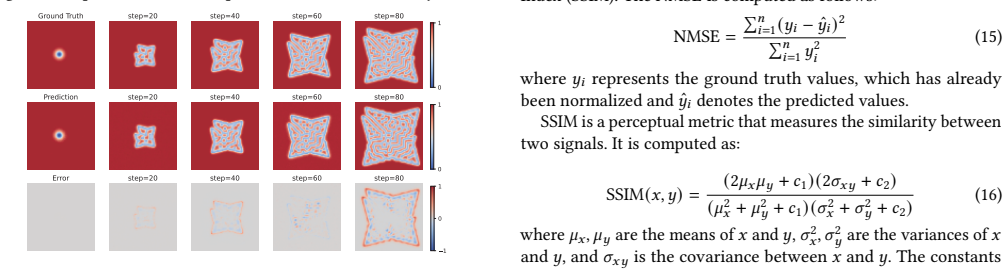
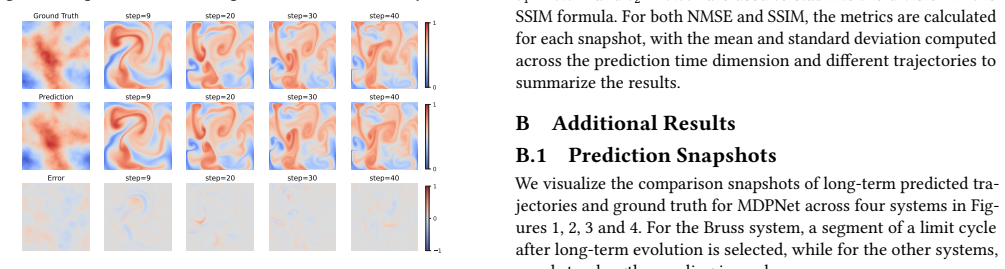
- [Sec. 4.1, Appendix B.1, Table 1] The evaluation protocol for the Brusselator is ambiguous and load-bearing. The dataset description states that the Brusselator converges to a limit cycle after a transient, and Appendix B.1 says that "for the Bruss system, a segment of a limit cycle after long-term evolution is selected" when reporting prediction snapshots. The main text does not state whether the NMSE/SSIM metrics in Table 1 are computed over full trajectories from arbitrary initial conditions (as implied by Sec. 2.1 and Sec. 4.3) or over a post-transient limit-cycle segment. If the metrics are computed only on the periodic segment, then the 95.03% reduction over ConvLSTM is not evidence of a general prediction capability from arbitrary initial conditions, and the 53.23% average should be recomputed or explicitly scoped. The authors must specify exactly which segment was used for Table 1 and ensure all baselines are evaluated identically.
- [Sec. 3.1.2, Eqs. (5)-(7)] The definition of the coarsening-guided diffusion schedule is incomplete and the forward process is not a standard diffusion process. The schedule is given as {N_k}_{k=1}^{K-1}, but the stage boundaries N_0 and N_K are undefined, and Eq. (5) sets alpha=1 for n<N_k, making the forward variable a coarse-grained deterministic transform rather than a noisy sample. The reverse process "starts from Gaussian noise," but the correspondence between the initial reverse sample and the forward endpoint is not specified. This makes the training objective in Eq. (10) ambiguous regarding the range of n. The authors should provide a complete, self-consistent specification of the forward and reverse processes, including the role of Q and the exact values of N_k.
- [Abstract, Table 1] The headline claim of an "average prediction error reduction of 53.23%" is the mean of per-system improvements, each computed against a different best baseline (G-LED for LO, ConvLSTM for Bruss, L-DeepONet for GS, ConvLSTM for NS). This is not a single consistent comparison. The Bruss result alone contributes 95.03 percentage points of that average; excluding it, the mean over the other three systems is 39.29%. The abstract and conclusions should either report the per-baseline reductions or state clearly that the average is over system-specific best baselines, and the paper should discuss the sensitivity of the headline number to the Bruss protocol.
minor comments (4)
- [Sec. 3.1.1, Eq. (4)] The text says "remains theoretically lossless when k=1 (i.e., x_tau = x^1_tau)", but by Eq. (4) x^1_tau is the sum of residuals from scales 2..K and the residual r^1_tau would still be nonzero. The correct statement is x_tau = x^1_tau + r^1_tau. Please fix the typo.
- [Sec. 4.4.2, Table 2] The table columns labeled "Diffuse Steps" and "Scale Num" are not explicitly connected to the control experiment described in the text. The left panel appears to be the single-scale control with varying total diffusion steps, and the right panel the multiscale model with fixed 200 steps per scale. Please label these panels in the table or in the caption.
- [Appendix A, Table 1] In the table for the cylinder flow system, the entry in the alpha column appears as "1.0μ" and the viscosity range is rendered as "1.06×10 4"; these are formatting errors. Also, the text says "We generate 50 training trajectories and 20 testing trajectories" but then refers to "10 training trajectories" and "10 OOD" trajectories; the numbers should be made consistent.
- [Sec. 3.2] The model assumes that the latent state z^k_tau is a sufficient statistic for future dynamics under a first-order Markovian ODE. For systems where the coarse-graining operator Q discards information needed to determine the future, or where memory beyond the current latent vector is required, the latent dynamics will drift. This limitation is not discussed; a sentence acknowledging it would improve the paper.
Circularity Check
No circularity found: MDPNet's latent encoder/decoder and GNODE are defined directly from the observed state and evaluated on held-out trajectory splits, with no prediction reducing to a fitted input or self-citation.
full rationale
The derivation chain is self-contained. The multiscale residual encoder Eq. (3) is an explicit coarse-graining decomposition r^k = Q(x - sum residuals, k); the coarsening-guided diffusion decoder Eqs. (5)-(7) defines the conditional denoiser from the same encoded latents; and the cross-scale predictor Eq. (8)-(9) is an initial-value ODE evolved from z(0). The training losses (10) and L_pred are standard noise-estimation and latent MSE objectives, and the reported metrics are computed on test trajectories from initial conditions not used for fitting. No parameter is fit to the reported error-reduction metric and then renamed as a prediction; sensitivity analysis in Sec. 4.4 selects scale number and latent dimension on validation-like comparisons, but this is ordinary model selection, not circularity. The self-citations ([33],[34],[35]) appear in related work and do not supply the load-bearing argument; the graph ODE, attention, and diffusion components are built on independent references. The only flagged issue is an evaluation-protocol ambiguity for Brusselator in Appendix B.1 (limit-cycle segment selection for snapshots vs. metrics), which is a correctness concern rather than a circularity of the derivation.
Assumptions & free parameters
free parameters (4)
- Scale number K =
3 (recommended; tested 1 to 5)
- Latent dimension d =
64
- Diffusion step allocation across scales =
Uniform 1:1:1 with 1000 total steps
- Downsampling operator Q =
Not specified
assumptions (5)
- domain assumption A low-dimensional latent representation is sufficient to describe the emergent dynamics of these systems.
- ad hoc to paper The diffusion reverse process progresses from coarse to fine structure, and this aligns with the spatial coarse-graining in Eqs 5 and 6.
- ad hoc to paper Residual decomposition in Eq 3 separates the system state into meaningful independent scale bands.
- domain assumption Latent dynamics are Markovian and autonomous, evolving as a first-order ODE with self-dynamics plus graph attention interaction.
- standard math Standard results for ODE solvers and diffusion model training hold.
Cite this review
Pith. "Pith review of Predicting the Dynamics of Complex System via Multiscale Diffusion Autoencoder." pith.science (2026). https://pith.science/paper/O26TXGZC
@misc{pith2026250502450,
  author       = {Pith},
  title        = {Pith review of: Predicting the Dynamics of Complex System via Multiscale Diffusion Autoencoder},
  year         = {2026},
  howpublished = {\url{https://pith.science/paper/O26TXGZC}},
  note         = {Machine review of arXiv:2505.02450}
}
read the original abstract
Predicting the dynamics of complex systems is crucial for various scientific and engineering applications. The accuracy of predictions depends on the model's ability to capture the intrinsic dynamics. While existing methods capture key dynamics by encoding a low-dimensional latent space, they overlook the inherent multiscale structure of complex systems, making it difficult to accurately predict complex spatiotemporal evolution. Therefore, we propose a Multiscale Diffusion Prediction Network (MDPNet) that leverages the multiscale structure of complex systems to discover the latent space of intrinsic dynamics. First, we encode multiscale features through a multiscale diffusion autoencoder to guide the diffusion model for reliable reconstruction. Then, we introduce an attention-based graph neural ordinary differential equation to model the co-evolution across different scales. Extensive evaluations on representative systems demonstrate that the proposed method achieves an average prediction error reduction of 53.23% compared to baselines, while also exhibiting superior robustness and generalization.
Figures


Figures from the paper (9 more)



Forward citations
Cited by 1 Pith paper
-
Beyond Equilibrium: Non-Equilibrium Foundations Should Underpin Generative Processes in Complex Dynamical Systems
A position paper arguing that non-equilibrium-physics-inspired generative models (like diffusion models) are, and should be, the foundation for modeling time-varying complex systems, supported by one 2D simulation.
Reference graph
Works this paper leans on
-
[1]
Yohai Bar-Sinai, Stephan Hoyer, Jason Hickey, and Michael P Brenner. 2019. Learning data-driven discretizations for partial differential equations.Proceedings of the National Academy of Sciences116, 31 (2019), 15344–15349
2019
-
[2]
Jan-Hendrik Bastek, WaiChing Sun, and Dennis M Kochmann. 2024. Physics- Informed Diffusion Models.arXiv preprint arXiv:2403.14404(2024)
arXiv 2024
-
[3]
Emanuele Bevacqua, Laura Suarez-Gutierrez, Aglaé Jézéquel, Flavio Lehner, Math- ieu Vrac, Pascal Yiou, and Jakob Zscheischler. 2023. Advancing research on compound weather and climate events via large ensemble model simulations. Nature Communications14, 1 (2023), 2145
2023
-
[4]
Harsh Bhatia, Timothy S Carpenter, Helgi I Ingólfsson, Gautham Dharuman, Piyush Karande, Shusen Liu, Tomas Oppelstrup, Chris Neale, Felice C Lightstone, Brian Van Essen, et al. 2021. Machine-learning-based dynamic-importance sam- pling for adaptive multiscale simulations.Nature Machine Intelligence3, 5 (2021), 401–409
work page 2021
-
[5]
Bernard R Brooks, Charles L Brooks III, Alexander D Mackerell Jr, Lennart Nilsson, Robert J Petrella, Benoît Roux, Youngdo Won, Georgios Archontis, Christian Bartels, Stefan Boresch, et al . 2009. CHARMM: the biomolecular simulation program.Journal of computational chemistry30, 10 (2009), 1545–1614
work page 2009
-
[6]
Casey M Brown, Jay R Lund, Ximing Cai, Patrick M Reed, Edith A Zagona, Avi Ostfeld, Jim Hall, Gregory W Characklis, Winston Yu, and Levi Brekke. 2015. The future of water resources systems analysis: Toward a scientific framework for sustainable water management.Water resources research51, 8 (2015), 6110–6124
work page 2015
-
[7]
Hanqun Cao, Cheng Tan, Zhangyang Gao, Yilun Xu, Guangyong Chen, Pheng- Ann Heng, and Stan Z Li. 2024. A survey on generative diffusion models.IEEE Transactions on Knowledge and Data Engineering(2024)
work page 2024
-
[8]
David W Cash, W Neil Adger, Fikret Berkes, Po Garden, Louis Lebel, Per Ols- son, Lowell Pritchard, and Oran Young. 2006. Scale and cross-scale dynamics: governance and information in a multilevel world.Ecology and society11, 2 (2006)
work page 2006
Show all 82 references
-
[9]
Kathleen Champion, Bethany Lusch, J Nathan Kutz, and Steven L Brunton. 2019. Data-driven discovery of coordinates and governing equations.Proceedings of the National Academy of Sciences116, 45 (2019), 22445–22451
2019
-
[10]
Ricky TQ Chen, Yulia Rubanova, Jesse Bettencourt, and David K Duvenaud. 2018. Neural ordinary differential equations.Advances in neural information processing systems31 (2018)
2018
-
[11]
Florinel-Alin Croitoru, Vlad Hondru, Radu Tudor Ionescu, and Mubarak Shah
-
[12]
Prafulla Dhariwal and Alexander Nichol. 2021. Diffusion models beat gans on image synthesis.Advances in neural information processing systems34 (2021), 8780–8794
2021
-
[13]
Jingtao Ding, Yu Zheng, Huandong Wang, Carlo Vittorio Cannistraci, Jianxi Gao, Yong Li, and Chuan Shi. 2025. Artificial intelligence for complex network: Potential, methodology and application. InCompanion Proceedings of the ACM on Web Conference 2025. 5–8
2025
-
[14]
Xinyao Fan, Yueying Wu, Chang Xu, Yuhao Huang, Weiqing Liu, and Jiang Bian. 2024. MG-TSD: Multi-granularity time series diffusion models with guided learning process.arXiv preprint arXiv:2403.05751(2024)
2024 arXiv
-
[15]
Marco Federici, Patrick Forré, Ryota Tomioka, and Bastiaan S Veeling. 2023. Latent representation and simulation of markov processes via time-lagged information bottleneck.arXiv preprint arXiv:2309.07200(2023)
2023 arXiv
-
[16]
Han Gao, Sebastian Kaltenbach, and Petros Koumoutsakos. 2024. Generative learning for forecasting the dynamics of high-dimensional complex systems. Nature Communications15, 1 (2024), 8904
2024
-
[17]
Jianxi Gao. 2024. Intrinsic simplicity of complex systems.Nature Physics20, 2 (2024), 184–185
2024
-
[18]
Guillermo García-Pérez, Marián Boguñá, and M Ángeles Serrano. 2018. Multiscale unfolding of real networks by geometric renormalization.Nature Physics14, 6 (2018), 583–589
2018
-
[19]
Gaurav Gupta, Xiongye Xiao, Radu Balan, and Paul Bogdan. 2022. Non-linear operator approximations for initial value problems. InInternational Conference on Learning Representations (ICLR)
2022
-
[20]
Gaurav Gupta, Xiongye Xiao, and Paul Bogdan. 2021. Multiwavelet-based opera- tor learning for differential equations.Advances in neural information processing systems34 (2021), 24048–24062
2021
-
[21]
2006.Information and self-organization: A macroscopic approach to complex systems
H Haken. 2006.Information and self-organization: A macroscopic approach to complex systems. Springer
2006
-
[22]
2012.Advanced synergetics: instability hierarchies of self-organizing systems and devices
H Haken. 2012.Advanced synergetics: instability hierarchies of self-organizing systems and devices. Springer
2012
-
[23]
Jonathan Ho, Ajay Jain, and Pieter Abbeel. 2020. Denoising diffusion probabilistic models.Advances in neural information processing systems33 (2020), 6840–6851
2020
-
[24]
Alain Hore and Djemel Ziou. 2010. Image quality metrics: PSNR vs. SSIM. In 2010 20th international conference on pattern recognition. IEEE, 2366–2369
2010
-
[25]
Yang Jin, Zhicheng Sun, Ningyuan Li, Kun Xu, Hao Jiang, Nan Zhuang, Quzhe Huang, Yang Song, Yadong Mu, and Zhouchen Lin. 2024. Pyramidal flow matching for efficient video generative modeling.arXiv preprint arXiv:2410.05954(2024)
2024
-
[26]
Tero Karras, Miika Aittala, Timo Aila, and Samuli Laine. 2022. Elucidating the design space of diffusion-based generative models.Advances in neural information processing systems35 (2022), 26565–26577
2022
-
[27]
Maciej Koch-Janusz and Zohar Ringel. 2018. Mutual information, neural networks and the renormalization group.Nature Physics14, 6 (2018), 578–582
2018
-
[28]
Dmitrii Kochkov, Jamie A Smith, Ayya Alieva, Qing Wang, Michael P Bren- ner, and Stephan Hoyer. 2021. Machine learning–accelerated computational fluid dynamics.Proceedings of the National Academy of Sciences118, 21 (2021), e2101784118
2021
-
[29]
Katiana Kontolati, Somdatta Goswami, George Em Karniadakis, and Michael D Shields. 2024. Learning nonlinear operators in latent spaces for real-time predic- tions of complex dynamics in physical systems.Nature Communications15, 1 (2024), 5101
2024
-
[30]
Doyup Lee, Chiheon Kim, Saehoon Kim, Minsu Cho, and Wook-Shin Han. 2022. Autoregressive image generation using residual quantization. InProceedings of the IEEE/CVF Conference on Computer Vision and Pattern Recognition. 11523–11532
2022
-
[31]
Seungjoon Lee, Mahdi Kooshkbaghi, Konstantinos Spiliotis, Constantinos I Siet- tos, and Ioannis G Kevrekidis. 2020. Coarse-scale PDEs from fine-scale obser- vations via machine learning.Chaos: An Interdisciplinary Journal of Nonlinear Science30, 1 (2020)
2020
-
[32]
Jinghai Li, Jiayuan Zhang, Wei Ge, and Xinhua Liu. 2004. Multi-scale methodology for complex systems.Chemical engineering science59, 8-9 (2004), 1687–1700
2004
-
[33]
Ruikun Li, Huandong Wang, Jingtao Ding, Yuan Yuan, Qingmin Liao, and Yong Li. 2025. Predicting Dynamical Systems across Environments via Diffusive Model Weight Generation.arXiv preprint arXiv:2505.13919(2025)
2025 arXiv
-
[34]
Ruikun Li, Huandong Wang, and Yong Li. 2023. Learning slow and fast system dynamics via automatic separation of time scales. InProceedings of the 29th ACM SIGKDD Conference on Knowledge Discovery and Data Mining. 4380–4390
2023
-
[35]
Ruikun Li, Huandong Wang, Qingmin Liao, and Yong Li. 2025. Predicting the Energy Landscape of Stochastic Dynamical System via Physics-informed Self- supervised Learning.arXiv preprint arXiv:2502.16828(2025)
2025 arXiv
-
[36]
Tianyi Li, Luca Biferale, Fabio Bonaccorso, Martino Andrea Scarpolini, and Michele Buzzicotti. 2024. Synthetic Lagrangian turbulence by generative diffusion models.Nature Machine Intelligence(2024), 1–11
2024
-
[37]
Zeyu Li, Wang Han, Yue Zhang, Qingfei Fu, Jingxuan Li, Lizi Qin, Ruoyu Dong, Hao Sun, Yue Deng, and Lijun Yang. 2024. Learning spatiotemporal dynamics with a pretrained generative model.Nature Machine Intelligence6, 12 (2024), 1566–1579
2024
-
[38]
Zongyi Li, Nikola Borislavov Kovachki, Kamyar Azizzadenesheli, Kaushik Bhat- tacharya, Andrew Stuart, Anima Anandkumar, et al . [n. d.]. Fourier Neural Operator for Parametric Partial Differential Equations. InInternational Confer- ence on Learning Representations
-
[39]
Marten Lienen, David Lüdke, Jan Hansen-Palmus, and Stephan Günnemann. 2023. From zero to turbulence: Generative modeling for 3d flow simulation.arXiv preprint arXiv:2306.01776(2023)
2023 arXiv
-
[40]
Mario Lino, Chris Cantwell, Anil A Bharath, and Stathi Fotiadis. 2021. Simulating continuum mechanics with multi-scale graph neural networks.arXiv preprint arXiv:2106.04900(2021)
2021 arXiv
-
[41]
Lu Lu, Pengzhan Jin, Guofei Pang, Zhongqiang Zhang, and George Em Karni- adakis. 2021. Learning nonlinear operators via DeepONet based on the universal approximation theorem of operators.Nature machine intelligence3, 3 (2021), 218–229
2021
-
[42]
Bethany Lusch, J Nathan Kutz, and Steven L Brunton. 2018. Deep learning for universal linear embeddings of nonlinear dynamics.Nature communications9, 1 (2018), 4950. KDD ’25, August 3–7, 2025, Toronto, ON, Canada Ruikun Li, Jingwen Cheng, Huandong Wang, Qingmin Liao, and Yong Li
2018
-
[43]
Andreas Mardt, Luca Pasquali, Hao Wu, and Frank Noé. 2018. VAMPnets for deep learning of molecular kinetics.Nature communications9, 1 (2018), 5
2018
-
[44]
Ruben Ohana, Michael McCabe, Lucas Meyer, Rudy Morel, Fruzsina J Agocs, Miguel Beneitez, Marsha Berger, Blakesley Burkhart, Stuart B Dalziel, Drum- mond B Fielding, et al. 2024. The Well: a Large-Scale Collection of Diverse Physics Simulations for Machine Learning.arXiv prepri...
2024 arXiv
-
[45]
Grace CY Peng, Mark Alber, Adrian Buganza Tepole, William R Cannon, Suvranu De, Savador Dura-Bernal, Krishna Garikipati, George Karniadakis, William W Lytton, Paris Perdikaris, et al. 2021. Multiscale modeling meets machine learning: What can we learn?Archives of Computational...
2021
-
[46]
Konpat Preechakul, Nattanat Chatthee, Suttisak Wizadwongsa, and Supasorn Suwajanakorn. 2022. Diffusion autoencoders: Toward a meaningful and decodable representation. InProceedings of the IEEE/CVF conference on computer vision and pattern recognition. 10619–10629
2022
-
[47]
Haiganoush K Preisler and Anthony L Westerling. 2007. Statistical model for forecasting monthly large wildfire events in western United States.Journal of Applied Meteorology and Climatology46, 7 (2007), 1020–1030
2007
-
[48]
Ilya Prigogine and Grégoire Nicolis. 1967. On symmetry-breaking instabilities in dissipative systems.The Journal of Chemical Physics46, 9 (1967), 3542–3550
1967
-
[49]
Chengping Rao, Pu Ren, Qi Wang, Oral Buyukozturk, Hao Sun, and Yang Liu
-
[50]
Robin Rombach, Andreas Blattmann, Dominik Lorenz, Patrick Esser, and Björn Ommer. 2022. High-resolution image synthesis with latent diffusion models. In Proceedings of the IEEE/CVF conference on computer vision and pattern recognition. 10684–10695
2022
-
[51]
Encoding physics to learn reaction–diffusion processes.Nature Machine Intelligence5, 7 (2023), 765–779
2023
-
[52]
Salva Rühling Cachay, Bo Zhao, Hailey Joren, and Rose Yu. 2024. Dyffusion: A dynamics-informed diffusion model for spatiotemporal forecasting.Advances in Neural Information Processing Systems36 (2024)
2024
-
[53]
Olaf Ronneberger, Philipp Fischer, and Thomas Brox. 2015. U-net: Convolu- tional networks for biomedical image segmentation. InMedical image computing and computer-assisted intervention–MICCAI 2015: 18th international conference, Munich, Germany, October 5-9, 2015, proceedings...
2015
-
[54]
Lifeng Shen, Weiyu Chen, and James Kwok. 2024. Multi-Resolution Diffusion Models for Time Series Forecasting. InThe Twelfth International Conference on Learning Representations
2024
-
[55]
Patrick Seifner and Ramsés J Sánchez. 2023. Neural Markov jump processes. In International Conference on Machine Learning. PMLR, 30523–30552
2023
-
[56]
Xingjian Shi, Zhourong Chen, Hao Wang, Dit-Yan Yeung, Wai-Kin Wong, and Wang-chun Woo. 2015. Convolutional LSTM network: A machine learning approach for precipitation nowcasting.Advances in neural information processing systems28 (2015)
2015
-
[57]
Zhi Sheng, Yuan Yuan, Yudi Zhang, Depeng Jin, and Yong Li. 2025. Collaborative Deterministic-Probabilistic Forecasting for Real-World Spatiotemporal Systems. arXiv preprint arXiv:2502.11013(2025)
2025
-
[58]
Jiaming Song, Chenlin Meng, and Stefano Ermon. 2020. Denoising diffusion implicit models.arXiv preprint arXiv:2010.02502(2020)
2020 arXiv
-
[59]
Dule Shu, Zijie Li, and Amir Barati Farimani. 2023. A physics-informed diffusion model for high-fidelity flow field reconstruction.J. Comput. Phys.478 (2023), 111972
2023
-
[60]
Yang Song, Jascha Sohl-Dickstein, Diederik P Kingma, Abhishek Kumar, Stefano Ermon, and Ben Poole. 2020. Score-based generative modeling through stochastic differential equations.arXiv preprint arXiv:2011.13456(2020)
2020 arXiv
-
[61]
Yang Song and Stefano Ermon. 2019. Generative modeling by estimating gradients of the data distribution.Advances in neural information processing systems32 (2019)
2019
-
[62]
Vincent Thibeault, Antoine Allard, and Patrick Desrosiers. 2024. The low-rank hypothesis of complex systems.Nature Physics20, 2 (2024), 294–302
2024
-
[63]
Makoto Takamoto, Timothy Praditia, Raphael Leiteritz, Daniel MacKinlay, Francesco Alesiani, Dirk Pflüger, and Mathias Niepert. 2022. Pdebench: An extensive benchmark for scientific machine learning.Advances in Neural Infor- mation Processing Systems35 (2022), 1596–1611
2022
-
[64]
Narek Tumanyan, Michal Geyer, Shai Bagon, and Tali Dekel. 2023. Plug-and-play diffusion features for text-driven image-to-image translation. InProceedings of the IEEE/CVF Conference on Computer Vision and Pattern Recognition. 1921–1930
2023
-
[65]
Keyu Tian, Yi Jiang, Zehuan Yuan, Bingyue Peng, and Liwei Wang. 2024. Visual autoregressive modeling: Scalable image generation via next-scale prediction. arXiv preprint arXiv:2404.02905(2024)
2024 arXiv
-
[66]
Petar Veličković, Guillem Cucurull, Arantxa Casanova, Adriana Romero, Pietro Liò, and Yoshua Bengio. 2018. Graph attention networks.ICLR(2018)
2018
-
[67]
Petar Veličković, Guillem Cucurull, Arantxa Casanova, Adriana Romero, Pietro Lio, and Yoshua Bengio. 2017. Graph attention networks.arXiv preprint arXiv:1710.10903(2017)
2017 arXiv
-
[68]
Pantelis R Vlachas, Georgios Arampatzis, Caroline Uhler, and Petros Koumout- sakos. 2022. Multiscale simulations of complex systems by learning their effective dynamics.Nature Machine Intelligence4, 4 (2022), 359–366
2022
-
[69]
Pablo Villegas, Tommaso Gili, Guido Caldarelli, and Andrea Gabrielli. 2023. Lapla- cian renormalization group for heterogeneous networks.Nature Physics19, 3 (2023), 445–450
2023
-
[70]
Qi Wang, Pu Ren, et al . 2024. P2C2Net: PDE-Preserved Coarse Correction Network for efficient prediction of spatiotemporal dynamics.arXiv preprint arXiv:2411.00040(2024)
2024 arXiv
-
[71]
Huandong Wang, Huan Yan, Can Rong, Yuan Yuan, Fenyu Jiang, Zhenyu Han, Hongjie Sui, Depeng Jin, and Yong Li. 2024. Multi-scale simulation of complex systems: a perspective of integrating knowledge and data.Comput. Surveys56, 12 (2024), 1–38
2024
-
[72]
A Waswani, N Shazeer, N Parmar, J Uszkoreit, L Jones, A Gomez, L Kaiser, and I Polosukhin. 2017. Attention is all you need. InNIPS
2017
-
[73]
Yating Wang, Siu Wun Cheung, Eric T Chung, Yalchin Efendiev, and Min Wang
-
[74]
Sanghyun Woo, Jongchan Park, Joon-Young Lee, and In So Kweon. 2018. CBAM: Convolutional Block Attention Module.ECCV(2018)
2018
-
[75]
Hao Wu, Kangyu Weng, Shuyi Zhou, Xiaomeng Huang, and Wei Xiong. 2024. Neural Manifold Operators for Learning the Evolution of Physical Dynamics. InProceedings of the 30th ACM SIGKDD Conference on Knowledge Discovery and Data Mining. 3356–3366
2024
-
[76]
2011.Principles of multiscale modeling
E Weinan. 2011.Principles of multiscale modeling. Cambridge University Press
2011
-
[77]
Xiongye Xiao, Defu Cao, Ruochen Yang, Gaurav Gupta, Gengshuo Liu, Chen- zhong Yin, Radu Balan, and Paul Bogdan. 2022. Coupled multiwavelet operator learning for coupled differential equations. InThe Eleventh International Confer- ence on Learning Representations
2022
-
[78]
Ling Yang, Zhilong Zhang, Yang Song, Shenda Hong, Runsheng Xu, Yue Zhao, Wentao Zhang, Bin Cui, and Ming-Hsuan Yang. 2023. Diffusion models: A comprehensive survey of methods and applications.Comput. Surveys56, 4 (2023), 1–39
2023
-
[79]
Tao Wu, Xiangyun Gao, Feng An, Xiaotian Sun, Haizhong An, Zhen Su, Shraddha Gupta, Jianxi Gao, and Jürgen Kurths. 2024. Predicting multiple observations in complex systems through low-dimensional embeddings.Nature Communications 15, 1 (2024), 2242
2024
-
[82]
Chengxi Zang and Fei Wang. 2020. Neural dynamics on complex networks. InProceedings of the 26th ACM SIGKDD international conference on knowledge discovery & data mining. 892–902. A Experiments Setup A.1 Data Generation Here, we introduce the dynamics and data generation proces...
2020
-
[2020]
Deep multiscale model learning.J. Comput. Phys.406 (2020), 109071
2020
-
[2023]
Diffusion models in vision: A survey.IEEE Transactions on Pattern Analysis and Machine Intelligence45, 9 (2023), 10850–10869
2023
Reviewed August 16, 2026 · model on record in the stance chip above.
Discussion (0). Continue with ORCID to comment.