REVIEW 4 major objections 6 minor 65 references
Spectral Insights and Evolutionary Pathways of Globular Cluster ULX in NGC 1399: A Two-Decade X-ray and Optical Study
T0 review · 4 major / 6 minor · reviewed 2026-08-09 · deepseek-v4-flash
Pith's one-line read This paper identifies the bright X-ray source GCU7 in the globular cluster NGC 1399 as a young ultra-compact X-ray binary: a neutron star accreting well above its Eddington limit from a helium white dwarf companion.
desk verdict Solid long-baseline observations kill the IMBH TDE interpretation for GCU7; the proposed He WD UCXB is plausible but rests on an admittedly non-unique CLOUDY fit and an untested R CrB alternative. read the letter →
The pith
A machine-rendered reading of the paper's core claim, the machinery that carries it, and where it could break.
The reading
What carries the argument
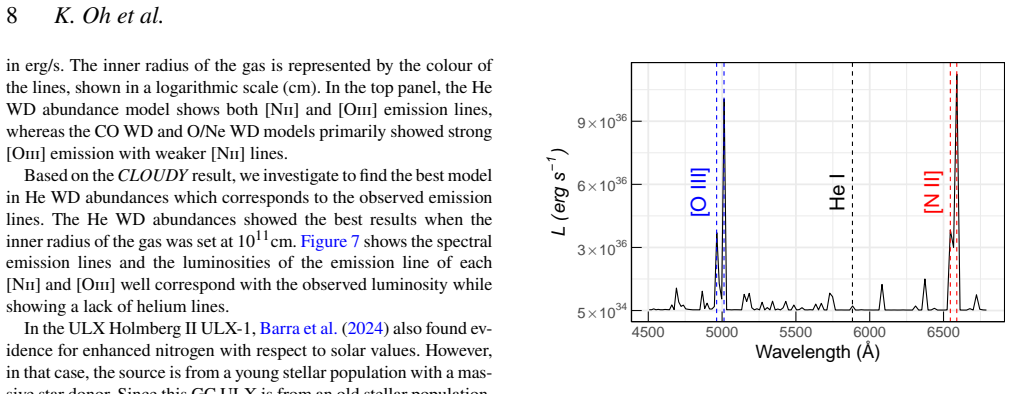
The argument is carried by three pieces: (1) the long-term X-ray and optical light curves that show stability over 20 and 15 years respectively, which rule out tidal disruption events and other transient models; (2) CLOUDY photoionization simulations of a spherical, low-density outflow with an X-ray blackbody at $7 \times 10^6$ K, an inner radius of $10^{11}$ cm, and a nitrogen-to-oxygen ratio about 20 times solar, which match the observed [N II] and [O III] luminosities while producing no hydrogen or helium lines; (3) secular evolution tracks for helium white dwarf donors with neutron star (and black hole) accretors, which predict a brief super-Eddington phase followed by a decline to the rates of known Galactic ultra-compact sources. The central object is the NS + He WD ultra-compact binary and its predicted evolutionary stage.
What would settle it
A decisive test would be ultraviolet spectroscopy of GCU7: the helium white dwarf model predicts strongly carbon-depleted, nitrogen-enhanced outflow material, so detecting carbon lines at near-solar abundances would rule out this donor. Alternatively, if the [O III] line luminosity decays by a factor of a few over the next several years, as predicted by partial tidal disruption models, the ultra-compact binary interpretation would be falsified.
Extended reading notes
Core claim
The paper's central claim is that CXO J033831.8-352604 (GCU7) is not an intermediate-mass black hole tidally disrupting a star, as proposed by earlier work, but a young ultra-compact X-ray binary in which a neutron star accretes from a helium white dwarf at rates up to ten times the Eddington limit. The evidence is the absence of long-term variability in both X-ray luminosity and the optical emission lines over two decades, the lack of hydrogen emission, and CLOUDY photoionization models that reproduce the observed [N II] and [O III] luminosities only with a nitrogen-to-oxygen ratio roughly twenty times solar and an inner gas radius of $10^{11}$ cm. Evolutionary tracks computed with a secular binary code show that such systems pass through a super-Eddington phase at ages between $10^3$ and $10^4$ years, then decline to mass-transfer rates like those of the well-studied Galactic ultra-compact X-ray binary 4U 1820-30.
Load-bearing premise
The identification rests on the photoionization model's assumption that the outflowing gas has a nitrogen-to-oxygen ratio roughly 20 times solar and an inner radius of $10^{11}$ cm, parameters that are tuned to match the observed line strengths rather than derived from a formal fit.
Editorial extensions
If this is right
- If GCU7 is a young UCXB, its mass-transfer rate should decline over time, and it should eventually resemble the well-studied Galactic ultra-compact binaries such as 4U 1820-30, a prediction that can be checked by continued X-ray and optical monitoring.
- The combination of stable X-ray luminosity, narrow forbidden lines, and absence of hydrogen provides a template for identifying other young ultra-compact binaries in extragalactic globular clusters.
- The Monte Carlo simulations imply that the most dynamically active clusters (those with collapsing cores) produce the most UCXBs, so targeted surveys of such clusters may uncover more examples of this short-lived phase.
- The paper's CLOUDY models show that helium-rich donors may not produce detectable helium lines at extragalactic distances, meaning that the absence of helium lines in GCU7 is consistent with, rather than an argument against, a helium white dwarf donor.
Reading between the lines
- An extension of this work would be to apply the same photoionization diagnostic to other GC ULXs with forbidden lines, using the N/O ratio as a remote indicator of donor composition even when time-domain data are sparse.
- The evolutionary tracks imply that the bright super-Eddington phase is short, so for every GCU7-like system there should be many older, X-ray-faint NS + He WD UCXBs in the same cluster; population models could test this by comparing the predicted number of such stars with X-ray surveys of globular clusters.
- If the N/O enhancement comes from cluster self-enrichment, as the paper notes, then the relative abundance of GCU7-like sources across clusters of different metallicity and dynamical history could constrain the fraction of stars with anomalous CNO abundances.
Editorial analysis
A structured set of objections, weighed in public.
Referee Report
Summary. The paper presents new and archival X-ray (Chandra, 1999–2023) and optical spectroscopy (Magellan, Gemini, SOAR, 2006–2023) of the globular-cluster ULX CXO J033831.8-352604 (GCU7) in NGC 1399. The authors show that the X-ray luminosity and the [N II] and [O III] emission lines have remained remarkably stable over roughly two decades, which they use to rule out the IMBH tidal-disruption scenario of Clausen et al. (2012). They then use CLOUDY photoionization models to argue that the emission lines are consistent with an outflow from a young ultra-compact X-ray binary with a neutron star accreting from a helium white dwarf, and they support this with evolutionary tracks and Monte Carlo globular-cluster simulations. A second source, GCU8, is briefly discussed as a bright, non-varying, optically quiet GC ULX.
Significance. The long-term multiwavelength dataset is valuable, and the conclusion that the specific IMBH TDE model is ruled out by the observed stability is convincing and well supported by the data. If the UCXB interpretation is correct, GCU7 would be the first extragalactic globular-cluster ULX identified as a young NS + He WD ultra-compact X-ray binary, a short-lived phase that is difficult to catch in Galactic clusters. The paper also makes a concrete, falsifiable prediction: the outflow should be carbon-depleted but nitrogen-rich, testable with future UV observations. However, the central donor identification rests on a CLOUDY model with hand-set, non-unique parameters and on an untested alternative model (a photoionized R CrB star), so the headline claim is not yet uniquely established.
major comments (4)
- [§2.4.3 and §3.3] The quantitative comparison between the CLOUDY model and the observations is not reproducible as written: Table 3 lists only equivalent widths, while the model outputs in Figure 7 are line luminosities, and the Introduction's 'line luminosity on the order of 1e36 erg/s' is never derived with uncertainties. Please report measured line fluxes and luminosities (with propagation from the flux-calibrated spectra and cluster continuum), or state the conversion explicitly, so the claimed match in Figure 7 can be checked.
- [§3.3] The CLOUDY demonstration is not a fit and does not establish uniqueness. The paper states that the N/O enhancement of ~20× solar is 'not derived from a formal fit' and that the inner radius of 1e11 cm was selected because the He WD abundances 'showed the best results'; density, column density, and covering fraction are also assumed. With only the [N II] and [O III] fluxes as constraints, the parameter space is severely underdetermined. Please systematically explore the parameters for the CO WD and O/Ne WD abundance sets (and for He WD with different N/O) and show whether any other combination can reproduce the observed line ratio and luminosity; if not, this should be stated with quantitative bounds rather than by inspection.
- [§1 and §3.3] The R CrB photoionization model of Maccarone & Warner (2011) is mentioned but never tested or ruled out. The paper's stated goal is to favor a model in which the ULX and the line-emitting material arise from the same binary, but a nearby H-poor star photoionized by the ULX would also produce [N II] and [O III] without requiring a He WD donor. Please provide an explicit argument or observational constraint (e.g., spatial offset limits, line radial velocity vs cluster velocity, variability coherence, or line-ratio diagnostics) that discriminates between these two geometries.
- [§3.4 and Abstract] The 'likely neutron star' identification is not directly constrained by the data. Figure 8 deliberately includes a 10 M⊙ BH + He WD track that also passes through super-Eddington rates, and the X-ray luminosity and spectral shape presented in Table 4 do not by themselves distinguish a NS from a BH accretor. The NS preference appears to rest on Galactic population statistics; please either present a quantitative argument from the observed Eddington ratio / mass-transfer stability for the inferred masses, or soften the Abstract's claim to reflect the degeneracy.
minor comments (6)
- [Table 1] The third column appears to list net counts (e.g., 152.79 for a 3.38 ks exposure) rather than counts/s; please correct the header or the values, since the current labeling is inconsistent.
- [Title] The title contains a typo: 'T wo-Decade' should be 'Two-Decade'.
- [§3.4] The text refers to 'RZ 2019'; this should be 'RZ2109'.
- [Figure 4] The Figure 4 caption says it presents 'the optical spectra of GCU7', but the figure shows equivalent width trends; please rephrase.
- [§2.4 and §3.3] Please report upper limits on Balmer and helium lines if they are covered by the spectra, since the H-poor and He-line-free claims are central to the interpretation.
- [§3.5] The Monte Carlo simulation section is presented as preliminary and is not quantitatively connected to the host cluster of GCU7; consider clarifying its role or moving it to an appendix.
Circularity Check
The central He WD identification rests on CLOUDY input parameters (N/O ≈ 20× solar, inner radius 10^11 cm) that are hand-tuned to match the observed emission lines and then presented as the model's prediction.
-
fitted input called prediction
[Section 3.3, paragraphs beginning 'In terms of abundances' and 'The implication is that strongly N-enhanced material']
"In terms of abundances, we assume that nitrogen is enhanced relative to oxygen by at least an order and up to two orders of magnitude above solar, corresponding to a N/O ratio of roughly 20 times solar abundances. We emphasize that this elevated ratio is not derived from a formal fit; rather, it is a plausible approximation consistent with the observed strengths of [Nii] and [Oiii] and the lack of hydrogen lines. ..."
The N enhancement is an input to the CLOUDY model, explicitly chosen to be 'consistent with the observed strengths of [Nii] and [Oiii]'. The same observed line strengths are then used as evidence that the He WD model succeeds, and the assumed N-rich composition is relabeled as the model's 'expected composition' and 'prediction'. The agreement between model and observation is therefore self-consistent by construction, not an independent test of the He WD donor hypothesis.
-
fitted input called prediction
[Section 3.3, paragraph 'Based on the CLOUDY result' and Figure 7 caption]
"Based on the CLOUDY result, we investigate to find the best model in He WD abundances which corresponds to the observed emission lines. The He WD abundances showed the best results when the inner radius of the gas was set at 1011cm. ... Figure 7 shows the spectral emission lines and the luminosities of the emission line of each [Nii] and [Oiii] well correspond with the observed luminosity while showing a lack of helium lines."
The inner gas radius is not independently constrained; it is set to the value that makes the He WD CLOUDY model reproduce the observed line luminosities. The statement that the model luminosities 'well correspond with the observed luminosity' is a restatement of the fitting condition, not a predictive test. With the radius (and the already-assumed N/O ratio) tuned to the data, the model's consistency with the observed [NII] and [OIII] fluxes carries no independent confirmatory weight.
full rationale
The paper's central claim that GCU7 is a young NS+He WD UCXB rests on two interlocking pieces of evidence: the CLOUDY photoionization model reproducing the observed [NII] and [OIII] lines, and the evolutionary tracks showing a super-Eddington phase appropriate for a young UCXB. The evolutionary tracks are not circular: they come from independent secular modeling (Bobrick et al. 2017; Church et al. 2017) and are used to argue that a young UCXB can produce the observed X-ray luminosity and stable line emission. The CLOUDY modeling, however, is partly circular in the sense of pattern 2. The N/O abundance ratio is explicitly assumed to be roughly 20 times solar 'consistent with the observed strengths of [Nii] and [Oiii]', and the inner radius is then set to 10^11 cm so that the predicted line luminosities match the observed values. The paper openly concedes that the N enhancement 'is not derived from a formal fit'. Yet later the same N-rich, C-depleted composition is described as the 'expected composition' and 'prediction' of the He WD model. The observed lines therefore do not provide an independent test of the He WD donor; the model has been adjusted until it matches the data. The alternative photoionization scenario of Maccarone & Warner (2011) is mentioned but never evaluated, and the model comparison among He WD, CO WD, and O/Ne WD is underconstrained (two line fluxes, many free parameters). These issues make the He WD identification suggestive but not uniquely established. The paper's X-ray and optical analysis, TDE ruling-out, and evolutionary modeling are independent and non-circular; self-citations to Oh et al. (2024) and Bobrick et al. (2017) are not load-bearing for the central identification beyond the standard use of prior simulations. Overall, the central claim is partially circular because a key input (N enhancement) is fitted to the very data it is then said to predict, and the geometric parameter is tuned to force agreement.
Assumptions & free parameters
free parameters (5)
- N/O abundance enhancement factor =
~20 times solar
- Hydrogen density n_H =
0.1 cm^-3 (varied 1, 0.1, 0.01 cm^-3)
- Column density N_H =
10^22 cm^-2
- Inner radius of emitting gas =
10^11 cm
- Covering fraction =
1 (spherical geometry)
assumptions (8)
- domain assumption CLOUDY photoionization code accurately predicts emission-line spectra for given physical conditions.
- domain assumption The ionizing radiation field can be represented by a single-temperature blackbody at T = 7e6 K.
- domain assumption Photoionization, not shocks or collisional excitation, dominates the [NII] and [OIII] line emission.
- domain assumption The secular evolution code of Bobrick et al. (2017) correctly models stable and unstable mass transfer in UCXBs.
- domain assumption MOCCA Monte Carlo cluster simulations represent the dynamical evolution of globular clusters.
- domain assumption The X-ray source GCU7 is physically associated with the globular cluster, not a background AGN.
- domain assumption The donor WD abundance tables from Koliopanos et al. (2013) are representative of He WD, CO WD, and O/Ne WD compositions.
- domain assumption The distance to NGC 1399 is 21.1 Mpc.
Cite this review
Pith. "Pith review of Spectral Insights and Evolutionary Pathways of Globular Cluster ULX in NGC 1399: A Two-Decade X-ray and Optical Study." pith.science (2026). https://pith.science/paper/O3AKBMRB
@misc{pith2026250118779,
  author       = {Pith},
  title        = {Pith review of: Spectral Insights and Evolutionary Pathways of Globular Cluster ULX in NGC 1399: A Two-Decade X-ray and Optical Study},
  year         = {2026},
  howpublished = {\url{https://pith.science/paper/O3AKBMRB}},
  note         = {Machine review of arXiv:2501.18779}
}
read the original abstract
We present new multi-wavelength observations of two ultraluminous X-ray sources (ULXs) hosted by globular clusters (GCs) in the giant elliptical NGC 1399, focusing on CXO J0338318-352604 (GCU7), only the second GC ULX known to have luminous optical emission lines. Notably, only NII and OIII emission is observed in the optical spectra, suggesting H-poor material. Previous work suggested the possibility that the properties of GCU7 could be explained by the tidal disruption of a horizontal branch star by an intermediate-mass black hole. We use new data to show that the lack of evolution in the X-ray or optical properties of the source over the last 20 years rules out this scenario. Instead, we use CLOUDY simulations to demonstrate that the optical emission lines are consistent with an outflow from an ultra-compact X-ray binary where a compact object - likely a neutron star (NS) - is accreting above the Eddington limit from a helium white dwarf (He WD). This binary would have dynamically formed from a direct collision between a NS and a red giant, or else via an exchange interaction. The ULX is predicted to evolve to lower mass transfer rates over time and eventually become a doppelganger to the well-studied ultra-compact X-ray binaries in Galactic GCs such as 4U 1820-30. These results show the utility of using extragalactic GCs to study short-lived phases in dynamical binary evolution that occur too rarely to be observed in Galactic clusters.
Figures


Figures from the paper (4 more)



Reference graph
Works this paper leans on
-
[1]
Alpaslan M., 2009, arXiv e-prints, https://ui.adsabs.harvard.edu/abs/2009arXiv0912.4755A p. arXiv:0912.4755
arXiv 2009
-
[2]
Armas Padilla M., Corral-Santana J. M., Borghese A., C \'u neo V. A., Mu \ n oz-Darias T., Casares J., Torres M. A. P., 2023, @doi [ ] 10.1051/0004-6361/202346797 , https://ui.adsabs.harvard.edu/abs/2023A&A...677A.186A 677, A186
-
[3]
Athukoralalage W. R., Dage K. C., Zepf S. E., Bahramian A., Cackett E. M., Kundu A., Maccarone T. J., 2023, @doi [ ] 10.1093/mnras/stac3145 , https://ui.adsabs.harvard.edu/abs/2023MNRAS.518..855A 518, 855
-
[4]
Barra F., Pinto C., Middleton M., Di Salvo T., Walton D. J., G \'u rpide A., Roberts T. P., 2024, @doi [ ] 10.1051/0004-6361/202348471 , https://ui.adsabs.harvard.edu/abs/2024A&A...682A..94B 682, A94
-
[5]
Bastian N., Lardo C., 2018, @doi [Annual Review of Astronomy and Astrophysics] 10.1146/annurev-astro-081817-051839 , https://ui.adsabs.harvard.edu/abs/2018ARA&A..56...83B 56, 83
-
[6]
Baumgardt H., Hilker M., 2018, @doi [ ] 10.1093/mnras/sty1057 , https://ui.adsabs.harvard.edu/abs/2018MNRAS.478.1520B 478, 1520
-
[7]
J., 2004, @doi [ ] 10.1086/421844 , https://ui.adsabs.harvard.edu/abs/2004ApJ...607L.119B 607, L119
Bildsten L., Deloye C. J., 2004, @doi [ ] 10.1086/421844 , https://ui.adsabs.harvard.edu/abs/2004ApJ...607L.119B 607, L119
-
[8]
Bobrick A., Davies M. B., Church R. P., 2017, @doi [ ] 10.1093/mnras/stx312 , https://ui.adsabs.harvard.edu/abs/2017MNRAS.467.3556B 467, 3556
Show all 65 references
-
[9]
Carretta E., Bragaglia A., Gratton R. G., Recio-Blanco A., Lucatello S., D'Orazi V., Cassisi S., 2010, @doi [Astronomy and Astrophysics] 10.1051/0004-6361/200913451 , https://ui.adsabs.harvard.edu/abs/2010A&A...516A..55C 516, A55
2010 doi
-
[10]
P., Strader J., Davies M
Church R. P., Strader J., Davies M. B., Bobrick A., 2017, @doi [ ] 10.3847/2041-8213/aa9aeb , https://ui.adsabs.harvard.edu/abs/2017ApJ...851L...4C 851, L4
2017 doi
-
[11]
Clausen D., Eracleous M., 2011, @doi [ ] 10.1088/0004-637X/726/1/34 , https://ui.adsabs.harvard.edu/abs/2011ApJ...726...34C 726, 34
2011 doi
-
[13]
C., Crain J
Clemens J. C., Crain J. A., Anderson R., 2004, in Moorwood A. F. M., Iye M., eds, Society of Photo-Optical Instrumentation Engineers (SPIE) Conference Series Vol. 5492, Ground-based Instrumentation for Astronomy. pp 331--340, @doi 10.1117/12.550069
2004 doi
-
[14]
D'A \` A., et al., 2021, @doi [ ] 10.1093/mnras/stab2427 , https://ui.adsabs.harvard.edu/abs/2021MNRAS.507.5567D 507, 5567
2021 doi
-
[15]
C., Zepf S
Dage K. C., Zepf S. E., Peacock M. B., Bahramian A., Noroozi O., Kundu A., Maccarone T. J., 2019a, @doi [ ] 10.1093/mnras/stz479 , https://ui.adsabs.harvard.edu/abs/2019MNRAS.485.1694D 485, 1694
-
[16]
C., et al., 2019b, @doi [ ] 10.1093/mnras/stz2514 , https://ui.adsabs.harvard.edu/abs/2019MNRAS.489.4783D 489, 4783
Dage K. C., et al., 2019b, @doi [ ] 10.1093/mnras/stz2514 , https://ui.adsabs.harvard.edu/abs/2019MNRAS.489.4783D 489, 4783
-
[17]
C., et al., 2024, @doi [ ] 10.1093/mnras/stae578 , https://ui.adsabs.harvard.edu/abs/2024MNRAS.529.1347D 529, 1347
Dage K. C., et al., 2024, @doi [ ] 10.1093/mnras/stae578 , https://ui.adsabs.harvard.edu/abs/2024MNRAS.529.1347D 529, 1347
2024 doi
-
[18]
Dirsch B., et al., 2004, @doi [ ] 10.1086/380607 , https://ui.adsabs.harvard.edu/abs/2004AJ....127.2114D 127, 2114
2004 doi
-
[19]
J., Korista K
Ferland G. J., Korista K. T., Verner D. A., Ferguson J. W., Kingdon J. B., Verner E. M., 1998, @doi [ ] 10.1086/316190 , https://ui.adsabs.harvard.edu/abs/1998PASP..110..761F 110, 761
1998 doi
-
[20]
C., Kramer M., Lyne A
Freire P. C., Kramer M., Lyne A. G., Camilo F., Manchester R. N., D'Amico N., 2001, @doi [ ] 10.1086/323248 , https://ui.adsabs.harvard.edu/abs/2001ApJ...557L.105F 557, L105
2001 doi
-
[21]
Gemini Observatory AURA 2016, Gemini IRAF: Data reduction software for the Gemini telescopes , Astrophysics Source Code Library, record ascl:1608.006
2016
-
[22]
Giersz M., 1998, @doi [ ] 10.1046/j.1365-8711.1998.01734.x , https://ui.adsabs.harvard.edu/abs/1998MNRAS.298.1239G 298, 1239
1998
-
[24]
O., Ivanova N., Engel M
Heinke C. O., Ivanova N., Engel M. C., Pavlovskii K., Sivakoff G. R., Cartwright T. F., Gladstone J. C., 2013, @doi [The Astrophysical Journal] 10.1088/0004-637X/768/2/184 , 768, 184
2013 doi
-
[25]
Iben Icko J., 1967, @doi [The Astrophysical Journal] 10.1086/149040 , https://ui.adsabs.harvard.edu/abs/1967ApJ...147..624I 147, 624
1967 doi
-
[26]
A., Brink T
Irwin J. A., Brink T. G., Bregman J. N., Roberts T. P., 2010, @doi [ ] 10.1088/2041-8205/712/1/L1 , https://ui.adsabs.harvard.edu/abs/2010ApJ...712L...1I 712, L1
2010 doi
-
[27]
O., Rasio F
Ivanova N., Heinke C. O., Rasio F. A., Belczynski K., Fregeau J. M., 2008, @doi [Monthly Notices of the Royal Astronomical Society] 10.1111/j.1365-2966.2008.13064.x , 386, 553
2008
-
[28]
W., Blakeslee J
Jord \'a n A., Peng E. W., Blakeslee J. P., C \^o t \'e P., Eyheramendy S., Ferrarese L., 2015, @doi [ ] 10.1088/0067-0049/221/1/13 , https://ui.adsabs.harvard.edu/abs/2015ApJS..221...13J 221, 13
2015 doi
-
[29]
Kaaret P., Corbel S., 2009, @doi [The Astrophysical Journal] 10.1088/0004-637X/697/1/950 , https://ui.adsabs.harvard.edu/abs/2009ApJ...697..950K 697, 950
2009 doi
-
[30]
King A., Lasota J.-P., Middleton M., 2023, @doi [ ] 10.1016/j.newar.2022.101672 , https://ui.adsabs.harvard.edu/abs/2023NewAR..9601672K 96, 101672
2023
-
[31]
Koliopanos F., Gilfanov M., Bildsten L., 2013, @doi [ ] 10.1093/mnras/stt542 , https://ui.adsabs.harvard.edu/abs/2013MNRAS.432.1264K 432, 1264
2013 doi
-
[32]
J., Basu-Zych A., Fragos T., Hornschemeier A., Lehmer B., Ptak A., 2020, @doi [ ] 10.1093/mnras/staa2481 , https://ui.adsabs.harvard.edu/abs/2020MNRAS.498.4790K 498, 4790
Kovlakas K., Zezas A., Andrews J. J., Basu-Zych A., Fragos T., Hornschemeier A., Lehmer B., Ptak A., 2020, @doi [ ] 10.1093/mnras/staa2481 , https://ui.adsabs.harvard.edu/abs/2020MNRAS.498.4790K 498, 4790
2020 doi
-
[33]
J., Zepf S
Kundu A., Maccarone T. J., Zepf S. E., 2007, @doi [ ] 10.1086/518021 , https://ui.adsabs.harvard.edu/abs/2007ApJ...662..525K 662, 525
2007 doi
-
[34]
P., Dubus G., Kruk K., 2008, @doi [ ] 10.1051/0004-6361:200809658 , https://ui.adsabs.harvard.edu/abs/2008A&A...486..523L 486, 523
Lasota J. P., Dubus G., Kruk K., 2008, @doi [ ] 10.1051/0004-6361:200809658 , https://ui.adsabs.harvard.edu/abs/2008A&A...486..523L 486, 523
2008 doi
-
[35]
Liu Z., et al., 2023, @doi [ ] 10.1051/0004-6361/202244805 , https://ui.adsabs.harvard.edu/abs/2023A&A...669A..75L 669, A75
2023 doi
-
[36]
J., Warner B., 2011, @doi [ ] 10.1111/j.1745-3933.2010.00973.x , https://ui.adsabs.harvard.edu/abs/2011MNRAS.410L..32M 410, L32
Maccarone T. J., Warner B., 2011, @doi [ ] 10.1111/j.1745-3933.2010.00973.x , https://ui.adsabs.harvard.edu/abs/2011MNRAS.410L..32M 410, L32
2011
-
[37]
J., Kundu A., Zepf S
Maccarone T. J., Kundu A., Zepf S. E., Rhode K. L., 2007, @doi [ ] 10.1038/nature05434 , https://ui.adsabs.harvard.edu/abs/2007Natur.445..183M 445, 183
2007 doi
-
[38]
Mummery A., van Velzen S., Nathan E., Ingram A., Hammerstein E., Fraser-Taliente L., Balbus S., 2024, @doi [ ] 10.1093/mnras/stad3001 , https://ui.adsabs.harvard.edu/abs/2024MNRAS.527.2452M 527, 2452
2024 doi
-
[39]
P., Soares-Furtado M., Ramirez-Ruiz E., 2019, @doi [Monthly Notices of the Royal Astronomical Society] 10.1093/mnras/stz3353 , 491, 4602
Naiman J. P., Soares-Furtado M., Ramirez-Ruiz E., 2019, @doi [Monthly Notices of the Royal Astronomical Society] 10.1093/mnras/stz3353 , 491, 4602
2019 doi
-
[40]
C., Haggard D., Kundu A., Plotkin R
Nair S., Dage K. C., Haggard D., Kundu A., Plotkin R. M., Rhode K. L., Zepf S. E., 2023, @doi [ ] 10.1093/mnras/stad1927 , https://ui.adsabs.harvard.edu/abs/2023MNRAS.524.3662N 524, 3662
2023 doi
-
[41]
G., Steeghs D., 2006, @doi [ ] 10.1111/j.1365-2966.2006.10496.x , https://ui.adsabs.harvard.edu/abs/2006MNRAS.370..255N 370, 255
Nelemans G., Jonker P. G., Steeghs D., 2006, @doi [ ] 10.1111/j.1365-2966.2006.10496.x , https://ui.adsabs.harvard.edu/abs/2006MNRAS.370..255N 370, 255
2006
-
[42]
R., Sluys M
Nelemans G., Yungelson L. R., Sluys M. V. v. d., Tout C. A., 2010, @doi [Monthly Notices of the Royal Astronomical Society] 10.1111/j.1365-2966.2009.15731.x , 401, 1347
2010
-
[43]
Y., Kim S., Giersz M., 2024, @doi [Monthly Notices of the Royal Astronomical Society] 10.1093/mnras/stae1355 , 532, 259
Oh K., Hong J., Hui C. Y., Kim S., Giersz M., 2024, @doi [Monthly Notices of the Royal Astronomical Society] 10.1093/mnras/stae1355 , 532, 259
2024 doi
-
[44]
W., Mirioni L., 2002, @doi [arXiv e-prints] 10.48550/arXiv.astro-ph/0202488 , https://ui.adsabs.harvard.edu/abs/2002astro.ph..2488P pp astro--ph/0202488
Pakull M. W., Mirioni L., 2002, @doi [arXiv e-prints] 10.48550/arXiv.astro-ph/0202488 , https://ui.adsabs.harvard.edu/abs/2002astro.ph..2488P pp astro--ph/0202488
-
[45]
W., Mirioni L., 2003, in Arthur J., Henney W
Pakull M. W., Mirioni L., 2003, in Arthur J., Henney W. J., eds, Revista Mexicana de Astronomia y Astrofisica Conference Series Vol. 15, Revista Mexicana de Astronomia y Astrofisica Conference Series. pp 197--199
2003
-
[46]
B., Zepf S
Peacock M. B., Zepf S. E., Maccarone T. J., 2012, @doi [ ] 10.1088/0004-637X/752/2/90 , https://ui.adsabs.harvard.edu/abs/2012ApJ...752...90P 752, 90
2012 doi
-
[47]
B., Zepf S
Peacock M. B., Zepf S. E., Kundu A., Chael J., 2017, @doi [Monthly Notices of the Royal Astronomical Society] 10.1093/mnras/stw2382 , https://ui.adsabs.harvard.edu/abs/2017MNRAS.464..713P 464, 713
2017 doi
- [48]
-
[49]
Pinto C., et al., 2020, @doi [ ] 10.1093/mnras/staa118 , https://ui.adsabs.harvard.edu/abs/2020MNRAS.492.4646P 492, 4646
2020 doi
-
[51]
C., Courteau S., Graves G., Schiavon R
Roediger J. C., Courteau S., Graves G., Schiavon R. P., 2014, @doi [The Astrophysical Journal Supplement Series] 10.1088/0067-0049/210/1/10 , https://ui.adsabs.harvard.edu/abs/2014ApJS..210...10R 210, 10
2014 doi
-
[52]
P., Caldwell N., Conroy C., Graves G
Schiavon R. P., Caldwell N., Conroy C., Graves G. J., Strader J., MacArthur L. A., Courteau S., Harding P., 2013, @doi [The Astrophysical Journal] 10.1088/2041-8205/776/1/L7 , https://ui.adsabs.harvard.edu/abs/2013ApJ...776L...7S 776, L7
2013 doi
-
[53]
C., Kundu A., Maccarone T
Shih I. C., Kundu A., Maccarone T. J., Zepf S. E., Joseph T. D., 2010, @doi [ ] 10.1088/0004-637X/721/1/323 , https://ui.adsabs.harvard.edu/abs/2010ApJ...721..323S 721, 323
2010 doi
- [54]
-
[55]
M., Zepf S
Steele M. M., Zepf S. E., Maccarone T. J., Kundu A., Rhode K. L., Salzer J. J., 2014, @doi [ ] 10.1088/0004-637X/785/2/147 , https://ui.adsabs.harvard.edu/abs/2014ApJ...785..147S 785, 147
2014 doi
-
[56]
D., Roberts T
Sutton A. D., Roberts T. P., Middleton M. J., 2013, @doi [ ] 10.1093/mnras/stt1419 , https://ui.adsabs.harvard.edu/abs/2013MNRAS.435.1758S 435, 1758
2013 doi
-
[57]
M., Langer N., Kramer M., 2012, @doi [Monthly Notices of the Royal Astronomical Society] 10.1111/j.1365-2966.2012.21446.x , 425, 1601
Tauris T. M., Langer N., Kramer M., 2012, @doi [Monthly Notices of the Royal Astronomical Society] 10.1111/j.1365-2966.2012.21446.x , 425, 1601
2012
-
[58]
C., Zepf S
Thygesen E., Sun Y., Huang J., Dage K. C., Zepf S. E., Kundu A., Haggard D., Maccarone T. J., 2023, @doi [ ] 10.1093/mnras/stac3244 , https://ui.adsabs.harvard.edu/abs/2023MNRAS.518.3386T 518, 3386
2023 doi
-
[59]
L., ed., Society of Photo-Optical Instrumentation Engineers (SPIE) Conference Series Vol
Tody D., 1986, in Crawford D. L., ed., Society of Photo-Optical Instrumentation Engineers (SPIE) Conference Series Vol. 627, Instrumentation in astronomy VI. p. 733, @doi 10.1117/12.968154
1986 doi
-
[60]
Tonry J., Davis M., 1979, @doi [ ] 10.1086/112569 , https://ui.adsabs.harvard.edu/abs/1979AJ.....84.1511T 84, 1511
1979 doi
-
[61]
J., Huang J
Verbunt F., Hut P., 1987, in Helfand D. J., Huang J. H., eds, IAU Symposium Vol. 125, The Origin and Evolution of Neutron Stars. p. 187
1987
-
[62]
J., et al., 2018, @doi [ ] 10.3847/2041-8213/aabadc , https://ui.adsabs.harvard.edu/abs/2018ApJ...857L...3W 857, L3
Walton D. J., et al., 2018, @doi [ ] 10.3847/2041-8213/aabadc , https://ui.adsabs.harvard.edu/abs/2018ApJ...857L...3W 857, L3
2018 doi
-
[63]
arXiv:2501.06037
Wiktorowicz G., Giersz M., Askar A., Hypki A., Helstrom L., 2025, Astronomy and Astrophysics, https://ui.adsabs.harvard.edu/abs/2025arXiv250106037W p. arXiv:2501.06037
2025 arXiv
-
[64]
Willman B., Strader J., 2012, @doi [ ] 10.1088/0004-6256/144/3/76 , https://ui.adsabs.harvard.edu/abs/2012AJ....144...76W 144, 76
2012 doi
-
[65]
R., 2008, @doi [Astronomy Letters] 10.1134/S1063773708090053 , https://ui.adsabs.harvard.edu/abs/2008AstL...34..620Y 34, 620
Yungelson L. R., 2008, @doi [Astronomy Letters] 10.1134/S1063773708090053 , https://ui.adsabs.harvard.edu/abs/2008AstL...34..620Y 34, 620
2008 doi
-
[66]
E., et al., 2008, @doi [ ] 10.1086/591937 , https://ui.adsabs.harvard.edu/abs/2008ApJ...683L.139Z 683, L139
Zepf S. E., et al., 2008, @doi [ ] 10.1086/591937 , https://ui.adsabs.harvard.edu/abs/2008ApJ...683L.139Z 683, L139
2008 doi
-
[67]
Zhou C., Feng H., Bian F., 2023, @doi [ ] 10.3847/1538-4357/acc5eb , https://ui.adsabs.harvard.edu/abs/2023ApJ...947...52Z 947, 52
2023 doi
-
[68]
M., Nelemans G., Voss R., Wood M
van Haaften L. M., Nelemans G., Voss R., Wood M. A., Kuijpers J., 2012, @doi [ ] 10.1051/0004-6361/201117880 , https://ui.adsabs.harvard.edu/abs/2012A&A...537A.104V 537, A104
2012 doi
Reviewed August 9, 2026 · model on record in the stance chip above.
Discussion (0). Continue with ORCID to comment.