Energetic Feasibility of Redirecting Trans-Neptunian Objects onto Mars-Impacting Orbits: Continuous Thrust and Gravity Assist Trajectories
Pith reviewed 2026-05-22 03:38 UTC · model grok-4.3
The pith
Redirecting trans-Neptunian objects to Mars-impacting orbits requires as little as 2.5 km/s velocity change with optimized low-thrust steering.
A machine-rendered reading of the paper's core claim, the machinery that carries it, and where it could break.
Core claim
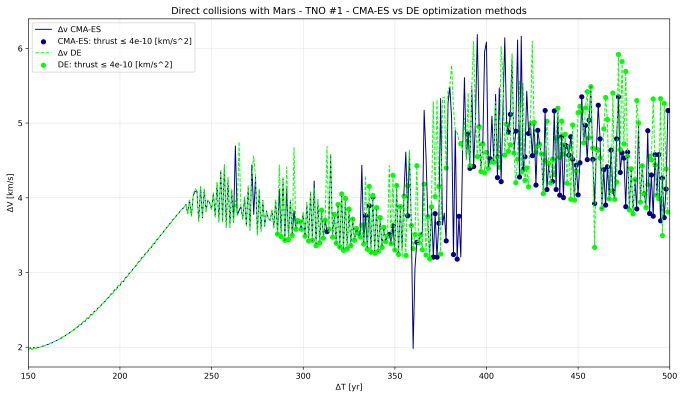
Time-dependent thrust steering optimized by global evolutionary algorithms drives classical Kuiper Belt and Scattered Disk objects onto Mars-impacting trajectories with ΔV of 2.5–3.2 km s⁻¹ over 380–540 years; a single Neptune encounter reduces this value still further in favorable cases.
What carries the argument
Time-dependent thrust-direction steering optimized via global evolutionary algorithms, which raises orbital eccentricity to produce Mars-impacting geometries.
If this is right
- Selecting TNOs from favorable orbital regions makes controlled redirection feasible with modest velocity budgets.
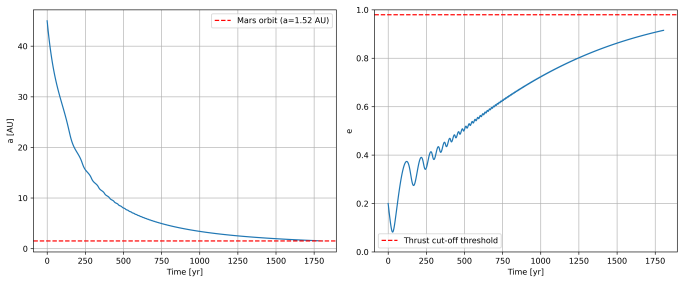
- Monotonic inward spirals are dynamically inefficient, demanding both high ΔV and millennia-long transfers.
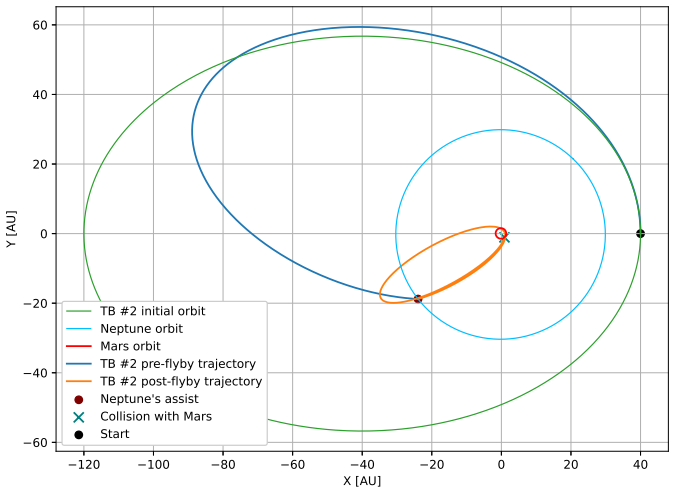
- Hybrid low-thrust plus single Neptune flyby paths can undercut the ΔV of direct optimized transfers.
Where Pith is reading between the lines
- The same steering methods could be tested for delivering material to other inner planets or to the Moon.
- Cataloguing real TNOs with orbits closest to the favorable phase-space regions would identify the lowest-cost candidates.
- Incorporating variable thrust levels or multiple flybys might lower the bound further but requires new optimization runs.
Load-bearing premise
The two-body problem with a fixed maximum low thrust gives a true lower bound on ΔV even when real multi-body perturbations are present.
What would settle it
An n-body integration of a chosen TNO under the reported thrust profile that requires substantially more than 3.2 km s⁻¹ total ΔV.
Figures




read the original abstract
We assess the dynamical feasibility of redirecting small volatile-bearing trans-Neptunian objects (TNOs) onto Mars-impacting orbits using continuous low-thrust propulsion and a single gravity-assist encounter. The study considers two representative dynamical classes: classical Kuiper Belt--like and Scattered Disk--like initial orbits, and determines the minimum characteristic velocity increment $\Delta V$ required to drive the objects onto a Mars-impacting trajectory within a specified transfer time $\Delta T$. The dynamics is modelled in the two-body problem with a fixed maximum low thrust included, allowing the computed $\Delta V$ to represent a dynamical lower bound independent of specific propulsion-technical implementation. Three trajectory classes are investigated: (i) inward spiral transfer, (ii) time-dependent thrust-direction steering optimized via global evolutionary algorithms, and (iii) hybrid transfers combining low thrust with a single Neptune flyby. Pure spiral trajectories yield very high velocity expenditures ($\Delta V \gtrsim 22~\mathrm{km~s^{-1}}$) and millennia durations, confirming that monotonic inward migration is dynamically inefficient for TNO redirection. In contrast, optimized steering strategies systematically increase orbital eccentricity and achieve Mars-impacting geometries with $\Delta V \approx 2.5$--$3.2~\mathrm{km~s^{-1}}$ over 380--540 yr timescales. A single Neptune encounter further reduces the total $\Delta V$ in favourable cases, with minimum values falling below those of direct optimized transfers. These results establish a quantitative lower bound on the energy cost of importing volatiles from the outer Solar System to Mars, showing that controlled redirection is feasible under modest $\Delta V$ budgets when target bodies are chosen from favourable regions of orbital phase space.
Editorial analysis
A structured set of objections, weighed in public.
Referee Report
Summary. The manuscript assesses the dynamical feasibility of redirecting volatile-bearing trans-Neptunian objects onto Mars-impacting orbits via continuous low-thrust propulsion, with and without a single Neptune gravity assist. Using two-body Sun-centered dynamics with a fixed maximum thrust magnitude, the authors apply global evolutionary algorithms to optimize thrust steering and compare three classes of trajectories: pure inward spirals, time-dependent optimized steering, and hybrid low-thrust plus flyby cases. They report that optimized steering achieves Mars impact with ΔV ≈ 2.5–3.2 km s⁻¹ over 380–540 yr, with further reductions possible via Neptune encounter, establishing a quantitative lower bound on the energy cost when targets are selected from favorable orbital phase space.
Significance. If the central numerical results hold, the work supplies a concrete, quantitative lower bound on the ΔV cost of importing outer-Solar-System volatiles to Mars and demonstrates that optimized steering and a single gravity assist are far more efficient than monotonic spiral migration. The use of global evolutionary optimization to explore thrust-direction histories is a methodological strength that supports the reported feasibility under the stated modeling assumptions.
major comments (1)
- [Abstract] Abstract and modeling description: The central claim that the reported ΔV values constitute a dynamical lower bound independent of propulsion-technical details rests on the two-body Sun-centered dynamics plus fixed-maximum low thrust. This modeling choice omits multi-body perturbations from Jupiter, Saturn, and Uranus over 380–540 yr transfers and approximates the Neptune encounter via an instantaneous velocity rotation rather than a full three-body hyperbolic deflection with correct timing and post-flyby heliocentric adjustment. If these effects increase the minimum ΔV or render some optimized trajectories unrealizable, the claimed lower bound does not hold.
Simulated Author's Rebuttal
We thank the referee for the constructive comments on our manuscript. Below we provide a point-by-point response to the major comment and indicate the revisions made to the manuscript.
read point-by-point responses
-
Referee: [Abstract] Abstract and modeling description: The central claim that the reported ΔV values constitute a dynamical lower bound independent of propulsion-technical details rests on the two-body Sun-centered dynamics plus fixed-maximum low thrust. This modeling choice omits multi-body perturbations from Jupiter, Saturn, and Uranus over 380–540 yr transfers and approximates the Neptune encounter via an instantaneous velocity rotation rather than a full three-body hyperbolic deflection with correct timing and post-flyby heliocentric adjustment. If these effects increase the minimum ΔV or render some optimized trajectories unrealizable, the claimed lower bound does not hold.
Authors: We thank the referee for this observation. Our analysis is performed strictly within the two-body Sun-centered problem with fixed maximum thrust, as stated in the manuscript, so that the computed ΔV constitutes a lower bound on the energy cost independent of propulsion-technical details such as variable thrust or efficiency. We acknowledge that the model omits perturbations from Jupiter, Saturn and Uranus over the long transfer times and approximates the Neptune encounter as an instantaneous velocity rotation. These simplifications were adopted to isolate the optimization of thrust steering and to obtain a clean baseline. In the revised manuscript we have updated the abstract and added clarifying text in the methods and discussion sections to state explicitly that the reported values are lower bounds under the two-body approximation and that multi-body effects and a full three-body flyby treatment lie outside the present scope. The numerical results and optimization methodology remain unchanged and valid within the stated model. revision: partial
Circularity Check
No circularity: results are direct outputs of numerical trajectory optimization
full rationale
The paper computes minimum ΔV via global evolutionary algorithms applied to the two-body equations of motion with a fixed maximum thrust magnitude. These ΔV values (≈2.5–3.2 km s⁻¹ for optimized steering, lower with Neptune encounter) are obtained as numerical solutions rather than being defined in terms of themselves or fitted to the target quantity. The modeling assumptions (two-body dynamics, constant max thrust, simplified flyby) are stated separately from the optimization results and do not create a self-definitional loop. No self-citations are invoked as load-bearing uniqueness theorems, and no ansatz or renaming of known results is used to generate the central quantitative bound. The derivation chain is therefore self-contained and independent of the reported outcomes.
Axiom & Free-Parameter Ledger
free parameters (2)
- maximum low-thrust magnitude
- transfer time ΔT
axioms (2)
- domain assumption Two-body problem with Sun as central body governs the motion except during the single gravity-assist encounter
- domain assumption A single Neptune flyby can be arranged without additional cost beyond the low-thrust budget
Lean theorems connected to this paper
-
IndisputableMonolith/Foundation/RealityFromDistinction.leanreality_from_one_distinction unclear?
unclearRelation between the paper passage and the cited Recognition theorem.
The dynamics is modelled in the two-body problem with a fixed maximum low thrust included, allowing the computed ΔV to represent a dynamical lower bound independent of specific propulsion-technical implementation.
-
IndisputableMonolith/Cost/FunctionalEquation.leanwashburn_uniqueness_aczel unclear?
unclearRelation between the paper passage and the cited Recognition theorem.
optimized steering strategies systematically increase orbital eccentricity and achieve Mars-impacting geometries with ΔV ≈ 2.5–3.2 km s⁻¹
What do these tags mean?
- matches
- The paper's claim is directly supported by a theorem in the formal canon.
- supports
- The theorem supports part of the paper's argument, but the paper may add assumptions or extra steps.
- extends
- The paper goes beyond the formal theorem; the theorem is a base layer rather than the whole result.
- uses
- The paper appears to rely on the theorem as machinery.
- contradicts
- The paper's claim conflicts with a theorem or certificate in the canon.
- unclear
- Pith found a possible connection, but the passage is too broad, indirect, or ambiguous to say the theorem truly supports the claim.
Reference graph
Works this paper leans on
-
[1]
Deep horizons: Canada’s underwater habitat pro- gram and vertical dimensions of marine sovereignty
Adler, A. (2020). "Deep horizons: Canada’s underwater habitat pro- gram and vertical dimensions of marine sovereignty". Centaurus. 62 (4): 763–782. doi:10.1111/1600-0498.12287. S2CID 22541 3688
-
[2]
Bottke, W.F., Morbidelli, A., Jedicke, R., Petit, J.-M., Levison, H.F., Michel, P., Metcalfe, T.S. (2002). Debiased orbital and absolute- magnitudedistributionoftheNear-EarthObjects.Icarus, 156, 399–433
work page 2002
-
[3]
(2023).poliastro: Version 0.17.0
Cano Rodríguez, J.L., Martínez Garrido, J., et al. (2023).poliastro: Version 0.17.0. Zenodo. https://doi.org/10.5281/zenodo.6817189
-
[4]
Choueiri, Edgar Y. (2009). New dawn of electric rocket. Next- Generation Thruster.Scientific American, 300(2), 58-65
work page 2009
-
[5]
Czechowski, L. (1991). The magmatic activity on asteroids.Earth, Moon, and Planets, vol. 52, 2, 113-130
work page 1991
-
[6]
Czechowski, L. et al. (2023). The formation of cone chains in the Chryse Planitia region on Mars and the thermodynamic aspects of this process. Icarus, doi.org/10.1016/j.icarus. 2023.115473
-
[7]
Czechowski,. L. (2025 B). Terraforming Mars–a feasibility study. Plan- etary Science Conference 2025, Kraków, 23-25, Oct. 2025
work page 2025
- [8]
-
[9]
Glover, T. (2011). VASIMR VX-200 Performance and Near-term SEP Capability for Mars Cargo Flights. Conference: Future In-Space Oper- ations Seminar, DOI:10.13140/RG.2.2.12214.83528
-
[10]
and Kereszturi, A., 2015, Encyclopedia of Planetary Land- forms,
Hargitai, H. and Kereszturi, A., 2015, Encyclopedia of Planetary Land- forms,. ISBN 978-1-4614-3133-6. Berlin: Springer-Verlag
work page 2015
-
[11]
Hess, A., Czechowski, L., Gabryszewski, R. (2025). Leveraging low thrust propulsion and simulated Neptune gravity assist maneuvers to redirect Trans-Neptunian Objects for Mars terraforming: a compara- tive assessment of∆Vand impact time requirements. Planetary Science Conference 2025, Kraków, 23-25, Oct. 2025. 23
work page 2025
-
[12]
Hoelker, R. F., & Silber, R. (1961). The bi-elliptical transfer between co-planar circular orbits.Planetary and Space Science, 7, 174–182
work page 1961
-
[13]
Hsieh, H.H. (2017). Main-belt comets: A new class of small bodies in the Solar System.Philosophical Transactions A, 375, 20160259
work page 2017
-
[14]
Jewitt, D. (2012). The active asteroids.Astronomical Journal, 143, 66
work page 2012
-
[15]
Kaib, N.A., Quinn, T. (2009). Reassessing the source of the Earth’s asteroids.Science, 325, 1234–1236
work page 2009
-
[16]
Kiriliuk, E.V., Zaborosky, S.A. (2017). Optimal bi-elliptic transfer be- tween two generic coplanar elliptical orbits.Acta Astronautica, 138, 462–472
work page 2017
-
[17]
Comet 67P/CG Nucleus Composition and Com- parison to Other Comets
Filacchione, G., Groussin, O., Herny, C., Kappel, D., Mottola, S., Ok- lay, N., Pommerol, A., Wright, I., Yoldi, Z., Ciarniello, M., Moroz, L., Raponi, A. (2019). "Comet 67P/CG Nucleus Composition and Com- parison to Other Comets".Space Sci Rev, 215:19
work page 2019
-
[18]
McKay, C.P., Toon, O.B., Kasting, J.F. (1991). Making Mars habitable. Nature, 352, 489–496
work page 1991
-
[19]
Metzger, P.T., Britt, D.T., Muscatello, A.C. (2016). Space development and space science together: An enabling strategy.Acta Astronautica, 129, 482–490
work page 2016
-
[20]
Pałka, P., Olszewski, R., Wendland, A. (2022). Using Spatial Data Science in Energy-Related Modeling of Terraforming the Martian At- mosphere.Energies, 15(14), 4957
work page 2022
-
[21]
Pan, L. et al. (2023). Impact-induced oxidation and its implications for early Mars.Geophysical Research Letters, 50, e2023GL102724
work page 2023
-
[22]
Pätzold, M. et al. (2016). A homogeneous nucleus for comet 67P/Churyumov–Gerasimenko from its gravity field.Nature, 530 (7588), 63–65
work page 2016
-
[23]
Rubin, M. et al. (2020). On the Origin and Evolution of the Ma- terial in 67P/Churyumov-Gerasimenko.Space Sci Rev, 216, 102, https://doi.org/10.1007/s11214-020-00718-2
-
[24]
Schorghofer, N. (2008). Subsurface ice on Mars and asteroids.Icarus, 195, 131–142. 24
work page 2008
-
[25]
Zhang, J., Su, H., Ji, Y., Fu, S., Yu, E. (2020). Hohmann Transfer Orbiting Applying into the Space Traveling.The Frontiers of Society, Science and Technology, 2(12)
work page 2020
-
[26]
Zubrin, R.M., McKay, C.P. (1993). Technological requirements for ter- raforming Mars. AIAA Paper 93-2005, American Institute of Aeronau- tics and Astronautics. 25
work page 1993
discussion (0)
Sign in with ORCID, Apple, or X to comment. Anyone can read and Pith papers without signing in.