Hierarchical RBF-KAN and RBF-SKAN Architectures for Multidimensional Function Approximation and Random Field Learning
Reviewed by Pith T0 review T1 audit T2 compute T3 formal T4 kernel 2026-06-28 15:16 UTCgrok-4.3pith:OEMWFNSNrecord.jsonopen to challenge →
The pith
Hierarchical RBF-KAN approximates high-dimensional functions by reducing effective dimensionality.
A machine-rendered reading of the paper's core claim, the machinery that carries it, and where it could break.
Core claim
The hierarchical RBF-KAN provides universal approximation with quantitative estimates showing the framework has the potential to partially alleviate the curse of dimensionality in learning high-dimensional functions by reducing the effective dimensionality of the approximation problem, while the hierarchical RBF-SKAN approximates random field models under the Wasserstein-2 metric.
What carries the argument
Hierarchical composition of radial basis function activations inside a Kolmogorov-Arnold network, which assembles higher-dimensional approximators from lower-dimensional radial-basis blocks.
If this is right
- The RBF-KAN delivers explicit approximation rates for any continuous multivariate function.
- The RBF-SKAN converges to target random fields in the Wasserstein-2 distance.
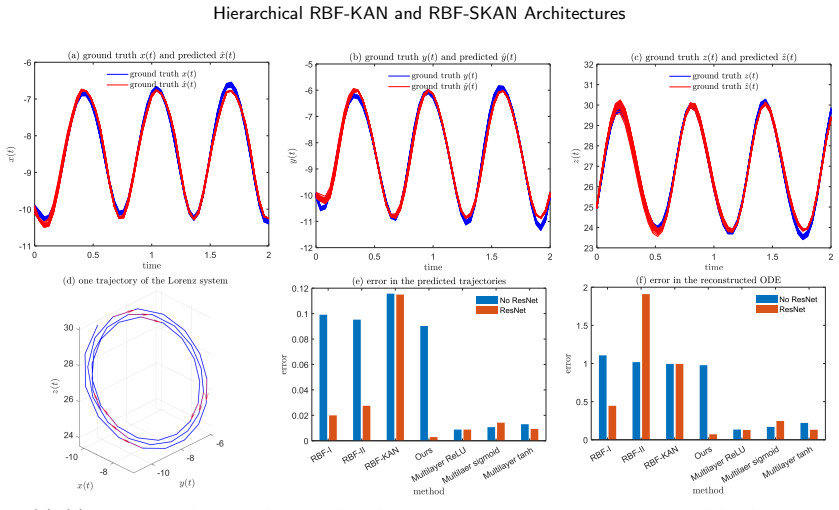
- Both networks are shown to learn the target objects effectively in numerical tests.
- The quantitative bounds suggest the method scales better than non-hierarchical networks when dimension grows.
Where Pith is reading between the lines
- If the effective-dimension reduction holds in practice, the same hierarchy could be applied to other basis families to test generality.
- Direct computation of the minimal number of radial centers needed at each level would make the dimension-reduction claim testable on concrete examples.
- The Wasserstein-2 guarantee for random fields opens the possibility of using the network for uncertainty quantification tasks that require distributional closeness.
Load-bearing premise
The hierarchical composition of radial basis functions actually reduces the effective dimensionality of the approximation problem rather than merely reparameterizing it.
What would settle it
A concrete high-dimensional test function where the hierarchical RBF-KAN achieves no better error rate or parameter scaling than a non-hierarchical radial-basis network of comparable size.
Figures


read the original abstract
In this manuscript, we propose and analyze hierarchical Kolmogorov--Arnold neural network architectures employing radial basis functions as activation functions for approximating deterministic functions and random field models. Specifically, we develop a hierarchical radial-basis-function Kolmogorov--Arnold network (hierarchical RBF-KAN) for multidimensional deterministic function approximation and a hierarchical radial-basis-function stochastic Kolmogorov--Arnold network (hierarchical RBF-SKAN) for random field learning. From a theoretical perspective, we establish universal approximation results for both architectures. In particular, we derive quantitative approximation estimates for the hierarchical RBF-KAN, showing that the proposed framework has the potential to partially alleviate the curse of dimensionality in learning high-dimensional functions by reducing the effective dimensionality of the approximation problem. Furthermore, we show that the hierarchical RBF-SKAN can approximate random field models under the Wasserstein-2 metric. Empirically, we show that our proposed radial-basis-function-based neural network structure could effectively learn multivariate functions and random field models.
Editorial analysis
A structured set of objections, weighed in public.
Referee Report
Summary. The manuscript proposes hierarchical RBF-KAN architectures using radial basis functions for multidimensional deterministic function approximation and hierarchical RBF-SKAN for random field learning. It claims to establish universal approximation theorems for both, derive quantitative approximation estimates for the RBF-KAN showing potential partial alleviation of the curse of dimensionality via reduced effective dimensionality, prove Wasserstein-2 approximation for random fields with the RBF-SKAN, and demonstrate empirical effectiveness on multivariate functions and random field models.
Significance. If the quantitative estimates are rigorously derived and establish approximation rates with dimension dependence milder than standard RBF networks (e.g., via explicit comparison of effective dimension or rates independent of input dimension d), the work would contribute to approximation theory for KAN-style networks and high-dimensional learning. The extension to stochastic fields under W2 metric and the empirical results on function/random field tasks provide additional value. Strengths include the hierarchical construction and dual deterministic/stochastic focus, but these hinge on the unverified dimension-reduction step.
major comments (3)
- [Abstract / Theoretical Analysis] Abstract and theoretical analysis section: the quantitative approximation estimates are asserted to show that the hierarchical composition 'has the potential to partially alleviate the curse of dimensionality ... by reducing the effective dimensionality,' yet no explicit error bound (such as a rate O(N^{-α}) with α independent of d), no comparison to a flat RBF network of equal parameter count, and no derivation establishing that the hierarchy collapses dimension rather than reparameterizes the same high-d problem are supplied. This assumption is load-bearing for the central claim.
- [Theoretical Analysis] Theoretical results for hierarchical RBF-KAN: the universal approximation result and quantitative estimates lack stated assumptions on the radial basis functions, the hierarchy depth, or the target function class (e.g., smoothness or separability conditions) that would be needed to convert the hierarchy into a provably milder dimension dependence.
- [RBF-SKAN for Random Fields] RBF-SKAN section: the claim that the architecture approximates random field models under the Wasserstein-2 metric is stated without an explicit theorem statement, proof sketch, or metric definition on the random-field space, preventing assessment of whether the result is nontrivial relative to existing neural approximations of measures.
minor comments (2)
- [Preliminaries] Notation for the hierarchical composition (e.g., how the outer and inner RBF layers are indexed) should be defined once in a preliminary section and used consistently.
- [Numerical Experiments] Empirical section: tables or figures reporting approximation errors should include baseline comparisons to standard RBF networks or plain KANs with matched parameter budgets to support the dimensionality-alleviation narrative.
Simulated Author's Rebuttal
We thank the referee for their careful reading and constructive comments. We address each major comment below and will revise the manuscript accordingly to improve the explicitness and rigor of the theoretical sections.
read point-by-point responses
-
Referee: [Abstract / Theoretical Analysis] Abstract and theoretical analysis section: the quantitative approximation estimates are asserted to show that the hierarchical composition 'has the potential to partially alleviate the curse of dimensionality ... by reducing the effective dimensionality,' yet no explicit error bound (such as a rate O(N^{-α}) with α independent of d), no comparison to a flat RBF network of equal parameter count, and no derivation establishing that the hierarchy collapses dimension rather than reparameterizes the same high-d problem are supplied. This assumption is load-bearing for the central claim.
Authors: We agree that the quantitative estimates require greater explicitness to support the central claim. In the revised manuscript, we will derive and present an explicit approximation rate of the form O(N^{-α}) with α independent of d under the stated conditions, include a direct comparison of these bounds against those for a flat RBF network with equivalent total parameter count, and add a derivation clarifying how the hierarchical composition reduces effective dimensionality via lower-dimensional subproblems rather than merely reparameterizing the original high-dimensional task. revision: yes
-
Referee: [Theoretical Analysis] Theoretical results for hierarchical RBF-KAN: the universal approximation result and quantitative estimates lack stated assumptions on the radial basis functions, the hierarchy depth, or the target function class (e.g., smoothness or separability conditions) that would be needed to convert the hierarchy into a provably milder dimension dependence.
Authors: We will explicitly list the required assumptions in the revised theoretical analysis section. These include: the radial basis functions are C^∞ and positive definite (e.g., Gaussian), the hierarchy has fixed depth L with each layer operating on a reduced-dimensional subspace, and the target functions admit a hierarchical decomposition belonging to a class with bounded smoothness in each component. These assumptions will be stated upfront to justify the milder dimension dependence. revision: yes
-
Referee: [RBF-SKAN for Random Fields] RBF-SKAN section: the claim that the architecture approximates random field models under the Wasserstein-2 metric is stated without an explicit theorem statement, proof sketch, or metric definition on the random-field space, preventing assessment of whether the result is nontrivial relative to existing neural approximations of measures.
Authors: We acknowledge that a more formal statement is needed. In the revision, we will add an explicit theorem for the Wasserstein-2 approximation property of the hierarchical RBF-SKAN, include a proof sketch that extends the deterministic universal approximation result using continuity properties of the Wasserstein metric, and define the metric on the space of random fields as the W2 distance between the pushforward measures induced on the appropriate function space. This will allow direct comparison to existing neural measure approximations. revision: yes
Circularity Check
No circularity in derivation chain; abstract states results without exhibiting equations or self-referential reductions.
full rationale
The provided abstract asserts universal approximation results and quantitative estimates for hierarchical RBF-KAN that purportedly alleviate the curse of dimensionality via effective dimension reduction, yet supplies no equations, derivation steps, fitted parameters, or citations. Without any visible load-bearing steps that reduce to self-definition, fitted inputs renamed as predictions, or self-citation chains, the derivation chain cannot be inspected for circularity. This is the default honest non-finding when no specific reductions are quotable from the text.
Axiom & Free-Parameter Ledger
axioms (1)
- standard math Universal approximation theorems exist for neural networks with suitable activations
Reference graph
Works this paper leans on
-
[1]
, author Novak, E
author Barthelmann, V. , author Novak, E. , author Ritter, K. , year 2000 . title High dimensional polynomial interpolation on sparse grids . journal Advances in Computational Mathematics volume 12 , pages 273--288
2000
-
[2]
, author Wei, H.L
author Billings, S.A. , author Wei, H.L. , author Balikhin, M.A. , year 2007 . title Generalized multiscale radial basis function networks . journal Neural Networks volume 20 , pages 1081--1094
2007
-
[3]
, author Lowe, D
author Broomhead, D.S. , author Lowe, D. , year 1988 . title Multivariable functional interpolation and adaptive networks . journal Complex Systems volume 2 , pages 321--355
1988
-
[4]
, year 2003
author Buhmann, M.D. , year 2003 . title Radial Basis Functions: Theory and Implementations . publisher Cambridge University Press
2003
-
[5]
, author Hoshino, M
author Chao, J. , author Hoshino, M. , author Kitamura, T. , author Masuda, T. , year 2001 . title A multilayer RBF network and its supervised learning , in: booktitle IJCNN'01. International Joint Conference on Neural Networks. Proceedings (Cat. No. 01Ch37222) , organization IEEE . pp. pages 1995--2000
2001
-
[6]
, author Liu, X
author Chao, Z. , author Liu, X. , author Wu, Z. , author Li, X. , year 2026 . title RBF-KAN : Radial basis function- Kolmogorov-Arnold networks . journal IEEE Internet of Things Journal
2026
-
[7]
, year 2013
author Cuturi, M. , year 2013 . title Sinkhorn distances: Lightspeed computation of optimal transport . journal Advances in Neural Information Processing Systems volume 26
2013
-
[8]
, year 2007
author Fasshauer, G.E. , year 2007 . title Meshfree Approximation Methods with MATLAB . publisher World Scientific
2007
-
[9]
, author Shiohama, K
author Greene, R.E. , author Shiohama, K. , year 1979 . title Diffeomorphisms and volume-preserving embeddings of noncompact manifolds . journal Transactions of the American Mathematical Society volume 255 , pages 403--414
1979
-
[10]
, author Zhang, X
author He, K. , author Zhang, X. , author Ren, S. , author Sun, J. , year 2016 . title Deep residual learning for image recognition , in: booktitle Proceedings of the IEEE conference on computer vision and pattern recognition , pp. pages 770--778
2016
-
[11]
, author Smale, S
author Hirsch, M.W. , author Smale, S. , author Devaney, R.L. , year 2013 . title Differential equations, dynamical systems, and an introduction to chaos . publisher Academic press
2013
-
[12]
, author Kawaguchi, K
author Jagtap, A.D. , author Kawaguchi, K. , author Karniadakis, G.E. , year 2020 . title Adaptive activation functions accelerate convergence in deep and physics-informed neural networks . journal Journal of Computational Physics volume 404 , pages 109136
2020
-
[13]
, author Zhu, L
author Jiang, Q. , author Zhu, L. , author Shu, C. , author Sekar, V. , year 2022 . title An efficient multilayer RBF neural network and its application to regression problems . journal Neural Computing and Applications volume 34 , pages 4133--4150
2022
-
[14]
Auto-Encoding Variational Bayes
author Kingma, D.P. , author Welling, M. , year 2013 . title Auto-encoding variational B ayes . journal arXiv preprint arXiv:1312.6114
work page internal anchor Pith review Pith/arXiv arXiv 2013
-
[15]
author Li, Z. , year 2024 . title Kolmogorov-Arnold networks are radial basis function networks . journal arXiv preprint arXiv:2405.06721
-
[16]
, author Wang, Y
author Liu, Z. , author Wang, Y. , author Vaidya, S. , author Ruehle, F. , author Halverson, J. , author Soljacic, M. , author Hou, T. , author Tegmark, M. , year 2025 . title KAN: Kolmogorov--Arnold networks , in: booktitle International Conference on Learning Representations , pp. pages 70367--70413
2025
-
[17]
, author Carro, B
author Lopez-Martin, M. , author Carro, B. , author Sanchez-Esguevillas, A. , author Lloret, J. , year 2017 . title Conditional variational autoencoder for prediction and feature recovery applied to intrusion detection in IoT . journal Sensors volume 17 , pages 1967
2017
-
[18]
, year 2017
author Lorenz, E.N. , year 2017 . title Deterministic nonperiodic flow 1 , in: booktitle Universality in Chaos, 2nd edition . publisher Routledge , pp. pages 367--378
2017
-
[19]
, author Darken, C.J
author Moody, J. , author Darken, C.J. , year 1989 . title Fast learning in networks of locally-tuned processing units . journal Neural Computation volume 1 , pages 281--294
1989
-
[20]
, author Pavlakou, T
author Papamakarios, G. , author Pavlakou, T. , author Murray, I. , year 2017 . title Masked autoregressive flow for density estimation . journal Advances in neural information processing systems volume 30
2017
-
[21]
, author Sandberg, I.W
author Park, J. , author Sandberg, I.W. , year 1991 . title Universal approximation using radial-basis-function networks . journal Neural Computation volume 3 , pages 246--257
1991
-
[22]
, author Girosi, F
author Poggio, T. , author Girosi, F. , year 2002 . title Networks for approximation and learning . journal Proceedings of the IEEE volume 78 , pages 1481--1497
2002
-
[23]
, year 1987
author Powell, M.J.D. , year 1987 . title Radial Basis Functions for Multivariable Interpolation: A Review . publisher Oxford University Press
1987
-
[25]
, author Wang, H
author Wu, Y. , author Wang, H. , author Zhang, B. , author Du, K.L. , year 2012 . title Using radial basis function networks for function approximation and classification . journal International Scholarly Research Notices volume 2012 , pages 324194
2012
-
[27]
, author Shen, Q
author Xia, M. , author Shen, Q. , year 2026 . title A local squared W asserstein-2 method for efficient reconstruction of models with uncertainty . journal Machine Learning: Science and Technology volume 7 , pages 035001
2026
-
[28]
, author Pei, J
author Zhao, Y. , author Pei, J. , author Chen, H. , year 2019 . title Multi-layer radial basis function neural network based on multi-scale kernel learning . journal Applied Soft Computing volume 82 , pages 105541
2019
-
[29]
Neural Networks , volume=
Generalized multiscale radial basis function networks , author=. Neural Networks , volume=. 2007 , publisher=
2007
-
[30]
An efficient multilayer
Jiang, Qinghua and Zhu, Lailai and Shu, Chang and Sekar, Vinothkumar , journal=. An efficient multilayer. 2022 , publisher=
2022
-
[31]
Chiu, Shao-Ting and Cheung, Siu Wun and Braga-Neto, Ulisses and Lee, Chak Shing and Li, Rui Peng , journal=
-
[32]
Advances in Neural Information Processing Systems , volume=
Sinkhorn distances: Lightspeed computation of optimal transport , author=. Advances in Neural Information Processing Systems , volume=
-
[33]
arXiv preprint arXiv:2511.13977 , year=
Efficient reconstruction of multidimensional random field models with heterogeneous data using stochastic neural networks , author=. arXiv preprint arXiv:2511.13977 , year=
-
[34]
Conditional variational autoencoder for prediction and feature recovery applied to intrusion detection in
Lopez-Martin, Manuel and Carro, Belen and Sanchez-Esguevillas, Antonio and Lloret, Jaime , journal=. Conditional variational autoencoder for prediction and feature recovery applied to intrusion detection in. 2017 , publisher=
2017
-
[35]
Advances in neural information processing systems , volume=
Masked autoregressive flow for density estimation , author=. Advances in neural information processing systems , volume=
-
[36]
Learning Likelihoods with Conditional Normalizing Flows
Learning likelihoods with conditional normalizing flows , author=. arXiv preprint arXiv:1912.00042 , year=
-
[37]
Auto-encoding variational
Kingma, Diederik P and Welling, Max , journal=. Auto-encoding variational
-
[38]
Journal of Computational Physics , volume=
Adaptive activation functions accelerate convergence in deep and physics-informed neural networks , author=. Journal of Computational Physics , volume=. 2020 , publisher=
2020
-
[39]
A multilayer
Chao, Jinhui and Hoshino, Miho and Kitamura, Tasuku and Masuda, Takeshi , booktitle=. A multilayer. 2001 , organization=
2001
-
[40]
2026 , publisher=
Chao, Zengfu and Liu, Xinran and Wu, Zheyu and Li, Xiaoping , journal=. 2026 , publisher=
2026
-
[41]
Neural Computation , volume=
Fast learning in networks of locally-tuned processing units , author=. Neural Computation , volume=. 1989 , publisher=
1989
-
[42]
Proceedings of the IEEE , volume=
Networks for approximation and learning , author=. Proceedings of the IEEE , volume=. 2002 , publisher=
2002
-
[43]
A local squared
Xia, Mingtao and Shen, Qijing , journal=. A local squared. 2026 , publisher=
2026
-
[44]
Fasshauer, Gregory E. , year=. Meshfree Approximation Methods with
-
[45]
Liu, Ziming and Wang, Yixuan and Vaidya, Sachin and Ruehle, Fabian and Halverson, James and Soljacic, Marin and Hou, Thomas and Tegmark, Max , booktitle=
-
[46]
Applied Soft Computing , volume=
Multi-layer radial basis function neural network based on multi-scale kernel learning , author=. Applied Soft Computing , volume=. 2019 , publisher=
2019
-
[47]
Neural Computation , volume=
Universal approximation using radial-basis-function networks , author=. Neural Computation , volume=. 1991 , publisher=
1991
-
[48]
Proceedings of the IEEE conference on computer vision and pattern recognition , pages=
Deep residual learning for image recognition , author=. Proceedings of the IEEE conference on computer vision and pattern recognition , pages=
-
[49]
International Scholarly Research Notices , volume=
Using radial basis function networks for function approximation and classification , author=. International Scholarly Research Notices , volume=. 2012 , publisher=
2012
-
[50]
and Lowe, David , title =
Broomhead, David S. and Lowe, David , title =. Complex Systems , volume =
-
[51]
Powell, Michael J. D. , title =. Algorithms for Approximation , editor =
-
[52]
, title =
Park, Jae-Young and Sandberg, Irwin W. , title =. Neural Computation , volume =
-
[53]
, title =
Buhmann, Martin D. , title =
-
[54]
Li, Ziyao , journal=
-
[55]
Advances in Computational Mathematics , volume=
High dimensional polynomial interpolation on sparse grids , author=. Advances in Computational Mathematics , volume=. 2000 , publisher=
2000
-
[56]
Transactions of the American Mathematical Society , volume=
Diffeomorphisms and volume-preserving embeddings of noncompact manifolds , author=. Transactions of the American Mathematical Society , volume=
-
[57]
Eigenvalues of the
Sonday, Benjamin E and Berry, Robert D and Najm, Habib N and Debusschere, Bert J , journal=. Eigenvalues of the. 2011 , publisher=
2011
-
[58]
2013 , publisher=
Differential equations, dynamical systems, and an introduction to chaos , author=. 2013 , publisher=
2013
-
[59]
Universality in Chaos, 2nd edition , pages=
Deterministic nonperiodic flow 1 , author=. Universality in Chaos, 2nd edition , pages=. 2017 , publisher=
2017
-
[60]
, title =
Fortunato, S. , title =. Phys. Rep.-Rev. Sec. Phys. Lett. , volume =. 2010 , pages =
2010
-
[61]
Newman, M. E. J. and Girvan, M. , title =. Phys. Rev. E. , volume =. 2004 , pages =
2004
-
[62]
and Reinhardt, T
Vehlow, C. and Reinhardt, T. and Weiskopf, D. , title =. IEEE Trans. Vis. Comput. Graph. , volume =. 2013 , pages =
2013
-
[63]
and Albert, R
Raghavan, U. and Albert, R. and Kumara, S. , title =. Phys. Rev E. , volume =. 2007 , pages =
2007
-
[64]
2011 , pages =
Robust network community detection using balanced propagation , journal =. 2011 , pages =
2011
-
[65]
and Li, S
Lou, H. and Li, S. and Zhao, Y. , title =. Physica A. , volume =. 2013 , pages =
2013
-
[66]
and Newman, M
Clauset, A. and Newman, M. E. J. and Moore, C. , title =. Phys. Rev. E. , volume =. 2004 , pages =
2004
-
[67]
Blondel, V. D. and Guillaume, J. L. and Lambiotte, R. and Lefebvre, E. , title =. J. Stat. Mech.-Theory Exp. , volume =. 2008 , pages =
2008
-
[68]
and Campari, R
Sobolevsky, S. and Campari, R. , title =. Phys. Rev. E. , volume =. 2014 , pages =
2014
-
[69]
and Barthelemy, M
Fortunato, S. and Barthelemy, M. , title =. Proc. Natl. Acad. Sci. U. S. A. , volume =. 2007 , pages =
2007
-
[70]
2011 , pages =
Unfolding communities in large complex networks: Combining defensive and offensive label propagation for core extraction , journal =. 2011 , pages =
2011
-
[71]
and Li, J
Wang, X. and Li, J. , title =. Physica A. , volume =. 2013 , pages =
2013
-
[72]
and Wang, X
Li, J. and Wang, X. and Eustace, J. , title =. Physica A. , volume =. 2013 , pages =
2013
-
[73]
Fabio, D. R. and Fabio, D. and Carlo, P. , title =. Sci. Rep. , volume =. 2013 , pages =
2013
-
[74]
and Wu, T
Chen, Q. and Wu, T. T. and Fang, M. , title =. Physica A. , volume =. 2013 , pages =
2013
-
[75]
and Wang, R
Zhang, S. and Wang, R. and Zhang, X. , title =. Physica A. , volume =. 2007 , pages =
2007
-
[76]
and Petr\'oczi, A
Nepusz, T. and Petr\'oczi, A. and N\'egyessy, L. and Bazs\'o, F. , title =. Phys. Rev. E. , volume =. 2008 , pages =
2008
-
[77]
and Liang, Z
Fabricio, B. and Liang, Z. , title =. Soft Comput. , volume =. 2013 , pages =
2013
-
[78]
and Gao, L
Sun, P. and Gao, L. and Han, S. , title =. Inf. Sci. , volume =. 2011 , pages =
2011
-
[79]
and Liu, D
Wang, W. and Liu, D. and Liu, X. and Pan, L. , title =. Physica A. , volume =. 2013 , pages =
2013
-
[80]
and Roberts, S
Psorakis, I. and Roberts, S. and Ebden, M. and Sheldon, B. , title =. Phys. Rev. E. , volume =. 2011 , pages =
2011
-
[81]
and Yeung, D
Zhang, Y. and Yeung, D. , title =. In Proc. ACM SIGKDD Conf. , year =
-
[82]
, title =
Liu, J. , title =. Eur. Phys. J. B. , volume =. 2010 , pages =
2010
discussion (0)
Sign in with ORCID, Apple, or X to comment. Anyone can read and Pith papers without signing in.