REVIEW 2 major objections 5 minor 1 cited by
Considerations on the Origin of IRAS 19312+1950 Based on Long-Term Maser Observations
T0 review · 2 major / 5 minor · reviewed 2026-08-10 · deepseek-v4-flash
Pith's one-line read After two decades of maser monitoring, IRAS 19312+1950 remains an unclassified object whose H2O masers make it a candidate Water Fountain star.
desk verdict Careful, honest maser monitoring of a genuinely puzzling object with a reusable 20-year dataset; the maser-to-CO association claim is nearly tautological and should be flagged as an unverified hypothesis. read the letter →
The pith
A machine-rendered reading of the paper's core claim, the machinery that carries it, and where it could break.
The reading
What carries the argument
The load-bearing structure is the two-component kinematic model of I19312's CO envelope, built from earlier BIMA mapping and a Shape model: a narrow, slowly moving bipolar flow and a broad, roughly spherical expanding inner component. The authors plot the averaged OH, H2O, and SiO maser spectra against the modelled velocity ranges of these two components, and because the maser velocities reach beyond the narrow component, they infer that all three maser species most likely reside in the broad component. The second piece of machinery is the monitoring time series itself, which catches correlated variability, most notably the near-simultaneous brightening of the H2O blueshifted peak and the SiO 42.821 GHz line around May 2018, a relationship invisible in single-epoch observations.
What would settle it
Map the absolute positions of the H2O, SiO, and OH maser spots with very-long-baseline interferometry and compare them with the modelled broad and narrow CO components; if the masers do not lie within the broad component, or if the H2O spots trace a collimated jet, the velocity-overlap argument for the water-fountain interpretation is refuted. Continued monitoring that still detects the SiO 42.821 GHz line after another decade would similarly contradict the expectation that SiO masers fade as an object enters the post-AGB phase.
Extended reading notes
Core claim
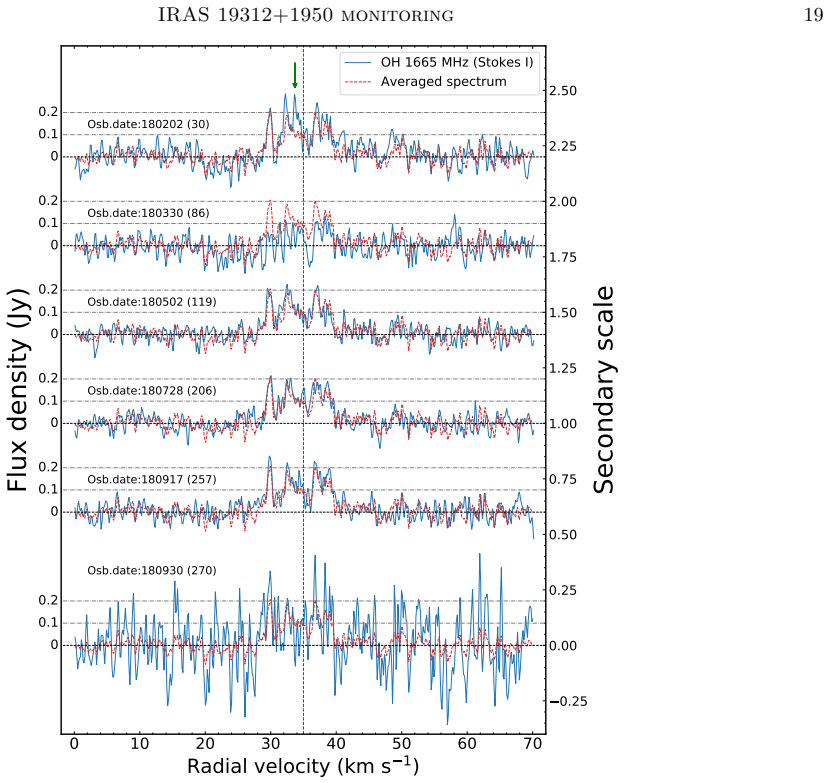
The paper's central claim is negative in form: after combining fresh 2018-2020 monitoring with all archival maser spectra, I19312 cannot be unambiguously assigned to any known class. The new data show OH maser features varying irregularly by up to a factor of about two, a H2O double-peaked profile whose dominant side switched from blueshifted ($22$--$28$ km s$^{-1}$) to redshifted ($38$--$42$ km s$^{-1}$) around January 2019 with brightness changes of more than a factor of 30, and SiO $v=1,2$, $J=1$--$0$ masers persisting near $50$--$55$ km s$^{-1}$ with the $v=2$ line stronger than the $v=1$ line. Because the H2O velocity range lies partly outside the OH range, the paper identifies I19312 as a candidate Water Fountain star, yet it immediately flags inconsistencies: the molecular gas mass of $225$--$478$ solar masses and the chemical abundance pattern fit neither a typical evolved star nor a young stellar object, and the red nova remnant alternative remains speculative.
Load-bearing premise
The load-bearing assumption is that the OH, H2O, and SiO masers genuinely sit inside the broad kinematic component of the CO envelope, a link inferred solely from velocity overlap because the absolute positions of the maser emission regions have never been measured.
Editorial extensions
If this is right
- If I19312 is a Water Fountain star, it becomes one of a handful of objects observed in the brief phase when H2O masers trace collimated outflows while OH masers still trace the remnant AGB wind.
- The derived luminosity of about $21500$ solar luminosities and the parallax distance of about $3.8$ kpc imply an intermediate-mass progenitor above roughly $2$ solar masses if the object is an evolved star.
- The 20-year persistence of SiO masers with the $v=2$, $J=1$--$0$ line stronger than $v=1$ sets a constraint that any successful model, whether evolved star or red nova remnant, must reproduce.
- The H2O maser switch from blueshifted to redshifted dominance between 2018 and 2020 shows that the maser excitation responds to changes in mass loss on month timescales, providing a new benchmark for envelope models.
Reading between the lines
- A testable extension the paper leaves implicit: if the May 2018 brightening of the H2O blueshifted feature and the SiO 42.821 GHz line shared a single trigger, a delayed response should eventually appear in the OH masers, which form farther out in the envelope, and could be sought in the 2018 NRT data and future monitoring.
- If future absolute-position measurements place the masers in the narrow bipolar flow instead of the broad component, the paper's kinematic association would fail, yet the water-fountain interpretation would actually be strengthened, because water-fountain H2O masers are expected to trace the jets.
- The paper's own comparison suggests, though it does not assert, that I19312 may be an interaction product---a merger or a wind-wind collision---rather than a single star in a standard evolutionary sequence; searching for a central binary or an archival outburst light echo would test that possibility.
Editorial analysis
A structured set of objections, weighed in public.
Referee Report
Summary. The paper reports long-term single-dish monitoring of SiO, H2O, and OH maser emission toward IRAS 19312+1950 (I19312) using the NRT and KVN telescopes, combined with a compilation of historical maser observations spanning about 20 years. The authors compare the maser properties with those of evolved stars, young stellar objects, water fountains, red nova remnants, and several peculiar objects, and they update the source luminosity from a new infrared SED. They conclude that the origin and evolutionary stage of I19312 remain unclear, while suggesting that the object is a candidate water fountain (WF) star because the H2O maser velocities extend beyond the OH maser velocity range, and that the masers are likely associated with the broad kinematic component of the CO envelope.
Significance. The observational work is careful and well documented: telescope parameters, calibration procedures, rms noise levels, and signal-to-noise ratios are reported, and detections below 5 sigma are explicitly flagged in the tables. The compilation of more than two decades of maser spectra is a useful legacy dataset for a poorly understood object. If the water-fountain candidacy holds, I19312 would be a rare post-AGB-type object, although the paper's cautious bottom line that the origin remains unclear is appropriate. The main value is the new monitoring data and the comparative discussion, rather than a decisive classification.
major comments (2)
- [Section 3.4, Figure 16, and Summary point 4] The claim that the OH, H2O, and SiO masers are likely associated with the broad CO component is supported only by velocity overlap. The broad component spans approximately 0-70 km/s in the CO model shown in Figure 16, which covers essentially the full velocity ranges of the masers (OH about 10-46 km/s, H2O about 22-42 km/s, SiO about 50-55 km/s). The overlap criterion therefore has almost no discriminating power. Because the authors explicitly state that absolute maser positions have not been determined, the 'complex geometry' interpretation in Section 4 and Summary point 4 should be presented as an unverified working hypothesis, or the paper should state clearly that the current data cannot distinguish association with the broad component from association with the narrow bipolar outflow or a distinct region.
- [Section 4.3.2 and Summary point 2] The water-fountain candidacy rests on the statement that H2O maser emission is detected outside the OH maser velocity range. From Tables 3 and 5, the H2O maser spans about 22-42 km/s while the OH 1612 MHz maser spans about 10-40 km/s, so the extension is only about 2 km/s at the red edge. This is far smaller than the high-velocity jet signatures of established water fountains discussed in the text. The only higher-velocity H2O feature, near 78 km/s on 2019-03-03, is a 3.2 sigma tentative detection and is not included in the analysis. Please either quantify how this marginal velocity extension satisfies the WF search criteria of Fan et al. (2024) or soften the WF-candidate claim accordingly.
minor comments (5)
- [Throughout] There are numerous typographical errors that should be corrected, including 'T erm' in the title, 'Wavelenght' in Table 9, 'specifitc' in Section 4.3, 'spieces' in Section 4.3.4, and 'Osb.date' in several figure labels.
- [Figure 3 caption] The caption for Figure 3 identifies the displayed line as OH 1665 MHz, while the figure header and the main text refer to the 1667 MHz line; the caption and the plotted transition should be aligned.
- [Section 2] The KVN calibration procedure is described in detail, but the absolute flux calibration uncertainty for the KVN measurements is not explicitly stated; please add the estimated uncertainty as is done for the NRT data.
- [Appendix A] The SED integration used to derive the luminosity includes optical and near-infrared photometry; please state explicitly whether any extinction correction was applied, since this can affect the derived luminosity.
- [Section 4.2] The statement that SiO masers have been detected from 'a total of eight YSOs' cites Cho et al. (2016); because this number may have changed, the sentence should be updated with a more recent census or a qualifying phrase.
Circularity Check
No significant circularity: the maser monitoring, SED luminosity, and class comparisons are independent; the CO-based broad-component association is a weak but non-circular inference.
full rationale
The paper's new results are measured maser line parameters, integrated fluxes, an SED luminosity, and qualitative comparisons of maser velocity ranges with historical data and with a CO kinematic model. None of these is obtained by defining an input in terms of an output. The luminosity (about 21500 Lsun) is a trapezoidal integral of archived photometry multiplied by the VLBI parallax distance (Imai et al. 2011); the distance and photometry are external to the paper's conclusion. The closest step to a circular construction is the statement that 'from a velocity perspective, it can be inferred that the OH, H2O, and SiO masers are likely associated with the broad component' (Section 3.4). This is not circular: the narrow and broad CO components come from independent CO interferometry and Shape modeling (Nakashima & Deguchi 2005; Qiu et al. 2023), not from the maser velocities, and the authors explicitly acknowledge that absolute maser positions are undetermined. The inference may be weakly constrained because the broad component covers a wide velocity range, but this is a limitation of evidence, not a reduction of the claim to its inputs. Self-citations supply prior observational data and modeling used as context rather than as a self-referential proof; the conclusion that the origin and evolutionary stage 'remain unclear' is non-committal and does not depend on a circular chain. No fitted parameter is relabeled as a prediction, and no uniqueness theorem from the authors' prior work is invoked to force an alternative. I therefore find no significant circularity.
Assumptions & free parameters
assumptions (4)
- domain assumption Distance to I19312 is 3.8 (-0.58/+0.83) kpc from VLBI annual parallax of the H2O maser (Imai et al. 2011).
- domain assumption Systemic velocity of about 35 km/s for the broad CO component (Nakashima & Deguchi 2005).
- domain assumption The molecular envelope has narrow and broad kinematic components, as modeled by Qiu et al. (2023).
- domain assumption Type I and Type II OH maser classification and radiative pumping assumptions from the literature (e.g., Habing 1996, Lewis 2000).
Cite this review
Pith. "Pith review of Considerations on the Origin of IRAS 19312+1950 Based on Long-Term Maser Observations." pith.science (2026). https://pith.science/paper/OGARMI7M
@misc{pith2026250113769,
  author       = {Pith},
  title        = {Pith review of: Considerations on the Origin of IRAS 19312+1950 Based on Long-Term Maser Observations},
  year         = {2026},
  howpublished = {\url{https://pith.science/paper/OGARMI7M}},
  note         = {Machine review of arXiv:2501.13769}
}
abstract
IRAS source 19312+1950 (hereafter I19312) is an infrared point source with maser emissions of SiO, H$_2$O, and OH molecules. Although initial observations suggested that I19312 might be an evolved star, its characteristics are not fully consistent with this classification. This study aims to further investigate the nature of I19312 by conducting long-term monitoring of its maser emissions and comparing the results with other known astrophysical objects. We conducted long-term monitoring of SiO, H$_2$O, and OH maser emissions using single-dish radio telescopes. The results were then compared with historical maser data and the characteristics of similar objects to infer the possible origin of I19312. The SiO maser emissions from I19312 were detected over a wide velocity range and exhibited significant time variability. The OH maser lines suggest characteristics of an evolved star, while the H$_2$O maser lines indicate molecular outflows. These features suggest that I19312 could be a candidate for a Water Fountain (WF) star, though there are inconsistencies, such as the large molecular gas mass, that challenge this hypothesis. The possibility of I19312 being a Red Nova Remnant (RNR) is also considered, but this remains speculative due to the lack of direct evidence. The evolutionary stage of I19312 remains unclear, but it shares multiple characteristics with both evolved stars with peculiar properties and RNRs. Further long-term monitoring and high-resolution interferometric observations are required to better constrain the nature of this object.
Figures


Figures from the paper (13 more)


Forward citations
Cited by 1 Pith paper
-
Unveiling the enigma of the Nakashima-Deguchi object (IRAS 19312+1950): a candidate Orion KL analog
Multi-telescope continuum and line data show NDO (IRAS 19312+1950) hosts cold dense gas with deuterated species and a bipolar outflow, making it a candidate Orion KL analog at ~3.8 kpc.
Reference graph
Works this paper leans on
-
[1]
2001, , 373, 932, 10.1051/0004-6361:20010535
Alcolea , J., Bujarrabal , V., S \'a nchez Contreras , C., Neri , R., & Zweigle , J. 2001, , 373, 932, 10.1051/0004-6361:20010535
-
[2]
2022, , 163, 85, 10.3847/1538-3881/ac3fb6
Amada , K., Imai , H., Hamae , Y., et al. 2022, , 163, 85, 10.3847/1538-3881/ac3fb6
- [3]
-
[4]
Barvainis , R., & Clemens , D. P. 1984, , 89, 1833, 10.1086/113695
-
[5]
Bowers , P. F., Johnston , K. J., & Spencer , J. H. 1983, , 274, 733, 10.1086/161485
-
[6]
Bujarrabal , V., Alcolea , J., Colomer , F., et al. 2007, in IAU Symposium, Vol. 242, Astrophysical Masers and their Environments, ed. J. M. Chapman & W. A. Baan , 271--278, 10.1017/S1743921307013129
-
[7]
2002, , 389, 271, 10.1051/0004-6361:20020455
Bujarrabal , V., Alcolea , J., S \'a nchez Contreras , C., & Sahai , R. 2002, , 389, 271, 10.1051/0004-6361:20020455
-
[8]
2015, Journal of Korean Astronomical Society, 48, 267, 10.5303/JKAS.2015.48.5.267
Cho , S.-H., Kim , J., & Yun , Y. 2015, Journal of Korean Astronomical Society, 48, 267, 10.5303/JKAS.2015.48.5.267
Show all 74 references
-
[9]
2016, , 826, 157, 10.3847/0004-637X/826/2/157
Cho , S.-H., Yun , Y., Kim , J., et al. 2016, , 826, 157, 10.3847/0004-637X/826/2/157
2016 doi
-
[10]
J., Bond , H
Claussen , M. J., Bond , H. E., Starrfield , S., & Healy , K. 2007, in Astronomical Society of the Pacific Conference Series, Vol. 363, The Nature of V838 Mon and its Light Echo, ed. R. L. M. Corradi & U. Munari , 87
2007
-
[11]
A., Boogert , A
Cordiner , M. A., Boogert , A. C. A., Charnley , S. B., et al. 2016, , 828, 51, 10.3847/0004-637X/828/1/51
2016 doi
-
[12]
M., Chapman , J
Deacon , R. M., Chapman , J. M., & Green , A. J. 2004, , 155, 595, 10.1086/425329
2004 doi
-
[13]
1999, , 51, 355, 10.1093/pasj/51.3.355
Deguchi , S., Fujii , T., Izumiura , H., et al. 1999, , 51, 355, 10.1093/pasj/51.3.355
1999 doi
-
[14]
2011, , 63, 309, 10.1093/pasj/63.1.309
Deguchi , S., Koike , K., Kuno , N., et al. 2011, , 63, 309, 10.1093/pasj/63.1.309
2011 doi
-
[15]
2005, , 57, L25, 10.1093/pasj/57.5.L25
Deguchi , S., Matsunaga , N., & Fukushi , H. 2005, , 57, L25, 10.1093/pasj/57.5.L25
2005 doi
-
[16]
2004, , 56, 1083, 10.1093/pasj/56.6.1083
Deguchi , S., Nakashima , J.-I., & Takano , S. 2004, , 56, 1083, 10.1093/pasj/56.6.1083
2004 doi
-
[17]
Dickinson , D. F. 1987, , 313, 408, 10.1086/164978
1987 doi
-
[18]
2013, Advances in Astronomy and Space Physics, 3, 75
Drozd , K., Swierczynski , E., Ragan , E., & Buil , C. 2013, Advances in Astronomy and Space Physics, 3, 75
2013
-
[19]
2024, , 270, 13, 10.3847/1538-4365/ad0458
Fan , H., Nakashima , J.-i., Engels , D., et al. 2024, , 270, 13, 10.3847/1538-4365/ad0458
2024 doi
-
[20]
Fok , T. K. T., Nakashima , J.-i., Yung , B. H. K., Hsia , C.-H., & Deguchi , S. 2012, , 760, 65, 10.1088/0004-637X/760/1/65
2012 doi
-
[21]
D., Wittkowski , M., Scholz , M., et al
Gray , M. D., Wittkowski , M., Scholz , M., et al. 2009, , 394, 51, 10.1111/j.1365-2966.2008.14237.x
2009
-
[22]
Habing , H. J. 1996, , 7, 97, 10.1007/PL00013287
1996 doi
-
[23]
A., Burdon , A., et al
Hafner , A., Green , J. A., Burdon , A., et al. 2024, , 41, e009, 10.1017/pasa.2024.3
2024 doi
-
[24]
2013, , 125, 539, 10.1086/671125
Han , S.-T., Lee , J.-W., Kang , J., et al. 2013, , 125, 539, 10.1086/671125
2013 doi
-
[25]
1994, in American Astronomical Society Meeting Abstracts, Vol
Hartigan , P., Edwards , S., & Ghandour , L. 1994, in American Astronomical Society Meeting Abstracts, Vol. 185, American Astronomical Society Meeting Abstracts, 48.15
1994
-
[26]
Haschick , A. D., ed. 1986, Masers, molecules and mass outflows in star forming regions. Proceedings of a meeting held by the Haystack Observatory, Westford, Mass., USA, 15 - 16 May 1985
1986
-
[27]
He , J. H. 2005, , 10, 283, 10.1016/j.newast.2004.11.001
2005 doi
-
[28]
J., Miyazaki , A., & Deguchi , S
Imai , H., Nakashima , J.-i., Diamond , P. J., Miyazaki , A., & Deguchi , S. 2005, , 622, L125, 10.1086/429820
2005 doi
-
[29]
2011, , 63, 81, 10.1093/pasj/63.1.81
Imai , H., Tafoya , D., Honma , M., Hirota , T., & Miyaji , T. 2011, , 63, 81, 10.1093/pasj/63.1.81
2011 doi
-
[30]
2023, , 75, 1183, 10.1093/pasj/psad064
Imai , H., Hamae , Y., Amada , K., et al. 2023, , 75, 1183, 10.1093/pasj/psad064
2023 doi
-
[31]
R., Snyder , L
Jewell , P. R., Snyder , L. E., Walmsley , C. M., Wilson , T. L., & Gensheimer , P. D. 1991, , 242, 211
1991
- [32]
-
[33]
M., Tylenda , R., et al
Kami \'n ski , T., Menten , K. M., Tylenda , R., et al. 2015, , 520, 322, 10.1038/nature14257
2015 doi
-
[34]
2017, , 607, A78, 10.1051/0004-6361/201731287
---. 2017, , 607, A78, 10.1051/0004-6361/201731287
2017 doi
-
[35]
2020, , 644, A59, 10.1051/0004-6361/202038648
---. 2020, , 644, A59, 10.1051/0004-6361/202038648
2020 doi
-
[36]
2018, , 617, A129, 10.1051/0004-6361/201833165
Kami \'n ski , T., Steffen , W., Tylenda , R., et al. 2018, , 617, A129, 10.1051/0004-6361/201833165
2018 doi
-
[37]
2021, , 655, A32, 10.1051/0004-6361/202141526
Kami \'n ski , T., Tylenda , R., Kiljan , A., et al. 2021, , 655, A32, 10.1051/0004-6361/202141526
2021 doi
-
[38]
R., Djupvik , A
Kami \'n ski , T., Schmidt , M. R., Djupvik , A. A., et al. 2024, , 682, A133, 10.1051/0004-6361/202347770
2024 doi
-
[39]
H., Bujarrabal , V., et al
Kim , J., Cho , S. H., Bujarrabal , V., et al. 2019, , 488, 1427, 10.1093/mnras/stz1830
2019 doi
-
[40]
2016, Journal of Korean Astronomical Society, 49, 261, 10.5303/JKAS.2016.49.6.261
Kim , J., Cho , S.-H., & Yoon , D.-H. 2016, Journal of Korean Astronomical Society, 49, 261, 10.5303/JKAS.2016.49.6.261
2016 doi
-
[41]
Lewis , B. M. 1989, , 338, 234, 10.1086/167194
1989 doi
- [42]
-
[43]
2003, in Astrophysics and Space Science Library, Vol
Messineo , M., Habing , H., Sjouwerman , L., Omont , A., & Menten , K. 2003, in Astrophysics and Space Science Library, Vol. 283, Mass-Losing Pulsating Stars and their Circumstellar Matter, ed. Y. Nakada , M. Honma , & M. Seki , 363--366, 10.1007/978-94-010-0139-7_83
2003 doi
-
[44]
Millar , T. J. 2020, Chinese Journal of Chemical Physics, 33, 668, 10.1063/1674-0068/cjcp2008145
2020 doi
-
[45]
Morris , M., & Bowers , P. F. 1980, , 85, 724, 10.1086/112732
1980 doi
-
[46]
F., & Turner , B
Morris , M., Bowers , P. F., & Turner , B. E. 1982, , 259, 625, 10.1086/160198
1982 doi
-
[47]
2007, , 470, 957, 10.1051/0004-6361:20066574
Murakawa , K., Nakashima , J., Ohnaka , K., & Deguchi , S. 2007, , 470, 957, 10.1051/0004-6361:20066574
2007 doi
-
[48]
2000, , 52, L43, 10.1093/pasj/52.5.L43
Nakashima , J.-i., & Deguchi , S. 2000, , 52, L43, 10.1093/pasj/52.5.L43
2000 doi
- [49]
- [50]
-
[51]
Nakashima , J.-i., Deguchi , S., Imai , H., Kemball , A., & Lewis , B. M. 2011, , 728, 76, 10.1088/0004-637X/728/2/76
2011 doi
-
[52]
2004, , 56, 193, 10.1093/pasj/56.1.193
Nakashima , J.-I., Deguchi , S., & Kuno , N. 2004, , 56, 193, 10.1093/pasj/56.1.193
2004 doi
-
[53]
A., Sobolev , A
Nakashima , J.-i., Ladeyschikov , D. A., Sobolev , A. M., et al. 2016, , 825, 16, 10.3847/0004-637X/825/1/16
2016 doi
-
[54]
M., Salii , S
Nakashima , J.-i., Sobolev , A. M., Salii , S. V., et al. 2015, , 67, 95, 10.1093/pasj/psv064
2015 doi
-
[55]
Olofsson , H., Vlemmings , W. H. T., Bergman , P., et al. 2017, , 603, L2, 10.1051/0004-6361/201731170
2017 doi
-
[56]
2019, , 623, A153, 10.1051/0004-6361/201834897
Olofsson , H., Khouri , T., Maercker , M., et al. 2019, , 623, A153, 10.1051/0004-6361/201834897
2019 doi
-
[57]
Palla , F., & Stahler , S. W. 1999, , 525, 772, 10.1086/307928
1999 doi
-
[58]
2023, , 669, A121, 10.1051/0004-6361/202244559
Qiu , J.-J., Zhang , Y., Nakashima , J.-i., et al. 2023, , 669, A121, 10.1051/0004-6361/202244559
2023 doi
-
[59]
2000, , 357, 651
S \'a nchez Contreras , C., Bujarrabal , V., Neri , R., & Alcolea , J. 2000, , 357, 651
2000
-
[60]
2008, , 60, 1077, 10.1093/pasj/60.5.1077
Shintani , M., Imai , H., Ando , K., et al. 2008, , 60, 1077, 10.1093/pasj/60.5.1077
2008 doi
-
[61]
I., Pashchenko , M
Slysh , V. I., Pashchenko , M. I., Rudnitski i , G. M., Vitrishchak , V. M., & Colom , P. 2010, Astronomy Reports, 54, 599, 10.1134/S1063772910070048
2010 doi
- [62]
-
[63]
B., Bond , H
Sparks , W. B., Bond , H. E., Cracraft , M., et al. 2008, , 135, 605, 10.1088/0004-6256/135/2/605
2008 doi
-
[64]
te Lintel Hekkert , P. T. L., Chapman , J. M., & Zijlstra , A. A. 1992, , 390, L23, 10.1086/186363
1992 doi
-
[65]
K., Kami \'n ski , T., & Schmidt , M
Tylenda , R., G \'o rny , S. K., Kami \'n ski , T., & Schmidt , M. 2015, , 578, A75, 10.1051/0004-6361/201425592
2015 doi
-
[66]
2016, , 592, A134, 10.1051/0004-6361/201527700
Tylenda , R., & Kami \'n ski , T. 2016, , 592, A134, 10.1051/0004-6361/201527700
2016 doi
-
[67]
2006, , 451, 223, 10.1051/0004-6361:20054201
Tylenda , R., & Soker , N. 2006, , 451, 223, 10.1051/0004-6361:20054201
2006 doi
-
[68]
2011, , 528, A114, 10.1051/0004-6361/201016221
Tylenda , R., Hajduk , M., Kami \'n ski , T., et al. 2011, , 528, A114, 10.1051/0004-6361/201016221
2011 doi
-
[69]
2013, , 555, A16, 10.1051/0004-6361/201321647
Tylenda , R., Kami \'n ski , T., Udalski , A., et al. 2013, , 555, A16, 10.1051/0004-6361/201321647
2013 doi
-
[70]
Verheyen , L., Messineo , M., & Menten , K. M. 2012, , 541, A36, 10.1051/0004-6361/201118265
2012 doi
-
[71]
A., Indebetouw , R., Bjorkman , J
Whitney , B. A., Indebetouw , R., Bjorkman , J. E., & Wood , K. 2004, , 617, 1177, 10.1086/425608
2004 doi
-
[72]
Yung , B. H. K., Nakashima , J.-i., & Henkel , C. 2014, , 794, 81, 10.1088/0004-637X/794/1/81
2014 doi
-
[73]
Yung , B. H. K., Nakashima , J.-i., Imai , H., et al. 2013, , 769, 20, 10.1088/0004-637X/769/1/20
2013 doi
-
[74]
A., Menten , K., Reid , M., & Beuther , H
Zapata , L. A., Menten , K., Reid , M., & Beuther , H. 2009, , 691, 332, 10.1088/0004-637X/691/1/332
2009 doi
Reviewed August 10, 2026 · model on record in the stance chip above.
Discussion (0). Continue with ORCID to comment.