REVIEW 4 major objections 6 minor 19 references
ReflexTrack: A Feedback-Driven Agent for Training-Free Referring Video Object Segmentation
T0 review · 4 major / 6 minor · reviewed 2026-07-31 · deepseek-v4-flash
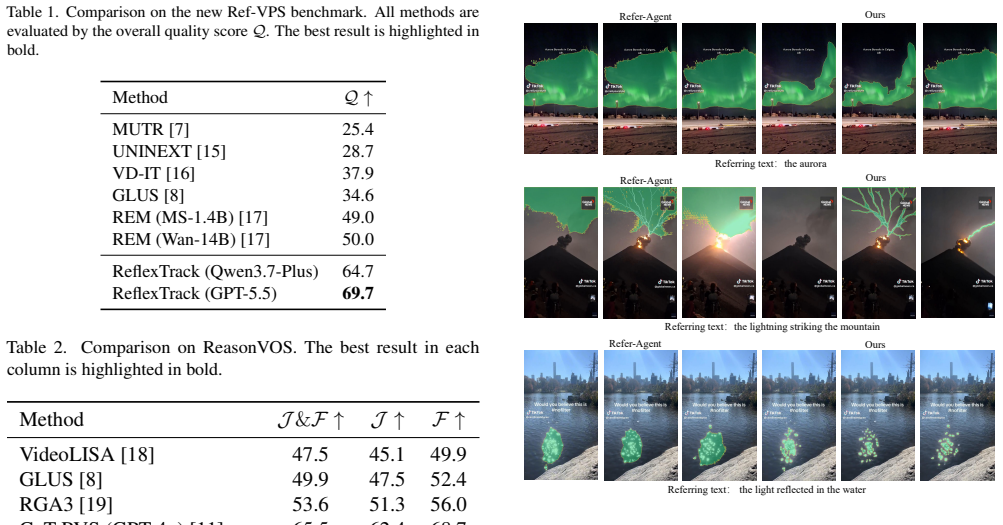
Pith's one-line read ReflexTrack closes the loop: after each segmentation, a language model checks the mask and repairs the spatial prompts or the affected video intervals, yielding Q=69.7 on Ref-VPS and J&F=67.2 on ReasonVOS without task-specific training.
desk verdict Useful training-free RVOS agent with a clean two-level feedback design; the main risks are the under-described new benchmark and the unvalidated MLLM evaluator, not the core idea. read the letter →
The pith
A machine-rendered reading of the paper's core claim, the machinery that carries it, and where it could break.
The reading
What carries the argument
Two complementary feedback loops built on frozen components. Mask-guided Spatial Refinement: for a keyframe, SAM 3 produces a mask from bounding-box and point prompts; a multimodal language model evaluates whether the mask is correct and complete, diagnoses truncation, background leakage, distractor attachment, and boundary errors, and updates the box plus positive/negative points; the loop iterates until acceptance. Video-level Mask Reflection: after the initial sequence is generated, adaptive frame sampling (endpoint, uniform, random) gives a VLM a cheap sequence-level picture, it outputs a quality score and unreliable intervals, a repair agent reconstructs the query context and picks keyf
What would settle it
Check the evaluators directly: construct a set of keyframe masks with human-rated correctness and completeness, run the paper's evaluation prompts on them, and compute agreement; if agreement is near chance, the feedback loop has no trustworthy signal. Or replace the evaluator with an 'always accept' judge and observe whether Q stays near 69.7; if it does, the reported gains come from prompt rewriting rather than prediction-level verification.
Extended reading notes
Core claim
The paper's central discovery is that evaluation should happen after pixel-level prediction, not only before it. Every spatial prompt is judged by the mask it actually produces, and every temporal interval is judged by the complete mask sequence; when a judge finds an error, the system revises prompts or re-propagates from new keyframes, and only accepts a repair if the judge confirms improvement. This two-stage closed loop—Mask-guided Spatial Refinement for spatial initialization and Video-level Mask Reflection for temporal reliability—is what the authors identify as the cause of the measured gains: spatial refinement alone adds 6.4 Q points over the open-loop base, and video-level reflecti
Load-bearing premise
The entire pipeline depends on the MLLM-based evaluators' ability to judge whether a mask is correct, complete, and temporally coherent; if those judges are wrong or biased, refinements and repairs can reinforce errors instead of fixing them, and the paper does not provide calibration or failure analysis for them.
Editorial extensions
If this is right
- If the closed loop is the cause of the gains, then any future improvement in the base segmentation model or grounding model should compound with ReflexTrack, since no retraining is needed.
- Because all components are frozen, the reflection and repair agents can be swapped for stronger MLLMs at inference time; the paper reports a 5-point Q gain simply by replacing the reflection model, so pipeline quality should track MLLM progress.
- The verified-replacement rule means the system is designed never to degrade an interval when no repair is better, so adding more candidate keyframes or repair rounds can only improve or keep the result, not hurt it.
- The two benchmarks suggest the method handles both spatial grounding errors (Ref-VPS, Q=69.7) and reasoning-heavy occlusions and reappearances (ReasonVOS, J&F=67.2), so feedback may be as important as strong grounding for temporal stability.
Reading between the lines
- The evaluate–repair–verify pattern is not tied to RVOS; the same loop could be applied to any task built from a promptable segmenter and an MLLM judge, such as text-specified object tracking or referring expression comprehension over other modalities, where mask correctness is independently checkable.
- A cost–benefit implication the authors leave implicit: each repair round invokes expensive MLLM calls, so the practical limit is the number of intervals flagged; one testable extension is to measure quality per dollar across different frame-sampling budgets.
- Because the evaluator is the sole arbiter of acceptance, the approach predicts that evaluator calibration—not just evaluator strength—will determine failure modes; a wrongly confident evaluator can turn the closed loop into an echo chamber, so comparing evaluator judgments to human ratings would be a useful diagnostic.
- If the authors are right that prediction-level feedback is the bottleneck, then training-free pipelines should not be compared only by final score but by how much verification they do; reproducibility of these gains on new videos may depend as much on the MLLM judge as on SAM 3.
Editorial analysis
A structured set of objections, weighed in public.
Referee Report
Summary. The paper proposes ReflexTrack, a training-free agentic pipeline for referring video object segmentation (RVOS). It augments a reasoning-grounding-segmentation pipeline with two feedback loops: (i) Mask-guided Spatial Refinement iteratively revises a keyframe bounding box and positive/negative point prompts based on an MLLM's evaluation of the induced mask; (ii) Video-level Mask Reflection samples frames, assesses the mask sequence, localizes low-quality intervals, generates repair candidates via SAM 3 re-propagation from reselected keyframes, and replaces an interval only when an MLLM quality score improves by more than a threshold δ. The authors report an overall Q score of 69.7 on a newly introduced Ref-VPS benchmark and J&F of 67.2 on ReasonVOS. An ablation shows Q rising from 54.2 (base) to 60.6 (+spatial refinement) to 64.7 (+temporal reflection) to 69.7 (with GPT-5.5 as the reflection model), yielding a 15.5-point total gain.
Significance. If the results hold, the paper makes a useful empirical contribution: prediction-level feedback can improve training-free RVOS beyond one-shot grounding, with a clean modular decomposition and monotone ablation gains. The use of frozen components only is also a strength. However, the central causal claim is not yet established because the entire feedback loop is gated by an MLLM evaluator that is never validated against ground-truth segmentation quality, the primary benchmark is not described, and no code, prompts, hyperparameters, or statistical robustness are provided. The reported 15.5-point gain could partly reflect a self-consistent but biased evaluator rather than genuine segmentation improvement. These gaps are load-bearing and need to be closed before the quantitative claims can be accepted.
major comments (4)
- [§2.3.1, §2.3.3, Eqs. (4)–(5)] The repair loop is gated entirely by E, the quality score produced by an MLLM of the same family that proposes the repairs. Eq. (4) selects the candidate maximizing E and Eq. (5) accepts an interval replacement only when E(M^(c*)) > E(M^(0)) + δ. No calibration, human-agreement study, or failure analysis for E is provided, and the ablation in Table 3 assigns the entire 15.5-point Q gain to this feedback. A biased evaluator could inflate gains by rewarding self-consistent prompt-mask pairs rather than actual segmentation quality. Please provide (a) validation of E against ground-truth J&F/Q on a held-out set, (b) inter-evaluator agreement, and (c) an oracle or human-in-the-loop experiment to bound the effect of evaluator error.
- [§3.1, Table 1] The 'new Ref-VPS benchmark' is not defined. There is no description of dataset construction, annotation protocol, train/validation/test split, number of videos/objects, or evaluation script. The central result (Q=69.7) is reported on this benchmark, so without a release or a detailed specification the comparison in Table 1 is unreproducible and cannot be audited. The paper should either use an existing public benchmark with a published protocol or fully specify and release the new benchmark.
- [§2.3.3, Eq. (5), §3.1] Several thresholds are never given: δ in Eq. (5), the maximum number of spatial-refinement iterations, the adaptive frame-sampling counts (S_end, S_uni, S_rand), the number of repair candidates C, and the maximum reflection rounds. These are free parameters of the method, and δ directly controls which interval replacements are accepted. Please report the exact values used and include a sensitivity analysis; otherwise the reported gains cannot be separated from threshold tuning.
- [§3.2–§3.3, Tables 1–3] All quantitative claims rest on single runs with no error bars, significance tests, or per-video results, and no code or evaluation protocol is supplied. Because the pipeline includes random frame sampling and API-based MLLM inference, run-to-run variability is expected. Please release code and evaluation scripts and report confidence intervals or multiple seeds, at least for the ablation in Table 3 and the main comparisons.
minor comments (6)
- [§2.3.3, Eq. (5)] There is a typo in Eq. (5): 'cMt' should be a regular variable such as M_t or \hat{M}_t.
- [§2.2–§2.3] The exact MLLM prompt templates are not included. Since the method is prompt-based and prompt wording can strongly affect evaluator behavior, releasing the full prompts is necessary for reproducibility.
- [§3.2, Table 2] On ReasonVOS, ReflexTrack's J&F (67.2) is below Refer-Agent (69.8) even though J is higher (70.1 vs 67.0). The paper should discuss the drop in F and avoid overclaiming from a single subscore.
- [§3.1] The definition of Q is not given. Please state the evaluation formula and the annotation instructions for the Ref-VPS benchmark.
- [§2.2.1, §2.3.2] The paper relies on SAM 3 but does not specify its video propagation configuration (e.g., memory bank, object tokens, or number of propagation steps). Please state the exact inference settings.
- [§3.2, Tables 1–2] The API models (GPT-5.5, Qwen3.7-Plus, Qwen-3.5 9B) are not versioned with timestamps. As API models change over time, this affects reproducibility; please note the access date and model version.
Circularity Check
No circularity found: the feedback loop is scored by an internal MLLM evaluator, but the reported results are measured on external benchmarks with public metrics.
full rationale
The derivation chain is not circular under the specified patterns. ReflexTrack produces keyframe masks with SAM 3, refines prompts via an MLLM evaluator (Eq. 1–2), and repairs temporal intervals by comparing candidate masks using an internal quality score E (Eq. 4–5). The central claim—that prediction-level feedback improves training-free RVOS—is then tested on external benchmarks (Ref-VPS Q, ReasonVOS J&F) against published baselines. No equation in the paper defines E in terms of Q or J&F, no parameter is fitted to the target labels and then reported as a prediction, and no load-bearing result is imported from the authors' own prior work. The internal evaluator is not calibrated or validated, which is a real validity/robustness concern: a biased evaluator could corrupt the repair selection. But that is a correctness risk, not circularity, because the final evaluation is independent of the feedback signal. The paper contains no uniqueness theorem, no ansatz smuggled in via self-citation, and no renaming of a known result as a new organization. Accordingly, the appropriate circularity score is 0.
Assumptions & free parameters
free parameters (5)
- δ (minimum accepted gain) =
not reported
- Maximum number of spatial-refinement iterations =
not reported
- Adaptive frame sampling counts (S_end, S_uni, S_rand) =
not reported
- Number of repair candidates C =
not reported
- Maximum rounds of video-level reflection =
not reported
assumptions (4)
- domain assumption MLLM-based evaluation agents reliably judge mask correctness, completeness, and temporal coherence.
- domain assumption SAM 3 can propagate masks accurately when given a good keyframe prompt, and failures are mainly due to prompt/initialization errors.
- domain assumption The Ref-VPS benchmark and its Q metric are valid, comparable across methods, and not seen by the frozen MLLMs during pretraining.
- domain assumption Initial Target Grounding produces prompts that are worth refining.
invented entities (1)
-
Ref-VPS benchmark (described as 'new')
Cite this review
Pith. "Pith review of ReflexTrack: A Feedback-Driven Agent for Training-Free Referring Video Object Segmentation." pith.science (2026). https://pith.science/paper/OICW5K4Q
@misc{pith2026260724098,
  author       = {Pith},
  title        = {Pith review of: ReflexTrack: A Feedback-Driven Agent for Training-Free Referring Video Object Segmentation},
  year         = {2026},
  howpublished = {\url{https://pith.science/paper/OICW5K4Q}},
  note         = {Machine review of arXiv:2607.24098}
}
abstract
Referring video object segmentation (RVOS) requires segmenting a target specified by natural language throughout a video. Recent agentic approaches combine multimodal large language models with promptable segmentation models to perform RVOS without task-specific training. However, most pipelines rely on one-shot spatial grounding followed by mask propagation, leaving both the initial prompts and temporal predictions largely unverified. We introduce ReflexTrack, a training-free, feedback-driven agent that closes this loop at both spatial and temporal levels. Mask-guided Spatial Refinement evaluates the mask induced by the current keyframe prompt and iteratively updates the bounding box together with positive and negative points, yielding a more reliable initialization. Video-level Mask Reflection assesses the complete mask sequence, localizes unreliable intervals, selects complementary repair keyframes, and generates candidate predictions through mask-guided re-propagation. Only candidates that provide a verified improvement are used to update the affected intervals, preserving reliable predictions elsewhere. All components remain frozen during inference. ReflexTrack achieves an overall $\mathcal{Q}$ score of $69.7$ on Ref-VPS and a $\mathcal{J}\&\mathcal{F}$ score of $67.2$ on ReasonVOS. These results demonstrate that prediction-level feedback substantially improves the reliability of training-free RVOS.
Figures


Figures from the paper (1 more)

Reference graph
Works this paper leans on
-
[1]
Actor and action video segmentation from a sentence,
K. Gavrilyuk, A. Ghodrati, Z. Li, and C. G. M. Snoek, “Actor and action video segmentation from a sentence,” inProceed- ings of the IEEE/CVF Conference on Computer Vision and Pattern Recognition, 2018, pp. 5958–5966
2018
-
[2]
URVOS: Unified referring video object segmentation network with a large-scale bench- mark,
S. Seo, J.-Y . Lee, and B. Han, “URVOS: Unified referring video object segmentation network with a large-scale bench- mark,” inEuropean Conference on Computer Vision, 2020, pp. 208–223
2020
-
[3]
MeViS: A large-scale benchmark for video segmentation with motion expressions,
H. Ding, C. Liu, S. He, X. Jiang, and C. C. Loy, “MeViS: A large-scale benchmark for video segmentation with motion expressions,” inProceedings of the IEEE/CVF International Conference on Computer Vision, 2023, pp. 2694–2703
2023
-
[4]
VISA: Reasoning video object segmen- tation via large language models,
C. Yan, H. Wang, S. Yan, X. Jiang, Y . Li, G. Kang, W. Lu, X. Zhang, and J. Xie, “VISA: Reasoning video object segmen- tation via large language models,” inEuropean Conference on Computer Vision, 2024, pp. 98–115
2024
-
[5]
End-to-end referring video object segmentation with multimodal trans- formers,
A. Botach, E. Zheltonozhskii, and C. Baskin, “End-to-end referring video object segmentation with multimodal trans- formers,” inProceedings of the IEEE/CVF Conference on Computer Vision and Pattern Recognition, 2022, pp. 4985– 4995
2022
-
[6]
Language as queries for referring video object segmentation,
J. Wu, Y . Jiang, P. Sun, Z. Yuan, and P. Luo, “Language as queries for referring video object segmentation,” inProceed- ings of the IEEE/CVF Conference on Computer Vision and Pattern Recognition, 2022, pp. 4974–4984
2022
-
[7]
Referred by multi-modality: A unified temporal transformer for video object segmentation,
S. Yan, R. Zhang, Z. Guo, W. Chen, W. Zhang, H. Li, Y . Qiao, H. He, and P. Gao, “Referred by multi-modality: A unified temporal transformer for video object segmentation,” inPro- ceedings of the AAAI Conference on Artificial Intelligence, vol. 38, no. 6, 2024, pp. 6449–6457
2024
-
[8]
GLUS: Global-local reasoning unified into a single large language model for video seg- mentation,
L. Lin, X. Yu, Z. Panget al., “GLUS: Global-local reasoning unified into a single large language model for video seg- mentation,” inProceedings of the IEEE/CVF Conference on Computer Vision and Pattern Recognition, 2025
2025
Show all 19 references
-
[9]
ReferDINO: Referring video object segmentation with visual grounding foundations,
T. Liang, K. Q. Lin, C. Tanet al., “ReferDINO: Referring video object segmentation with visual grounding foundations,” inProceedings of the IEEE/CVF International Conference on Computer Vision, 2025, pp. 20 009–20 019
2025
-
[10]
Unleashing the temporal- spatial reasoning capacity of GPT for training-free audio and language referenced video object segmentation,
S. Huang, R. Ling, H. Liet al., “Unleashing the temporal- spatial reasoning capacity of GPT for training-free audio and language referenced video object segmentation,”arXiv preprint arXiv:2408.15876, 2024
2024 arXiv
-
[11]
CoT-RVS: Zero-shot chain-of-thought reasoning segmentation for videos,
S.-H. Kao, Y .-W. Tai, and C.-K. Tang, “CoT-RVS: Zero-shot chain-of-thought reasoning segmentation for videos,”arXiv preprint arXiv:2505.18561, 2025
2025
-
[12]
Refer-agent: A collaborative multi-agent system with reasoning and reflec- tion for referring video object segmentation,
H. Jiang, T. Liang, W.-S. Zheng, and J.-F. Hu, “Refer-agent: A collaborative multi-agent system with reasoning and reflec- tion for referring video object segmentation,”arXiv preprint arXiv:2602.03595, 2026
2026
-
[13]
SAM 2: Segment any- thing in images and videos,
N. Ravi, V . Gabeur, Y .-T. Huet al., “SAM 2: Segment any- thing in images and videos,” inInternational Conference on Learning Representations, 2025
2025
-
[14]
SAM 3: Segment anything with concepts,
N. Carion, L. Gustafson, Y .-T. Huet al., “SAM 3: Segment anything with concepts,”arXiv preprint arXiv:2511.16719, 2025
2025 arXiv
-
[15]
Universal instance perception as object discovery and retrieval,
B. Yan, Y . Jiang, J. Wu, D. Wang, P. Luo, Z. Yuan, and H. Lu, “Universal instance perception as object discovery and retrieval,” inProceedings of the IEEE/CVF Conference on Computer Vision and Pattern Recognition, 2023
2023
-
[16]
Exploring pre-trained text-to-video diffusion models for re- ferring video object segmentation,
Z. Zhu, X. Feng, D. Chen, J. Yuan, C. Qiao, and G. Hua, “Exploring pre-trained text-to-video diffusion models for re- ferring video object segmentation,” inEuropean Conference on Computer Vision, 2024
2024
-
[17]
Refereverything: Towards segmenting everything we can speak of in videos,
A. Bagchi, Z. Bao, Y .-X. Wang, P. Tokmakov, and M. Hebert, “Refereverything: Towards segmenting everything we can speak of in videos,” inProceedings of the IEEE/CVF Inter- national Conference on Computer Vision, 2025, pp. 23 221– 23 231. 6
2025
-
[18]
One token to seg them all: Lan- guage instructed reasoning segmentation in videos,
Z. Bai, T. He, H. Mei, P. Wang, Z. Gao, J. Chen, L. Liu, Z. Zhang, and M. Z. Shou, “One token to seg them all: Lan- guage instructed reasoning segmentation in videos,”arXiv preprint arXiv:2409.19603, 2024
2024 arXiv
-
[19]
Object-centric video question answering with visual grounding and referring,
H. Wang, Q. Chen, C. Yan, J. Cai, X. Jiang, Y . Hu, W. Xie, and E. Gavves, “Object-centric video question answering with visual grounding and referring,” inProceedings of the IEEE/CVF International Conference on Computer Vision, 2025, pp. 22 274–22 284. 7
2025
Reviewed July 31, 2026 · model on record in the stance chip above.
Discussion (0). Continue with ORCID to comment.