Decoy State based Time Synchronization
Pith reviewed 2026-05-22 09:43 UTC · model grok-4.3
The pith
Decoy states with different photon numbers enable clock synchronization in QKD using only the key-generation pulses.
A machine-rendered reading of the paper's core claim, the machinery that carries it, and where it could break.
Core claim
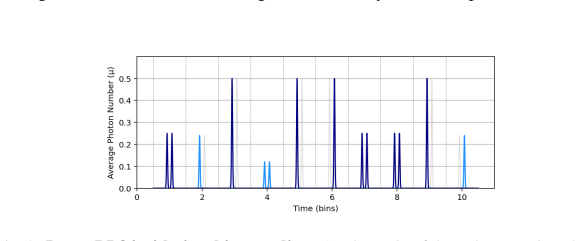
In decoy-state-based BB84 protocols that use weak coherent pulses, the distinct mean photon numbers of the signal and decoy states produce statistically different arrival-time distributions; comparing these distributions allows the receiver to estimate the transmitter-receiver clock offset without altering the QKD protocol or using any dedicated synchronization channel.
What carries the argument
The distinguishable arrival-time histograms of photons from higher-intensity signal states versus lower-intensity decoy states, used to extract the clock offset by statistical comparison.
If this is right
- QKD setups no longer require a separate physical channel for clock synchronization.
- The synchronization method can be added by a receiver-side software change alone.
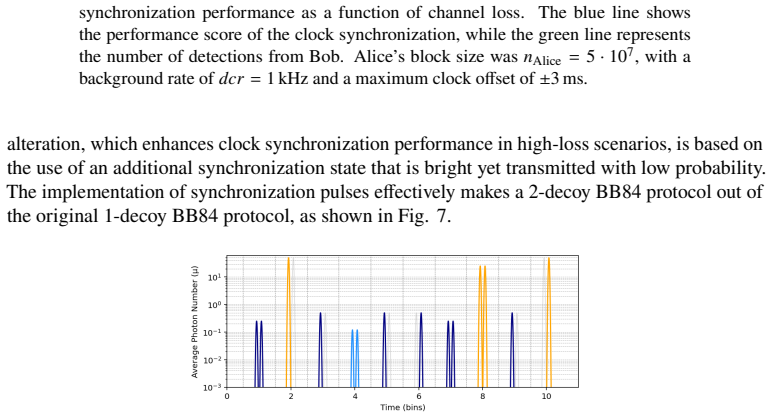
- An additional decoy state with very high mean photon number improves synchronization accuracy in high-loss channels.
- Overall system cost and complexity drop because one dedicated synchronization channel is eliminated.
Where Pith is reading between the lines
- Portable or field-deployed QKD systems could become simpler to set up if no dedicated sync fiber or wireless link is needed.
- The same intensity-difference timing discrimination might be checked for use in other quantum communication tasks that require precise arrival-time knowledge.
- Real hardware tests with varying fiber lengths and detector types would reveal how far the method extends beyond the simulated parameter space.
Load-bearing premise
The arrival-time patterns produced by the two pulse intensities remain different enough to extract a usable clock offset even after channel loss, detector jitter, and background counts are included.
What would settle it
A measurement or simulation in which the clock offset estimated from the signal-versus-decoy arrival-time difference has an error larger than the timing window needed for correct raw-key bit assignment and error-rate calculation under the loss and noise levels of the target fiber link.
Figures





read the original abstract
Time synchronization is a crucial requirement in quantum key distribution (QKD)8 protocols, ensuring accurate key generation via the correct assignment of bits of raw key and9 enabling eavesdropping detection via the precise recording of photon statistics. State-of-the-art10 experiments typically use an extra channel to synchronize the clocks of the transmitter and receiver11 via classical signals. In this work, we study the possibility of performing clock synchronization12 via the signals used for the key generation, which are already present in decoy-state-based BB8413 protocols.14 Without altering the protocol in any way, we use the different mean photon numbers of the15 signal and decoy states for time synchronization without a dedicated physical channel capable of16 clock synchronization. The proposed method relies only on the photons sent and received for17 key generation and does not require any change to the QKD protocol. The only change in the18 experiment is on the software level, thus making it very simple to implement.19 We demonstrate clock synchronization method in a simulation of a specific fiber-based QKD20 experiment. Like other decoy-state-based BB84 protocols, it is based on weak coherent pulses.21 In this simulation, we investigate the parameter space to find limits and optimal choices of our22 proposed method.23 In addition to the non-protocol-altering clock synchronization method, we also discuss an24 approach that significantly improves performance in lossy channels by introducing an additional25 decoy state with a very high mean photon number.26 By eliminating the need for an extra channel capable of clock synchronization, both methods27 proposed potentially reduce the complexity and cost of QKD systems and improve their agility
Editorial analysis
A structured set of objections, weighed in public.
Referee Report
Summary. The manuscript proposes a clock synchronization method for decoy-state BB84 QKD protocols that leverages the known differences in mean photon numbers between signal and decoy states to estimate clock offset from detection times, without requiring a separate synchronization channel. The approach is demonstrated through simulations of a fiber-based QKD setup, exploring parameter space for limits and optimal choices, and an additional high-mean-photon-number decoy state is suggested to improve performance in lossy channels.
Significance. If validated, this method could reduce the hardware complexity and cost of QKD systems by eliminating the need for dedicated timing channels, enhancing their practicality and agility. The simulation-based exploration of parameter space provides useful insights into feasibility, and the software-only implementation is a practical advantage. Credit is given for the reproducible simulation approach and the proposal of an enhanced decoy state for lossy regimes.
major comments (2)
- [Simulation results section (fiber-based QKD experiment demonstration)] The simulation does not report quantitative metrics such as the variance or standard error of the estimated clock offset as a function of channel loss, detector jitter, and background noise levels. This information is essential to evaluate whether the distinguishability of signal and decoy detection statistics remains sufficient for accurate synchronization in high-loss regimes typical of fiber QKD.
- [Simulation setup / Methods] Details on the specific error model (e.g., how photon arrival times are modeled with jitter, loss, and dark counts) and the exact parameter choices for mean photon numbers, pulse rates, and detection efficiencies are not fully specified, which limits assessment of the robustness of the claimed synchronization accuracy.
minor comments (2)
- The abstract could include a brief quantitative statement on achieved precision or success rate in the simulation to better convey the method's performance.
- [Discussion of additional decoy state] Clarify how the additional high mean photon number decoy state integrates with the standard decoy-state protocol without affecting the key generation security proofs.
Simulated Author's Rebuttal
We thank the referee for the constructive comments and for recognizing the potential of the proposed synchronization method. We address each major comment below and have revised the manuscript to strengthen the presentation of the simulation results and methods.
read point-by-point responses
-
Referee: [Simulation results section (fiber-based QKD experiment demonstration)] The simulation does not report quantitative metrics such as the variance or standard error of the estimated clock offset as a function of channel loss, detector jitter, and background noise levels. This information is essential to evaluate whether the distinguishability of signal and decoy detection statistics remains sufficient for accurate synchronization in high-loss regimes typical of fiber QKD.
Authors: We agree that explicit quantitative metrics on the estimation precision would better demonstrate robustness. Our original simulations mapped feasible operating regimes by varying loss and other parameters, but did not include variance or standard-error curves. In the revised manuscript we have added a new subsection and accompanying figure that reports the standard deviation of the recovered clock offset versus channel loss (0–35 dB), detector jitter (20–120 ps), and background-count rates. The added data confirm that the signal–decoy arrival-time difference remains statistically distinguishable with sub-nanosecond uncertainty even at 30 dB loss when the decoy intensity is chosen appropriately. revision: yes
-
Referee: [Simulation setup / Methods] Details on the specific error model (e.g., how photon arrival times are modeled with jitter, loss, and dark counts) and the exact parameter choices for mean photon numbers, pulse rates, and detection efficiencies are not fully specified, which limits assessment of the robustness of the claimed synchronization accuracy.
Authors: We apologize for the incomplete specification. The simulation employs a Poisson photon-number distribution for each weak-coherent pulse, Gaussian timing jitter applied to detection events, exponential attenuation for fiber loss, and an independent Poisson process for dark counts. We have now inserted a dedicated “Simulation Model” paragraph in the Methods section that lists all numerical parameters used (signal intensity μ_s = 0.45, decoy intensity μ_d = 0.12, repetition rate 5 MHz, detector efficiency 15 %, jitter σ = 45 ps, dark-count rate 10 Hz) together with the exact functional forms of the timing and loss models. These additions enable full reproducibility and allow readers to assess sensitivity to each parameter. revision: yes
Circularity Check
No circularity: synchronization uses protocol-fixed intensities via standard correlation
full rationale
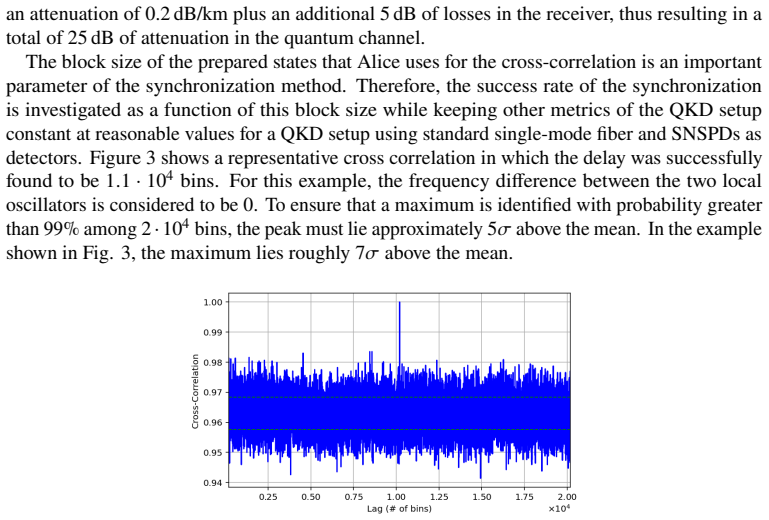
The paper's central method correlates known, predetermined mean photon numbers of signal and decoy states (fixed by the existing decoy-state BB84 protocol) with observed detection timestamps to estimate clock offset. This relies on standard statistical techniques such as maximum-likelihood estimation or cross-correlation applied to the intensity sequence and arrival times; no parameter is fitted from the target data and then renamed as a prediction, no self-citation chain justifies a uniqueness claim, and no ansatz is smuggled in. The derivation chain is self-contained against external benchmarks of photon statistics and does not reduce any result to its own inputs by construction.
Axiom & Free-Parameter Ledger
free parameters (1)
- mean photon numbers of signal and decoy states
axioms (1)
- domain assumption Photon arrival times obey Poisson statistics determined by the mean photon number and the channel transmission probability.
Lean theorems connected to this paper
-
IndisputableMonolith/Cost/FunctionalEquation.leanwashburn_uniqueness_aczel unclear?
unclearRelation between the paper passage and the cited Recognition theorem.
The cross-correlation is given by (a ★ b)(n) = sum a(m) b(m+n); tau_offset = argmax((a ★ b)(n))
-
IndisputableMonolith/Foundation/RealityFromDistinction.leanreality_from_one_distinction unclear?
unclearRelation between the paper passage and the cited Recognition theorem.
We demonstrate clock synchronization method in a simulation of a specific fiber-based QKD experiment... investigate the parameter space
What do these tags mean?
- matches
- The paper's claim is directly supported by a theorem in the formal canon.
- supports
- The theorem supports part of the paper's argument, but the paper may add assumptions or extra steps.
- extends
- The paper goes beyond the formal theorem; the theorem is a base layer rather than the whole result.
- uses
- The paper appears to rely on the theorem as machinery.
- contradicts
- The paper's claim conflicts with a theorem or certificate in the canon.
- unclear
- Pith found a possible connection, but the passage is too broad, indirect, or ambiguous to say the theorem truly supports the claim.
Reference graph
Works this paper leans on
-
[1]
The security of practical quantum key distribution,
V. Scarani, H. Bechmann-Pasquinucci, N. J. Cerf,et al., “The security of practical quantum key distribution,” Rev. Mod. Phys.81, 1301–1350 (2009)
work page 2009
-
[2]
Quantum cryptography: Public key distribution and coin tossing,
C. H. Bennett and G. Brassard, “Quantum cryptography: Public key distribution and coin tossing,” Theor. Comput. Sci.560, 7–11 (2014)
work page 2014
-
[3]
Decoy state quantum key distribution,
H.-K. Lo, X. Ma, and K. Chen, “Decoy state quantum key distribution,” Phys. Rev. Lett.94, 230504 (2005)
work page 2005
-
[4]
Quantum key distribution with entangled photons generated on demand by a quantum dot,
F. B. Basset, M. Valeri, E. Roccia,et al., “Quantum key distribution with entangled photons generated on demand by a quantum dot,” Sci. Adv.7, eabe6379 (2021)
work page 2021
-
[5]
Device calibration impacts security of quantum key distribution,
N. Jain, C. Wittmann, L. Lydersen,et al., “Device calibration impacts security of quantum key distribution,” Phys. Rev. Lett.107, 110501 (2011)
work page 2011
-
[6]
Quantum man-in-the-middle attack on the calibration process of quantum key distribution,
Y.-Y. Fei, X.-D. Meng, M. Gao,et al., “Quantum man-in-the-middle attack on the calibration process of quantum key distribution,” Sci. Reports8, 4283 (2018)
work page 2018
-
[7]
Nonclassicalattackonaquantumkeydistributionsystem,
A.Pljonkin,D.Petrov,L.Sabantina,andK.Dakhkilgova,“Nonclassicalattackonaquantumkeydistributionsystem,” Entropy23, 509 (2021)
work page 2021
-
[8]
Free-space quantum key distribution with entangled photons,
I. Marcikic, A. Lamas-Linares, and C. Kurtsiefer, “Free-space quantum key distribution with entangled photons,” Appl. Phys. Lett.89, 101122 (2006)
work page 2006
-
[9]
Symmetrical clock synchronization with time-correlated photon pairs,
J. Lee, L. Shen, A. Cerè,et al., “Symmetrical clock synchronization with time-correlated photon pairs,” Appl. Phys. Lett.114, 101102 (2019)
work page 2019
-
[10]
Feasibility of 300 km quantum key distribution with entangled states,
T. Scheidl, R. Ursin, A. Fedrizzi,et al., “Feasibility of 300 km quantum key distribution with entangled states,” New J. Phys.11, 085002 (2009)
work page 2009
-
[11]
Fastandsimplequbit-basedsynchronizationforquantumkeydistribution,
L.Calderaro,A.Stanco,C.Agnesi,et al.,“Fastandsimplequbit-basedsynchronizationforquantumkeydistribution,” Phys. Rev. Appl.13, 054041 (2020)
work page 2020
-
[12]
C. Agnesi, M. Avesani, L. Calderaro,et al., “Simple quantum key distribution with qubit-based synchronization and a self-compensating polarization encoder,” Optica7, 284–290 (2020)
work page 2020
-
[13]
Fastqubit-basedfrequency-recoveryalgorithmforquantumkeydistribution,
F.-Y.Lu,Z.-K.Huang,C.Zhang,et al.,“Fastqubit-basedfrequency-recoveryalgorithmforquantumkeydistribution,” Phys. Rev. Appl.24, 064071 (2025)
work page 2025
-
[14]
D. Scalcon, C. Agnesi, M. Avesani,et al., “Cross-encoded quantum key distribution exploiting time-bin and polarization states with qubit-based synchronization,” Adv. Quantum Technol.5, 2200051 (2022)
work page 2022
-
[15]
J.Krause,N.Walenta,J.Hilt,andR.Freund,“Clock-offsetrecoverywithsublinearcomplexityenablessynchronization on low-level hardware for quantum key distribution,” Phys. Rev. Appl.23, 044015 (2025)
work page 2025
-
[16]
Synchronization using quantum photons for satellite-to-ground quantum key distribution,
C.-Z. Wang, Y. Li, W.-Q. Cai,et al., “Synchronization using quantum photons for satellite-to-ground quantum key distribution,” Opt. Express29, 29595–29603 (2021)
work page 2021
-
[17]
Qubit-based clock synchronization for qkd systems using a bayesian approach,
R. D. Cochran and D. J. Gauthier, “Qubit-based clock synchronization for qkd systems using a bayesian approach,” Entropy23, 988 (2021)
work page 2021
-
[18]
Practical decoy state for quantum key distribution,
X. Ma, B. Qi, Y. Zhao, and H.-K. Lo, “Practical decoy state for quantum key distribution,” Phys. Rev. A72, 012326 (2005)
work page 2005
-
[19]
Efficient time-bin encoding for practical high-dimensional quantum key distribution,
I. Vagniluca, B. Da Lio, D. Rusca,et al., “Efficient time-bin encoding for practical high-dimensional quantum key distribution,” Phys. Rev. Appl.14, 014051 (2020)
work page 2020
-
[20]
Simple 2.5 ghz time-bin quantum key distribution,
A. Boaron, B. Korzh, R. Houlmann,et al., “Simple 2.5 ghz time-bin quantum key distribution,” Appl. Phys. Lett. 112, 171108 (2018)
work page 2018
-
[21]
Secure quantum key distribution with realistic devices,
F. Xu, X. Ma, Q. Zhang,et al., “Secure quantum key distribution with realistic devices,” Rev. Mod. Phys.92, 025002 (2020)
work page 2020
-
[22]
The european satellite-based qkd system eagle-1,
T. Hiemstra, D. Hasler, D. Paone,et al., “The european satellite-based qkd system eagle-1,” inFree-Space Laser Communications XXXVII,H. Hemmati and B. S. Robinson, eds. (SPIE, 2025), p. 30
work page 2025
-
[23]
Clock synchronization by remote detection of correlated photon pairs,
C. Ho, A. Lamas-Linares, and C. Kurtsiefer, “Clock synchronization by remote detection of correlated photon pairs,” New J. Phys.11, 045011 (2009)
work page 2009
-
[24]
Two-way quantum time transfer: a method for daytime space-earth links,
R. Lafler, M. L. Eickhoff, S. C. Newey,et al., “Two-way quantum time transfer: a method for daytime space-earth links,” Phys. Rev. Appl.22, 024012 (2024)
work page 2024
-
[25]
Finite-key analysis for the 1-decoy state qkd protocol,
D. Rusca, A. Boaron, F. Grünenfelder,et al., “Finite-key analysis for the 1-decoy state qkd protocol,” Appl. Phys. Lett.112, 171104 (2018)
work page 2018
-
[26]
Fast fourier transform ip core user guide,
Xilinx, “Fast fourier transform ip core user guide,” (2020)
work page 2020
-
[27]
Fpga implementations of fast fourier transforms for real-time signal and image processing,
I. Uzun and A. Bouridane, “Fpga implementations of fast fourier transforms for real-time signal and image processing,” inProceedings. 2003 IEEE International Conference on Field-Programmable Technology (FPT) (IEEE Cat. No.03EX798),(2003), pp. 102–109
work page 2003
-
[28]
Eagle-1 time synchronization scheme,
C. Rößler, B. Hacker, K. Günthner, and C. Marquardt, “Eagle-1 time synchronization scheme,” Tech. rep., EAGLE-1 Consortium (2024). Accessed: 2026-04-15
work page 2024
-
[29]
Qubit-Based Distributed Frame Synchronization for Quantum Key Distribution,
Y. Chen, C. Huang, G. Lin,et al., “Qubit-Based Distributed Frame Synchronization for Quantum Key Distribution,” J. Light. Tech.43, 5032–5039 (2025)
work page 2025
-
[30]
Background noise of satellite-to-ground quantum key distribution,
M. Er-long, H. Zheng-fu, G. Shun-sheng,et al., “Background noise of satellite-to-ground quantum key distribution,” New J. Phys.7, 215 (2005)
work page 2005
-
[31]
Adaptive-optics-enabledquantumcommunication: Atechnique for daytime space-to-earth links,
M.T.Gruneisen,M.L.Eickhoff,S.C.Newey,et al.,“Adaptive-optics-enabledquantumcommunication: Atechnique for daytime space-to-earth links,” Phys. Rev. Appl.16, 014067 (2021). A. Supplement 1: Benchmarking table for prepare and measure - qubit based clock synchronization methods Comparison of clock synchronization methods for prepare-and-measure QKD. Block siz...
work page 2021
discussion (0)
Sign in with ORCID, Apple, or X to comment. Anyone can read and Pith papers without signing in.