REVIEW 3 major objections 7 minor 68 references
A new shear–kSZ estimator turns kSZ, reconstructed velocities, and weak lensing into a direct measurement of the matter–electron power spectrum and the baryonic suppression of cosmic structure.
Reviewed by Pith at T0; open to challenge. T0 means a machine referee read the full paper against a public rubric. the ladder, T0–T4 →
T0 review · grok-4.5
2026-07-30 11:12 UTC pith:ON53KTU3
load-bearing objection Clean three-field estimator that actually targets P_me (and thus S(k)); the algebra and sim checks hold, the 16σ number is a forecast with a standard reconstruction-proxy caveat. the 3 major comments →
Shear-kSZ: A New Estimator for the Matter-Electron Power Spectrum from kSZ Tomography and Weak Lensing
The pith
A machine-rendered reading of the paper's core claim, the machinery that carries it, and where it could break.
Core claim
The shear–kSZ estimator Ĉ^{T V_i}_ℓ ≡ ⟨T, (ṽ_i/c) κ⟩ has expectation value equal to a calibratable velocity kernel V_i times the lensing kernel and the projected matter–electron spectrum P_me(k_ℓ, z_i)/χ_i². Because κ traces total matter, P_me maps to the baryonic suppression S(k)=P_mm/P_DMO_mm via an exact cold-dark-matter plus baryon decomposition, up to a sub-percent dark-matter backreaction and a small bounded electron auto-spectrum term. The analytic model matches AbacusSummit measurements at ≲5% for ℓ≳500; CMB foregrounds cancel by velocity parity; and a realistic SO+DESI+LSST forecast yields SNR≈16 (f_sky=0.2), corresponding to roughly 1% on S(k).
What carries the argument
The shear–kSZ estimator and its factorization: after pairing the coherent large-scale velocities, ⟨Ĉ^{T V_i}_ℓ⟩ collapses to a single velocity kernel V_i (or band matrix A_ij) multiplying W_κ P_me/χ². All reconstruction fidelity, smoothing, and sampling live in the calibratable kernel; scale dependence is carried only by P_me.
Load-bearing premise
The forecast treats a Gaussian-smoothed true halo velocity field as a faithful stand-in for real continuity-equation velocity reconstruction on spectroscopic galaxies, with all losses absorbed into a simulation-measured calibration matrix.
What would settle it
Measure the three-field cross-spectrum on real SO-like temperature maps, DESI LRG velocity reconstructions, and LSST (or Euclid) high-z shear; if the multipole shape and multi-bin amplitude match the beam-convolved model with an A_ij kernel calibrated on the same reconstruction mocks, and if a direct τ–matter cross-check in hydro simulations still recovers S(k) to ≲0.5%, the central claim holds.
If this is right
- P_me from shear–kSZ can be turned into a sub-percent constraint on the baryonic suppression S(k) used in Stage-IV cosmic shear.
- Joint shear–kSZ plus cosmic shear can constrain baryonic feedback internally instead of only marginalizing flexible correction models.
- A ~10σ detection is already expected with early LSST releases because CMB noise, not lensing depth, dominates.
- Advanced Simons Observatory is projected to roughly double the signal-to-noise; lower-redshift tracers (e.g. BGS) open more background source samples.
- CMB-lensing κ can replace galaxy shear for higher-redshift foregrounds and maximal overlap with the temperature map.
Where Pith is reading between the lines
- If the method works on data, stacked kSZ (P_ge) and shear–kSZ (P_me) together become a differential test of how electrons occupy biased tracers versus the full matter field.
- The same velocity-parity cancellation that kills tSZ/CIB bias could be reused for other odd-parity momentum–density–density estimators beyond kSZ.
- Edge-bin leakage from gas outside the reconstruction volume is a generic survey-boundary systematic that any tomographic kSZ analysis will need to model or cut.
- A polarization-only CMB-lensing κ channel would push the usable multipole range deeper into the beam-limited regime where much of the SNR lives.
Editorial analysis
A structured set of objections, weighed in public.
Referee Report
Summary. The manuscript proposes "shear-kSZ," a three-field cross-correlation between the CMB temperature (kSZ) map, a tomographically binned line-of-sight velocity template from spectroscopic tracers, and the weak-lensing convergence. The expectation value factorizes (Eqs. 12–19) into a per-bin velocity kernel — encoded in a band matrix A_ij = ⟨ṽ_i v̄_j⟩ — multiplying the projected matter–electron cross-power P_me(k). Because the density leg is κ rather than a galaxy overdensity, the estimator accesses P_me for the full matter field, and an exact species decomposition (Eq. 22) converts P_me into the baryonic suppression S(k) up to a bounded electron auto-spectrum term and sub-percent dark-matter backreaction. The analytic model is validated against AbacusSummit at ≲5% for ℓ≳500, unbiasedness is tested with independent noise seeds, the P_me→S(k) closure is verified on MillenniumTNG to 0.2–0.5%, and a Fisher forecast gives SNR≈16 for SO-like CMB × DESI-like LRGs × LSST-like high-z sources over f_sky=0.2.
Significance. If the forecast holds, this is a valuable addition to the kSZ toolkit: a direct, tracer-independent probe of P_me(k) with a concrete, near-term path to constraining the baryonic suppression that dominates Stage-IV shear systematics. The paper ships several genuine strengths: a first-principles derivation including an exact line-of-sight velocity sum rule (Eq. 18) that dictates the tomographic design; a parameter-free end-to-end comparison to the simulation (Fig. 3); an unbiasedness test with independent noise seeds plus a useful pipeline caution (App. B1); a velocity-parity argument for foreground cancellation; and a hydro-simulation verification of the P_me→S(k) closure (App. C). The forecast is for a concrete, falsifiable measurement on current/near-term data. The soft spot is that both the quoted validation precision and the SNR rest on an in-realization calibration and a smoothed-true-velocity stand-in for reconstruction, neither of which is available on real data.
major comments (3)
- [§II D, §V A / Fig. 3, Fig. 9] The ≲5% validation (Figs. 3, 9) and the App. D precision claim (σ_x/x = 1/16 → ~1% on S) use A_ij measured against the same realization's velocities, which absorbs the coherent 10–20% long-mode modulation (App. B3). On real data A_ij must come from mocks or linear theory, so this modulation reappears as multiplicative scatter on the recovered P_me, coherent over ~3–4 bins and all ℓ. A back-of-envelope estimate (15% per coherence patch, ~7 independent patches across 24 bins) gives ~6% scatter on the overall amplitude — comparable to the 6.25% statistical error at SNR=16 — potentially doubling the S(k) error budget. The test needed is feasible in-scope: redo Figs. 3/9 with A_ij from linear theory (Fig. 2 shows the normalized shape matches) or from a different AbacusSummit phase, and propagate the result into App. D.
- [§III E, §V E / Table I] The forecast SNR=16 (Table I) uses a Gaussian-smoothed true-halo-velocity template (R_s=15 h⁻¹Mpc) as a stand-in for continuity-equation reconstruction. Since A_ij absorbs only the amplitude, the SNR depends on the template's noise through C^{ViVj}_ℓ in Eq. (29), and the stand-in contains no reconstruction noise, RSD, bias, or fiber incompleteness. The fidelity comparison offered (reconstruction r≈0.6–0.7 vs ⟨ṽv⟩/σ²_v≈0.5) contrasts a correlation coefficient with a regression slope — these are not the same statistic and do not establish equivalent noise properties. Given that reconstruction on AbacusSummit LRG mocks is standard (and the smoothing suppression 0.51 vs 0.70 transverse-linear prediction already shows the proxy is imperfectly understood), the headline '16σ' and '~10σ at LSST Y1' claims need either an actual reconstruction run or an explicit, quantified sensitivity statement.
- [§II F / App. C] The P_me→S(k) closure (Eq. 22) uses the Cauchy–Schwarz bound with r_me≈1 and a small dark-matter backreaction, verified only on MillenniumTNG at z=0.5 (App. C, Figs. 10–11). The paper itself cites observational evidence for feedback stronger than MTNG, where r_me and the backreaction could deviate more. Since the sub-percent S(k) accuracy is a headline claim, the closure test should be repeated on at least one strong-feedback hydrodynamical model (e.g., a CAMELS/FLAMINGO variant) at the LRG redshift range, or the claim should be explicitly scoped to MTNG-like physics.
minor comments (7)
- [Fig. 5 caption vs §III C 2] Caption gives σ_z=0.25, n_eff=26 arcmin⁻², and 'top/bottom rows', whereas §III C 2 uses σ_z=0.05(1+z), n_eff≈4.6 arcmin⁻², and the figure shows two panels arranged left/right. Please reconcile — this looks like a leftover from an earlier draft.
- [§V D] Two consecutive paragraphs state the SNR impact of the diagonal approximation as '<1%' and '15–20% at low ℓ', with the inversion sentence repeated nearly verbatim. Presumably total vs low-ℓ SNR, but as written it reads as contradictory.
- [§IV A / Eq. (29)] The Gaussian covariance of Eq. (29) omits connected four-point terms in the V_i–V_j covariance; κ is substantially non-Gaussian at ℓ∼2000–4000 where the SNR peaks. A brief quantification (or a statement that C^{ViVj} measured from the realization partially captures this) would strengthen the forecast.
- [§III D] Please clarify whether the adopted SO ILC Deproj-0 noise curve includes astrophysical foreground residuals (tSZ, CIB). Velocity parity removes their bias but not their variance, and C^{TT}_ℓ dominates the noise budget.
- [App. A] The edge-bin correction of Eq. (A1) relies on linear-theory Ψ∥ and an assumed τ̄′ beyond the tracer volume; please state the expected accuracy of this correction versus the ~8% cost of excising edge bins.
- [various] Typos: 'to mimic the effective of smoothing' (§III E); 'in very agreement' (§V B); 'with gaining very little independent information' (§II C). Notation: Eq. (2) writes P_me where Eq. (14) defines C^{me}_ℓ; please harmonize.
- [§IV B] The Fisher sum starts at ℓ_min=2 although the model is validated only for ℓ≳500 (§II E). For the observed cases the low-ℓ contribution is negligible, but for the ideal cases it inflates the SNR; a one-line statement of the ℓ<500 contribution would help.
Circularity Check
No load-bearing circular derivation; only a mild same-realization A_ij calibration that partly anchors amplitude in the ≲5% validation, while factorization and S(k) algebra remain independent.
specific steps
-
fitted input called prediction
[Sec. II D, Eq. (19)–(20); Sec. V A, Fig. 3 and Fig. 9]
"with the velocity kernel calibrated via the measured A_ij and the density leg measured from the stacked matter shells of each bin, with no free parameters... agreement is at the ≲5% level (median over interior bins) for ℓ≳10^3. ... because A_ij is measured from the same realization, it captures the sample variance of the long-wavelength radial velocity modes, which modulate the amplitude of the estimator coherently across neighboring bins and across all multipoles"
A_ij ≡ ⟨ṽ_i v̄_j⟩ and the per-bin density leg are taken from the same AbacusSummit realization as the measured Ĉ_TVi. The model amplitude is therefore largely fixed by construction (including cancellation of the coherent 10–20% long-mode modulation the paper itself reports), so the quoted ≲5% “validation” is primarily a test that factorization and high-ℓ approximations hold, not an independent first-principles prediction of the cross-spectrum amplitude. On real data A_ij cannot be measured against true velocities of the same sky; the paper treats this as calibration analogous to stacked-kSZ transfer functions, which is methodologically standard but makes the simulation agreement partly self-anchored.
full rationale
The master formula (Eqs. 12–19) is derived from Wick contractions of the four-point, Limber collapse for ℓ≫L_v, and the line-of-sight velocity sum rule; those steps do not define the observable in terms of the target P_me. The species identity (Eq. 22) relating P_me to S(k) is algebraic and is checked on an external hydro run (MillenniumTNG, App. C), not fitted to the AbacusSummit estimator. Foreground cancellation follows from velocity parity and is not assumed into the signal. The sole mild circularity-adjacent practice is that the end-to-end “percent-level” validation inserts the band matrix A_ij and the density-leg C_me measured from the same realization as the cross-spectrum, so amplitude (and long-mode sample variance) is largely absorbed by construction; what is non-circularly tested is the factorization/scale dependence and neglected contractions at high ℓ. That is ordinary transfer-function calibration (as in stacked kSZ), not a fitted constant renamed as a prediction of S(k) or of the SNR. Forecasts use the measured signal template under a Gaussian covariance and do not close a definitional loop. No uniqueness theorem or ansatz is smuggled in via self-citation. Score 1 reflects only that minor same-realization amplitude anchoring in the validation plots, not a circular central claim.
Axiom & Free-Parameter Ledger
free parameters (6)
- Velocity smoothing scale R_s =
15 h⁻¹ Mpc
- Radial bin width Δχ_bin =
40 h⁻¹ Mpc
- Effective sky overlap f_sky =
0.2
- Gas transfer function T_gas(k) from MillenniumTNG =
MTNG-calibrated T_gas(k)
- Stellar fraction f_⋆ in S(k) closure =
1.5%
- LSST high-z source selection window =
z_ph [1.5,2.6], n_eff≈4.6/arcmin²
axioms (10)
- domain assumption Optically thin kSZ: ΔT/T = -∫ τ'(1+δ_e) v_r/c with e^{-τ}≈1
- domain assumption For ℓ≫L_v the ⟨v ṽ⟩⟨δ_e κ⟩ Wick contraction dominates and the velocity–density convolution collapses to a zero-lag velocity kernel times C_me
- domain assumption Limber approximation for the density–lensing pairing collapses the line-of-sight integral onto the kSZ shell
- standard math Exact sum rule ∫ dr Ψ_∥(r)=0 for line-of-sight velocity correlations, implying tomographic binning is required
- domain assumption Free electrons trace ionized baryons (δ_e≃δ_gas) up to known helium/ionization factors in n̄_e; stars are a small known f_⋆ correction
- domain assumption Dark-matter backreaction P_cc/P_DMO_cc = 1+O(0.1%) on scales of interest so f_c² P_cc/P_DMO_mm ≃ f_c² at sub-percent level in S
- domain assumption Electron–matter correlation coefficient near unity (r_me≈1) so Cauchy–Schwarz nearly saturates and f_b² P_ee is a small bounded correction
- ad hoc to paper Gaussian covariance of C_ℓ^{T V_i} suffices for Fisher SNR; connected long-mode velocity modulation is mild after A_ij calibration
- domain assumption High-z LSST-like sources have negligible support at z≤1, eliminating IA and boost factors by construction
- domain assumption Velocity-odd parity: velocity-independent foregrounds (tSZ, CIB, radio, dust, primary CMB) average to zero in ⟨X ṽ κ⟩
invented entities (1)
-
Shear–kSZ estimator Ĉ_ℓ^{T V_i} with V_i=(ṽ_i/c)κ
independent evidence
read the original abstract
We propose a new estimator for the ionized gas--matter power spectrum, which correlates the kinematic Sunyaev--Zel'dovich (kSZ) field with the line-of-sight velocity field and the weak-lensing convergence map. Analogously to the standard stacked kSZ estimator, this estimator factorizes into a calibratable velocity kernel multiplying the matter--electron cross-power spectrum, $P_{me}(k)$. Because the estimator accesses $P_{me}(k)$ for the full matter distribution rather than around a specific biased tracer as is the case with the standard stacked kSZ estimator, it allows us to determine the baryonic suppression of the matter power spectrum, $S(k)$, one of the dominant astrophysical systematics for Stage-IV cosmic shear. We derive and validate an analytical expression for the estimator against simulations, finding percent-level agreement. Due to its parity structure, contributions from cosmic microwave background (CMB) foregrounds cancel. Using a realistic CMB temperature map with Simons Observatory-like noise and beam, a smoothed velocity field as obtained via linear velocity reconstruction applied to DESI-like luminous red galaxies (LRGs), and LSST-like sources at high redshifts, which suppresses the effect of intrinsic alignments and boost factors, we forecast a $16\sigma$ measurement over $f_{\rm sky}=0.2$ (corresponding to 1\% measurement of $S(k)$), establishing our estimator as a readily measurable target for current surveys, e.g., LSST and \textit{Euclid}. Because the signal-to-noise is dominated by CMB noise rather than lensing depth, we expect a detection already at $\sim10\sigma$ with early LSST data releases. Substantial (factor of 2) gains in signal-to-noise are expected with Advanced Simons Observatory. While here we focus on DESI-like LRGs as the foreground sample, lower-redshift samples provide an even wider array of source samples in the background.
Figures




Reference graph
Works this paper leans on
-
[1]
Independence of noise realisations The bias check of Section V B requires that the pri- mary CMB realisation and the LSST shape-noise reali- sation be statistically independent. During this analysis we found that generating both Gaussian fields from the same random seed induces a spurious cross-correlation C TCMBκnoise ℓ = q C T T ℓ N κ ℓ at all multipole...
-
[2]
(31), band-averaged in the logarithmicℓ bins used throughout, for the five representative bins in the two ideal configurations
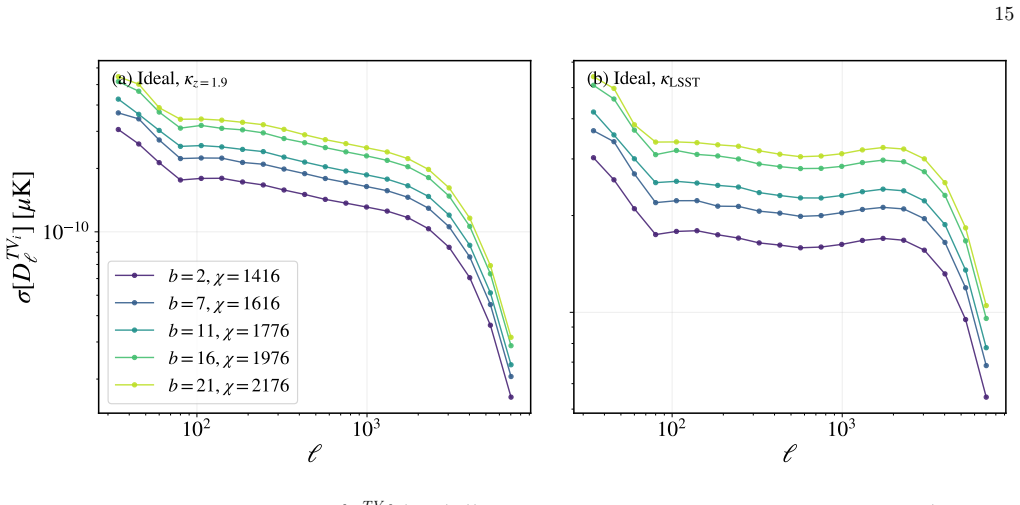
Scale dependence of the measurement uncertainty Figure 8 shows the per-band Gaussian uncertainty σ[DT Vi ℓ ] of Eq. (31), band-averaged in the logarithmicℓ bins used throughout, for the five representative bins in the two ideal configurations. Two regimes are visible. At low multipoles the error is dominated by mode counting: a logarithmic band centred at...
-
[3]
Baryons that keep their hair are exactly the ones kSZ can see – a stripped, no-hair gas profile is what it cannot
Measurement and model comparison In this section, we study the comparison between the- ory and model across all 24 bins by condensing it to one number per bin: the measurement-to-model ratio in the peak bandℓ∈[1500,4000]. Over the interior bins, excluding the two anomalous groups discussed next, the parameter-free model matches the measurement with a medi...
-
[4]
M. Fukugita and P. J. E. Peebles, ApJ616, 643 (2004), arXiv:astro-ph/0406095 [astro-ph]
Pith/arXiv arXiv 2004
-
[5]
J. M. Shull, B. D. Smith, and C. W. Danforth, ApJ759, 23 (2012), arXiv:1112.2706 [astro-ph.CO]
Pith/arXiv arXiv 2012
-
[6]
F. Nicastro, J. Kaastra, Y. Krongold, S. Borgani, E. Branchini, R. Cen, M. Dadina, C. W. Danforth, M. Elvis, F. Fiore, A. Gupta, S. Mathur, D. Mayya, F. Paerels, L. Piro, D. Rosa-Gonzalez, J. Schaye, J. M. Shull, J. Torres-Zafra, N. Wijers, and L. Zappacosta, Na- ture558, 406 (2018), arXiv:1806.08395 [astro-ph.GA]
Pith/arXiv arXiv 2018
-
[7]
J.-P. Macquart, J. X. Prochaska, M. McQuinn, K. W. Bannister, S. Bhandari, C. K. Day, A. T. Deller, R. D. Ekers, C. W. James, L. Marnoch, S. Os lowski, C. Phillips, S. D. Ryder, D. R. Scott, R. M. Shannon, and N. Tejos, Nature581, 391 (2020), arXiv:2005.13161 [astro-ph.CO]
Pith/arXiv arXiv 2020
-
[8]
N. E. Chisari, A. J. Mead, S. Joudaki, P. G. Ferreira, A. Schneider, J. Mohr, T. Tr¨ oster, D. Alonso, I. G. Mc- Carthy, S. Martin-Alvarez, J. Devriendt, A. Slyz, and M. P. van Daalen, The Open Journal of Astrophysics2, 4 (2019), arXiv:1905.06082 [astro-ph.CO]
Pith/arXiv arXiv 2019
-
[9]
M. P. van Daalen, J. Schaye, C. M. Booth, and C. Dalla Vecchia, MNRAS415, 3649 (2011), arXiv:1104.1174 [astro-ph.CO]
Pith/arXiv arXiv 2011
-
[10]
ˇZ. Ivezi´ c, S. M. Kahn, J. A. Tyson, B. Abel, E. Acosta, R. Allsman, D. Alonso, Y. AlSayyad, S. F. Anderson, J. Andrew, J. R. P. Angel, G. Z. Angeli, R. Ansari, P. Antilogus, C. Araujo, R. Armstrong, K. T. Arndt, P. Astier, ´E. Aubourg, N. Auza, T. S. Axelrod, D. J. Bard, J. D. Barr, A. Barrau, J. G. Bartlett, A. E. Bauer, B. J. Bauman, S. Baumont, E. B...
Pith/arXiv arXiv 2019
-
[11]
R. Laureijs, J. Amiaux, S. Arduini, J. L. Augu` eres, J. Brinchmann, R. Cole, M. Cropper, C. Dabin, L. Du- vet, A. Ealet, B. Garilli, P. Gondoin, L. Guzzo, J. Hoar, H. Hoekstra, R. Holmes, T. Kitching, T. Maciaszek, Y. Mellier, F. Pasian, W. Percival, J. Rhodes, G. Saave- dra Criado, M. Sauvage, R. Scaramella, L. Valenziano, S. Warren, R. Bender, F. Casta...
Pith/arXiv arXiv 2011
-
[12]
R. A. Sunyaev and I. B. Zeldovich, ARA&A18, 537 (1980)
1980
-
[13]
T. Mroczkowski, D. Nagai, K. Basu, J. Chluba, J. Say- ers, R. Adam, E. Churazov, A. Crites, L. Di Mas- colo, D. Eckert, J. Macias-Perez, F. Mayet, L. Perotto, E. Pointecouteau, C. Romero, F. Ruppin, E. Scanna- pieco, and J. ZuHone, Space Sci. Rev.215, 17 (2019), arXiv:1811.02310 [astro-ph.CO]
Pith/arXiv arXiv 2019
-
[14]
N. Hand, G. E. Addison, E. Aubourg, N. Battaglia, E. S. Battistelli, D. Bizyaev, J. R. Bond, H. Brew- ington, J. Brinkmann, B. R. Brown, S. Das, K. S. Dawson, M. J. Devlin, J. Dunkley, R. Dunner, D. J. Eisenstein, J. W. Fowler, M. B. Gralla, A. Hajian, M. Halpern, M. Hilton, A. D. Hincks, R. Hlozek, J. P. Hughes, L. Infante, K. D. Irwin, A. Kosowsky, Y.-T...
Pith/arXiv arXiv 2012
-
[15]
B. Soergel, S. Flender, K. T. Story, L. Bleem, T. Gi- annantonio, G. Efstathiou, E. Rykoff, B. A. Benson, T. Crawford, S. Dodelson, S. Habib, K. Heitmann, G. Holder, B. Jain, E. Rozo, A. Saro, J. Weller, F. B. Ab- dalla, S. Allam, J. Annis, R. Armstrong, A. Benoit-L´ evy, G. M. Bernstein, J. E. Carlstrom, A. Carnero Rosell, M. Carrasco Kind, F. J. Castand...
Pith/arXiv arXiv 2016
-
[16]
F. De Bernardis, S. Aiola, E. M. Vavagiakis, N. Battaglia, M. D. Niemack, J. Beall, D. T. Becker, J. R. Bond, E. Calabrese, H. Cho, K. Coughlin, R. Datta, M. De- vlin, J. Dunkley, R. Dunner, S. Ferraro, A. Fox, P. A. Gallardo, M. Halpern, N. Hand, M. Hasselfield, S. W. Henderson, J. C. Hill, G. C. Hilton, M. Hilton, A. D. Hincks, R. Hlozek, J. Hubmayr, K....
Pith/arXiv arXiv 2017
-
[17]
V. Calafut, P. A. Gallardo, E. M. Vavagiakis, S. Amodeo, S. Aiola, J. E. Austermann, N. Battaglia, E. S. Battis- telli, J. A. Beall, R. Bean, J. R. Bond, E. Calabrese, S. K. Choi, N. F. Cothard, M. J. Devlin, C. J. Duell, S. M. Duff, A. J. Duivenvoorden, J. Dunkley, R. Dunner, S. Ferraro, Y. Guan, J. C. Hill, G. C. Hilton, M. Hilton, R. Hloˇ zek, Z. B. Hu...
Pith/arXiv arXiv 2021
-
[18]
Y. Gong, P. A. Gallardo, R. Bean, J. Moore, E. M. Vav- agiakis, N. Battaglia, B. Hadzhiyska, Y.-H. Hsu, J. N. Aguilar, S. Ahlen, D. Bianchi, D. Brooks, T. Clay- baugh, R. Canning, M. Devlin, P. Doel, A. de la Ma- corra, S. Ferraro, A. Font-Ribera, J. E. Forero-Romero, E. Gazta˜ naga, G. Gutierrez, S. G. A. Gontcho, J. Guy, K. Honscheid, C. Howlett, R. H. ...
arXiv 2026
-
[19]
B. Hadzhiyska, Y. Gong, Y. Hsu, P. A. Gallardo, J. Aguilar, S. Ahlen, D. Alonso, R. Bean, D. Bianchi, D. Brooks, F. J. Castander, T. Claybaugh, S. Cole, A. Cuceu, A. de la Macorra, A. Dey, S. Fer- raro, A. Font-Ribera, J. E. Forero-Romero, S. G. A. Gontcho, G. Gutierrez, J. Guy, H. K. Herrera-Alcantar, C. Howlett, D. Huterer, M. Ishak, R. Joyce, T. Kisner...
arXiv 2026
-
[20]
O. Dor´ e, J. F. Hennawi, and D. N. Spergel, ApJ606, 46 (2004), arXiv:astro-ph/0309337 [astro-ph]
Pith/arXiv arXiv 2004
-
[21]
J. C. Hill, S. Ferraro, N. Battaglia, J. Liu, and D. N. Spergel, Phys. Rev. Lett.117, 051301 (2016), arXiv:1603.01608 [astro-ph.CO]
Pith/arXiv arXiv 2016
-
[22]
A. Kusiak, B. Bolliet, S. Ferraro, J. C. Hill, and A. Krolewski, Phys. Rev. D104, 043518 (2021), arXiv:2102.01068 [astro-ph.CO]
Pith/arXiv arXiv 2021
-
[23]
S. Ho, S. Dedeo, and D. Spergel, arXiv e-prints , arXiv:0903.2845 (2009), arXiv:0903.2845 [astro-ph.CO]
Pith/arXiv arXiv 2009
-
[24]
K. M. Smith, M. S. Madhavacheril, M. M¨ unchmeyer, S. Ferraro, U. Giri, and M. C. Johnson, arXiv e-prints , arXiv:1810.13423 (2018), arXiv:1810.13423 [astro-ph.CO]
Pith/arXiv arXiv 2018
-
[25]
M. M¨ unchmeyer, M. S. Madhavacheril, S. Ferraro, M. C. Johnson, and K. M. Smith, Phys. Rev. D100, 083508 (2019), arXiv:1810.13424 [astro-ph.CO]
Pith/arXiv arXiv 2019
-
[26]
F. McCarthy, N. Battaglia, R. Bean, J. Richard Bond, H. Cai, E. Calabrese, W. R. Coulton, M. J. Devlin, J. Dunkley, S. Ferraro, V. Gluscevic, Y. Guan, J. Colin Hill, M. C. Johnson, A. Kusiak, A. Lagu¨ e, N. MacCrann, M. S. Madhavacheril, K. Moodley, S. Naess, F. J. Qu, B. Ried Guachalla, N. Sehgal, B. D. Sherwin, C. Sif´ on, K. M. Smith, S. T. Staggs, A. ...
Pith/arXiv arXiv 2025
-
[27]
S. C. Hotinli, K. M. Smith, and S. Ferraro, arXiv e-prints , arXiv:2506.21657 (2025), arXiv:2506.21657 [astro-ph.CO]
Pith/arXiv arXiv 2025
-
[28]
A. Lagu¨ e, M. S. Madhavacheril, K. M. Smith, S. Ferraro, and E. Schaan, Phys. Rev. Lett.134, 151003 (2025), arXiv:2411.08240 [astro-ph.CO]
Pith/arXiv arXiv 2025
-
[29]
E. Schaan, S. Ferraro, S. Amodeo, N. Battaglia, S. Aiola, J. E. Austermann, J. A. Beall, R. Bean, D. T. Becker, R. J. Bond, E. Calabrese, V. Calafut, S. K. Choi, E. V. Denison, M. J. Devlin, S. M. Duff, A. J. Duivenvoorden, J. Dunkley, R. D¨ unner, P. A. Gallardo, Y. Guan, D. Han, J. C. Hill, G. C. Hilton, M. Hilton, R. Hloˇ zek, J. Hub- mayr, K. M. Huffe...
Pith/arXiv arXiv 2021
-
[30]
S. Amodeo, N. Battaglia, E. Schaan, S. Ferraro, E. Moser, S. Aiola, J. E. Austermann, J. A. Beall, R. Bean, D. T. Becker, R. J. Bond, E. Calabrese, V. Cala- fut, S. K. Choi, E. V. Denison, M. Devlin, S. M. Duff, A. J. Duivenvoorden, J. Dunkley, R. D¨ unner, P. A. Gal- lardo, K. R. Hall, D. Han, J. C. Hill, G. C. Hilton, M. Hilton, R. Hloˇ zek, J. Hubmayr,...
Pith/arXiv arXiv 2021
-
[31]
B. Hadzhiyska, S. Ferraro, B. Ried Guachalla, E. Schaan, J. Aguilar, S. Ahlen, N. Battaglia, J. R. Bond, D. Brooks, E. Calabrese, S. K. Choi, T. Claybaugh, W. R. Coulton, K. Dawson, M. Devlin, B. Dey, P. Doel, A. J. Duiv- envoorden, J. Dunkley, G. S. Farren, A. Font-Ribera, J. E. Forero-Romero, P. A. Gallardo, E. Gazta˜ naga, S. Gontcho Gontcho, M. Gralla...
Pith/arXiv arXiv 2025
-
[32]
B. Ried Guachalla, E. Schaan, B. Hadzhiyska, S. Fer- raro, J. N. Aguilar, S. Ahlen, N. Battaglia, D. Bianchi, R. Bond, D. Brooks, T. Claybaugh, W. R. Coulton, A. de la Macorra, M. J. Devlin, A. Dey, P. Doel, J. Dunk- ley, K. Fanning, J. Forero-Romero, E. Gazta˜ naga, S. Gontcho a Gontcho, G. Gutierrez, J. Guy, J. C. Hill, K. Honscheid, S. Juneau, T. Kisne...
arXiv 2025
-
[33]
B. Hadzhiyska, S. Ferraro, and R. Zhou, Phys. Rev. D 111, 023534 (2025), arXiv:2412.03631 [astro-ph.CO]
Pith/arXiv arXiv 2025
-
[34]
B. Hadzhiyska, S. Ferraro, G. S. Farren, N. Sailer, and R. Zhou, Phys. Rev. D112, 123507 (2025), arXiv:2507.14136 [astro-ph.CO]
Pith/arXiv arXiv 2025
-
[35]
E. Schaan, S. Ferraro, M. Vargas-Maga˜ na, K. M. Smith, S. Ho, S. Aiola, N. Battaglia, J. R. Bond, F. De Bernardis, E. Calabrese, H.-M. Cho, M. J. Devlin, J. Dunkley, P. A. Gallardo, M. Hasselfield, S. Hender- son, J. C. Hill, A. D. Hincks, R. Hlozek, J. Hubmayr, J. P. Hughes, K. D. Irwin, B. Koopman, A. Kosowsky, D. Li, T. Louis, M. Lungu, M. Madhavacher...
Pith/arXiv arXiv 2016
-
[36]
F. J. Qu, B. Ried Guachalla, E. Schaan, B. Hadzhiyska, S. Ferraro, J. Aguilar, S. Ahlen, A. Baleato Lizan- cos, D. Bianchi, D. Brooks, R. Canning, F. J. Ca- stander, E. Chaussidon, T. Claybaugh, A. Cuceu, A. de la Macorra, B. Dey, P. Doel, A. Font-Ribera, J. E. Forero-Romero, E. Gazta˜ naga, S. G. A. Gontcho, G. Gutierrez, H. K. Herrera-Alcantar, K. Honsc...
Pith/arXiv arXiv 2026
-
[37]
B. Hadzhiyska, S. Ferraro, F. J. Qu, B. Ried Guachalla, E. Schaan, J. Aguilar, S. Ahlen, D. Bianchi, D. Brooks, F. J. Castander, E. Chaussidon, T. Claybaugh, A. de la Macorra, A. Dey, B. Dey, P. Doel, J. E. Forero- Romero, E. Gazta˜ naga, S. G. A. Gontcho, G. Gutierrez, J. Guy, K. Honscheid, C. Howlett, D. Huterer, M. Ishak, R. Joyce, R. Kehoe, T. Kisner,...
Pith/arXiv arXiv 2026
-
[38]
M. P. van Daalen, I. G. McCarthy, and J. Schaye, MN- RAS491, 2424 (2020), arXiv:1906.00968 [astro-ph.CO]
Pith/arXiv arXiv 2020
-
[39]
DESI Collaboration, A. Aghamousa, J. Aguilar, S. Ahlen, S. Alam, L. E. Allen, C. Allende Prieto, J. Annis, S. Bailey, C. Balland, O. Ballester, C. Bal- tay, L. Beaufore, C. Bebek, T. C. Beers, E. F. Bell, J. L. Bernal, R. Besuner, F. Beutler, C. Blake, H. Bleuler, M. Blomqvist, R. Blum, A. S. Bolton, C. Briceno, D. Brooks, J. R. Brownstein, E. Buckley-Gee...
Pith/arXiv arXiv 2016
-
[40]
N. A. Maksimova, L. H. Garrison, D. J. Eisenstein, B. Hadzhiyska, S. Bose, and T. P. Satterthwaite, MN- RAS508, 4017 (2021), arXiv:2110.11398 [astro-ph.CO]
Pith/arXiv arXiv 2021
-
[41]
R. Zhou, B. Dey, J. A. Newman, D. J. Eisenstein, K. Dawson, S. Bailey, A. Berti, J. Guy, T.-W. Lan, H. Zou, J. Aguilar, S. Ahlen, S. Alam, D. Brooks, A. de la Macorra, A. Dey, G. Dhungana, K. Fan- ning, A. Font-Ribera, S. G. A. Gontcho, K. Honscheid, M. Ishak, T. Kisner, A. Kov´ acs, A. Kremin, M. Lan- driau, M. E. Levi, C. Magneville, M. Manera, P. Marti...
Pith/arXiv arXiv 2023
-
[42]
White, MNRAS450, 3822 (2015), arXiv:1504.03677 [astro-ph.CO]
M. White, MNRAS450, 3822 (2015), arXiv:1504.03677 [astro-ph.CO]
Pith/arXiv arXiv 2015
-
[43]
B. Ried Guachalla, E. Schaan, B. Hadzhiyska, and S. Ferraro, Phys. Rev. D109, 103533 (2024), arXiv:2312.12435 [astro-ph.CO]
Pith/arXiv arXiv 2024
-
[44]
B. Hadzhiyska, S. Ferraro, B. Ried Guachalla, and E. Schaan, Phys. Rev. D109, 103534 (2024), arXiv:2312.12434 [astro-ph.CO]
Pith/arXiv arXiv 2024
-
[45]
L. Ondaro-Mallea, R. E. Angulo, B. Hadzhiyska, and J. Schaye, arXiv e-prints , arXiv:2607.23339 (2026), arXiv:2607.23339 [astro-ph.CO]
Pith/arXiv arXiv 2026
-
[46]
A. Wayland, D. Alonso, and A. L. Posta, J. Cosmol- ogy Astropart. Phys.2026, 015 (2026), arXiv:2509.18732 [astro-ph.CO]
arXiv 2026
-
[47]
L. Harscouet, K. Wolz, A. Wayland, D. Alonso, and B. Hadzhiyska, arXiv e-prints , arXiv:2512.14625 (2025), arXiv:2512.14625 [astro-ph.CO]
arXiv 2025
-
[48]
Gorski, ApJ332, L7 (1988)
K. Gorski, ApJ332, L7 (1988)
1988
-
[49]
F. McCarthy, B. Hadzhiyska, J. R. Bond, W. R. Coul- ton, J. Dunkley, C. Embil Villagra, M. C. Johnson, K. Moodley, T. Namikawa, B. Ried Guachalla, B. D. Sherwin, C. Sif´ on, A. van Engelen, E. M. Vavagiakis, and E. J. Wollack, arXiv e-prints , arXiv:2511.15701 (2025), arXiv:2511.15701 [astro-ph.CO]
arXiv 2025
-
[50]
L. Ondaro-Mallea, R. E. Angulo, G. Aric` o, J. Schaye, I. G. McCarthy, and M. Schaller, A&A697, A63 (2025), arXiv:2412.09526 [astro-ph.CO]
Pith/arXiv arXiv 2025
-
[51]
D. Sharma, B. Dai, F. Villaescusa-Navarro, and U. Sel- jak, MNRAS538, 1415 (2025), arXiv:2401.15891 [astro- ph.CO]
Pith/arXiv arXiv 2025
-
[52]
Planck Collaboration, N. Aghanim, Y. Akrami, M. Ash- down, J. Aumont, C. Baccigalupi, M. Ballardini, A. J. Banday, R. B. Barreiro, N. Bartolo, S. Basak, R. Battye, K. Benabed, J.-P. Bernard, M. Bersanelli, P. Bielewicz, J. J. Bock, J. R. Bond, J. Borrill, F. R. Bouchet, F. Boulanger, M. Bucher, C. Burigana, R. C. Butler, E. Calabrese, J.-F. Cardoso, J. Ca...
Pith/arXiv arXiv 2020
-
[53]
B. Hadzhiyska, L. H. Garrison, D. Eisenstein, and S. Bose, MNRAS509, 2194 (2022), arXiv:2110.11413 [astro-ph.CO]
Pith/arXiv arXiv 2022
-
[54]
B. Hadzhiyska, S. Yuan, C. Blake, D. J. Eisenstein, J. Aguilar, S. Ahlen, D. Brooks, T. Claybaugh, A. de la Macorra, P. Doel, N. Emas, J. E. Forero-Romero, C. Garcia-Quintero, M. Ishak, S. Joudaki, E. Jullo, R. Kehoe, T. Kisner, A. Kremin, A. Krolewski, M. Lan- driau, J. U. Lange, M. Manera, R. Miquel, J. Nie, C. Pop- pett, A. Porredon, G. Rossi, R. Rugge...
Pith/arXiv arXiv 2023
-
[55]
K. M. G´ orski, E. Hivon, A. J. Banday, B. D. Wandelt, F. K. Hansen, M. Reinecke, and M. Bartelmann, ApJ 622, 759 (2005), arXiv:astro-ph/0409513 [astro-ph]
Pith/arXiv arXiv 2005
-
[56]
C. Hern´ andez-Aguayo, V. Springel, R. Pakmor, M. Bar- rera, F. Ferlito, S. D. M. White, L. Hernquist, B. Hadzhiyska, A. M. Delgado, R. Kannan, S. Bose, and C. Frenk, MNRAS524, 2556 (2023), arXiv:2210.10059 [astro-ph.CO]
Pith/arXiv arXiv 2023
-
[57]
R. Pakmor, V. Springel, J. P. Coles, T. Guillet, C. Pfrom- 23 mer, S. Bose, M. Barrera, A. M. Delgado, F. Ferlito, C. Frenk, B. Hadzhiyska, C. Hern´ andez-Aguayo, L. Hern- quist, R. Kannan, and S. D. M. White, MNRAS524, 2539 (2023), arXiv:2210.10060 [astro-ph.CO]
Pith/arXiv arXiv 2023
-
[58]
B. Hadzhiyska, S. Ferraro, R. Pakmor, S. Bose, A. M. Delgado, C. Hern´ andez-Aguayo, R. Kannan, V. Springel, S. D. M. White, and L. Hernquist, MNRAS526, 369 (2023), arXiv:2305.00992 [astro-ph.CO]
Pith/arXiv arXiv 2023
-
[59]
R. H. Liu, B. Hadzhiyska, S. Ferraro, S. Bose, and C. Hern´ andez-Aguayo, Phys. Rev. D113, 063558 (2026), arXiv:2504.11794 [astro-ph.CO]
Pith/arXiv arXiv 2026
-
[60]
The LSST Dark Energy Science Collaboration, R. Man- delbaum, T. Eifler, R. Hloˇ zek, T. Collett, E. Gawiser, D. Scolnic, D. Alonso, H. Awan, R. Biswas, J. Blazek, P. Burchat, N. E. Chisari, I. Dell’Antonio, S. Digel, J. Frieman, D. A. Goldstein, I. Hook, ˇZ. Ivezi´ c, S. M. Kahn, S. Kamath, D. Kirkby, T. Kitching, E. Krause, P.-F. Leget, P. J. Marshall, J...
Pith/arXiv arXiv 2018
-
[61]
A. Nicola, B. Hadzhiyska, N. Findlay, C. Garc ´ ıa-Garc ´ ıa, D. Alonso, A. Slosar, Z. Guo, N. Kokron, R. Angulo, A. Aviles, J. Blazek, J. Dunkley, B. Jain, M. Pellejero, J. Sullivan, C. W. Walter, M. Zennaro, and LSST Dark Energy Science Collaboration, J. Cosmology Astropart. Phys.2024, 015 (2024), arXiv:2307.03226 [astro-ph.CO]
Pith/arXiv arXiv 2024
-
[62]
P. Ade, J. Aguirre, Z. Ahmed, S. Aiola, A. Ali, D. Alonso, M. A. Alvarez, K. Arnold, P. Ashton, J. Auster- mann, H. Awan, C. Baccigalupi, T. Baildon, D. Bar- ron, N. Battaglia, R. Battye, E. Baxter, A. Bazarko, J. A. Beall, R. Bean, D. Beck, S. Beckman, B. Beringue, F. Bianchini, S. Boada, D. Boettger, J. R. Bond, J. Bor- rill, M. L. Brown, S. M. Bruno, S...
Pith/arXiv arXiv 2019
-
[63]
M. Abitbol, I. Abril-Cabezas, S. Adachi, P. Ade, A. E. Adler, P. Agrawal, J. Aguirre, Z. Ahmed, S. Aiola, T. Alford, A. Ali, D. Alonso, M. A. Alvarez, R. An, K. Arnold, P. Ashton, Z. Atkins, J. Austermann, S. Az- zoni, C. Baccigalupi, A. Baleato Lizancos, D. Barron, P. Barry, J. Bartlett, N. Battaglia, R. Battye, E. Bax- ter, A. Bazarko, J. A. Beall, R. B...
Pith/arXiv arXiv 2025
-
[64]
A. J. Mead, S. Brieden, T. Tr¨ oster, and C. Heymans, MNRAS502, 1401 (2021), arXiv:2009.01858 [astro- ph.CO]
Pith/arXiv arXiv 2021
-
[65]
A. Schneider and R. Teyssier, J. Cosmology Astropart. Phys.2015, 049 (2015), arXiv:1510.06034 [astro-ph.CO]. 24
Pith/arXiv arXiv 2015
-
[66]
A. Schneider, R. Teyssier, J. Stadel, N. E. Chis- ari, A. M. C. Le Brun, A. Amara, and A. Re- fregier, J. Cosmology Astropart. Phys.2019, 020 (2019), arXiv:1810.08629 [astro-ph.CO]
Pith/arXiv arXiv 2019
-
[67]
I. G. McCarthy, A. Amon, J. Schaye, E. Schaan, R. E. Angulo, J. Salcido, M. Schaller, L. Bigwood, W. Elbers, R. Kugel, J. C. Helly, V. J. Forouhar Moreno, C. S. Frenk, R. J. McGibbon, L. Ondaro-Mallea, and M. P. van Daalen, MNRAS540, 143 (2025), arXiv:2410.19905 [astro-ph.CO]
Pith/arXiv arXiv 2025
-
[68]
L. Bigwood, A. Amon, A. Schneider, J. Salcido, I. G. McCarthy, C. Preston, D. Sanchez, D. Sijacki, E. Schaan, S. Ferraro, N. Battaglia, A. Chen, S. Dodelson, A. Rood- man, A. Pieres, A. Fert´ e, A. Alarcon, A. Drlica-Wagner, A. Choi, A. Navarro-Alsina, A. Campos, A. J. Ross, A. Carnero Rosell, B. Yin, B. Yanny, C. S´ anchez, C. Chang, C. Davis, C. Doux, D...
Pith/arXiv arXiv 2024
discussion (0)
Sign in with ORCID, Apple, or X to comment. Anyone can read and Pith papers without signing in.