REVIEW 4 major objections 5 minor 1 cited by
Synesthesia of Machine (SoM)-Driven Analog Precoder Optimization for Enhanced ISAC Performance in Sub-THz Systems
T0 review · 4 major / 5 minor · reviewed 2026-08-11 · deepseek-v4-flash
Pith's one-line read By shaping beam squint with true-time delays, a sub-THz integrated sensing and communication transmitter can push both its data rate and its sensing accuracy outward on the achievable Pareto frontier.
desk verdict The paper offers a useful TTD beam-shaping heuristic and a complex-valued network, but the central monotonicity theorem is unproved and likely false as stated. read the letter →
The pith
A machine-rendered reading of the paper's core claim, the machinery that carries it, and where it could break.
The reading
What carries the argument
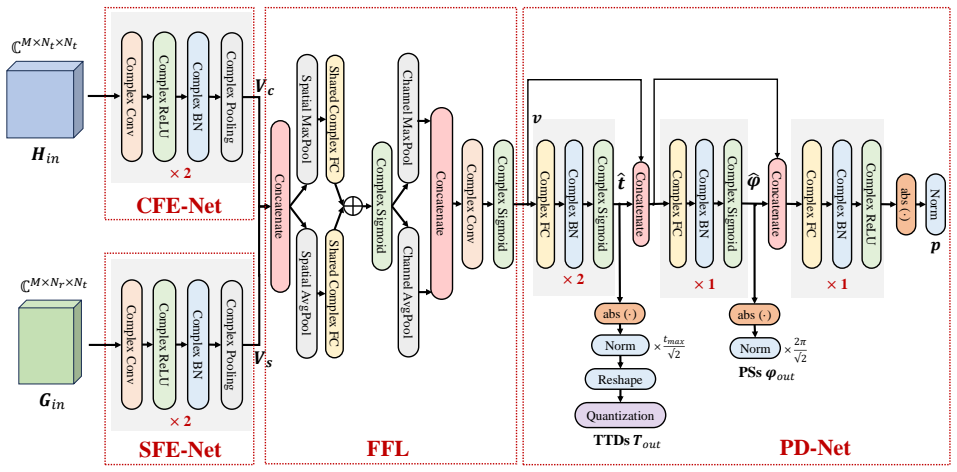
The load-bearing objects are the normalized beamspace power distributions $\hat{\mathbf{b}}_c$ and $\hat{\mathbf{b}}_s$, built by summing DFT-transformed per-subcarrier channels, and the correlation measure $\mathrm{Cor}(h_c,\mathbf{G})=1/\mathrm{KL}(\hat{\mathbf{b}}_c,\hat{\mathbf{b}}_s)$. Proposition 1's monotonicity claim is what carries the argument: larger correlation improves both the rate and the inverse CRB along the Pareto frontier through greater overlap of the beamspace peaks of the user and the targets. True-time delays supply the physical knob, because their frequency-dependent phase shifts reshape the equivalent wideband channel and thereby change the correlation; the optimization benchmark searches over TTD values element-wise and then alternates between a closed-form phase-shifter update and a convex power allocation, while the proposed CSP-Net replaces that search with an unsupervised complex-valued convolutional architecture whose loss includes the normalized correlation.
What would settle it
Fix one sub-THz channel realization with a user and several targets, hold phase shifters and transmit power fixed, and compute the rate-CRB Pareto frontier for the TTD setting that maximizes $\mathrm{Cor}(h_c,\mathbf{G})$ against a setting with lower correlation; if the lower-correlation setting achieves a strictly better rate at the same CRB or a lower CRB at the same rate, the monotonicity asserted in Proposition 1 is falsified.
Extended reading notes
Core claim
The paper's central discovery is Proposition 1, which states that under the same transmit power, every rate-CRB pair on the Pareto boundary of the achievable region improves as $\mathrm{Cor}(h_c,\mathbf{G})=1/\mathrm{KL}(\hat{\mathbf{b}}_c,\hat{\mathbf{b}}_s)$ grows. The proof confines the transmit covariance to the reduced subspace spanned by the target steering vectors, their angle derivatives, and the user steering vector, then connects a higher correlation to a larger overlap of beamspace peaks, which raises both the communication and the sensing Fisher-information terms in the rate and inverse-CRB expressions. The paper further demonstrates in simulations that maximizing this correlation with true-time delays and alternating optimization yields near-optimal dual-functional performance, and that the learned network reproduces the behavior with far lower complexity.
Load-bearing premise
The proof assumes without numerical verification that the optimal transmit covariance lies in the reduced subspace spanned by target steering vectors, their angle derivatives, and the user steering vector, and it takes as given a link between larger Kullback-Leibler-based correlation and larger beamspace peak overlap that the cited source does not actually prove.
Editorial extensions
If this is right
- TTD tuning becomes a principled design degree of freedom: analog precoders in sub-THz ISAC can be designed by maximizing the correlation surrogate instead of solving the full nonconvex trade-off.
- The SA-Opt benchmark approaches the separate communication-dedicated and sensing-dedicated limits, closing most of the rate-CRB gap within about 1.5--2 dB at high SNR in the paper's simulations.
- CSP-Net reduces the design complexity to quadratic scaling in the number of antennas and subcarriers, with only a small performance loss, which matters for time-varying mobile channels.
- Dual-functional gain depends on the spatial distribution of user and targets: it grows when user-target angular separation shrinks, and the squint-aware schemes degrade more gracefully than fixed beam-squint control as separation grows.
Reading between the lines
- Because the correlation criterion is defined on normalized beamspace distributions rather than on the specific TTD hardware, the same design heuristic may transfer to hybrid or fully digital arrays in lower bands, with the gain shrinking as beam squint weakens.
- A natural testable extension is the multi-user or multi-target regime, where a single scalar correlation would need to be generalized to a set of beamspace coincidences, and it is not obvious that the monotone Pareto behavior survives.
- The proof's restriction to the $3K+1$ subspace is the most fragile step; an independent numerical check across random channels could reveal whether the monotonicity holds for the true unconstrained optimum or only within the assumed subspace.
Editorial analysis
A structured set of objections, weighed in public.
Referee Report
Summary. The paper proposes a true-time-delay (TTD) based analog precoder design for sub-THz integrated sensing and communication (ISAC) systems. It introduces a communication-sensing (C-S) channel correlation measure Cor(hc,G) defined via the inverse KL divergence of beamspace distributions, and claims (Proposition 1) that higher Cor improves the rate-CRB Pareto boundary under the same transmit power. Based on this, the authors formulate an optimization benchmark (SA-Opt) that maximizes Cor through TTDs and then optimizes phase shifters and power allocation, and a low-complexity complex-valued neural network (CSP-Net) trained with an unsupervised loss that combines correlation, rate, and CRB. Simulation results show performance gains over controlled beam-squint and dedicated baselines.
Significance. If the main claim holds, the paper offers a practically meaningful design principle: TTDs can be used to actively tune the beamspace correlation between communication and sensing channels in sub-THz ISAC, improving joint performance over existing squint-mitigation approaches. The proposal of a lightweight complex-valued network with a tailored architecture is a useful contribution, and the empirical comparison against several external baselines (comm-dedicated, sensing-dedicated, CBS-ISAC, Opt w/o TTD) strengthens the plausibility of the proposed schemes. The paper also provides a complexity analysis showing a substantial reduction for CSP-Net relative to SA-Opt. However, the theoretical foundation is currently incomplete, as the proof of Proposition 1 relies on an unproved and generally questionable monotonicity bridge between a KL-based correlation measure and beamspace peak overlap, and the simulation results do not provide uncertainty quantification or a fully specified 'ideal' benchmark.
major comments (4)
- [Appendix A, Proposition 1 proof] The step 'It can be proved that a higher Cor(hc,G) gives rise to a higher S(hc,G) [28]' is not established by the cited reference. Reference [28] (Hershey and Olsen, ICASSP 2007) addresses approximation of KL divergence between Gaussian mixture models and contains no statement relating KL divergence to indicator-based peak overlap S. Moreover, the claim is false in general: Cor is defined via the KL divergence between the full normalized beamspace distributions (Eq. 16), while S counts exact coincidences of argmax peaks. Two distributions can be KL-close while having disjoint dominant peaks if their sidelobes are similar, so Cor can be large while S is zero; conversely, matching peaks with different tail masses can keep S constant while Cor varies. Since the objective (17) and the loss (22) directly optimize Cor, this unproved bridge is load-bearing for the paper's central design principle.
- [Appendix A, Eq. (A.4)] The expressions for ξc,m,n1,n2 and ξs,m,n1,n2 are asserted without derivation, and the statement that both 'improve' as S increases is not formalized. These quantities are inner products involving steering-vector overlaps and the subspace basis; they are not simple monotone functions of the indicator sum S. Without a rigorous derivation or a counterexample-free argument, the claim that larger S increases R* and decreases CRB* remains unsupported. This is a second load-bearing gap in the proof of Proposition 1.
- [Appendix A, Eq. (A.1)] The proof assumes, following [15], that the optimal transmit covariance lies in the reduced subspace Um = [At,m*, Ȧt,θ,m*, Ȧt,φ,m*, at(θc,φc,fm)] of dimension Nr = 3K+1. This assumption is imported without re-derivation for the TTD-modified equivalent channels ẽc,m = FTD,m^H hc,m and ẽG,m = Gm FTD,m. The diagonal, frequency-dependent TTD matrix FTD,m alters the channel structure, so it is not immediate that the subspace optimality result of [15] carries over. This should be either proved or explicitly justified; otherwise the Pareto-boundary analysis in (A.2)-(A.3) is not applicable.
- [Section 6.3, Fig. 5] The paper repeatedly describes SA-Opt as 'near-optimal', but Fig. 5 shows an 'ideal case' curve whose definition is never stated in the text (e.g., is it infinite-resolution TTDs? an upper bound obtained by exhaustive search over unquantized delays? or a genie-aided scheme?). Without a precise definition and a quantitative measure of the gap, the near-optimal claim is not substantiated. Additionally, no error bars, confidence intervals, or statistical significance tests are reported for any of the simulation comparisons, so it is unclear whether the performance differences among schemes are meaningful given the random channel realizations.
minor comments (5)
- [Eq. (16)] The correlation measure is defined as 1/KL(bhb_c, bhb_s), but KL divergence is asymmetric in general. The paper does not specify which argument is the reference distribution or whether a symmetrized version is intended. The lack of symmetry in Cor should be addressed explicitly.
- [Algorithm 1, line 5] The notation 'Cor(hc,Gs; T[qh,qv]=t)' is unclear: the subscripts on Gs are inconsistent with the rest of the paper (usually G), and the semicolon notation is not defined. It should be clarified that the correlation is computed on the equivalent channels after applying the candidate TTD value.
- [Eq. (19)] The closed-form solution for fPS is presented without showing the Cauchy-Schwarz relaxation steps or the conditions under which the relaxation is tight. Adding a short derivation would improve reproducibility and clarify the role of the sum over r of ẽG_m^H[r,:].
- [Eq. (22) and Section 4.2.3] The quantities Cor*, R_max, and CRB_min in the loss function are not defined in the text. Cor* presumably denotes some normalization of the correlation value, but its definition is missing. Similarly, R_max and CRB_min likely refer to the dedicated-communication and dedicated-sensing points, but this should be stated explicitly. Also, the phase output φout = 2π/√2 |φ̂| is not constrained to lie in [0, 2π); the finite-resolution property of phase shifters (18a) should be handled explicitly.
- [References and typos] There are small presentation issues: 'sening' should be 'sensing' in Section 3.3; reference [25] is listed as arXiv:2405.14347 but the standard arXiv identifier for 'Deep complex networks' is 1705.09792 (please verify the correct version); and the word 'e ffective' appears with a misplaced space in Section 6.2 (and elsewhere). These do not affect the technical content.
Circularity Check
No definitional or self-citation circularity; the main theorem depends on an unproved Cor-to-S bridge, which is a support gap rather than a constructional loop.
full rationale
The paper's empirical claims are validated against external baselines (CBS-ISAC, communication/sensing-dedicated schemes, Opt w/o TTD), so the reported dual-functional gains are not merely fitted or self-referential. Self-citations ([8], [19], [23]) are used for conceptual framing, the SoM name, and the standard DFT beamspace dictionary/sparsity tool; none is the load-bearing premise of the central proof. The proof of Proposition 1 in Appendix A is not circular in the strict sense: Cor is defined as reciprocal KL in Eq. (16), the performance expressions (A.2)-(A.4) follow from an imported subspace characterization from [15], and the only problematic link is the sentence 'It can be proved that a higher Cor(hc,G) gives rise to a higher S(hc,G) [28]' (Appendix A). That assertion is not established by [28] and not derived in the paper; it is an omitted proof / citation gap that would invalidate Proposition 1 if false, but it is not an equation that reduces to the proposition by construction. The subspace assumption (A.1) from [15] is likewise imported without re-derivation for TTD-modified equivalent channels, another support gap rather than a circularity. Score 2 reflects the presence of minor non-load-bearing self-citations and the incomplete theoretical derivation, without treating the gaps as definitional circularity.
Assumptions & free parameters
free parameters (3)
- eta (sensing-communication weight in Eq. 18) =
not specified
- Gamma (user SNR threshold in Eq. 20a) =
not specified
- Cor* normalization in loss (Eq. 22) =
computed, method not detailed
assumptions (4)
- domain assumption The sub-THz channel is dominated by a single LoS path for communication and by K single-bounce targets for sensing.
- domain assumption Target angles are known at the start of each frame and remain fixed during data transmission.
- domain assumption The optimal transmit covariance lies in the reduced subspace Um with dimension 3K+1 (Appendix A, Eq. A.1).
- ad hoc to paper A higher C-S correlation Cor implies a higher beamspace peak-overlap S(hc,G).
Cite this review
Pith. "Pith review of Synesthesia of Machine (SoM)-Driven Analog Precoder Optimization for Enhanced ISAC Performance in Sub-THz Systems." pith.science (2026). https://pith.science/paper/OS6MPHQ6
@misc{pith2026241213532,
  author       = {Pith},
  title        = {Pith review of: Synesthesia of Machine (SoM)-Driven Analog Precoder Optimization for Enhanced ISAC Performance in Sub-THz Systems},
  year         = {2026},
  howpublished = {\url{https://pith.science/paper/OS6MPHQ6}},
  note         = {Machine review of arXiv:2412.13532}
}
read the original abstract
Integrated sensing and communication (ISAC) is anticipated to be widely used in future sub-terahertz (sub-THz) systems. With the line-of-sight (LoS) propagation characteristics of sub-THz channels, ISAC transmitter design largely parallels analog precoder optimization. However, balancing both sensing and communication functionalities is challenging due to the beam squint effect in sub-THz systems, limiting ISAC performance gains. To overcome this, the unique design flexibility of sub-THz analog hardware is explored to better adapt to the electromagnetic characteristics of sub-THz channels. It is demonstrated that adjusting the equivalent channel through the analog precoder enhances dual-functional gains. Based on this, a near-optimal benchmark for analog precoder optimization is proposed. To address excessive algorithmic complexity, inspiration is drawn from the synesthesia of machine (SoM) to develop a lightweight complex-valued squint-aware network (CSP-Net). This network reduces complexity by utilizing both communication and sensing channel data, with an architecture tailored to specific data and task characteristics. The effectiveness of the proposed schemes is validated through simulations.
Figures


Figures from the paper (2 more)


Forward citations
Cited by 1 Pith paper
-
Synesthesia of Machines (SoM)-Enhanced Sub-THz ISAC Transmission for Air-Ground Network
A vision-RF fusion framework with squint-aware beam tracking improves the time-averaged communication-sensing tradeoff in sub-THz air-ground ISAC.
Reference graph
Works this paper leans on
-
[28]
Approximating the Kullback Leibler di- vergence between gaussian mixture models,
J. R. Hershey and P. A. Olsen, “Approximating the Kullback Leibler di- vergence between gaussian mixture models,” in IEEE International Con- ference on Acoustics, Speech and Signal Processing - ICASSP 2007 , vol. 4, 2007, pp. 317–320. 10
work page 2007
-
[15]
S. Lu, X. Meng, Z. Du, Y . Xiong, and F. Liu, “On the performance gain of integrated sensing and communications: A subspace correlation per- spective,” in IEEE International Conference on Communications , 2023, pp. 2735–2740
work page 2023
-
[1]
Enabling joint communication and radar sensing in mobile net- works—A survey,
J. A. Zhang, M. L. Rahman, K. Wu, X. Huang, Y . J. Guo, S. Chen, and J. Yuan, “Enabling joint communication and radar sensing in mobile net- works—A survey,”IEEE Commun. Surveys Tuts., vol. 24, no. 1, pp. 306– 345, 1st Quart. 2022
work page 2022
-
[2]
Integrated sensing and commu- nications (ISAC) for vehicular communication networks (VCN),
X. Cheng, D. Duan, S. Gao, and L. Yang, “Integrated sensing and commu- nications (ISAC) for vehicular communication networks (VCN),” IEEE Internet Things J., vol. 9, no. 23, pp. 23 441–23 451, Dec. 2022
work page 2022
-
[3]
Integrated sensing and communications: Towards dual- functional wireless networks for 6G and beyond,
F. Liu et al. , “Integrated sensing and communications: Towards dual- functional wireless networks for 6G and beyond,” IEEE J. Select. Areas Commun., vol. 40, no. 6, pp. 1728–1767, Jun. 2022
work page 2022
-
[4]
S. Gao, X. Cheng, and L. Yang, “Spatial multiplexing with limited RF chains: Generalized beamspace modulation (GBM) for mmwave massive MIMO,” IEEE J. Select. Areas Commun., vol. 37, no. 9, pp. 2029–2039, Sept. 2019
work page 2019
-
[5]
THz ISAC: A physical- layer perspective of terahertz integrated sensing and communication,
C. Han, Y . Wu, Z. Chen, Y . Chen, and G. Wang, “THz ISAC: A physical- layer perspective of terahertz integrated sensing and communication,” IEEE Commun. Mag., vol. 62, no. 2, pp. 102–108, Feb. 2024
work page 2024
-
[6]
THz channel model- ing: Consolidating the road to THz communications,
S. Liu, X. Yu, R. Guo, Y . Tang, and Z. Zhao, “THz channel model- ing: Consolidating the road to THz communications,” China Commun., vol. 18, no. 5, pp. 33–49, May 2021
work page 2021
Show all 28 references
-
[7]
Multibeam for joint communication and radar sensing using steerable analog antenna arrays,
J. A. Zhang, X. Huang, Y . J. Guo, J. Yuan, and R. W. Heath, “Multibeam for joint communication and radar sensing using steerable analog antenna arrays,” IEEE Trans. Veh. Technol., vol. 68, no. 1, pp. 671–685, Jan. 2019
2019
-
[8]
Doubly-dynamic ISAC precoding for vehicular networks: A constrained deep reinforcement learning (CDRL) approach,
Z. Yang, S. Gao, and X. Cheng, “Doubly-dynamic ISAC precoding for vehicular networks: A constrained deep reinforcement learning (CDRL) approach,” in IEEE Global Communications Conference (GLOBECOM), 2024
2024
-
[9]
Low-complexity joint transceiver optimization for MmWave/THz MU-MIMO ISAC systems,
P. Wang, J. Fang, X. Zeng, Z. Chen, and H. Li, “Low-complexity joint transceiver optimization for MmWave/THz MU-MIMO ISAC systems,” IEEE Internet Things J., vol. 12, no. 5, pp. 5289–5304, Mar. 2025
2025
-
[10]
Channel estima- tion and hybrid combining for wideband terahertz massive MIMO sys- tems,
K. Dovelos, M. Matthaiou, H. Q. Ngo, and B. Bellalta, “Channel estima- tion and hybrid combining for wideband terahertz massive MIMO sys- tems,” IEEE J. Select. Areas Commun. , vol. 39, no. 6, pp. 1604–1620, Jun. 2021
2021
-
[11]
Hybrid arrays: How many RF chains are required to prevent beam squint?
H. Do, N. Lee, R. W. Heath, and A. Lozano, “Hybrid arrays: How many RF chains are required to prevent beam squint?” IEEE Trans. Wireless Commun., vol. 23, no. 9, pp. 11 708–11 722, Sept. 2024
2024
-
[12]
Delay-phase precoding for wideband THz massive MIMO,
L. Dai, J. Tan, Z. Chen, and H. V . Poor, “Delay-phase precoding for wideband THz massive MIMO,”IEEE Trans. Wireless Commun., vol. 21, no. 9, pp. 7271–7286, Sept. 2022
2022
-
[13]
Integrated sensing and communications with joint beam-squint and beam-split for mmWave /THz massive MIMO,
F. Gao, L. Xu, and S. Ma, “Integrated sensing and communications with joint beam-squint and beam-split for mmWave /THz massive MIMO,” IEEE Trans. Commun., vol. 71, no. 5, pp. 2963–2976, May 2023
2023
-
[14]
YOLO: An e fficient terahertz band integrated sensing and communications scheme with beam squint,
H. Luo, F. Gao, H. Lin, S. Ma, and H. V . Poor, “YOLO: An e fficient terahertz band integrated sensing and communications scheme with beam squint,” IEEE Trans. Wireless Commun., vol. 23, no. 8, pp. 9389–9403, Aug. 2024
2024
-
[16]
A shared cluster-based stochastic channel model for integrated sensing and communication sys- tems,
Y . Liu, J. Zhang, Y . Zhang, Z. Yuan, and G. Liu, “A shared cluster-based stochastic channel model for integrated sensing and communication sys- tems,” IEEE Trans. Veh. Technol., vol. 73, no. 5, pp. 6032–6044, May 2024
2024
-
[17]
RIS-assisted integrated sensing and communications: A subspace rotation approach,
X. Meng, F. Liu, S. Lu, S. P. Chepuri, and C. Masouros, “RIS-assisted integrated sensing and communications: A subspace rotation approach,” in 2023 IEEE Radar Conference (RadarConf23), 2023, pp. 1–6
2023
-
[18]
Intelligent multi-modal sensing-communication inte- gration: Synesthesia of machines,
X. Cheng et al. , “Intelligent multi-modal sensing-communication inte- gration: Synesthesia of machines,” IEEE Commun. Surveys Tuts., vol. 26, no. 1, pp. 258–301, 1st Quart. 2024
2024
-
[19]
Synesthesia of machines (SoM)-enhanced ISAC precoding for vehicular networks with double dy- namics,
Z. Yang, S. Gao, X. Cheng, and L. Yang, “Synesthesia of machines (SoM)-enhanced ISAC precoding for vehicular networks with double dy- namics,” 2024, arXiv:2408.13546
2024 arXiv
-
[20]
Terahertz-band joint ultra- massive mimo radar-communications: Model-based and model-free hy- brid beamforming,
A. M. Elbir, K. V . Mishra, and S. Chatzinotas, “Terahertz-band joint ultra- massive mimo radar-communications: Model-based and model-free hy- brid beamforming,” IEEE J. Sel. Topics Signal Process. , vol. 15, no. 6, 9 pp. 1468–1483, Nov. 2021
2021
-
[21]
Learning to precode for integrated sensing and communication systems,
R. P. Sankar, S. S. Nair, S. Doshi, and S. P. Chepuri, “Learning to precode for integrated sensing and communication systems,” in 2023 31st Euro- pean Signal Processing Conference (EUSIPCO), 2023, pp. 695–699
2023
-
[22]
Frame struc- ture and protocol design for sensing-assisted NR-V2X communications,
Y . Li, F. Liu, Z. Du, W. Yuan, Q. Shi, and C. Masouros, “Frame struc- ture and protocol design for sensing-assisted NR-V2X communications,” IEEE Trans. Mobile Comput. , vol. 23, no. 12, pp. 11 045–11 060, Dec. 2024
2024
-
[23]
Mutual information maximizing wide- band multi-user (wMU) mmwave massive MIMO,
S. Gao, X. Cheng, and L. Yang, “Mutual information maximizing wide- band multi-user (wMU) mmwave massive MIMO,” IEEE Trans. Com- mun., vol. 69, no. 5, pp. 3067–3078, May 2021
2021
-
[24]
Cram´er-Rao bound optimization for joint radar-communication beamforming,
F. Liu, Y .-F. Liu, A. Li, C. Masouros, and Y . C. Eldar, “Cram´er-Rao bound optimization for joint radar-communication beamforming,” IEEE Trans. Signal Process., vol. 70, pp. 240–253, Dec. 2022
2022
-
[25]
Deep complex networks,
C. Trabelsi et al., “Deep complex networks,” 2017, arXiv:2405.14347
2017 arXiv
-
[26]
CBAM: Convolutional block attention module,
S. Woo, J. Park, J.-Y . Lee, and I. S. Kweon, “CBAM: Convolutional block attention module,” in Computer Vision – ECCV 2018, 2018, pp. 3–19
2018
-
[27]
Joint delay-phase precoding under true-time delay constraints in wideband sub-THz hybrid massive MIMO systems,
D. Q. Nguyen and T. Kim, “Joint delay-phase precoding under true-time delay constraints in wideband sub-THz hybrid massive MIMO systems,” IEEE Trans. Commun., vol. 72, no. 10, pp. 6633–6646, Oct. 2024
2024
Reviewed August 11, 2026 · model on record in the stance chip above.
Discussion (0). Continue with ORCID to comment.