Torsion-induced gauge structure in curved quantum waveguides
Pith reviewed 2026-06-28 09:52 UTC · model grok-4.3
The pith
Torsion of a space curve induces a matrix-valued Abelian gauge potential in the effective Hamiltonian when a degenerate transverse subspace is retained.
A machine-rendered reading of the paper's core claim, the machinery that carries it, and where it could break.
Core claim
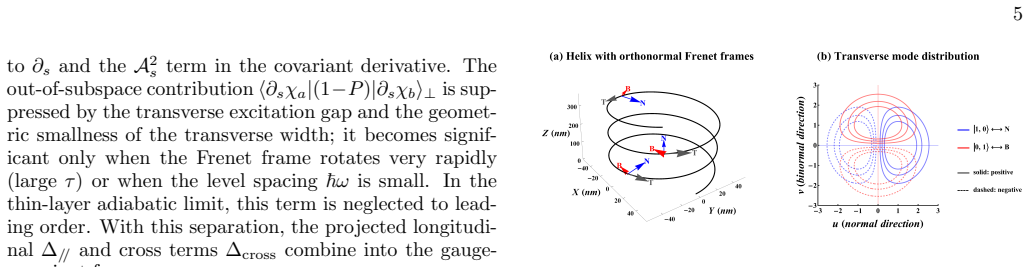
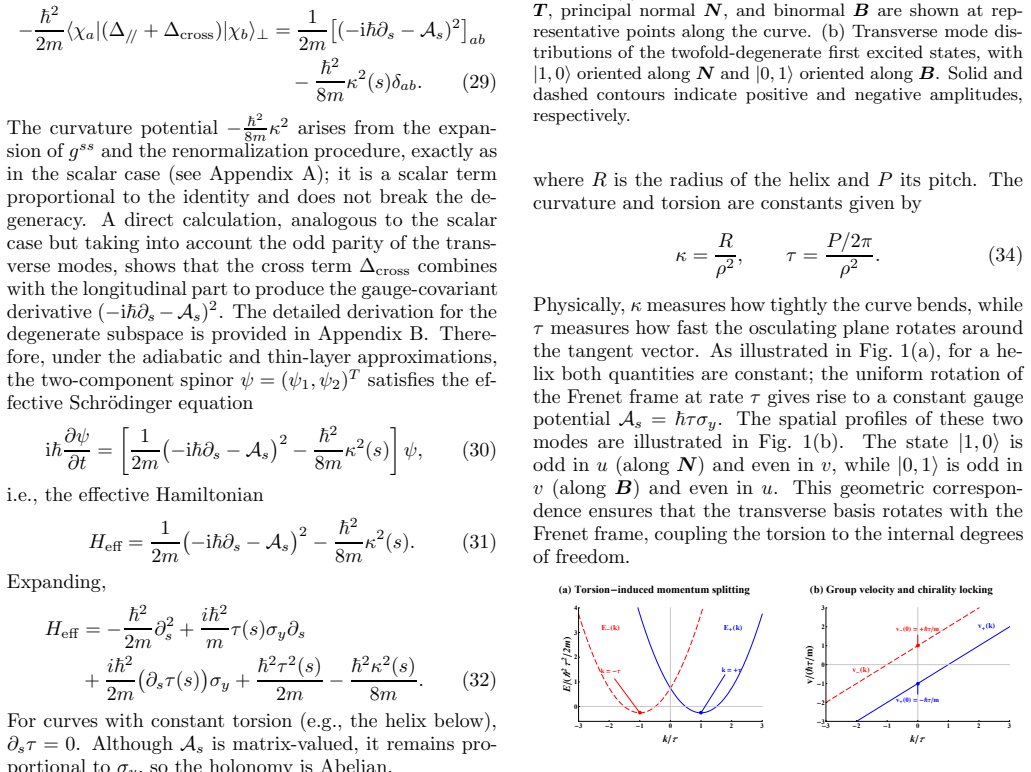
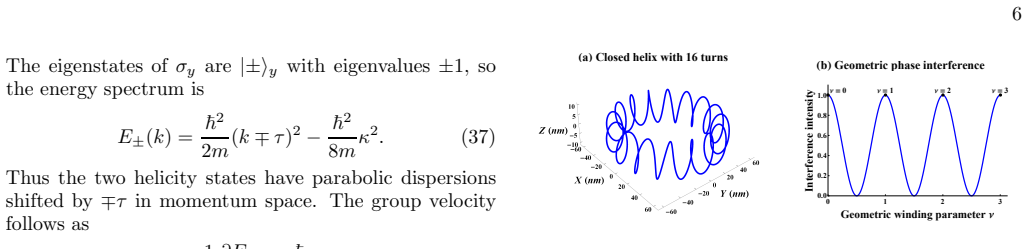
When a degenerate transverse subspace is retained, the rotation of the Frenet normal frame becomes dynamically relevant and generates a matrix-valued Abelian gauge potential directly determined by the local torsion of the curve. The resulting effective Hamiltonian takes a gauge-covariant form and produces two transverse-mode branches whose parabolic dispersions are shifted in opposite directions in momentum space. For closed curves, the associated holonomy is controlled by the integrated torsion and leads to geometric interference. These results provide a direct realization of a Wilczek-Zee-type connection induced purely by spatial geometry in curved quantum waveguides.
What carries the argument
The torsion-determined matrix-valued Abelian gauge potential generated by projection onto a degenerate subspace in the co-rotating Frenet-frame basis.
If this is right
- The effective Hamiltonian acquires a gauge-covariant structure under local frame rotations.
- The two retained transverse modes acquire parabolic dispersions shifted equally but oppositely in wave-vector space.
- Closed curves produce a geometric phase determined solely by the integrated torsion along the loop.
- An identical torsion-induced gauge structure appears in the degenerate bending modes of an isotropic elastic rod.
Where Pith is reading between the lines
- Shape alone could be used to imprint controllable phases on propagating quantum states without external electromagnetic fields.
- The same projection technique may generate analogous gauge structures in other degenerate wave systems such as optical fibers or acoustic waveguides.
- Higher degeneracy or additional constraints could promote the Abelian connection to a non-Abelian one.
Load-bearing premise
The projection onto a degenerate transverse subspace in the co-rotating Frenet-frame basis remains valid and captures the torsion effect without higher-order corrections from the thin-layer approximation.
What would settle it
Observation that the two degenerate-mode dispersion branches are shifted in opposite directions in momentum space by an amount set by the local torsion, independent of the curvature radius.
Figures
read the original abstract
We investigate the quantum dynamics of a particle confined to a space curve within the thin-layer quantization framework. For a nondegenerate scalar transverse mode, torsion does not enter the local effective Hamiltonian, which contains only the curvature-induced scalar geometric potential. In contrast, when a degenerate transverse subspace is retained, the rotation of the Frenet normal frame becomes dynamically relevant and generates a matrix-valued Abelian gauge potential. Using a projection-based derivation in a co-rotating Frenet-frame basis, we show that this effective gauge potential is directly determined by the local torsion of the curve. The resulting effective Hamiltonian takes a gauge-covariant form and produces two transverse-mode branches whose parabolic dispersions are shifted in opposite directions in momentum space. For closed curves, the associated holonomy is controlled by the integrated torsion and leads to geometric interference. These results provide a direct realization of a Wilczek--Zee-type connection induced purely by spatial geometry in curved quantum waveguides. We further construct a classical-wave analogue using the degenerate bending modes of an isotropic elastic rod, demonstrating that the same torsion-induced gauge structure appears in continuum wave physics.
Editorial analysis
A structured set of objections, weighed in public.
Referee Report
Summary. The manuscript investigates quantum dynamics of a particle confined to a space curve in the thin-layer quantization framework. For nondegenerate scalar transverse modes, torsion does not enter the effective Hamiltonian, which contains only the curvature-induced scalar geometric potential. When a degenerate transverse subspace is retained, the rotation of the Frenet normal frame generates a matrix-valued Abelian gauge potential directly determined by local torsion. Using a projection-based derivation in the co-rotating Frenet-frame basis, the effective Hamiltonian is shown to be gauge-covariant, producing two transverse-mode branches with parabolic dispersions shifted in opposite directions in momentum space. For closed curves, the holonomy is controlled by integrated torsion, leading to geometric interference. A classical-wave analogue is constructed using degenerate bending modes of an isotropic elastic rod.
Significance. If the central derivation holds, the work provides a direct geometric realization of a Wilczek-Zee-type connection induced purely by spatial geometry in curved quantum waveguides, with the torsion-controlled holonomy offering a mechanism for geometric phases and interference. The classical analogue in elastic rods extends the result to continuum wave physics and may aid experimental tests. The projection method in the co-rotating frame is a methodological strength when the thin-layer remainder is controlled.
major comments (2)
- [Abstract and projection-based derivation] Abstract and projection-based derivation: the claim that the effective gauge potential is directly determined by local torsion (with no extra terms at the retained order) requires an explicit demonstration that next-order terms in the thin-layer expansion of the 3D Laplacian (e.g., torsion-derivative operators or curvature-torsion cross terms) vanish identically upon projection onto the degenerate subspace; without this, gauge covariance of the effective 1D Hamiltonian is not guaranteed.
- [Effective Hamiltonian and dispersion shifts] Effective Hamiltonian and dispersion shifts: the assertion of two branches whose parabolic dispersions are shifted in opposite directions in momentum space is load-bearing for the torsion-induced gauge structure; the explicit matrix form of the connection A(s) (in terms of torsion au(s)) and the resulting eigenvalue problem after projection must be supplied to confirm the shifts arise solely from the gauge term.
minor comments (1)
- [Abstract] The abstract is concise but would benefit from a single sentence stating the explicit dependence of the gauge potential on torsion to guide readers.
Simulated Author's Rebuttal
We thank the referee for the careful reading and constructive comments on our manuscript. We address each major comment below and agree that the requested explicit demonstrations will strengthen the presentation.
read point-by-point responses
-
Referee: [Abstract and projection-based derivation] Abstract and projection-based derivation: the claim that the effective gauge potential is directly determined by local torsion (with no extra terms at the retained order) requires an explicit demonstration that next-order terms in the thin-layer expansion of the 3D Laplacian (e.g., torsion-derivative operators or curvature-torsion cross terms) vanish identically upon projection onto the degenerate subspace; without this, gauge covariance of the effective 1D Hamiltonian is not guaranteed.
Authors: We agree that an explicit demonstration of the vanishing of next-order terms is required for rigor. In the revised manuscript we will add a dedicated calculation (in the main text or an appendix) projecting the relevant higher-order operators from the thin-layer expansion of the 3D Laplacian onto the degenerate transverse subspace and showing that torsion-derivative and curvature-torsion cross terms yield zero contributions at the retained order. This will confirm that the gauge potential is determined solely by local torsion and that the effective Hamiltonian remains gauge-covariant. revision: yes
-
Referee: [Effective Hamiltonian and dispersion shifts] Effective Hamiltonian and dispersion shifts: the assertion of two branches whose parabolic dispersions are shifted in opposite directions in momentum space is load-bearing for the torsion-induced gauge structure; the explicit matrix form of the connection A(s) (in terms of torsion τ(s)) and the resulting eigenvalue problem after projection must be supplied to confirm the shifts arise solely from the gauge term.
Authors: We accept that the explicit matrix form and eigenvalue problem are needed to make the dispersion shifts fully transparent. The revised manuscript will present the explicit Abelian connection matrix A(s) = τ(s) times the appropriate antisymmetric matrix arising from the co-rotating Frenet-frame projection, followed by the projected one-dimensional eigenvalue problem. Its solution will be shown to produce the two oppositely shifted parabolic branches, thereby confirming that the shifts originate from the gauge term alone. revision: yes
Circularity Check
No circularity: derivation proceeds from thin-layer projection without self-referential reduction
full rationale
The paper derives the torsion-induced gauge potential via explicit projection of the 3D Laplacian onto a degenerate transverse subspace in the co-rotating Frenet frame. The abstract states that the resulting matrix-valued connection is 'directly determined by the local torsion' as an output of that projection, not by fitting parameters or by redefining the input. No self-citation is invoked as load-bearing for the central claim, and the nondegenerate case is contrasted to show torsion enters only when degeneracy is retained. The derivation chain therefore remains self-contained against the stated thin-layer assumptions; no equation reduces to its own input by construction.
Axiom & Free-Parameter Ledger
axioms (2)
- domain assumption Thin-layer quantization framework for confining a particle to a space curve
- domain assumption Validity of projection onto degenerate transverse subspace in co-rotating Frenet frame
Reference graph
Works this paper leans on
-
[1]
Non-Abelian SU (2) gauge potentials have also been realized with ultracold atoms, enabling measurements of Wilson loops associated with geometric holonomies [13]
and in electronic states of curved nanostructures [12]. Non-Abelian SU (2) gauge potentials have also been realized with ultracold atoms, enabling measurements of Wilson loops associated with geometric holonomies [13]. These examples show that geometry-induced gauge structures are not merely formal theoretical construc- tions but can produce observable ph...
-
[2]
Substituting into Eq
Hence Ds acts as i(k ∓ τ) in the respective eigenchannels. Substituting into Eq. (49) gives the dispersion relation ω ± (k) = √ EI ρA (k ∓ τ)2. (50) Equation (50) is the direct classical analogue of the quan- tum spectrumE± (k) = ℏ2 2m (k∓τ)2. The momentum shift 8 k → k ∓ τ induced by the geometric connection is iden- tical; the only difference is the quad...
-
[3]
Jensen and H
H. Jensen and H. Koppe, Ann. Phys. (N.Y.) 63, 586 (1971)
1971
-
[4]
R. C. T. da Costa, Phys. Rev. A 23, 1982 (1981), URL https://link.aps.org/doi/10.1103/PhysRevA. 23.1982
-
[5]
R. C. T. da Costa, Phys. Rev. A 25, 2893 (1982)
1982
-
[6]
Ferrari and G
G. Ferrari and G. Cuoghi, Phys. Rev. Lett. 100, 230403 (2008)
2008
-
[7]
Y.-L. Wang, L. Du, C. Xu, X.-J. Liu, and H.-S. Zong, Phys. Rev. A 90, 042117 (2014)
2014
-
[8]
E. O. Silva, S. C. Ulhoa, F. E. Barone, and A. E. Santana, Ann. Phys. 362, 489 (2015)
2015
-
[9]
Takagi and T
S. Takagi and T. Tanzawa, Prog. Theor. Phys. 87, 561 (1992)
1992
-
[10]
L. I. Magarill and M. V. Entin, J. Exp. Theor. Phys. 96, 766 (2003)
2003
-
[11]
Ortix, Phys
C. Ortix, Phys. Rev. B 91, 245412 (2015)
2015
-
[12]
Wilczek and A
F. Wilczek and A. Zee, Phys. Rev. Lett. 52, 2111 (1984)
1984
-
[13]
Szameit, F
A. Szameit, F. Dreisow, M. Heinrich, R. Keil, S. Nolte, A. T¨ unnermann, and S. Longhi, Phys. Rev. Lett. 104, 150403 (2010)
2010
-
[14]
J. Onoe, T. Ito, H. Shima, H. Yoshioka, and S. Kimura, Europhys. Lett. 98, 27001 (2012)
2012
-
[15]
Sugawa, F
S. Sugawa, F. Salces-Carcoba, Y. Yue, A. Putra, and I. B. Spielman, npj Quantum Inf. 7, 144 (2021)
2021
-
[16]
P. Duclos and P. Exner, Rev. Math. Phys. 7, 73 (1995), URL https://doi.org/10.1142/S0129055X95000045
-
[17]
R. L. Bishop, American Mathematical Monthly 82, 246 (1975)
1975
-
[18]
K. F. Graff, Wave Motion in Elastic Solids (Dover Pub- lications, New York, 1991), unabridged, corrected repub- lication of the work originally published by Ohio State University Press, Columbus, 1975
1991
-
[19]
S. Wang, G. Ma, and C. T. Chan, Sci. Adv. 4, eaaq1475 (2018)
2018
-
[20]
M. R. Dennis and J. H. Hannay, Proceedings of the Royal Society A: Mathematical, Physical and Engineering Sci- ences 461, 3245 (2005)
2005
discussion (0)
Sign in with ORCID, Apple, or X to comment. Anyone can read and Pith papers without signing in.