REVIEW 4 major objections 5 minor 1 cited by
Running flow matching in a learned continuous latent action space, rather than raw control space, decouples global motion structure from low-level noise and yields near-single-step, smooth, long-horizon imitation for robot manipulation.
Reviewed by Pith at T0; open to challenge. T0 means a machine referee read the full paper against a public rubric. the ladder, T0–T4 →
T0 review · deepseek-v4-flash
2026-08-03 06:13 UTC pith:OZB7D6Z7
load-bearing objection A solid, well-engineered latent flow policy for manipulation with strong speed and success numbers, but the smoothness gains are partly trained into the system and the real-world comparison is confounded by an extra camera input; the core mechanism claim needs a cleaner test. the 4 major comments →
CoLA-Flow Policy: Temporally Coherent Imitation Learning via Continuous Latent Action Flow Matching for Robotic Manipulation
The pith
A machine-rendered reading of the paper's core claim, the machinery that carries it, and where it could break.
Core claim
We propose a trajectory-level latent action flow policy. Instead of generating controls directly, we encode action chunks into continuous latent trajectories with a recurrent (GRU) encoder and a variational regularizer, learn a consistency flow in that latent space, and decode generated latent trajectories into executable actions with FiLM conditioning. We show that this decoupling reduces amplification of modelling errors during generation, producing measurably smoother trajectories (up to 93.7% smoother than raw-action flow in real-world mean smoothness) and higher success (77.5% average real-world vs 52.5% for raw action-space flow), at 7.5 ms simulation and 8.59 ms real-world per-step in
What carries the argument
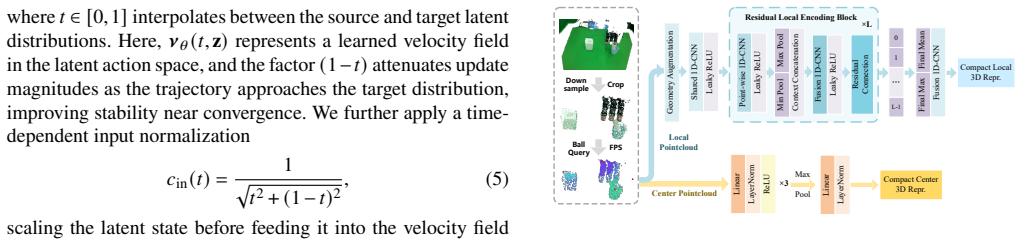
The central object is a continuous latent action trajectory: short action chunks are mapped through a GRU encoder into history-dependent latent codes forming a smooth manifold, regularized by a KL term and a smoothness penalty. A consistency flow-matching ODE is learned in this latent space, with a time-dependent input normalization and a velocity field predicting the path from base noise to target latent codes; generated latent trajectories are decoded into control commands by an MLP modulated with FiLM features from wrist-camera images, while a dual-branch point-cloud encoder injects local and global geometric context into the flow network.
Load-bearing premise
The load-bearing premise is that gains come from performing flow in a temporally coherent latent space, which presumes a controlled comparison: the latent encoder also receives an explicit smoothness penalty, and the real-world model additionally receives a wrist-camera FiLM signal that the baselines do not.
What would settle it
Train a version of the proposed policy without the smoothness penalty in the latent encoder, or add the same wrist-camera FiLM conditioning to the raw-action-space flow baseline, and compare real-world success and smoothness; if the gaps disappear, latent-space flow matching is not the operative cause.
If this is right
- Near-single-step latent flow generation keeps inference in a real-time regime (7.5 ms simulation, 8.59 ms real world), roughly 7.5x faster than the diffusion baseline used in the paper.
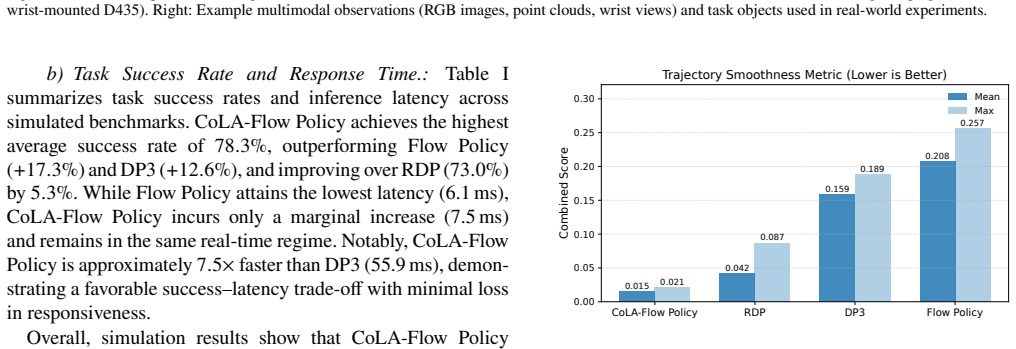
- Latent-space flow substantially reduces trajectory jerk and high-frequency spectral energy in executed joint trajectories (up to 93.7% real-world smoothness reduction vs raw action-space flow).
- Task success improves over raw-action-space flow by +17.3 points simulated and +25 points real-world average, while remaining faster than diffusion-based policies.
- Decoupling latent trajectory planning from decoding means execution-time sensory modalities can be added (e.g., wrist-camera FiLM) without changing the generative flow model.
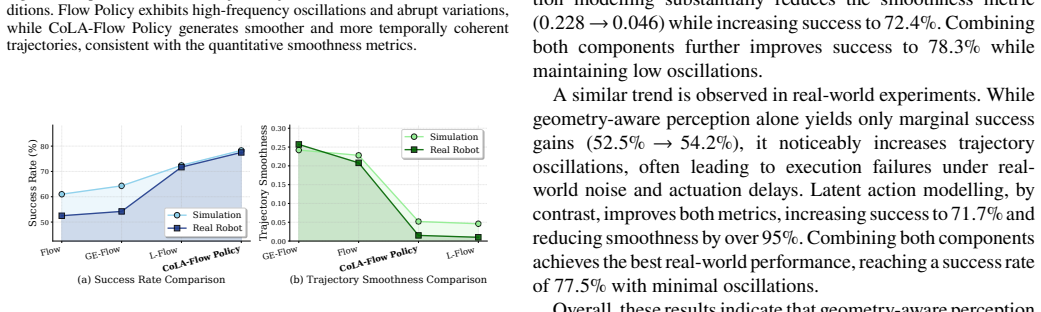
- Ablations attribute most of the stability gain to latent action modelling, with geometry-aware point-cloud conditioning contributing additional success.
Where Pith is reading between the lines
- The paper's headline mechanism claim would be stronger with component-level ablations: the latent encoder is trained with an explicit smoothness penalty, and the real-world model uses a wrist-camera FiLM signal the baselines lack, so the reported gains may not isolate flow-in-latent-space as the cause.
- A direct testable extension is to train the same architecture without the smoothness penalty, or provide the wrist-camera signal to the raw-action flow baseline; if success and smoothness gaps persist, the latent-space mechanism is confirmed.
- The latent action flow idea is not tied to flow matching: the same temporally coherent latent representation could plausibly reduce jitter in diffusion- or RL-based policies, a connection the paper leaves implicit.
- Since smoothness is measured by the paper's own jerk-plus-spectral-energy metric, its magnitudes (e.g., 93.7%) are not directly comparable to smoothness metrics defined by other work; standardization would help.
Editorial analysis
A structured set of objections, weighed in public.
Referee Report
Summary. The paper proposes CoLA-Flow Policy, a trajectory-level imitation learning framework that performs consistency flow matching in a learned continuous latent action space, conditioned on 3D point-cloud geometry and with execution-time FiLM-based decoding from a wrist-camera image. The central claim is that operating the flow in a temporally coherent latent action space decouples global motion structure from low-level control noise, enabling near-single-step inference while reducing trajectory jitter and improving long-horizon success. The manuscript reports simulation results on Adroit and Meta-World (78.3% vs. 61.0% average success over the raw-action Flow Policy baseline, 7.5 ms per-step latency) and real-world results on a Franka/LEAP Hand platform (77.5% vs. 52.5% average success over Flow Policy, up to 93.7% smoothness improvement), together with ablations of the geometry-aware perception and latent-action components.
Significance. If the central attribution is correct, this is a practically relevant contribution: it would show that latent-space flow matching can reconcile the expressiveness of generative policies with real-time control and stable execution, a trade-off that has limited diffusion- and flow-based manipulation policies. The paper has notable strengths: real-robot deployment with a high-dimensional dexterous hand, evaluation across 37 simulated tasks, comparisons against several recent baselines (DP3, iDP3, RDP, Flow Policy), and an ablation study that decomposes the contribution of geometry-aware perception and latent action modelling. However, as detailed below, the evidence does not yet isolate the mechanism claimed — flow matching in latent space — from the effects of the explicitly trained smoothness penalty and the additional wrist-camera input given only to the proposed method. These are load-bearing concerns for the paper's central claim, not presentation issues.
major comments (4)
- [Sec. IV-A, Eq. (13); Sec. III-A-d] The evaluation smoothness metric S_smooth is directly minimized by the latent encoder-decoder training objective. Eq. (13) is a weighted sum of discrete-time jerk and high-frequency spectral energy, and Sec. III-A-d states that the latent encoder-decoder is trained with 'a lightweight smoothness constraint' on the same quantities. The weights alpha=0.25, beta=0.75 are chosen after 'extensive empirical evaluation'. Unless the exact penalty form and weight are reported and an ablation without the smoothness penalty is provided, the headline smoothness improvements (77.2% simulated, 93.7% real) are at least partly a direct effect of the training objective, not evidence for latent-space flow matching. Please specify the penalty, its weight, the cutoff frequency f_c, and include a no-smoothness-penalty control.
- [Sec. IV-D, Fig. 8] The ablation toggles the entire latent-action pipeline (L-Flow vs. Flow), not the choice of generative model in the latent space. The reader cannot tell whether flow matching in latent space is responsible for the gains, or whether any one-step regressor (e.g., an MLP or transformer mapping from noise/observation to the same latent trajectory) would perform comparably. A no-flow baseline in the same latent space, with the same latent encoder-decoder, same smoothness penalty, and same conditioning, is required to support the paper's central mechanism claim that 'latent flow suppresses error amplification during generation' (Sec. III-B-a). Without it, the contribution of flow matching per se is untested.
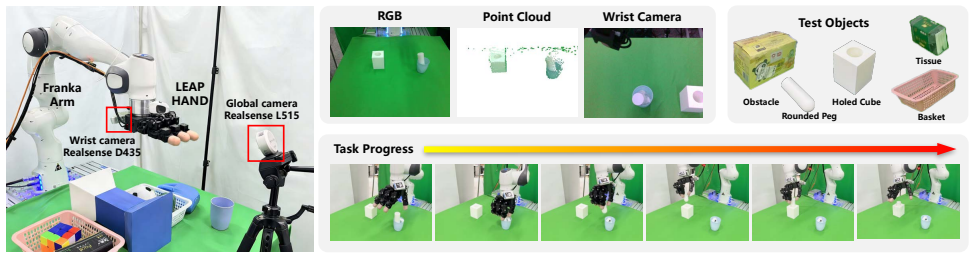
- [Sec. IV-C-1-a, Table II] The real-world comparison is confounded by input modality. The proposed method's decoder receives wrist-camera RGB via FiLM at execution time, while DP3 and Flow Policy baselines do not receive this signal (RDP receives wrist images in place of tactile inputs). The paper itself acknowledges that wrist-camera observations may contribute to success (Sec. IV-C-2-b). Thus the real-world success improvement (77.5% vs. 52.5% over Flow Policy) cannot be attributed to latent-space flow matching. Please provide an ablation of the wrist-camera input for CoLA-Flow Policy and, where feasible, run the baselines with the same wrist-camera conditioning.
- [Sec. III-A-d / Sec. IV-A] Several hyperparameters that directly shape the 'temporally coherent' latent space are unreported, including the KL weight, the smoothness-penalty weight, the cutoff frequency f_c in Eq. (12), the chunk size c, the horizon H, and the latent dimension. These are essential for reproduction and for assessing how much temporal coherence is imposed by construction rather than learned by the flow. Reporting them would also allow the reader to evaluate whether the latent space is 'continuous' by design or only by regularization strength.
minor comments (5)
- [Table I caption] The caption says ΔSuccess/ΔTime denote 'relative changes w.r.t. DP3', but the values are absolute differences (percentage points for success, milliseconds for time). For example, CoLA-Flow Policy's ΔTime is -48.4, which is 7.5 - 55.9 ms, not a relative change. Please correct the caption or the table values.
- [Fig. 4 and Fig. 6] The legend label 'Combined Score' is not defined in the text. It appears to denote mean and max of S_smooth over tasks; please make this explicit in the captions.
- [Author affiliation] The footnote contains a typo: 'All authors are with with the State Key Laboratory...'.
- [Sec. IV-B-2-a] The first sentence says 'Quantitative real-world results are summarized...' in the simulation results section; this should read 'simulation results'.
- [Eq. (4)-(6)] The function f_theta is alternatively called a 'flow function' and a 'consistency flow'; the relationship to the consistency flow matching objective of [32] is not fully specified. Please clarify the training loss and how Eq. (4) is supervised.
Circularity Check
Smoothness improvements are fitted by construction; success-rate claims remain externally grounded.
specific steps
-
fitted input called prediction
[Sec. III-A-d / Fig. 2 (smoothness penalty) vs. Sec. IV-A Eq. (13) (evaluation metric) and Sec. IV-C-2 (claim)]
"The final trajectory smoothness metric is given by Ssmooth=α Sjerk+β Sfreq, where lower values indicate smoother trajectories with reduced abrupt variations and high-frequency oscillations. Based on extensive empirical evaluation and normalization of the two terms, we set α=0.25 and β=0.75 in all experiments. The latent action encoder–decoder is first trained using a variational objective with reconstruction, KL regularization, and a lightweight smoothness constraint to learn a temporally coherent latent space."
The headline smoothness result is not an emergent property of latent-space flow matching: the model is explicitly trained with a 'smoothness constraint' (also labeled 'Smoothness Penalty' in Fig. 2) and then evaluated with Ssmooth, which is the same weighted combination of jerk and high-frequency spectral energy defined in Eq. (13). The metric weights α=0.25 and β=0.75 were fixed only after 'extensive empirical evaluation,' and no reported ablation removes the smoothness penalty while retaining latent-space flow matching. Thus the claimed improvements ('up to 93.7%' smoother) measure an objective the method was explicitly optimized against; the specific claim that latent flow matching suppresses error amplification is not independently tested. The success-rate and latency comparisons use e
full rationale
The main success-rate and latency claims are grounded in external baselines (DP3, iDP3, RDP, Flow Policy), so the central empirical story is not circularly derived from self-citations: the equations for flow matching (Eqs. 3–6) are standard CFM machinery, and the point-cloud conditioning is tested against external methods. The clearest circular step is the smoothness evaluation: the method's training objective includes an explicit smoothness penalty, while the reported evaluation metric is a weighted combination of jerk and high-frequency spectral energy (Eq. 13), with weights chosen post hoc. Reporting this as a discovered improvement is a fitted-input-called-prediction pattern. The real-world comparison also includes a decoder FiLM conditioning channel for CoLA-Flow Policy that Flow Policy does not receive; that is a confound for attribution, not a definitional circularity. Similarly, the lack of a no-flow latent baseline is an experimental gap rather than an equation-level reduction. Overall, the paper has partial circularity concentrated in the smoothness contribution, but the success-rate and speed results retain independent content.
Axiom & Free-Parameter Ledger
free parameters (5)
- Smoothness metric weights alpha, beta =
alpha=0.25, beta=0.75
- KL regularization weight
- Smoothness penalty weight
- Smoothness cutoff frequency f_c
- Chunk size c, horizon H, latent dimension
axioms (5)
- standard math Consistency flow matching (CFM; Eqs. 3-5) provides a valid one-step generative model for the latent action distribution.
- domain assumption Samples from the standard normal prior at inference (Eq. 6) land on the latent manifold and decode to executable actions.
- domain assumption The GRU encoder's history dependence plus the smoothness penalty make the latent trajectory space smooth enough that one-step flow integration does not amplify noise.
- ad hoc to paper The author-defined smoothness metric (Eq. 13) is a valid proxy for execution quality.
- domain assumption 30 demonstrations per task (heuristic policies in simulation, human teleoperation in the real world) suffice to train the latent encoder plus flow policy.
read the original abstract
Learning long-horizon robotic manipulation requires jointly achieving expressive behavior modeling, real-time inference, and stable execution, which remains challenging for existing generative policies. Diffusion-based approaches offer strong modeling capacity but incur high inference latency, while flow matching enables fast, near-single-step generation yet often suffers from unstable execution when operating directly in the raw action space. We propose Continuous Latent Action Flow Policy (CoLA-Flow Policy), a trajectory-level imitation learning framework that performs flow matching in a continuous latent action space. By encoding action sequences into temporally coherent latent trajectories and learning an explicit latent-space flow, CoLA-Flow Policy decouples global motion structure from low-level control noise, enabling smooth and reliable long-horizon execution. The framework further integrates geometry-aware point cloud conditioning and execution-time multimodal modulation, using visual cues as a representative modality to enhance real-world robustness. Experiments in simulation and on real robots show that CoLA-Flow Policy achieves near-single-step inference, improves trajectory smoothness by up to 93.7% and task success by up to 25 percentage points over raw action-space flow baselines, while remaining significantly faster than diffusion-based policies.
Figures




Forward citations
Cited by 1 Pith paper
-
EDAR: Learning Environment-Dependent Action Representations for Robotic Manipulation
Action latents supervised by both control reconstruction and environment-conditioned visual consequences outperform trajectory-centric tokenizers for robotic manipulation, especially long-horizon tasks.
Reference graph
Works this paper leans on
-
[1]
Diffusion policy: Visuomotor policy learning via action diffusion,
C. Chi, Z. Xu, S. Feng, E. Cousineau, Y. Du, B. Burchfiel, R. Tedrake, and S. Song, “Diffusion policy: Visuomotor policy learning via action diffusion,”The International Journal of Robotics Research, vol. 44, no. 10-11, pp. 1684–1704, 2025
2025
-
[2]
Vo-dp: Semantic-geometric adaptive diffusion policy for vision- only robotic manipulation,
Z. Ni, Y. He, L. Qian, J. Mao, F. Fu, W. Sui, H. Su, J. Peng, Z. Wang, and B. He, “Vo-dp: Semantic-geometric adaptive diffusion policy for vision- only robotic manipulation,”arXiv preprint arXiv:2510.15530, 2025
arXiv 2025
-
[3]
3d diffusion policy: Generalizable visuomotor policy learning via simple 3d representations,
Y. Ze, G. Zhang, K. Zhang, C. Hu, M. Wang, and H. Xu, “3d diffusion policy: Generalizable visuomotor policy learning via simple 3d representations,” inProceedings of Robotics: Science and Systems (RSS), 2024
2024
-
[4]
Dexcap: Scalable and portable mocap data collection system for dexterous manipulation,
C. Wang, H. Shi, W. Wang, R. Zhang, L. Fei-Fei, and C. K. Liu, “Dexcap: Scalable and portable mocap data collection system for dexterous manipulation,” inProceedings of Robotics: Science and Systems (RSS), 2024
2024
-
[5]
Hierarchical diffusion policy: ma- nipulation trajectory generation via contact guidance,
D. Wang, C. Liu, F. Chang, and Y. Xu, “Hierarchical diffusion policy: ma- nipulation trajectory generation via contact guidance,”IEEE Transactions on Robotics, 2025
2025
-
[6]
Flow matching for generative modeling,
Y. Lipman, R. T. Chen, H. Ben-Hamu, M. Nickel, and M. Le, “Flow matching for generative modeling,”arXiv preprint arXiv:2210.02747, 2022
Pith/arXiv arXiv 2022
-
[7]
Flow matching on general geometries,
R. T. Chen and Y. Lipman, “Flow matching on general geometries,”arXiv preprint arXiv:2302.03660, 2023
Pith/arXiv arXiv 2023
-
[8]
Adaptive flow matching for resolving small- scale physics,
S. Fotiadis, N. D. Brenowitz, T. Geffner, Y. Cohen, M. Pritchard, A. Vahdat, and M. Mardani, “Adaptive flow matching for resolving small- scale physics,” inForty-second International Conference on Machine Learning, 2025
2025
-
[9]
Flowpolicy: Enabling fast and robust 3d flow-based policy via consistency flow matching for robot manipulation,
Q. Zhang, Z. Liu, H. Fan, G. Liu, B. Zeng, and S. Liu, “Flowpolicy: Enabling fast and robust 3d flow-based policy via consistency flow matching for robot manipulation,” inProceedings of the AAAI Conference on Artificial Intelligence, vol. 39, no. 14, 2025, pp. 14 754–14 762
2025
-
[10]
Fast and robust visuomotor riemannian flow matching policy,
H. Ding, N. Jaquier, J. Peters, and L. Rozo, “Fast and robust visuomotor riemannian flow matching policy,”IEEE Transactions on robotics, 2025
2025
-
[11]
Riemannian flow matching policy for robot motion learning,
M. Braun, N. Jaquier, L. D. Rozo, and T. Asfour, “Riemannian flow matching policy for robot motion learning,”2024 IEEE/RSJ International Conference on Intelligent Robots and Systems (IROS), pp. 5144–5151, 2024
2024
-
[12]
Generalizable humanoid manipulation with 3d diffusion policies,
Y. Ze, Z. Chen, W. Wang, T. Chen, X. He, Y. Yuan, X. B. Peng, and J. Wu, “Generalizable humanoid manipulation with 3d diffusion policies,” in2025 IEEE/RSJ International Conference on Intelligent Robots and Systems (IROS). IEEE, 2025, pp. 2873–2880
2025
-
[13]
Reactive diffusion policy: Slow-fast visual-tactile policy learning for contact-rich manipulation,
H. Xue, J. Ren, W. Chen, G. Zhang, Y. Fang, G. Gu, H. Xu, and C. Lu, “Reactive diffusion policy: Slow-fast visual-tactile policy learning for contact-rich manipulation,” inProceedings of Robotics: Science and Systems (RSS), 2025
2025
-
[14]
Denoising diffusion probabilistic models,
J. Ho, A. Jain, and P. Abbeel, “Denoising diffusion probabilistic models,” Advances in neural information processing systems, vol. 33, pp. 6840– 6851, 2020
2020
-
[15]
Denoising diffusion implicit models,
J. Song, C. Meng, and S. Ermon, “Denoising diffusion implicit models,” inInternational Conference on Learning Representations, 2021
2021
-
[16]
Implicit behavioral cloning,
P. Florence, C. Lynch, A. Zeng, O. A. Ramirez, A. Wahid, L. Downs, A. Wong, J. Lee, I. Mordatch, and J. Tompson, “Implicit behavioral cloning,” inConference on robot learning. PMLR, 2022, pp. 158–168
2022
-
[17]
Deep residual learning for image recognition,
K. He, X. Zhang, S. Ren, and J. Sun, “Deep residual learning for image recognition,” inProceedings of the IEEE conference on computer vision and pattern recognition, 2016, pp. 770–778
2016
-
[18]
An image is worth 16x16 words: Transformers for image recognition at scale,
A. Dosovitskiy, L. Beyer, A. Kolesnikov, D. Weissenborn, X. Zhai, T. Un- terthiner, M. Dehghani, M. Minderer, G. Heigold, S. Gelly, J. Uszkoreit, and N. Houlsby, “An image is worth 16x16 words: Transformers for image recognition at scale,”ICLR, 2021
2021
-
[19]
Dexgraspnet: A large-scale robotic dexterous grasp dataset for general objects based on simulation,
R. Wang, J. Zhang, J. Chen, Y. Xu, P. Li, T. Liu, and H. Wang, “Dexgraspnet: A large-scale robotic dexterous grasp dataset for general objects based on simulation,”arXiv preprint arXiv:2210.02697, 2022
Pith/arXiv arXiv 2022
-
[20]
Dexgraspnet 2.0: Learning generative dexterous grasping in large-scale synthetic cluttered scenes,
J. Zhang, H. Liu, D. Li, X. Yu, H. Geng, Y. Ding, J. Chen, and H. Wang, “Dexgraspnet 2.0: Learning generative dexterous grasping in large-scale synthetic cluttered scenes,” in8th Annual Conference on Robot Learning, 2024
2024
-
[21]
Pointnet: Deep learning on point sets for 3d classification and segmentation,
C. R. Qi, H. Su, K. Mo, and L. J. Guibas, “Pointnet: Deep learning on point sets for 3d classification and segmentation,” inProceedings of the IEEE conference on computer vision and pattern recognition, 2017, pp. 652–660
2017
-
[22]
Fast-grasp’d: Dexterous multi-finger grasp generation through differentiable simulation,
D. Turpin, T. Zhong, S. Zhang, G. Zhu, E. Heiden, M. Macklin, S. Tsogkas, S. Dickinson, and A. Garg, “Fast-grasp’d: Dexterous multi-finger grasp generation through differentiable simulation,” inICRA, 2023
2023
-
[23]
Neural discrete representation learning,
A. Van Den Oord, O. Vinyalset al., “Neural discrete representation learning,”Advances in neural information processing systems, vol. 30, 2017
2017
-
[24]
Genie: Generative interactive environments,
J. Bruce, M. D. Dennis, A. Edwards, J. Parker-Holder, Y. Shi, E. Hughes, M. Lai, A. Mavalankar, R. Steigerwald, C. Appset al., “Genie: Generative interactive environments,” inForty-first International Conference on Machine Learning, 2024
2024
-
[25]
Agibot world colosseo: A large-scale manipulation platform for scalable and intelligent embodied systems,
Q. Bu, J. Cai, L. Chen, X. Cui, Y. Ding, S. Feng, X. He, X. Huanget al., “Agibot world colosseo: A large-scale manipulation platform for scalable and intelligent embodied systems,” in2025 IEEE/RSJ International Conference on Intelligent Robots and Systems (IROS). IEEE, 2025
2025
-
[26]
Adaworld: Learning adaptable world models with latent actions,
S. Gao, S. Zhou, Y. Du, J. Zhang, and C. Gan, “Adaworld: Learning adaptable world models with latent actions,” inInternational Conference on Machine Learning (ICML), 2025
2025
-
[27]
Como: Learning continuous latent motion from internet videos for scalable robot learning,
J. Yang, Y. Shi, H. Zhu, M. Liu, K. Ma, Y. Wang, G. Wu, T. He, and L. Wang, “Como: Learning continuous latent motion from internet videos for scalable robot learning,”arXiv preprint arXiv:2505.17006, 2025
Pith/arXiv arXiv 2025
-
[28]
Latent action learning requires supervision in the pres- ence of distractors,
A. Nikulin, I. Zisman, D. Tarasov, N. Lyubaykin, A. Polubarov, I. Kiselev, and V. Kurenkov, “Latent action learning requires supervision in the pres- ence of distractors,” inInternational Conference on Machine Learning (ICML), 2025
2025
-
[29]
Auto-encoding variational bayes,
D. P. Kingma and M. Welling, “Auto-encoding variational bayes,”arXiv preprint arXiv:1312.6114, 2013
Pith/arXiv arXiv 2013
-
[30]
Film: Visual reasoning with a general conditioning layer,
E. Perez, F. Strub, H. De Vries, V. Dumoulin, and A. Courville, “Film: Visual reasoning with a general conditioning layer,” inProceedings of the AAAI conference on artificial intelligence, vol. 32, no. 1, 2018
2018
-
[31]
Momentum contrast for unsupervised visual representation learning,
K. He, H. Fan, Y. Wu, S. Xie, and R. Girshick, “Momentum contrast for unsupervised visual representation learning,” inProceedings of the IEEE/CVF conference on computer vision and pattern recognition, 2020, pp. 9729–9738
2020
-
[32]
Consistency flow matching: Defining straight flows with velocity consistency,
L. Yang, Z. Zhang, Z. Zhang, X. Liu, M. Xu, W. Zhang, C. Meng, S. Ermon, and B. Cui, “Consistency flow matching: Defining straight flows with velocity consistency,”arXiv preprint arXiv:2407.02398, 2024
Pith/arXiv arXiv 2024
-
[33]
Learning complex dexterous manipulation with deep reinforcement learning and demonstrations,
A. Rajeswaran, V. Kumar, A. Gupta, G. Vezzani, J. Schulman, E. Todorov, and S. Levine, “Learning complex dexterous manipulation with deep reinforcement learning and demonstrations,”arXiv preprint arXiv:1709.10087, 2017
Pith/arXiv arXiv 2017
-
[34]
Meta-world: A benchmark and evaluation for multi-task and meta reinforcement learning,
T. Yu, D. Quillen, Z. He, R. Julian, K. Hausman, C. Finn, and S. Levine, “Meta-world: A benchmark and evaluation for multi-task and meta reinforcement learning,” inConference on robot learning. PMLR, 2020, pp. 1094–1100
2020
-
[35]
Mujoco: A physics engine for model- based control,
E. Todorov, T. Erez, and Y. Tassa, “Mujoco: A physics engine for model- based control,” in2012 IEEE/RSJ international conference on intelligent robots and systems. IEEE, 2012, pp. 5026–5033
2012
discussion (0)
Sign in with ORCID, Apple, or X to comment. Anyone can read and Pith papers without signing in.