REVIEW 3 major objections 4 minor 18 references
On monotone completion of risk markets: Limit results for incomplete risk markets
T0 review · 3 major / 4 minor · reviewed 2026-08-16 · deepseek-v4-flash
Pith's one-line read Repeatedly refining the bundles of scenarios in an incomplete risk market drives total welfare up monotonically and pushes equilibrium risk prices to their complete-market limits.
desk verdict Worth a careful referee: the finite refinement argument is clean, and the dual-price convergence theorem is a real new result, but Sections 3–4 rely on unverified functional-analytic hypotheses and an unproved equilibrium-equivalence claim. read the letter →
The pith
A machine-rendered reading of the paper's core claim, the machinery that carries it, and where it could break.
The reading
What carries the argument
The load-bearing object is the pair of optimization problems (5) and (7): the social welfare problem restricts trades to the information available at level $m$ and requires $\sum_i W_i=0$, while the dual pricing problem maximizes $\sum_i E[Z_i Y_i]$ over risk sets $D_i$ subject to the equality of the conditional expectations $E[Y_i|\mathcal{F}_m]$. That equality is the market-consensus condition that agents agree on the price of every tradable risk. The proof chain uses a minimax theorem to identify the dual of the welfare problem, weak* compactness of the risk sets to obtain optimal densities, and a perturbation-sensitivity result plus martingale convergence to show the optimal-solution map is upper semicontinuous at the complete market.
What would settle it
Choose two agents with identical risk sets (for instance, both using CVaR with the same $\beta$) and identical endowments on the dyadic filtration of $[0,1]$, so that the dual problem (7) has many optimal pricing densities at every $m$; then compute, for a fixed zero-sum trade $W$ with $W_1=-W_2$, the values $\sum_i E[W_i Y_i^m]$ along different choices of the optima. If there is any selection of optimal $(Y_1^m,Y_2^m)$ whose weak* limit is not an optimal solution of (8), or for which $\sum_i E[W_i Y_i^m]$ fails to go to zero, the asserted upper semicontinuity of the optimal-solution multifunction is false.
Extended reading notes
Core claim
The paper's central claim is that an incomplete risk market can be completed by a sequence of refinements—splitting scenario bundles, or enlarging the filtration $\mathcal{F}_m$—and that this sequence has two guaranteed properties: total welfare is nondecreasing at every step, and in the limit the prices of risk approach those of the complete market. In the general probability-space setting the argument is carried by a dual characterization: the equilibrium pricing densities $(Y_1,\dots,Y_n)$ are the optima of the problem in which each agent's density lies in his risk set $D_i$ and the conditional expectations $E[Y_i|\mathcal{F}_m]$ coincide across agents. Theorem 4 asserts that the set of such optima is upper semicontinuous as $m\to\infty$, and Corollary 1 states the concrete consequence that for any zero-sum trade $(W_1,\dots,W_n)$ in $L^p$, $\sum_i E[W_i Y_i^m]\to 0$, the price the trade would fetch in a complete market.
Load-bearing premise
The argument assumes that the social welfare problem has an optimal trade vector and that its solution and the prices that come out of it are exactly the competitive equilibrium of the risk market; if that equivalence or the existence of an optimal trade fails, the monotone welfare and price-convergence results may not describe what actually happens in the market.
Editorial extensions
If this is right
- In the finite-scenario model, any refinement of the scenario bundles admits an equilibrium whose total welfare is at least as high as before (Theorem 1).
- In the countable-state model with the cumulative-bundle scheme, every single-scenario security can be replicated by finitely many traded instruments, so the incomplete market sequence is asymptotically complete and equilibria converge to the complete-market equilibrium.
- In the general probability-space model, the price of any zero-sum trade in the incomplete market converges to zero as the filtration grows to the full $\sigma$-field (Corollary 1), so risk prices approach complete-market prices.
- Agents in an incomplete market agree on the price of every tradable risk, since $E[Y_i|\mathcal{F}_m]$ is equal across agents, while they may still disagree on non-tradable risks.
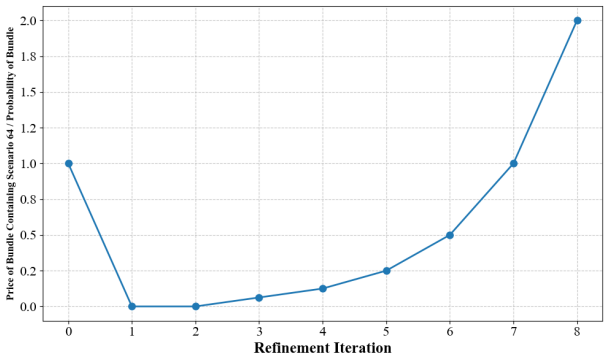
- Refining a bundle whose price is zero, while leaving other bundles unchanged, does not improve welfare (Proposition 1).
Reading between the lines
- The monotone welfare property gives a practical design rule for real markets: new instruments can be introduced one refinement at a time, and the dual prices of (7) identify which bundle carries the largest welfare gain, so a sequence of refinements can be chosen greedily.
- The convergence statement suggests a testable measure of market completeness: record the price of a fixed zero-sum trade as tradable instruments are added; the rate at which this price approaches zero can serve as an index of incomplete-market distortion.
- The zero-priced-bundle result implies that refinements must be coordinated: refining only bundles that nobody prices can stall welfare gains, an observation relevant to financial innovation in illiquid or segmented markets.
- The paper's proof strategy depends on exact equilibrium/social-welfare equivalence, so the conclusions should be expected to need modification for markets with transaction costs, bid-ask spreads, or non-convex risk preferences.
Signed reviews
Editorial analysis
A structured set of objections, weighed in public.
Referee Report
Summary. The paper studies incomplete risk markets in which agents evaluate liabilities by coherent risk measures. For a finite scenario set, trades are restricted to scenario bundles; by iteratively refining the partition, the authors argue that social welfare increases monotonically and prices converge to the complete-market outcome (Theorem 1, Proposition 1, Example 1). For countably many states (Section 3), the refinement idea is linked to Zame's asymptotic completeness theorem. For a general probability space (Section 4), the authors replace bundles by a filtration F_m, formulate a social optimization problem (5), characterize its dual via a minimax argument (Theorem 3), and prove upper semicontinuity of the optimal dual solution set at the complete market (Theorem 4), with Corollary 1 stating that incomplete-market risk prices price any zero-sum trade to zero in the limit. The main claimed contribution is a monotone market-completion mechanism with limit price convergence.
Significance. If the missing equivalence and existence results can be supplied, the paper would be a useful contribution to the literature on risk markets: it gives an iterative completion mechanism with monotone welfare improvement, connects the finite-bundle construction to a filtration-based limit, and Theorem 4's martingale argument is largely self-contained and appears correct modulo a local error in the appendix. The numerical examples in Sections 2 and 3 are reproducible and informative. However, because the central object is claimed to be a market equilibrium, the unproved welfare-equilibrium equivalence and the assumed existence of an optimal trade vector are the key risks; the significance of the paper depends on resolving them.
major comments (3)
- [§4.2, Eq. (5) and Theorem 3] The paper asserts that 'the market clearing problem can be expressed as a social optimization' (Eq. (5)) and, in Section 2, that the equilibrium is equivalent to the social problem (3), but it never states a formal definition of competitive equilibrium for the general probability-space model and never proves the equivalence. Theorem 3 shows that if W* solves (5), then there are Y*_i in D_i with common E[Y*_i|F_m]; it does not by itself show that W* and the price system Λ=E[Y*_i|F_m] make each agent's trade individually optimal. Since the subgradient inequality used in the proof gives E[uY*_i]=E[uΛ] only for u in L_p(F_m), the missing argument is likely available, but it must be supplied. The same proof assumes an optimal W* exists: the text says 'For any elements W* optimal...', and Theorem 4's market-price interpretation of the dual optima is vacuous if (5) has no solution. Boundedness below of (5) follows from Assumption 2, but attainment in the infinite-dimensional space L_p(F_m) does not, and no existence theorem is provided or cited.
- [§3, Definition 2 and Theorem 2] The statement that the uniform distance d∞(x,y)=sup_s|x(s)-y(s)| 'defines a complete and metrizable topology on L1(S,P)' is not correct as stated: d∞ is extended-valued on unbounded L1 functions and is not a metric, and the sup-norm topology is not complete in the usual sense on L1. More importantly, the convergence claim for the countable-state case is obtained by invoking Zame's Theorem 2 without checking that the model satisfies Zame's hypotheses (commodity space, preferences, asset span, topology). The displayed security matrix does show exact Arrow-Debreu replication, but asymptotic completeness in Zame's sense requires his theorem to apply; as written, the argument is incomplete.
- [Appendix A, proof of Theorem 4, Eq. (A.3)] In the case m_∞<∞, the display (A.3) asserts E[E[Y_i∞|F_m] W_i]=E[E[Y_i∞ W_i|F_m]] for arbitrary W_i in L_p; this equality is generally false (the left-hand side equals E[E[Y_i∞|F_m] E[W_i|F_m]], not E[Y_i∞ W_i]). The proof can be repaired locally: taking W_i=U, W_j=-U with U in F_m in the preceding display gives E[(Y_i∞-Y_j∞)U]=0 for all U in F_m, which directly yields E[Y_i∞|F_m]=E[Y_j∞|F_m]. The authors should correct the argument, since the version in the appendix contains an invalid step.
minor comments (4)
- [§4.1] The statement that L^{p1} ⊆ L^{p2} if and only if p1≥p2 is not correct as an equivalence for arbitrary probability spaces; the forward implication holds on finite measure spaces, but the converse can fail, for instance when all random variables are essentially bounded.
- [§2, first paragraph] There is a typo in 'In this this section'; it should read 'In this section'.
- [§3, Definition 2] Definition 2 says an equilibrium allocation of M_n is 'within ε of' an equilibrium allocation of M_CM, but the metric in which this distance is measured is not specified.
- [§4.3] The prose in §4.3 says the incomplete-market prices Y_i on F_m 'converge to the complete-market price Y0 as m→∞', which is stronger than Theorem 4. Theorem 4 only gives upper semicontinuity of the solution set, and if the complete-market solution set is not a singleton, arbitrary selections need not converge to a unique limit. Corollary 1's quantitative statement is accurate, but the surrounding prose should be softened unless uniqueness is proved.
Circularity Check
No circularity: the monotone welfare result is a constraint-relaxation effect, the price convergence is proved from external theorems plus weak-star compactness, and the self-citation to Ralph and Smeers is not load-bearing.
full rationale
I find no circular step in the derivation chain. Theorem 1's monotone welfare improvement follows from the observation that refining the partition relaxes the group constraints in the social optimization problem; the conclusion is not assumed but is the content of the relaxation. Theorem 3 derives the dual pricing condition E[Yi|Fm] equal for all i by applying Fan's minimax theorem and identifying S-perp as the equal-conditional-expectation subspace; the result is proved rather than imported. Theorem 4 and Corollary 1 establish upper semicontinuity of the solution sets of (7) and (8) using Bonnans-Shapiro Proposition 4.4 and weak-star compactness, so the claimed price convergence is a consequence of that semicontinuity, not an input. The citation to [3] (Ralph and Smeers), which involves co-author Danny Ralph, supplies the welfare-equilibrium viewpoint, but the paper gives its own proof of the dual characterization in the general setting; hence the self-citation is not load-bearing. The main support gaps are the unproved assertion in Section 4.2 that the market clearing problem 'can be expressed' as the social optimization (5), and the reliance in the proof of Theorem 3 on the assumed existence of an optimum; these are correctness and support issues, not circular reductions. Similarly, the claim in Section 3 that the uniform norm is complete on L1 is false, but that is a correctness problem rather than a circular one. For the circularity question, the derivation chain is self-contained.
Assumptions & free parameters
assumptions (5)
- domain assumption Each agent's coherent risk measure is representable as r_i(Z) = max{E[ZY] : Y in D_i} with D_i closed, convex, bounded in L^q (q conjugate of p), and the intersection of all D_i is nonempty.
- domain assumption The social optimization problem (5) is equivalent to the competitive equilibrium of the incomplete risk market in the general L^p setting.
- ad hoc to paper An optimal solution (W*_1,...,W*_n) to the social optimization problem exists.
- domain assumption The countable-state market sequences satisfy the hypotheses of Zame's asymptotic completeness theorem, and the uniform (sup) distance is a complete metric on the payoff space L^1(S,P).
- standard math Fan's minimax theorem applies to the social optimization problem (6)/(9).
Cite this review
Pith. "Pith review of On monotone completion of risk markets: Limit results for incomplete risk markets." pith.science (2026). https://pith.science/paper/P2LKINZ3
@misc{pith2026250418436,
  author       = {Pith},
  title        = {Pith review of: On monotone completion of risk markets: Limit results for incomplete risk markets},
  year         = {2026},
  howpublished = {\url{https://pith.science/paper/P2LKINZ3}},
  note         = {Machine review of arXiv:2504.18436}
}
read the original abstract
We consider a competitive market with risk-averse participants. We assume that agents' risks are measured by coherent risk measures introduced by Artzner et al. (1999). Fundamental theorems of welfare economics have long established the equivalence of competitive equilibria and system welfare optimization (see, e.g., Samuelson (1947)). These have been extended to the case of risk-averse agents with complete risk markets in Ralph and Smeers (2015). In this paper, we consider risk trading in incomplete markets and introduce a mechanism to complete the market iteratively while monotonically enhancing welfare.
Figures


Figures from the paper (1 more)
Reference graph
Works this paper leans on
-
[1]
P. Artzner, F. Delbaen, J.-M. Eber, D. Heath, Coherent measures of risk, Mathematical Finance 9 (3) (1999) 203–228. doi:10.1111/1467-9965.00068
arXiv 1999
-
[2]
P. A. Samuelson, Foundations of Economic Analysis, Harvard University Press, 1947
1947
- [3]
-
[4]
A. Bergson, Comparative productivity: the ussr, eastern europe, and the west, The American Economic Review (1987) 342–357
work page 1987
-
[5]
A. Bergson, The ussr before the fall: how poor and why, Journal of Economic Perspectives 5 (4) (1991) 29–44
work page 1991
-
[6]
J. R. Moroney, Energy consumption, capital and real output: A comparison of market and planned economies, Journal of comparative economics 14 (2) (1990) 199–220
work page 1990
-
[7]
M. Blaug, The fundamental theorems of modern welfare economics, historically contemplated., History of political economy 39 (2) (2007)
work page 2007
-
[8]
K. J. Arrow, An extension of the basic theorems of classical welfare economics, in: J. Neyman (Ed.), Proceedings of the Second Berkeley Symposium on Mathematical Statistics and Probability, University of California Press, Berkeley, CA, 1951, pp. 507–532
work page 1951
Show all 18 references
-
[9]
K. J. Arrow, The role of securities in the optimal allocation of risk-bearing, The Review of Economic Studies 31 (2) (1964) 91–96. URL http://www.jstor.org/stable/2296188
1964
-
[10]
Hart, On the optimality of equilibrium when the market structure is incomplete, Journal of Economic Theory 11 (3) (1975) 418–443
O. Hart, On the optimality of equilibrium when the market structure is incomplete, Journal of Economic Theory 11 (3) (1975) 418–443. URL https://EconPapers.repec.org/RePEc:eee:jetheo:v:11:y:1975:i:3:p:418-443
1975
-
[11]
Elul, Welfare effects of financial innovation in incomplete markets economies with several consump- tion goods, Journal of Economic Theory 65 (1) (1995) 43–78
R. Elul, Welfare effects of financial innovation in incomplete markets economies with several consump- tion goods, Journal of Economic Theory 65 (1) (1995) 43–78
1995
-
[12]
R. T. Rockafellar, S. Uryasev, et al., Optimization of conditional value-at-risk, Journal of risk 2 (2000) 21–42
2000
-
[13]
W. R. Zame, Asymptotic behavior of asset markets: asymptotic inefficiency, in: General Equilibrium, Growth, and Trade, Elsevier, 1993, pp. 203–233
1993
-
[14]
Anderson, A review of duality theory for linear programming over topological vector spaces, Journal of Mathematical Analysis and Applications 97 (2) (1983) 380–392
E. Anderson, A review of duality theory for linear programming over topological vector spaces, Journal of Mathematical Analysis and Applications 97 (2) (1983) 380–392. doi:https://doi.org/10.1016/ 0022-247X(83)90204-4. URL https://www.sciencedirect.com/science/article/pii/0022...
1983
-
[15]
J. H. Cochrane, J. Saa-Requejo, Beyond arbitrage: Good-deal asset price bounds in incomplete markets, Journal of Political Economy 108 (1) (2000) 79–119. URL http://www.jstor.org/stable/10.1086/262112
2000 doi
-
[16]
Fan, Minimax theorems, Proceedings of the National Academy of Sciences 39 (1) (1953) 42–47
K. Fan, Minimax theorems, Proceedings of the National Academy of Sciences 39 (1) (1953) 42–47
1953
-
[17]
J. F. Bonnans, A. Shapiro, Perturbation analysis of optimization problems, Springer Science & Business Media, 2013
2013
-
[18]
Durrett, Probability: theory and examples, Vol
R. Durrett, Probability: theory and examples, Vol. 49, Cambridge university press, 2019. April 28, 2025
2019
Reviewed August 16, 2026 · model on record in the stance chip above.
Discussion (0). Continue with ORCID to comment.