Universal photon blockade via two-photon light-matter interaction at chiral exceptional points
Pith reviewed 2026-06-26 20:42 UTC · model grok-4.3
The pith
Chiral exceptional points in a microcavity produce opposite photon statistics in modes traveling in different directions.
A machine-rendered reading of the paper's core claim, the machinery that carries it, and where it could break.
Core claim
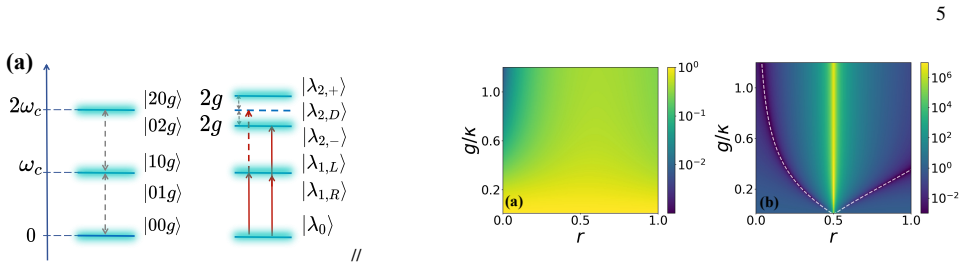
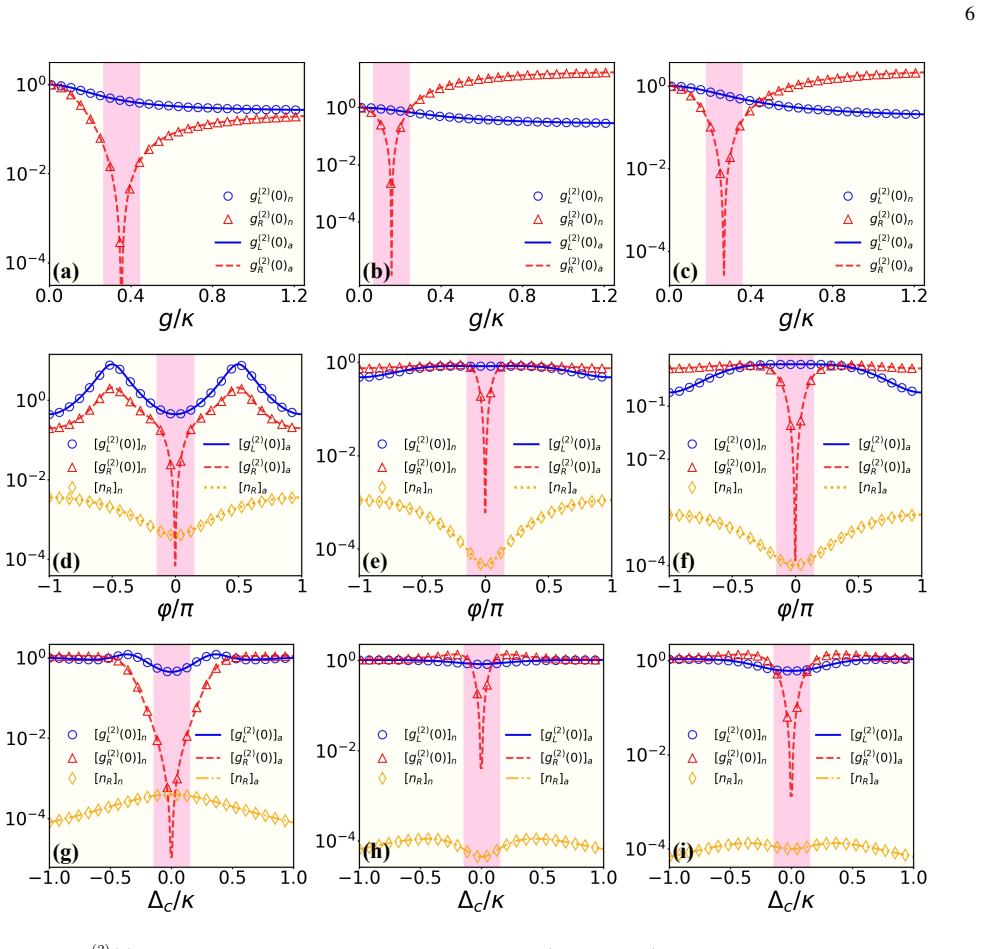
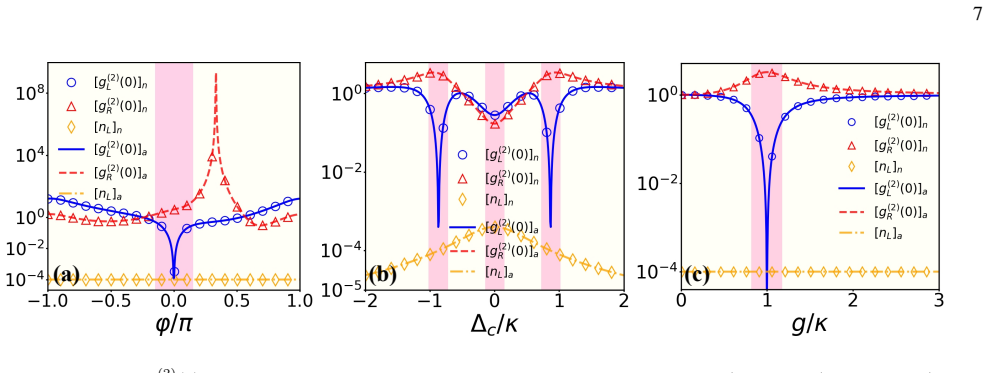
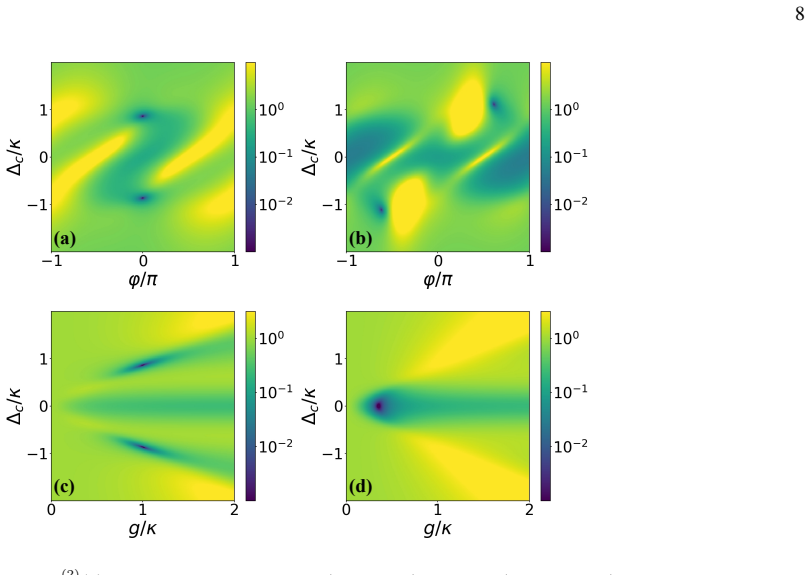
The presence of the CEPs leads to a stark contrast in the photon statistics of two whispering-gallery modes with opposite propagating directions. That is, one mode exhibits a strong PB effect while the other displays either sub-Poissonian or super-Poissonian distribution.
What carries the argument
Chiral exceptional points generated by two-photon light-matter interaction, which enforce nonreciprocal control over photon number distributions in counter-propagating modes.
If this is right
- The system supports multiplexing quantum sources that emit single photons in one direction and multiple photons in the opposite direction.
- Photon blockade becomes direction-dependent without requiring external magnetic fields or other symmetry-breaking elements.
- Selective generation of single-photon versus two-photon states follows from choosing the output port.
- The approach supplies a theoretical basis for nonreciprocal quantum optical devices built on microcavities.
Where Pith is reading between the lines
- The same contrast might appear in other non-Hermitian platforms if the two-photon coupling can be engineered to produce chiral points.
- Integrated photonic circuits could use this effect to route quantum light signals differently based on propagation direction.
- Experiments could test whether the effect survives when the cavity is coupled to waveguides or when thermal noise is added.
Load-bearing premise
The two-photon light-matter interaction in the microcavity is assumed to produce chiral exceptional points that directly control the nonreciprocal photon statistics as described.
What would settle it
Measure the second-order correlation function g(2) for light extracted from each of the two counter-propagating whispering-gallery modes and check whether one remains below 1 while the other rises above or equals 1 when the chiral exceptional points are present.
Figures


read the original abstract
The photon blockade (PB) effect is a hallmark non-classical phenomenon in quantum optics and finds important applications for building quantum sources, while the control of PB by the non-Hermitian exceptional points remains largely unexplored. In this work, we theoretically investigate universal photon blockade in a microcavity harboring chiral exceptional points (CEPs) for building multiplexing quantum sources with nonreciprocal photon statistics. The results reveal that the presence of the CEPs leads to a stark contrast in the photon statistics of two whispering-gallery modes with opposite propagating directions. That is, one mode exhibits a strong PB effect while the other displays either sub-Poissonian or super-Poissonian distribution. Our findings thus may pave the way for advanced applications of photon blockade, and provide a theoretical foundation for the selective generation of single-photon and two-photon emission
Editorial analysis
A structured set of objections, weighed in public.
Referee Report
Summary. The manuscript proposes a theoretical scheme for universal photon blockade (PB) in a microcavity system with two-photon light-matter interactions that generate chiral exceptional points (CEPs). It claims that these CEPs produce a stark directional contrast in photon statistics between counter-propagating whispering-gallery modes: one mode exhibits strong PB while the other shows sub-Poissonian or super-Poissonian statistics, enabling nonreciprocal single- or two-photon sources.
Significance. If the derivations hold, the result offers a route to nonreciprocal quantum light sources via non-Hermitian physics, extending PB control beyond Hermitian or reciprocal settings. The work builds on standard non-Hermitian quantum optics and provides a theoretical basis for multiplexing applications; the absence of free parameters in the core model (as implied by the CEP construction) is a positive feature.
major comments (2)
- [§3] §3, Eq. (8)–(10): the derivation of the CEP condition from the two-photon interaction Hamiltonian must be shown explicitly to confirm that the nonreciprocal statistics arise directly from the exceptional-point degeneracy rather than from auxiliary parameter tuning.
- [Fig. 4] Fig. 4 and associated text: the reported g^(2)(0) values for the two modes differ by more than an order of magnitude; the manuscript should include a parameter-sensitivity analysis to establish that this contrast persists under realistic fabrication tolerances.
minor comments (2)
- [Abstract] The abstract and introduction use 'universal' without a precise definition; clarify whether it refers to parameter independence or to the directional contrast alone.
- [§2] Notation for the two-photon coupling strength g_2 is introduced without an explicit comparison to the single-photon rate; add a sentence in §2 to fix the relative scale.
Simulated Author's Rebuttal
We thank the referee for the positive assessment and recommendation for minor revision. We address each major comment below and will incorporate the suggested changes into the revised manuscript.
read point-by-point responses
-
Referee: §3, Eq. (8)–(10): the derivation of the CEP condition from the two-photon interaction Hamiltonian must be shown explicitly to confirm that the nonreciprocal statistics arise directly from the exceptional-point degeneracy rather than from auxiliary parameter tuning.
Authors: We agree that an explicit step-by-step derivation strengthens the presentation. In the revised manuscript we will expand §3 to include the full algebraic derivation of the CEP condition directly from the two-photon interaction Hamiltonian, beginning with the matrix form of Eqs. (8)–(10) and showing how the exceptional-point degeneracy enforces the nonreciprocal photon statistics without auxiliary tuning. revision: yes
-
Referee: Fig. 4 and associated text: the reported g^(2)(0) values for the two modes differ by more than an order of magnitude; the manuscript should include a parameter-sensitivity analysis to establish that this contrast persists under realistic fabrication tolerances.
Authors: We acknowledge the importance of demonstrating robustness. In the revised version we will add a parameter-sensitivity analysis to the caption and text of Fig. 4, showing how the g^(2)(0) contrast behaves under small variations in the coupling strengths and detunings that correspond to typical fabrication tolerances in microcavity systems. revision: yes
Circularity Check
No significant circularity detected from available text
full rationale
The abstract and reader's summary provide no derivation details, equations, or self-citations. No load-bearing steps are visible that reduce predictions to fitted parameters, self-definitions, or author-specific uniqueness theorems. The central claim about CEPs controlling nonreciprocal photon statistics is presented as a standard theoretical investigation in non-Hermitian quantum optics without evidence of internal reduction to inputs by construction. The derivation chain cannot be assessed as circular from the given material and appears self-contained against external benchmarks.
Axiom & Free-Parameter Ledger
Reference graph
Works this paper leans on
-
[1]
Imamoglu, H
A. Imamoglu, H. Schmidt, G. Woods, and M. Deutsch, Strongly Interacting Photons in a Nonlinear Cavity, Phys. Rev. Lett.79, 1467 (1997)
1997
-
[3]
Zubizarreta Casalengua, J
E. Zubizarreta Casalengua, J. C. Lopez Carreno, F. P. Laussy, and E. del Valle, Conventional and Unconventional Photon Statistics, Laser Photonics Rev.14, 1900279 (2020)
2020
-
[4]
Li, Y .-L
M. Li, Y .-L. Zhang, S.-H. Wu, C.-H. Dong, X.-B. Zou, G.-C. Guo, and C.-L. Zou, Single-Mode Photon Blockade Enhanced by Bi-Tone Drive, Phys. Rev. Lett.129, 043601 (2022)
2022
-
[5]
Huang, S
R. Huang, S. K. ¨Ozdemir, J.-Q. Liao, F. Minganti, L.-M. Kuang, F. Nori, and H. Jing, Exceptional Photon Blockade: Engineer- ing Photon Blockade with Chiral Exceptional Points, Laser Photonics Rev.16, 2100430 (2022)
2022
-
[6]
Ben-Asher, A
A. Ben-Asher, A. I. Fern ´andez-Dom´ınguez, and J. Feist, Non- Hermitian Anharmonicity Induces Single-Photon Emission, Phys. Rev. Lett.130, 243601 (2023)
2023
-
[7]
Z.-G. Lu, Y . Wu, and X.-Y . L¨u, Chiral Interaction Induced Near- Perfect Photon Blockade, Phys. Rev. Lett.134, 013602 (2025)
2025
-
[8]
K. Hou, C. J. Zhu, Y . P. Yang, and G. S. Agarwal, Interfering pathways for photon blockade in cavity QED with one and two qubits, Phys. Rev. A100, 063817 (2019)
2019
-
[9]
Huang, A
R. Huang, A. Miranowicz, J.-Q. Liao, F. Nori, and H. Jing, Nonreciprocal Photon Blockade, Phys. Rev. Lett.121, 153601 (2018)
2018
-
[10]
Peyskens and D
F. Peyskens and D. Englund, Quantum photonics model for nonclassical light generation using integrated nanoplasmonic cavity-emitter systems, Phys. Rev. A97, 063844 (2018)
2018
-
[11]
J. Li, C. Ding, and Y . Wu, Enhanced photon antibunching via interference effects in a∆configuration, Phys. Rev. A100, 033814 (2019)
2019
-
[12]
Zubizarreta Casalengua, J
E. Zubizarreta Casalengua, J. C. L ´opez Carre ˜no, F. P. Laussy, and E. del Valle, Tuning photon statistics with coherent fields, Phys. Rev. A101, 063824 (2020)
2020
-
[13]
Lu, J.-F
Y .-W. Lu, J.-F. Liu, R. Li, Y . Wu, H. Tan, and Y . Li, Single- photon blockade in quasichiral atom–photon interaction: si- multaneous high purity and high efficiency, New J. Phys.24, 053029 (2022)
2022
-
[14]
Q. Bin, H. Jing, Y . Wu, F. Nori, and X.-Y . L¨u, and Y . Li, Nonre- ciprocal Bundle Emissions of Quantum Entangled Pairs, Phys. Rev. Lett.133, 043601 (2024)
2024
-
[15]
Lodahl, S
P. Lodahl, S. Mahmoodian, and S. Stobbe, Interfacing single photons and single quantum dots with photonic nanostructures, Rev. Mod. Phys.87, 347 (2015)
2015
-
[16]
J. Peng, J. Tang, P. Tang, Z. Ren, Junlong Tian, N. Barraza, G. A. Barrios, L. Lamata, and E. Solanoet al., Deterministic single-photon source in the ultrastrong-coupling regime, Phys. Rev. A108, L031701 (2023)
2023
-
[17]
T. C. H. Liew and V . Savona, Single Photons from Coupled Quantum Modes, Phys. Rev. Lett.104, 183601 (2010)
2010
-
[18]
Bamba, A
M. Bamba, A. Imamo ˘glu, I. Carusotto, and C. Ciuti, Origin of strong photon antibunching in weakly nonlinear photonic molecules, Phys. Rev. A83, 021802(R) (2011)
2011
-
[19]
Lu, J.-F
Y .-W. Lu, J.-F. Liu, R. Liu, and H.-X. Jiang, Enhanced quantum coherence of plasmonic resonances with a chiral exceptional points, Commun. Phys.7, 166 (2024)
2024
-
[20]
Vaneph, A
C. Vaneph, A. Morvan, G. Aiello, M. F ´echant, M. Aprili, J. Gabelli, and J. Est`eve, Observation of the Unconventional Pho- ton Blockade in the Microwave Domain, Phys. Rev. Lett.121, 043602 (2018)
2018
-
[21]
H. J. Snijders, J. A. Frey, J. Norman,et al., Observation of the Unconventional Photon Blockade, Phys. Rev. Lett.121, 043601 (2018)
2018
-
[22]
Zou, X.-Y
F. Zou, X.-Y . Zhang, X.-W. Xu, J.-F. Huang, and J.-Q. Liao, Multiphoton blockade in the two-photon Jaynes-Cummings model, Phys. Rev. A102, 053710 (2020)
2020
-
[23]
Marinelli,et al., Photon blockade in a Tavis-Cummings sys- tem, Phys
B. Marinelli,et al., Photon blockade in a Tavis-Cummings sys- tem, Phys. Rev. Applied24, 044103 (2025)
2025
-
[24]
Y .-H. Zhou, T. Liu, Q.-P. Su, X.-Y . Zhang, Q.-C. Wu, D.-X. Chen, Z.-C. Shi, H. Z. Shen, and C.-P. Yang, Universal Photon Blockade, Phys. Rev. Lett.134, 183601 (2025)
2025
-
[25]
Y .-H. Zhou, T. Liu, Q.-P. Su, Q.-C. Wu, B.-Q. Guo, Z.-C. Shi, H. Z. Shen, and C.-P. Yang, Universal photon blockade in two coupled cavities with Kerr nonlinearities, Phys. Rev. A113, 033722 (2026)
2026
-
[26]
G.-H. Lv, R. Hou, Y .-H. Zhou, X. Han, H.-F. Wang, and S. Zhang, Universal photon blockades via parametric amplifica- tion in second-order nonlinearly coupled cavities, Opt. Express 34, 421 (2026)
2026
-
[27]
Sun, W.-B
C.-Z. Sun, W.-B. Yan, R.-B. Yin, Z.-X. Man, Y .-J. Xia, Y .-J. Zhang, and Q.-Y . Cai, Universal nonreciprocal photon block- ade, Phys. Rev. A113, 033720 (2026)
2026
-
[28]
H. Xu, D. Mason, L. Jiang, and J. G. E. Harris, Topological energy transfer in an optomechanical system with exceptional points, Nature537, 80 (2016)
2016
-
[29]
J.-F. Liu, R. Su, Y . Zhao, and Y .-W. Lu, Nonreciprocal light- matter interaction in a plasmonic-photonic cavity with chiral exceptional points, Phys. Rev. A113, 023710 (2026)
2026
-
[30]
Miri and A
M.-A. Miri and A. Alu, Exceptional points in optics and pho- tonics, Science363, aar7709 (2019)
2019
-
[31]
C. Wang, Z. Fu, W. Mao, J. Qie, A. D. Stone, and L. Yang, Non-Hermitian optics and photonics: from classical to quan- tum, Adv. Opt. Photon.15, 442 (2023)
2023
-
[32]
Ramy El-Ganainy, et al, Non-Hermitian physics and PT sym- metry, Nature Physics14, 11 (2018)
2018
-
[33]
K.¨Ozdemir, S
S ¸. K.¨Ozdemir, S. Rotter, F. Nori, and L. Yang, Parity-time sym- metry and exceptional points in photonics, Nat. Mater.18, 783 (2019)
2019
-
[34]
Zhong, J
Q. Zhong, J. Ren, M. Khajavikhan, D. N. Christodoulides, S. K. ¨Ozdemir, and R. El-Ganainy, Sensing with Exceptional Sur- faces in Order to Combine Sensitivity with Robustness, Phys. Rev. Lett.122, 153902 (2019)
2019
-
[35]
H. Lee, L. Chang, A. Kecebas, D. Mao, Y . Xiao, T. Li, A. Alu, S. K. ¨Ozdemir, and T. Gu, Chiral exceptional point enhanced active tuning and nonreciprocity in micro-resonators, Light Sci. 10 Appl.14, 45 (2025)
2025
-
[36]
J. Li, M. Tang, X. Wang, C. N. Saggau, Y . Yin, L. Ma, Q. Song, O. G. Schmidt, and J. Wang, Reconfigurable resonance trapping in single optical microresonators, Newton1, 100171 (2025)
2025
-
[37]
H.-Z. Chen, T. Liu, H.-Y . Luan,et al., Revealing the missing dimension at an exceptional point, Nature Phys.16, 571 (2020)
2020
-
[38]
B. Li, Y . Zuo, L.-M. Kuang,et al., Loss-induced quantum non- reciprocity, npj Quantum Inf.10, 75 (2024)
2024
-
[39]
Y . Lu, Y . Zhao, R. Li, and J. Liu, Anomalous spontaneous emis- sion dynamics at chiral exceptional points, Opt. Express30. 41784 (2022)
2022
-
[40]
C. Wang, X. Jiang, G. Zhao, M. Zhang, C. W. Hsu, B. Peng, A. D. Stone, L. Jiang, and L. Yang, Electromagnetically induced transparency at a chiral exceptional point, Nat. Phys.16, 334 (2020)
2020
-
[41]
Penget al., Parity–time-symmetric whispering-gallery mi- crocavities, Nat
B. Penget al., Parity–time-symmetric whispering-gallery mi- crocavities, Nat. Phys.10, 394 (2014)
2014
-
[42]
H. Lee, A. Kecebas, F. Wang,et al., Chiral exceptional point and coherent suppression of backscattering in silicon microring with low loss Mie scatterer, eLight3, 20 (2023)
2023
-
[43]
Huang, J.-Q
J.-F. Huang, J.-Q. Liao, and L.-M. Kuang, Ultrastrong Jaynes- Cummings model, Phys. Rev. A101, 043835 (2020)
2020
-
[44]
Song and Y .-J
T.-Q. Song and Y .-J. Zhu, Solving Generalized Non-degenerate Two-Mode Two-Photon Jaynes–Cummings Model by Super- symmetric Unitary Transformation, Commun. Theor. Phys.38, 85 (2002)
2002
-
[45]
Zhang and J.-B
J.-S. Zhang and J.-B. Xu, Entanglement dynamics of two two- mode two-photon Jaynes–Cummings models in the presence of phase decoherence, Mod. Phys. Lett. B22, 561 (2008)
2008
-
[46]
H. J. Carmichael, Quantum trajectory theory for cascaded open systems, Phys. Rev. Lett.70, 2273 (1993)
1993
-
[47]
C. W. Gardiner, Driving a quantum system with the output field from another driven quantum system, Phys. Rev. Lett.70, 2269 (1993)
1993
-
[48]
Pichler, T
H. Pichler, T. Ramos, A. J. Daley, and P. Zoller, Quantum optics of chiral spin networks, Phys. Rev. A91, 042116 (2015)
2015
-
[49]
C. A. Downing, J. C. L ´opez Carre˜no, F. P. Laussy, E. del Valle, and A. I. Fern ´andez-Dom´ınguez, Quasichiral Interactions be- tween Quantum Emitters at the Nanoscale, Phys. Rev. Lett.122, 057401 (2019)
2019
-
[50]
M. O. Scully and M. S. Zubairy,Quantum Optics(Cambridge University Press, Cambridge, 1997)
1997
-
[51]
J. R. Johansson, P. D. Nation, and F. Nori, QuTiP: An open- source Python framework for the dynamics of open quantum systems, Comput. Phys. Commun.183, 1760 (2012)
2012
-
[52]
J. R. Johansson, P. D. Nation, and F. Nori, QuTiP 2: A Python framework for the dynamics of open quantum systems, Com- put. Phys. Commun.184, 1234 (2013)
2013
-
[53]
Zhang and Z
H. Zhang and Z. Duan, Photon blockade in the Jaynes- Cummings model with two-photon dissipation, Opt. Express 31, 22580 (2023)
2023
-
[54]
Tang, Quantum switching between nonclassical correlated single photons and two-photon bundles in a two-photon Jaynes- Cummings model, Opt
J. Tang, Quantum switching between nonclassical correlated single photons and two-photon bundles in a two-photon Jaynes- Cummings model, Opt. Express31, 12471 (2023)
2023
-
[55]
McCollum and I
C. McCollum and I. M. Mirza, Exploring photon blockade in multimode Jaynes-Cummings models with two-photon dissipa- tion, Phys. Rev. A113, 013733 (2026)
2026
-
[56]
Flayac and V
H. Flayac and V . Savona,Unconventional photon blockade, Phys. Rev. A96, 053810 (2017)
2017
-
[57]
Felicetti, D
S. Felicetti, D. Z. Rossatto, E. Rico, E. Solano, and P. Forn- D´ıaz,Two-photon quantum Rabi model with superconducting circuits, Phys. Rev. A97, 013851 (2018)
2018
-
[58]
J.-C. Tang, J. Zhao, H. Yang, J. Tian, P. Tang, S.-P. Wang, L. Lamata, and J. Peng, Deterministic two-photon controlled-Z gate with the two-photon quantum Rabi model, Phys. Rev. A 111, 052601 (2025)
2025
-
[59]
Li, L.-B
H.-J. Li, L.-B. Fan, S. Ma, J.-Q. Liao, and C.-C. Shu, Exploring photon blockade in a two-photon Jaynes-Cummings model with atom and cavity drivings, Phys. Rev. A110, 043707 (2024)
2024
-
[60]
L.-J. Feng, J. Ni, and S.-Q. Gong, Photon blockade induced by two-photon absorption in cavity quantum electrodynamics, Opt. Express32, 5117 (2024)
2024
-
[61]
Gerry and P
C. Gerry and P. Knight,Introductory Quantum Optics(Cam- bridge University Press, Cambridge, UK, 2005)
2005
discussion (0)
Sign in with ORCID, Apple, or X to comment. Anyone can read and Pith papers without signing in.