CMBolic: Symbolic emulators for the Cosmic Microwave Background. I. Lensing
Pith reviewed 2026-06-27 20:46 UTC · model grok-4.3
The pith
Symbolic analytic functions emulate the CMB lensing power spectrum to 0.3 percent accuracy.
A machine-rendered reading of the paper's core claim, the machinery that carries it, and where it could break.
Core claim
CMBolic emulates the lensing potential power spectrum C_ell^{phi phi} using analytic functions of model parameters and ell that achieve mean absolute fractional errors below 0.32 percent over the extended parameter space, and these emulators yield cosmological posteriors from ACT DR6 and Planck lensing data that match those obtained with CLASS while reducing computation time from two weeks to under three minutes.
What carries the argument
Analytic symbolic expressions, obtained via symbolic regression, that represent the lensing power spectrum directly as functions of the cosmological parameters and multipole ell.
If this is right
- The emulators support direct substitution into existing Bayesian inference pipelines without modification to the likelihood code.
- Runtime reductions make repeated analyses or scans over wide priors feasible on standard hardware.
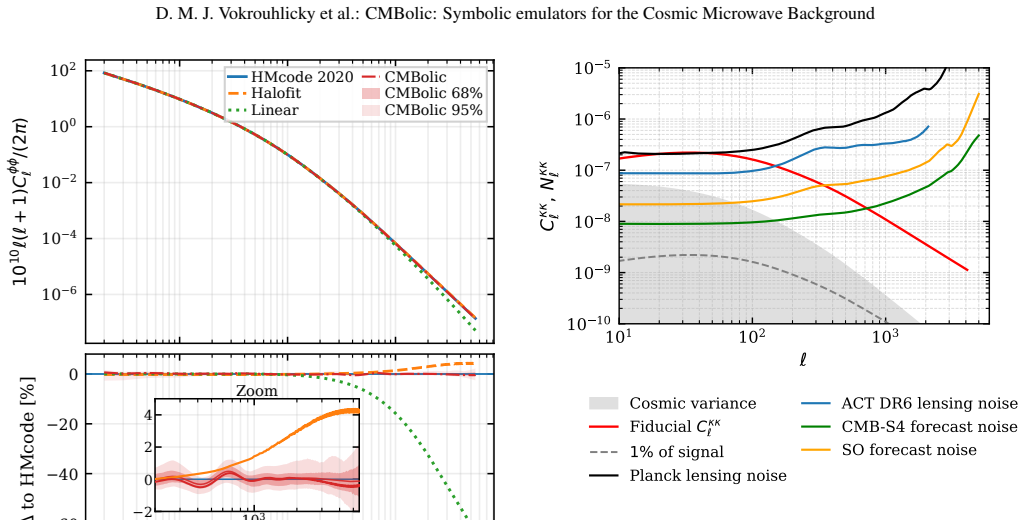
- The achieved accuracy lies below the noise levels projected for CMB Stage 4 surveys.
- The same symbolic approach can be applied to additional CMB spectra in later installments of the suite.
Where Pith is reading between the lines
- Analytic forms may enable direct differentiation or integration of the emulator expressions when deriving approximate scaling laws for lensing with dark energy or neutrino parameters.
- The method could lower barriers to exploring models with additional parameters that are currently expensive to sample with full Boltzmann solvers.
- Public release of the closed-form expressions would allow immediate incorporation into community analysis frameworks without retraining steps.
Load-bearing premise
The fitted symbolic expressions generalize accurately to the full extended parameter space and to the specific likelihoods from ACT DR6 and Planck without introducing systematic biases that shift the posteriors relative to CLASS.
What would settle it
A side-by-side run in which the parameter posteriors obtained from the ACT DR6 or Planck lensing likelihoods differ between CMBolic and CLASS by more than the statistical uncertainty of those datasets.
Figures





read the original abstract
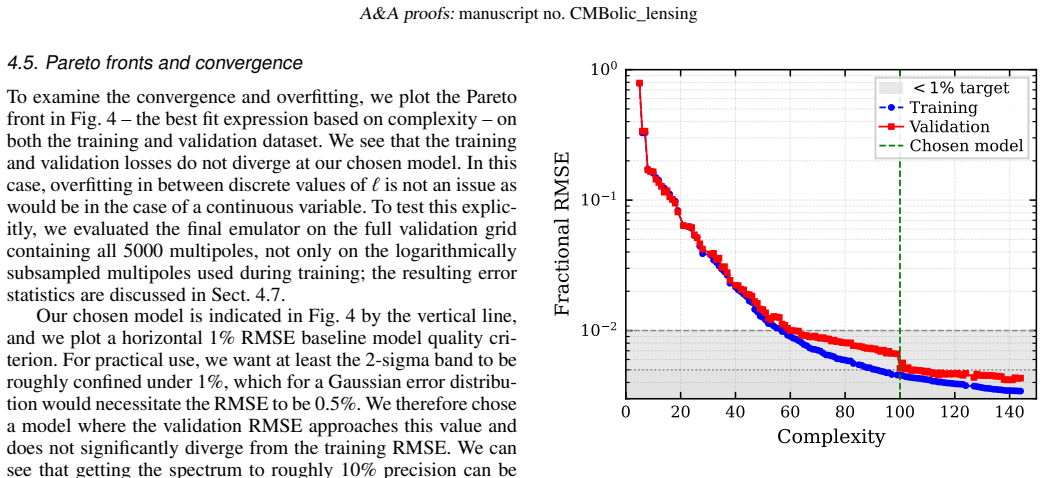
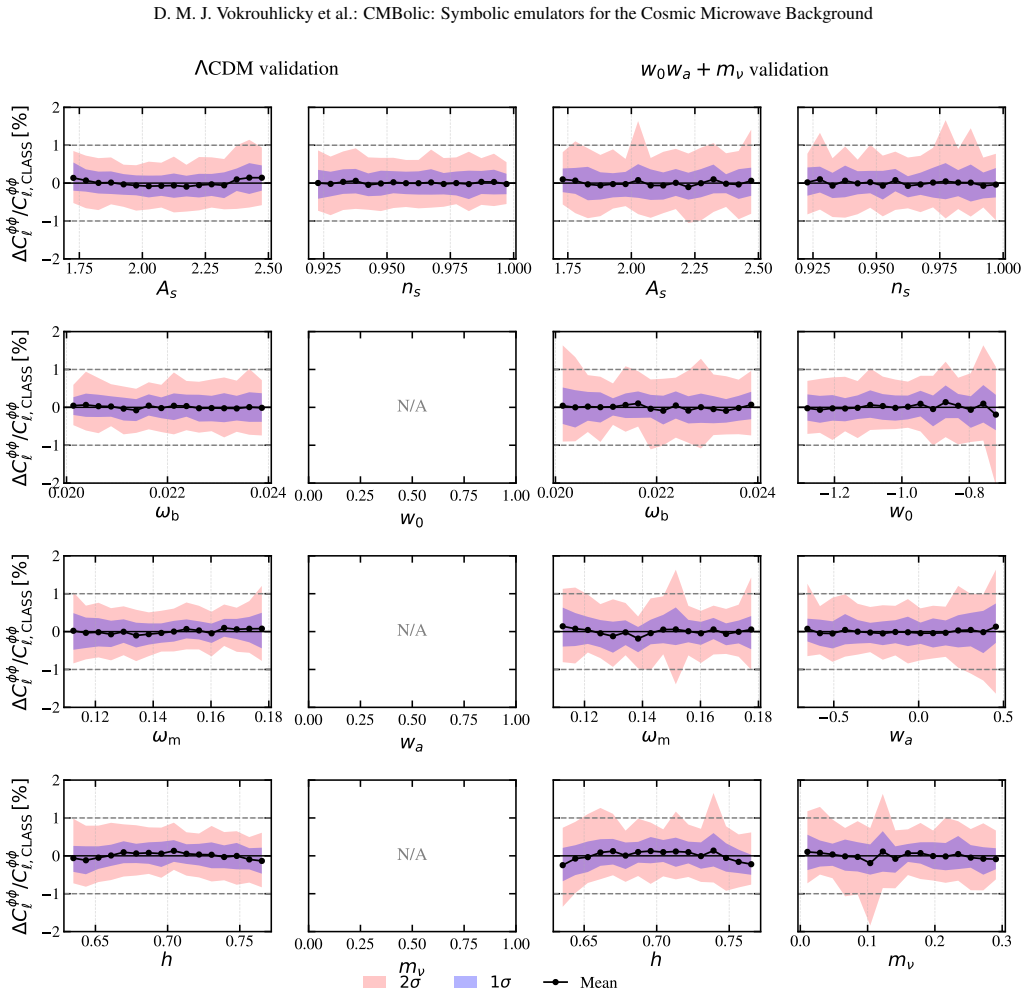
We present the first installment of CMBolic: a suite of symbolic cosmic microwave background (CMB) emulators. In this instance, we emulate the CMB lensing potential power spectrum $C_\ell^{\phi\phi}$ for the widely used extended $\Lambda$CDM model which simultaneously includes massive neutrinos and evolving dark energy modelled using the Chevallier-Polarski-Linder (CPL) parameterization. We achieve comparable precision to existing neural network emulators, with the added benefit of simpler handling as our emulators are analytic functions of the model parameters and multipole $\ell$. On independent validation spectra evaluated in the range $2\leq \ell \leq 5500$, CMBolic achieves mean absolute fractional errors of $0.27\%$ in the $\Lambda$CDM subspace and $0.32\%$ across the full extended parameter space. This emulation error is well below even the most optimistic noise forecasts from CMB Stage 4 experiments. We apply CMBolic to cosmological parameter estimation with Bayesian inference using the lensing-only likelihoods from ACT DR6 and Planck. We show excellent agreement between the posteriors obtained by CMBolic and the Boltzmann code CLASS. This demonstrates the practical use of CMBolic on cosmological parameter estimation, reducing the runtime from 2 weeks to under 3 minutes.
Editorial analysis
A structured set of objections, weighed in public.
Referee Report
Summary. The manuscript introduces CMBolic, a suite of symbolic emulators for the CMB lensing potential power spectrum C_ℓ^{φφ} in an extended ΛCDM cosmology that includes massive neutrinos and CPL dark energy. The emulators are presented as analytic functions of the model parameters and multipole ℓ, with reported mean absolute fractional errors of 0.27% in the ΛCDM subspace and 0.32% across the full extended parameter space on independent validation spectra for 2 ≤ ℓ ≤ 5500. The work applies these emulators to Bayesian parameter estimation using ACT DR6 and Planck lensing-only likelihoods, claiming excellent posterior agreement with the Boltzmann code CLASS and a reduction in runtime from 2 weeks to under 3 minutes.
Significance. If the precision claims and posterior agreement are robust, the symbolic approach offers an interpretable and easily deployable alternative to neural-network emulators for CMB spectra. The analytic form could enable faster inference and potentially greater transparency in cosmological analyses, with the demonstrated runtime reduction representing a clear practical benefit for applications involving repeated likelihood evaluations.
major comments (2)
- [Abstract] Abstract: The central claims of 0.27–0.32% mean absolute fractional errors and posterior agreement rest on aggregate validation statistics, but the manuscript provides no description of the symbolic regression algorithm, training data generation, sampled parameter ranges, or error propagation; without these, the support for uniformity of accuracy across the extended parameters (∑m_ν, w0, wa) cannot be assessed.
- [Parameter estimation section] Parameter estimation section: The claim of excellent agreement with CLASS posteriors is not accompanied by per-parameter residual maps, error dependence on extended parameters, or quantile differences in recovered posteriors; an aggregate error metric alone does not rule out systematic biases that could tilt the likelihood surface in regions of high neutrino mass or extreme dark-energy evolution.
Simulated Author's Rebuttal
We thank the referee for their careful reading of the manuscript and for highlighting areas where additional detail would strengthen the presentation. We address each major comment below. Where the comments identify gaps in the current text, we have revised the manuscript to incorporate the requested information and supporting figures.
read point-by-point responses
-
Referee: [Abstract] Abstract: The central claims of 0.27–0.32% mean absolute fractional errors and posterior agreement rest on aggregate validation statistics, but the manuscript provides no description of the symbolic regression algorithm, training data generation, sampled parameter ranges, or error propagation; without these, the support for uniformity of accuracy across the extended parameters (∑m_ν, w0, wa) cannot be assessed.
Authors: We agree that the manuscript would be improved by a more explicit and self-contained description of these elements. The symbolic regression procedure (using PySR), the generation of the training set with CLASS, the sampled ranges for the extended parameters, and the error metric definition are described in Sections 2 and 3, but these sections were not sufficiently cross-referenced from the abstract or results. We have added a concise methods summary to the abstract, expanded Section 2 with a dedicated paragraph on the regression algorithm and hyper-parameters, inserted the exact parameter ranges as a new table, and included a supplementary figure showing the fractional error distribution binned by ∑m_ν, w0, and wa to demonstrate uniformity across the extended space. revision: yes
-
Referee: [Parameter estimation section] Parameter estimation section: The claim of excellent agreement with CLASS posteriors is not accompanied by per-parameter residual maps, error dependence on extended parameters, or quantile differences in recovered posteriors; an aggregate error metric alone does not rule out systematic biases that could tilt the likelihood surface in regions of high neutrino mass or extreme dark-energy evolution.
Authors: The referee correctly notes that visual comparison of 1D/2D posteriors and an aggregate error figure are insufficient to exclude parameter-dependent biases. We have revised the parameter-estimation section to include: (i) a new figure showing the difference in the marginalized 1D posteriors for each sampled parameter (including ∑m_ν, w0, wa), (ii) a table reporting the 16th/50th/84th percentiles obtained with CMBolic versus CLASS for the ACT DR6 and Planck lensing analyses, and (iii) a supplementary plot of emulator error versus each extended parameter evaluated at the best-fit points. These additions confirm that no statistically significant shifts appear in the high-∑m_ν or extreme (w0, wa) regions. revision: yes
Circularity Check
No circularity; emulators are fitted to external Boltzmann outputs and validated on held-out spectra
full rationale
The paper describes fitting symbolic expressions for C_ℓ^φφ to spectra generated by the external code CLASS, then measuring mean absolute fractional errors on independent validation spectra (2≤ℓ≤5500) drawn from both ΛCDM and extended parameter spaces. Posteriors are compared directly to CLASS on ACT DR6 and Planck lensing likelihoods. No self-definitional equations, fitted-input-called-prediction steps, or load-bearing self-citations appear in the abstract or described chain. The central result (low emulation error and posterior agreement) is externally benchmarked rather than internally forced.
Axiom & Free-Parameter Ledger
Reference graph
Works this paper leans on
-
[1]
2019, arXiv preprint arXiv:1907.04473 Article number, page 12 D
Abazajian, K., Addison, G., Adshead, P., et al. 2019, arXiv preprint arXiv:1907.04473 Article number, page 12 D. M. J. V okrouhlicky et al.: CMBolic: Symbolic emulators for the Cosmic Microwave Background
Pith/arXiv arXiv 2019
-
[2]
2025a, arXiv e- prints, arXiv:2510.20453
AbdusSalam, S., Abel, S., Bartlett, D., & Crispim Romão, M. 2025a, arXiv e- prints, arXiv:2510.20453
-
[3]
2025, arXiv preprint arXiv:2503.00636
Abitbol, M., Abril-Cabezas, I., Adachi, S., et al. 2025, arXiv preprint arXiv:2503.00636
arXiv 2025
-
[4]
2025, Journal of Cosmology and As- troparticle Physics, 2025, 021
Adame, A., Aguilar, J., Ahlen, S., et al. 2025, Journal of Cosmology and As- troparticle Physics, 2025, 021
2025
-
[5]
2019, Journal of Cosmology and Astropar- ticle Physics, 2019, 056
Ade, P., Aguirre, J., Ahmed, Z., et al. 2019, Journal of Cosmology and Astropar- ticle Physics, 2019, 056
2019
-
[6]
A., Aghanim, N., Arnaud, M., et al
Ade, P. A., Aghanim, N., Arnaud, M., et al. 2016, Astronomy & Astrophysics, 594, A15
2016
-
[7]
2020, Astronomy & Astrophysics, 641, A8
Aghanim, N., Akrami, Y ., Ashdown, M., et al. 2020, Astronomy & Astrophysics, 641, A8
2020
-
[8]
2019, Jour- nal of Cosmology and Astroparticle Physics, 2019, 028
Albers, J., Fidler, C., Lesgourgues, J., Schöneberg, N., & Torrado, J. 2019, Jour- nal of Cosmology and Astroparticle Physics, 2019, 028
2019
-
[9]
E., Zennaro, M., Contreras, S., et al
Angulo, R. E., Zennaro, M., Contreras, S., et al. 2021, MNRAS, 507, 5869
2021
-
[10]
2020, Journal of Cosmology and Astroparticle Physics, 2020, 021 Aricò, G., Angulo, R
Archidiacono, M., Hannestad, S., & Lesgourgues, J. 2020, Journal of Cosmology and Astroparticle Physics, 2020, 021 Aricò, G., Angulo, R. E., & Zennaro, M. 2021, arXiv e-prints, arXiv:2104.14568
arXiv 2020
-
[11]
Asgari, M. et al. 2021, Astron. Astrophys., 645, A104
2021
-
[12]
2025, arXiv preprint arXiv:2507.05858
Bahl, H., Fuchs, E., Menen, M., & Plehn, T. 2025, arXiv preprint arXiv:2507.05858
arXiv 2025
-
[13]
2024, Astronomy & Astrophysics, 686, A10
Balkenhol, L., Trendafilova, C., Benabed, K., & Galli, S. 2024, Astronomy & Astrophysics, 686, A10
2024
-
[14]
J., Kammerer, L., Kronberger, G., et al
Bartlett, D. J., Kammerer, L., Kronberger, G., et al. 2023, arXiv preprint arXiv:2311.15865
arXiv 2023
-
[15]
Bartlett, D. J. & Pandey, S. 2025, arXiv e-prints, arXiv:2510.18749
Pith/arXiv arXiv 2025
-
[16]
Bartlett, D. J., Wandelt, B. D., Zennaro, M., Ferreira, P. G., & Desmond, H. 2024, arXiv preprint arXiv:2402.17492
arXiv 2024
-
[17]
C., et al
Bolliet, B., Spurio Mancini, A., Hill, J. C., et al. 2024, Monthly Notices of the Royal Astronomical Society, 531, 1351
2024
-
[18]
2024, The Open Journal of Astro- physics, 7
Bonici, M., Bianchini, F., & Ruiz-Zapatero, J. 2024, The Open Journal of Astro- physics, 7
2024
-
[19]
2025, JCAP, 2025, 044
Bonici, M., D’Amico, G., Bel, J., & Carbone, C. 2025, JCAP, 2025, 044
2025
-
[20]
2020, in Proceedings of the 2020 Genetic and Evolutionary Computation Conference Companion, GECCO ’20 (New York, NY , USA: Association for Computing Machinery), 1562–1570
Burlacu, B., Kronberger, G., & Kommenda, M. 2020, in Proceedings of the 2020 Genetic and Evolutionary Computation Conference Companion, GECCO ’20 (New York, NY , USA: Association for Computing Machinery), 1562–1570
2020
-
[21]
Calabrese, E., Hill, J. C., Jense, H. T., et al. 2025a, arXiv preprint arXiv:2503.14454
-
[22]
2022, Journal of Cosmology and As- troparticle Physics, 2022, 039
Carron, J., Mirmelstein, M., & Lewis, A. 2022, Journal of Cosmology and As- troparticle Physics, 2022, 039
2022
-
[23]
Cava, W. G. L., Orzechowski, P., Burlacu, B., et al. 2021, CoRR, abs/2107.14351 [2107.14351]
arXiv 2021
-
[24]
2023, arXiv preprint arXiv:2305.01582 de França, F
Cranmer, M. 2023, arXiv preprint arXiv:2305.01582 de França, F. O. & Kronberger, G. 2025, arXiv preprint arXiv:2501.17848
Pith/arXiv arXiv 2023
- [25]
-
[26]
Fendt, W. A. & Wandelt, B. D. 2007a, arXiv e-prints, arXiv:0712.0194
-
[27]
& Rubin, D
Gelman, A. & Rubin, D. B. 1992, Statistical science, 7, 457
1992
-
[28]
2024, Advances in Neural Information Processing Systems, 37, 44678
Grayeli, A., Sehgal, A., Costilla Reyes, O., Cranmer, M., & Chaudhuri, S. 2024, Advances in Neural Information Processing Systems, 37, 44678
2024
-
[29]
Green, D. & Meyers, J. 2025, Physical Review D, 111, 083507 Günther, S. 2023, arXiv preprint arXiv:2307.01138 Günther, S., Lesgourgues, J., Samaras, G., et al. 2022, Journal of Cosmology and Astroparticle Physics, 2022, 035
arXiv 2025
-
[30]
2016, Journal of Low Temper- ature Physics, 184, 772
Henderson, S., Allison, R., Austermann, J., et al. 2016, Journal of Low Temper- ature Physics, 184, 772
2016
- [31]
-
[32]
J., Kronberger, G., Desmond, H., & Ferreira, P
Kammerer, L., Bartlett, D. J., Kronberger, G., Desmond, H., & Ferreira, P. G. 2025, Astron. Astrophys., 701, A284
2025
-
[33]
2002, Astrophys
Kaplinghat, M., Knox, L., & Skordis, C. 2002, Astrophys. J., 578, 665
2002
-
[34]
Knabenhans, M. et al. 2021, Mon. Not. Roy. Astron. Soc., 505, 2840
2021
-
[35]
1995, Physical Review D, 52, 4307
Knox, L. 1995, Physical Review D, 52, 4307
1995
-
[36]
Koza, J. R. 1992, Genetic programming: on the programming of computers by means of natural selection (Cambridge, MA, USA: MIT Press)
1992
-
[37]
M., & Affenzeller, M
Kronberger, G., Burlacu, B., Kommenda, M., Winkler, S. M., & Affenzeller, M. 2024, Symbolic Regression (Chapman & Hall/CRC Press)
2024
-
[38]
2011, arXiv preprint arXiv:1104.2932
Lesgourgues, J. 2011, arXiv preprint arXiv:1104.2932
Pith/arXiv arXiv 2011
-
[39]
& Challinor, A
Lewis, A. & Challinor, A. 2011, Astrophysics source code library, ascl
2011
-
[40]
Limber, D. N. 1953, Astrophysical Journal, vol. 117, p. 134, 117, 134
1953
-
[41]
2025, arXiv preprint arXiv:2503.14743
Lodha, K., Calderon, R., Matthewson, W., et al. 2025, arXiv preprint arXiv:2503.14743
Pith/arXiv arXiv 2025
-
[42]
Madhavacheril, M. S. et al. 2024, Astrophys. J., 962, 113
2024
-
[43]
2021, Monthly Notices of the Royal Astronomical Society, 502, 1401
Mead, A., Brieden, S., Tröster, T., & Heymans, C. 2021, Monthly Notices of the Royal Astronomical Society, 502, 1401
2021
-
[44]
2016, Monthly Notices of the Royal Astronomical Society, 459, 1468
Mead, A., Heymans, C., Lombriser, L., et al. 2016, Monthly Notices of the Royal Astronomical Society, 459, 1468
2016
-
[45]
J., Peacock, J
Mead, A. J., Peacock, J. A., Heymans, C., Joudaki, S., & Heavens, A. F. 2015, Monthly Notices of the Royal Astronomical Society, 454, 1958
2015
-
[46]
R., Sorourifar, F., Peng, Y ., & Paulson, J
Muthyala, M. R., Sorourifar, F., Peng, Y ., & Paulson, J. A. 2025, Industrial & Engineering Chemistry Research
2025
-
[47]
B., Hannestad, S., & Tram, T
Nygaard, A., Holm, E. B., Hannestad, S., & Tram, T. 2023, Journal of Cosmol- ogy and Astroparticle Physics, 2023, 025
2023
-
[48]
2019, PyTorch: An Imperative Style, High- Performance Deep Learning Library
Paszke, A., Gross, S., Massa, F., et al. 2019, PyTorch: An Imperative Style, High- Performance Deep Learning Library
2019
-
[49]
Qu, F. J. et al. 2024, Astrophys. J., 962, 112
2024
-
[50]
A., Kronberger, G., & Winkler, S
Radwan, Y . A., Kronberger, G., & Winkler, S. 2024, arXiv preprint arXiv:2406.03585
arXiv 2024
-
[51]
Secco, L. F. et al. 2022, Phys. Rev. D, 105, 103537
2022
-
[52]
2019, arXiv preprint arXiv:1906.10134
Sehgal, N., Aiola, S., Akrami, Y ., et al. 2019, arXiv preprint arXiv:1906.10134
arXiv 2019
-
[53]
E., Peacock, J
Smith, R. E., Peacock, J. A., Jenkins, A., et al. 2003, Monthly Notices of the Royal Astronomical Society, 341, 1311 Spurio Mancini, A., Piras, D., Alsing, J., Joachimi, B., & Hobson, M. P. 2022, Monthly Notices of the Royal Astronomical Society, 511, 1771
2003
-
[54]
J., Pandey, S., et al
Sui, C., Bartlett, D. J., Pandey, S., et al. 2025, Astron. Astrophys., 698, A1
2025
-
[55]
2012, The As- trophysical Journal, 761, 152
Takahashi, R., Sato, M., Nishimichi, T., Taruya, A., & Oguri, M. 2012, The As- trophysical Journal, 761, 152
2012
-
[56]
& Koksbang, S
Thing, M. & Koksbang, S. 2025, Journal of Cosmology and Astroparticle Physics, 2025, 040
2025
-
[57]
2023, Journal of Cosmology and Astropar- ticle Physics, 2023, 016
To, C.-H., Rozo, E., Krause, E., et al. 2023, Journal of Cosmology and Astropar- ticle Physics, 2023, 016
2023
-
[58]
& Lewis, A
Torrado, J. & Lewis, A. 2021, Journal of Cosmology and Astroparticle Physics, 2021, 057
2021
-
[59]
Virgolin, M. & Pissis, S. P. 2022, Transactions on Machine Learning Research [arXiv:2207.01018] V okrouhlicky, D. & Skordis, C. 2026, in preparation Article number, page 13 A&A proofs:manuscript no. CMBolic_lensing Appendix A: CLASS settings The full recommended accuracy settings for CLASS from the ACT DR6 analysis are "N_ncdm": 1, "N_ur": 2.0308, "T_cmb"...
arXiv 2022
discussion (0)
Sign in with ORCID, Apple, or X to comment. Anyone can read and Pith papers without signing in.