REVIEW 4 major objections 5 minor 36 references
Trustworthy GNNs with LLMs: A Systematic Review and Taxonomy
T0 review · 4 major / 5 minor · reviewed 2026-08-08 · deepseek-v4-flash
Pith's one-line read This survey claims to be the first to organize LLM-GNN trust research into a taxonomy of reliability, robustness, privacy, and reasoning.
desk verdict A readable but overclaimed survey: the four-part taxonomy is a plausible orientation device, but the 'first systematic review' claim needs a real method and crisper category boundaries. read the letter →
The pith
A machine-rendered reading of the paper's core claim, the machinery that carries it, and where it could break.
The reading
What carries the argument
The taxonomy itself is the central object: a two-level classification (four trust dimensions, each populated by named methods) that appears in Figure 2. It does the work of turning a scattered literature into comparative categories: reliability groups methods that regenerate or edit graph data to reduce inherent noise; robustness groups methods that restore or evaluate structure under adversarial perturbation; privacy groups methods that distill LLM knowledge into local GNNs or otherwise limit exposure; reasoning groups methods that use LLM inference and explanation to make graph decisions transparent. The categories are meant to clarify connections and differences among approaches and to expose gaps such as fairness and text-free graphs.
What would settle it
Find a published LLM-GNN trust method that cannot be placed in any of the four categories, or that fits reliability and robustness equally well with no stated tie-breaker; either would show that the claimed partition is not a natural division of the field.
Extended reading notes
Core claim
The paper claims to be the first to propose a taxonomy specifically for LLM-GNN integration aimed at trustworthiness. It classifies existing methods into reliability (handling non-adversarial noise and distribution shift), robustness (withstanding malicious structure and feature perturbations), privacy (defending against membership, inversion, attribute, and model-extraction attacks), and reasoning (including explainability). Within each category it surveys representative approaches—for example, LLM-generated pseudo-labels and graph edits for reliability, LLM-based edge repair for robustness, knowledge distillation for privacy, and LLM reasoning graphs for interpretation—and it uses the taxonomy to identify limitations and future directions. The four categories are presented as the organizing axes of a map for trusted integration of LLMs with GNNs.
Load-bearing premise
The taxonomy's four categories—reliability, robustness, privacy, and reasoning—are assumed to be an exhaustive and mutually exclusive way to divide all trustworthy LLM-GNN methods, yet the survey offers no formal rule for assigning a method to exactly one category.
Editorial extensions
If this is right
- Researchers gain a common vocabulary that lets new LLM-GNN trust methods be positioned as reliability, robustness, privacy, or reasoning contributions, making cross-paper comparison easier.
- The taxonomy reveals concrete gaps: distribution shift under reliability, text-free graphs under robustness, privacy protection rather than privacy attacks, and fairness are all flagged as underexplored agendas.
- Placing explainability inside the reasoning category implies that explanation-oriented LLM-GNN work is expected to justify its trust contribution in terms of reasoning support.
- If the categories are adopted, evaluation benchmarks, such as robustness under topological attacks, can be organized by category, easing reproducibility and comparison across studies.
Reading between the lines
- The four categories are not formally disjoint: structural noise (reliability) and topological attacks (robustness) differ mainly in attacker intent, so a method like edge pruning could be filed under either; a sharper taxonomy might add an explicit adversarial-versus-non-adversarial axis.
- The privacy category is populated mostly by distillation to avoid sending sensitive text to LLM APIs; a testable extension is to classify emerging differentially private or federated LLM-GNN training under the same category and compare their guarantees.
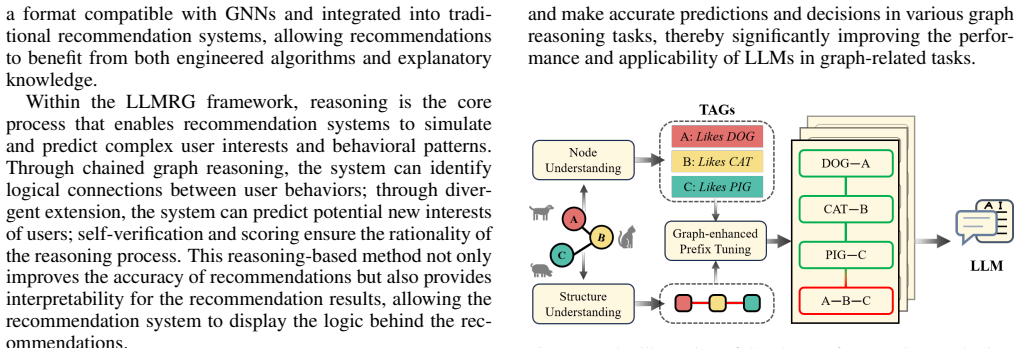
- Placing explainability inside reasoning implies that future explanation methods will be judged by how well they support LLM-style reasoning chains; splitting transparency from inference quality would likely change how methods like VGRL and LLMRG are compared.
Editorial analysis
A structured set of objections, weighed in public.
Referee Report
Summary. This manuscript surveys the integration of large language models (LLMs) and graph neural networks (GNNs) for trustworthy graph learning. It proposes a four-category taxonomy—reliability, robustness, privacy, and reasoning—and briefly reviews representative methods in each category, including LLMDGCN, GraphEdit, LLM4RGNN, LLMGRobustness, LLM-GNN distillation, LLMRG, GraphLLM, GREASELM, LLMEP, and VGRL. The paper also discusses future directions such as privacy-robustness trade-offs, low-text-dependency LLM-GNN models, multimodal LLMs, and fairness. The central claim, stated in the Contributions section, is that this is the first taxonomy specifically for LLM-GNN integration aimed at improving model trustworthiness, and that the taxonomy clarifies connections and differences among approaches.
Significance. If the taxonomy were well-defined and the survey genuinely comprehensive, the paper would provide a useful organizing resource for a rapidly growing area bridging LLMs and graph learning, and its future-work discussion on privacy-robustness conflicts and fairness would be valuable. The manuscript usefully collects several recent methods and highlights important open problems. However, because the taxonomy's category boundaries are not operationalized, the coverage is limited to about ten methods, and no systematic selection protocol is reported, the claimed contributions are currently more of a focused position survey than a systematic, first-of-its-kind taxonomy. The paper does not provide code, data, or machine-checked artifacts; reproducibility concerns therefore apply to the survey methodology rather than to computational results.
major comments (4)
- [Sections 3.1 and 3.2, Figure 2] The taxonomy lacks a decision rule for assigning methods to categories, and the reliability and robustness categories overlap. Section 3.1 defines reliability as handling 'non-adversarial threats' such as inherent structural, attribute, and label noise, while Section 3.2 defines robustness as maintaining performance under perturbations and explicitly includes 'random noise in the data' alongside malicious attacks. Random non-adversarial structural noise therefore falls in both categories. The operational overlap is concrete: LLM4RGNN (Robustness, Section 3.2) and GraphEdit (Reliability, Section 3.1) both use LLM-based edge addition or removal, differing only in the assumed intent of the noise. Please provide an explicit assignment criterion, such as adversary intent, method mechanism, or optimization objective, and reclassify or justify the borderline cases.
- [Section 3 and Figure 2] The 'systematic review' and 'first taxonomy' claims are not supported by a reproducible methodology. The paper does not report a search strategy, database list, time span, inclusion or exclusion criteria, screening procedure, or coverage analysis, and Figure 2 displays only ten methods. Without such a protocol, the reader cannot determine whether the taxonomy organizes the field or a convenience sample of representative work. Please add a methodology section that specifies how papers were collected and selected, or substantially weaken the systematic and comprehensive claims and position the paper as a focused survey.
- [Sections 3.4 and 4] The taxonomy's exhaustiveness is asserted rather than derived. Section 3.4 states, 'we put reasoning and explainability together,' without justifying why these constitute a single trustworthiness dimension, especially since explainability is often treated separately in the trustworthy-GNN literature. Section 4 then describes fairness as 'an important subfield of trustworthy,' yet no fairness category appears in Figure 2 or in the four-part taxonomy. Since the categories are not derived from a closed definition of trustworthiness, the claim that the taxonomy clarifies connections and differences among approaches is undercut. Please justify the four dimensions, add fairness or explicitly explain its omission, and provide criteria for mutual exclusivity and exhaustiveness.
- [Sections 3.1-3.4] The paper lists methods and describes their frameworks but does not compare them on consistent axes such as task type, graph modality, text dependency, attack model, LLM usage strategy, or reported quantitative gains. A comparison table summarizing each method's category, mechanism, datasets, and limitations would be necessary to substantiate the claim that the taxonomy clarifies 'connections and differences among various approaches.' Without such synthesis, the review remains descriptive rather than analytically useful for choosing among methods.
minor comments (5)
- [Abstract and Introduction] There are typos and grammatical errors, including 'the the trusted integration' in the abstract and 'LLMS' in the introduction; the paper would benefit from a careful proofreading pass.
- [Section 3.2 and Figure 4] The text referencing Figure 4(a) and Figure 4(b) appears inconsistent with the figure caption: the caption labels (a) as LLM4RGNN and (b) as LLMGRobustness, while the body text associates the LLM-as-enhancer/predictor discussion with Figure 4(a) and the edge-predictor framework with Figure 4(b). Please align the text and figure labels.
- [Section 3.3 and Figure 5] The sentence beginning 'One existing solution is to train a GNN model using an LLM...' does not name the method and ends in a dangling clause, making the described solution difficult to identify from the text alone; please complete the sentence and cite the specific approach.
- [References] Reference formatting is inconsistent: one entry appears as 'Zhang et al., ]' with missing year and title, and several arXiv preprints lack version identifiers or access dates; please normalize all references.
- [Section 2.2] The message-passing update is described only verbally with a bullet list of symbols; adding the standard update equation would improve precision for readers not already familiar with GNNs.
Circularity Check
No circularity: the taxonomy is a qualitative construction with no derivation; self-cited VGRL is an illustrative example and not load-bearing.
full rationale
This paper is a literature survey and taxonomy; it contains no equations, fitted parameters, or quantitative predictions whose outputs could reduce to their inputs. The central claim—that the four-category taxonomy is the first in the LLM-GNN trustworthiness area—is a novelty and framing claim, not a derived theorem. The taxonomy categories (Reliability, Robustness, Privacy, Reasoning) are introduced by definition in Section 3, and the survey's content consists of classifying cited prior methods. The same-author preprint VGRL [Ji et al., 2024] is used as one of five examples under Reasoning/Explainability (Section 3.4), but the category definition and the survey's supporting characterization rest on independently authored methods (LLMRG, GraphLLM, GREASELM, LLMEP); removing VGRL would not alter the taxonomy or its claimed utility. Other self-citations (e.g., [Zhang et al., 2023b], [Pan et al., 2024b]) are background or generic support and are not load-bearing. The manuscript's weaknesses—overlapping category boundaries (e.g., inherent noise under Reliability vs. random noise under Robustness), no formal assignment criterion, and no reported systematic search protocol—are correctness/completeness concerns about whether the taxonomy is well-founded, not circularity concerns: they do not show that the survey's content is equivalent to its inputs by construction. Therefore no circular step is exhibited and the score is 0.
Assumptions & free parameters
assumptions (2)
- domain assumption The four trustworthiness categories, reliability, robustness, privacy, and reasoning, are exhaustive and mutually exclusive for LLM-GNN trustworthiness work.
- domain assumption LLM integration improves GNN trustworthiness.
Cite this review
Pith. "Pith review of Trustworthy GNNs with LLMs: A Systematic Review and Taxonomy." pith.science (2026). https://pith.science/paper/P5FYAKBN
@misc{pith2026250208353,
  author       = {Pith},
  title        = {Pith review of: Trustworthy GNNs with LLMs: A Systematic Review and Taxonomy},
  year         = {2026},
  howpublished = {\url{https://pith.science/paper/P5FYAKBN}},
  note         = {Machine review of arXiv:2502.08353}
}
read the original abstract
With the extensive application of Graph Neural Networks (GNNs) across various domains, their trustworthiness has emerged as a focal point of research. Some existing studies have shown that the integration of large language models (LLMs) can improve the semantic understanding and generation capabilities of GNNs, which in turn improves the trustworthiness of GNNs from various aspects. Our review introduces a taxonomy that offers researchers a clear framework for comprehending the principles and applications of different methods and helps clarify the connections and differences among various approaches. Then we systematically survey representative approaches along the four categories of our taxonomy. Through our taxonomy, researchers can understand the applicable scenarios, potential advantages, and limitations of each approach for the the trusted integration of GNNs with LLMs. Finally, we present some promising directions of work and future trends for the integration of LLMs and GNNs to improve model trustworthiness.
Figures


Figures from the paper (4 more)



Reference graph
Works this paper leans on
-
[1]
Compositional fairness constraints for graph embeddings
[Bose and Hamilton, 2019] Avishek Bose and William Hamilton. Compositional fairness constraints for graph embeddings. In International Conference on Machine Learning, pages 715–724. PMLR,
work page 2019
-
[5]
Graph Learning with Localized Neighborhood Fairness
[Chen et al., 2022] April Chen, Ryan Rossi, Nedim Lipka, Jane Hoffswell, Gromit Chan, Shunan Guo, Eunyee Koh, Sungchul Kim, and Nesreen K Ahmed. Graph learn- ing with localized neighborhood fairness. arXiv preprint arXiv:2212.12040,
work page Pith review arXiv 2022
-
[8]
[Fionda, 2019] Valeria Fionda. Networks in biology. In Shoba Ranganathan, Michael Gribskov, Kenta Nakai, and Christian Sch ¨onbach, editors, Encyclopedia of Bioinfor- matics and Computational Biology , pages 915–921. Aca- demic Press, Oxford,
work page 2019
-
[9]
Learning on graphs with large language models (llms): A deep dive into model robustness
[Guo et al., 2024a] Kai Guo, Zewen Liu, Zhikai Chen, Hongzhi Wen, Wei Jin, Jiliang Tang, and Yi Chang. Learning on graphs with large language models (llms): A deep dive into model robustness. arXiv preprint arXiv:2407.12068,
-
[10]
Beijing Uni- versity of Posts and Telecommunications, University of Hong Kong, Institute of Computing Technology, Chinese Academy of Sciences, National University of Singapore. [Guo et al., 2025] Daya Guo, Dejian Yang, Haowei Zhang, Junxiao Song, Ruoyu Zhang, Runxin Xu, Qihao Zhu, Shi- rong Ma, Peiyi Wang, Xiao Bi, et al. Deepseek-r1: In- centivizing reas...
arXiv 2025
-
[12]
[Ji et al., 2022] Y . Ji, L. Zhang, J. Wu, B. Wu, L.-K. Huang, T. Xu, Y . Rong, L. Li, J. Ren, D. Xue, H. Lai, S. Xu, J. Feng, W. Liu, P. Luo, S. Zhou, J. Huang, P. Zhao, and Y . Bian. Drugood: Out-of-distribution (ood) dataset cura- tor and benchmark for ai-aided drug discovery – a focus on affinity prediction problems with noise annotations. arXiv e-prints, jan
work page 2022
-
[13]
[Ji et al., 2024] Xingyu Ji, JiaLe Liu, Lu Li, Maojun Wang, and Zeyu Zhang. Verbalized graph representation learn- ing: A fully interpretable graph model based on large lan- guage models throughout the entire process. Preprint,
work page 2024
-
[14]
[Jiang et al., 2021] Dejun Jiang, Zhenxing Wu, Chang-Yu Hsieh, Guangyong Chen, Ben Liao, Zhe Wang, Chao Shen, Dongsheng Cao, Jian Wu, and Tingjun Hou. Could graph neural networks learn better molecular representa- tion for drug discovery? a comparison study of descriptor- based and graph-based models. Journal of Cheminformat- ics, 13(12),
work page 2021
Show all 36 references
-
[16]
Llm-empowered few-shot node classifica- tion on incomplete graphs with real node degrees,
[Li et al., 2024] Yun Li, Yi Yang, Jiaqi Zhu, Hui Chen, and Hongan Wang. Llm-empowered few-shot node classifica- tion on incomplete graphs with real node degrees,
2024
-
[17]
[Liu et al., 2023] Yang Liu, Yuanshun Yao, Jean-Francois Ton, Xiaoying Zhang, Ruocheng Guo Hao Cheng, Yegor Klochkov, Muhammad Faaiz Taufiq, and Hang Li
Institute of Software, Chinese Academy of Sciences, Bei- jing, China; University of Chinese Academy of Sciences, Beijing, China. [Liu et al., 2023] Yang Liu, Yuanshun Yao, Jean-Francois Ton, Xiaoying Zhang, Ruocheng Guo Hao Cheng, Yegor Klochkov, Muhammad Faaiz Taufiq, and Han...
2023 arXiv
-
[18]
Learning to drop: Robust graph neural network via topological denoising
[Luo et al., 2021] Dongsheng Luo, Wei Cheng, Wenchao Yu, Bo Zong, Jingchao Ni, Haifeng Chen, and Xiang Zhang. Learning to drop: Robust graph neural network via topological denoising. In WSDM,
2021
-
[19]
Large language models in cybersecurity: State-of-the-art
[Motlagh et al., 2023] Farzad Nourmohammadzadeh Mot- lagh, Mehrdad Hajizadeh, Mehryar Majd, Pejman Na- jafi, Feng Cheng, and Christoph Meinel. Large language models in cybersecurity: State-of-the-art. arXiv preprint arXiv:2304.13712,
2023 arXiv
-
[20]
[Pan et al., 2024b] Yiru Pan, Xingyu Ji, Jiaqi You, Lu Li, Zhenping Liu, Xianlong Zhang, Zeyu Zhang, and Maojun Wang
Emory University, Department of Com- puter Science, Atlanta, GA, USA. [Pan et al., 2024b] Yiru Pan, Xingyu Ji, Jiaqi You, Lu Li, Zhenping Liu, Xianlong Zhang, Zeyu Zhang, and Maojun Wang. Csgdn: Contrastive signed graph diffusion network for predicting crop gene-phenotype asso...
-
[21]
Learning transferable visual models from nat- ural language supervision
[Radford et al., 2021] Alec Radford, Jong Wook Kim, Chris Hallacy, Aditya Ramesh, Gabriel Goh, Sandhini Agar- wal, Girish Sastry, Amanda Askell, Pamela Mishkin, Jack Clark, et al. Learning transferable visual models from nat- ural language supervision. In Proceedings of the In...
2021
-
[22]
Fairdrop: Biased edge dropout for enhancing fairness in graph representa- tion learning
[Spinelli et al., 2021] Indro Spinelli, Simone Scardapane, Amir Hussain, and Aurelio Uncini. Fairdrop: Biased edge dropout for enhancing fairness in graph representa- tion learning. IEEE Transactions on Artificial Intelligence, 3(3):344–354,
2021
-
[23]
[Wang et al., 2021] J. Wang, S. Zhang, Y . Xiao, and R. Song. A review on graph neural network methods in financial applications. arXiv preprint, arXiv:2111.15367,
2021 arXiv
-
[24]
Enhancing rec- ommender systems with large language model reasoning graphs
[Wang et al., 2023] Yan Wang, Zhixuan Chu, Xin Ouyang, Simeng Wang, Hongyan Hao, Yue Shen, Jinjie Gu, Siqiao Xue, James Y Zhang, Qing Cui, et al. Enhancing rec- ommender systems with large language model reasoning graphs. arXiv preprint arXiv:2308.10835,
2023 arXiv
-
[25]
Chi, Quoc V
[Wei et al., 2022] Jason Wei, Xuezhi Wang, Dale Schuur- mans, Maarten Bosma, Brian Ichter, Fei Xia, Ed H. Chi, Quoc V . Le, and Denny Zhou. Chain-of-thought prompt- ing elicits reasoning in large language models. arXiv preprint arXiv:2201.11903,
2022 arXiv
-
[26]
A com- prehensive survey on graph neural networks
[Wu et al., 2020] Zonghan Wu, Shirui Pan, Fengwen Chen, Guodong Long, Chengqi Zhang, and S Yu Philip. A com- prehensive survey on graph neural networks. IEEE trans- actions on neural networks and learning systems, 32(1):4– 24,
2020
-
[27]
Graph learning: A survey
[Xia et al., 2021] Feng Xia, Ke Sun, Shuo Yu, Abdul Aziz, Liangtian Wan, Shirui Pan, and Huan Liu. Graph learning: A survey. IEEE Transactions on Artificial Intelligence , 2(2):109–127,
2021
-
[28]
Review of graph-based hazardous event detection meth- ods for autonomous driving systems
[Xiao et al., 2023] Dannier Xiao, Mehrdad Dianati, William Gonc ¸alves Geiger, and Roger Woodman. Review of graph-based hazardous event detection meth- ods for autonomous driving systems. IEEE Transactions on Intelligent Transportation Systems , 24(5):4697–4715,
2023
-
[29]
Graphformers: Gnn- nested transformers for representation learning on textual graph
[Yang et al., 2021] Junhan Yang, Zheng Liu, Shitao Xiao, Chaozhuo Li, Defu Lian, Sanjay Agrawal, Amit Singh, Guangzhong Sun, and Xing Xie. Graphformers: Gnn- nested transformers for representation learning on textual graph. Advances in Neural Information Processing Sys- tems, ...
2021
-
[30]
The dawn of lmms: Preliminary explorations with gpt-4v (ision)
[Yang et al., 2023] Zhengyuan Yang, Linjie Li, Kevin Lin, Jianfeng Wang, Chung-Ching Lin, Zicheng Liu, and Li- juan Wang. The dawn of lmms: Preliminary explorations with gpt-4v (ision). arXiv preprint arXiv:2309.17421 , 9(1):1,
2023 arXiv
-
[31]
Fairsin: Achieving fairness in graph neural networks through sensitive information neutralization
[Yang et al., 2024] Cheng Yang, Jixi Liu, Yunhe Yan, and Chuan Shi. Fairsin: Achieving fairness in graph neural networks through sensitive information neutralization. In Proceedings of the AAAI Conference on Artificial Intelli- gence, volume 38, pages 9241–9249,
2024
-
[32]
Drope- dge not foolproof: Effective augmentation method for signed graph neural networks
[Zhang et al., ] Zeyu Zhang, Lu Li, Shuyan Wan, Sijie Wang, Zhiyi Wang, Zhiyuan Lu, Dong Hao, and Wanli Li. Drope- dge not foolproof: Effective augmentation method for signed graph neural networks. InThe Thirty-eighth Annual Conference on Neural Information Processing Systems....
2022 arXiv
-
[33]
Rsgnn: A model-agnostic ap- proach for enhancing the robustness of signed graph neu- ral networks
[Zhang et al., 2023b] Zeyu Zhang, Jiamou Liu, Xianda Zheng, Yifei Wang, Pengqian Han, Yupan Wang, Kaiqi Zhao, and Zijian Zhang. Rsgnn: A model-agnostic ap- proach for enhancing the robustness of signed graph neu- ral networks. In Proceedings of the ACM Web Conference 2023, pag...
2023
-
[34]
[Zhang et al., 2024c] Zhongjian Zhang, Xiao Wang, Huichi Zhou, Yue Yu, Mengmei Zhang, Cheng Yang, and Chuan Shi
Stanford University. [Zhang et al., 2024c] Zhongjian Zhang, Xiao Wang, Huichi Zhou, Yue Yu, Mengmei Zhang, Cheng Yang, and Chuan Shi. Can large language models improve the adversar- ial robustness of graph neural networks? arXiv preprint arXiv:2408.08685,
-
[35]
A survey of large language models
[Zhao et al., 2023] Wayne Xin Zhao, Kun Zhou, Junyi Li, Tianyi Tang, Xiaolei Wang, Yupeng Hou, Yingqian Min, Beichen Zhang, Junjie Zhang, Zican Dong, et al. A survey of large language models. arXiv preprint arXiv:2303.18223,
2023 arXiv
-
[36]
Fair graph representation learning via sensitive attribute disentanglement
[Zhu et al., 2024] Yuchang Zhu, Jintang Li, Zibin Zheng, and Liang Chen. Fair graph representation learning via sensitive attribute disentanglement. In Proceedings of the ACM on Web Conference 2024, pages 1182–1192, 2024
2024
-
[2019]
Language models are few-shot learners
[Brown et al., 2020] Tom Brown, Benjamin Mann, Nick Ry- der, Melanie Subbiah, Jared D Kaplan, Prafulla Dhari- wal, Arvind Neelakantan, Pranav Shyam, Girish Sastry, Amanda Askell, et al. Language models are few-shot learners. NeurIPS,
2020
-
[2020]
Graphllm: Boosting graph reasoning ability of large language model
[Chai et al., 2023] Ziwei Chai, Tianjie Zhang, Liang Wu, Kaiqiao Han, Xiaohai Hu, Xuanwen Huang, and Yang Yang. Graphllm: Boosting graph reasoning ability of large language model. arXiv preprint arXiv:2310.05845,
2023 arXiv
-
[2021]
A survey of graph meets large language model: Progress and future directions
[Li et al., 2023] Yuhan Li, Zhixun Li, Peisong Wang, Jia Li, Xiangguo Sun, Hong Cheng, and Jeffrey Xu Yu. A survey of graph meets large language model: Progress and future directions. arXiv preprint arXiv:2311.12399,
2023 arXiv
-
[2022]
Exploring the potential of large language models (llms) in learning on graphs
[Chen et al., 2024] Zhikai Chen, Haitao Mao, Hang Li, Wei Jin, Hongzhi Wen, Xiaochi Wei, Shuaiqiang Wang, Dawei Yin, Wenqi Fan, Hui Liu, et al. Exploring the potential of large language models (llms) in learning on graphs. ACM SIGKDD Explorations Newsletter, 25(2):42–61,
2024
-
[2023]
Iterative deep graph learning for graph neural net- works: Better and robust node embeddings
[Chen et al., 2020] Yu Chen, Lingfei Wu, and Mohammed Zaki. Iterative deep graph learning for graph neural net- works: Better and robust node embeddings. In NeurIPS,
2020
-
[2024]
A survey for in-context learning
[Dong et al., 2022] Qingxiu Dong, Lei Li, Damai Dai, Ce Zheng, Zhiyong Wu, Baobao Chang, Xu Sun, Jingjing Xu, and Zhifang Sui. A survey for in-context learning. arXiv preprint, arXiv:2301.00234,
2022 arXiv
-
[2025]
Harnessing explanations: Llm-to-lm interpreter for en- hanced text-attributed graph representation learning.arXiv preprint arXiv:2305.19523,
[He et al., 2023] Xiaoxin He, Xavier Bresson, Thomas Lau- rent, Adam Perold, Yann LeCun, and Bryan Hooi. Harnessing explanations: Llm-to-lm interpreter for en- hanced text-attributed graph representation learning.arXiv preprint arXiv:2305.19523,
2023 arXiv
Reviewed August 8, 2026 · model on record in the stance chip above.
Discussion (0). Continue with ORCID to comment.