REVIEW 4 major objections 4 minor 2 cited by
Helicity effect on turbulent passive and active scalar diffusivities
T0 review · 4 major / 4 minor · reviewed 2026-08-10 · deepseek-v4-flash
Pith's one-line read Kinetic helicity increases the turbulent diffusivity of passive and active scalars, opposite to its effect on turbulent magnetic diffusivity.
desk verdict Solid new test-field measurements showing a ~10-15% helicity enhancement of turbulent scalar diffusivity, but the printed theory in Eq. (16) has a sign error that makes the claimed agreement impossible. read the letter →
The pith
A machine-rendered reading of the paper's core claim, the machinery that carries it, and where it could break.
The reading
What carries the argument
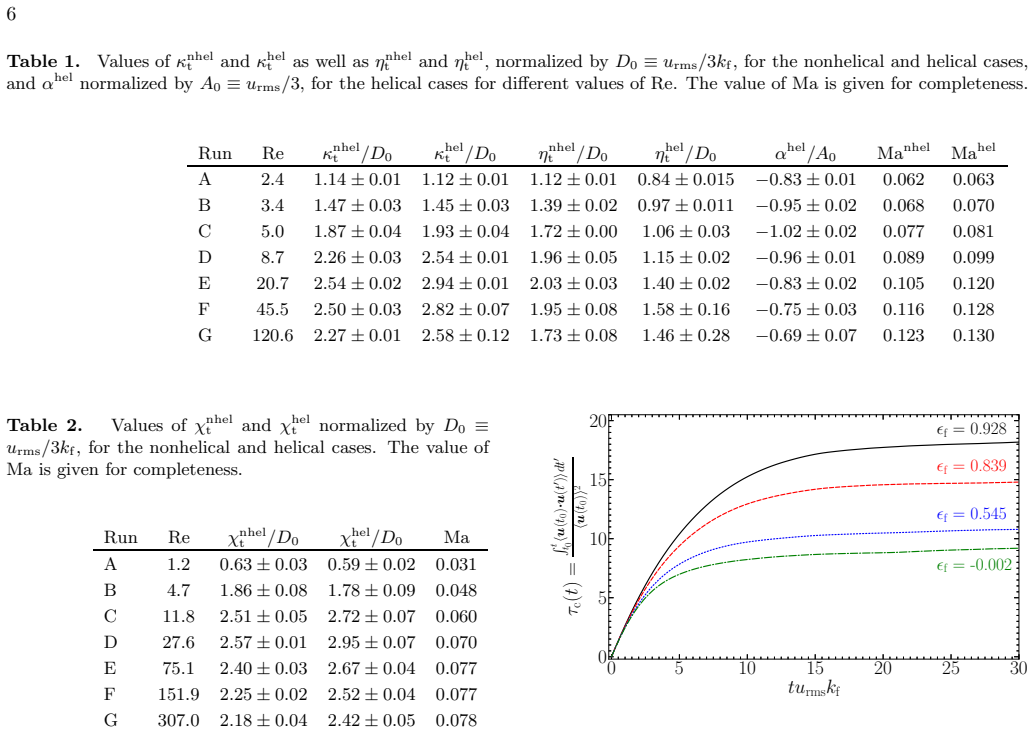
The central mechanism is the dependence of the turbulent correlation time $\tau_c$ on kinetic helicity $H_K = \langle \mathbf{u}\cdot\boldsymbol{\omega}\rangle$. The paper measures $\tau_c$ two ways—through the time integral of the velocity autocorrelation and through the energy-to-dissipation ratio $E_K/\epsilon_K$—and finds growth with the fractional helicity $\epsilon_f = H_K/(k_f u_{\rm rms}^2)$, fitted as $\tau_c/\tau_0 \approx 1+0.5\epsilon_f^4$. Combined with the theoretical transport coefficients, $\eta_t(H_K) = \eta_{t0}(\tau_c/\tau_0)(1 - \tau_c^2 H_K^2/(3\langle u^2\rangle))$ and $\kappa_t(H_K) = \kappa_{t0}(\tau_c/\tau_0)(1 - \tau_c^2 H_K^2/(6\langle u^2\rangle))$, the increased correlation time overcompensates the negative helical correction for scalars but not for magnetic fields. The numerical workhorse is the test-field method, which solves auxiliary equations for fluctuations induced by imposed large-scale sinusoidal test fields and extracts $\eta_t$, $\kappa_t$, and $\chi_t$ from the resulting mean fluxes.
What would settle it
A matched pair of simulations with identical forcing spectra and Mach number, differing only by the addition of helicity in the forcing, would settle the attribution: if $\kappa_t$ and $\tau_c$ do not increase, the claim fails.
Extended reading notes
Core claim
Working with forced homogeneous turbulence and sinusoidal test fields, the paper establishes that the turbulent scalar diffusivity $\kappa_t$ is larger when the flow carries kinetic helicity than when it does not, while under the same conditions the turbulent magnetic diffusivity $\eta_t$ is smaller. Tables 1 and 2 show the $\kappa_t$ and $\chi_t$ enhancement for $Re \gtrsim 10$, with the effect absent at the smallest Reynolds number. The proposed mechanism is a lengthening of the velocity correlation time by helicity: measured both from the velocity autocorrelation integral and from the kinetic-energy-to-dissipation ratio, $\tau_c$ rises with the fractional helicity $\epsilon_f$, consistent with $\tau_c/\tau_0 \approx 1 + 0.5\epsilon_f^4$. Inserting this into the companion theory's expressions for $\eta_t(H_K)$ and $\kappa_t(H_K)$ yields suppression for the magnetic diffusivity and enhancement for the scalar diffusivity, matching the simulations. The paper also notes that simulations where helicity is produced self-consistently by rotating stratified turbulence do not show the scalar enhancement, which it ascribes to rotational suppression of turbulent transport.
Load-bearing premise
The central attribution assumes the helical and nonhelical runs differ only in the injected kinetic helicity, so the measured increases in $\kappa_t$, $\chi_t$, and $\tau_c$ come from helicity rather than from the slightly different Mach numbers or unchanged forcing statistics.
Editorial extensions
If this is right
- Mean-field models of stellar convection and other helical flows should use a larger turbulent scalar and thermal diffusivity than nonhelical calibrations predict at the same Reynolds number.
- Astrophysical estimates of turbulent magnetic diffusivity that ignore helicity will be systematically too high, while estimates of chemical or thermal mixing will be systematically too low.
- Closure schemes for turbulent transport must include a helicity-dependent correlation time; approaches that omit it predict the wrong sign for the scalar correction.
- The growth of $\tau_c$ with helicity implies that helicity alters the effective eddy turnover time, which may also affect transport coefficients such as turbulent viscosity.
- The weak dependence of the scalar enhancement on forcing wavenumber suggests the effect persists across a range of turbulent scales.
Reading between the lines
- The Appendix A discrepancy suggests a decisive test: force stratified rotating turbulence with and without explicit helical injection; if the scalar enhancement appears only with forced helicity, the conclusion applies to externally helical flows and not to helicity generated self-consistently by rotation and stratification.
- A direct measurement of $\tau_c$ at higher Reynolds numbers would clarify whether the $\epsilon_f^4$ growth and the resulting diffusivity enhancement saturate; if they saturate, the quantitative predictions would need revision.
- If the correlation-time mechanism is correct, helicity should also measurably change turbulent viscosity, since it shares the same $\tau_c$ prefactor; this could be checked with existing Reynolds-stress measurements.
- The opposite signs of the magnetic and scalar corrections offer a possible diagnostic: in a helical astrophysical flow, comparing the mixing of a chemical tracer with the evolution of a magnetic field could constrain the local fractional helicity.
Editorial analysis
A structured set of objections, weighed in public.
Referee Report
Summary. The paper reports direct numerical simulations of isothermal and nonisothermal turbulence in which the turbulent passive scalar diffusivity κt and the active scalar (thermal) diffusivity χt are measured with the test-field method for helical and nonhelical forcing. The central numerical claim is that kinetic helicity enhances κt and χt by about 10–15% for Reynolds numbers above about 10, opposite to the well-known suppression of the turbulent magnetic diffusivity ηt. The paper additionally reports that the turbulent correlation time τc increases with fractional helicity, and presents this as the key theoretical interpretation, citing a companion theory paper. A comparison with rotating stratified turbulence in Appendix A shows no such enhancement, which the authors attribute to rotational suppression without a quantitative test.
Significance. If the numerical result stands, it identifies a new and potentially important transport effect: helicity affects scalar diffusion in the opposite sense from magnetic diffusion. The test-field simulations are direct measurements, not derived from the theory, so the core numerical finding is not circular. The paper also offers a falsifiable prediction (the correlation-time increase) and provides data tables with error bars. However, the theoretical comparison, which is a central part of the paper's interpretation, contains apparent sign and normalization errors that, as printed, contradict the reported numerical enhancements.
major comments (4)
- [§3.3, Eq. (16)] Equation (16), κt(HK)=κt0 (τc/τ0)(1 − τc² HK²/(6⟨u²⟩)), contains a negative helicity correction. Combining it with Eq. (17), τc/τ0≈1+0.5 εf⁴, yields κt/κt0 = t(1 − t² εf²/6) with t=1+0.5 εf⁴. For the fully helical runs (εf≈0.93, as in Fig. 5), this evaluates to ≈1.00, and the maximum over all εf is only ≈1.02 near εf≈0.8. This is mathematically incapable of producing the 10–16% enhancements reported in Tables 1 and 2 (e.g., κhel/κnhel=1.14 at Re=120; χhel/χnhel=1.12 at Re=152). As written, the printed formula predicts a slight reduction for small εf and a negligible increase at most. The theoretical interpretation therefore cannot explain the central numerical result; either Eq. (16) has a sign typo or the curves in Fig. 7 do not come from Eqs. (15)–(17).
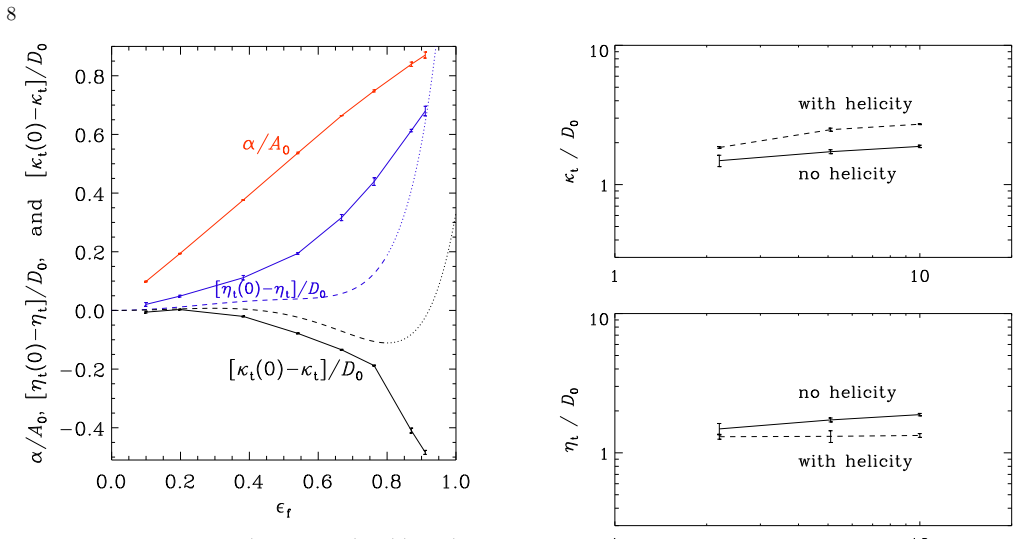
- [§3.3, text before Fig. 7] The text states that "the turbulent diffusion coefficient for the scalar field is increased by the kinetic helicity," but the figure is described as plotting κt(0)−κt. With Eq. (16) having a minus sign, κt(0)−κt is positive when κt is reduced, so a positive curve in Fig. 7 would indicate suppression, not enhancement. The textual claim and the plotted quantity are therefore inconsistent. This is not a cosmetic issue—it prevents the reader from knowing whether the figure actually supports the stated conclusion.
- [§3.3, Eq. (17) vs. Fig. 6] The empirical fit τc/τ0 ≈ 1 + 0.5 εf⁴ appears to be inconsistent with the data shown in Figure 6. In that figure, the normalized correlation time τc urms kf (= τc/τ0, since τ0=(urms kf)⁻¹) is approximately 2.5 at εf=0 and rises to about 7.5 at εf≈0.93 for the correlation-based estimate, with the dissipation-based estimate showing a similar offset. A fit of the form τc/τ0 ≈ 2.5 + 5 εf⁴ (with considerable scatter) would describe the data, not 1 + 0.5 εf⁴. The offset of roughly 2.5 is missing from Eq. (17). Since Eq. (17) is presented as the basis for the theoretical comparison, its mismatch with the displayed data is a load-bearing error.
- [§3.3, reliability warning] The paper explicitly states that the theoretical results for εf ≳ 0.8 "may not be reliable" and plots those parts with dotted lines. However, the fully helical runs in Tables 1 and 2 correspond precisely to that regime (εf≈0.93), and Figure 7 presumably compares the numerical data at these high εf values with the theory. Any apparent agreement in Fig. 7 therefore occurs in the regime where the authors themselves doubt the theory, which undermines the claimed validation. The authors should either provide a quantitative criterion for reliability or restrict the comparison to εf values where the theory is trusted.
minor comments (4)
- [Fig. 5] The y-axis label in Figure 5 is the full defining formula for τc(t), not the normalized quantity actually plotted; this makes it impossible to read the figure without guessing the normalization. Please replace it with a clear label such as τc(t)/τ0 or τc(t) urms kf.
- [Table 1] Several entries list errors as ±0.00 (e.g., ηnhel for Runs C and D, and αhel for Run c in Table 3). Such values are unrealistic; either give an upper bound (e.g., <0.005) or quote more significant digits.
- [§3.1 and Fig. 5] The text says the correlation time "is more than double" as εf increases from zero to one (near Fig. 5), but the normalized values in Fig. 6 show a factor of about three between εf=0 and εf≈0.93 (from ≈2.5 to ≈7.5). Please reconcile the wording with the data; also note that Eq. (17) gives a factor of only 1.37, which is inconsistent with both.
- [Appendix A] The comparison with rotating stratified turbulence is only qualitative; the claim that rotational suppression is the dominant effect is not tested quantitatively. A simple scaling estimate (e.g., comparing Co and Gr with εf) would strengthen the argument.
Circularity Check
No significant circularity: the central enhancement claims are direct simulation outputs; the Section 3.3 interpretation is post-hoc and Eq. (16) as printed cannot reproduce the enhancement, a correctness issue rather than circularity.
full rationale
The paper's main claims (κt and χt enhanced by helicity, Tables 1–2; τc increase, Figs. 5–6) are measured quantities from test-field runs and enthalpy-flux correlations, not derived from the theory or from fitted parameters. The theoretical section 3.3 imports Eqs. (15)–(16) from the accompanying same-author paper and combines them with Eq. (17), an empirical fit to the same simulations, so the 'theoretical' curves are partly post-hoc. However, this is not a circular reduction of the central result: the measured diffusivities do not depend on Eq. (17), and, as printed, Eq. (16) with τc/τ0 = 1 + 0.5 εf^4 gives at most ≈1.02 for κt/κt0, so it cannot even produce the 10–16% enhancements in Tables 1–2. The discrepancy with rotating stratified turbulence (Appendix A) is acknowledged as a limitation and attributed to rotational suppression without quantitative test; that is a correctness/generality concern, not a circularity. The self-citation to Rogachevskii et al. (2025) supplies the theoretical framework but is not the sole support for the paper's empirical findings, so it is not load-bearing circularity.
Assumptions & free parameters
free parameters (2)
- Coefficient in empirical correlation-time relation (Eq. 17) =
0.5
- Power-law exponent in empirical correlation-time relation (Eq. 17) =
4
assumptions (5)
- domain assumption The turbulent scalar and electromotive fluxes can be parameterized with local transport coefficients alpha, eta, and kappa (Eqs. 10 and 11).
- domain assumption Turbulence is homogeneous in the xy plane and transport coefficients are well defined at test-field wavenumber k_T = k_1 with scale separation k_f/k_1 = 5.1.
- domain assumption The companion path-integral formulas for eta_t(H_K) and kappa_t(H_K), Eqs. (15) and (16) from Rogachevskii et al. (2025), are correct.
- domain assumption Compressibility affects only the nonhelical contribution to turbulent diffusion, so small Mach number differences between helical and nonhelical runs can be ignored.
- ad hoc to paper The correlation time increase with helicity is governed by Eq. (17), tau_c/tau_0 approximately 1 + 0.5 epsilon_f^4.
Cite this review
Pith. "Pith review of Helicity effect on turbulent passive and active scalar diffusivities." pith.science (2026). https://pith.science/paper/P6FTY6DC
@misc{pith2026250108879,
  author       = {Pith},
  title        = {Pith review of: Helicity effect on turbulent passive and active scalar diffusivities},
  year         = {2026},
  howpublished = {\url{https://pith.science/paper/P6FTY6DC}},
  note         = {Machine review of arXiv:2501.08879}
}
abstract
Turbulent flows are known to produce enhanced effective magnetic and passive scalar diffusivities, which can fairly accurately be determined with numerical methods. It is now known that, if the flow is also helical, the effective magnetic diffusivity is reduced relative to the nonhelical value. Neither the usual second-order correlation approximation nor the various $\tau$ approaches have been able to capture this. Here we show that the helicity effect on the turbulent passive scalar diffusivity works in the opposite sense and leads to an enhancement. We have also demonstrated that the correlation time of the turbulent velocity field increases with the kinetic helicity. This is a key point in the theoretical interpretation of the obtained numerical results. Simulations in which helicity is being produced self-consistently by stratified rotating turbulence resulted in a turbulent passive scalar diffusivity that was found to be decreasing with increasing rotation rate.
Figures


Figures from the paper (4 more)



Forward citations
Cited by 2 Pith papers
-
Theory of the kinetic helicity effect on turbulent diffusion of magnetic and scalar fields
A path-integral theory predicts kinetic helicity lowers turbulent magnetic diffusivity but raises scalar diffusivity; the effect is driven by an assumed helicity-dependent correlation time, which the paper's Table 1 d...
-
Connecting mean-field theory with dynamo simulations
Mean-field dynamo models reproduce the large-scale magnetic modes of 3D simulations at least qualitatively, but quantitative closure remains incomplete because transport coefficients are hard to measure and non-locali...
Reference graph
Works this paper leans on
-
[1]
2005, AN, 326, 787, doi: 10.1002/asna.200510414
Brandenburg, A. 2005, AN, 326, 787, doi: 10.1002/asna.200510414
-
[2]
Brandenburg, A., R¨ adler, K. H., & Kemel, K. 2012, A&A, 539, A35, doi: 10.1051/0004-6361/201117871
-
[3]
2008, A&A, 482, 739, doi: 10.1051/0004-6361:200809365
Brandenburg, A., R¨ adler, K.-H., & Schrinner, M. 2008, A&A, 482, 739, doi: 10.1051/0004-6361:200809365
-
[4]
2017, AN, 338, 790, doi: 10.1002/asna.201713384
Brandenburg, A., Schober, J., & Rogachevskii, I. 2017, AN, 338, 790, doi: 10.1002/asna.201713384
-
[5]
2002, GApFD, 96, 319, doi: 10.1080/03091920290032974
Brandenburg, A., & Sokoloff, D. 2002, GApFD, 96, 319, doi: 10.1080/03091920290032974
-
[6]
Brandenburg, A., Svedin, A., & Vasil, G. M. 2009, MNRAS, 395, 1599, doi: 10.1111/j.1365-2966.2009.14646.x
arXiv 2009
-
[7]
G., Hnatich, M., Jurˇ ciˇ sinov´ a, E., et al
Chkhetiani, O. G., Hnatich, M., Jurˇ ciˇ sinov´ a, E., et al. 2006, PhRvE, 74, 036310, doi: 10.1103/PhysRevE.74.036310 de Avillez, M. A., & Mac Low, M.-M. 2002, ApJ, 581, 1047, doi: 10.1086/344256
-
[8]
2013, MNRAS, 432, 1651, doi: 10.1093/mnras/stt590
Devlen, E., Brandenburg, A., & Mitra, D. 2013, MNRAS, 432, 1651, doi: 10.1093/mnras/stt590
Show all 29 references
-
[9]
Z., & Silant’ev, N
Dolginov, A. Z., & Silant’ev, N. A. 1987, Zh. Eksp. Teor. Fiz., 93, 159
1987
-
[10]
1997, Phys
Elperin, T., Kleeorin, N., & Rogachevskii, I. 1997, Phys. Rev. E, 55, 2713, doi: 10.1103/PhysRevE.55.2713
1997 doi
-
[11]
Furutsu, K. 1963, J. Res. Natl Bureau Standards – D. Radio Propagation, 67D, 303–323
1963
-
[12]
2012, PhFl, 24, 075106
Brandenburg, A. 2012, PhFl, 24, 075106
2012
-
[13]
2009, ApJ, 706, 712, doi: 10.1088/0004-637X/706/1/712
Hubbard, A., & Brandenburg, A. 2009, ApJ, 706, 712, doi: 10.1088/0004-637X/706/1/712
2009 doi
-
[14]
2014, A&A, 568, A112, doi: 10.1051/0004-6361/201423499 K¨ apyl¨ a, P
Rogachevskii, I. 2014, A&A, 568, A112, doi: 10.1051/0004-6361/201423499 K¨ apyl¨ a, P. J., & Singh, N. K. 2022, JFM, 952, R1, doi: 10.1017/jfm.2022.906
2014 doi
-
[15]
Kishore, G., & Singh, N. K. 2025, ArXiv:2502.02946
2025 arXiv
-
[16]
J., Tavakol, R., & Brandenburg, A
Mitra, D., K¨ apyl¨ a, P. J., Tavakol, R., & Brandenburg, A. 2009, A&A, 495, 1, doi: 10.1051/0004-6361:200810359
2009 doi
-
[17]
Mizerski, K. A. 2023, PhRvE, 107, 055205, doi: 10.1103/PhysRevE.107.055205
2023 doi
-
[18]
1988, GApFD, 43, 149, doi: 10.1080/03091928808213623
Nicklaus, B., & Stix, M. 1988, GApFD, 43, 149, doi: 10.1080/03091928808213623
1988 doi
-
[19]
Novikov, E. A. 1965, JETP, 20, 1290 Pencil Code Collaboration, Brandenburg, A., Johansen, A., et al. 2021, J. Open Source Softw., 6, 2807, doi: 10.21105/joss.02807 R¨ adler, K.-H., Brandenburg, A., Del Sordo, F., &
1965 doi
-
[20]
2011, PhRvE, 84, 046321, doi: 10.1103/PhysRevE.84.046321 R¨ adler, K.-H., Kleeorin, N., & Rogachevskii, I
Rheinhardt, M. 2011, PhRvE, 84, 046321, doi: 10.1103/PhysRevE.84.046321 R¨ adler, K.-H., Kleeorin, N., & Rogachevskii, I. 2003, GApFD, 97, 249, doi: 10.1080/0309192031000151212
2011 doi
-
[21]
2012, AN, 333, 71, doi: 10.1002/asna.201111625
Rheinhardt, M., & Brandenburg, A. 2012, AN, 333, 71, doi: 10.1002/asna.201111625
2012 doi
-
[22]
Rogachevskii, I. 2021, Introduction to turbulent transpor t of particles, temperature and magnetic fields: analytical methods for physicists and engineers (Cambridge University Press), doi: 10.1063/5.0188732,2024
2021 doi
-
[23]
2018, JPlPh, 84, 735840502, doi: 10.1017/S0022377818000983 11
Rogachevskii, I., Kleeorin, N., & Brandenburg, A. 2018, JPlPh, 84, 735840502, doi: 10.1017/S0022377818000983 11
2018 doi
-
[24]
2025, ApJ, in press; arXiv:2501.13807, doi: 10.48550/arXiv.2501.13807 R¨ udiger, G
Rogachevskii, I., Kleeorin, N., & Brandenburg, A. 2025, ApJ, in press; arXiv:2501.13807, doi: 10.48550/arXiv.2501.13807 R¨ udiger, G. 1989, Differential rotation and stellar convection. Sun and the solar stars (Berlin: Akademie Verlag)
-
[25]
2018 , ApJ, 858, 124, doi: 10.3847/1538-4357/aaba75
Schober, J., Rogachevskii, I., Brandenburg, A., et al. 2018 , ApJ, 858, 124, doi: 10.3847/1538-4357/aaba75
2018 doi
-
[26]
, & Christensen, U
Schrinner, M., R¨ adler, K.-H., Schmitt, D., Rheinhardt, M. , & Christensen, U. 2005, AN, 326, 245, doi: 10.1002/asna.200410384
2005 doi
-
[27]
, & Christensen, U
Schrinner, M., R¨ adler, K.-H., Schmitt, D., Rheinhardt, M. , & Christensen, U. R. 2007, GApFD, 101, 81, doi: 10.1080/03091920701345707
2007 doi
-
[28]
2008, MNRAS, 385, L15, doi: 10.1111/j.1745-3933.2008.00423.x
Sur, S., Brandenburg, A., & Subramanian, K. 2008, MNRAS, 385, L15, doi: 10.1111/j.1745-3933.2008.00423.x
2008
-
[29]
1990, PhRvA, 41, 5683, doi: 10.1103/PhysRevA.41.5683
Zhou, Y. 1990, PhRvA, 41, 5683, doi: 10.1103/PhysRevA.41.5683
1990 doi
Reviewed August 10, 2026 · model on record in the stance chip above.
Discussion (0). Continue with ORCID to comment.