REVIEW 4 major objections 5 minor 123 references
Episodic accretion in high-mass star formation: An analysis of thermal instability for axially symmetric disks
T0 review · 4 major / 5 minor · reviewed 2026-08-06 · deepseek-v4-flash
Pith's one-line read Resolving a disk's vertical structure shows thermal-instability bursts in high-mass protostars are too weak, too long, and too slow to match observed outbursts, so another mechanism is needed.
desk verdict Genuinely new 2D vertical-structure results, but an internal contradiction about the equation of state in Section 2 versus Appendix C undercuts the central claim about classical thermal instability. read the letter →
The pith
A machine-rendered reading of the paper's core claim, the machinery that carries it, and where it could break.
The reading
What carries the argument
The machinery is the classical hydrogen-ionization thermal instability, encoded in an S-curve of disk surface density versus midplane temperature, and realized here in a two-dimensional axially symmetric radiation-hydrodynamic simulation. The S-curve is created by a bimodal viscosity prescription in which the dimensionless $\alpha$ viscosity parameter jumps from $\alpha_c=0.05$ on the cold branch to $\alpha_h=0.5$ on the hot branch across a critical temperature $T_{cr}=25000$ K, mimicking the opacity change when hydrogen ionizes; this prescribed jump is what makes the disk cycle between a cool, weakly accreting state and a hot, vigorously accreting state. The two-dimensional setup with flux-limited radiative transport and explicit vertical resolution is what lets the paper see how convection, vertical puffing, and midplane-versus-surface flows alter the burst energetics, the effects that soften and lengthen the outbursts compared with one-dimensional treatments.
What would settle it
A single well-observed HMYSO burst with a measured peak accretion rate above $10^{-3}\,M_\odot\,\text{yr}^{-1}$ and a rise time below one year, in a system showing no sign of clump or companion-driven accretion, would contradict the claim that thermal instability alone cannot produce such bursts; alternatively, re-running the same two-dimensional model with an $\alpha_h/\alpha_c$ contrast larger than 10 would reveal whether the burst deficit is simply a parameter choice.
Extended reading notes
Core claim
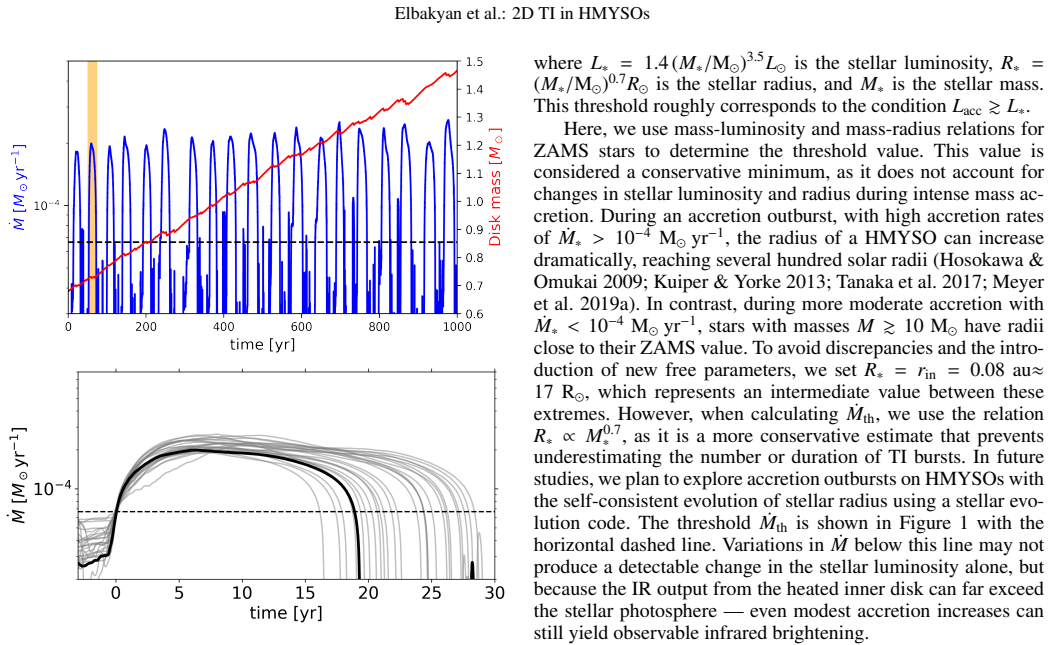
Resolving the disk's vertical structure in two dimensions transforms the predicted shape of thermal-instability outbursts. Instead of the short, bright spikes of vertically averaged one-dimensional models, the energy released by hydrogen ionization is distributed gradually through a disk that puffs up to $z/r\sim1$, develops steep midplane-to-surface temperature gradients, and drives vigorous convection that carries mass between the midplane and upper layers and even outward during the burst. The result is a burst of roughly 19 years with a peak accretion rate near $2\times10^{-4}\,M_\odot\,\text{yr}^{-1}$, followed by a sharp drop as the inner disk is depleted and then a slow recovery as fresh material is transported inward. While these bursts are bright enough to be detected in the infrared with about 1.5 magnitudes of variation, observed HMYSO outbursts reach $10^{-3}\,M_\odot\,\text{yr}^{-1}$ and rise in weeks to a year, not 5–10 years, so the modeled bursts cannot account for them. The paper's central claim is therefore that thermal instability, modeled with full vertical structure, is a real contributor to episodic accretion in high-mass protostars but appears insufficient on its own to explain the observed outburst phenomena.
Load-bearing premise
The whole thermal-instability cycle rests on the assumed jump in disk viscosity between the cold and hot states, a factor of 10 with a 25 000 K transition temperature, so if the real viscosity contrast in high-mass disks is weaker or stronger, the burst amplitudes, durations, and the paper's mismatch with observations would all change.
Editorial extensions
If this is right
- Observed HMYSO bursts with peak accretion rates around $10^{-3}\,M_\odot\,\text{yr}^{-1}$ and rise times of weeks to a year likely require an additional driver, since the thermal-instability-only bursts here cap out near $2\text{--}3\times10^{-4}\,M_\odot\,\text{yr}^{-1}$ with 5–10 year rise times.
- Vertical resolution matters: predictions from one-dimensional vertically averaged TI models (shorter, brighter bursts with reflares) are replaced by longer, gentler two-dimensional bursts, so future modeling of episodic accretion should resolve the vertical structure or justify why it does not.
- The thermally unstable region extends farther out than one-dimensional models place on the cold branch, so the radius that participates in a TI burst grows once vertical energy transport is resolved.
- In the 20 $M_\odot$ stellar-mass model, the peak accretion rate falls below the observable threshold, implying TI-driven bursts may be undetectable for the most massive protostars.
- Burst peak and duration scale with the inner disk radius ($\dot{M}_{\rm peak}\propto r_{\rm in}^{1.37}$, duration $\propto r_{\rm in}^{0.5}$), so the inner truncation radius is a key control on whether and how brightly TI bursts appear.
Reading between the lines
- If the viscosity contrast is the controlling knob, an observational campaign that measures burst statistics across many HMYSOs could indirectly constrain $\alpha_c$ and $\alpha_h$, turning TI burst properties into a viscosity diagnostic.
- A directly testable extension: the model predicts outflow mass rates exceeding the accretion rate during the burst peak, so radio or CO observations timed to an outburst could look for this characteristic outflow-to-inflow reversal.
- The absence of reflares in two dimensions suggests that reflares in one-dimensional TI models may be artifacts of vertical averaging; if true, similar checks in other TI applications, such as dwarf novae or FU Ori disks, might change their predicted light curves.
- Coupling TI with gravitational instability could resolve the discrepancy: clump-driven luminosity may heat the disk onto the hot branch, producing the slow decay observed without requiring pure TI alone.
Editorial analysis
A structured set of objections, weighed in public.
Referee Report
Summary. The paper presents two-dimensional, axially symmetric radiation-hydrodynamics simulations of the inner 10 au of a circumstellar disk around a 10 Msun protostar, with the aim of assessing whether the classical thermal instability (TI) can explain episodic accretion bursts in high-mass young stellar objects (HMYSOs). The model uses the PLUTO code, flux-limited diffusion for radiation transport, a Shakura-Sunyaev alpha viscosity with a prescribed cold/hot jump (Eq. 9), and mass deposition at a constant rate. The fiducial run produces periodic bursts with peak accretion rates of 1.9-2.6e-4 Msun/yr, durations of 15-30 years, and recurrence times of 20-50 years. Synthetic infrared light curves show ~1.5 mag brightening. Comparing these bursts with observed HMYSO outbursts, which show peak accretion rates of a few times 10^-3 Msun/yr and faster rise times, the authors conclude that TI alone is insufficient to explain the full range of observed outburst phenomena. Appendices provide a parameter study, resolution tests, and a comparison with earlier 1D models.
Significance. If the central claim stands, the paper is a valuable negative result: it shows that resolving the vertical structure in 2D moderates TI burst amplitudes and durations compared with 1D models, and that the resulting bursts are too faint and too slow to explain the observed rapid, bright HMYSO outbursts. The work is strengthened by a broad parameter study (Appendix A), explicit resolution convergence tests (Appendix A.4), and synthetic observations that include viewing-angle effects. The conclusion is a falsifiable prediction about burst properties, not a fit to the observed bursts. However, the significance is conditional on resolving an internal inconsistency in the equation of state used for the 2D runs and on the robustness of the assumed viscosity prescription.
major comments (4)
- [Section 2, Section 2.1, Appendix C] There is a direct internal contradiction about the equation of state. Section 2 states that the 2D runs use the non-perfect ideal EoS of D'Angelo & Bodenheimer (2013), which accounts for hydrogen ionization and dissociation with a non-constant adiabatic index. Appendix C, however, states that the 2D model uses a simplified equation of state with a fixed mean molecular weight (mu=2.353), while the 1D calculations use the more detailed EoS that accounts for hydrogen dissociation and ionization. If the fixed-mu description is the correct one, then the 2D bursts are driven by the imposed alpha(T) jump of Eq. (9), not by the additional specific heat and opacity-thermodynamics coupling that defines classical hydrogen-ionization TI. The central quantitative comparison in Section 4.2 would then be a statement about the prescribed viscosity-transition model rather than about classical TI in HMYSO disks. Please reconcile these two descriptions; if the simplified EoS was indeed used, either rerun the fiducial model with the full EoS or explicitly restrict the conclusions to the simplified model.
- [Appendix C] The 1D versus 2D comparison is confounded by two simultaneous changes: the 1D run uses a lower mass deposition rate (10^-4 Msun/yr) than the 2D fiducial run (8x10^-4 Msun/yr), and the equations of state differ between the two setups. The claim that full vertical structure is responsible for the longer, gentler burst profiles is therefore not uniquely supported by this comparison. The authors acknowledge that EoS differences may partly explain the difference, but the conclusion in Sections 5.2 and 6 still attributes the difference primarily to dimensionality. Please provide a matched comparison (same deposition rate and same EoS), or state explicitly that the comparison is illustrative and that the 2D-specific effect has not been isolated.
- [Section 2.2, Eq. (9); Appendix A.3] The load-bearing quantitative result—peak accretion rates of 2-3x10^-4 Msun/yr and durations of 15-30 years—depends on the assumed viscosity parameters alpha_c=0.05, alpha_h=0.5, and Tcr=25000 K in Eq. (9). The sensitivity study in Appendix A.3 shows that lowering alpha_h to 0.1 yields only low-amplitude variability rather than true outbursts, while raising alpha_c to 0.2 suppresses bursts entirely. Since MHD simulations and observations allow a range of alpha values, the conclusion that TI is too weak is not shown to be robust to plausible parameter variations. Please either justify the chosen values as tightly constrained for high-mass disks or extend the parameter study (e.g., alpha_h=0.2, alpha_c=0.02, a range of Tcr) and demonstrate that the mismatch with observed peak accretion rates persists.
- [Section 4.2] The comparison between predicted and observed peak accretion rates relies on observationally inferred values of a few times 10^-3 Msun/yr. These inferred rates are model-dependent (derived from luminosities, distances, and extinction assumptions), and the paper does not state the inference method or its uncertainties. Since the central negative claim rests on this order-of-magnitude discrepancy, please specify how the observed peak accretion rates were obtained and, where possible, compare directly with observed light curves or luminosities rather than with derived accretion rates.
minor comments (5)
- [Throughout] There are numerous LaTeX spacing artifacts in the text, such as "di fferent", "V orobyov", "e ffect", and "pu ffed-up"; a careful proofreading pass is needed.
- [Section 5.3] The argument that stellar irradiation mainly affects the surface layers and does not change the midplane temperature is plausible but not quantified; a simple test with an irradiation temperature floor would strengthen this claim.
- [Appendix A.4] The statement that the fiducial and high-resolution runs have "effectively converged" is based on a 25% shorter duration at 4x resolution (TI_12, about 14 years versus 15-30 years); please state explicitly why this difference is acceptable given the central claim about burst durations.
- [Section 3, Eq. (10)] The detectability threshold Mth uses R* = rin = 0.08 au, but the text also invokes a mass-radius relation R* proportional to M^0.7; please clarify which expression is used for each of the stellar-mass models and justify the choice.
- [Section 5.2 and Appendix C] The term "reflares" is used without a definition in the main text; a one-sentence definition and a reference to the 1D context would help the reader.
Circularity Check
No circularity in the core derivation; the burst properties are genuine simulation outputs, though an internal EoS inconsistency in Appendix C weakens the classical-TI interpretation.
full rationale
The central quantitative claims (peak accretion rates of 1.9-2.6e-4 Msun/yr and durations of 15-30 years) are outputs of a time-dependent 2D radiation-hydrodynamics simulation and are explicitly compared with, not fitted to, observed HMYSO bursts; the reported mismatch is therefore a genuine prediction. The viscosity parameters of Eq. (9) and the chosen alpha values are inputs adopted from external constraints and are varied in a parameter study, not fitted to reproduce the target observables, so the conclusion that TI is too weak is not forced by construction. Self-citations (Elbakyan et al. 2021, 2024; Nayakshin et al. 2024) are used for context and for 1D/2D comparisons and are not load-bearing for the central claim. The paper itself flags a limitation in Appendix C: Section 2 states the 2D model uses the D'Angelo and Bodenheimer EoS accounting for hydrogen ionization and dissociation, while Appendix C states that the 2D model uses a simplified equation of state with a fixed mean molecular weight, whereas the 1D calculations employ a more detailed equation of state that accounts for hydrogen dissociation and ionization. If the latter is correct, the simulated bursts are driven by the imposed alpha(T) jump and opacity tables rather than by the full hydrogen-ionization thermodynamics, which is a model-fidelity concern affecting how the classical-TI-insufficient conclusion should be interpreted. This is a correctness issue, not a circular reduction of the prediction to its inputs.
Assumptions & free parameters
free parameters (5)
- alpha_cold (alpha_c) =
0.05 (fiducial); 0.01, 0.2 tested
- alpha_hot (alpha_h) =
0.5 (fiducial); 0.1 tested
- Tcr =
25000 K
- Mdot_dep =
8e-4 Msun/yr (fiducial); 3e-4 and 5e-3 Msun/yr tested
- r_in =
0.08 au (fiducial); 0.04, 0.12, 0.16 au tested
assumptions (5)
- domain assumption Axial symmetry about the rotation axis and equatorial symmetry at the midplane reduce the disk to a 2D (r, theta) domain, excluding non-axisymmetric modes.
- ad hoc to paper Angular momentum transport is described by the Shakura-Sunyaev alpha prescription with a bimodal cold/hot viscosity (Eq. 9).
- domain assumption Radiative transfer is treated with the gray flux-limited diffusion approximation in LTE.
- domain assumption Direct stellar irradiation and magnetic fields are neglected.
- domain assumption The hydrogen ionization opacity jump is the cause of the thermal instability (standard TI mechanism).
Cite this review
Pith. "Pith review of Episodic accretion in high-mass star formation: An analysis of thermal instability for axially symmetric disks." pith.science (2026). https://pith.science/paper/P7WWK6T6
@misc{pith2026250720781,
  author       = {Pith},
  title        = {Pith review of: Episodic accretion in high-mass star formation: An analysis of thermal instability for axially symmetric disks},
  year         = {2026},
  howpublished = {\url{https://pith.science/paper/P7WWK6T6}},
  note         = {Machine review of arXiv:2507.20781}
}
abstract
High-mass young stellar objects exhibit episodic accretion bursts similar to their low-mass counterparts. Understanding these outbursts is crucial for elucidating massive star formation and disk evolution around high-mass protostars. We investigate thermal instability's role in triggering accretion outbursts using a two-dimensional hydrodynamical model that fully resolves the vertical structure of the inner disk. This approach provides a more realistic depiction of axially symmetric disk dynamics and assesses observable burst signatures. We simulate the inner 10 astronomical units of a circumstellar disk around a high-mass protostar, incorporating viscous heating and radiative transport in radial and vertical directions. Unlike previous one-dimensional studies, our two-dimensional model resolves time-dependent vertical disk structure, capturing complex radial-vertical dynamics. Our simulations show thermal instability causes significant structural changes. Steep temperature gradients and vigorous convection develop at outburst onset, with gas flows differing between midplane and upper layers. Energy release produces 15-30 year outbursts with peak accretion rates of $2-3\times10^{-4}~\rm M_{\odot}~\rm{yr}^{-1}$. While observable, these bursts are insufficiently bright with rise times differing from rapid observed events. Our models lack the "reflares" seen in one-dimensional calculations. Resolving full vertical disk structure is essential for accurate thermal instability modeling. While thermal instability significantly influences episodic accretion, it appears insufficient alone to explain observed HMYSO outburst diversity. Additional mechanisms are required for comprehensive understanding.
Figures


Figures from the paper (2 more)


Reference graph
Works this paper leans on
-
[1]
2023, , 677, A171
Ahmadi , A., Beuther , H., Bosco , F., et al. 2023, , 677, A171
2023
-
[2]
2019, , 632, A50
Ahmadi , A., Kuiper , R., & Beuther , H. 2019, , 632, A50
2019
-
[3]
P., Trapman , L., et al
Ansdell , M., Williams , J. P., Trapman , L., et al. 2018, , 859, 21
2018
-
[4]
Armitage , P. J. 2015, arXiv e-prints, arXiv:1509.06382
arXiv 2015
-
[5]
M., et al
Audard , M., \'A brah \'a m , P., Dunham , M. M., et al. 2014, in Protostars and Planets VI, ed. H. Beuther , R. S. Klessen , C. P. Dullemond , & T. Henning , 387
2014
-
[6]
& Stone , J
Bai , X.-N. & Stone , J. M. 2013, , 769, 76
2013
-
[7]
J., & Simon , J
Beckwith , K., Armitage , P. J., & Simon , J. B. 2011, , 416, 361
2011
-
[8]
Bell , K. R. & Lin , D. N. C. 1994, ApJ, 427, 987
1994
Show all 123 references
-
[9]
2025, arXiv e-prints, arXiv:2501.16866
Beuther , H., Kuiper , R., & Tafalla , M. 2025, arXiv e-prints, arXiv:2501.16866
2025 arXiv
-
[10]
2013, , 558, A81
Beuther , H., Linz , H., & Henning , T. 2013, , 558, A81
2013
-
[11]
J., Johnston , K
Beuther , H., Walsh , A. J., Johnston , K. G., et al. 2017, , 603, A10
2017
-
[12]
P., Zhu , Z., et al
Birnstiel , T., Dullemond , C. P., Zhu , Z., et al. 2018, , 869, L45
2018
-
[13]
& Bastien , P
Bonnell , I. & Bastien , P. 1992, , 401, L31
1992
-
[14]
Bonnell , I. A. & Bate , M. R. 2006, , 370, 488
2006
-
[15]
K., Smale , A
Cannizzo , J. K., Smale , A. P., Wood , M. A., Still , M. D., & Howell , S. B. 2012, , 747, 117
2012
-
[16]
2017, Nature Physics, 13, 276
Caratti o Garatti , A., Stecklum , B., Garcia Lopez , R., et al. 2017, Nature Physics, 13, 276
2017
-
[17]
& Flock , M
Cecil , M. & Flock , M. 2024, , 692, A171
2024
-
[18]
M., & Zhang , Q
Cesaroni , R., Galli , D., Lodato , G., Walmsley , C. M., & Zhang , Q. 2007, in Protostars and Planets V, ed. B. Reipurth , D. Jewitt , & K. Keil , 197
2007
-
[19]
2021, , 922, 90
Chen , Z., Sun , W., Chini , R., et al. 2021, , 922, 90
2021
-
[20]
A., Ru \' z-Rodr \' guez , D., Perez , S., et al
Cieza , L. A., Ru \' z-Rodr \' guez , D., Perez , S., et al. 2018, , 474, 4347
2018
-
[21]
Coleman , M. S. B., Blaes , O., Hirose , S., & Hauschildt , P. H. 2018, , 857, 52
2018
-
[22]
Coleman , M. S. B., Kotko , I., Blaes , O., Lasota , J. P., & Hirose , S. 2016, , 462, 3710
2016
-
[23]
Connelley , M. S. & Reipurth , B. 2018, , 861, 145
2018
-
[24]
J., Ashraf , M., et al
Contreras Pe \ n a , C., Herczeg , G. J., Ashraf , M., et al. 2023, , 521, 5669
2023
-
[25]
D'Angelo , C. R. & Spruit , H. C. 2010, , 406, 1208
2010
-
[26]
& Bodenheimer , P
D'Angelo , G. & Bodenheimer , P. 2013, , 778, 77
2013
-
[27]
W., Stone , J
Davis , S. W., Stone , J. M., & Pessah , M. E. 2010, , 713, 52
2010
-
[28]
M., & Lasota , J
Dubus , G., Hameury , J. M., & Lasota , J. P. 2001, , 373, 251
2001
-
[29]
P., Birnstiel , T., Huang , J., et al
Dullemond , C. P., Birnstiel , T., Huang , J., et al. 2018, , 869, L46
2018
-
[30]
P., Juhasz , A., Pohl , A., et al
Dullemond , C. P., Juhasz , A., Pohl , A., et al. 2012, RADMC-3D: A multi-purpose radiative transfer tool , Astrophysics Source Code Library, record ascl:1202.015
2012
-
[31]
G., Nayakshin , S., Caratti o Garatti , A., Kuiper , R., & Guo , Z
Elbakyan , V. G., Nayakshin , S., Caratti o Garatti , A., Kuiper , R., & Guo , Z. 2024, , 692, A256
2024
-
[32]
G., Nayakshin , S., Meyer , D
Elbakyan , V. G., Nayakshin , S., Meyer , D. M. A., & Vorobyov , E. I. 2023, , 518, 791
2023
-
[33]
G., Nayakshin , S., Vorobyov , E
Elbakyan , V. G., Nayakshin , S., Vorobyov , E. I., Caratti o Garatti , A., & Eisl \"o ffel , J. 2021, , 651, L3
2021
-
[34]
2023, , 676, A107
Fedriani , R., Caratti o Garatti , A., Cesaroni , R., et al. 2023, , 676, A107
2023
-
[35]
J., Hillenbrand , L
Fischer , W. J., Hillenbrand , L. A., Herczeg , G. J., et al. 2023, 534, 355
2023
-
[36]
M., Simon , J
Flaherty , K., Hughes , A. M., Simon , J. B., et al. 2020, , 895, 109
2020
-
[37]
J., & Henning , T
Flock , M., Dzyurkevich , N., Klahr , H., Turner , N. J., & Henning , T. 2011, , 735, 122
2011
-
[38]
J., & Benisty , M
Flock , M., Fromang , S., Turner , N. J., & Benisty , M. 2017, , 835, 230
2017
-
[39]
P., Cabrit , S., et al
Frank , A., Ray , T. P., Cabrit , S., et al. 2014, in Protostars and Planets VI, ed. H. Beuther , R. S. Klessen , C. P. Dullemond , & T. Henning , 451--474
2014
-
[40]
& Nelson , R
Fromang , S. & Nelson , R. P. 2006, , 457, 343
2006
-
[41]
1998, , 492, 323
Gullbring , E., Hartmann , L., Brice \ n o , C., & Calvet , N. 1998, , 492, 323
1998
-
[42]
1998, , 298, 1048
Hameury , J.-M., Menou , K., Dubus , G., Lasota , J.-P., & Hure , J.-M. 1998, , 298, 1048
1998
-
[43]
& Kenyon , S
Hartmann , L. & Kenyon , S. J. 1996, , 34, 207
1996
-
[44]
Herbig , G. H. 1977, , 217, 693
1977
-
[45]
Herbig , G. H. 1989, in European Southern Observatory Conference and Workshop Proceedings, Vol. 33, European Southern Observatory Conference and Workshop Proceedings, ed. B. Reipurth , 233--246
1989
-
[46]
Herbig , G. H. 2008, , 135, 637
2008
-
[47]
2015, , 448, 3105
Hirose , S. 2015, , 448, 3105
2015
-
[48]
H., Coleman , M
Hirose , S., Blaes , O., Krolik , J. H., Coleman , M. S. B., & Sano , T. 2014, , 787, 1
2014
-
[49]
H., & Stone , J
Hirose , S., Krolik , J. H., & Stone , J. M. 2006, , 640, 901
2006
-
[50]
1994, , 428, 654
Hollenbach , D., Johnstone , D., Lizano , S., & Shu , F. 1994, , 428, 654
1994
-
[51]
1979, Progress of Theoretical Physics, 61, 1307
H \= o shi , R. 1979, Progress of Theoretical Physics, 61, 1307
1979
-
[52]
& Omukai , K
Hosokawa , T. & Omukai , K. 2009, , 691, 823
2009
-
[53]
R., Brogan , C
Hunter , T. R., Brogan , C. L., De Buizer , J. M., et al. 2021, , 912, L17
2021
-
[54]
R., Brogan , C
Hunter , T. R., Brogan , C. L., MacLeod , G., et al. 2017, , 837, L29
2017
-
[55]
D., Cyganowski , C
Ilee , J. D., Cyganowski , C. J., Brogan , C. L., et al. 2018, , 869, L24
2018
-
[56]
M., Wehner , D., & Kuiper , R
Jordan , L. M., Wehner , D., & Kuiper , R. 2024, , 689, A354
2024
-
[57]
2020, , 895, 41
Kadam , K., Vorobyov , E., Reg \'a ly , Z., K \'o sp \'a l , \'A ., & \'A brah \'a m , P. 2020, , 895, 41
2020
-
[58]
R., Pringle , J
King , A. R., Pringle , J. E., & Livio , M. 2007, , 376, 1740
2007
-
[59]
& Sudnik , N
Kochukhov , O. & Sudnik , N. 2013, , 554, A93
2013
-
[60]
& Lasota , J
Kotko , I. & Lasota , J. P. 2012, , 545, A115
2012
-
[61]
R., Klein , R
Krumholz , M. R., Klein , R. I., & McKee , C. F. 2007, , 665, 478
2007
-
[62]
2010 a , , 722, 1556
Kuiper , R., Klahr , H., Beuther , H., & Henning , T. 2010 a , , 722, 1556
2010
-
[63]
2011, , 732, 20
Kuiper , R., Klahr , H., Beuther , H., & Henning , T. 2011, , 732, 20
2011
-
[64]
2010 b , , 511, A81
Kuiper , R., Klahr , H., Dullemond , C., Kley , W., & Henning , T. 2010 b , , 511, A81
2010
-
[65]
& Yorke , H
Kuiper , R. & Yorke , H. W. 2013, , 772, 61
2013
-
[66]
W., & Mignone , A
Kuiper , R., Yorke , H. W., & Mignone , A. 2020, , 250, 13
2020
-
[67]
2001, , 45, 449
Lasota , J.-P. 2001, , 45, 449
2001
-
[68]
2020, , 641, A112
Lebreuilly , U., Commer c on , B., & Laibe , G. 2020, , 641, A112
2020
-
[69]
Lin , D. N. C., Papaloizou , J., & Faulkner , J. 1985, , 212, 105
1985
-
[70]
B., Takami , M., Kudo , T., et al
Liu , H. B., Takami , M., Kudo , T., et al. 2016, Science Advances, 2, e1500875
2016
-
[71]
& Clarke , C
Lodato , G. & Clarke , C. J. 2004, , 353, 841
2004
-
[72]
E., Manara , C
Lodato , G., Scardoni , C. E., Manara , C. F., & Testi , L. 2017, , 472, 4700
2017
-
[73]
G., Kuiper , R., Klahr , H., Dullemond , C
Malygin , M. G., Kuiper , R., Klahr , H., Dullemond , C. P., & Henning , T. 2014, , 568, A91
2014
-
[74]
2000, , 314, 498
Menou , K., Hameury , J.-M., Lasota , J.-P., & Narayan , R. 2000, , 314, 498
2000
-
[75]
Meyer , D. M. A., Kreplin , A., Kraus , S., et al. 2019 a , , 487, 4473
2019
-
[76]
Meyer , D. M. A., Vorobyov , E. I., Elbakyan , V. G., et al. 2019 b , , 482, 5459
2019
-
[77]
M.-A., Vorobyov , E
Meyer , D. M.-A., Vorobyov , E. I., Kuiper , R., & Kley , W. 2017, , 464, L90
2017
-
[78]
& Meyer-Hofmeister , E
Meyer , F. & Meyer-Hofmeister , E. 1981, , 104, L10
1981
-
[79]
2007, , 170, 228
Mignone , A., Bodo , G., Massaglia , S., et al. 2007, , 170, 228
2007
-
[80]
Miller , K. A. & Stone , J. M. 2000, , 534, 398
2000
-
[81]
2021, , 647, A114
Moscadelli , L., Beuther , H., Ahmadi , A., et al. 2021, , 647, A114
2021
-
[82]
2018, , 56, 41
Motte , F., Bontemps , S., & Louvet , F. 2018, , 56, 41
2018
-
[83]
Mulders , G. D. & Dominik , C. 2012, , 539, A9
2012
-
[84]
Najita , J. R. & Bergin , E. A. 2018, , 864, 168
2018
-
[85]
2024, , 530, 1749
Nayakshin , S., Cruz S \'a enz de Miera , F., K \'o sp \'a l , \'A ., et al. 2024, , 530, 1749
2024
-
[86]
& Lodato , G
Nayakshin , S. & Lodato , G. 2012, , 426, 70
2012
-
[87]
& Kuiper , R
Oliva , A. & Kuiper , R. 2023, , 669, A80
2023
-
[88]
Oliva , G. A. & Kuiper , R. 2020, , 644, A41
2020
-
[89]
B., et al
P \'e rez , S., Hales , A., Liu , H. B., et al. 2020, , 889, 59
2020
-
[90]
Pinte , C., Dent , W. R. F., M \'e nard , F., et al. 2016, , 816, 25
2016
-
[91]
C., Heever , S
Proven-Adzri , E., MacLeod , G. C., Heever , S. P. v. d., et al. 2019, , 487, 2407
2019
-
[92]
E., Ouyed , R., Fendt , C., & Brandenburg , A
Pudritz , R. E., Ouyed , R., Fendt , C., & Brandenburg , A. 2007, in Protostars and Planets V, ed. B. Reipurth , D. Jewitt , & K. Keil , 277
2007
-
[93]
Rafikov , R. R. 2017, , 837, 163
2017
-
[94]
Rosotti , G. P. 2023, , 96, 101674
2023
-
[95]
P., Teague , R., Dullemond , C., Booth , R
Rosotti , G. P., Teague , R., Dullemond , C., Booth , R. A., & Clarke , C. J. 2020, , 495, 173
2020
-
[96]
2021, , 652, A71
Sabatini , G., Bovino , S., Giannetti , A., et al. 2021, , 652, A71
2021
-
[97]
2018, , 609, A77
Scepi , N., Lesur , G., Dubus , G., & Flock , M. 2018, , 609, A77
2018
-
[98]
2003, , 410, 611
Semenov , D., Henning , T., Helling , C., Ilgner , M., & Sedlmayr , E. 2003, , 410, 611
2003
-
[99]
Shakura , N. I. & Sunyaev , R. A. 1973, , 24, 337
1973
-
[100]
H., & Hirose , S
Shi , J., Krolik , J. H., & Hirose , S. 2010, , 708, 1716
2010
-
[101]
B., Beckwith , K., & Armitage , P
Simon , J. B., Beckwith , K., & Armitage , P. J. 2012, , 422, 2685
2012
-
[102]
1999, , 49, 391
Smak , J. 1999, , 49, 391
1999
-
[103]
2024, , 633, 58
Speedie , J., Dong , R., Hall , C., et al. 2024, , 633, 58
2024
-
[104]
2021, , 646, A161
Stecklum , B., Wolf , V., Linz , H., et al. 2021, , 646, A161
2021
-
[105]
2021, , 655, A110
Steiner , D., Gehrig , L., Ratschiner , B., et al. 2021, , 655, A110
2021
-
[106]
Tanaka , K. E. I., Tan , J. C., & Zhang , Y. 2017, , 835, 32
2017
-
[107]
2015, , 446, 4088
Tapia , M., Roth , M., & Persi , P. 2015, , 446, 4088
2015
-
[108]
2017, , 838, 151
Tsukamoto , Y., Okuzumi , S., & Kataoka , A. 2017, , 838, 151
2017
-
[109]
2015, , 580, A110
Vaidya , B., Mignone , A., Bodo , G., & Massaglia , S. 2015, , 580, A110
2015
-
[110]
Vorobyov , E. I. & Basu , S. 2006, ApJ, 650, 956
2006
-
[111]
Vorobyov , E. I. & Basu , S. 2010, ApJ, 719, 1896
2010
-
[112]
I., Khaibrakhmanov , S., Basu , S., & Audard , M
Vorobyov , E. I., Khaibrakhmanov , S., Basu , S., & Audard , M. 2020, , 644, A74
2020
-
[113]
A., Neiner , C., Alecian , E., et al
Wade , G. A., Neiner , C., Alecian , E., et al. 2016, , 456, 2
2016
-
[114]
Wells , M. R. A., Beuther , H., Molinari , S., et al. 2024, , 690, A185
2024
-
[115]
2024, , 688, A8
Wolf , V., Stecklum , B., Caratti o Garatti , A., et al. 2024, , 688, A8
2024
-
[116]
Yorke , H. W. & Sonnhalter , C. 2002, , 569, 846
2002
-
[117]
J., Henshaw , J
Zhang , S., Cyganowski , C. J., Henshaw , J. D., et al. 2024, [ [arXiv] 2407.19552 ]
2024 arXiv
-
[118]
M., et al
Zhang , Y.-K., Chen , X., Sobolev , A. M., et al. 2022, , 260, 34
2022
-
[119]
2009 a , , 694, 1045
Zhu , Z., Hartmann , L., & Gammie , C. 2009 a , , 694, 1045
2009
-
[120]
Zhu , Z., Hartmann , L., Gammie , C., & McKinney , J. C. 2009 b , , 701, 620
2009
-
[121]
& Yorke , H
Zinnecker , H. & Yorke , H. W. 2007, , 45, 481
2007
-
[122]
, " * write output.state after.block = add.period write newline
ENTRY address archiveprefix author booktitle chapter edition editor howpublished institution eprint journal key month note number organization pages publisher school series title type volume year label extra.label sort.label short.list INTEGERS output.state before.all mid.sent...
-
[123]
write newline
" write newline "" before.all 'output.state := FUNCTION n.dashify 't := "" t empty not t #1 #1 substring "-" = t #1 #2 substring "--" = not "--" * t #2 global.max substring 't := t #1 #1 substring "-" = "-" * t #2 global.max substring 't := while if t #1 #1 substring * t #2 gl...
Reviewed August 6, 2026 · model on record in the stance chip above.
Discussion (0). Sign in to comment.