REVIEW 4 major objections 5 minor 1 cited by
Towards Generalized and Training-Free Text-Guided Semantic Manipulation
T0 review · 4 major / 5 minor · reviewed 2026-08-16 · deepseek-v4-flash
Pith's one-line read The paper asserts that semantic addition, removal, and style transfer can be achieved by projecting one prompt's noise direction onto another and recombining the components, with no training, mask, or inversion, and shows the recipe…
desk verdict The projection step that separates 'shared' from 'novel' semantics is asserted, not derived, and the paper's evaluation is too clean; still, the idea is simple enough to deserve a careful referee. read the letter →
The pith
A machine-rendered reading of the paper's core claim, the machinery that carries it, and where it could break.
The reading
What carries the argument
The central object is the conditional noise direction $\epsilon_c = \epsilon_\theta(x_t, c) - \epsilon_\theta(x_t, \varnothing)$, which the score-function relation $\epsilon_\theta(x_t,c) \approx -\sigma_t \nabla_x \log p_t(x_t \mid c)$ connects to the gradient of the log-likelihood, hence to a direction in semantic space. The mechanism is orthogonal projection of one such direction onto another: for addition the target direction is decomposed as $\epsilon_{\mathrm{tgt}} = \epsilon_{\mathrm{tgt}}^\parallel + \epsilon_{\mathrm{tgt}}^\perp$ against the source direction, and only $\epsilon_{\mathrm{tgt}}^\perp$ is injected; for removal the source direction is decomposed against the target direction and the parallel component is subtracted. The paper also introduces a cosine weight scheduler for the injected component, based on the observation that early denoising steps fix global layout while later steps refine details, so target semantics should enter late to avoid altering unedited structure.
What would settle it
Test for semantic purity of the perpendicular direction: generate a source image from 'a red car', set the target to 'a red car with a blue hat on the driver', compute the perpendicular component of the target noise against the source noise, and inject that component into an unrelated generation such as 'a bowl of fruit on a table'. If the component isolates only the hat semantics, the fruit image should acquire a hat and no car-related content; any car content appearing in the fruit image shows the perpendicular direction is not semantically pure. For removal, erase 'collar' from 'a dog wearing a red collar' using the parallel-component subtraction and measure CLIP similarity of the output to 'collar': a persistently high score while the rest of the image is unchanged indicates the projection failed to isolate the removed attribute.
Extended reading notes
Core claim
Let $\epsilon_\theta(x_t, c)$ be the noise a diffusion model predicts at step $t$ under prompt $c$, and define the semantic direction $\epsilon_c = \epsilon_\theta(x_t,c) - \epsilon_\theta(x_t,\varnothing)$. The paper argues through a Bayes'-rule and score-function derivation that combined conditioning can be approximated by $\epsilon(\varnothing)+[\epsilon(c_1)-\epsilon(\varnothing)]+[\epsilon(c_2)-\epsilon(\varnothing)]$, and removal by the analogous subtraction. GTF's departure from that raw formula is to project before combining: in addition, $\epsilon_{\mathrm{tgt}}$ is split into a part parallel to $\epsilon_{\mathrm{src}}$, which is treated as shared content, and a part $\epsilon_{\mathrm{tgt}}^\perp$ perpendicular to it, which is treated as the novel attribute, and the guidance is $w_1\epsilon_{\mathrm{src}} + w_2\epsilon_{\mathrm{tgt}}^\perp$; in removal, $\epsilon_{\mathrm{src}}$ is split against $\epsilon_{\mathrm{tgt}}$ and the parallel part is subtracted from the orthogonal residual. The paper claims this projection keeps the common content intact while letting the user control exactly how much of the new or removed attribute enters the result, and it demonstrates the same recipe on Stable Diffusion for images, AnimateDiff for video, and LGM and LucidDreamer for 3D.
Load-bearing premise
The construction collapses if the parallel and perpendicular parts of the projected noise vectors do not correspond to distinct semantic attributes, because then the perpendicular part can carry over shared content or miss part of the new concept, and the paper gives no proof that noise-space directions are semantically disentangled.
Editorial extensions
If this is right
- Because GTF only recombines noise predictions, any diffusion-based generator that exposes conditional and unconditional score estimates can adopt the same code path for addition, removal, and style transfer.
- Training-free operation means a newly released diffusion backbone can be edited with GTF immediately, without fine-tuning, prompt optimization, or architecture changes.
- Semantic removal becomes symmetric with addition: subtracting the source noise's projection onto the target direction erases the target concept, which the paper demonstrates on large objects such as fences and guitars.
- The cosine late-injection scheduler suggests that editing strength should ramp up as denoising progresses, giving downstream methods a concrete default schedule for noise-composition editing.
Reading between the lines
- The clean semantic split is an idealization: the projection separates vectors, not meanings, so correlated attributes will bleed across the parallel and perpendicular parts; a natural follow-up is to estimate the two weights from the noise statistics of each prompt pair instead of setting them by hand, since the paper's ablations show the output is sensitive to them.
- Because the method is demonstrated on generated images and videos, applying it to real photographs or footage would first require an inversion pass that rewrites the noise trajectory; whether the projection decomposition survives inversion is a testable question the paper does not address.
- The finding that monotonically increasing schedulers preserve source content better could be turned into a quantitative principle: if early denoising sets layout, then the injected semantics should be confined to later timesteps, which might predict and prevent the residual-content failures the authors observe with cosine scheduling in some 3D removal cases.
Signed reviews
Editorial analysis
A structured set of objections, weighed in public.
Referee Report
Summary. The paper introduces GTF, a training-free, plug-and-play method for text-guided semantic manipulation in diffusion models. It interprets diffusion noise prediction as score estimation (Eq. 1), derives composition rules for semantic addition and removal using Bayes' rule (Eqs. 2-7), and then proposes to combine source and target conditional noise vectors with an orthogonal projection that is intended to separate shared from novel semantics (Section 3.3.2). The resulting update rules are applied at every denoising step and integrated into Stable Diffusion for image editing, AnimateDiff for video editing, and LGM and LucidDreamer for 3D editing. The paper reports qualitative comparisons, CLIP-based metrics, and user studies against six image-editing and six video-editing baselines, plus ablations over the two weights and several weight schedulers.
Significance. If the geometric claim in Section 3.3.2 is correct, GTF would be a broadly useful operator: a single training-free noise-composition rule that handles addition, removal, and style transfer across image, video, and 3D generation while requiring no architecture changes. The empirical scope is a genuine strength: the method is tested on four different diffusion backbones, compared with twelve baselines, and evaluated with user studies, and the paper also provides a transparent Bayes-rule derivation that makes the method easy to audit. The main limitation is that the implemented algorithm is not actually derived from that derivation, and the load-bearing projection assumption is asserted without supporting evidence; the quantitative claims also lack error bars and significance tests. The contribution is therefore promising but conditional on closing this gap between theory and algorithm.
major comments (4)
- [Section 3.3.2 (Eqs. 4, 7, 8)] The implemented update rule does not follow from the Bayes-rule analysis. Equation (4) gives epsilon_pred = epsilon(empty) + [epsilon(c1)-epsilon(empty)] + [epsilon(c2)-epsilon(empty)] for addition, and Equation (7) gives epsilon_pred = epsilon(empty) + [epsilon(c1')-epsilon(empty)] - [epsilon(c2)-epsilon(empty)] for removal. The implemented rules in Section 3.3.2 are epsilon_hat_add = w1*epsilon_src + w2*epsilon_tgt^perp and epsilon_hat_remove = w1*epsilon_src^perp - w2*epsilon_src^parallel, with epsilon_src and epsilon_tgt defined relative to epsilon(empty) in Equation (8). Neither formula is equal to Equation (4) or Equation (7): the epsilon(empty) base term is missing, and the target noise is replaced by a projected component. The phrase 'following the interpretation in Eq. (4)' does not bridge this gap, so the main theoretical grounding for the method is not currently connected to the algorithm being evaluated.
- [Section 3.3.2] The semantic-disentanglement assumption is asserted rather than established. The method assumes that the orthogonal component of epsilon_tgt relative to epsilon_src contains exactly the novel semantics and that the parallel component contains exactly the shared content, with the mirror-image statement for removal. This is a strong geometric claim about high-dimensional noise vectors in a specific diffusion model; it is not a consequence of Equations (4) or (7), and the paper reports no measurement linking noise-space orthogonality to semantic attributes. The continuous growth or shrinkage of objects with w2 in Figures 4 and 5 is consistent with the projection simply reweighting a generic direction rather than extracting a cleanly separated semantic component. I ask for either a derivation under a stated assumption, an empirical validation of the projection's semantic meaning, or an explicit statement that the projection is a heuristic component of the method rather than a consequence of the theoretical analysis.
- [Tables 1-4 and Sections 4.2-4.3] All quantitative claims are reported as single-point estimates. No standard deviations, number of seeds, or significance tests are given for the CLIP metrics in Tables 1 and 3, and the user-study percentages in Tables 2 and 4 are not accompanied by confidence intervals or participant-level analysis. Since the headline empirical claim is that GTF outperforms six image baselines and five of six video baselines, the reported margins (for example, CLIP_Dir differences of 0.05-0.08 in Table 1) need repeated-run variability and a paired significance test before they can support that claim.
- [Section 4.5 and Appendices B-C] The 'training-free/plug-and-play' claim is weakened by the number of task-dependent choices left to the user. The method has free parameters w1 and w2 and a choice of scheduler for w2, and the ablations in Figures 4, 5, and 7 and Appendix C.2 show that these choices qualitatively change the result, with different schedulers preferred in different tasks. To support the claim that GTF requires no tuning, the paper should either specify a single default configuration that works across all reported tasks or provide a practical selection criterion and characterize sensitivity to these choices.
minor comments (5)
- [Section 4.1, Implementation Details] The word 'intergrate' should be 'integrate' in the sentence describing integration into AnimateDiff.
- [Section 4.2, Quantitative Comparisons] The text states that GTF 'significantly outperforms all baselines in CLIP_Dir (36.83)', but Table 1 reports CLIP_Dir values around 0.2; the number 36.83 appears to be a typo, possibly for 34.8568 (CLIP_Sim) or 0.2697 (CLIP_Dir addition).
- [Appendix B, Equations (9)-(13)] The schedulers are defined as functions of timestep t, while the discussion in Section 4.5 describes linear and cosine as 'monotonically increasing' because generation proceeds from t=T to t=0; please state this convention explicitly so that Equations (10) and (11) are not misread as decreasing functions of generation progress.
- [Section 3.2, Equations (5)-(7)] The notation for semantic removal is confusing: c1 denotes the remaining semantics, c2 the removed attribute, and c1' the combined source prompt, but c1' is not introduced before Equation (6); please define all three prompts explicitly before the derivation.
- [Sections 4.3-4.4 and Appendix C.3] The 3D experiments are qualitative only, and the user-study section reports total valid votes (1430 and 630) but not the number of participants; adding a small quantitative table for 3D and reporting participant counts would strengthen the reproducibility of the generalizability claim.
Circularity Check
No significant circularity: the Bayes-rule composition is self-contained, and the projection step is an unproved geometric assumption rather than a result forced by the paper's own equations.
full rationale
The paper's derivation chain is not circular. The score-based interpretation of noise prediction (Eq. 1) is an external, standard result from SMLD [60], and the Bayes-rule derivations in Sec. 3.2 (Eqs. 2-7) follow algebraically from the stated conditional-independence assumption; Eq. 4 and Eq. 7 are obtained by taking gradients of the log-posterior and replacing scores with noise predictions, with no fitted quantity renamed as a prediction. The projection step in Sec. 3.3.2 is an additional geometric assumption: the paper asserts that the orthogonal component of the target noise captures target-unique semantics and that the parallel component captures shared content, but this assertion is not derived from Eqs. 4 or 7. That is a correctness and validation gap, not circularity, because the method is then tested against external baselines, CLIP metrics, and user studies, and the weights w1 and w2 are ablated rather than fitted to the reported metrics. There are no load-bearing self-citations, no imported uniqueness theorem, and no known result merely renamed under new coordinates. The inconsistency that Eq. 8 drops the epsilon(empty) base term appearing in Eqs. 4 and 7, and the unverified claim that noise-space directions align with individual semantic attributes, are substantive concerns about whether the theory justifies the algorithm, but they do not make the derivation equivalent to its own inputs by construction. The central claim is therefore not circular under the standards of this review.
Assumptions & free parameters
free parameters (3)
- w1 =
not specified for main tables; up to 1.7 in Fig. 4
- w2 =
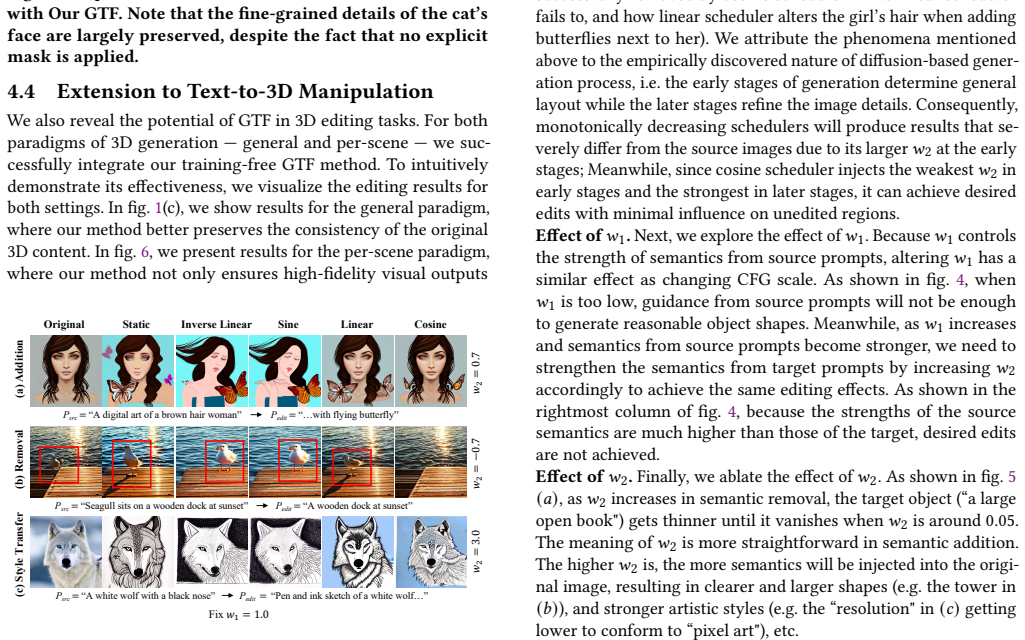
varies by task: 0.05 for removal, 3.0 for addition, 2.0 for 3D in Figs. 5, 8, 9
- scheduler for w2 =
cosine by default; static preferred in some 3D removal cases
assumptions (4)
- domain assumption Noise prediction approximates the score function (Eq. 1).
- ad hoc to paper Conditional independence of the two text prompts given the image: p(c1, c2 | x) = p(c1 | x) p(c2 | x) (Eq. 2).
- ad hoc to paper The orthogonal projection of target noise onto source noise separates shared from novel semantics (Section 3.3.2).
- domain assumption The unconditional prediction epsilon(empty) represents the marginal score p(x).
Cite this review
Pith. "Pith review of Towards Generalized and Training-Free Text-Guided Semantic Manipulation." pith.science (2026). https://pith.science/paper/PB4MXKAR
@misc{pith2026250417269,
  author       = {Pith},
  title        = {Pith review of: Towards Generalized and Training-Free Text-Guided Semantic Manipulation},
  year         = {2026},
  howpublished = {\url{https://pith.science/paper/PB4MXKAR}},
  note         = {Machine review of arXiv:2504.17269}
}
abstract
Text-guided semantic manipulation refers to semantically editing an image generated from a source prompt to match a target prompt, enabling the desired semantic changes (e.g., addition, removal, and style transfer) while preserving irrelevant contents. With the powerful generative capabilities of the diffusion model, the task has shown the potential to generate high-fidelity visual content. Nevertheless, existing methods either typically require time-consuming fine-tuning (inefficient), fail to accomplish multiple semantic manipulations (poorly extensible), and/or lack support for different modality tasks (limited generalizability). Upon further investigation, we find that the geometric properties of noises in the diffusion model are strongly correlated with the semantic changes. Motivated by this, we propose a novel $\textit{GTF}$ for text-guided semantic manipulation, which has the following attractive capabilities: 1) $\textbf{Generalized}$: our $\textit{GTF}$ supports multiple semantic manipulations (e.g., addition, removal, and style transfer) and can be seamlessly integrated into all diffusion-based methods (i.e., Plug-and-play) across different modalities (i.e., modality-agnostic); and 2) $\textbf{Training-free}$: $\textit{GTF}$ produces high-fidelity results via simply controlling the geometric relationship between noises without tuning or optimization. Our extensive experiments demonstrate the efficacy of our approach, highlighting its potential to advance the state-of-the-art in semantics manipulation.
Figures


Figures from the paper (8 more)




Forward citations
Cited by 1 Pith paper
-
EditVerse3D: High-Quality 3D Object Editing with Region-Aware Learning
An end-to-end 3D editing framework achieves high-fidelity local edits from coarse bounding boxes and 2D image prompts using region-aware loss reweighting and a large-scale parts-derived training dataset.
Reference graph
Works this paper leans on
-
[1]
Mohammadreza Armandpour, Ali Sadeghian, Huangjie Zheng, Amir Sadeghian, and Mingyuan Zhou. 2023. Re-imagine the Negative Prompt Algorithm: Transform 2D Diffusion into 3D, alleviate Janus problem and Beyond. arXiv:2304.04968 [cs.CV] https://arxiv.org/abs/2304.04968
arXiv 2023
- [2]
-
[3]
Manuel Brack, Felix Friedrich, Dominik Hintersdorf, Lukas Struppek, Patrick Schramowski, and Kristian Kersting. 2023. SEGA: Instructing Text-to-Image Models using Semantic Guidance. arXiv:2301.12247 [cs.CV] https://arxiv.org/ abs/2301.12247
arXiv 2023
-
[4]
Manuel Brack, Felix Friedrich, Katharina Kornmeier, Linoy Tsaban, Patrick Schramowski, Kristian Kersting, and Apolinário Passos. 2024. LEDITS++: Lim- itless Image Editing using Text-to-Image Models. arXiv:2311.16711 [cs.CV] https://arxiv.org/abs/2311.16711
arXiv 2024
-
[5]
Mingdeng Cao, Xintao Wang, Zhongang Qi, Ying Shan, Xiaohu Qie, and Yinqiang Zheng. 2023. MasaCtrl: Tuning-Free Mutual Self-Attention Control for Consis- tent Image Synthesis and Editing. In Proceedings of the IEEE/CVF International Conference on Computer Vision (ICCV) . 22560–22570
2023
-
[6]
Duygu Ceylan, Chun-Hao Paul Huang, and Niloy J. Mitra. 2023. Pix2Video: Video Editing using Image Diffusion. arXiv:2303.12688 [cs.CV] https://arxiv.org/abs/ 2303.12688
arXiv 2023
-
[7]
Minghao Chen, Junyu Xie, Iro Laina, and Andrea Vedaldi. 2023. SHAP-EDITOR: Instruction-guided Latent 3D Editing in Seconds. arXiv:2312.09246 [cs.CV] https://arxiv.org/abs/2312.09246
arXiv 2023
-
[8]
Weifeng Chen, Yatai Ji, Jie Wu, Hefeng Wu, Pan Xie, Jiashi Li, Xin Xia, Xuefeng Xiao, and Liang Lin. 2024. Control-A-Video: Controllable Text-to- Video Diffusion Models with Motion Prior and Reward Feedback Learning. arXiv:2305.13840 [cs.CV] https://arxiv.org/abs/2305.13840
arXiv 2024
Show all 82 references
-
[9]
Xinhua Cheng, Tianyu Yang, Jianan Wang, Yu Li, Lei Zhang, Jian Zhang, and Li Yuan. 2024. Progressive3D: Progressively Local Editing for Text-to-3D Content Creation with Complex Semantic Prompts. arXiv:2310.11784 [cs.CV] https: //arxiv.org/abs/2310.11784
2024 arXiv
-
[10]
Ernie Chu, Tzuhsuan Huang, Shuo-Yen Lin, and Jun-Cheng Chen. 2023. MeDM: Mediating Image Diffusion Models for Video-to-Video Translation with Temporal Correspondence Guidance. arXiv:2308.10079 [cs.CV] https://arxiv.org/abs/2308. 10079
2023 arXiv
-
[11]
Yuren Cong, Mengmeng Xu, Christian Simon, Shoufa Chen, Jiawei Ren, Yanping Xie, Juan-Manuel Perez-Rua, Bodo Rosenhahn, Tao Xiang, and Sen He. 2024. FLATTEN: optical FLow-guided ATTENtion for consistent text-to-video editing. arXiv:2310.05922 [cs.CV] https://arxiv.org/abs/2310.05922
2024 arXiv
-
[12]
Paul Couairon, Clément Rambour, Jean-Emmanuel Haugeard, and Nicolas Thome
-
[13]
Dale Decatur, Itai Lang, Kfir Aberman, and Rana Hanocka. 2023. 3D Paintbrush: Local Stylization of 3D Shapes with Cascaded Score Distillation. arXiv:2311.09571 [cs.GR] https://arxiv.org/abs/2311.09571
2023 arXiv
-
[14]
Hager, Fed- erico Tombari, and Christian Rupprecht
Helisa Dhamo, Azade Farshad, Iro Laina, Nassir Navab, Gregory D. Hager, Fed- erico Tombari, and Christian Rupprecht. 2020. Semantic Image Manipulation Using Scene Graphs. arXiv:2004.03677 [cs.CV] https://arxiv.org/abs/2004.03677
2020 arXiv
-
[15]
Jiahua Dong and Yu-Xiong Wang. 2024. ViCA-NeRF: View-Consistency-Aware 3D Editing of Neural Radiance Fields. arXiv:2402.00864 [cs.CV] https://arxiv. org/abs/2402.00864
2024 arXiv
-
[16]
Patrick Esser, Johnathan Chiu, Parmida Atighehchian, Jonathan Granskog, and Anastasis Germanidis. 2023. Structure and Content-Guided Video Synthesis with Diffusion Models. arXiv:2302.03011 [cs.CV] https://arxiv.org/abs/2302.03011
2023 arXiv
-
[17]
Patrick Esser, Sumith Kulal, Andreas Blattmann, Rahim Entezari, Jonas Müller, Harry Saini, Yam Levi, Dominik Lorenz, Axel Sauer, Frederic Boesel, Dustin Podell, Tim Dockhorn, Zion English, Kyle Lacey, Alex Goodwin, Yannik Marek, and Robin Rombach. 2024. Scaling Rectified Flow ...
2024 arXiv
-
[18]
Shuangkang Fang, Yufeng Wang, Yi Yang, Yi-Hsuan Tsai, Wenrui Ding, Shuchang Zhou, and Ming-Hsuan Yang. 2023. Editing 3D Scenes via Text Prompts without Retraining. arXiv:2309.04917 [cs.CV] https://arxiv.org/abs/2309.04917
2023 arXiv
-
[19]
Stanislav Frolov, Tobias Hinz, Federico Raue, Jörn Hees, and Andreas Dengel
-
[20]
Bermano, Gal Chechik, and Daniel Cohen-Or
Rinon Gal, Yuval Alaluf, Yuval Atzmon, Or Patashnik, Amit H. Bermano, Gal Chechik, and Daniel Cohen-Or. 2022. An Image is Worth One Word: Personalizing Text-to-Image Generation using Textual Inversion. arXiv:2208.01618 [cs.CV] https://arxiv.org/abs/2208.01618
2022 arXiv
-
[21]
Rinon Gal, Or Patashnik, Haggai Maron, Gal Chechik, and Daniel Cohen-Or
-
[22]
Michal Geyer, Omer Bar-Tal, Shai Bagon, and Tali Dekel. 2023. TokenFlow: Con- sistent Diffusion Features for Consistent Video Editing. arXiv:2307.10373 [cs.CV] https://arxiv.org/abs/2307.10373
2023 arXiv
-
[23]
Yuwei Guo, Ceyuan Yang, Anyi Rao, Zhengyang Liang, Yaohui Wang, Yu Qiao, Maneesh Agrawala, Dahua Lin, and Bo Dai. 2023. AnimateDiff: Animate Your Personalized Text-to-Image Diffusion Models without Specific Tuning
2023
-
[24]
arXiv:2108.00946 [cs.CV]
StyleGAN-NADA: CLIP-Guided Domain Adaptation of Image Generators. arXiv:2108.00946 [cs.CV]
-
[25]
Amir Hertz, Ron Mokady, Jay Tenenbaum, Kfir Aberman, Yael Pritch, and Daniel Cohen-Or. 2022. Prompt-to-prompt image editing with cross attention control. (2022)
2022
-
[26]
Jack Hessel, Ari Holtzman, Maxwell Forbes, Ronan Le Bras, and Yejin Choi
-
[27]
Efros, Aleksander Holynski, and Angjoo Kanazawa
Ayaan Haque, Matthew Tancik, Alexei A. Efros, Aleksander Holynski, and Angjoo Kanazawa. 2023. Instruct-NeRF2NeRF: Editing 3D Scenes with Instructions. arXiv:2303.12789 [cs.CV] https://arxiv.org/abs/2303.12789
2023 arXiv
-
[28]
Junha Hyung, Sungwon Hwang, Daejin Kim, Hyunji Lee, and Jaegul Choo. 2023. Local 3D Editing via 3D Distillation of CLIP Knowledge. arXiv:2306.12570 [cs.CV] https://arxiv.org/abs/2306.12570
2023 arXiv
-
[29]
Xuan Ju, Ailing Zeng, Yuxuan Bian, Shaoteng Liu, and Qiang Xu. 2024. PnP Inversion: Boosting Diffusion-based Editing with 3 Lines of Code. International Conference on Learning Representations (ICLR) (2024)
2024
-
[30]
Hiromichi Kamata, Yuiko Sakuma, Akio Hayakawa, Masato Ishii, and Takuya Narihira. 2023. Instruct 3D-to-3D: Text Instruction Guided 3D-to-3D conversion. arXiv:2303.15780 [cs.CV] https://arxiv.org/abs/2303.15780
2023 arXiv
-
[31]
Jonathan Ho, Ajay Jain, and Pieter Abbeel. 2020. Denoising Diffusion Probabilistic Models. arXiv:2006.11239 [cs.LG] https://arxiv.org/abs/2006.11239
2020 arXiv
-
[32]
Bahjat Kawar, Shiran Zada, Oran Lang, Omer Tov, Huiwen Chang, Tali Dekel, Inbar Mosseri, and Michal Irani. 2023. Imagic: Text-Based Real Image Editing with Diffusion Models. arXiv:2210.09276 [cs.CV] https://arxiv.org/abs/2210.09276
2023 arXiv
-
[33]
Bernhard Kerbl, Georgios Kopanas, Thomas Leimkühler, and George Dret- takis. 2023. 3D Gaussian Splatting for Real-Time Radiance Field Rendering. arXiv:2308.04079 [cs.GR] https://arxiv.org/abs/2308.04079
2023 arXiv
-
[34]
Umar Khalid, Hasan Iqbal, Nazmul Karim, Jing Hua, and Chen Chen. 2024. La- tentEditor: Text Driven Local Editing of 3D Scenes. arXiv:2312.09313 [cs.CV] https://arxiv.org/abs/2312.09313
2024 arXiv
-
[35]
Tero Karras, Samuli Laine, and Timo Aila. 2019. A Style-Based Generator Architecture for Generative Adversarial Networks. arXiv:1812.04948 [cs.NE] https://arxiv.org/abs/1812.04948
2019 arXiv
-
[36]
Freeman, Phillip Isola, Amir Globerson, Michal Irani, and Inbar Mosseri
Oran Lang, Yossi Gandelsman, Michal Yarom, Yoav Wald, Gal Elidan, Avinatan Hassidim, William T. Freeman, Phillip Isola, Amir Globerson, Michal Irani, and Inbar Mosseri. 2021. Explaining in Style: Training a GAN to explain a classifier in StyleSpace. arXiv:2104.13369 [cs.CV] ht...
2021 arXiv
-
[37]
Bowen Li, Xiaojuan Qi, Philip H. S. Torr, and Thomas Lukasiewicz. 2020. Light- weight Generative Adversarial Networks for Text-Guided Image Manipulation. arXiv:2010.12136 [cs.CV] https://arxiv.org/abs/2010.12136
2020 arXiv
-
[38]
Jianhui Li, Shilong Liu, Zidong Liu, Yikai Wang, Kaiwen Zheng, Jinghui Xu, Jianmin Li, and Jun Zhu. 2024. InstructPix2NeRF: Instructed 3D Portrait Editing from a Single Image. arXiv:2311.02826 [cs.CV] https://arxiv.org/abs/2311.02826
2024 arXiv
-
[39]
Gwanghyun Kim, Taesung Kwon, and Jong Chul Ye. 2022. Diffu- sionCLIP: Text-Guided Diffusion Models for Robust Image Manipulation. arXiv:2110.02711 [cs.CV] https://arxiv.org/abs/2110.02711
2022 arXiv
-
[40]
Yixun Liang, Xin Yang, Jiantao Lin, Haodong Li, Xiaogang Xu, and Yingcong Chen
-
[41]
Luping Liu, Yi Ren, Zhijie Lin, and Zhou Zhao. 2022. Pseudo Numerical Methods for Diffusion Models on Manifolds. arXiv:2202.09778 [cs.CV] https://arxiv.org/ abs/2202.09778
2022 arXiv
-
[42]
Yiwei Ma, Xiaioqing Zhang, Xiaoshuai Sun, Jiayi Ji, Haowei Wang, Guannan Jiang, Weilin Zhuang, and Rongrong Ji. 2023. X-Mesh: Towards Fast and Accurate Text- driven 3D Stylization via Dynamic Textual Guidance. arXiv:2303.15764 [cs.CV] https://arxiv.org/abs/2303.15764
2023 arXiv
-
[43]
Xirui Li, Chao Ma, Xiaokang Yang, and Ming-Hsuan Yang. 2023. VidToMe: Video Token Merging for Zero-Shot Video Editing. arXiv:2312.10656 [cs.CV] https://arxiv.org/abs/2312.10656
2023 arXiv
-
[44]
Chenlin Meng, Yutong He, Yang Song, Jiaming Song, Jiajun Wu, Jun-Yan Zhu, and Stefano Ermon. 2022. SDEdit: Guided Image Synthesis and Editing with Stochastic Differential Equations. arXiv:2108.01073 [cs.CV] https://arxiv.org/abs/2108.01073
2022 arXiv
-
[45]
Aryan Mikaeili, Or Perel, Mehdi Safaee, Daniel Cohen-Or, and Ali Mahdavi-Amiri
-
[46]
Srinivasan, Matthew Tancik, Jonathan T
Ben Mildenhall, Pratul P. Srinivasan, Matthew Tancik, Jonathan T. Barron, Ravi Ramamoorthi, and Ren Ng. 2020. NeRF: Representing Scenes as Neural Radiance Fields for View Synthesis. arXiv:2003.08934 [cs.CV] https://arxiv.org/abs/2003. 08934
2020 arXiv
-
[47]
Brubaker, Jonathan Kelly, Alex Levinshtein, Konstantinos G
Ashkan Mirzaei, Tristan Aumentado-Armstrong, Marcus A. Brubaker, Jonathan Kelly, Alex Levinshtein, Konstantinos G. Derpanis, and Igor Gilitschenski
-
[48]
Sean Memery, Osmar Cedron, and Kartic Subr. 2023. Generating Parametric BRDFs from Natural Language Descriptions. arXiv:2306.15679 [cs.GR] https: //arxiv.org/abs/2306.15679
2023 arXiv
-
[49]
Alex Nichol, Prafulla Dhariwal, Aditya Ramesh, Pranav Shyam, Pamela Mishkin, Bob McGrew, Ilya Sutskever, and Mark Chen. 2022. GLIDE: Towards Photo- realistic Image Generation and Editing with Text-Guided Diffusion Models. arXiv:2112.10741 [cs.CV] https://arxiv.org/abs/2112.10741
2022 arXiv
-
[50]
Jonas Oppenlaender. 2022. The Creativity of Text-to-Image Generation. In Proceedings of the 25th International Academic Mindtrek Conference (Academic Mindtrek 2022). ACM, 192–202. doi:10.1145/3569219.3569352
2022
-
[51]
arXiv:2303.10735 [cs.CV] https://arxiv.org/abs/2303.10735
SKED: Sketch-guided Text-based 3D Editing. arXiv:2303.10735 [cs.CV] https://arxiv.org/abs/2303.10735
-
[52]
Barron, and Ben Mildenhall
Ben Poole, Ajay Jain, Jonathan T. Barron, and Ben Mildenhall. 2022. DreamFusion: Text-to-3D using 2D Diffusion. arXiv:2209.14988 [cs.CV] https://arxiv.org/abs/ 2209.14988
2022 arXiv
-
[53]
Chenyang Qi, Xiaodong Cun, Yong Zhang, Chenyang Lei, Xintao Wang, Ying Shan, and Qifeng Chen. 2023. FateZero: Fusing Attentions for Zero-shot Text- based Video Editing. arXiv:2303.09535 (2023)
2023 arXiv
-
[54]
arXiv:2308.08947 [cs.CV] https://arxiv.org/abs/2308.08947
Watch Your Steps: Local Image and Scene Editing by Text Instructions. arXiv:2308.08947 [cs.CV] https://arxiv.org/abs/2308.08947
-
[55]
Eyal Molad, Eliahu Horwitz, Dani Valevski, Alex Rav Acha, Yossi Matias, Yael Pritch, Yaniv Leviathan, and Yedid Hoshen. 2023. Dreamix: Video Diffusion Models are General Video Editors. arXiv:2302.01329 [cs.CV] https://arxiv.org/ abs/2302.01329
2023 arXiv
-
[56]
Yichun Shi, Peng Wang, Jianglong Ye, Mai Long, Kejie Li, and Xiao Yang. 2024. MVDream: Multi-view Diffusion for 3D Generation. arXiv:2308.16512 [cs.CV] https://arxiv.org/abs/2308.16512
2024 arXiv
-
[57]
Chaehun Shin, Heeseung Kim, Che Hyun Lee, Sang gil Lee, and Sungroh Yoon. 2023. Edit-A-Video: Single Video Editing with Object-Aware Consistency. arXiv:2303.07945 [cs.CV] https://arxiv.org/abs/2303.07945
2023 arXiv
-
[58]
Francesco Palandra, Andrea Sanchietti, Daniele Baieri, and Emanuele Rodolà
-
[59]
arXiv:2403.05154 [cs.CV] https://arxiv.org/abs/2403.05154
GSEdit: Efficient Text-Guided Editing of 3D Objects via Gaussian Splatting. arXiv:2403.05154 [cs.CV] https://arxiv.org/abs/2403.05154
-
[60]
Yang Song and Stefano Ermon. 2020. Generative Modeling by Estimating Gra- dients of the Data Distribution. arXiv:1907.05600 [cs.LG] https://arxiv.org/abs/ 1907.05600
2020 arXiv
-
[61]
Jiaxiang Tang, Zhaoxi Chen, Xiaokang Chen, Tengfei Wang, Gang Zeng, and Ziwei Liu. 2024. LGM: Large Multi-View Gaussian Model for High-Resolution 3D Content Creation. arXiv:2402.05054 [cs.CV] https://arxiv.org/abs/2402.05054
2024 arXiv
-
[62]
Robin Rombach, Andreas Blattmann, Dominik Lorenz, Patrick Esser, and Björn Ommer. 2022. High-Resolution Image Synthesis With Latent Diffusion Models. In Proceedings of the IEEE/CVF Conference on Computer Vision and Pattern Recognition (CVPR). 10684–10695
2022
-
[63]
Nataniel Ruiz, Yuanzhen Li, Varun Jampani, Yael Pritch, Michael Rubinstein, and Kfir Aberman. 2023. DreamBooth: Fine Tuning Text-to-Image Diffusion Models for Subject-Driven Generation. arXiv:2208.12242 [cs.CV] https://arxiv.org/abs/ 2208.12242
2023 arXiv
-
[64]
Qian Wang, Biao Zhang, Michael Birsak, and Peter Wonka. 2023. MDP: A Gener- alized Framework for Text-Guided Image Editing by Manipulating the Diffusion Path. arXiv:2303.16765 [cs.CV] https://arxiv.org/abs/2303.16765
2023 arXiv
-
[65]
Wen Wang, Yan Jiang, Kangyang Xie, Zide Liu, Hao Chen, Yue Cao, Xinlong Wang, and Chunhua Shen. 2024. Zero-Shot Video Editing Using Off-The-Shelf Image Diffusion Models. arXiv:2303.17599 [cs.CV] https://arxiv.org/abs/2303.17599
2024 arXiv
-
[66]
Hyeonseop Song, Seokhun Choi, Hoseok Do, Chul Lee, and Taehyeong Kim
-
[67]
arXiv:2308.11974 [cs.CV] https://arxiv.org/abs/2308.11974
Blending-NeRF: Text-Driven Localized Editing in Neural Radiance Fields. arXiv:2308.11974 [cs.CV] https://arxiv.org/abs/2308.11974
-
[68]
Jiaming Song, Chenlin Meng, and Stefano Ermon. 2022. Denoising Diffusion Implicit Models. arXiv:2010.02502 [cs.LG] https://arxiv.org/abs/2010.02502
2022 arXiv
-
[69]
Weihao Xia, Yulun Zhang, Yujiu Yang, Jing-Hao Xue, Bolei Zhou, and Ming- Hsuan Yang. 2022. GAN Inversion: A Survey. arXiv:2101.05278 [cs.CV] https: //arxiv.org/abs/2101.05278
2022 arXiv
-
[70]
Hanshu Yan, Jun Hao Liew, Long Mai, Shanchuan Lin, and Jiashi Feng. 2023. Mag- icProp: Diffusion-based Video Editing via Motion-aware Appearance Propagation. arXiv:2309.00908 [cs.CV] https://arxiv.org/abs/2309.00908
2023 arXiv
-
[71]
Ming Tao, Bing-Kun Bao, Hao Tang, Fei Wu, Longhui Wei, and Qi Tian
-
[72]
arXiv:2206.01160 [cs.CV] https://arxiv.org/abs/2206.01160
DE-Net: Dynamic Text-guided Image Editing Adversarial Networks. arXiv:2206.01160 [cs.CV] https://arxiv.org/abs/2206.01160
-
[73]
Narek Tumanyan, Michal Geyer, Shai Bagon, and Tali Dekel. 2022. Plug- and-Play Diffusion Features for Text-Driven Image-to-Image Translation. arXiv:2211.12572 [cs.CV] https://arxiv.org/abs/2211.12572
2022 arXiv
-
[76]
Xi Wang, Nicolas Dufour, Nefeli Andreou, Marie-Paule Cani, Victoria Fernandez Abrevaya, David Picard, and Vicky Kalogeiton. 2024. Analysis of Classifier-Free Guidance Weight Schedulers. arXiv:2404.13040 [cs.CV] https://arxiv.org/abs/ 2404.13040
2024 arXiv
-
[77]
Chen Wu and Fernando De la Torre. 2024. Contrastive Prompts Improve Dis- entanglement in Text-to-Image Diffusion Models. arXiv:2402.13490 [cs.CV] https://arxiv.org/abs/2402.13490
2024 arXiv
-
[78]
Jay Zhangjie Wu, Yixiao Ge, Xintao Wang, Weixian Lei, Yuchao Gu, Yufei Shi, Wynne Hsu, Ying Shan, Xiaohu Qie, and Mike Zheng Shou. 2023. Tune-A- Video: One-Shot Tuning of Image Diffusion Models for Text-to-Video Generation. arXiv:2212.11565 [cs.CV] https://arxiv.org/abs/2212.11565
2023 arXiv
-
[81]
Shuai Yang, Yifan Zhou, Ziwei Liu, and Chen Change Loy. 2023. Rerender A Video: Zero-Shot Text-Guided Video-to-Video Translation. arXiv:2306.07954 [cs.CV] https://arxiv.org/abs/2306.07954
2023 arXiv
-
[82]
=0.05 𝑤"=0.4 𝑤
Lvmin Zhang, Anyi Rao, and Maneesh Agrawala. 2023. Adding Conditional Control to Text-to-Image Diffusion Models. arXiv:2302.05543 [cs.CV] https: //arxiv.org/abs/2302.05543 A Related Works A.1 Text-to-Image Text-to-image editing has emerged as a highly active research area. Ear...
2023 arXiv
-
[2021]
Neural Networks 144 (Dec
Adversarial text-to-image synthesis: A review. Neural Networks 144 (Dec. 2021), 187–209. doi:10.1016/j.neunet.2021.07.019
2021 doi
-
[2022]
arXiv:2104.08718 [cs.CV] https://arxiv.org/abs/2104.08718
CLIPScore: A Reference-free Evaluation Metric for Image Captioning. arXiv:2104.08718 [cs.CV] https://arxiv.org/abs/2104.08718
-
[2023]
arXiv:2311.11284 [cs.CV] https://arxiv.org/abs/2311.11284
LucidDreamer: Towards High-Fidelity Text-to-3D Generation via Interval Score Matching. arXiv:2311.11284 [cs.CV] https://arxiv.org/abs/2311.11284
-
[2024]
arXiv:2306.08707 [cs.CV] https://arxiv.org/abs/2306.08707
VidEdit: Zero-Shot and Spatially Aware Text-Driven Video Editing. arXiv:2306.08707 [cs.CV] https://arxiv.org/abs/2306.08707
Reviewed August 16, 2026 · model on record in the stance chip above.
Discussion (0). Continue with ORCID to comment.