Probing Single-Particle Spatial Extent With Helical Neutron Wavefronts
Pith reviewed 2026-06-26 10:54 UTC · model grok-4.3
The pith
Helical neutron wavefronts distinguish single-particle wavepacket extent from transverse coherence length.
A machine-rendered reading of the paper's core claim, the machinery that carries it, and where it could break.
Core claim
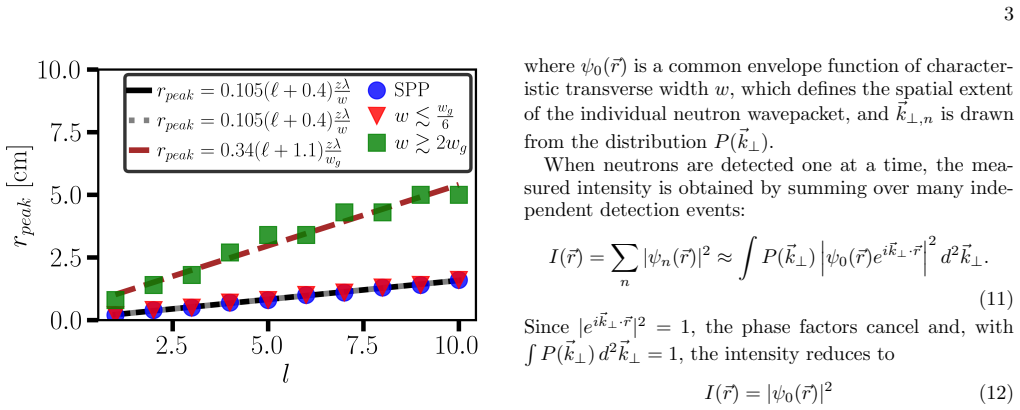
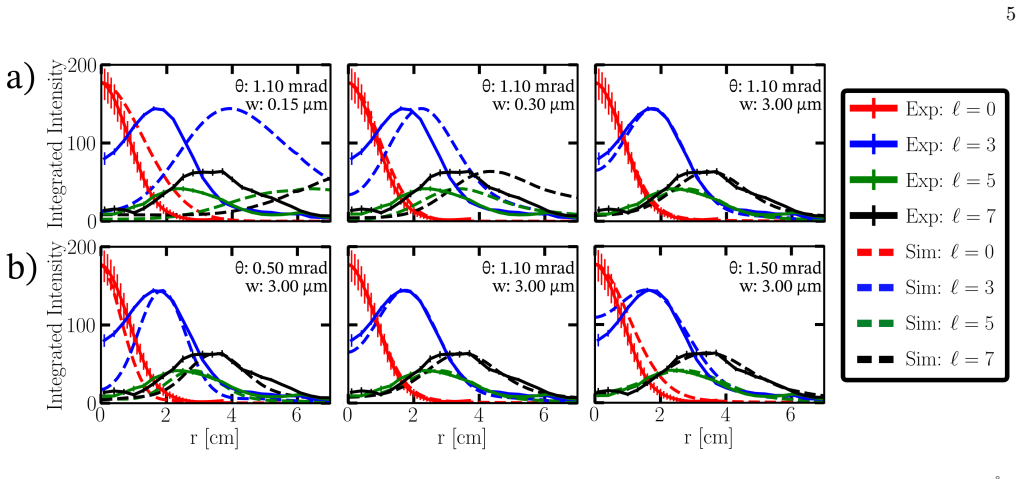
Helical neutron states produce annular intensity profiles whose peak radius depends on the transverse wavepacket extent while coherence length contributes only to profile broadening. In the reported geometry the measured divergence of 1.1 mrad yields a transverse coherence length of 180 nm, yet the identical data require the individual neutron wavepackets to extend at least 2 micrometers.
What carries the argument
Helical neutron wavefronts that generate annular intensity profiles whose peak radius isolates wavepacket extent from coherence length.
If this is right
- Transverse coherence length and single-particle wavepacket extent can be measured independently in neutron beams.
- The wavepacket extent in the reported setup exceeds the coherence length by more than an order of magnitude.
- The helical-wavefront method resolves the confusion that both quantities produce identical intensity broadening in ordinary measurements.
Where Pith is reading between the lines
- The same helical-state technique could be adapted to other neutral particles such as atoms or molecules to test whether their coherence and packet extents are likewise distinct.
- If wavepacket extent remains much larger than coherence length across different beam preparations, neutron optics models may need to treat the two lengths as separate parameters rather than interchangeable.
- Direct imaging of the annular profiles offers a route to calibrate wavepacket size in neutron interferometers without relying on divergence alone.
Load-bearing premise
The peak radius of the annular profile is determined solely by wavepacket extent while coherence length affects only the broadening, with no other propagation effects present.
What would settle it
An experiment in which the measured peak radius of the annular profile changes when coherence length is varied while wavepacket extent is held fixed, or fails to match the radius predicted from independent wavepacket measurements.
Figures



read the original abstract
Distinguishing transverse coherence length from single-particle wavepacket extent is fundamentally challenging, as both manifest through spatial broadening of observed intensity profiles in conventional experiments. Here we introduce a method based on helical neutron wavefronts that enables this separation. Helical neutron states produce annular intensity profiles whose peak radius depends on the transverse wavepacket extent, while coherence length only contributes to profile broadening. In our experimental geometry we measure a beam divergence of ~1.1 mrad, corresponding to a transverse coherence length of ~180 nm. In contrast, the same measurement places a lower bound of >= 2 um on the spatial extent of the individual neutron wavepackets, more than an order of magnitude larger than the coherence length. These results provide direct experimental evidence that transverse coherence length and single-particle wavepacket extent are distinct physical quantities, resolving a longstanding source of confusion in the neutron literature.
Editorial analysis
A structured set of objections, weighed in public.
Referee Report
Summary. The manuscript introduces a method based on helical neutron wavefronts to separate transverse coherence length from single-particle wavepacket extent. Helical states produce annular intensity profiles where the peak radius is claimed to depend only on wavepacket extent while coherence length affects only broadening. From a measured beam divergence of ~1.1 mrad the authors report a coherence length of ~180 nm and a lower bound of >=2 um on wavepacket extent, claiming this provides direct experimental evidence that the two quantities are distinct.
Significance. If the modeling isolation holds, the result would clarify a persistent point of confusion in neutron optics by showing that coherence length and wavepacket extent can differ by more than an order of magnitude. The helical-wavefront approach is a potentially useful addition to the experimental toolkit for neutron interferometry and coherence studies.
major comments (2)
- [Abstract] Abstract: the central separation rests on the unverified modeling assumption that the annular peak radius is set solely by the single-particle transverse extent while coherence length contributes exclusively to radial broadening. No derivation, propagation simulation, or test for coupling from partial coherence, mode dispersion, or diffraction is supplied; if any such effect shifts the peak location the reported distinction and the >=2 um lower bound do not follow from the 1.1 mrad datum.
- [Experimental section] Experimental section (implied by numerical claims): the reported values are given without error bars, raw intensity profiles, fitting procedures, or exclusion criteria, making it impossible to assess the statistical support for the 180 nm and >=2 um figures or the claimed separation.
minor comments (1)
- The abstract states numerical results directly but supplies no supporting equations or figures; adding at least one schematic of the helical-state propagation and the intensity annulus would improve clarity.
Simulated Author's Rebuttal
We thank the referee for the careful reading and constructive feedback. The comments highlight the need for explicit verification of the modeling assumptions and fuller documentation of the experimental analysis. We address each point below and will revise the manuscript accordingly to strengthen the presentation while preserving the core claims.
read point-by-point responses
-
Referee: [Abstract] Abstract: the central separation rests on the unverified modeling assumption that the annular peak radius is set solely by the single-particle transverse extent while coherence length contributes exclusively to radial broadening. No derivation, propagation simulation, or test for coupling from partial coherence, mode dispersion, or diffraction is supplied; if any such effect shifts the peak location the reported distinction and the >=2 um lower bound do not follow from the 1.1 mrad datum.
Authors: We agree that the abstract states the separation without supplying the supporting derivation or simulations. The underlying physical model is that a helical wavefront with azimuthal phase winding produces a radial intensity maximum whose location is fixed by the single-particle transverse wave-packet extent (via the Fourier relationship between the helical phase gradient and the transverse momentum distribution), while the mutual coherence function enters only as a radial convolution that broadens the ring without shifting its peak. In the paraxial regime relevant to our beam divergence (~1.1 mrad), standard propagation calculations show that partial coherence, mode dispersion, and diffraction contribute negligibly to peak displacement. We will add a dedicated theoretical section containing the analytic derivation, numerical wave-packet propagation simulations, and explicit checks for coupling effects. The coherence length follows directly from the measured divergence via the standard relation l_c ≈ λ/(2π θ), and the >=2 μm lower bound on wave-packet extent is set by the observed ring radius being incompatible with smaller extents under the same model. revision: yes
-
Referee: [Experimental section] Experimental section (implied by numerical claims): the reported values are given without error bars, raw intensity profiles, fitting procedures, or exclusion criteria, making it impossible to assess the statistical support for the 180 nm and >=2 um figures or the claimed separation.
Authors: The numerical results quoted in the abstract are derived from the full data set presented in the experimental section, but we acknowledge that error bars, representative raw profiles, and the precise fitting/exclusion protocol are not summarized in the abstract itself. In the revised manuscript we will (i) attach error bars to the reported 180 nm and >=2 μm values, (ii) include example raw annular intensity profiles together with the fitted curves, (iii) describe the fitting procedure (radial Gaussian or Airy-function convolution) and any data-selection criteria, and (iv) state the statistical uncertainties and goodness-of-fit metrics. These additions will allow direct evaluation of the support for the quoted figures and the separation claim. revision: yes
Circularity Check
No significant circularity; reported bounds derive from measured divergence and profile geometry under stated modeling assumption
full rationale
The paper measures beam divergence (~1.1 mrad) to obtain coherence length (~180 nm) and uses the same annular profile data to place a lower bound (>=2 um) on wavepacket extent. The separation rests on the modeling claim that peak radius isolates extent while coherence affects only broadening, but this is presented as an input assumption rather than a quantity fitted to the target distinction or reduced by construction to the measured inputs. No self-citation load-bearing steps, no fitted parameters renamed as predictions, and no equations shown that equate the claimed distinction to its own data by definition. The result is therefore self-contained against external benchmarks (measured divergence and geometry) and receives only a minor score for the unverified isolation assumption.
Axiom & Free-Parameter Ledger
Reference graph
Works this paper leans on
-
[1]
Rauch and S
H. Rauch and S. A. Werner,Neutron interferometry: lessons in experimental quantum mechanics. Oxford Uni- versity Press, New York, 2015
2015
-
[2]
Neutron imaging in materials science,
N. Kardjilov, I. Manke, A. Hilger, M. Strobl, and J. Ban- hart, “Neutron imaging in materials science,”Materials Today, vol. 14, no. 6, pp. 248–256, 2011
2011
-
[3]
Lindner and J
P. Lindner and J. Oberdisse,Neutrons, X-rays, and light: scattering methods applied to soft condensed matter. El- sevier, 2024
2024
-
[4]
Utsuro and V
M. Utsuro and V. K. Ignatovich,Handbook of neutron optics. John Wiley & Sons, 2010
2010
-
[5]
Neutron and x-ray diffraction studies of liquids and glasses,
H. E. Fischer, A. C. Barnes, and P. S. Salmon, “Neutron and x-ray diffraction studies of liquids and glasses,”Re- ports on Progress in Physics, vol. 69, no. 1, pp. 233–299, 2006
2006
-
[6]
Direct mea- surement of the longitudinal coherence length of a ther- mal neutron beam,
H. Kaiser, S. A. Werner, and E. A. George, “Direct mea- surement of the longitudinal coherence length of a ther- mal neutron beam,”Physical Review Letters, vol. 50, pp. 560–563, Feb 1983
1983
-
[7]
Longitudinal co- herence in neutron interferometry,
A. Klein, G. I. Opat, and W. Hamilton, “Longitudinal co- herence in neutron interferometry,”Physical Review Let- ters, vol. 50, no. 8, p. 563, 1983. 7
1983
-
[8]
Measure- ments of the vertical coherence length in neutron in- terferometry,
D. Pushin, M. Arif, M. Huber, and D. Cory, “Measure- ments of the vertical coherence length in neutron in- terferometry,”Physical review letters, vol. 100, no. 25, p. 250404, 2008
2008
-
[9]
Measurement and characterization of the three-dimensional coherence function in neutron inter- ferometry,
H. Rauch, H. W¨ olwitsch, H. Kaiser, R. Clothier, and S. A. Werner, “Measurement and characterization of the three-dimensional coherence function in neutron inter- ferometry,”Physical Review, vol. A53, pp. 902–908, Feb 1996
1996
-
[10]
Single-slit diffraction of neutrons,
C. Shull, “Single-slit diffraction of neutrons,”Physical Review, vol. 179, no. 3, p. 752, 1969
1969
-
[11]
Intrinsic or- bital angular momentum states of neutrons,
R. L. Cappelletti, T. Jach, and J. Vinson, “Intrinsic or- bital angular momentum states of neutrons,”Physical review letters, vol. 120, no. 9, p. 090402, 2018
2018
-
[12]
Computerized simulation of 2-dimensional phase contrast images using spiral phase plates in neutron interferometry,
W. Treimer, F. Haußer, and M. Suda, “Computerized simulation of 2-dimensional phase contrast images using spiral phase plates in neutron interferometry,”Zeitschrift f¨ ur Naturforschung A, vol. 79, no. 9, pp. 873–880, 2024
2024
-
[13]
On neutron holography, neutron interferom- etry, and neutron orbital angular momentum,
W. Treimer, F. Hausser, I. Beckers, M. Suda, and T. Jach, “On neutron holography, neutron interferom- etry, and neutron orbital angular momentum,”Optics Express, vol. 33, no. 20, pp. 42385–42401, 2025
2025
-
[14]
Method for the definitive detec- tion of orbital angular momentum states in neutrons by spin-polarized he 3,
T. Jach and J. Vinson, “Method for the definitive detec- tion of orbital angular momentum states in neutrons by spin-polarized he 3,”Physical Review C, vol. 105, no. 6, p. L061601, 2022
2022
-
[15]
Experimental limit on neutron orbital an- gular momentum detection using polarized 3he,
D. Sarenac, O. Lailey, D. Garrad, P. Vadnere, N. Shen- tevski, C. Clark, D. Cory, J. Cotter, H. Ekinci, M. Hu- ber,et al., “Experimental limit on neutron orbital an- gular momentum detection using polarized 3he,”arXiv preprint arXiv:2603.16655, 2026
arXiv 2026
-
[16]
The quantum theory of optical coher- ence,
R. J. Glauber, “The quantum theory of optical coher- ence,”Physical Review, vol. 130, no. 6, p. 2529, 1963
1963
-
[17]
Coherent and incoherent states of the radiation field,
R. J. Glauber, “Coherent and incoherent states of the radiation field,”Physical Review, vol. 131, no. 6, p. 2766, 1963
1963
-
[18]
Determina- tion of the effective transverse coherence of the neutron wave packet as employed in reflectivity investigations of condensed-matter structures. i. measurements,
C. F. Majkrzak, C. Metting, B. B. Maranville, J. A. Dura, S. Satija, T. Udovic, and N. F. Berk, “Determina- tion of the effective transverse coherence of the neutron wave packet as employed in reflectivity investigations of condensed-matter structures. i. measurements,”Physical Review A, vol. 89, no. 3, p. 033851, 2014
2014
-
[19]
The effect of transverse wavefront width on specular neutron reflection,
C. Majkrzak, N. F. Berk, B. B. Maranville, J. Dura, and T. Jach, “The effect of transverse wavefront width on specular neutron reflection,”Applied Crystallography, vol. 55, no. 4, pp. 787–812, 2022
2022
-
[20]
Longitu- dinal coherence and interferometry in dispersive media,
W. A. Hamilton, A. G. Klein, and G. I. Opat, “Longitu- dinal coherence and interferometry in dispersive media,” Physical Review, vol. A28, pp. 3149–3152, Nov 1983
1983
-
[21]
Experimental realization of neutron helical waves,
D. Sarenac, M. E. Henderson, H. Ekinci, C. W. Clark, D. G. Cory, L. DeBeer-Schmitt, M. G. Huber, C. Ka- pahi, and D. A. Pushin, “Experimental realization of neutron helical waves,”Science Advances, vol. 8, no. 46, p. eadd2002, 2022
2022
-
[22]
Small-angle scat- tering interferometry with neutron orbital angular mo- mentum states,
D. Sarenac, M. E. Henderson, H. Ekinci, C. W. Clark, D. G. Cory, L. DeBeer-Schmitt, M. G. Huber, O. Lailey, J. S. White, K. Zhernenkov,et al., “Small-angle scat- tering interferometry with neutron orbital angular mo- mentum states,”Nature Communications, vol. 15, no. 1, p. 10785, 2024
2024
-
[23]
Mul- timode structured neutron beams,
O. Lailey, D. Sarenac, C. W. Clark, D. G. Cory, L. DeBeer-Schmitt, H. Ekinci, D. V. Garrad, M. E. Henderson, M. G. Huber, P. Vadnere,et al., “Mul- timode structured neutron beams,”arXiv preprint arXiv:2511.07662, 2025
arXiv 2025
-
[24]
Die wahrscheinliche schwingungsverteilung in einer von einer lichtquelle direkt oder mittels einer linse beleuchteten ebene,
P. H. van Cittert, “Die wahrscheinliche schwingungsverteilung in einer von einer lichtquelle direkt oder mittels einer linse beleuchteten ebene,” Physica, vol. 1, no. 1-6, pp. 201–210, 1934
1934
-
[25]
The concept of degree of coherence and its application to optical problems,
F. Zernike, “The concept of degree of coherence and its application to optical problems,”Physica, vol. 5, no. 8, pp. 785–795, 1938
1938
-
[26]
Slit and phase grating diffraction with a double crystal diffractometer,
W. Treimer, A. Hilger, and M. Strobl, “Slit and phase grating diffraction with a double crystal diffractometer,” Physica B: Condensed Matter, vol. 385, pp. 1388–1391, 2006
2006
-
[27]
The plain truth about forming a plane wave of neutrons,
A. G. Wagh, S. Abbas, and W. Treimer, “The plain truth about forming a plane wave of neutrons,”Nuclear Instru- ments and Methods in Physics Research Section A: Accel- erators, Spectrometers, Detectors and Associated Equip- ment, vol. 634, no. 1, pp. S41–S45, 2011
2011
-
[28]
Neutron diffraction from macroscopic objects and transverse coherence of the wavefunction: The fres- nel zone plates,
M. Altissimo, C. Petrillo, F. Sacchetti, L. Sani, and J. Stahn, “Neutron diffraction from macroscopic objects and transverse coherence of the wavefunction: The fres- nel zone plates,”Nuclear Instruments and Methods in Physics Research Section A: Accelerators, Spectrometers, Detectors and Associated Equipment, vol. 586, no. 1, pp. 68–72, 2008
2008
-
[29]
Divergence of an orbital-angular- momentum-carrying beam upon propagation,
M. J. Padgett, F. M. Miatto, M. P. Lavery, A. Zeilinger, and R. W. Boyd, “Divergence of an orbital-angular- momentum-carrying beam upon propagation,”New Journal of Physics, vol. 17, no. 2, p. 023011, 2015
2015
-
[30]
Small angle neutron scattering using sans2d,
R. Heenan, S. Rogers, D. Turner, A. Terry, J. Tread- gold, and S. King, “Small angle neutron scattering using sans2d,”Neutron News, vol. 22, no. 2, pp. 19–21, 2011
2011
-
[31]
Mantid—data analysis and visualization package for neutron scattering andµsr experiments,
O. Arnold, J.-C. Bilheux, J. Borreguero, A. Buts, S. I. Campbell, L. Chapon, M. Doucet, N. Draper, R. F. Leal, M. Gigg,et al., “Mantid—data analysis and visualization package for neutron scattering andµsr experiments,” Nuclear instruments and methods in physics research sec- tion a: accelerators, spectrometers, detectors and associ- ated equipment, vol. 7...
2014
-
[32]
Generation of neutron airy beams,
D. Sarenac, O. Lailey, M. E. Henderson, H. Ekinci, C. W. Clark, D. G. Cory, L. DeBeer-Schmitt, M. G. Huber, J. S. White, K. Zhernenkov,et al., “Generation of neutron airy beams,”Physical Review Letters, vol. 134, no. 15, p. 153401, 2025
2025
-
[33]
Phase vortex lattices in neutron interferometry,
N. Geerits, H. Lemmel, A.-S. Berger, and S. Sponar, “Phase vortex lattices in neutron interferometry,”Com- munications Physics, vol. 6, no. 1, p. 209, 2023
2023
-
[34]
Topological shaping of vortex neu- tron beams using forked phase gratings,
S. McKay, S. R. Parnell, R. M. Dalgliesh, N. V. Lavrik, I. I. Kravchenko, Q. Le Thien, D. V. Baxter, G. Or- tiz, and R. Pynn, “Topological shaping of vortex neu- tron beams using forked phase gratings,”Phys. Rev. Res., vol. 8, p. 023199, May 2026
2026
discussion (0)
Sign in with ORCID, Apple, or X to comment. Anyone can read and Pith papers without signing in.