REVIEW 3 major objections 4 minor 91 references
Effects of correlated noise on the excitation of robust breathers in an ac-driven, lossy sine-Gordon system
T0 review · 3 major / 4 minor · reviewed 2026-08-08 · deepseek-v4-flash
Pith's one-line read In a damped, ac-driven sine-Gordon system, breathers still emerge under Gaussian noise with finite correlation time or length, and the breather-only occurrence frequency is nonmonotonic in both, peaking near 0.9 for temporal and 0.6 for…
desk verdict Useful numerical extension of noise-induced breather generation to colored noise, but the headline nonmonotonicity needs a finite-time convergence check and error bars before I'd trust the peak. read the letter →
The pith
A machine-rendered reading of the paper's core claim, the machinery that carries it, and where it could break.
The reading
What carries the argument
The central object is the stochastically forced sine-Gordon equation $\varphi_{xx}-\varphi_{tt}-\alpha\varphi_t=\sin\varphi-A\sin(\omega t)-\gamma(x,t)$, with damping $\alpha=0.2$, ac drive $A=0.59$ at frequency $\omega=0.6$, and zero-mean Gaussian noise $\gamma$ with exponential correlation either in time, $\langle\gamma(x,t)\gamma(x',t')\rangle=(\varepsilon/\tau)\delta(x-x')e^{-|t-t'|/\tau}$, or in space, $\langle\gamma(x,t)\gamma(x',t')\rangle=(\varepsilon/\lambda)e^{-|x-x'|/\lambda}\delta(t-t')$. Temporal correlations are generated numerically through an Ornstein–Uhlenbeck process; spatial correlations are generated in Fourier space from the square root of the correlation spectrum. The statistical argument rests on classifying $N=250$--$500$ independent runs by an amplitude threshold: at least one kink if a $2\pi$-step appears, breathers-only if all modes have amplitudes between $\varphi^*=4\arctan(\sqrt{1-\omega^2}/\omega)$ and $2\pi$, and no excitation otherwise. The hitting time $t^*$, the first time $|\varphi|$ reaches $\varphi^*$ anywhere in the domain, supplies the timescale observable whose inverse is measured as a function of $\tau$ and $\lambda$.
What would settle it
Repeat the measurement of the breather-only occurrence frequency $f_b$ at the largest correlation scales studied (e.g., $\tau\simeq 9$ and $\lambda\simeq 25$) with simulation windows $T=500$, $1000$, and $2000$; if $f_b$ keeps increasing with $T$ instead of falling after its intermediate peak, the claimed nonmonotonicity is a finite-horizon artifact rather than a stationary property of the noisy dynamics.
Extended reading notes
Core claim
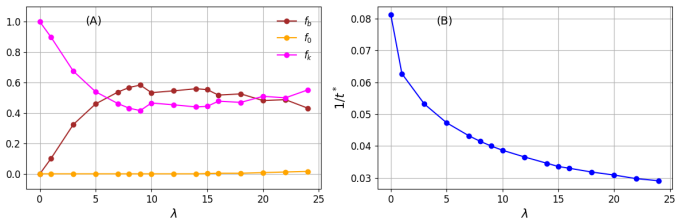
Breathers—localized, time-oscillating kink–antikink bound states—are shown to be robustly excited in a damped, ac-driven sine-Gordon system when the Gaussian noise is temporally correlated (Ornstein–Uhlenbeck) or spatially correlated (exponential kernel), not only in the white-noise limit. For a fixed noise amplitude $\varepsilon=0.04$, which in the white-noise limit yields kink-type excitations in almost every run, the breather-only occurrence frequency $f_b$ is a nonmonotonic function of both correlation scales: it rises from near zero at $\tau=\Delta t$ to a maximum of approximately $0.9$ as $\tau$ grows, and from near zero at $\lambda=\Delta x$ to approximately $0.6$ for intermediate $\lambda$, before falling as correlations become very large. The average inverse hitting time $1/t^*$, where $t^*$ is the first time $|\varphi|$ crosses the static breather amplitude threshold $\varphi^*=4\arctan(\sqrt{1-\omega^2}/\omega)$, decreases monotonically with both $\tau$ and $\lambda$, indicating that correlated noise slows the stochastic generation of solitonic modes. Spatially correlated noise with $\lambda$ larger than the kink width produces a distinct collective regime in which fluctuations spread across the system and generate cascades of solitons that can still relax into stable, isolated breathers.
Load-bearing premise
The classification assumes that every run that would eventually produce a breather does so within the fixed simulation window $T=500$, so runs whose breathers form later are recorded as 'no excitation' and the reported fall of $f_b$ at large correlation scales may be an artifact of stopping too early.
Editorial extensions
If this is right
- At fixed noise amplitude, tuning $\tau$ or $\lambda$ switches the system's most probable outcome from kink-dominated to breather-dominated and back, providing continuous control over breather-only occurrence.
- Because the average inverse hitting time falls monotonically with both correlation scales, noise correlations act as a built-in delay that sets when, on average, solitonic modes first appear.
- For spatial correlation lengths exceeding the kink width, excitation events become collective cascades that spread over the whole junction and only later condense into stable isolated breathers.
- The white-noise results of the earlier protocol are recovered in both limits $\tau\to0$ and $\lambda\to0$, so the correlated-noise regime is a genuine extension of the known breather-generation mechanism.
Reading between the lines
- If the downturn of $f_b$ at large $\tau$ and $\lambda$ is partly caused by the finite simulation window $T=500$, then extending the runs until hitting times saturate could shift the apparent peak to larger correlation scales or flatten it; this is an implicit alternative reading of the data, not a claim the paper makes.
- Because the noise variance is rescaled by $1/\tau$ and $1/\lambda$, some of the reported effect is equivalent to lowering the effective white-noise intensity; the genuinely new information is how the shape of the excitation-time distribution and the spatial pattern of events change with correlations.
- The collective cascade regime seen for large $\lambda$ suggests a concrete experimental target: using spatially correlated noise to create synchronized multi-soliton states in long Josephson junctions, a state the paper observes qualitatively but does not quantify.
Editorial analysis
A structured set of objections, weighed in public.
Referee Report
Summary. The paper studies the damped, ac-driven sine-Gordon equation (Eq. 1) under Gaussian noise with either finite temporal correlation (Eq. 2) or finite spatial correlation (Eq. 3). The authors simulate the stochastic partial differential equation with implicit finite differences, generate correlated noise via an Ornstein-Uhlenbeck scheme (Appendix A) and a Fourier-space method (Appendix B), and validate the generators against analytical correlation functions. They classify N=250 to N=500 independent runs into kink-containing (fk), breather-only (fb), and no-excitation (f0) outcomes, and define a hitting time t* at which the field first reaches the static-breather amplitude threshold. The central claim is that breathers are still excited for correlated noise and that fb is nonmonotonic in both the correlation time τ and the correlation length λ, rising to about 0.9 and 0.6, respectively, before falling again at large correlation scales, while the inverse hitting time decreases monotonically. The white-noise limits are reported to reproduce previous results from Refs. [48,49].
Significance. If the central claim holds, the paper provides a practically useful control knob for the noise-assisted generation of dissipative-robust sine-Gordon breathers, which is relevant for proposed experiments in long Josephson junctions. The manuscript is careful in several respects: the numerical noise generators are described in detail and checked against analytical correlation functions in Figs. A.6 and B.7, the parameter set is anchored to previous white-noise studies, and the qualitative distinction between isolated (temporal-correlation) and collective (spatial-correlation) excitation pathways is physically interesting. However, the main quantitative claim is currently not fully supported because the finite observation window T=500 censors late events, and because the correlation-scale scans also change the effective noise amplitude through the 1/τ and 1/λ prefactors. These issues affect the magnitude and even the existence of the reported nonmonotonic peaks, so the result is significant but requires additional numerical controls before it can be regarded as established.
major comments (3)
- [§3.1, Fig. 3, Appendix A] The central nonmonotonic claim for fb(τ) is not protected against censoring by the finite observation window T=500. The paper defines t*=∞ for runs in which |φ| never reaches φ* (Section 3.1), and Fig. 3(B) shows that 1/t* decreases monotonically with τ, so runs that would cross the threshold after T are counted in f0 rather than in fb. Since f0 rises on exactly the large-τ side of the fb peak in Fig. 3(A), the reported downturn of fb may be an artifact of the horizon rather than a steady-state property. A T-convergence check at representative τ values (for example, doubling or tripling T at the peak and at the largest τ) or a survival/hazard analysis is needed to support the shape of the fb(τ) curve claimed in the abstract.
- [§2, Eqs. (2)-(3), Appendices A and B] The correlation-scale scans conflate correlation with noise amplitude. With the prefactors ε/τ and ε/λ in Eqs. (2) and (3), the stationary variance of the noise decreases as τ or λ increases, as the histograms in Figs. A.6 and B.7 confirm. Therefore the rise in fb in Figs. 3 and 5 could, in principle, be reproduced by simply lowering the white-noise amplitude in the same ε scan; the claim that correlations themselves provide a control knob beyond amplitude rescaling requires either matching the stationary variance across τ/λ or comparing each correlated case against white noise with the same variance. Without such a control, the reported nonmonotonicity in Fig. 3(A) may be an amplitude effect rather than a genuine correlation effect.
- [§3.2, Fig. 5(B), Appendix B] The censoring issue also affects the spatial-correlation case, where Fig. 5(B) shows 1/t* decreasing monotonically with λ. The f0 curve in Fig. 5(A) is essentially zero for most λ and begins to rise only at the largest studied value, λ=25=L/2, which is exactly the range where Appendix B reports finite-size deviations in the generated correlation function. Consequently, the small f0 rise at λ=25 cannot be cleanly interpreted as either a physical freezing effect or a finite-size artifact. Restricting the interpretation to λ values where the noise generator is validated, and additionally checking the T-dependence for intermediate λ, would make the spatial-correlation conclusion much more robust.
minor comments (4)
- [Appendix A and Fig. A.6] There are typos: the Appendix A title reads "T emporally" instead of "Temporally", and the Fig. A.6 caption uses "approeach" instead of "approach".
- [§3.1 and §3.2] The manuscript does not explain why Fig. 2 uses N=500 trajectories while Figs. 3 and 5 use N=250, nor does it report confidence intervals for the binomial frequencies. At N=250, the standard error for a frequency near 0.5 is about 0.03, which is not negligible for distinguishing neighboring points in the fb curves.
- [§3.1] The definition of t*=∞ for runs with no threshold crossing is a censored-data convention, but the text does not state how many runs are censored in each panel of Figs. 3(B) and 5(B). Reporting the censored fraction would help the reader gauge how much of the decreasing 1/t* curve is driven by the f0 events.
- [§3.2] The sentence "The f0 curve is essentially equal to zero—up to λ≈L/2, where it shows a small, but appreciable, increasing trend" would benefit from a quantitative statement of the standard error at λ=25, since with N=250 a single run already changes f0 by 0.004 and the reported trend is only a few runs wide.
Circularity Check
No significant circularity: the central fb(τ) and fb(λ) results are measured from simulations using an externally defined breather threshold, and the cited prior work only supplies the white-noise baseline and motivation.
full rationale
The paper's central claims are numerical measurements rather than derivations. The occurrence frequencies fk, fb, and f0 are counted from N=250 or N=500 independent runs, with the breather-only category defined by the amplitude threshold φ* = 4 arctan(√(1−ω²)/ω), taken from standard static sine-Gordon breather theory (Refs. [25,26]) and not fitted to the simulation output. There is no parameter fitted to a subset of the data and then reported as a prediction, and no equation of the paper reduces fb(τ) or fb(λ) to an input by construction. The τ and λ scans are implemented through the correlation functions in Eqs. (2) and (3), and the numerical noise generators are separately validated against the analytical correlation functions in Appendices A and B, so the noise statistics are checked independently of the output statistics. Self-citations, chiefly Refs. [48,49], are used to motivate the phenomenon and to set the white-noise limit and parameter values; the text states that 'the remaining parameters are set such that Ref. [48,49]’s results are progressively reached as τ→0'. This is a consistency check and a baseline, not a load-bearing derivation: rejecting those references would not force or invalidate the measured τ/λ dependence, which stands on the present simulations. The finite observation window T=500 and the ε/τ and ε/λ prefactors raise legitimate questions about late-event censoring and effective-amplitude rescaling, and the paper itself acknowledges the slowdown and the amplitude rescaling; however, these are correctness or interpretation concerns, not circularity, because the reported quantities are not made equal to the model inputs by definition. Accordingly, no circular step can be exhibited, and the honest finding is no significant circularity.
Assumptions & free parameters
assumptions (5)
- standard math The implicit finite-difference scheme converges to the solution of the stochastic damped driven sine-Gordon equation on the chosen grid.
- standard math The Ornstein-Uhlenbeck process defined by Eq. (A.2) has the same statistics as the noise in Eq. (2).
- standard math The Fourier-space algorithm of Appendix B generates noise with the correlation function Eq. (3).
- domain assumption An excitation is a breather if its amplitude lies between φ* and 2π, where φ* is the static breather amplitude.
- domain assumption T=500 is long enough to capture the relevant breather-generation statistics for all reported τ and λ.
Cite this review
Pith. "Pith review of Effects of correlated noise on the excitation of robust breathers in an ac-driven, lossy sine-Gordon system." pith.science (2026). https://pith.science/paper/PBXKFOEH
@misc{pith2026250208439,
  author       = {Pith},
  title        = {Pith review of: Effects of correlated noise on the excitation of robust breathers in an ac-driven, lossy sine-Gordon system},
  year         = {2026},
  howpublished = {\url{https://pith.science/paper/PBXKFOEH}},
  note         = {Machine review of arXiv:2502.08439}
}
read the original abstract
Thermal noise and harmonic forcing have recently been shown to cooperatively excite sine-Gordon breathers robust to dissipation. Such a phenomenon has been found assuming a Gaussian noise source, delta-correlated both in time and space. In light of the potential implications of this generation technique, e.g., for the experimental observation of breathers in long Josephson junctions, it is physically motivated to investigate the effects of more realistic noise sources with finite correlation time and/or correlation length. Here, breathers are demonstrated to still emerge under this broader class of noise sources. The correlation time and the correlation length are found to offer control over the probability of observing breathers, as well on the typical timescale for their emergence. In particular, our results show that, as compared to the thermal case, the temporal and spatial correlations in the noise can lead to a larger breather-only occurrence frequency, i.e., the latter quantity behaves nonmonotonically versus both the correlation time and the correlation length. Overall, noise correlations represent a powerful tool for controlling the excitation of the elusive breather modes in view of experiments.
Figures


Figures from the paper (2 more)

Reference graph
Works this paper leans on
-
[1]
M. S. Miguel, R. Toral, Stochastic effects in physical systems, in: Instabil- ities and nonequilibrium structures VI, Springer, 2000, pp. 35–127
2000
-
[2]
A. C. Scott, Encyclopedia of Nonlinear Science, Routledge, 2006
2006
-
[3]
Garc ´ ıa-Ojalvo, J
J. Garc ´ ıa-Ojalvo, J. Sancho, Noise in spatially extended systems, Springer Science & Business Media, 2012
2012
-
[4]
Sancho, M
J. Sancho, M. San Miguel, Langevin equations with colored noise, Noise in nonlinear dynamical systems 1 (1989) 72–109
1989
-
[5]
H¨ aunggi, P
P. H¨ aunggi, P. Jung, Colored noise in dynamical systems, Adv. Chem. Phys. 89 (1994) 239–326
1994
-
[6]
Maggi, N
C. Maggi, N. Gnan, M. Paoluzzi, E. Zaccarelli, A. Crisanti, Critical active dynamics is captured by a colored-noise driven field theory, Commun. Phys. 5 (1) (2022) 55
2022
-
[7]
O. M. Tiokang, F. N. Tchangnwa, J. D. Tchinda, A. T. Tsokeng, M. Tchoffo, Effects of colored noise on the dynamics of quantum entangle- ment of a one-parameter qubit–qutrit system, Chin. Phys. B 31 (5) (2022) 050306
2022
-
[8]
Barone, G
A. Barone, G. Patern` o, Physics and Applications of the Josephson Effect, Wiley, New York, 1982
1982
Show all 91 references
-
[9]
N. F. Pedersen, Solitons in Josephson Transmission Lines, in: S. E. Trullinger, V. E. Zakharov, V. L. Pokrovsky (Eds.), Solitons, Elsevier, 1986, pp. 469–501. 14
1986
-
[10]
R. D. Parmentier, Solitons and Long Josephson Junctions, in: H. Wein- stock, R. W. Ralston (Eds.), The New Superconducting Electronics, Kluwer Academic Publishers, 1993, pp. 221–248
1993
-
[11]
A. V. Ustinov, Solitons in Josephson junctions, Physica D 123 (1-4) (1998) 315–329
1998
-
[12]
J. J. Mazo, A. V. Ustinov, The sine-Gordon equation in Josephson- junction arrays, Springer International Publishing, 2014, pp. 155–175. doi:10.1007/978-3-319-06722-3_7
2014 doi
-
[13]
I. I. Soloviev, N. V. Klenov, S. V. Bakurskiy, A. L. Pankratov, L. S. Kuzmin, Symmetrical Josephson vortex interferometer as an advanced ballistic single-shot detector, Applied Physics Letters 105 (20) (2014) 202602. arXiv:https://pubs.aip.org/aip/apl/article-pdf/doi/ 10.1063/...
2014 doi
-
[14]
Tafuri, Fundamentals and Frontiers of the Josephson Effect, Springer Nature, 2019
F. Tafuri, Fundamentals and Frontiers of the Josephson Effect, Springer Nature, 2019
2019
-
[15]
A. I. Braginski, Superconductor electronics: Status and outlook, Journal of Superconductivity and Novel Magnetism 32 (1) (2019) 23–44. doi: 10.1007/s10948-018-4884-4 . URL https://doi.org/10.1007/s10948-018-4884-4
2019 doi
-
[16]
L. S. Revin, A. L. Pankratov, A. V. Gordeeva, A. A. Yablokov, I. V. Rakut, V. O. Zbrozhek, L. S. Kuzmin, Microwave photon detection by an al joseph- son junction, Beilstein Journal of Nanotechnology 11 (1) (2020) 960–965
2020
-
[17]
Davydova, S
M. Davydova, S. Prembabu, L. Fu, Universal josephson diode effect, Sci- ence Advances 8 (23) (2022) eabo0309. arXiv:https://www.science. org/doi/pdf/10.1126/sciadv.abo0309, doi:10.1126/sciadv.abo0309. URL https://www.science.org/doi/abs/10.1126/sciadv.abo0309
2022 doi
-
[18]
Nadeem, M
M. Nadeem, M. S. Fuhrer, X. Wang, The superconducting diode ef- fect, Nature Reviews Physics 5 (10) (2023) 558–577. doi:10.1038/ s42254-023-00632-w . URL https://doi.org/10.1038/s42254-023-00632-w
2023 doi
-
[19]
Guarcello, S
C. Guarcello, S. Pagano, G. Filatrella, Efficiency of diode effect in asymmet- ric inline long Josephson junctions, Applied Physics Letters 124 (16) (2024) 162601. arXiv:https://pubs.aip.org/aip/apl/article-pdf/doi/10. 1063/5.0211230/19883359/162601\_1\_5.0211230.pdf, doi:10.1...
2024 doi
-
[20]
Ghosh, V
S. Ghosh, V. Patil, A. Basu, Kuldeep, A. Dutta, D. A. Jangade, R. Kulka- rni, A. Thamizhavel, J. F. Steiner, F. von Oppen, M. M. Deshmukh, High-temperature josephson diode, Nature Materials 23 (5) (2024) 612–
2024
-
[21]
R. A. Hovhannisyan, T. Golod, V. M. Krasnov, Controllable manipulation of semifluxon states in phase-shifted josephson junctions, Phys. Rev. Lett. 132 (2024) 227001. doi:10.1103/PhysRevLett.132.227001. URL https://link.aps.org/doi/10.1103/PhysRevLett.132.227001
2024 doi
-
[22]
Citro, C
R. Citro, C. Guarcello, S. Pagano, Josephson Junctions, Superconducting Circuits, and Qubit for Quantum Technologies, Springer Nature Switzer- land, Cham, 2024, pp. 1–59. doi:10.1007/978-3-031-55657-9_1 . URL https://doi.org/10.1007/978-3-031-55657-9_1
2024 doi
-
[23]
S. Benz, J. Biesecker, C. Burroughs, M. Castellanos-Beltran, P. Dressel- haus, N. Flowers-Jacobs, A. Fox, P. Hopkins, R. Johnson-Wilke, D. Olaya, et al., Ac metrology applications of the josephson effect, Applied Physics Letters 125 (5) (2024)
2024
-
[24]
V. M. Krasnov, Resonant switching current detector based on under- damped josephson junctions, Physical Review Applied 22 (2) (2024) 024015
2024
-
[25]
A. C. Scott, Nonlinear Science: Emergence and Dynamics of Coherent Structures, Oxford, 2003
2003
-
[26]
Dauxois, M
T. Dauxois, M. Peyrard, Physics of Solitons, Cambridge University Press, 2006
2006
-
[27]
Fujii, M
T. Fujii, M. Nishida, N. Hatakenaka, Mobile qubits in quantum joseph- son circuits, Phys. Rev. B 77 (2008) 024505. doi:10.1103/PhysRevB.77. 024505. URL https://link.aps.org/doi/10.1103/PhysRevB.77.024505
2008 doi
-
[28]
A. V. Gordeeva, A. L. Pankratov, Defect formation in long josephson junc- tions, Phys. Rev. B 81 (2010) 212504. doi:10.1103/PhysRevB.81.212504. URL https://link.aps.org/doi/10.1103/PhysRevB.81.212504
2010 doi
-
[29]
V. M. Krasnov, Terahertz electromagnetic radiation from intrinsic joseph- son junctions at zero magnetic field via breather-type self-oscillations, Phys. Rev. B 83 (2011) 174517. doi:10.1103/PhysRevB.83.174517. URL https://link.aps.org/doi/10.1103/PhysRevB.83.174517
2011 doi
-
[30]
De Santis, C
D. De Santis, C. Guarcello, B. Spagnolo, A. Carollo, D. Valenti, Generation of travelling sine-gordon breathers in noisy long joseph- son junctions, Chaos, Solitons & Fractals 158 (2022) 112039. doi:https://doi.org/10.1016/j.chaos.2022.112039. 16 URL https://www.sciencedirect....
2022
-
[31]
Sundaresh, J
A. Sundaresh, J. I. V¨ ayrynen, Y. Lyanda-Geller, L. P. Rokhinson, Diamag- netic mechanism of critical current non-reciprocity in multilayered super- conductors, Nature Communications 14 (1) (2023) 1628
2023
-
[32]
A. R. Bishop, K. Fesser, P. S. Lomdahl, S. E. Trullinger, Influence of soli- tons in the initial state on chaos in the driven damped sine-Gordon system, Physica D 7 (1-3) (1983) 259–279
1983
-
[33]
Bishop, P
A. Bishop, P. Lomdahl, Nonlinear dynamics in driven, damped sine-Gordon systems, Physica D 18 (1-3) (1986) 54–66
1986
-
[34]
P. S. Lomdahl, M. R. Samuelsen, Persistent breather excitations in an ac- driven sine-Gordon system with loss, Phys. Rev. A 34 (1) (1986) 664
1986
-
[35]
Y. S. Kivshar, B. A. Malomed, Dynamics of solitons in nearly integrable systems, Rev. Mod. Phys. 61 (4) (1989) 763
1989
-
[36]
P. S. Lomdahl, M. R. Samuelsen, Modulation of the breather frequency in the ac-driven sine-Gordon system with loss, Phys. Lett. A 128 (8) (1988) 427–432
1988
-
[37]
Gr¨ onbech-Jensen, Y
N. Gr¨ onbech-Jensen, Y. S. Kivshar, M. R. Samuelsen, Stabilization of breathers in a parametrically driven sine-Gordon system with loss, Phys. Rev. B 43 (1991) 5698–5701
1991
-
[38]
Grønbech-Jensen, B
N. Grønbech-Jensen, B. A. Malomed, M. R. Samuelsen, Stability of breathers in the ac-driven sine-Gordon system, Phys. Lett. A 166 (5) (1992) 347–351. doi:10.1016/0375-9601(92)90720-7
1992 doi
-
[39]
Grønbech-Jensen, Zero-voltage states in ac-driven long Josephson junc- tions, Phys
N. Grønbech-Jensen, Zero-voltage states in ac-driven long Josephson junc- tions, Phys. Rev. B 45 (1992) 7315–7320. doi:10.1103/PhysRevB.45. 7315
1992 doi
-
[40]
Y. S. Kivshar, N. Grønbech-Jensen, R. D. Parmentier, Kinks in the presence of rapidly varying perturbations, Phys. Rev. E 49 (5) (1994) 4542
1994
-
[41]
N. R. Quintero, A. S´ anchez, ac driven sine-Gordon solitons: dynamics and stability, Eur. Phys. J. B 6 (1998) 133–142
1998
-
[42]
Zharnitsky, I
V. Zharnitsky, I. Mitkov, N. Grønbech-Jensen, π kinks in strongly ac driven sine-Gordon systems, Phys. Rev. E 58 (1) (1998) R52
1998
-
[43]
K. Ø. Rasmussen, V. Zharnitsky, I. Mitkov, N. Grønbech-Jensen, Higher- order effects on Shapiro steps in Josephson junctions, Phys. Rev. B 59 (1) (1999) 58
1999
-
[44]
Salerno, Y
M. Salerno, Y. Zolotaryuk, Soliton ratchetlike dynamics by ac forces with harmonic mixing, Phys. Rev. E 65 (5) (2002) 056603. 17
2002
-
[45]
Zamora-Sillero, N
E. Zamora-Sillero, N. R. Quintero, F. G. Mertens, Ratchet effect in a damped sine-Gordon system with additive and parametric ac driving forces, Phys. Rev. E 74 (4) (2006) 046607
2006
-
[46]
Alvarez-Nodarse, N
R. Alvarez-Nodarse, N. R. Quintero, F. G. Mertens, Kink topology control by high-frequency external forces in nonlinear Klein-Gordon models, Phys. Rev. E 90 (4) (2014) 042916
2014
-
[47]
Kiselev, V
O. Kiselev, V. Y. Novokshenov, Emergence and Decay of π-Kinks in the Sine-Gordon Model with High-Frequency Pumping, J. Math. Sci. 252 (2) (2021) 175–189
2021
-
[48]
De Santis, C
D. De Santis, C. Guarcello, B. Spagnolo, A. Carollo, D. Valenti, Ac-locking of thermally-induced sine-Gordon breathers, Chaos Solitons Fractals 170 (2023) 113382. doi:10.1016/j.chaos.2023.113382
2023
-
[49]
De Santis, C
D. De Santis, C. Guarcello, B. Spagnolo, A. Carollo, D. Valenti, Noise- induced, ac-stabilized sine-Gordon breathers: Emergence and statistics, Commun. Nonlinear Sci. Numer. Simul. 131 (2024) 107796. doi:10.1016/ j.cnsns.2023.107796
2024
-
[50]
P. J. Pascual, S. Jim´ enez, L. V´ azquez, Numerical simulations of a nonlin- ear Klein-Gordon model. Applications, in: P. L. Garrido, J. Marro (Eds.), Third Granada Lectures in Computational Physics, Springer Berlin Hei- delberg, 1995, pp. 211–270
1995
-
[51]
Jim´ enez, P
S. Jim´ enez, P. Pascual, C. Aguirre, L. V´ azquez, A panoramic view of some perturbed nonlinear wave equations, Intern. Journ. of Bifurcation and Chaos 14 (01) (2004) 1–40
2004
-
[52]
De Santis, C
D. De Santis, C. Guarcello, B. Spagnolo, A. Carollo, D. Valenti, Breather dynamics in a stochastic sine-Gordon equation: Evidence of noise-enhanced stability, Chaos Solitons Fractals 168 (2023) 113115. doi:10.1016/j. chaos.2023.113115
2023
-
[53]
Dienst, E
A. Dienst, E. Casandruc, D. Fausti, L. Zhang, M. Eckstein, M. Hoff- mann, V. Khanna, N. Dean, M. Gensch, S. Winnerl, W. Seidel, S. Pyon, T. Takayama, H. Takagi, A. Cavalleri, Optical excitation of Josephson plasma solitons in a cuprate superconductor, Nat. Mater. 12 (6) (2013) 535–541
2013
-
[54]
Laplace, A
Y. Laplace, A. Cavalleri, Josephson plasmonics in layered superconduc- tors, Adv. Phys.-X 1 (3) (2016) 387–411. doi:10.1080/23746149.2016. 1212671
2016
-
[55]
S. Fava, G. D. Vecchi, G. Jotzu, M. Buzzi, T. Gebert, Y. Liu, B. Keimer, A. Cavalleri, Magnetic field expulsion in optically driven YBa 2Cu3O6.48 (2024). arXiv:2405.00848. 18
2024 arXiv
-
[56]
Gritsev, A
V. Gritsev, A. Polkovnikov, E. Demler, Linear response theory for a pair of coupled one-dimensional condensates of interacting atoms, Phys. Rev. B 75 (2007) 174511. doi:10.1103/PhysRevB.75.174511
2007 doi
-
[57]
Gritsev, E
V. Gritsev, E. Demler, M. Lukin, A. Polkovnikov, Spectroscopy of collective excitations in interacting low-dimensional many-body systems using quench dynamics, Phys. Rev. Lett. 99 (20) (2007) 200404
2007
-
[58]
E. G. Dalla Torre, E. Demler, A. Polkovnikov, Universal Rephasing Dy- namics after a Quantum Quench via Sudden Coupling of Two Initially Independent Condensates, Phys. Rev. Lett. 110 (2013) 090404. doi: 10.1103/PhysRevLett.110.090404
2013 doi
-
[59]
Neuenhahn, A
C. Neuenhahn, A. Polkovnikov, F. Marquardt, Localized Phase Structures Growing Out of Quantum Fluctuations in a Quench of Tunnel-coupled Atomic Condensates, Phys. Rev. Lett. 109 (2012) 085304. doi:10.1103/ PhysRevLett.109.085304
2012
-
[60]
Lovas, R
I. Lovas, R. Citro, E. Demler, T. Giamarchi, M. Knap, E. Orignac, Many- body parametric resonances in the driven sine-Gordon model, Phys. Rev. B 106 (2022) 075426. doi:10.1103/PhysRevB.106.075426
2022 doi
-
[61]
E. Wybo, A. Bastianello, M. Aidelsburger, I. Bloch, M. Knap, Prepar- ing and Analyzing Solitons in the Sine-Gordon Model with Quantum Gas Microscopes, Phys. Rev. X Quantum 4 (2023) 030308. doi:10.1103/ PRXQuantum.4.030308
2023
-
[62]
W. F. Ames, Numerical Methods for Partial Differential Equations, Aca- demic press, 1977
1977
-
[63]
W. H. Press, S. A. Teukolsky, W. T. Vetterling, B. P. Flannery, Numer- ical Recipes in Fortran 77: The Art of Scientific Computing, Cambridge University Press, 1992
1992
-
[64]
Guarcello, D
C. Guarcello, D. Valenti, B. Spagnolo, Phase dynamics in graphene-based Josephson junctions in the presence of thermal and correlated fluctuations, Phys. Rev. B 92 (2015) 174519. doi:10.1103/PhysRevB.92.174519
2015 doi
-
[65]
De Santis, C
D. De Santis, C. Guarcello, B. Spagnolo, A. Carollo, D. Valenti, Genera- tion of travelling sine-Gordon breathers in noisy long Josephson junctions, Chaos Solitons Fractals 158 (2022) 112039. doi:10.1016/j.chaos.2022. 112039
2022 doi
-
[66]
De Santis, C
D. De Santis, C. Guarcello, B. Spagnolo, A. Carollo, D. Valenti, Supratransmission-induced travelling breathers in long Josephson junc- tions, Commun. Nonlinear Sci. Numer. Simul. (2022) 106736doi:10.1016/ j.cnsns.2022.106736. 19
2022
-
[67]
De Santis, B
D. De Santis, B. Spagnolo, A. Carollo, D. Valenti, C. Guarcello, Heat- transfer fingerprint of Josephson breathers, Chaos Solitons Fractals 185 (2024) 115088. doi:10.1016/j.chaos.2024.115088
2024
-
[68]
D. R. Gulevich, M. B. Gaifullin, F. V. Kusmartsev, Controlled dynamics of sine-Gordon breather in long Josephson junctions, Eur. Phys. J. B 85 (2012) 24
2012
-
[69]
Monaco, Traveling electromagnetic waves in annular Josephson tunnel junctions, Wave Motion 88 (2019) 214–225
R. Monaco, Traveling electromagnetic waves in annular Josephson tunnel junctions, Wave Motion 88 (2019) 214–225. doi:10.1016/j.wavemoti. 2019.04.010
2019 doi
-
[70]
A. V. Chechkin, O. Y. Sliusarenko, R. Metzler, J. Klafter, Barrier crossing driven by L´ evy noise: Universality and the role of noise intensity, Phys. Rev. E 75 (4) (2007) 041101
2007
-
[71]
G. Afek, N. Davidson, D. A. Kessler, E. Barkai, Colloquium: Anomalous statistics of laser-cooled atoms in dissipative optical lattices, Rev. Mod. Phys. 95 (3) (2023) 031003
2023
-
[72]
Baule, P
A. Baule, P. Sollich, Exponential increase of transition rates in metastable systems driven by non-Gaussian noise, Sci. Rep. 13 (1) (2023) 3853
2023
-
[73]
Guarcello, D
C. Guarcello, D. Valenti, G. Augello, B. Spagnolo, The role of non-Gaussian sources in the transient dynamics of long Josephson junctions., Acta Phys. Pol. B 44 (5) (2013)
2013
-
[74]
Guarcello, G
C. Guarcello, G. Filatrella, B. Spagnolo, V. Pierro, D. Valenti, Voltage drop across Josephson junctions for L´ evy noise detection, Phys. Rev. Res. 2 (4) (2020) 043332
2020
-
[75]
Guarcello, L´ evy noise effects on Josephson junctions, Chaos Solitons Fractals 153 (2021) 111531
C. Guarcello, L´ evy noise effects on Josephson junctions, Chaos Solitons Fractals 153 (2021) 111531. doi:10.1016/j.chaos.2021.111531
2021
-
[76]
K. G. Fedorov, A. L. Pankratov, Mean time of the thermal escape in a current-biased long-overlap Josephson junction, Phys. Rev. B 76 (2007) 024504
2007
-
[77]
K. G. Federov, A. L. Pankratov, B. Spagnolo, Influence of length on the noise delayed switching of long Josephson junctions, Intern. Journ. of Bi- furcation and Chaos 18 (09) (2008) 2857–2862
2008
-
[78]
A. L. Pankratov, Noise self-pumping in long Josephson junctions, Phys. Rev. B 78 (2008) 024515
2008
-
[79]
Augello, D
G. Augello, D. Valenti, A. L. Pankratov, B. Spagnolo, Lifetime of the superconductive state in short and long Josephson junctions, Eur. Phys. J. B 70 (1) (2009) 145–151. doi:10.1140/epjb/e2009-00155-x. 20
2009 doi
-
[80]
A. L. Pankratov, A. V. Gordeeva, L. S. Kuzmin, Drastic Suppression of Noise-Induced Errors in Underdamped Long Josephson Junctions, Phys. Rev. Lett. 109 (2012) 087003
2012
-
[81]
Guarcello, D
C. Guarcello, D. Valenti, A. Carollo, B. Spagnolo, Stabilization Effects of Dichotomous Noise on the Lifetime of the Superconducting State in a Long Josephson Junction, Entropy 17 (2015) 2862–2875
2015
-
[82]
Belinski, E
V. Belinski, E. Verdaguer, Gravitational solitons, Cambridge University Press, 2001
2001
-
[83]
Purwins, H
H.-G. Purwins, H. B¨ odeker, S. Amiranashvili, Dissipative solitons, Ad- vances in Physics 59 (5) (2010) 485–701
2010
-
[84]
S. V. Suchkov, A. A. Sukhorukov, J. Huang, S. V. Dmitriev, C. Lee, Y. S. Kivshar, Nonlinear switching and solitons in pt-symmetric photonic sys- tems, Laser & Photonics Reviews 10 (2) (2016) 177–213
2016
-
[85]
V. G. Bykov, S. V. Trofimenko, Slow strain waves in blocky geological media from GPS and seismological observations on the Amurian plate, Nonlinear Process. Geophys. 23 (6) (2016) 467–475.doi:10.5194/npg-23-467-2016
2016 doi
-
[86]
Y. Song, X. Shi, C. Wu, D. Tang, H. Zhang, Recent progress of study on optical solitons in fiber lasers, Applied Physics Reviews 6 (2) (2019)
2019
-
[87]
W. Wang, L. Wang, W. Zhang, Advances in soliton microcomb generation, Advanced Photonics 2 (3) (2020) 034001–034001
2020
-
[88]
L. V. Yakushevich, L. A. Krasnobaeva, Ideas and methods of nonlinear mathematics and theoretical physics in dna science: the mclaughlin-scott equation and its application to study the dna open state dynamics, Biophys. Rev. 13 (2021) 315–338
2021
-
[89]
B. A. Malomed, Soliton models: Traditional and novel, one- and multidi- mensional, Low Temp. Phys. 48 (11) (2022) 856–895. doi:10.1063/10. 0014579
2022 doi
-
[90]
B. A. Malomed, Multidimensional soliton systems, Advances in Physics: X 9 (1) (2024) 2301592. 21
2024
-
[618]
URL https://doi.org/10.1038/s41563-024-01804-4
doi:10.1038/s41563-024-01804-4 . URL https://doi.org/10.1038/s41563-024-01804-4
Reviewed August 8, 2026 · model on record in the stance chip above.
Discussion (0). Continue with ORCID to comment.