REVIEW 3 major objections 4 minor 2 cited by
AnomalyGFM: Graph Foundation Model for Zero/Few-shot Anomaly Detection
T0 review · 3 major / 4 minor · reviewed 2026-08-07 · deepseek-v4-flash
Pith's one-line read One pre-trained GNN and two learnable class prototypes—one normal, one abnormal—can score node anomalies on unseen graphs across domains, and a few labeled normal nodes can refine the normal prototype.
desk verdict A useful GAD foundation model with a real zero-shot asterisk: beta is calibrated per target graph, so the frozen-model claim needs a fixed-beta ablation to hold. read the letter →
The pith
A machine-rendered reading of the paper's core claim, the machinery that carries it, and where it could break.
The reading
What carries the argument
The central object is the node representation residual, $r_i = h_i - \frac{1}{|N(i)|}\sum_{j \in N(i)} h_j$, computed in a feature space unified by SVD projection and produced by a two-layer GCN. The mechanism is prototype alignment: two data-independent, learnable prototypes $p_n$ and $p_a$ (mapped from Gaussian-initialized vectors) are trained with the alignment loss $\|r_i - p_n\|^2$ for normal nodes and $\|r_i - p_a\|^2$ for abnormal nodes, jointly with a binary cross-entropy loss on node embeddings. At inference, the same frozen GNN and prototypes score new nodes, and a small learnable prompt plus adaptation layer can refine $p_n$ from few labeled normal nodes. The residual is what carries the cross-domain transfer; everything else is a way of distilling it into two vectors.
What would settle it
Pre-train on Facebook, then run zero-shot inference on a heterophilous graph where normal nodes are connected across clusters and therefore have larger neighbor residuals than many anomalies; if AUROC drops to chance while the same graph is well handled by a per-graph supervised detector, the residual-based prototype transfer is not the source of the reported gains.
Extended reading notes
Core claim
The paper's central claim is that node representation residuals—the difference between a node's GNN embedding and the mean embedding of its neighbors—live in a unified feature space across graphs, and that aligning two learnable class prototypes to those residuals yields graph-agnostic normal and abnormal representations. After pre-training on one auxiliary graph (e.g., Facebook), the frozen GNN and frozen prototypes assign an anomaly score to every node of a new graph using only the similarity between the node's residual and the abnormal prototype plus a weighted inverse similarity to the normal prototype; the per-graph weight β is chosen from the target graph's global average edge similarity. When a few labeled normal nodes are available, the normal prototype is refined by a one-class prompt-tuning loss while the GNN and abnormal prototype stay frozen. The paper reports that this procedure outperforms unsupervised, supervised, and generalist graph methods on 11 real-world GAD datasets in both zero-shot and few-shot settings, and that subgraph-based inference scales it to very large graphs.
Load-bearing premise
The load-bearing premise is that a node's representation minus its neighbors' average is a consistent cross-domain abnormality signal—small for normal nodes and large for abnormal nodes—and that the per-graph scoring weight β can be set from the target graph's average edge similarity; if either assumption fails on a new domain, the shared prototype space has no common signal to transfer.
Editorial extensions
If this is right
- A single pre-trained GNN plus two prototype vectors can serve as a ready-made anomaly scorer for new graphs with no retraining, across social, financial, and co-review domains.
- Very large graphs can be scored from small random-walk subgraphs around each test node, avoiding the need to load the full graph into memory.
- One or a few labeled normal nodes can be used to refine the normal prototype through prompt tuning, improving anomaly scores without retraining the GNN or the abnormal prototype.
- Anomaly scores become comparable across graphs because every node is scored by the same residual-to-prototype similarity, enabling a uniform threshold rather than a per-graph retrained detector.
Reading between the lines
- One extension the paper leaves implicit: the same residual-to-prototype alignment could be applied to edge-level or motif-level anomalies, defining residuals for graph substructures rather than single nodes.
- Because the scoring weight β is set from a target-graph statistic (global average edge similarity), a practical extension is to learn or calibrate β on the fly from residual norms or a tiny labeled split, which would remove a hidden per-dataset input; the paper does not test this.
- The residual assumption deserves a cross-domain stress test: pre-train on one domain and evaluate on a heterophilous graph whose normal nodes are connected across clusters; if residuals lose their ordering there, the foundation-model claim would be restricted to homophily-dominated graphs.
Editorial analysis
A structured set of objections, weighed in public.
Referee Report
Summary. The paper proposes AnomalyGFM, a graph foundation model for zero-shot and few-shot graph anomaly detection (GAD). A GCN is pre-trained on an auxiliary labeled graph, and node representation residuals are computed as the difference between a node's embedding and the mean embedding of its neighbors. Two learnable, data-independent prototypes for the normal and abnormal classes are aligned to these residuals during pre-training. At test time the GNN and prototypes are frozen, and each node's anomaly score is computed by Eq. (9) as the sum of a similarity to the abnormal prototype and a beta-weighted inverse similarity to the normal prototype. When a few labeled normal nodes are available, only the normal prototype is updated through prompt tuning (Eqs. (7)-(8)). Experiments on eleven real-world GAD datasets compare AnomalyGFM to unsupervised, supervised, and generalist baselines under zero-shot and few-shot settings, with additional experiments on large-scale graphs.
Significance. If the claims are substantiated, the paper makes a useful contribution: it proposes a simple, efficient, and scalable GAD-oriented model that transfers across domains without retraining, supports both zero-shot and few-shot scenarios, and releases code. The benchmark is broad (eleven datasets, multiple baselines, ablations, sensitivity analyses, and Wilcoxon tests), and the residual-plus-prototype idea is clean and easy to reproduce. However, two load-bearing issues currently prevent full confidence: the zero-shot scoring weight beta is chosen per target graph from a target-graph statistic, which weakens the 'fixed frozen model' claim, and the reported T-Finance result in Table 4 is inconsistent with Table 2.
major comments (3)
- [Section 3.5, Eq. (9); Section 4.6; Appendix B.3, Table 9] The zero-shot scoring function is not a fixed, graph-agnostic rule. The weight beta is chosen from the target graph's global average edge similarity (Sim), with beta=0 when Sim>0.5 and beta=4 when Sim<=0.5. Seven of the nine zero-shot test graphs in Table 2 have Sim>0.5, so for those datasets the score reduces to exp(r_i^T p_a) and the normal-prototype term is unused. This contradicts the central claim that a single frozen GNN and two prototype vectors score unseen graphs without any further tuning; inference requires computing a target-graph statistic and applying a manually calibrated threshold. The sensitivity analysis in Fig. 7 varies beta within datasets and does not validate a global fixed beta. Please report zero-shot and few-shot results with a globally fixed beta (e.g., beta=0 and beta=4 across all datasets) and clearly state which beta rule produced the headline numbers in Tables 2 and 3.
- [Section 4.4, Table 4 vs. Table 2] AnomalyGFM's T-Finance AUROC is reported as 0.7852 in Table 4 (subgraph inference) but 0.5614 in Table 2 (zero-shot inference), and the AUPRC values also differ (0.1059 vs. 0.0593). For every competing method, the T-Finance numbers in Table 4 are identical to those in Table 2. This suggests either a different evaluation protocol (subgraph vs. full-graph inference) or a reporting inconsistency. Please reconcile the two numbers, explain which inference mode produced each table, and if subgraph inference is the intended deployment mode, include the subgraph-inference results in the main zero-shot table or justify the different setting.
- [Section 3.1, Eq. (1)] The feature-unification step is underspecified. If SVD is fit separately to each graph's feature matrix, the resulting d'-dimensional spaces are not mutually aligned, so the 'unified feature space' in which residuals and prototypes are compared is not actually a single shared space across graphs. This matters because feature dimensions vary from 10 to 576 across the datasets, and a per-dataset SVD cannot by itself provide a common coordinate system. Please clarify whether a single SVD basis is learned on the auxiliary graph and reused for test graphs, and if per-dataset SVD is used, provide evidence or an ablation that the pre-trained GNN transfers across these different coordinate systems.
minor comments (4)
- [Algorithm 1, line 16] The total loss in Algorithm 1 is written as L_total = L_BCE + beta * L_alignment, but Eq. (6) defines alpha as the alignment weight and beta as the scoring weight in Eq. (9). This is a typo that should be corrected to alpha.
- [Tables 2-4] Only three-run averages are reported without standard deviations or per-run values. Please include standard deviations or per-run results in the appendix to support the significance claims.
- [Section 3.5, paragraph on very large-scale graphs] The word 'AnonalyGFM' should be 'AnomalyGFM'.
- [Section 4.2, Table 2] The text states that AnomalyGFM outperforms UNPrompt on all datasets except Tolokers; this is true for AUROC but not for AUPRC on Tolokers, where AnomalyGFM is higher (0.2749 vs. 0.2219). Please state the metric or qualify the claim.
Circularity Check
No significant circularity: the prototype-residual model is tested on held-out graphs, and the per-target beta choice is a disclosed hyperparameter informed by a test-graph statistic, not a label-fitted input.
full rationale
The paper's derivation chain is self-contained rather than circular. AnomalyGFM pre-trains a GNN and two class prototypes on an auxiliary labeled graph (Eqs. 3-6), then freezes them and scores nodes on unseen graphs using Eq. 9; the zero-shot evaluation in Table 2 is therefore a genuine held-out test. The residual definition in Eq. 3 and the scoring rule in Eq. 9 are not restatements of the evaluation labels, and the alignment loss in Eq. 4 is a standard supervised objective on the pretraining graph, not a target-dependent construction. The residual-transfer premise is supported by citations [18, 27], one of which ([27]) overlaps with the authors, but it is also supported by ARC [18] and by the cross-dataset experiments themselves; it is not a uniqueness theorem and does not force the reported AUROC. The beta hyperparameter in Table 9 is set from the target graph's global average edge similarity (a test-graph statistic) and is disclosed in Sec. 4.6 and App. B.3; this weakens the literal claim of a single fixed scoring rule and could be a robustness concern, but beta is not fitted to anomaly labels and the reported scores are not equal to the beta input by construction. No equation in the paper reduces to its own input, and no fitted parameter is renamed as a prediction. Accordingly, the only mild issue is minor self-citation for the residual expectation and SVD preprocessing, neither of which is load-bearing.
Assumptions & free parameters
free parameters (6)
- beta =
0, 0.5, or 4 depending on target graph average edge similarity threshold
- alpha =
1
- common feature dimension d' =
300
- prototype dimension T =
300
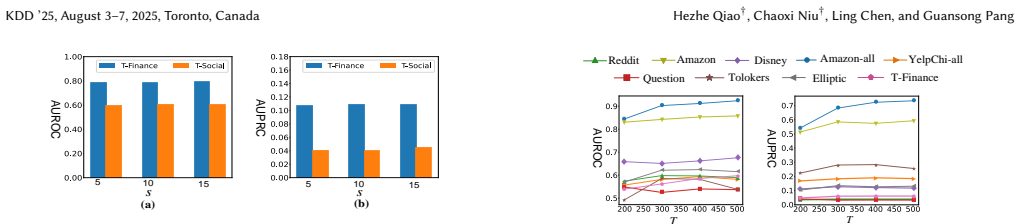
- subgraph size s =
5
- Gaussian prior parameters mu and sigma =
0 and 1
assumptions (5)
- domain assumption Normal nodes have small representation residual from neighbors, abnormal nodes have large residual, consistently across graphs.
- domain assumption SVD projection approximately preserves distance relationships across heterogeneous feature spaces.
- ad hoc to paper The anomaly scoring formula exp(r^T p_a) + beta exp(-r^T p_n) provides a valid ranking.
- domain assumption A random-walk subgraph of size s preserves the residual deviation of the target node.
- domain assumption A prompt update using only labeled normal nodes is sufficient for few-shot adaptation.
Cite this review
Pith. "Pith review of AnomalyGFM: Graph Foundation Model for Zero/Few-shot Anomaly Detection." pith.science (2026). https://pith.science/paper/PC4IKBHG
@misc{pith2026250209254,
  author       = {Pith},
  title        = {Pith review of: AnomalyGFM: Graph Foundation Model for Zero/Few-shot Anomaly Detection},
  year         = {2026},
  howpublished = {\url{https://pith.science/paper/PC4IKBHG}},
  note         = {Machine review of arXiv:2502.09254}
}
read the original abstract
Graph anomaly detection (GAD) aims to identify abnormal nodes that differ from the majority of the nodes in a graph, which has been attracting significant attention in recent years. Existing generalist graph models have achieved remarkable success in different graph tasks but struggle to generalize to the GAD task. This limitation arises from their difficulty in learning generalized knowledge for capturing the inherently infrequent, irregular and heterogeneous abnormality patterns in graphs from different domains. To address this challenge, we propose AnomalyGFM, a GAD-oriented graph foundation model that supports zero-shot inference and few-shot prompt tuning for GAD in diverse graph datasets. One key insight is that graph-agnostic representations for normal and abnormal classes are required to support effective zero/few-shot GAD across different graphs. Motivated by this, AnomalyGFM is pre-trained to align data-independent, learnable normal and abnormal class prototypes with node representation residuals (i.e., representation deviation of a node from its neighbors). The residual features essentially project the node information into a unified feature space where we can effectively measure the abnormality of nodes from different graphs in a consistent way. This provides a driving force for the learning of graph-agnostic, discriminative prototypes for the normal and abnormal classes, which can be used to enable zero-shot GAD on new graphs, including very large-scale graphs. If there are few-shot labeled normal nodes available in the new graphs, AnomalyGFM can further support prompt tuning to leverage these nodes for better adaptation. Comprehensive experiments on 11 widely-used GAD datasets with real anomalies, demonstrate that AnomalyGFM significantly outperforms state-of-the-art competing methods under both zero- and few-shot GAD settings.
Figures


Figures from the paper (3 more)


Forward citations
Cited by 2 Pith papers
-
DP-DGAD: A Generalist Dynamic Graph Anomaly Detector with Dynamic Prototypes
DP-DGAD pretrains on labeled dynamic graphs and adapts to unlabeled ones through evolving normal/abnormal prototypes and pseudo-labels, reporting large AUROC/AUPRC gains on eight target datasets.
-
Context-Based Fake News Detection using Graph Based Approach: ACOVID-19 Use-case
The paper applies the GBAD graph anomaly detection algorithm to conceptual graphs of news articles to identify fake news, yet it validates the approach only with qualitative examples.
Reference graph
Works this paper leans on
-
[1]
Leman Akoglu, Hanghang Tong, and Danai Koutra. 2015. Graph based anomaly detection and description: a survey. Data mining and knowledge discovery 29 (2015), 626–688
work page 2015
-
[2]
Dominique Beaini, Shenyang Huang, Joao Alex Cunha, Zhiyi Li, Gabriela Moisescu-Pareja, Oleksandr Dymov, Samuel Maddrell-Mander, Callum McLean, Frederik Wenkel, Luis Müller, et al. 2023. Towards foundational models for molec- ular learning on large-scale multi-task datasets. arXiv preprint arXiv:2310.04292 (2023)
arXiv 2023
-
[3]
Bo Chen, Jing Zhang, Xiaokang Zhang, Yuxiao Dong, Jian Song, Peng Zhang, Kaibo Xu, Evgeny Kharlamov, and Jie Tang. 2022. Gccad: Graph contrastive cod- ing for anomaly detection. IEEE Transactions on Knowledge and Data Engineering 35, 8 (2022), 8037–8051
work page 2022
-
[4]
Jingyan Chen, Guanghui Zhu, Chunfeng Yuan, and Yihua Huang. 2024. Boost- ing Graph Anomaly Detection with Adaptive Message Passing. In The Twelfth International Conference on Learning Representations
work page 2024
-
[5]
Kaize Ding, Jundong Li, Nitin Agarwal, and Huan Liu. 2021. Inductive anomaly detection on attributed networks. In Proceedings of the twenty-ninth international conference on international joint conferences on artificial intelligence . 1288–1294
work page 2021
-
[6]
Kaize Ding, Jundong Li, Rohit Bhanushali, and Huan Liu. 2019. Deep anomaly detection on attributed networks. In Proceedings of the 2019 SIAM international conference on data mining . SIAM, 594–602
work page 2019
-
[7]
Yingtong Dou, Zhiwei Liu, Li Sun, Yutong Deng, Hao Peng, and Philip S Yu. 2020. Enhancing graph neural network-based fraud detectors against camouflaged fraudsters. In Proceedings of the 29th ACM international conference on information & knowledge management. 315–324
work page 2020
-
[8]
Haoyi Fan, Fengbin Zhang, and Zuoyong Li. 2020. Anomalydae: Dual autoen- coder for anomaly detection on attributed networks. In ICASSP 2020-2020 IEEE International Conference on Acoustics, Speech and Signal Processing (ICASSP). IEEE, 5685–5689
work page 2020
Show all 50 references
-
[9]
Taoran Fang, Yunchao Zhang, Yang Yang, Chunping Wang, and Lei Chen. 2024. Universal prompt tuning for graph neural networks. Advances in Neural Infor- mation Processing Systems 36 (2024)
2024
-
[10]
Mikhail Galkin, Xinyu Yuan, Hesham Mostafa, Jian Tang, and Zhaocheng Zhu
-
[11]
Yuan Gao, Xiang Wang, Xiangnan He, Zhenguang Liu, Huamin Feng, and Yong- dong Zhang. 2023. Addressing heterophily in graph anomaly detection: A per- spective of graph spectrum. In Proceedings of the ACM Web Conference 2023 . 1528–1538
2023
-
[12]
Diederik P Kingma. 2014. Adam: A method for stochastic optimization. arXiv preprint arXiv:1412.6980 (2014)
2014 arXiv
-
[13]
Thomas N Kipf and Max Welling. 2016. Semi-supervised classification with graph convolutional networks. arXiv preprint arXiv:1609.02907 (2016)
2016 arXiv
-
[14]
Srijan Kumar, Xikun Zhang, and Jure Leskovec. 2019. Predicting dynamic em- bedding trajectory in temporal interaction networks. In Proceedings of the 25th ACM SIGKDD international conference on knowledge discovery & data mining . 1269–1278
2019
-
[15]
Yuhan Li, Peisong Wang, Zhixun Li, Jeffrey Xu Yu, and Jia Li. 2024. Zerog: Investigating cross-dataset zero-shot transferability in graphs. In Proceedings of the 30th ACM SIGKDD Conference on Knowledge Discovery and Data Mining . 1725–1735
2024
-
[16]
Yiqing Lin, Jianheng Tang, Chenyi Zi, H Vicky Zhao, Yuan Yao, and Jia Li
-
[17]
Yang Liu, Xiang Ao, Zidi Qin, Jianfeng Chi, Jinghua Feng, Hao Yang, and Qing He. 2021. Pick and choose: a GNN-based imbalanced learning approach for fraud detection. In Proceedings of the web conference 2021 . 3168–3177
2021
-
[18]
Yixin Liu, Shiyuan Li, Yu Zheng, Qingfeng Chen, Chengqi Zhang, and Shirui Pan
-
[19]
Yixin Liu, Zhao Li, Shirui Pan, Chen Gong, Chuan Zhou, and George Karypis
-
[20]
Zemin Liu, Xingtong Yu, Yuan Fang, and Xinming Zhang. 2023. Graphprompt: Unifying pre-training and downstream tasks for graph neural networks. In Pro- ceedings of the ACM Web Conference 2023 . 417–428
2023
-
[21]
arXiv preprint arXiv:2405.16771 (2024)
ARC: A Generalist Graph Anomaly Detector with In-Context Learning. arXiv preprint arXiv:2405.16771 (2024)
2024 arXiv
-
[22]
Haitao Mao, Zhikai Chen, Wenzhuo Tang, Jianan Zhao, Yao Ma, Tong Zhao, Neil Shah, Mikhail Galkin, and Jiliang Tang. [n. d.]. Position: Graph Foundation Models Are Already Here. In Forty-first International Conference on Machine Learning
-
[23]
Chaoxi Niu, Hezhe Qiao, Changlu Chen, Ling Chen, and Guansong Pang. 2024. Zero-shot Generalist Graph Anomaly Detection with Unified Neighborhood Prompts. arXiv preprint arXiv:2410.14886 (2024)
2024 arXiv
-
[24]
Junjun Pan, Yixin Liu, Yizhen Zheng, and Shirui Pan. 2023. PREM: A Simple Yet Effective Approach for Node-Level Graph Anomaly Detection. In 2023 IEEE International Conference on Data Mining (ICDM) . IEEE, 1253–1258
2023
-
[25]
Xiaoxiao Ma, Jia Wu, Shan Xue, Jian Yang, Chuan Zhou, Quan Z Sheng, Hui Xiong, and Leman Akoglu. 2021. A comprehensive survey on graph anomaly detection with deep learning. IEEE Transactions on Knowledge and Data Engineering 35, 12 (2021), 12012–12038
2021
-
[26]
Oleg Platonov, Denis Kuznedelev, Michael Diskin, Artem Babenko, and Liudmila Prokhorenkova. 2023. A critical look at the evaluation of GNNs under heterophily: Are we really making progress? arXiv preprint arXiv:2302.11640 (2023)
2023 arXiv
-
[27]
Hezhe Qiao and Guansong Pang. 2023. Truncated affinity maximization: One- class homophily modeling for graph anomaly detection. Advances in Neural Information Processing Systems 36 (2023)
2023
-
[28]
Hezhe Qiao, Hanghang Tong, Bo An, Irwin King, Charu Aggarwal, and Guansong Pang. 2024. Deep Graph Anomaly Detection: A Survey and New Perspectives. arXiv preprint arXiv:2409.09957 (2024)
2024 arXiv
-
[29]
Guansong Pang, Chunhua Shen, Longbing Cao, and Anton Van Den Hengel. 2021. Deep learning for anomaly detection: A review. ACM computing surveys (CSUR) 54, 2 (2021), 1–38
2021
-
[30]
Mingchen Sun, Kaixiong Zhou, Xin He, Ying Wang, and Xin Wang. 2022. Gppt: Graph pre-training and prompt tuning to generalize graph neural networks. In Proceedings of the 28th ACM SIGKDD Conference on Knowledge Discovery and Data Mining. 1717–1727
2022
-
[31]
Xiangguo Sun, Hong Cheng, Jia Li, Bo Liu, and Jihong Guan. 2023. All in one: Multi-task prompting for graph neural networks. In Proceedings of the 29th ACM SIGKDD Conference on Knowledge Discovery and Data Mining . 2120–2131
2023
-
[32]
Jianheng Tang, Fengrui Hua, Ziqi Gao, Peilin Zhao, and Jia Li. 2023. Gadbench: Revisiting and benchmarking supervised graph anomaly detection. Advances in Neural Information Processing Systems 36 (2023), 29628–29653
2023
-
[33]
Patricia Iglesias Sánchez, Emmanuel Müller, Fabian Laforet, Fabian Keller, and Klemens Böhm. 2013. Statistical selection of congruent subspaces for mining attributed graphs. In 2013 IEEE 13th international conference on data mining . IEEE, 647–656
2013
-
[34]
Petar Veličković, Guillem Cucurull, Arantxa Casanova, Adriana Romero, Pietro Lio, and Yoshua Bengio. 2017. Graph attention networks. arXiv preprint arXiv:1710.10903 (2017)
2017 arXiv
-
[35]
Qizhou Wang, Guansong Pang, Mahsa Salehi, Wray Buntine, and Christopher Leckie. 2023. Open-Set Graph Anomaly Detection via Normal Structure Regular- isation. arXiv preprint arXiv:2311.06835 (2023)
2023 arXiv
-
[36]
Xuhong Wang, Baihong Jin, Ying Du, Ping Cui, Yingshui Tan, and Yupu Yang
-
[37]
Jianheng Tang, Jiajin Li, Ziqi Gao, and Jia Li. 2022. Rethinking graph neural networks for anomaly detection. In International Conference on Machine Learning. PMLR, 21076–21089
2022
-
[38]
Zhihao Wen, Yuan Fang, Yihan Liu, Yang Guo, and Shuji Hao. 2023. Voucher Abuse Detection with Prompt-based Fine-tuning on Graph Neural Networks. In Proceedings of the 32nd ACM International Conference on Information and Knowledge Management. 4864–4870
2023
-
[39]
Xiongxiao Xu, Kaize Ding, Canyu Chen, and Kai Shu. 2024. MetaGAD: Meta Representation Adaptation for Few-Shot Graph Anomaly Detection. In 2024 IEEE 11th International Conference on Data Science and Advanced Analytics (DSAA) . IEEE, 1–10
2024
-
[40]
Zhiming Xu, Xiao Huang, Yue Zhao, Yushun Dong, and Jundong Li. 2022. Con- trastive attributed network anomaly detection with data augmentation. InPacific- Asia conference on knowledge discovery and data mining . Springer, 444–457
2022
-
[41]
Neural computing and applications 33 (2021), 12073–12085
One-class graph neural networks for anomaly detection in attributed networks. Neural computing and applications 33 (2021), 12073–12085
2021
-
[42]
Mark Weber, Giacomo Domeniconi, Jie Chen, Daniel Karl I Weidele, Claudio Bellei, Tom Robinson, and Charles E Leiserson. 2019. Anti-money laundering in bitcoin: Experimenting with graph convolutional networks for financial forensics. arXiv preprint arXiv:1908.02591 (2019)
2019 arXiv
-
[43]
Shuang Zhou, Qiaoyu Tan, Zhiming Xu, Xiao Huang, and Fu-lai Chung. 2021. Sub- tractive aggregation for attributed network anomaly detection. In Proceedings of the 30th ACM International Conference on Information & Knowledge Management . 3672–3676
2021
-
[44]
Jiawen Zhu and Guansong Pang. 2024. Toward generalist anomaly detection via in-context residual learning with few-shot sample prompts. In Proceedings of the IEEE/CVF Conference on Computer Vision and Pattern Recognition . 17826–17836
2024
-
[45]
Chenyi Zi, Haihong Zhao, Xiangguo Sun, Yiqing Lin, Hong Cheng, and Jia Li. 2024. ProG: A Graph Prompt Learning Benchmark. arXiv preprint arXiv:2406.05346 (2024). AnomalyGFM: Graph Foundation Model for Zero/Few-shot Anomaly Detection KDD ’25, August 3–7, 2025, Toronto, Canada A...
2024 arXiv
-
[46]
Haihong Zhao, Aochuan Chen, Xiangguo Sun, Hong Cheng, and Jia Li. 2024. All in one and one for all: A simple yet effective method towards cross-domain graph pretraining. In Proceedings of the 30th ACM SIGKDD Conference on Knowledge Discovery and Data Mining . 4443–4454
2024
-
[47]
Qihang Zhou, Guansong Pang, Yu Tian, Shibo He, and Jiming Chen. 2023. Anoma- lyclip: Object-agnostic prompt learning for zero-shot anomaly detection. arXiv preprint arXiv:2310.18961 (2023)
2023
-
[2021]
IEEE transactions on neural networks and learning systems 33, 6 (2021), 2378–2392
Anomaly detection on attributed networks via contrastive self-supervised learning. IEEE transactions on neural networks and learning systems 33, 6 (2021), 2378–2392
2021
-
[2023]
arXiv preprint arXiv:2310.04562 (2023)
Towards foundation models for knowledge graph reasoning. arXiv preprint arXiv:2310.04562 (2023)
2023 arXiv
-
[2024]
arXiv preprint arXiv:2411.06427 (2024)
UniGAD: Unifying Multi-level Graph Anomaly Detection. arXiv preprint arXiv:2411.06427 (2024)
2024 arXiv
Reviewed August 7, 2026 · model on record in the stance chip above.
Discussion (0). Continue with ORCID to comment.