REVIEW 3 major objections 6 minor 1 cited by
Aligning Large Language Models with Implicit Preferences from User-Generated Content
T0 review · 3 major / 6 minor · reviewed 2026-08-07 · deepseek-v4-flash
Pith's one-line read Unlabeled user posts can supply preference data for alignment: scoring answers against the source post as a reference lifts AlpacaEval 2.0 length-controlled win rate to 35.93%, 9.37 points over the same DPO recipe on curated data.
desk verdict The reference-conditioned preference data idea is real and the ablation holds up, but the headline 9.37% SOTA gain is inflated by an unfair baseline — the honest number is closer to 5 points. read the letter →
The pith
A machine-rendered reading of the paper's core claim, the machinery that carries it, and where it could break.
The reading
What carries the argument
The load-bearing mechanism is the reference-conditioned reward model, Prometheus-7b-v2.0, an open judge LLM trained to score a response against a reference document and a rubric. PUGC feeds the original UGC as that reference, so the reward score $y_j = \mathrm{RM}(a_j \mid x', d)$ measures how well each sampled response holds up against the sharer's own account; the preferred response is the highest-scoring one and the rejected response the lowest. Supporting machinery includes an instruction-generation and relevance-filtering step that pairs each UGC document with a query it can actually answer, self-consistency decoding with $N=8$ reward-score samples to stabilize the judge, and tie-breaking that favors shorter high-scoring and longer low-scoring responses to suppress length bias.
What would settle it
Generate several thousand preference pairs with PUGC on a fresh UGC domain outside Prometheus's training mix, have a panel of independent human annotators rank the response pairs, and measure agreement with Prometheus's reference-conditioned rankings; if human agreement is near chance, or no higher than the no-reference scoring condition, the claimed implicit-preference signal is not real. A complementary check is to re-derive the 9.37-point AlpacaEval gain with pair labels assigned by length-normalized reward scores; if the gain disappears, the result is an artifact of reward-model length bias rather than content preference.
Extended reading notes
Core claim
The paper's central claim is that implicit human preferences can be extracted from unlabeled user-generated content without any explicit preference annotation. PUGC does this in four steps: an LLM generates a plausible reader instruction from a UGC document and filters out documents the source cannot answer; the policy model samples several responses to that instruction; a reference-conditioned reward model, Prometheus-7b-v2.0, scores each response with the original UGC supplied as a reference; and the highest- and lowest-scoring responses become a preference pair for DPO or SimPO training. The authors argue that the UGC text acts as a proxy for the sharer-preferred answer, so scoring against the reference surfaces implicit preferences that no explicit label set would capture. If correct, this makes preference data effectively free at scale and, because domain UGC is easier to collect than domain instructions, makes domain-specific alignment a matter of choosing the right corpus.
Load-bearing premise
The pipeline assumes that Prometheus-7b-v2.0, a reward model trained to judge answers against a reference document, produces scores on UGC-derived prompts that reliably track what human readers prefer; the paper tests this on only 202 GPT-4-judged pairs and 191 human-judged pairs, and when the reward model is swapped for a strong general-purpose one, Skywork-Llama-8B, the headline win rate collapses from 35.93% to 16.12%.
Editorial extensions
If this is right
- Preference data becomes a byproduct of existing text collections: any corpus of first-person knowledge, such as reviews, tutorials, or support threads, can be converted into preference pairs without a human annotation step.
- Domain-specific alignment reduces to corpus choice: Goodreads book reviews as UGC beat general Dolma UGC by roughly 7 percentage points in a head-to-head comparison, suggesting the pipeline can be pointed at a target domain.
- Iterating the pipeline online continues to help: three rounds of resampling responses from the updated policy reach 37.51% LC win rate versus 35.93% offline.
- The benefit is uneven across tasks: the paper reports no gains, and slight drops, on math, coding, and reasoning benchmarks such as GSM8k, MMLU-Pro, and TruthfulQA, which it attributes to scarce reasoning-domain UGC and the reward model's focus on chat quality rather than reasoning accuracy.
- Safety is not sacrificed: PUGC-trained models hold their SafetyBench average at 72.0 versus 71.9 for the SFT base, while the UltraFeedback-trained baseline degrades to 70.4, and injecting 1,000 deliberately unsafe UGC documents degrades safety only slightly.
Reading between the lines
- If reference-conditioned judges continue to improve, this recipe could generalize to any domain with abundant expository text, shifting the main bottleneck of alignment from data annotation to reward-model engineering.
- A testable extension the authors leave implicit: replace the reference with a distilled answer synthesized from several UGC documents on the same question; if reward agreement with humans holds up, the preference signal is robust to noisy references, and if it falls, the signal depends on exact-document overlap.
- The collapse with random reference UGC suggests the reward model is performing content-level comparison rather than using the reference as a mere style prompt; a study of which response features drive the score differences would clarify what implicit preference is actually being learned.
- The paper controls for verbosity at evaluation time with length-controlled win rate but not at label-creation time, where raw reward scores pick the chosen response; re-ranking the same preference pairs with length-normalized scores would reveal whether the gain is genuine content preference or partly an anti-length bias.
Editorial analysis
A structured set of objections, weighed in public.
Referee Report
Summary. The paper introduces PUGC, a pipeline that converts unlabeled user-generated content (UGC) into preference data for DPO/SimPO training. It generates reader instructions from UGC using an LLM, filters for relevance, samples responses from the policy model, and scores them with Prometheus-7b-v2.0 using the original UGC as a reference document; the highest- and lowest-scoring responses form preference pairs. On AlpacaEval 2.0, PUGC+DPO with Mistral-7B-Instruct-v0.2 achieves 35.93% length-controlled win rate, an absolute gain of 9.37 points over the UltraFeedback-based DPO baseline (26.56%). Ablations show the UGC reference contributes about 4.8 points (35.93 vs 31.12), and the paper reports additional results on MT-Bench, domain-specific alignment, safety, theory of mind, and reward-model agreement.
Significance. If the central result is robust, PUGC offers a scalable source of preference supervision that does not require human-written prompts or GPT-4-generated preference labels. The controlled comparison (same reward model, same training recipe, same 60k data budget) is a real strength, and the paper is unusually transparent: it releases code and data, reports ablations that consistently isolate the reference mechanism, and candidly documents failures on math/coding and a large drop with a different reward model. The most trustworthy finding is the internal ablation showing that reference-conditioned reward scoring against UGC improves DPO data; whether this constitutes a new state-of-the-art alignment method is less certain given the baseline-comparison and reward-model-dependence issues below.
major comments (3)
- [§4, Table 1, and Table 7] The headline "9.37% improvement over traditional methods" is not an apples-to-apples comparison. The UltraFeedback baseline in Table 1 is scored with Prometheus-7b-v2.0 without a reference, even though that model is explicitly trained to judge responses against a reference document; this is an off-distribution use. Appendix Table 7 reports the same UltraFeedback pipeline with Skywork-Llama-3.1-8B, a reference-free reward model, reaching 30.85% LC. The advantage of PUGC over that configuration is 5.08 points, not 9.37. The "same reward model for fairness" rationale in §3 is therefore misleading: fairness would require each pipeline to use a reward model suited to its mode (reference-conditioned for PUGC, reference-free for standard preference data), or the claim should be restricted to "compared with the same reference-conditioned judge used without its intended reference."
- [Table 3 and §5] The central mechanism is demonstrated with a single reward model. Table 3 shows that replacing Prometheus-7b-v2.0 with Skywork-Llama-3.1-8B, even with UGC as reference, drops the LC win rate to 16.12%, below the SFT baseline of 17.11% (Table 1). The paper attributes this to Skywork's generalization, but the consequence is that PUGC's ability to "leverage implicit preferences" has not been shown for reference-free reward models; the framework's success is contingent on one judge trained with reference answers. Since the contribution is a data-generation framework, the authors should either demonstrate the mechanism with at least one additional reference-conditioned reward model or narrow the claim to Prometheus-class judges.
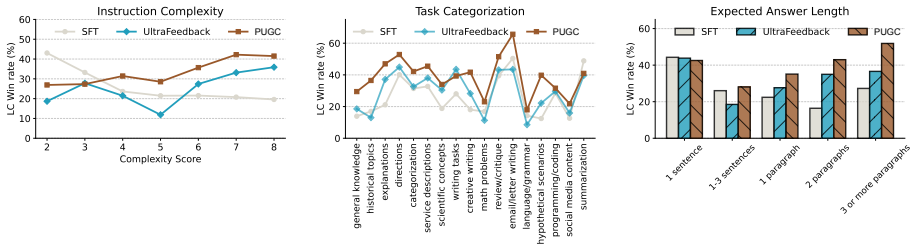
- [Appendix E / Figure 9] The instruction-generation step produces prompts that, by the paper's own t-SNE analysis, are closer to AlpacaEval test prompts than UltraFeedback prompts are. This raises the possibility that part of the AlpacaEval gain reflects distribution matching to the evaluation set rather than better preference learning. The authors should report a quantitative overlap or contamination check (e.g., n-gram overlap between generated instructions and AlpacaEval prompts, or evaluation on a benchmark with a deliberately different prompt distribution) to support the claim that the gain transfers beyond prompts that resemble UGC-derived instructions.
minor comments (6)
- [Throughout] There are several typos and formatting issues: "Alapaca" in the Figure 4 caption, "T ask" in the Figure 6 caption, "humanPreferences" and "unlabeledUser-Generated" in the abstract, and "9.4$" instead of "9.4%" in Table 8.
- [Appendix L] Appendix L states "We will include these results in the final version," which indicates the manuscript is not final; please integrate the validation into the main text or remove the sentence.
- [§8 and References] The related work refers to "BackHump (Li et al., 2023a)" but the same work is called "HumpBack" in the introduction; please make the naming consistent.
- [§3 / Appendix C] Table 7 is central to the baseline-fairness issue but appears only in an appendix; consider moving it to the main text or explicitly referencing it where the 9.37% claim is made.
- [Appendix C] The paragraph titled "The practicality of PUGC" reads like a response to a reviewer rather than a scientific statement; it should be integrated into the main text or removed.
- [§4] The paper calls 35.93% a "state-of-the-art" result but does not specify the comparison set or date of the leaderboard; please clarify which models and as-of-date are included in that claim.
Circularity Check
No significant circularity: PUGC's training reward signal (Prometheus with UGC reference) is validated against an independent GPT-4-Turbo judge; no fitted parameter or self-citation chain forces the headline result.
full rationale
The claimed derivation chain is: sample Dolma UGC; generate and filter reader instructions with an LLM; sample policy responses; score responses with Prometheus-7b-v2.0 conditioned on the UGC as reference; build DPO/SimPO preference pairs; evaluate on AlpacaEval 2.0 and MT-Bench with GPT-4-Turbo and GPT-4 judges. The training reward signal and the evaluation signal are distinct: the UGC reference appears in the reward-scoring prompt but not in the GPT-4 judge prompt used for AlpacaEval, so the 35.93% LC result is not equivalent to the training objective by construction. The w/o-reference ablation (31.12%) and random-reference ablation (16.74%) are internal ablations, not fitted predictions, and they do not reduce to the evaluation metric. Self-citations (Tan and Jiang 2023; Tan et al. 2024) are used only as background motivation for UGC reflecting human values, not as a load-bearing proof or uniqueness theorem; no step imports a conclusion from same-author prior work to force the paper's choice. No equation reduces to its own input, and no fitted parameter is renamed as a prediction. The main caveat is comparison fairness rather than circularity: the UltraFeedback baseline uses Prometheus in a reference-free mode even though Prometheus is trained for reference-conditioned judging, and Table 7 shows Skywork + UltraFeedback reaches 30.85% LC, shrinking the headline 9.37% gain to about 5.08%. That is a benchmarking issue, not a circular-derivation issue, and it does not undermine the internal finding that adding the UGC reference improves the trained model.
Assumptions & free parameters
free parameters (5)
- UGC quality threshold =
score >= 4 on a 5-point scale
- Self-consistency N for reward scoring =
N=8
- Length-based tie-breaking rule =
prefer shortest high-scoring response; reject longest low-scoring response
- Decoding temperatures for instruction generation and response sampling =
instruction gen: temp 0.7, top_p 0.9; response sampling: temp 0.8, top_p 0.95
- Number of responses K sampled per prompt =
not reported in main text
assumptions (5)
- domain assumption UGC sharers' expressed preferences are a good proxy for what readers expect from an AI assistant
- domain assumption Prometheus-7b-v2.0 reference-conditioned scores track human preferences
- domain assumption GPT-4-Turbo pairwise judgments on AlpacaEval 2.0 measure human preference
- domain assumption Llama-3-70B quality scores correlate with human quality judgments
- standard math DPO and SimPO objectives optimize the stated preference objective given the constructed pairs
Cite this review
Pith. "Pith review of Aligning Large Language Models with Implicit Preferences from User-Generated Content." pith.science (2026). https://pith.science/paper/PD7OBRIY
@misc{pith2026250604463,
  author       = {Pith},
  title        = {Pith review of: Aligning Large Language Models with Implicit Preferences from User-Generated Content},
  year         = {2026},
  howpublished = {\url{https://pith.science/paper/PD7OBRIY}},
  note         = {Machine review of arXiv:2506.04463}
}
read the original abstract
Learning from preference feedback is essential for aligning large language models (LLMs) with human values and improving the quality of generated responses. However, existing preference learning methods rely heavily on curated data from humans or advanced LLMs, which is costly and difficult to scale. In this work, we present PUGC, a novel framework that leverages implicit human Preferences in unlabeled User-Generated Content (UGC) to generate preference data. Although UGC is not explicitly created to guide LLMs in generating human-preferred responses, it often reflects valuable insights and implicit preferences from its creators that has the potential to address readers' questions. PUGC transforms UGC into user queries and generates responses from the policy model. The UGC is then leveraged as a reference text for response scoring, aligning the model with these implicit preferences. This approach improves the quality of preference data while enabling scalable, domain-specific alignment. Experimental results on Alpaca Eval 2 show that models trained with DPO and PUGC achieve a 9.37% performance improvement over traditional methods, setting a 35.93% state-of-the-art length-controlled win rate using Mistral-7B-Instruct. Further studies highlight gains in reward quality, domain-specific alignment effectiveness, robustness against UGC quality, and theory of mind capabilities. Our code and dataset are available at https://zhaoxuan.info/PUGC.github.io/
Figures


Figures from the paper (5 more)



Forward citations
Cited by 1 Pith paper
-
Synthetic Interaction Data for Scalable Personalization in Large Language Models
PersonaGym simulates noisy multi-turn user–assistant interactions to build PersonaAtlas, and PPOpt learns to rewrite user prompts from interaction history, improving judged personalization on synthetic benchmarks.
Reference graph
Works this paper leans on
-
[1]
Write a detailed feedback that assess the quality of the response strictly based on the given score rubric, not evaluating in general
-
[2]
You should refer to the score rubric
After writing a feedback, write a score that is an integer between 1 and 5. You should refer to the score rubric
-
[3]
(write a feedback for criteria) [RESULT] (an integer number between 1 and 5)
The output format should look as follows: "(write a feedback for criteria) [RESULT] (an integer number between 1 and 5)"
-
[4]
Please do not generate any other opening, closing, and explanations. ###The instruction to evaluate: {Instruction} ###Response to evaluate: {Response} ###Reference Document: {Reference_UGC} ###Score Rubrics: {Rubric} ###Feedback: Rubric Template [{criteria}] Score 1:{score1_description} Score 2:{score2_description} Score 3:{score3_description} Score 4:{sc...
work page 2024
-
[5]
InThe Twelfth Inter- national Conference on Learning Representations
Prometheus: Inducing fine-grained evaluation capability in language models. InThe Twelfth Inter- national Conference on Learning Representations. Seungone Kim, Juyoung Suk, Ji Yong Cho, Shayne Longpre, Chaeeun Kim, Dongkeun Yoon, Guijin Son, Yejin Cho, Sheikh Shafayat, Jinheon Baek, et al. 2024b. The biggen bench: A principled benchmark for fine-grained e...
arXiv 2023
-
[6]
From live data to high-quality benchmarks: The arena-hard pipeline. Xian Li, Ping Yu, Chunting Zhou, Timo Schick, Omer Levy, Luke Zettlemoyer, Jason Weston, and Mike Lewis. 2023a. Self-alignment with instruction backtranslation.arXiv preprint arXiv:2308.06259. Xuechen Li, Tianyi Zhang, Yann Dubois, Rohan Taori, Ishaan Gulrajani, Carlos Guestrin, Percy Lia...
-
[7]
Let’s verify step by step.arXiv preprint arXiv:2305.20050. Bill Yuchen Lin, Yuntian Deng, Khyathi Chandu, Faeze Brahman, Abhilasha Ravichander, Valentina Pyatkin, Nouha Dziri, Ronan Le Bras, and Yejin Choi. 2024. Wildbench: Benchmarking llms with challenging tasks from real users in the wild.arXiv preprint arXiv:2406.04770. Bill Yuchen Lin, Abhilasha Ravi...
arXiv 2024
-
[8]
Swaroop Mishra, Daniel Khashabi, Chitta Baral, and Hannaneh Hajishirzi
Simpo: Simple preference optimization with a reference-free reward.arXiv preprint arXiv:2405.14734. Swaroop Mishra, Daniel Khashabi, Chitta Baral, and Hannaneh Hajishirzi. 2021. Cross-task generaliza- tion via natural language crowdsourcing instructions. arXiv preprint arXiv:2104.08773. Arindam Mitra, Luciano Del Corro, Shweti Mahajan, Andres Codas, Clari...
arXiv 2021
Show all 34 references
-
[9]
Ryan Park, Rafael Rafailov, Stefano Ermon, and Chelsea Finn
Training language models to follow instruc- tions with human feedback.Advances in neural information processing systems, 35:27730–27744. Ryan Park, Rafael Rafailov, Stefano Ermon, and Chelsea Finn. 2024. Disentangling length from quality in direct preference optimization.arXiv...
2024 arXiv
-
[10]
Michael Santacroce, Yadong Lu, Han Yu, Yuanzhi Li, and Yelong Shen
Direct preference optimization: Your language model is secretly a reward model.Advances in Neural Information Processing Systems, 36. Michael Santacroce, Yadong Lu, Han Yu, Yuanzhi Li, and Yelong Shen. 2023. Efficient rlhf: Re- ducing the memory usage of ppo.arXiv preprint arX...
2023 arXiv
-
[11]
Yubo Wang, Xueguang Ma, Ge Zhang, Yuansheng Ni, Abhranil Chandra, Shiguang Guo, Weiming Ren, Aaran Arulraj, Xuan He, Ziyan Jiang, et al
Super-naturalinstructions: Generalization via declarative instructions on 1600+ nlp tasks.arXiv preprint arXiv:2204.07705. Yubo Wang, Xueguang Ma, Ge Zhang, Yuansheng Ni, Abhranil Chandra, Shiguang Guo, Weiming Ren, Aaran Arulraj, Xuan He, Ziyan Jiang, et al. 2024. Mmlu-pro: A...
2024 arXiv
-
[12]
InForty-first International Conference on Machine Learning
Iterative preference learning from human feedback: Bridging theory and practice for rlhf under kl-constraint. InForty-first International Conference on Machine Learning. Wei Xiong, Hanze Dong, Chenlu Ye, Han Zhong, Nan Jiang, and Tong Zhang. 2023. Gibbs sampling from human fee...
2023 arXiv
-
[14]
instruction
We discard categories that contain less than 10 samples to ensure the evaluation quality. Table 10: Breakdown of Alpaca Eval test set instructions by expected response length. Category Number Percentage 1 sentence 23 2.9% 1-3 sentences 177 22.0% 1 paragraph 322 40.0% 2 paragra...
2021
-
[19]
According to a study by Pew Research Center, 62% of US adults get news on social media
Social Media: Social media platforms have become an integral part of news- gathering, dissemination, and consumption. According to a study by Pew Research Center, 62% of US adults get news on social media. This trend has significant implications for media companies as they nee...
-
[20]
According to a report by Cisco, video will account for 82% of all internet traffic by 2022
Video Content: Video content is becoming increasingly important in the media industry. According to a report by Cisco, video will account for 82% of all internet traffic by 2022. Media companies are investing heavily in video production and distribution to meet the growing dem...
2022
-
[21]
According to a report by eMarketer, 24.5 million US adults will use a voice assistant for news in 2022
V oice Assistants: V oice assistants such as Amazon Alexa and Google Assistant are becoming increasingly popular for news consumption. According to a report by eMarketer, 24.5 million US adults will use a voice assistant for news in 2022. Media companies are exploring new ways...
2022
-
[22]
According to a report by Pew Research Center, 43% of US adults get local news daily
Local News: Local news is experiencing a resurgence as consumers look for more personalized and community-focused content. According to a report by Pew Research Center, 43% of US adults get local news daily. Media companies are investing in local news reporting and delivery to...
-
[23]
This trend challenges traditional media companies’ monopoly on news production and distribution
Social Media as News Sources: The increasing use of social media as a news source indicates a trend towards decentralized news-gathering and dissemination. This trend challenges traditional media companies’ monopoly on news production and distribution. It also creates new oppo...
-
[24]
This trend provides an opportunity for media companies to explore new revenue streams through podcast advertising and sponsorships
Podcasting: The rise of podcasting as a popular form of news consumption indicates a trend towards audio content. This trend provides an opportunity for media companies to explore new revenue streams through podcast advertising and sponsorships
-
[25]
This trend can lead to cost savings for media companies and increased efficiency, but it also raises ethical concerns regarding accuracy and fact-checking
Artificial Intelligence and Automated Journalism: The use of artificial intelligence (AI) and automated journalism indicates a trend towards data-driven journalism and content generation. This trend can lead to cost savings for media companies and increased efficiency, but it ...
-
[26]
This trend creates new opportunities for media companies to generate revenue through advertising and subscription models
Video Content: The trend towards video content, as seen in the success of YouTube and streaming services, suggests a shift towards visual storytelling and entertainment. This trend creates new opportunities for media companies to generate revenue through advertising and subscr...
-
[27]
This trend provides opportunities for media companies to generate revenue through targeted advertising and subscription models based on user data
Personalization: The trend towards personalized content and recommendations, as seen in the success of Netflix and Spotify, suggests a future where media consumption is tailored to individual preferences. This trend provides opportunities for media companies to generate revenu...
-
[28]
This trend provides opportunities for media companies to generate revenue through targeted advertising based on user data
Programmatic Advertising: The trend towards programmatic advertising, which uses algorithms to target specific audiences, suggests a future where advertising is more efficient and effective. This trend provides opportunities for media companies to generate revenue through targ...
-
[29]
This trend creates new opportunities for revenue generation through advertising and subscription models based on user engagement and experience
Virtual and Augmented Reality: The trend towards virtual and augmented reality content suggests a future where news and entertainment are more immersive and interactive. This trend creates new opportunities for revenue generation through advertising and subscription models bas...
-
[30]
supposed
Blockchain Technology: The trend towards blockchain technology in the media industry suggests a future where content is verified, secure, and transparent. This trend creates new opportunities for revenue generation through subscription models based on trust and security. It al...
2014
-
[31]
Descriptive Language: - Richness and Vividness: Does the author use vivid and rich language to paint a picture of the setting, characters, and actions? Is the language engaging and evocative, making the reader feel immersed in the story? - Consistency: Is the descriptive langu...
-
[32]
Here are some key elements to consider:
Character Development: - Complexity: Are the characters multi-dimensional and complex, with well-defined motivations, strengths, weaknesses, and backstories? Do they grow and change throughout the novel, or do they remain static? - Consistency: Is the character development con...
-
[33]
Descriptive Language: - Vivid Imagery: Does the author use descriptive language to paint a clear and vivid picture of the settings, characters, and emotions? Is the imagery evocative and transporting, allowing readers to immerse themselves in the story?(continued) Table 22: Pr...
-
[34]
Character Development: - Complexity: Are the characters well-developed and complex? Do they have distinct personalities, motivations, and backstories that make them feel real and relatable? - Consistency: Are the characters consistent in their actions, thoughts, and dialogue t...
-
[2021]
Our results show that the prompts generated by PUGC are more closely aligned with those from the Alpaca Eval test set, while the UltraFeedback prompts exhibit greater diversity
for prompt encoding and apply t-SNE to visualize the prompt embeddings. Our results show that the prompts generated by PUGC are more closely aligned with those from the Alpaca Eval test set, while the UltraFeedback prompts exhibit greater diversity. This observation aligns wit...
2024
-
[2022]
Stephen Casper, Xander Davies, Claudia Shi, Thomas Krendl Gilbert, Jérémy Scheurer, Javier Rando, Rachel Freedman, Tomasz Korbak, David Lindner, Pedro Freire, et al
Training a helpful and harmless assistant with reinforcement learning from human feedback.arXiv preprint arXiv:2204.05862. Stephen Casper, Xander Davies, Claudia Shi, Thomas Krendl Gilbert, Jérémy Scheurer, Javier Rando, Rachel Freedman, Tomasz Korbak, David Lindner, Pedro Fre...
2023 arXiv
-
[2023]
Ning Ding, Yulin Chen, Bokai Xu, Yujia Qin, Zhi Zheng, Shengding Hu, Zhiyuan Liu, Maosong Sun, and Bowen Zhou
Safe rlhf: Safe reinforcement learning from human feedback.arXiv preprint arXiv:2310.12773. Ning Ding, Yulin Chen, Bokai Xu, Yujia Qin, Zhi Zheng, Shengding Hu, Zhiyuan Liu, Maosong Sun, and Bowen Zhou. 2023. Enhancing chat language models by scaling high-quality instructional...
2023 arXiv
-
[2024]
Journal of Machine Learning Research, 25(70):1–53
Scaling instruction-finetuned language models. Journal of Machine Learning Research, 25(70):1–53. Karl Cobbe, Vineet Kosaraju, Mohammad Bavarian, Mark Chen, Heewoo Jun, Lukasz Kaiser, Matthias Plappert, Jerry Tworek, Jacob Hilton, Reiichiro Nakano, et al. 2021. Training verifi...
2021 arXiv
-
[4455]
Yuntao Bai, Andy Jones, Kamal Ndousse, Amanda Askell, Anna Chen, Nova DasSarma, Dawn Drain, Stanislav Fort, Deep Ganguli, Tom Henighan, et al
PMLR. Yuntao Bai, Andy Jones, Kamal Ndousse, Amanda Askell, Anna Chen, Nova DasSarma, Dawn Drain, Stanislav Fort, Deep Ganguli, Tom Henighan, et al
Reviewed August 7, 2026 · model on record in the stance chip above.
Discussion (0). Sign in to comment.