REVIEW 3 major objections 6 minor 12 references
Time2Agri: Temporal Pretext Tasks for Agricultural Monitoring
T0 review · 3 major / 6 minor · reviewed 2026-08-06 · deepseek-v4-flash
Pith's one-line read Agriculture-specific temporal pretext tasks outperform generic SSL and supervised baselines on crop and yield monitoring.
desk verdict Plausible temporal pretext tasks, but the regional pretraining shares SICKLE's evaluation distribution, so the headline regional-vs-national and absolute-gain claims need a clean data split before they hold. read the letter →
The pith
A machine-rendered reading of the paper's core claim, the machinery that carries it, and where it could break.
The reading
What carries the argument
The machinery is a set of three pretext heads attached to a ViT-S encoder fed with bitemporal Sentinel-2 RGB+NIR pairs. TD stacks the two CLS tokens and classifies the absolute month gap $|\Delta t|$. FP concatenates both frames' patch latents, adds positional and month/year time encodings, and decodes a per-pixel map of the top-3 dominant temporal frequencies obtained by Fourier analysis of the NDVI time series. FF adds a time-translator module that maps the past frame's latent into a predicted future latent, decoded into a future frame under normalized MSE. A deliberate design choice is the time encoding: month and year are encoded separately rather than as day-of-year, preserving inter-year differences. The shared idea is that solving these tasks requires the encoder to internalize phenological stage, crop cycle length, and inter-annual change.
What would settle it
Pretrain FF and FP on Sentinel-2 time series from a neighboring region or an earlier period that is disjoint from SICKLE's labeled tiles, then fine-tune and evaluate on SICKLE; if the IoU and MAPE advantages over MAE and DoFA disappear or shrink sharply, the reported gains depend on pretraining on the evaluation distribution.
Extended reading notes
Core claim
The central claim is that agricultural landscapes' predictable, cyclic dynamics are a richer source of self-supervision than generic spatial reconstruction or invariance objectives. The paper argues that sowing-to-harvest phenology leaves regular spectral and temporal signatures, so a model that predicts growth-stage transitions will encode crop identity, yield-relevant stress, and field structure. FF and FP are the claimed carriers: FF's future-frame objective forces the encoder to anticipate phenological development from a single past observation, yielding the best crop-type and field-boundary representations; FP's frequency-prediction objective forces it to infer long-horizon seasonal and rotation patterns, yielding the best yield estimates. The paper also claims regional-scale pretraining outperforms national-scale pretraining on regional downstream tasks, framing agricultural foundation models as needing geographic specialization.
Load-bearing premise
Regional pretraining chips were sampled from the same Sentinel-2 tiles and the same January 2018 to April 2021 period as the SICKLE evaluation benchmark, and the paper does not state a train/test split between pretraining and downstream data; the regional results assume this overlap does not inflate the measured gains.
Editorial extensions
If this is right
- In label-scarce agricultural regions, unlabeled seasonal satellite imagery alone can yield crop-type and field-boundary models competitive with or better than globally pretrained foundation models and supervised training.
- Yield forecasting can be improved by a pretext task that predicts long-horizon temporal frequencies, reducing in-season yield MAPE to 30.7%.
- Regional pretraining on a target agricultural region outperforms national-scale pretraining for regional downstream tasks, suggesting that geographic specialization matters more than raw scale for these applications.
- Future-frame prediction transfers across national field-boundary delineation, reaching 54.2% IoU on FTW India even when trained on a different supervised source region.
Reading between the lines
- The paper does not run a held-out evaluation, so a direct extension would be to pretrain on one set of tiles or years and evaluate on a spatially or temporally disjoint set; this would reveal how much of the regional advantage comes from pretraining on the evaluation distribution.
- The complementary strengths of FF (identification) and FP (yield) suggest a multi-task or jointly optimized pretext objective could improve both, since they rely on different time horizons of the same seasonal signal.
- The regional-over-national result, if it generalizes, implies agricultural foundation models should be built per agro-ecological zone rather than as one global model, which runs against the scaling trend in general remote sensing foundation models.
Editorial analysis
A structured set of objections, weighed in public.
Referee Report
Summary. The paper proposes three self-supervised pretext tasks—time-difference prediction (TD), temporal-frequency prediction (FP), and future-frame prediction (FF)—for agricultural remote sensing. The authors pretrain ViT-S encoders on newly constructed Sentinel-2 time series from Tamil Nadu (regional) and India (national) and evaluate on the SICKLE benchmark (crop mapping, yield, phenological dates) and the FTW India benchmark (field boundary delineation). They report that FF achieves 69.6% IoU for crop mapping, FP achieves 30.7% MAPE for in-season yield, FF achieves 54.2% IoU on FTW India, and that regional pretraining outperforms national pretraining on regional tasks.
Significance. If the results are reliable, this is a useful contribution: it shows that pretext tasks designed around crop phenology can beat generic MAE/contrastive SSL and a strong RSFM baseline, and it raises a substantive question about geographic scale in agricultural SSL. The paper is mostly clearly written and the experimental scope (multiple tasks, two benchmarks, a gap analysis) is appropriate. Its main limitations are empirical: the pretraining data overlaps the evaluation distributions, and all results are single runs without variance estimates, so the headline claims are not yet established at the required level of confidence.
major comments (3)
- [3.1 and Appendix A] The regional pretraining set is constructed by exhaustively sampling all 224x224 chips from SICKLE's four Sentinel-2 tiles (44PKS, 44PKT, 44PLS, 44PLT) over January 2018 to April 2021, which is exactly SICKLE's spatial and temporal extent, and the manuscript nowhere states that these pretraining chips are disjoint from the SICKLE train/test split or that a spatial or temporal holdout was applied. Since SICKLE annotations cover paddy parcels within these same tiles, the encoder and downstream head may have been pretrained on the evaluation distribution; this would inflate the absolute gains of FF/FP over MAE and DoFA in Table 1 and would confound the regional-vs-national conclusion in Table 4, where India FF is not pretrained on SICKLE extent. Please state the exact split used, and if no split exists, rerun the regional experiments with the SICKLE evaluation fields/tiles excluded from pretraining.
- [Appendix B and Table 3] The national pretraining data is constructed from the FTW India subset, and the authors do not state that the 399 held-out FTW India test chips were excluded from the pretraining set; the 3x3 neighbor sampling around each chip also means that even excluding exact test chips may not prevent pretraining on neighboring chips covering the same agricultural fields. If the FTW India test chips or their neighbors are included in pretraining, the reported 54.2% IoU for FF in Table 3 is partly a measure of pretraining on the test distribution rather than transfer. Please clarify whether the held-out test split was removed before pretraining and, if not, rerun the FTW India evaluation with a clean holdout.
- [4.2, Tables 1–4] All results are reported as single numbers with no error bars, multiple seeds, or significance tests. Several headline gaps are small relative to likely stochastic variation: in Table 3, FF vs MAE on FTW India is 0.542 vs 0.528 IoU (1.4 points), and in Table 1, the transplanting-date MAPE for FF (0.028) is worse than MAE (0.023), while harvest-date differences are below 0.003 MAPE. The claim of consistent improvements therefore cannot be evaluated statistically. Please report mean and standard deviation over at least three seeds and, where possible, a paired significance test for the main comparisons.
minor comments (6)
- [4.3, Tables 1–2] Several quantitative statements in Section 4.3 do not match the tables: the text says FP outperforms FF and TD by 2.4% and 2.5% MAPE points on both in-season and complete-season yield, but Table 1 shows in-season differences of 1.8 and 2.2 points; the text also says date prediction achieves 3.01% MAPE with FF-(3,6,9), while Table 2 contains no such value (the closest values are 1.50%, 2.19%, and 5.39%). Please correct the prose or the tables.
- [4.3] The phrase 'FF outperforms FP and TD by 7.6% and 3.0%' should be phrased as 7.6 and 3.0 percentage points of IoU, since the underlying numbers are differences between percentages, not relative improvements.
- [General] The paper does not mention code, pretrained weights, or data release. For an empirical paper of this type, please include a reproducibility statement with code, data-construction scripts, and model weights.
- [Table 3] The Object Recall values in Table 3 are all very low (at most 0.03), including for strong baselines; the paper should explain how this metric is computed and why all methods perform near this floor, since otherwise the values are hard to interpret.
- [Figure 1 caption] The caption says 'on the right side' twice when describing both the traditional and the proposed pretext tasks; the intended contrast is presumably 'left' versus 'right'.
- [3.2, FF paragraph] The phrase 'encoding casual relationship' should be 'encoding causal relationship'.
Circularity Check
Regional and national pretraining sets are built from the evaluation benchmarks' own spatial/temporal extent (SICKLE tiles/time; FTW India chips including held-out test chips), so the headline geographic-scale and FTW India claims are partly circular; the within-pool pretext-task comparisons retain independent content.
-
self definitional
[Section 3.1 (Pretraining Data); Appendix A; Section 4.5 (Role of Geographical Scale)]
"We used the already existing SICKLE and Fields of the World(FTW) benchmarks as our heuristic for sampling our training chips over the respective regions. ... To construct our regional scale pretraining dataset, we systematically identified all Sentinel-2 tiles that intersect with SICKLE’s spatial extent, specifically tiles 44PKS, 44PKT, 44PLS, and 44PLT ... we downloaded Sentinel-2 L2A Scene Classification Layer(SCL) for time period spanning January 1, 2018, to April 1, 2021, which aligns with the temporal coverage of the SICKLE dataset."
The 'regional' condition is defined as the SICKLE benchmark's own tiles and acquisition window, and the downstream evaluation is the same SICKLE benchmark. The paper describes no chip-level or field-level split between pretraining chips and SICKLE evaluation chips. Consequently, the Table 4 regional-over-national result (9.1% IoU, 3.0% MAPE) is not a clean test of geographic scale; it is a comparison between a model pretrained on the evaluation distribution and a model pretrained on a different distribution. The claimed geographic-specialization conclusion therefore reduces, by construction, to the choice of pretraining extent rather than to an independent empirical discovery.
-
self definitional
[Appendix B (National Pretraining Data Construction); Section 4.4 and Table 3]
"FTW includes over 70,000 samples globally with 1,960 samples specifically from India(of which 399 samples are held-out for testing). ... To construct our national-scale pretraining dataset, we extended the India subset of FTW ... For each chip in the dataset, we sampled its eight neighboring chips ... This resulted in a 3x3 grid around each FTW sample."
The national pretraining set is built from 'the India subset of FTW', and that subset is explicitly stated to contain 399 held-out test chips. The construction samples a 3x3 grid around 'each chip in the dataset' and never states that the held-out test chips were excluded. Since Table 3 reports results on the FTW India test set, the FF 54.2% IoU claim is not a clean external-transfer result: the encoder may have been pretrained on the test chips or their immediate spatial neighbors. The headline 'outperforming all baselines' on FTW India is thus partly forced by the pretraining/evaluation overlap rather than by task transfer alone.
full rationale
The core within-pool pretext-task comparisons (FF/FP/TD vs MAE, Table 1) are not circular: all models are pretrained on the same regional data and evaluated on SICKLE, so the relative ranking of temporal pretext tasks versus masked autoencoding is an empirical result. The score is elevated because two headline claims are built on pretraining data derived from the evaluation benchmarks themselves: SICKLE's tiles and time window for the regional-vs-national claim, and the FTW India subset (including, as stated, 399 held-out test chips) for the national field-boundary claim. In both cases the paper does not document a train/test separation, so the claimed advantages reduce in part to pretraining on the evaluation distribution. This is a self-definitional/contamination issue rather than a fitted-parameter-as-prediction issue; no load-bearing self-citation chain is present. The core pretext-task design retains independent content.
Assumptions & free parameters
free parameters (4)
- Top-K dominant frequencies (K=3) =
3
- Maximum temporal gap between bitemporal pairs =
3 months
- Savitzky-Golay window length and polyorder =
7 and 4
- Time encoding scheme (month and year PE) =
month plus year embeddings
assumptions (5)
- domain assumption Agricultural landscapes exhibit predictable, recurring seasonal cycles with strong spatial clustering of temporal frequencies; urban areas do not.
- domain assumption Future frames in agricultural fields can be predicted from a single past frame plus calendar timestamps without external data such as weather.
- domain assumption The per-pixel dominant frequency map computed from the full NDVI time series is a valid, non-leaking target for FP when the model sees only two frames.
- standard math Standard ViT, transformer decoder, FFT, and Savitzky-Golay machinery are correct as implemented.
- ad hoc to paper Regional pretraining data sampled from SICKLE's spatial and temporal extent is not materially overlapping with the SICKLE evaluation split.
Cite this review
Pith. "Pith review of Time2Agri: Temporal Pretext Tasks for Agricultural Monitoring." pith.science (2026). https://pith.science/paper/PDJI2NSU
@misc{pith2026250704366,
  author       = {Pith},
  title        = {Pith review of: Time2Agri: Temporal Pretext Tasks for Agricultural Monitoring},
  year         = {2026},
  howpublished = {\url{https://pith.science/paper/PDJI2NSU}},
  note         = {Machine review of arXiv:2507.04366}
}
read the original abstract
Self Supervised Learning(SSL) has emerged as a prominent paradigm for label-efficient learning, and has been widely utilized by remote sensing foundation models(RSFMs). Recent RSFMs including SatMAE, DoFA, primarily rely on masked autoencoding(MAE), contrastive learning or some combination of them. However, these pretext tasks often overlook the unique temporal characteristics of agricultural landscape, namely nature's cycle. Motivated by this gap, we propose three novel agriculture-specific pretext tasks, namely Time-Difference Prediction(TD), Temporal Frequency Prediction(FP), and Future-Frame Prediction(FF). Comprehensive evaluation on SICKLE dataset shows FF achieves 69.6% IoU on crop mapping and FP reduces yield prediction error to 30.7% MAPE, outperforming all baselines, and TD remains competitive on most tasks. Further, we also scale FF to the national scale of India, achieving 54.2% IoU outperforming all baselines on field boundary delineation on FTW India dataset.
Figures


Figures from the paper (3 more)


Reference graph
Works this paper leans on
-
[1]
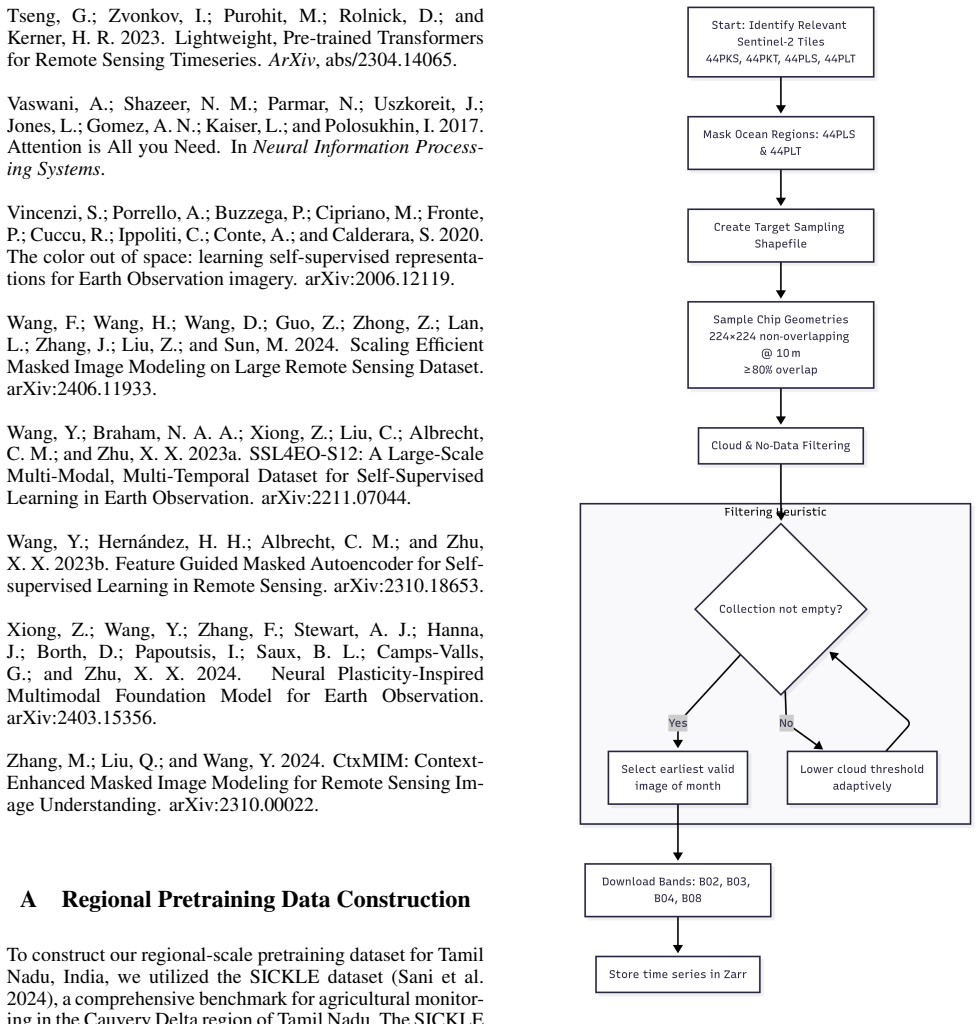
Identifying Relevant Sentinel-2 Tiles : The spatial ex- tent of SICKLE dataset overlaps four Sentinel-2 tiles: 44PKS, 44PKT, 44PLS, and 44PLT
-
[2]
Masking Ocean Regions : Among the identified tiles, 44PLS and 44PLT contain significant ocean coverage, which exhibits temporal dynamics vastly different from agricultural land. To ensure the dataset focuses on rele- vant agricultural areas, we masked out the ocean regions and created a shapefile representing the target sampling region
-
[3]
A Causally Informed Pretraining Approach for Multi- modal Foundation Models: Applications in Remote Sensing. Reed, C. J.; Gupta, R.; Li, S.; Brockman, S.; Funk, C.; Clipp, B.; Keutzer, K.; Candido, S.; Uyttendaele, M.; and Darrell, T. 2023. Scale-MAE: A Scale-Aware Masked Au- toencoder for Multiscale Geospatial Representation Learn- ing. arXiv:2212.14532....
arXiv 2023
-
[4]
Cloud and NoData Filtering: For each sampled chip ge- ometry, we downloaded Sentinel-2 L2A Scene Classifi- cation Layer(SCL) for time period spanning January 1, 2018, to April 1, 2021 , which aligns with the temporal coverage of the SICKLE dataset. For each chip, we ap- plied the following heuristic: • We prioritized selecting the earliest image in the mo...
work page 2018
-
[5]
The re- sulting dataset is high-resolution monthly time series tai- lored for temporal pretext tasks
Data Acquisiton: For the identified timestamps for each chip geometry, we acquired B02, B03, B04,and B08 bands and stored the time series in a Zarr store. The re- sulting dataset is high-resolution monthly time series tai- lored for temporal pretext tasks. B National Pretraining Data Construction For our national-scale experiments, we utilized India sub- ...
work page 2024
-
[6]
Sampling Sentinel-2 Chips Geometries : Using the tar- get shapefile, we exhaustively sampled 224 x 224 non- overlapping chip geometries at a spatial resolution of 10m. To ensure the chips were representative of the agri- cultural areas, we retained only those with at least 80% overlap with the target shapefile
-
[9]
Sampling Neighboring Chips : FTW provides prede- fined chip geometries, which cover diverse regions in India. For each chip in the dataset, we sampled its eight neighboring chips(top,bottom,left,right,top- right,top-left,bottom-right,bottom-left). This resulted in a 3x3 grid around each FTW sample. The rationale be- hind this approach was that areas surro...
-
[10]
Temporal Coverage: Similar to regional-scale dataset, we kept monthly temporal resolution, but kept acqusition period from January 2016 to January 2019
work page 2016
Show all 12 references
-
[11]
(a) The predicted future aligns well with the actual future; the frequency map naturally delineates farm parcels
Cloud and No-Data Filtering : To ensure high-quality imagery, we used the same filtering heuristic: Figure 6: Visualization of predictions by TD, FP, and FF models across different samples. (a) The predicted future aligns well with the actual future; the frequency map naturall...
-
[12]
C Visualization of Results Figure 6 presents qualitative examples of our model’s pre- text predictions: a
Data Acquisiton: For each filtered chip in the 3x3 grid, we downloaded B02, B03, B04,and B08 bands and stored the time series in a Zarr store. C Visualization of Results Figure 6 presents qualitative examples of our model’s pre- text predictions: a. Well-behaved growth cycle: ...
-
[2024]
Rome: FAO
The State of Food Security and Nutrition in the World 2024 – Financing to end hunger, food insecurity and malnu- trition in all its forms. Rome: FAO. A, T.; D, B.; J, A. N.; L, A.; K, A.; P, B.; A, D. J.; A, F.; G, F.; S, G.; A, H. E.; D, M.; M, M.; N, M.; P, S.; S, S. N.; and...
2024 arXiv
-
[2025]
arXiv:2408.03464
Vision Foundation Models in Remote Sensing: A Sur- vey. arXiv:2408.03464. Ma˜nas, O.; Lacoste, A.; Gir ´o-i Nieto, X.; Vazquez, D.; and Rodr´ıguez, P. 2021. Seasonal Contrast: Unsupervised Pre-Training From Uncurated Remote Sensing Data. In Proceedings of the IEEE/CVF Internat...
2021 arXiv
Reviewed August 6, 2026 · model on record in the stance chip above.
Discussion (0). Continue with ORCID to comment.