Modeling and Resource Optimization for Quantum Oracles
Pith reviewed 2026-05-21 04:17 UTC · model grok-4.3
The pith
The ASDT algorithm achieves the optimal gate count for quantum oracles under fixed qubit constraints.
A machine-rendered reading of the paper's core claim, the machinery that carries it, and where it could break.
Core claim
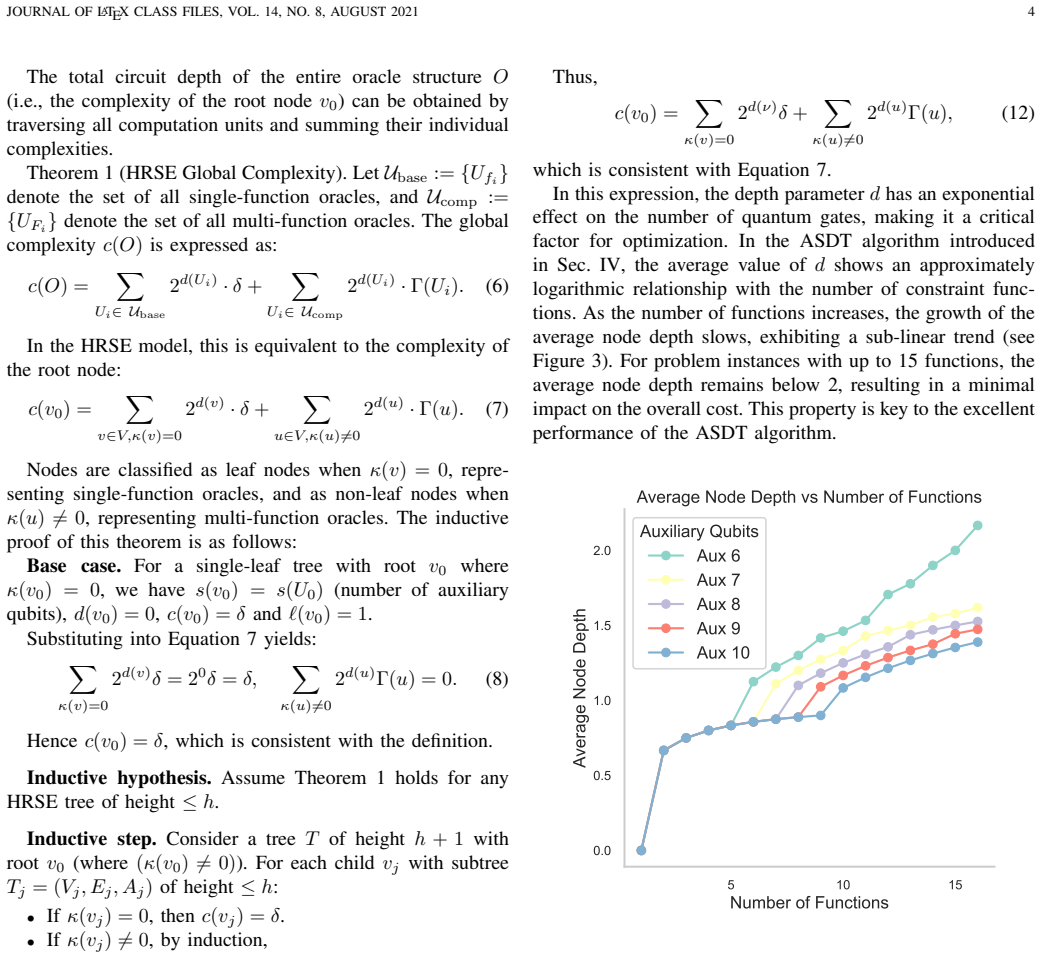
The central claim is that the Hierarchical Recursive Synthesis-Evaluation model enables precise gate-complexity analysis of oracles, and that the Adaptive Space-depth Trade-off algorithm built on it achieves optimal gate count for a given number of qubits, as established by theoretical proof, while also reducing average quantum circuit depth by 53.99 percent relative to the W-cycle approach when the number of variables is 10, 15, or 20.
What carries the argument
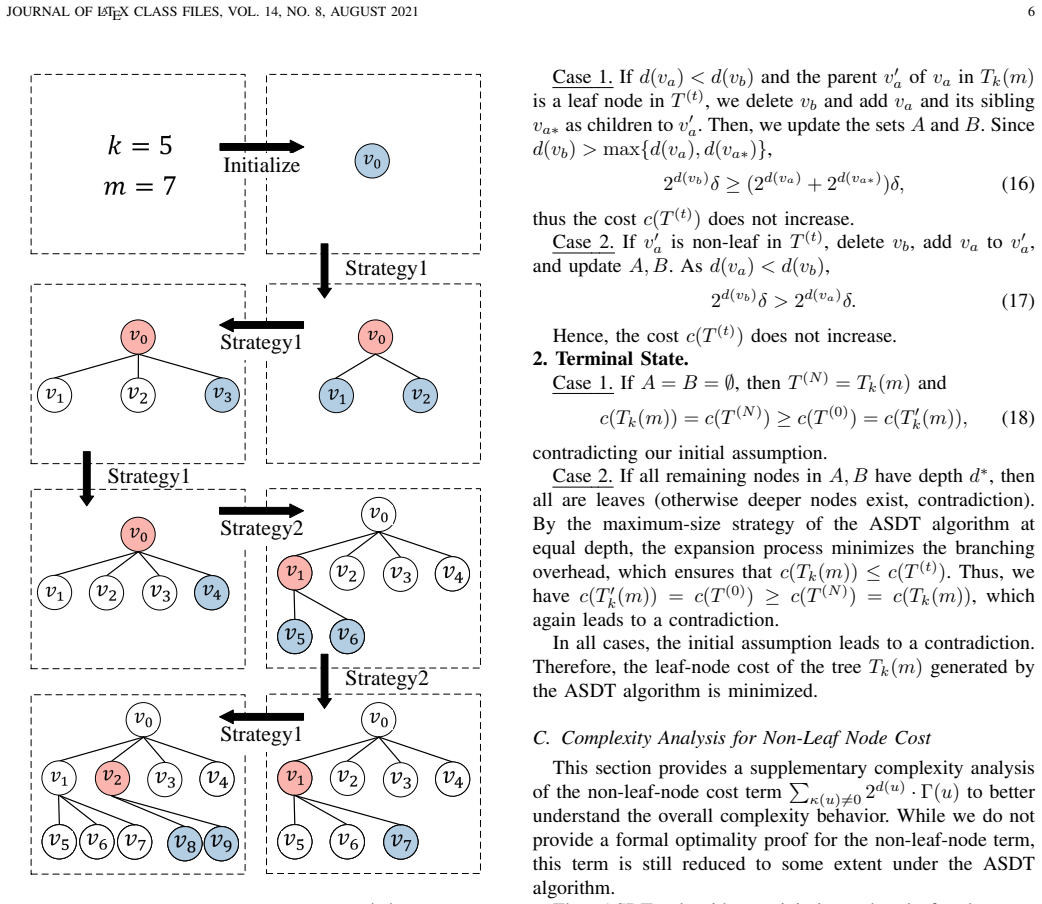
The Adaptive Space-depth Trade-off (ASDT) algorithm, which uses hierarchical recursive decomposition to trade off space against depth and thereby minimize total gates while obeying a fixed qubit budget.
If this is right
- Oracle circuits can be constructed with provably minimal gate counts for any chosen qubit number.
- Average circuit depth falls by 53.99 percent in the tested range of 10 to 20 variables, directly shortening algorithm run times.
- The HRSE model supplies a repeatable method for computing gate complexity of oracles before they are implemented.
- The same synthesis procedure applies across multiple quantum algorithms that rely on oracles.
Where Pith is reading between the lines
- The optimality result could be tested on oracles appearing inside Grover search or quantum machine-learning routines to measure end-to-end speedups.
- Scaling the recursive decomposition to variable counts beyond 20 would show whether the gate-count advantage persists or encounters new overheads.
- Integration of the ASDT procedure into existing quantum compilers might yield further resource savings when oracles are combined with other circuit blocks.
Load-bearing premise
The hierarchical recursive decomposition in the HRSE model is assumed to capture the full gate complexity of arbitrary oracles without missing hidden costs or requiring additional qubits beyond the fixed constraint.
What would settle it
A concrete counter-example oracle for which an alternative synthesis method produces fewer gates than ASDT at the same qubit count would falsify the optimality claim.
Figures



read the original abstract
Quantum computing has demonstrated its significant advantage over supercomputing for specific applications and shown promising prospect, such as machine learning, cryptography, finance, etc.. Quantum oracles are very common in many quantum algorithms and oracle resource consumption directly affects algorithm performance. However, existing oracle designs often exhibit high resource overhead and limited compatibility. Moreover, structured description tools and complexity analysis methods are lacked. In this work, we introduces a Hierarchical Recursive Synthesis-Evaluation (HRSE) model, enabling formal description and precise quantum gate complexity analysis of oracles. Based on this model, we propose an Adaptive Space-depth Trade-off (ASDT) algorithm for generating oracle structures under a fixed qubit constraint. We provide a theoretical proof showing that the ASDT algorithm achieves the optimal gate count for a given number of qubits. Experimental results show that the ASDT algorithm reduces the average quantum circuit depth by 53.99% compared with the W-cycle approach, with the number of variables being 10, 15, and 20, respectively.
Editorial analysis
A structured set of objections, weighed in public.
Referee Report
Summary. The manuscript introduces the Hierarchical Recursive Synthesis-Evaluation (HRSE) model for formally describing quantum oracles and analyzing their quantum gate complexity. It then proposes the Adaptive Space-depth Trade-off (ASDT) algorithm to generate oracle structures under a fixed qubit constraint, provides a theoretical proof that ASDT achieves the optimal gate count for a given number of qubits, and presents experimental results demonstrating a 53.99% reduction in average quantum circuit depth compared to the W-cycle approach for 10, 15, and 20 variables.
Significance. Should the theoretical proof be rigorous and the HRSE model comprehensively capture all aspects of gate complexity without unaccounted overheads, the ASDT algorithm could offer a systematic approach to optimizing oracle resources in quantum algorithms. This has potential implications for improving the efficiency of quantum computations in fields such as machine learning, cryptography, and finance. The provision of a formal model and optimality proof, if substantiated, strengthens the contribution beyond empirical improvements.
major comments (2)
- §4 (ASDT Algorithm and Optimality Proof): The theoretical proof that ASDT achieves optimal gate count for a given number of qubits is central to the paper's claims. However, it appears to rest on the HRSE decomposition exactly equaling the full gate complexity. Please clarify in the proof whether all ancillary operations, non-recursive base cases, and any qubit reallocations are fully accounted for within the fixed qubit constraint, as any omission would render the optimality bound incomplete for arbitrary oracles.
- §5 (Experimental Results): The reported 53.99% depth reduction is given as an average for 10, 15, and 20 variables, but details on the implementation of the W-cycle baseline, error analysis, and specific circuit depths for each case are not sufficiently elaborated. This makes it difficult to assess the robustness of the experimental validation of the theoretical claims.
minor comments (2)
- Abstract: The abstract mentions 'the number of variables being 10, 15, and 20, respectively' which is unclear; consider rephrasing for clarity.
- Introduction: Some sentences in the introduction could benefit from improved grammar and flow, e.g., 'we introduces' should be 'we introduce'.
Simulated Author's Rebuttal
We thank the referee for their constructive comments, which help clarify key aspects of our work. We address each major comment below and indicate the changes planned for the revised manuscript.
read point-by-point responses
-
Referee: §4 (ASDT Algorithm and Optimality Proof): The theoretical proof that ASDT achieves optimal gate count for a given number of qubits is central to the paper's claims. However, it appears to rest on the HRSE decomposition exactly equaling the full gate complexity. Please clarify in the proof whether all ancillary operations, non-recursive base cases, and any qubit reallocations are fully accounted for within the fixed qubit constraint, as any omission would render the optimality bound incomplete for arbitrary oracles.
Authors: The HRSE model defines oracles recursively with all operations, including ancillary qubits and base cases, strictly bounded by the total qubit constraint from the outset. The optimality proof in Section 4 accounts for these elements by treating the entire decomposition as a closed system where base cases are direct implementations using no extra qubits beyond the allocation, and any internal reallocations occur within the fixed limit without external overhead. We will revise the proof section to include an explicit statement and a short illustrative example confirming that ancillary operations and non-recursive cases are fully incorporated, thereby completing the bound for the oracles addressed by the model. revision: yes
-
Referee: §5 (Experimental Results): The reported 53.99% depth reduction is given as an average for 10, 15, and 20 variables, but details on the implementation of the W-cycle baseline, error analysis, and specific circuit depths for each case are not sufficiently elaborated. This makes it difficult to assess the robustness of the experimental validation of the theoretical claims.
Authors: We agree that greater detail on the experiments will strengthen the presentation. In the revised Section 5 we will add: a description of the W-cycle baseline as the standard non-adaptive recursive decomposition; a table reporting the exact circuit depths for both ASDT and W-cycle at 10, 15, and 20 variables; and the error-analysis procedure, which averaged results over 100 random oracle instances per variable count with standard deviations. These additions will allow direct verification of the reported 53.99% average depth reduction. revision: yes
Circularity Check
No circularity: ASDT optimality is a separate theoretical proof within the introduced HRSE model
full rationale
The paper introduces the HRSE model as a new formal framework for describing oracles and analyzing gate complexity, then separately proposes the ASDT algorithm and provides a theoretical proof of its optimality for fixed qubit counts. The experimental depth-reduction numbers (53.99% vs. W-cycle) are presented as empirical validation on specific variable counts and are not used to define or fit the optimality claim. No step reduces a claimed prediction or first-principles result to a fitted parameter or self-referential definition by construction; the derivation chain remains self-contained against the model's own assumptions without importing uniqueness via self-citation or smuggling ansatzes.
Axiom & Free-Parameter Ledger
axioms (2)
- domain assumption Quantum oracles can be decomposed into a hierarchical recursive structure whose gate complexity is exactly captured by the HRSE model.
- domain assumption The only resource constraint that matters is a fixed upper bound on the number of qubits.
Lean theorems connected to this paper
-
IndisputableMonolith/Foundation/ArithmeticFromLogic.leanLogicNat induction and embed echoes?
echoesECHOES: this paper passage has the same mathematical shape or conceptual pattern as the Recognition theorem, but is not a direct formal dependency.
HRSE model T=(V,E,A) with A(vi)=(s(vi),d(vi),κ(vi),c(vi),ℓ(vi)); c(vi)=Σ 2·c(vj)+Γ(vi) for non-leaves; Theorem 1 global complexity Σ 2^d(v)·δ + Σ 2^d(u)·Γ(u)
-
IndisputableMonolith/Cost/FunctionalEquation.leanwashburn_uniqueness_aczel unclear?
unclearRelation between the paper passage and the cited Recognition theorem.
ASDT optimality proof by contradiction on leaf-node cost P κ(v)=0 2^d(v)·δ under fixed qubit constraint k
What do these tags mean?
- matches
- The paper's claim is directly supported by a theorem in the formal canon.
- supports
- The theorem supports part of the paper's argument, but the paper may add assumptions or extra steps.
- extends
- The paper goes beyond the formal theorem; the theorem is a base layer rather than the whole result.
- uses
- The paper appears to rely on the theorem as machinery.
- contradicts
- The paper's claim conflicts with a theorem or certificate in the canon.
- unclear
- Pith found a possible connection, but the passage is too broad, indirect, or ambiguous to say the theorem truly supports the claim.
Reference graph
Works this paper leans on
-
[1]
Machine learning in the quantum realm: The state-of-the-art, challenges, and future vision,
E. H. Houssein, Z. Abohashima, M. Elhoseny, and W. M. Mohamed, “Machine learning in the quantum realm: The state-of-the-art, challenges, and future vision,”Expert Syst. Appl., vol. 194, p. 116512, 2022
work page 2022
-
[2]
Chal- lenges and opportunities in quantum machine learning,
M. Cerezo, G. Verdon, H.-Y . Huang, L. Cincio, and P. J. Coles, “Chal- lenges and opportunities in quantum machine learning,”Nat. Comput. Sci., vol. 2, no. 9, pp. 567–576, 2022
work page 2022
-
[3]
Quantum machine learning: Classifications, challenges, and solutions,
W. Lu, Y . Lu, J. Li, A. Sigov, L. Ratkin, and L. A. Ivanov, “Quantum machine learning: Classifications, challenges, and solutions,”J. Ind. Inf. Integr., vol. 42, p. 100736, 2024
work page 2024
-
[4]
Experimental quantum secret sharing and third-man quantum cryptography,
Y . A. Chenet al., “Experimental quantum secret sharing and third-man quantum cryptography,”Phys. Rev. Lett., vol. 95, no. 20, p. 200502, 2005
work page 2005
-
[5]
Quantum cryptography: A survey,
L. Upadhyay, “Quantum cryptography: A survey,” inInnovations in Bio- Inspired Computing and Applications, A. Abraham, N. Gandhi, and M. Pant, Eds. Cham: Springer, 2019, pp. 20–35
work page 2019
-
[6]
State-of-the-art survey of quantum cryptog- raphy,
A. Kumar and S. Garhwal, “State-of-the-art survey of quantum cryptog- raphy,”Arch. Comput. Methods Eng., vol. 28, pp. 3831–3868, 2021
work page 2021
-
[7]
A survey on quantum computational finance for derivatives pricing and VaR,
A. G ´omez, ´A. Leitao, A. Manzano, D. Musso, M. Nogueiras, G. Ord ´o˜nez, and C. V ´azquez, “A survey on quantum computational finance for derivatives pricing and VaR,”Arch. Comput. Methods Eng., vol. 29, no. 6, pp. 4137–4163, 2022
work page 2022
-
[8]
A. S. Naiket al., “From portfolio optimization to quantum blockchain and security: A systematic review of quantum computing in finance,” Financial Innovation, vol. 11, no. 1, pp. 1–67, 2025
work page 2025
-
[9]
Algorithms for quantum computation: discrete logarithms and factoring,
P. W. Shor, “Algorithms for quantum computation: discrete logarithms and factoring,” inProc. 35th Annu. Symp. Found. Comput. Sci. (FOCS), 1994, pp. 124–134
work page 1994
-
[10]
A fast quantum mechanical algorithm for database search,
L. K. Grover, “A fast quantum mechanical algorithm for database search,” inProc. 28th Annu. ACM Symp. Theory Comput. (STOC), 1996
work page 1996
-
[11]
On the power of quantum computation,
D. R. Simon, “On the power of quantum computation,” inProc. 35th Annu. Symp. Found. Comput. Sci. (FOCS), 1994, pp. 116–123
work page 1994
-
[12]
Optimizing the quantum circuit for solving Boolean equations based on Grover search algorithm,
H. Liu, F. Li, and Y . Fan, “Optimizing the quantum circuit for solving Boolean equations based on Grover search algorithm,”Electronics, vol. 11, no. 15, p. 2467, 2022
work page 2022
-
[13]
Resource efficient Boolean function solver on quantum computer,
X. Li, H. Shen, W. Gao, and Y . Li, “Resource efficient Boolean function solver on quantum computer,”Quantum, vol. 8, p. 1500, 2024
work page 2024
-
[14]
Quantum hybrid algorithm for solving SAT problem,
C. M. Varmantchaonalaet al., “Quantum hybrid algorithm for solving SAT problem,”Eng. Appl. Artif. Intell., vol. 121, p. 106058, 2023
work page 2023
-
[15]
Efficient quantum circuit synthesis for SAT-oracle with limited auxiliary qubit,
S. Yanget al., “Efficient quantum circuit synthesis for SAT-oracle with limited auxiliary qubit,”IEEE Trans. Comput.-Aided Des. Integr. Circuits Syst., vol. 43, no. 3, pp. 868–877, 2023
work page 2023
-
[16]
A. Al-Bayaty and M. Perkowski, “A concept of controlling Grover diffusion operator: a new approach to solve arbitrary Boolean-based problems,”Sci. Rep., vol. 14, no. 1, p. 23570, 2024
work page 2024
-
[17]
Simple vertex coloring algorithms,
J. Morris and F. Song, “Simple vertex coloring algorithms,” arXiv:2102.07089, 2021
-
[18]
Quantum algorithms for graph coloring and other partitioning, covering, and packing problems,
S. Gaspers and J. Z. Li, “Quantum algorithms for graph coloring and other partitioning, covering, and packing problems,” arXiv:2311.08042, 2023
-
[19]
Alternative tower field construction for quantum implementation of the AES S-box,
D. Chunget al., “Alternative tower field construction for quantum implementation of the AES S-box,”IEEE Trans. Comput., vol. 71, no. 10, pp. 2553–2564, 2021
work page 2021
-
[20]
Implementing Grover’s on AES-based AEAD schemes,
S. Mandalet al., “Implementing Grover’s on AES-based AEAD schemes,”Sci. Rep., vol. 14, no. 1, p. 21105, 2024
work page 2024
-
[21]
Automatic generation of Grover quantum oracles for arbitrary data structures,
R. Seidelet al., “Automatic generation of Grover quantum oracles for arbitrary data structures,”Quantum Sci. Technol., vol. 8, no. 2, p. 025003, 2023
work page 2023
-
[22]
F. Gaitan, “Circuit implementation of oracles used in a quantum algo- rithm for solving nonlinear partial differential equations,”Phys. Rev. A, vol. 109, no. 3, p. 032604, 2024
work page 2024
-
[23]
Novel oracle constructions for quantum random access memory,
´A. Nagy and C. Zhang, “Novel oracle constructions for quantum random access memory,” arXiv:2405.20225, 2024
-
[24]
Time/space trade-offs for reversible computation,
C. H. Bennett, “Time/space trade-offs for reversible computation,”SIAM J. Comput., vol. 18, no. 4, pp. 766–776, 1989
work page 1989
-
[25]
A divide-and-conquer pebbling strategy for oracle synthesis in quantum computing,
K. Zhang, R. Li, and M. Ying, “A divide-and-conquer pebbling strategy for oracle synthesis in quantum computing,”IEEE Trans. Comput.-Aided Des. Integr. Circuits Syst., 2025
work page 2025
-
[26]
Quantum oracles and construction of quantum gate matrices,
H. Y . Wong, “Quantum oracles and construction of quantum gate matrices,” inIntroduction to Quantum Computing: From a Layperson to a Programmer in 30 Steps, Springer, 2023, pp. 211–219
work page 2023
-
[27]
Improved algorithms for quantum identification of Boolean oracles,
A. Ambainiset al., “Improved algorithms for quantum identification of Boolean oracles,”Theor. Comput. Sci., vol. 378, no. 1, pp. 41–53, 2007
work page 2007
-
[28]
Quantum Oracle Classification - The Case of Group Structure
M. Zhandry, “Quantum oracle classification: the case of group structure,” arXiv:1510.08352, 2015
work page internal anchor Pith review Pith/arXiv arXiv 2015
-
[29]
One-query quantum algorithms for the index-qhidden subgroup problem,
A. Te’eni, Y . Oz, and E. Cohen, “One-query quantum algorithms for the index-qhidden subgroup problem,” arXiv:2510.10538, 2025
work page internal anchor Pith review arXiv 2025
-
[30]
Low quantum cost realization of generalized Peres and Toffoli gates with multiple-control signals,
M. Szyprowski and P. Kerntopf, “Low quantum cost realization of generalized Peres and Toffoli gates with multiple-control signals,” inProc. IEEE-NANO, 2013, pp. 802–807
work page 2013
-
[31]
Decompositions ofn-qubit Toffoli gates with linear circuit complexity,
Y . Heet al., “Decompositions ofn-qubit Toffoli gates with linear circuit complexity,”Int. J. Theor. Phys., vol. 56, no. 7, pp. 2350–2361, 2017
work page 2017
-
[32]
Scalable algorithm simplification using quantum AND logic,
J. Chuet al., “Scalable algorithm simplification using quantum AND logic,”Nat. Phys., vol. 19, no. 1, pp. 126–131, 2023
work page 2023
-
[33]
Quantum circuit for multi-qubit Toffoli gate with optimal resource,
J. Nie, W. Zi, and X. Sun, “Quantum circuit for multi-qubit Toffoli gate with optimal resource,” arXiv:2402.05053, 2024. JOURNAL OF LATEX CLASS FILES, VOL. 14, NO. 8, AUGUST 2021 10 Zhihang Liis currently pursuing the Ph.D. de- gree in computer science with the Laboratory for Advanced Computing and Intelligence Engineer- ing, Zhengzhou, China, under the s...
-
[34]
degree from Tsinghua University
Before that, he received the B.S. degree from Tsinghua University. He is currently a Full Professor with the College of Computer Science and Electronic Engineering, Hunan University, where he leads the CYCLE Lab. His research interests focus on building intelligent software systems, with an emphasis on machine learn- ing systems, polyhedral compilation, a...
discussion (0)
Sign in with ORCID, Apple, or X to comment. Anyone can read and Pith papers without signing in.