Integral-equation analysis of transient diffusion-limited currents at disk electrodes: Asymptotic expansion and compact approximation
Pith reviewed 2026-05-10 16:45 UTC · model grok-4.3
The pith
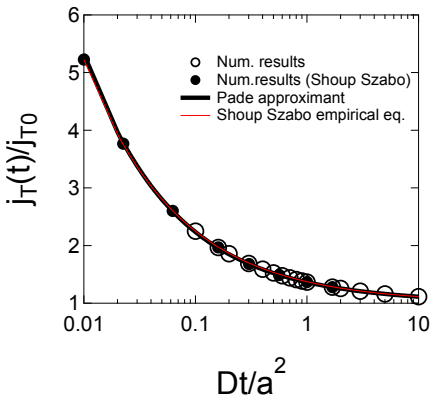
A Padé approximant yields a compact analytical expression for transient currents at disk electrodes over experimental time ranges.
A machine-rendered reading of the paper's core claim, the machinery that carries it, and where it could break.
Core claim
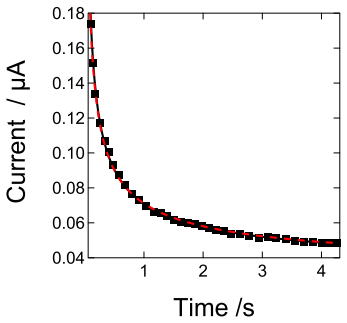
The mixed-boundary diffusion problem is formulated in the Laplace domain and reduced to a Fredholm integral equation that directly determines the Faradaic current. The steady-state limit recovers Saito's equation, while a systematic long-time asymptotic expansion quantifies the approach to steady state. A Padé approximant yields a compact analytical expression in the time domain that accurately describes the current over experimentally relevant time ranges. In contrast to existing high-accuracy numerical procedures, the present formulation provides an explicit and compact analytical representation that facilitates interpretation and practical implementation. The short-time response exhibits
What carries the argument
Fredholm integral equation in the Laplace domain obtained by reducing the mixed-boundary diffusion problem, from which the Faradaic current is extracted directly.
If this is right
- The steady-state current exactly recovers Saito's equation.
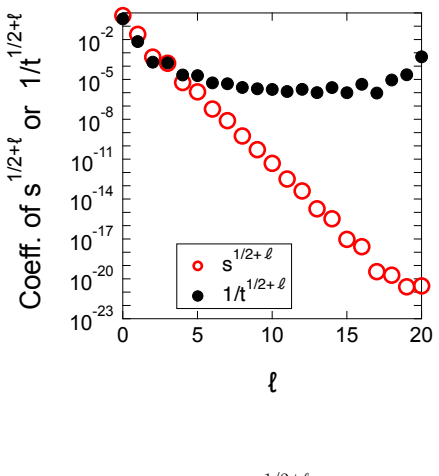
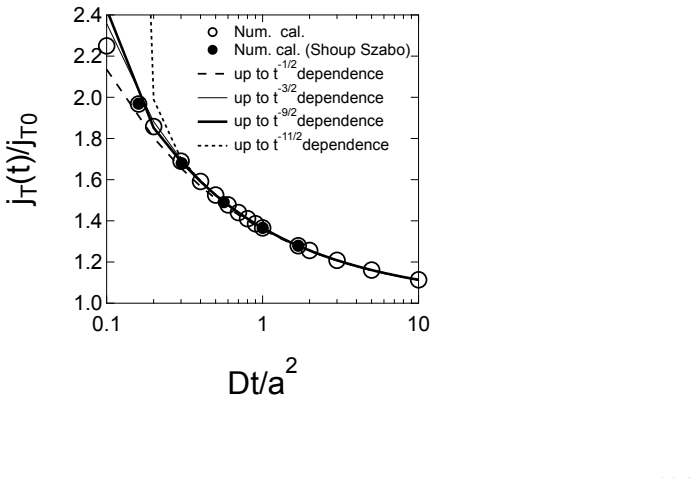
- The long-time asymptotic expansion quantifies the rate of approach to steady state.
- The short-time response reproduces Cottrell's equation together with the edge-effect correction specific to the disk.
- The compact Padé expression supplies an explicit analytical tool for data fitting and diffusion-parameter extraction without invoking hybrid numerical schemes.
Where Pith is reading between the lines
- Experimental groups could insert the closed-form expression into routine data-analysis software to replace simulation-based fitting.
- The same Laplace-domain integral-equation reduction might be applied to other simple electrode shapes to generate analogous compact approximations.
- The method offers a concrete benchmark against which the accuracy of other widely used analytical approximations in disk chronoamperometry can be tested.
Load-bearing premise
The mixed-boundary diffusion problem can be reduced without loss of accuracy to a Fredholm integral equation in the Laplace domain whose solution directly determines the Faradaic current.
What would settle it
A high-precision numerical solution of the three-dimensional diffusion equation for the disk geometry or a laboratory chronoamperometric measurement on a well-characterized disk electrode that deviates substantially from the Padé formula predictions over the stated time ranges would falsify the central claim.
Figures
read the original abstract
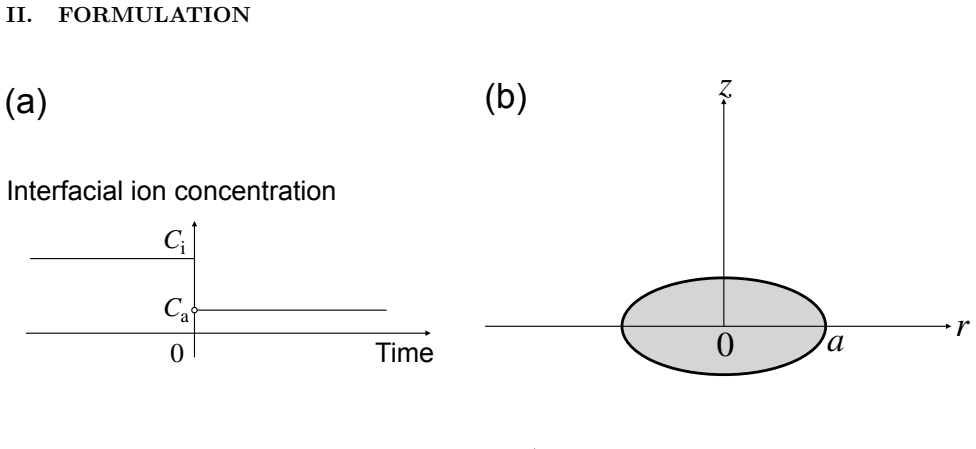
The transient diffusion-limited current at a disk electrode following a change in interfacial ion concentration induced by a potential step is analyzed with direct relevance to chronoamperometric measurements. The mixed-boundary diffusion problem is formulated in the Laplace domain and reduced to a Fredholm integral equation that directly determines the Faradaic current. The steady-state limit recovers Saito's equation, while a systematic long-time asymptotic expansion quantifies the approach to steady state. A Pad\'{e} approximant yields a compact analytical expression in the time domain that accurately describes the current over experimentally relevant time ranges. In contrast to existing high-accuracy numerical procedures based on hybrid asymptotic and polynomial approximations, the present formulation provides an explicit and compact analytical representation that facilitates interpretation and practical implementation. The short-time response exhibits Cottrell's equation with edge effects characteristic of disk electrodes. Overall, the framework provides practical tools for analyzing transient currents, extracting diffusion parameters, and assessing the accuracy of widely used analytical approximations in disk-electrode chronoamperometry.
Editorial analysis
A structured set of objections, weighed in public.
Referee Report
Summary. The paper formulates the transient diffusion-limited current at a disk electrode after a potential step as a mixed-boundary-value problem, applies the Laplace transform, and reduces it to a Fredholm integral equation of the second kind whose solution yields the Faradaic current. It recovers Saito's steady-state limit, derives a long-time asymptotic expansion, constructs a Padé approximant to the Laplace-domain solution, and inverts the approximant to obtain a compact closed-form expression in the time domain claimed to be accurate over experimentally relevant timescales while also reproducing Cottrell short-time behavior with disk edge corrections.
Significance. If the Padé approximant is shown to remain accurate across the full range of the Laplace variable (including the intermediate-s regime), the work would supply a practical, explicit analytical tool for chronoamperometric analysis at disk electrodes that facilitates parameter extraction and avoids reliance on purely numerical or hybrid asymptotic-polynomial schemes.
major comments (1)
- [Abstract] Abstract: the assertion that the Padé approximant 'accurately describes the current over experimentally relevant time ranges' is not accompanied by any reported maximum relative residual, L2 error, or pointwise comparison between the approximant and the numerical solution of the underlying Fredholm integral equation, particularly for intermediate Laplace-s values that map to the transition between short-time Cottrell and long-time Saito regimes.
minor comments (2)
- The manuscript would benefit from a dedicated figure or table showing the relative deviation of the compact approximant from the integral-equation solution at representative times (e.g., t = 0.1, 1, 10 in dimensionless units) to make the accuracy claim verifiable.
- Clarify whether the Padé coefficients are obtained by fitting to discrete numerical evaluations of the integral-equation kernel or by symbolic matching of series coefficients; the former requires explicit reporting of the fitting range and residual norm.
Simulated Author's Rebuttal
We appreciate the referee's detailed comments and recommendation for major revision. We respond to the major comment as follows and will revise the manuscript accordingly to strengthen the presentation of our results.
read point-by-point responses
-
Referee: [Abstract] Abstract: the assertion that the Padé approximant 'accurately describes the current over experimentally relevant time ranges' is not accompanied by any reported maximum relative residual, L2 error, or pointwise comparison between the approximant and the numerical solution of the underlying Fredholm integral equation, particularly for intermediate Laplace-s values that map to the transition between short-time Cottrell and long-time Saito regimes.
Authors: We thank the referee for this observation. The manuscript does provide comparisons between the Padé approximant and the numerical solution of the Fredholm equation in the results section, demonstrating good agreement. However, we acknowledge that the abstract lacks specific quantitative error metrics. In the revised manuscript, we will modify the abstract to include the maximum relative residual and L2 error between the approximant and the numerical solution. We will also add explicit pointwise comparisons for intermediate Laplace-s values in the main text to better illustrate the accuracy in the transition regime. revision: yes
Circularity Check
Derivation chain is self-contained with no circular reductions
full rationale
The paper formulates the mixed-boundary diffusion problem directly from the diffusion equation and boundary conditions, applies the Laplace transform, and reduces it to a Fredholm integral equation of the second kind whose solution determines the Faradaic current; this is a standard exact transformation with no self-referential definitions. The steady-state limit recovers the known Saito equation, long-time asymptotics are expanded systematically from the integral equation, and the Padé approximant is applied to the resulting s-dependent solution to obtain a compact time-domain form. No step equates an output to its input by construction, renames a known result as new unification, or relies on a load-bearing self-citation whose content reduces to the present work. The framework is independent of its claimed compact expression and remains falsifiable against external numerical benchmarks or experiments.
Axiom & Free-Parameter Ledger
axioms (1)
- domain assumption The diffusion process obeys Fick's second law with mixed Dirichlet-Neumann boundary conditions at the electrode surface and at infinity.
discussion (0)
Sign in with ORCID, Apple, or X to comment. Anyone can read and Pith papers without signing in.