REVIEW 3 major objections 4 minor 41 references
Relative Layer-Wise Relevance Propagation: a more Robust Neural Networks eXplaination
T0 review · 3 major / 4 minor · reviewed 2026-08-10 · deepseek-v4-flash
Pith's one-line read The paper claims that a new relative layer-wise relevance propagation rule, R-LRP, explains dense, convolutional, and residual image classifiers without dividing by near-zero values or tuning hyperparameters, and that it outperforms…
desk verdict R-LRP is a simple, hyperparameter-free attribution rule that empirically looks strong, but the paper's central conservation-law claim is false: for a linear layer the relevance sum is y^2/N, not c*y, so the residual normalization rests on a broken premise. read the letter →
The pith
A machine-rendered reading of the paper's core claim, the machinery that carries it, and where it could break.
The reading
What carries the argument
The central object is the relative contribution formula $z_{i,j,k}^{(l)} = \frac{1}{M_j^{(l+1)}} w_{i,j}^{(l+1)} x_i^{(l)} z_{j,k}^{(l+1)}$, followed by a layer-wise averaging step $z_{i,k}^{(l)} = \frac{\mathrm{Card}(J)}{N^{(l+1)}} \sum_J z_{i,j,k}^{(l)}$. It replaces the ratio-based LRP rule (which divides by the pre-activation sum over inputs) with a multiplication-only recurrence, so near-zero denominators never appear. The factor $\mathrm{Card}(J)/N^{(l+1)}$ rescales the sum of contributions so that the conservation law is preserved up to a global multiplicative constant, and the same machinery is extended to convolutions (via transposed convolutions), pooling, and residual blocks with a normalization of skip-connection and residual-path contributions.
What would settle it
A controlled benchmark with known discriminative features (for example, a synthetic dataset where a specific image region determines the class) would settle the claim: if R-LRP's top-k pixels do not localize that region with higher precision than random selection or LRP0, the reported superiority of R-LRP would be an artifact of the masking protocol.
Extended reading notes
Core claim
R-LRP computes the contribution of neuron i in layer l to output k through a backward product of weights, activations, and already-computed upper-layer relevance, normalized by the number of inputs to each neuron and averaged over connected outputs, as in equations (6)–(7). Because no denominator is formed from the network's weighted sums, the rule does not blow up when a neuron's pre-activation is near zero. The authors state that the sum of all input contributions equals the selected output up to a single multiplicative factor, so the classical LRP conservation law holds in relative form. On their masked-image accuracy benchmarks, R-LRP outperforms the standard LRP variants at small keep-fractions, and it produces more object-focused maps in pointing-game and distance-to-mask tests.
Load-bearing premise
The evaluation assumes that a method is a better explanation if keeping only its highest-relevance inputs and zeroing the rest preserves classification accuracy.
Editorial extensions
If this is right
- R-LRP can be dropped into existing dense, convolutional, and residual image classifiers without tuning epsilon, gamma, alpha, or beta, removing a common barrier to adopting LRP.
- Explanations from R-LRP should remain stable in very deep networks because no stage of the backward pass divides by a quantity that can approach zero.
- The masked-image accuracy protocol used in the paper, if it is accepted, provides a quantitative ranking of attribution methods that does not depend on a human looking at heatmaps.
- Cross-network comparisons become feasible: the paper uses R-LRP to show that VGG16 and VGG19 rely on similar pixels while ResNet50 relies on different, more conceptual regions.
- Absolute-value relevance can be reported as an additional map that highlights negative contributors, which the paper shows improves object localization.
Reading between the lines
- The top-k masking protocol may reward concentrated maps even when they are not faithful to the network's actual decision; a fairer test would compare against a random pixel baseline and use multiple masking strategies.
- Because R-LRP's conservation law holds only up to a global factor, the raw relevance values are not directly comparable across different output classes; a calibration step would be needed for cross-class comparisons.
- The normalization step for residual blocks is heuristic, and its validity for very deep networks with many branches could be tested on architectures that are even deeper than ResNet50.
- A natural and testable extension is applying R-LRP to transformer-based architectures, which the authors explicitly list as future work; whether the relative-relevance rule survives attention layers is an open empirical question.
Editorial analysis
A structured set of objections, weighed in public.
Referee Report
Summary. The paper proposes a new attribution method, Relative Layer-Wise Relevance Propagation (R-LRP), defined by Eqs. (6)-(7). The rule propagates a selected output backward through dense, convolutional, and residual layers without dividing by pre-activations, and it is claimed to involve no hyperparameters and to satisfy the classical LRP conservation law up to a multiplicative factor. The empirical sections compare R-LRP with LRP0, LRP-epsilon, LRP-gamma, and LRP-alpha-beta on a modified MNIST task, a cat-vs-dog dataset, and a subset of Synthetic ImageNet-1K with VGG16, VGG19, and ResNet50, using a top-k pixel/input masking accuracy protocol and two mask-based qualitative measures.
Significance. The proposal is attractive in spirit: the base R-LRP rule is simple, contains no learned parameters beyond the network weights, and the authors release source code. The experimental study covers several architectures and includes both quantitative and qualitative evaluations. If the central conservation-law claim were correct, R-LRP would be a valuable parameter-free alternative to existing LRP variants. However, the central theoretical claim is not correct: the sum of input relevances is not proportional to the selected output by a constant factor. The empirical superiority claim is also weakened by the chosen masking protocol and limited sampling, so the main contributions of the paper do not currently hold.
major comments (3)
- [Section 2.1, Definition 9, Eqs. (6)-(7)] The claimed conservation law "up to a multiplicative factor" is false. Consider a single fully connected layer with one output neuron y = sum_i w_i x_i and bias zero. With z^{(q+1)} = y, Eq. (6) gives z_i = (1/N^(0)) w_i x_i y and Eq. (7) gives sum_i z_i = (1/N^(0)) y sum_i w_i x_i = y^2 / N^(0). The ratio (sum_i z_i)/y = y/N^(0) depends on the input through y, so there is no constant c satisfying sum_i z_i = c y for all inputs. Thus Definition 8 is not satisfied even up to a global factor, contradicting the abstract and the statement in Section 2.1 that "the sum of the inputs' contributions is equal to the selected output (up to a factor for our case)."
- [Section 2.3, Proposition 14, Eq. (13)] The residual-block normalization in Eq. (13) is derived from the equality sum_N(l) z_p = sum_N(m) z_p, which is the conservation law shown above to fail for R-LRP. The rescaling factors in Eq. (13) are therefore data-dependent corrections rather than consequences of a valid conservation property. In addition, Eq. (13) divides by sums of relevances, which can be zero or arbitrarily small; this contradicts the paper's advertised property of avoiding division by small values, and the "except for Resnet skip connection" qualification does not cover these normalization denominators. The residual-block handling is therefore not soundly justified.
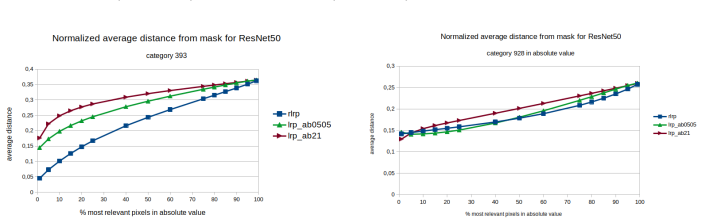
- [Sections 3-5, evaluation protocol] The main empirical evidence for superiority is the top-k masking protocol in which all but the most relevant inputs/pixels are set to zero and the network accuracy is measured. This protocol rewards methods that produce concentrated maps, regardless of whether the selected regions correspond to the actual decision process, and it does not compare against any ground-truth attribution. The ImageNet-1K evaluation in Section 5 uses only two random images per category, and no error bars or per-image variance are reported. These limitations are partially acknowledged only for the qualitative mask-based evaluation in Section 6, but they also affect the quantitative claims of "better results" in Section 7. As presented, the empirical evidence does not support the claim that R-LRP is superior to other LRP methods in general.
minor comments (4)
- [Title and Abstract] The word "eXplaination" in the title should be "Explanation."
- [Authors' affiliations] The affiliation text "partial secondment at Buawei" appears to contain a typo; it should likely read "Huawei."
- [Section 4.1] The dataset attribution "Charm Myae Zaw and all" is unclear; a formal Kaggle citation or a URL should be provided.
- [Definition 9, Eq. (7)] The factor Card(J)/N^{(l+1)} in Eq. (7) is redundant when J is the full set of neurons in layer l+1, and its meaning for boundary positions in padded convolutions is not defined; the relationship between J and N^{(l+1)} should be clarified.
Circularity Check
Minor self-definitional normalization in the residual-block rule; the core R-LRP definition and empirical comparisons are independent.
-
self definitional
[Section 2.3, Proposition 14, Eq. (13)]
"From the conservation law (equation 2), we can state that, X_N(l) z (l) p = X_N(m) z (m) p , ∀(l, m) ∈ {0, ..., q} × {0, ..., q} Thus, the normalization consists in having the same value for sums at the end and the beginning of each part of the residual building block. ... Based on the conservation law property, we then define the contribution of the inputs of a learning block by z(l) i,j = z1(l) i,k P_N(m) z1(m) p / P_N(l) z1(l) p + z2(l) i,k P_N(m) z2(m) p / P_N(l) z2(l) p (13)"
Equation (13) is not derived from Eq. (6); it is constructed by multiplying each branch's start-of-block relevance by the ratio of that branch's end-of-block sum to its start-of-block sum. Therefore the block-level conservation equality is guaranteed by algebraic identity, i.e. the proposition's 'conservation law' is inserted as the normalization rule rather than obtained from the R-LRP propagation rule. The wording 'Based on the conservation law property' makes the target property an input to the definition. This is a self-definitional patch confined to residual blocks; the dense/convolutional R-LRP formula and the benchmark comparisons do not reduce to it.
full rationale
The core R-LRP rule (Eqs. 6-8) is a closed-form backpropagation formula using only network weights, activations, and a backward relevance variable; no parameter is fitted to the data whose explanations are evaluated, and no external self-cited result is needed to define it. The empirical claims (Sections 3-5) are tested against external datasets with a uniform masking protocol for all methods, and Section 6 even reports categories where R-LRP does not localize well, so the claimed superiority is not enforced by construction. The one exhibitable circular element is Proposition 14/Eq. (13), where residual-branch contributions are rescaled by their own sum ratios, making that block's conservation property definitional rather than derived; this is a secondary, disclosed normalization and does not drive the main empirical comparisons. The skeptic's algebraic objection to the 'up to a factor' claim for dense layers is a correctness concern about a false assertion, not a circularity: a false theorem is still non-circular. Overall, the central R-LRP contribution remains independently testable, so the score is 2 rather than higher.
Assumptions & free parameters
assumptions (3)
- standard math The DAG representation of feed-forward neural networks (Definition 1) supports a unique backward propagation path for relevance.
- domain assumption The conservation law (Definition 8) holds for LRP methods and is used to justify normalization in R-LRP.
- domain assumption Activation functions are piecewise linear (ReLU) or can be treated as identity in backward relevance computation.
Cite this review
Pith. "Pith review of Relative Layer-Wise Relevance Propagation: a more Robust Neural Networks eXplaination." pith.science (2026). https://pith.science/paper/PRTT37Y7
@misc{pith2026250114322,
  author       = {Pith},
  title        = {Pith review of: Relative Layer-Wise Relevance Propagation: a more Robust Neural Networks eXplaination},
  year         = {2026},
  howpublished = {\url{https://pith.science/paper/PRTT37Y7}},
  note         = {Machine review of arXiv:2501.14322}
}
read the original abstract
Machine learning methods are solving very successfully a plethora of tasks, but they have the disadvantage of not providing any information about their decision. Consequently, estimating the reasoning of the system provides additional information. For this, Layer-Wise Relevance Propagation (LRP) is one of the methods in eXplainable Machine Learning (XML). Its purpose is to provide contributions of any neural network output in the domain of its input. The main drawback of current methods is mainly due to division by small values. To overcome this problem, we provide a new definition called Relative LRP where the classical conservation law is satisfied up to a multiplicative factor but without divisions by small values except for Resnet skip connection. In this article, we will focus on image classification. This allows us to visualize the contributions of a pixel to the predictions of a multi-layer neural network. Pixel contributions provide a focus to further analysis on regions of potential interest. R-LRP can be applied for any dense, CNN or residual neural networks. Moreover, R-LRP doesn't need any hyperparameters to tune contrary to other LRP methods. We then compare the R-LRP method on different datasets with simple CNN, VGG16, VGG19 and Resnet50 networks.
Figures


Figures from the paper (28 more)




Reference graph
Works this paper leans on
-
[1]
What is relevant in a text document?: An interpretable machine learning approach
Leila Arras et al. “What is relevant in a text document?: An interpretable machine learning approach”. In: (2017).doi: 10.1371/journal.pone.0181142. 27 E. Nyiri and O. Gibaru
-
[2]
On pixel-wise explanations for non-linear classifier decisions by layer-wise relevance propagation
Sebastian Bach et al. “On pixel-wise explanations for non-linear classifier decisions by layer-wise relevance propagation”. In:PLoS ONE(2015). doi: 10.1371/journal.pone. 0130140
-
[3]
Empirical Evaluation of Gated Recurrent Neural Networks on Sequence Modeling
Junyoung Chung et al. “Empirical Evaluation of Gated Recurrent Neural Networks on Sequence Modeling”. In:28th Conference on Neural Information Processing Systems (NIPS) Deep Learning and Representation Learning Workshop(2014). doi: 10.48550/ arXiv.1412.3555
-
[4]
Explaining by Removing: A Unified Framework for Model Explanation
Ian C. Covert, Scott Lundberg, and Su-In Lee. “Explaining by Removing: A Unified Framework for Model Explanation”. In:Journal of Machine Learning Research22 (2021), pp. 1–90.doi: 10.48550/arXiv.2011.14878
-
[5]
Nonlinear Approximation and (Deep) ReLU Networks
Ingrid Daubechies et al. “Nonlinear Approximation and (Deep) ReLU Networks”. In: Contructive Approximation55 (2022), pp. 127–172.doi: 10.1007/s00365-021-09548- z
-
[6]
Ronald DeVore, Boris Hanin, and Guergana Petrova. “Neural Network Approximation”. In: Acta Numerica30 (2021), pp. 337–444.doi: 10.1017/S0962492921000052
-
[7]
A guide to convolution arithmetic for deep learning
Vincent Dumoulin and Francesco Visin. “A guide to convolution arithmetic for deep learning”. In: (2016).doi: 10.48550/arXiv.1603.07285
-
[8]
Combining pretrained CNN feature extractors to enhance clustering of complex natural images
Joris Guérin et al. “Combining pretrained CNN feature extractors to enhance clustering of complex natural images”. In:Neurocomputing 423 (2021), pp. 551–571.doi: 10. 1016/j.neucom.2019.05.064
work page 2021
Show all 41 references
-
[9]
Semantically Meaningful View Selection
Joris Guérin et al. “Semantically Meaningful View Selection”. In:IEEE International Conference on Intelligent Robots and Systems (IROS)(2018), pp. 1061–1066. doi: 10.1109/IROS.2018.8593524
2018
-
[10]
Unsupervised robotic sorting: Towards autonomous decision making robots
Joris Guérin et al. “Unsupervised robotic sorting: Towards autonomous decision making robots”. In:International Journal of Artificial Intelligence and Applications (IJAIA) 9.2 (2018), pp. 81–98.doi: 10.5121/ijaia.2018.9207
2018
-
[11]
Deep Residual Learning for Image Recognition
Kaiming He et al. “Deep Residual Learning for Image Recognition”. In:IEEE Conference on Computer Vision and Pattern Recognition(2016), pp. 770–778.doi: 10.1109/CVPR. 2016.90
2016 doi
-
[12]
Long Short-term Memory
Sepp Hochreiter and Jürgen Schmidhuber. “Long Short-term Memory”. In:Neural Computation 9.8 (1997), pp. 1735–1780.doi: 10.1162/neco.1997.9.8.1735
1997 doi
-
[13]
Explainable AI Methods - A Brief Overview
Andreas Holzinger et al. “Explainable AI Methods - A Brief Overview”. In:xxAI - Beyond Explainable AI: International Workshop, Held in Conjunction with ICML 2020, July 18, 2020, Vienna, Austria, Revised and Extended Papers. Ed. by Andreas Holzinger et al. Cham: Springer Intern...
2020
-
[14]
url: https://doi.org/10.1007/978-3- 031-04083-2_2
doi: 10.1007/978-3-031-04083-2_2 . url: https://doi.org/10.1007/978-3- 031-04083-2_2
-
[15]
Explaining the unique nature of individual gait patterns with deep learning
Fabian Horst et al. “Explaining the unique nature of individual gait patterns with deep learning”. In:Scientific Reports9.2391 (2019). doi: 10.1038/s41598-019-38748-8
2019 doi
-
[16]
A Visual Designer of Layer-wise Relevance Propagation Models
Xinyi Huang et al. “A Visual Designer of Layer-wise Relevance Propagation Models”. In: Computer Graphics Forum40.3 (2021), pp. 227–238.doi: 10.1111/cgf.14302. 28 R-LRP XML
2021 doi
-
[17]
Explaining CNN and RNN Using Selective Layer-Wise Relevance Propagation
Yeon-Jee Jung, Seung-Ho Han, and Ho-Jin Choi. “Explaining CNN and RNN Using Selective Layer-Wise Relevance Propagation”. In:IEEE Access9 (2021), pp. 18670– 18681. doi: 10.1109/ACCESS.2021.3051171
2021
-
[18]
Towards Best Practice in Explaining Neural Network Decisions with LRP
Maximilian Kohlbrenner et al. “Towards Best Practice in Explaining Neural Network Decisions with LRP”. In:International Joint Conference on Neural Networks (IJCNN) (2020), pp. 1–7.doi: 10.1109/IJCNN48605.2020.9206975
2020
-
[19]
Understanding and Comparing Deep Neural Networks for Age and Gender Classification
Sebastian Lapuschkin et al. “Understanding and Comparing Deep Neural Networks for Age and Gender Classification”. In:IEEE International Conference on Computer Vision Workshops (ICCVW)(2017), pp. 1629–1638.doi: 10.1109/ICCVW.2017.191
2017 doi
-
[20]
Unmasking Clever Hans predictors and assessing what machines really learn
Sebastian Lapuschkin et al. “Unmasking Clever Hans predictors and assessing what machines really learn”. In:Nature Communications 10.1096 (2019). doi: 10.1038/ s41467-019-08987-4
2019
-
[21]
Explaining nonlinear classification decisions with deep Taylor decomposition
Grégoire Montavon et al. “Explaining nonlinear classification decisions with deep Taylor decomposition”. In: Pattern Recognition65 (2017), pp. 211–222. doi: 10 . 1016 / j . patcog.2016.11.008
2017
-
[22]
Layer-Wise Relevance Propagation: An Overview
Grégoire Montavon et al. “Layer-Wise Relevance Propagation: An Overview”. In:Lecture Notes in Computer Science book series11700 (2019)
2019
- [23]
-
[24]
Why Should I Trust You?: Explaining the Predictions of any Classifier
Marco Tulio Ribeiro, Sameer Singh, and Carlos Guestrin. “Why Should I Trust You?: Explaining the Predictions of any Classifier”. In:Proceedings of the 22nd ACM SIGKDD International Conference on Knowledge Discovery and Data Mining(2016), pp. 1135–
2016
-
[25]
Online Recognition of Incomplete Gesture Data to Interface Collaborative Robots
Miguel Simão, Olivier Gibaru, and Pedro Neto. “Online Recognition of Incomplete Gesture Data to Interface Collaborative Robots”. In:IEEE Transactions on Industrial Electronics 66.12 (2019), pp. 9372–9382.doi: 10.1109/TIE.2019.2891449
2019
-
[26]
Grad-CAM: Visual Explanations from Deep Networks via Gradient-based Localization
Ramprasaath R. Selvaraju et al. “Grad-CAM: Visual Explanations from Deep Networks via Gradient-based Localization”. In:IEEE International Conference on Computer Vision (ICCV)(2017), pp. 618–626.doi: 10.1109/ICCV.2017.74
2017 doi
-
[27]
Improving novelty detection with generative adversarial networks on hand gesture data
Miguel Simão, Pedro Neto, and Olivier Gibaru. “Improving novelty detection with generative adversarial networks on hand gesture data”. In:Neurocomputing 358 (2019), pp. 437–445. doi: 10.1016/j.neucom.2019.05.064
2019 doi
-
[28]
EMG-based online classification of gestures with recurrent neural networks
Miguel Simão, Pedro Neto, and Olivier Gibaru. “EMG-based online classification of gestures with recurrent neural networks”. In:Pattern Recognition Letters128 (2019), pp. 45–51. doi: 10.1016/j.patrec.2019.07.021
2019 doi
-
[29]
A Review on Electromyography Decoding and Pattern Recognition for Human-Machine Interaction
Miguel Simão et al. “A Review on Electromyography Decoding and Pattern Recognition for Human-Machine Interaction”. In:IEEE Access7 (2019), pp. 39564–39582.doi: 10.1109/ACCESS.2019.2906584. 29 E. Nyiri and O. Gibaru
2019
-
[30]
Using data dimensionality reduction for recognition of incomplete dynamic gestures
Miguel Simão, Pedro Neto, and Olivier Gibaru. “Using data dimensionality reduction for recognition of incomplete dynamic gestures”. In:Pattern Recognition Letters99 (2017), pp. 32–38.doi: 10.1016/j.patrec.2017.01.003
2017 doi
- [31]
- [32]
- [33]
-
[34]
Interpretable human action recognition in compressed do- main
Vignesh Srinivasan et al. “Interpretable human action recognition in compressed do- main”. In:IEEE International Conference on Acoustics, Speech and Signal Processing (ICASSP) (2017), pp. 1692–1696.doi: 10.1109/ICASSP.2017.7952445
2017
-
[35]
Thulasiraman and M
K. Thulasiraman and M. N. S. Swamy.Graphs: Theory and Algorithms. John Wiley & Sons, 1992. isbn: 978-0-471-51356-8. doi: 10.1002/9781118033104
1992 doi
-
[36]
Analyzing Neuroimaging Data Through Recurrent Deep Learning Models
Armin W. Thomas et al. “Analyzing Neuroimaging Data Through Recurrent Deep Learning Models”. In:Frontiers in Neuroscience13 (2019). doi: 10.3389/fnins.2019. 01321
2019 doi
- [37]
- [38]
-
[39]
Top-down Neural Attention by Excitation Backprop
Jianming Zhang et al. “Top-down Neural Attention by Excitation Backprop”. In: International Journal of Computer Vision126 (2018), pp. 1084–1102.doi: 10.1007/ s11263-017-1059-x. 30
2018
-
[40]
Visualizing and Understanding Convolutional Networks
Matthew D Zeiler and Rob Fergus. “Visualizing and Understanding Convolutional Networks”. In:Computer Vision – ECCV 2014. ECCV 20148689 (2014). doi: 10. 1007/978-3-319-10590-1_53
2014
-
[1144]
doi: 10.1145/2939672.2939778
Reviewed August 10, 2026 · model on record in the stance chip above.
Discussion (0). Continue with ORCID to comment.