REVIEW 4 major objections 5 minor 76 references
TARS: Timestep-Aware Data Scaling for 3D-Free Video Re-Shooting
T0 review · 4 major / 5 minor · reviewed 2026-08-04 · deepseek-v4-flash
Pith's one-line read Video re-shooting can be taught with just 60K paired clips and no 3D reconstruction, by routing paired data only to the high-noise denoising steps.
desk verdict Timestep-aware data routing is a genuinely useful idea, but the paper's central mechanism and its evaluation need more rigor before I'd trust the SOTA claim. read the letter →
The pith
A machine-rendered reading of the paper's core claim, the machinery that carries it, and where it could break.
The reading
What carries the argument
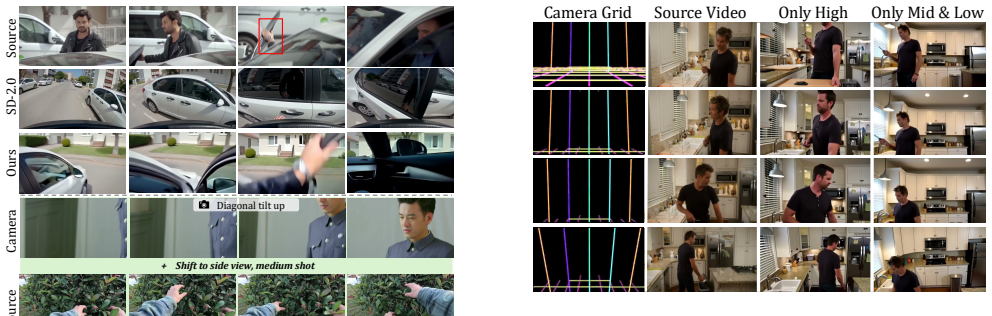
The load-bearing mechanism is timestep-aware data routing, realized through a two-stage training scheme. Stage 1 trains on self-supervised clip pairs—random splits of a single video—with a camera grid (a video-format rendering of camera trajectory as moving grid lines in an empty 3D room) as conditioning, to learn camera dynamics and viewpoint semantics. Stage 2 fine-tunes only on the high-noise timesteps with 60K cross-pair videos, leveraging the claimed 'shortcut effect': the model prefers the temporally synchronized motion solution because it is easier to optimize, a tendency reinforced by text conditioning and classifier-free guidance.
What would settle it
Train the Stage-2 model with the same 60K cross-pair samples but route them only to mid/low timesteps (t<0.95), keeping self-supervised data for the high-noise regime. If temporal synchronization (V-MPGE) remains as good as the proposed routing, the central claim that high-noise steps need the paired data collapses. Alternatively, collect paired videos where the source and target are deliberately out of sync (e.g., shifted by a few frames): under the shortcut-effect hypothesis, the model should still converge to the synchronized interpretation when text-conditioning is informative; if it inste
Extended reading notes
Core claim
The paper's central claim is that the division of labor across diffusion timesteps—high-noise steps for coarse spatiotemporal structure, low-noise steps for appearance—allows a data-routing strategy for video re-shooting. By sending only a small amount of strictly paired cross-video data to the high-noise interval t∈[0.95,1.0] and filling the rest of training with self-supervised clip-split data, the model learns accurate camera control, preserves appearance, and—via a hypothesized 'shortcut effect'—acquires temporally synchronized subject motion from the source video without large paired datasets or 3D reconstruction. The paper further introduces text-driven semantic viewpoint control, deco
Load-bearing premise
The paper asserts, without derivation or measurement, that when multiple valid motions are possible, the diffusion model naturally converges to the motion synchronized with the source video because it is easier to optimize; if this 'shortcut effect' does not hold, Stage-2 fine-tuning would not align subject motion and the entire data-scaling argument collapses.
Editorial extensions
If this is right
- Video re-shooting no longer requires either explicit 3D reconstruction or massive paired datasets; the paired-data bottleneck is relaxed by roughly an order of magnitude (from millions to tens of thousands).
- Models trained this way can synthesize previously unseen regions under large camera motions and support reverse-angle re-shooting and perspective switching, because high-noise self-supervised data provides broad priors for novel views.
- Text-driven semantic control over shot scale, viewing angle, and perspective becomes a viable alternative to supplying camera parameters, since the self-supervised stage learns the association between language and viewpoint.
- The timestep-aware routing principle suggests that any video-to-video task requiring global motion alignment may be trainable with far less paired data than currently assumed, provided the paired supervision is concentrated where the corresponding structure is decided.
Reading between the lines
- The 'shortcut effect' is the linchpin but is asserted, not measured. A natural extension is to test it directly: if the synchronized solution is genuinely easier to optimize, per-timestep loss curves for synchronized vs. shuffled-motion pairs should diverge in the high-noise regime early in training.
- The 95% figure (paired supervision unnecessary for up to 95% of steps) implies a scaling law: for a fixed paired budget, the optimal time interval to allocate them shrinks as the self-supervised corpus grows; one could look for a phase transition in motion synchronization as the high-noise window narrows below [0.95,1.0].
- If the routing principle transfers, tasks like human pose transfer, relighting, or object re-posing might similarly need only targeted paired supervision at the timesteps where the corresponding global attribute is decided, rather than full-pipeline pairing.
- The text-conditioning reinforcement hypothesis suggests a testable dependency: removing CFG or text prompts should degrade motion synchronization even with paired high-noise training; measuring that drop would separate the two mechanisms.
Editorial analysis
A structured set of objections, weighed in public.
Referee Report
Summary. The paper proposes TARS, a two-stage 3D-free video re-shooting framework. Stage 1 trains on large-scale self-supervised clip pairs created by splitting a video into two parts and using a camera grid and MLLM-generated viewpoint text as conditioning. Stage 2 fine-tunes the model on a small set (60K) of cross-pair videos, but only in the high-noise timestep regime t∈[0.95,1.0], based on the observation that low-frequency structure and camera motion are established early in the denoising process. The authors report state-of-the-art camera accuracy, viewpoint control, spatio-temporal consistency, and visual quality against CamClone, TrajCrafter, and Seedance 2.0.
Significance. If the central claim is substantiated, the paper offers a practical recipe for video re-shooting that avoids explicit 3D reconstruction and relies on a modest amount of paired data, while adding text-driven semantic viewpoint control. The underlying timestep-aware analysis is plausible and builds on established coarse-to-fine properties of diffusion models. However, the key mechanistic assertion — the 'shortcut effect' — is not measured or derived, and the quantitative evidence suffers from undefined evaluation metrics and missing sensitivity analyses. The work has clear potential, but its load-bearing empirical claims require strengthening before the contribution can be accepted.
major comments (4)
- [Stage 2: Eliciting Spatio-Temporal Consistency via Few Cross-Paired Data] The central claim that 60K cross-pair samples restricted to t∈[0.95,1.0] suffice to elicit temporally synchronized subject motion rests entirely on the asserted 'shortcut effect.' No derivation, measurement, or controlled experiment is provided to show that the model preferentially converges to the temporally synchronized solution. The ablations in Table 3 do not vary the cross-pair data budget (e.g., 0K, 10K, 60K, 120K) or the high-noise threshold (e.g., 0.95, 0.8, 0.0). The 'High' and 'Mid&Low' rows are inference-time source injections, not training-time data-routing experiments. Without such a sweep, the sufficiency of 60K paired clips is not empirically established, and the main contribution of the paper remains unvalidated.
- [Evaluation Metrics] Several metrics in Tables 1 and 3 are not defined in the paper: CE, FDR, VDR, FSCS, GCR, LSR, and V-MPGE. The text states that 'all metrics are assessed by Gemini 3.1 Pro,' but does not specify the prompts, the scoring rubric, the number of evaluation samples, or how the LLM-based scores were aggregated. ArcFace is mentioned without indicating which identity embedding model is used and how similarity is computed. Without metric definitions and protocols, the quantitative comparisons are not reproducible and the reported improvements cannot be independently verified.
- [Timestep-Aware Data Routing] The statement that 'for the vast majority (potentially up to 95%) of the denoising steps, such strict pairing constraints are unnecessary' is a direct restatement of the hand-set threshold t∈[0.95,1.0], not an independently measured finding. The threshold is described as 'empirically defined' but no sensitivity analysis is given. If the threshold were changed, the claimed 95% figure would change accordingly. The Figure 3 visualization and the 'High' vs 'Mid&Low' ablation support a qualitative division of labor, but they do not justify the specific 0.95 threshold or the claim that 95% of training steps can safely ignore paired supervision. A threshold sweep is needed to make this load-bearing claim credible.
- [Stage 1: Self-Supervised Learning for Re-Shooting] The camera-grid representation and the clip-splitting self-supervised strategy are adopted from prior work (Liu et al. 2026, OmniDirector), as cited in the Method section. The abstract and contributions list 'self-supervised training' as a new element, but the only genuinely new component appears to be the timestep-aware routing of cross-pair data. With the routing hypothesis not yet validated by controlled data-budget/threshold experiments, the incremental contribution over the prior work is not clearly demonstrated. The authors should clarify the novelty boundary and provide the missing ablation evidence.
minor comments (5)
- [Abstract] There is a formatting typo in the abstract: 'Videore-shootingaimstoregeneratevideoswithcontrollable' should have spaces. The abstract also includes a project page URL, which is helpful.
- [Evaluation Metrics / Table 1] The acronyms R-Prec and T-Prec are introduced, but the caption of Table 1 does not explain that they are rotation and translation precision. The reference 'DPA-V3 (Lin et al. 2025)' appears to cite 'Depth Anything 3' rather than a camera pose estimator; please verify the correct reference.
- [Table 3] The row labels 'Stage1' and 'Stage2' are ambiguous: 'Stage1' means full self-supervised training without the second-stage fine-tuning, while 'Stage2' means training only on the cross-pair data. Consider renaming to 'Stage 1 only' and 'Stage 2 only' for clarity.
- [Stage 2] The phrase 'potentially up to 95%' is imprecise and suggests an estimate rather than a definition. Since the threshold is a design choice, state explicitly that 95% corresponds to the chosen t∈[0.95,1.0] interval.
- [General] The evaluation relies heavily on LLM-based metrics (Gemini 3.1 Pro) without any validation or comparison to human judgment. At minimum, a small human study or a description of the prompt used would help calibrate the reliability of these scores.
Circularity Check
Scored 4: the headline 'up to 95%' data-saving figure is the algebraic complement of the hand-set t∈[0.95,1.0] threshold, and the 60K-sufficiency claim rests on an unmeasured, self-asserted 'shortcut effect'; no budget or threshold sweep is reported. The camera-grid self-citation is load-bearing for infrastructure but internally validated, so it is not counted as circular.
-
self definitional
[Method → Timestep-Aware Data Routing (intro); Experiments → Experimental Setups (high-noise regime definition)]
"In fact, for the vast majority (potentially up to 95%) of the denoising steps, such strict pairing constraints are unnecessary. ... We empirically define the high-noise regime as the timesteps t∈[0.95,1.0]."
The paper reports 'potentially up to 95%' of denoising steps as not requiring strict pairing and presents this as a data-efficiency finding ('In fact...'). But 95% is exactly 1 − 0.95, the complement of the threshold chosen to define the high-noise regime, and the threshold is 'empirically define[d]' with no reported sweep over the cutoff. The supporting evidence uses the same partition (Figure 4 labels 0.98/0.96/0.95 as high-noise; Figure 3 'Only High' vs 'Only Mid&Low'; Table 3 High vs Mid&Low rows), so the quantified 'up to 95%' claim restates the hand-set boundary rather than measuring a model property. The qualitative coarse-to-fine claim has independent support, but the specific quantity is self-definitional.
-
other
[Method → Stage 2: Eliciting Spatio-Temporal Consistency via Few Cross-Paired Data]
"In experiments, we observe a shortcut effect: when multiple valid solutions exist, the diffusion model naturally tends to converge to the solution whose motion is temporally synchronized with the input video, as this solution is easier to optimize. ... Therefore, even a small amount of strictly paired supervision is sufficient to activate this behavior..."
The paper's central data-scaling claim — that 60K cross-pair samples confined to t∈[0.95,1.0] suffice to elicit synchronized subject motion — is justified by an asserted 'shortcut effect' that the model 'naturally tends' toward the temporally synchronized solution. The effect is presented as observed ('In experiments, we observe') with no reported experiment, measurement, or derivation, and the conclusion 'even a small amount of strictly paired supervision is sufficient' is a logical restatement of that premise: the mechanism and the claim are the same assertion. No cross-pair budget sweep (0K/10K/60K/120K) or high-noise threshold sweep (0.95/0.8/0.0) is reported, so the training-time routing hypothesis is never tested against the Stage-1 misaligned supervision that continues to occupy the
full rationale
The derivation chain is largely self-contained and externally benchmarked (Table 1 vs CamClone/TrajCrafter/SD-2.0), but two internally load-bearing claims have by-construction or self-asserted character. (1) The headline quantitative finding, 'potentially up to 95%' of denoising steps not requiring strict pairing, is exactly the complement of the hand-set threshold t∈[0.95,1.0] (5% of the trajectory). The threshold is 'empirically define[d]' with no reported sweep, and the supporting visualizations and ablations (Figures 3-4; Table 3 High vs Mid&Low) use the same 0.95 partition, so the 95% figure is a restatement of the design choice rather than an independent measurement. (2) The sufficiency of 60K paired samples restricted to that 5% regime is carried by an asserted 'shortcut effect' — the model 'naturally tends' to the temporally synchronized solution — presented as observed with no reported experiment; the conclusion 'even a small amount of strictly paired supervision is sufficient' restates that premise, and no budget or threshold sweep directly tests the routing hypothesis. The self-citation of the camera-grid / clip-split infrastructure (Liu et al. 2026, OmniDirector, with heavily overlapping authors) is real and load-bearing for the method's scaffolding, but the present paper validates those components internally (Stage-1 ablation in Table 3) and against external baselines, so per the rules this is not counted as circularity. The qualitative coarse-to-fine claim also has independent support (source-injection experiments; prior eDiff-I/FreeU analyses). Overall, the quantified 95% claim reduces by construction and the 60K-sufficiency mechanism is self-asserted, but the central system's derivation does not reduce wholesale to its inputs, giving a moderate score of 4.
Assumptions & free parameters
free parameters (4)
- High-noise timestep threshold =
t = 0.95
- Cross-pair dataset size =
60K (10K real + 50K UE)
- Sampling gap for clip splits =
unspecified (large-gap non-overlapping)
- Classifier-free guidance scale =
not reported
assumptions (5)
- domain assumption High-noise diffusion timesteps primarily determine coarse spatiotemporal structure and camera motion; mid/low-noise steps refine texture and identity.
- ad hoc to paper The shortcut effect: when a diffusion model has multiple valid solutions, it converges to the one temporally synchronized with the input because that is easier to optimize.
- domain assumption Camera grid is an accurate and universal video-format representation of camera motion.
- domain assumption Flow-matching objective with condition c={V_src, G, T} learns the desired conditional video distribution.
- domain assumption Evaluation instruments (DPA-V3 for camera, Gemini 3.1 Pro for viewpoint/quality) are reliable.
Cite this review
Pith. "Pith review of TARS: Timestep-Aware Data Scaling for 3D-Free Video Re-Shooting." pith.science (2026). https://pith.science/paper/PRVKRQBQ
@misc{pith2026260728261,
  author       = {Pith},
  title        = {Pith review of: TARS: Timestep-Aware Data Scaling for 3D-Free Video Re-Shooting},
  year         = {2026},
  howpublished = {\url{https://pith.science/paper/PRVKRQBQ}},
  note         = {Machine review of arXiv:2607.28261}
}
read the original abstract
Video re-shooting aims to regenerate videos with controllable camera motion and viewpoint. Existing methods rely on explicit 3D priors, which are limited by reconstruction quality and often perform poorly when synthesizing previously unseen regions, or on paired videos with different camera trajectories, whose scarcity hinders generalization. We revisit video re-shooting through text-driven semantic viewpoint specification, enabling control over shot scale, viewing angle, and first-/third-person perspective. To this end, we propose TARS, a 3D-free video re-shooting paradigm. Timestep-wise sensitivity analysis reveals that camera motion is primarily established during high-noise stages, where coarse spatiotemporal structures are formed. Based on this insight, we introduce self-supervised training to learn camera dynamics and fundamental visual representations without paired re-shooting data or 3D reconstruction. Through data scaling and joint textual-camera conditioning, TARS supports robust camera and viewpoint control, plausibly synthesizing regions beyond the source view under large camera motions while enabling reverse-angle re-shooting and perspective switching. Extensive experiments show that TARS provides more accurate and temporally consistent camera control than prior methods. Project Page: https://ymlinfeng.github.io/TARS.github.io/
Figures


Figures from the paper (2 more)


Reference graph
Works this paper leans on
-
[1]
2026 , eprint=
ARGUS: Stacked Multi-View Identity Mosaic Injection for Subject-Preserving Video Generation , author=. 2026 , eprint=
2026
-
[2]
Shen, Zehong and Pi, Huaijin and Xia, Yan and Cen, Zhi and Peng, Sida and Hu, Zechen and Bao, Hujun and Hu, Ruizhen and Zhou, Xiaowei , title =. 2024 , isbn =. doi:10.1145/3680528.3687565 , booktitle =
arXiv 2024
-
[3]
Proceedings of the IEEE/CVF Conference on Computer Vision and Pattern Recognition (CVPR) , month =
Deng, Jiankang and Guo, Jia and Xue, Niannan and Zafeiriou, Stefanos , title =. Proceedings of the IEEE/CVF Conference on Computer Vision and Pattern Recognition (CVPR) , month =
-
[4]
Lin, Haotong and Chen, Sili and Liew, Junhao and Chen, Donny Y and Li, Zhenyu and Shi, Guang and Feng, Jiashi and Kang, Bingyi , journal=
-
[5]
Ho, Jonathan and Chan, William and Saharia, Chitwan and Whang, Jay and Gao, Ruiqi and Gritsenko, Alexey and Kingma, Diederik P and Poole, Ben and Norouzi, Mohammad and Fleet, David J and others , journal=
-
[6]
Wang, Xiang and Yuan, Hangjie and Zhang, Shiwei and Chen, Dayou and Wang, Jiuniu and Zhang, Yingya and Shen, Yujun and Zhao, Deli and Zhou, Jingren , journal=
-
[7]
Blattmann, Andreas and Dockhorn, Tim and Kulal, Sumith and Mendelevitch, Daniel and Kilian, Maciej and Lorenz, Dominik and Levi, Yam and English, Zion and Voleti, Vikram and Letts, Adam and others , journal=
-
[8]
Zheng, Zangwei and Peng, Xiangyu and Yang, Tianji and Shen, Chenhui and Li, Shenggui and Liu, Hongxin and Zhou, Yukun and Li, Tianyi and You, Yang , journal=
Show all 76 references
-
[9]
Ma, Xin and Wang, Yaohui and Chen, Xinyuan and Jia, Gengyun and Liu, Ziwei and Li, Yuan-Fang and Chen, Cunjian and Qiao, Yu , journal=
-
[10]
ICASSP 2026-2026 IEEE International Conference on Acoustics, Speech and Signal Processing (ICASSP) , pages=
Make a Game: A Novel Paradigm for Interactive Game Rendering , author=. ICASSP 2026-2026 IEEE International Conference on Acoustics, Speech and Signal Processing (ICASSP) , pages=. 2026 , organization=
2026
-
[11]
Ma, Yue and He, Yingqing and Wang, Hongfa and Wang, Andong and Shen, Leqi and Qi, Chenyang and Ying, Jixuan and Cai, Chengfei and Li, Zhifeng and Shum, Heung-Yeung and others , booktitle=
-
[12]
Lin, Han and Zala, Abhay and Cho, Jaemin and Bansal, Mohit , booktitle=
-
[13]
Bar-Tal, Omer and Chefer, Hila and Tov, Omer and Herrmann, Charles and Paiss, Roni and Zada, Shiran and Ephrat, Ariel and Hur, Junhwa and Liu, Guanghui and Raj, Amit and others , booktitle=
-
[14]
Ren, Weiming and Yang, Huan and Zhang, Ge and Wei, Cong and Du, Xinrun and Huang, Wenhao and Chen, Wenhu , journal=
-
[15]
Chen, Xinyuan and Wang, Yaohui and Zhang, Lingjun and Zhuang, Shaobin and Ma, Xin and Yu, Jiashuo and Wang, Yali and Lin, Dahua and Qiao, Yu and Liu, Ziwei , booktitle=
-
[16]
2024 , organization=
Xing, Jinbo and Xia, Menghan and Zhang, Yong and Chen, Haoxin and Yu, Wangbo and Liu, Hanyuan and Liu, Gongye and Wang, Xintao and Shan, Ying and Wong, Tien-Tsin , booktitle=. 2024 , organization=
2024
-
[17]
Zhang, Shiwei and Wang, Jiayu and Zhang, Yingya and Zhao, Kang and Yuan, Hangjie and Qin, Zhiwu and Wang, Xiang and Zhao, Deli and Zhou, Jingren , journal=
-
[18]
Chen, Weifeng and Ji, Yatai and Wu, Jie and Wu, Hefeng and Xie, Pan and Li, Jiashi and Xia, Xin and Xiao, Xuefeng and Lin, Liang , journal=
-
[19]
Zhang, Yabo and Wei, Yuxiang and ZHANG, XIAOPENG and Zuo, Wangmeng and Tian, Qi and others , booktitle=
-
[20]
Mou, Chong and Wang, Xintao and Xie, Liangbin and Wu, Yanze and Zhang, Jian and Qi, Zhongang and Shan, Ying , booktitle=
-
[21]
Zhang, Lvmin and Rao, Anyi and Agrawala, Maneesh , booktitle=
-
[22]
Polyak, Adam and Zohar, Amit and Brown, Andrew and Tjandra, Andros and Sinha, Animesh and Lee, Ann and Vyas, Apoorv and Shi, Bowen and Ma, Chih-Yao and Chuang, Ching-Yao and others , journal=
-
[23]
Peebles, William and Xie, Saining , booktitle=
-
[24]
Forty-first international conference on machine learning , year=
Esser, Patrick and Kulal, Sumith and Blattmann, Andreas and Entezari, Rahim and M. Forty-first international conference on machine learning , year=
-
[25]
Tim Brooks and Bill Peebles and Connor Holmes and Will DePue and Yufei Guo and Li Jing and David Schnurr and Joe Taylor and Troy Luhman and Eric Luhman and Clarence Ng and Ricky Wang and Aditya Ramesh , year=
-
[26]
Luo, Yawen and Shi, Xiaoyu and Zhuang, Junhao and Chen, Yutian and Liu, Quande and Wang, Xintao and Wan, Pengfei and Xue, Tianfan , journal=
-
[27]
Wu, Xiaoxue and Gao, Bingjie and Qiao, Yu and Wang, Yaohui and Chen, Xinyuan , journal=
-
[28]
IEEE transactions on pattern analysis and machine intelligence , volume=
A generic camera model and calibration method for conventional, wide-angle, and fish-eye lenses , author=. IEEE transactions on pattern analysis and machine intelligence , volume=. 2006 , publisher=
2006
-
[29]
Villegas, R and Moraldo, H and Castro, S and Babaeizadeh, M and Zhang, H and Kunze, J and Kindermans, PJ and Saffar, MT and Erhan, D , booktitle=
-
[30]
Singer, Uriel and Polyak, Adam and Hayes, Thomas and Yin, Xi and An, Jie and Zhang, Songyang and Hu, Qiyuan and Yang, Harry and Ashual, Oron and Gafni, Oran and others , journal=
-
[31]
Ho, Jonathan and Salimans, Tim and Gritsenko, Alexey and Chan, William and Norouzi, Mohammad and Fleet, David J , journal=
-
[32]
HaCohen, Yoav and Brazowski, Benny and Chiprut, Nisan and Bitterman, Yaki and Kvochko, Andrew and Berkowitz, Avishai and Shalem, Daniel and Lifschitz, Daphna and Moshe, Dudu and Porat, Eitan and Richardson, Eitan and Guy Shiran and Itay Chachy and Jonathan Chetboun and Michael...
-
[33]
Luo, Yawen and Shi, Xiaoyu and Bai, Jianhong and Xia, Menghan and Xue, Tianfan and Wang, Xintao and Wan, Pengfei and Zhang, Di and Gai, Kun , booktitle=
-
[34]
Bai, Jianhong and Xia, Menghan and Fu, Xiao and Wang, Xintao and Mu, Lianrui and Cao, Jinwen and Liu, Zuozhu and Hu, Haoji and Bai, Xiang and Wan, Pengfei and others , booktitle=
-
[35]
Ho, Jonathan and Jain, Ajay and Abbeel, Pieter , journal=
-
[36]
2026 International Conference on 3D Vision (3DV) , pages=
Keetha, Nikhil and M. 2026 International Conference on 3D Vision (3DV) , pages=. 2026 , organization=
2026
-
[37]
2025 , publisher=
Yu, Wangbo and Xing, Jinbo and Yuan, Li and Hu, Wenbo and Li, Xiaoyu and Huang, Zhipeng and Gao, Xiangjun and Wong, Tien-Tsin and Shan, Ying and Tian, Yonghong , journal=. 2025 , publisher=
2025
-
[38]
He, Hao and Yang, Ceyuan and Lin, Shanchuan and Xu, Yinghao and Wei, Meng and Gui, Liangke and Zhao, Qi and Wetzstein, Gordon and Jiang, Lu and Li, Hongsheng , booktitle=
-
[39]
Li, Xinyang and Lai, Zhangyu and Xu, Linning and Qu, Yansong and Cao, Liujuan and Zhang, Shengchuan and Dai, Bo and Ji, Rongrong , journal=
-
[40]
Bai, Shuai and Cai, Yuxuan and Chen, Ruizhe and Chen, Keqin and Chen, Xionghui and Cheng, Zesen and Deng, Lianghao and Ding, Wei and Gao, Chang and Ge, Chunjiang and others , journal=
-
[41]
Guo, Yuwei and Yang, Ceyuan and Rao, Anyi and Liang, Zhengyang and Wang, Yaohui and Qiao, Yu and Agrawala, Maneesh and Lin, Dahua and Dai, Bo , journal=
-
[42]
Kong, Weijie and Tian, Qi and Zhang, Zijian and Min, Rox and Dai, Zuozhuo and Zhou, Jin and Xiong, Jiangfeng and Li, Xin and Wu, Bo and Zhang, Jianwei and others , journal=
-
[43]
Zheng, Guangcong and Li, Teng and Jiang, Rui and Lu, Yehao and Wu, Tao and Li, Xi , journal=
-
[44]
Xu, Dejia and Nie, Weili and Liu, Chao and Liu, Sifei and Kautz, Jan and Wang, Zhangyang and Vahdat, Arash , journal=
-
[45]
2024 , organization=
Girdhar, Rohit and Singh, Mannat and Brown, Andrew and Duval, Quentin and Azadi, Samaneh and Rambhatla, Sai Saketh and Shah, Akbar and Yin, Xi and Parikh, Devi and Misra, Ishan , booktitle=. 2024 , organization=
2024
-
[46]
Chen, Haoxin and Zhang, Yong and Cun, Xiaodong and Xia, Menghan and Wang, Xintao and Weng, Chao and Shan, Ying , booktitle=
-
[47]
Yin, Shengming and Wu, Chenfei and Liang, Jian and Shi, Jie and Li, Houqiang and Ming, Gong and Duan, Nan , journal=
-
[48]
2024 , organization=
Zhao, Rui and Gu, Yuchao and Wu, Jay Zhangjie and Zhang, David Junhao and Liu, Jia-Wei and Wu, Weijia and Keppo, Jussi and Shou, Mike Zheng , booktitle=. 2024 , organization=
2024
-
[49]
Proceedings of the 32nd ACM International Conference on Multimedia , pages=
Soucek, Tom. Proceedings of the 32nd ACM International Conference on Multimedia , pages=
-
[50]
Seedance, Team and Chen, De and Chen, Liyang and Chen, Xin and Chen, Ying and Chen, Zhuo and Chen, Zhuowei and Cheng, Feng and Cheng, Tianheng and Cheng, Yufeng and others , journal=
-
[51]
Hu, Teng and Zhang, Jiangning and Yi, Ran and Wang, Yating and Huang, Hongrui and Weng, Jieyu and Wang, Yabiao and Ma, Lizhuang , journal=
-
[52]
Ling, Pengyang and Bu, Jiazi and Zhang, Pan and Dong, Xiaoyi and Zang, Yuhang and Wu, Tong and Chen, Huaian and Wang, Jiaqi and Jin, Yi , journal=
-
[53]
Bahmani, Sherwin and Skorokhodov, Ivan and Qian, Guocheng and Siarohin, Aliaksandr and Menapace, Willi and Tagliasacchi, Andrea and Lindell, David B and Tulyakov, Sergey , booktitle=
-
[54]
Wang, Zhouxia and Yuan, Ziyang and Wang, Xintao and Li, Yaowei and Chen, Tianshui and Xia, Menghan and Luo, Ping and Shan, Ying , booktitle=
-
[55]
Huang, Ziqi and He, Yinan and Yu, Jiashuo and Zhang, Fan and Si, Chenyang and Jiang, Yuming and Zhang, Yuanhan and Wu, Tianxing and Jin, Qingyang and Chanpaisit, Nattapol and others , booktitle=
-
[56]
2025 , publisher=
Huang, Ziqi and Zhang, Fan and Xu, Xiaojie and He, Yinan and Yu, Jiashuo and Dong, Ziyue and Ma, Qianli and Chanpaisit, Nattapol and Si, Chenyang and Jiang, Yuming and others , journal=. 2025 , publisher=
2025
-
[57]
He, Hao and Xu, Yinghao and Guo, Yuwei and Wetzstein, Gordon and Dai, Bo and Li, Hongsheng and Yang, Ceyuan , journal=
-
[58]
Wang, Qinghe and Shi, Xiaoyu and Li, Baolu and Bian, Weikang and Liu, Quande and Lu, Huchuan and Wang, Xintao and Wan, Pengfei and Gai, Kun and Jia, Xu , booktitle=
-
[59]
Lin, Kuan Heng and Liu, Zhizheng and Salamanca, Pablo and Kant, Yash and Burgert, Ryan and Xu, Yuancheng and Namekata, Koichi and Zhao, Yiwei and Zhou, Bolei and Goldblum, Micah and others , booktitle=
-
[60]
Liu, Jiwen and Li, Shujuan and Fang, Zhixue and Li, Xiaohan and Zhou, Yan and Meng, Zijie and Zhang, Zhimin and Luo, Yawen and Zhang, Guoxin and Liu, Yu-Shen and Wan, Pengfei , journal=
-
[61]
Proceedings of the IEEE/CVF Conference on Computer Vision and Pattern Recognition (CVPR) , month =
Wang, Jianyuan and Chen, Minghao and Karaev, Nikita and Vedaldi, Andrea and Rupprecht, Christian and Novotny, David , title =. Proceedings of the IEEE/CVF Conference on Computer Vision and Pattern Recognition (CVPR) , month =. 2025 , pages =
2025
-
[62]
Proceedings of the IEEE/CVF Conference on Computer Vision and Pattern Recognition (CVPR) , month =
Li, Zhengqi and Tucker, Richard and Cole, Forrester and Wang, Qianqian and Jin, Linyi and Ye, Vickie and Kanazawa, Angjoo and Holynski, Aleksander and Snavely, Noah , title =. Proceedings of the IEEE/CVF Conference on Computer Vision and Pattern Recognition (CVPR) , month =. 2...
2025
-
[63]
Zhang, Junyi and Herrmann, Charles and Hur, Junhwa and Jampani, Varun and darrell, trevor and Cole, Forrester and Sun, Deqing and Yang, Ming-Hsuan , booktitle =
-
[64]
Proceedings of the IEEE/CVF Winter Conference on Applications of Computer Vision (WACV) , month =
Lin, Shanchuan and Liu, Bingchen and Li, Jiashi and Yang, Xiao , title =. Proceedings of the IEEE/CVF Winter Conference on Applications of Computer Vision (WACV) , month =. 2024 , pages =
2024
-
[65]
and Ben-Hamu, Heli and Nickel, Maximilian and Le, Matt , year =
Lipman, Yaron and Chen, Ricky T.Q. and Ben-Hamu, Heli and Nickel, Maximilian and Le, Matt , year =
-
[66]
Proceedings of the IEEE/CVF Conference on Computer Vision and Pattern Recognition (CVPR) , month =
Chen, Haoxin and Zhang, Yong and Cun, Xiaodong and Xia, Menghan and Wang, Xintao and Weng, Chao and Shan, Ying , title =. Proceedings of the IEEE/CVF Conference on Computer Vision and Pattern Recognition (CVPR) , month =. 2024 , pages =
2024
-
[67]
Chun-Han Yao and Yiming Xie and Vikram Voleti and Huaizu Jiang and Varun Jampani , journal=
-
[68]
Bahmani, Sherwin and Skorokhodov, Ivan and Siarohin, Aliaksandr and Menapace, Willi and Qian, Guocheng and Vasilkovsky, Michael and Lee, Hsin-Ying and Wang, Chaoyang and Zou, Jiaxu and Tagliasacchi, Andrea and Lindell, David and Tulyakov, Sergey , booktitle =
-
[69]
European Conference on Computer Vision (ECCV) , year=
Generative Camera Dolly: Extreme Monocular Dynamic Novel View Synthesis , author=. European Conference on Computer Vision (ECCV) , year=
-
[70]
Wang, Yifan and Zhou, Jianjun and Zhu, Haoyi and Chang, Wenzheng and Zhou, Yang and Li, Zizun and Chen, Junyi and Pang, Jiangmiao and Shen, Chunhua and He, Tong , journal=
-
[71]
Proceedings of the IEEE/CVF Conference on Computer Vision and Pattern Recognition (CVPR) , month =
Ren, Xuanchi and Shen, Tianchang and Huang, Jiahui and Ling, Huan and Lu, Yifan and Nimier-David, Merlin and M\"uller, Thomas and Keller, Alexander and Fidler, Sanja and Gao, Jun , title =. Proceedings of the IEEE/CVF Conference on Computer Vision and Pattern Recognition (CVPR...
2025
-
[72]
Ma, Yue and Feng, Kunyu and Hu, Zhongyuan and Wang, Xinyu and Wang, Yucheng and Zheng, Mingzhe and He, Xuanhua and Zhu, Chenyang and Liu, Hongyu and He, Yingqing and others , journal=
-
[73]
Si, Chenyang and Huang, Ziqi and Jiang, Yuming and Liu, Ziwei , booktitle=
-
[74]
Balaji, Yogesh and Nah, Seungjun and Huang, Xun and Vahdat, Arash and Song, Jiaming and Zhang, Qinsheng and Kreis, Karsten and Aittala, Miika and Aila, Timo and Laine, Samuli and others , journal=
-
[75]
Yu, Mark and Hu, Wenbo and Xing, Jinbo and Shan, Ying , booktitle=
-
[76]
Wang, Qinghe and Luo, Yawen and Shi, Xiaoyu and Jia, Xu and Lu, Huchuan and Xue, Tianfan and Wang, Xintao and Wan, Pengfei and Zhang, Di and Gai, Kun , booktitle=
Reviewed August 4, 2026 · model on record in the stance chip above.
Discussion (0). Sign in to comment.