REVIEW 5 major objections 7 minor 1 cited by
DreamScene: 3D Gaussian-based End-to-end Text-to-3D Scene Generation
T0 review · 5 major / 7 minor · reviewed 2026-08-06 · deepseek-v4-flash
Pith's one-line read DreamScene claims to turn text prompts into editable, consistent 3D scenes in about 1.5 hours using LLM-planned layouts and 3D Gaussian generation.
desk verdict A credible engineering pipeline for text-to-3D scenes, but the AI planner is load-bearing and unevaluated, and the experimental rigor lags the strength of the claims. read the letter →
The pith
A machine-rendered reading of the paper's core claim, the machinery that carries it, and where it could break.
The reading
What carries the argument
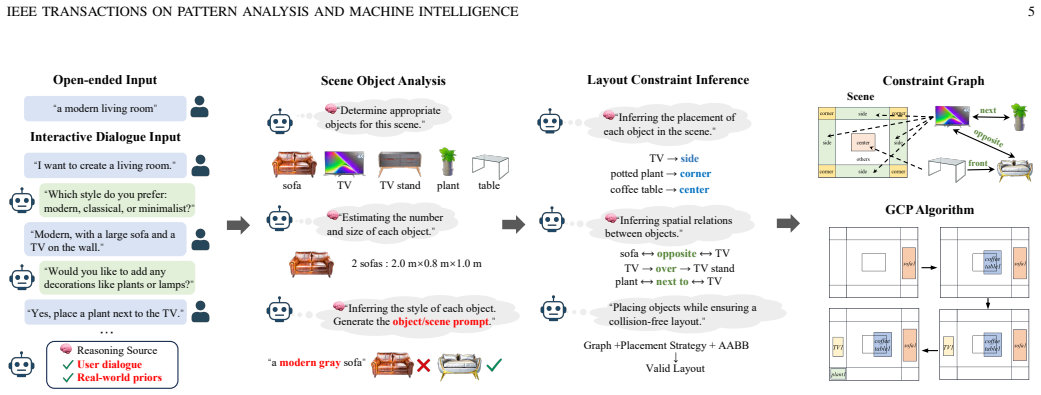
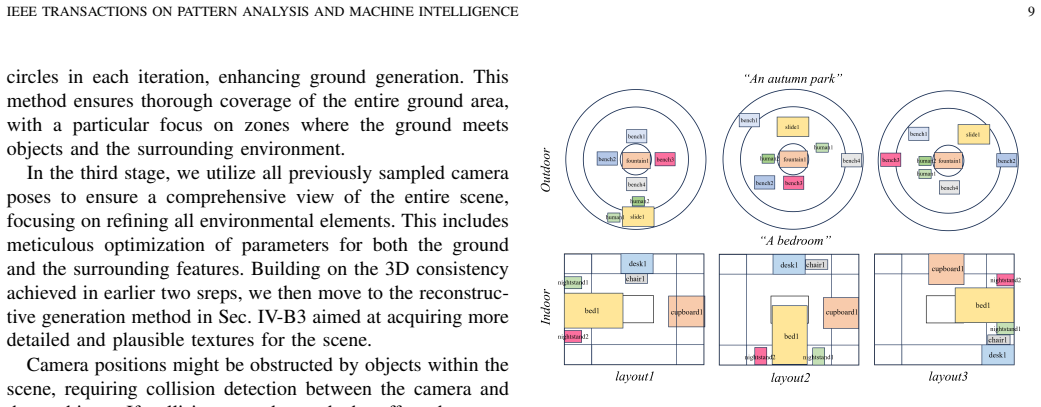
The load-bearing machinery is the hybrid constraint graph with the graph-based constraint placement (GCP) algorithm on the planning side, and Formation Pattern Sampling (FPS) on the generation side. GCP starts from a selected anchor object, propagates directional constraints breadth-first, filters candidate grid positions by axis-aligned bounding-box collisions, and assigns fallback poses to leftovers; its output is an affine transform $(s_i, r_i, t_i)$ per object. FPS replaces single-timestep score distillation with a multi-timestep classifier-score gradient, aggregating $\epsilon_\phi(x_{t_i}; y, t_i) - \epsilon_\phi(x_{t_i}; \varnothing, t_i)$ over $m$ intervals; it prunes Gaussians by a score based on volume and distance to the rendering plane, and then switches to a reconstruction loss $L_{\mathrm{rec}}$ on denoised pseudo-GT images. The appendix derives the MTS gradient as a trajectory-alignment term, connecting it to two-stage 2D diffusion editing. A three-stage camera schedule then refines surroundings, ground, and the full scene, and because each object is a separate set of Gaussians under its own affine transform, editing reduces to changing those parameters or re-running the planner.
What would settle it
Take 100 open-ended scene prompts, run only the planning module, and have independent raters judge whether the inferred object list, sizes, and spatial relations are physically plausible for the stated scene; if a substantial fraction are implausible, the end-to-end claim fails even if object synthesis itself is strong. A sharper variant is to feed a prompt that is grammatical but physically impossible and check whether the system either rejects it or produces a visibly nonsensical layout.
Extended reading notes
Core claim
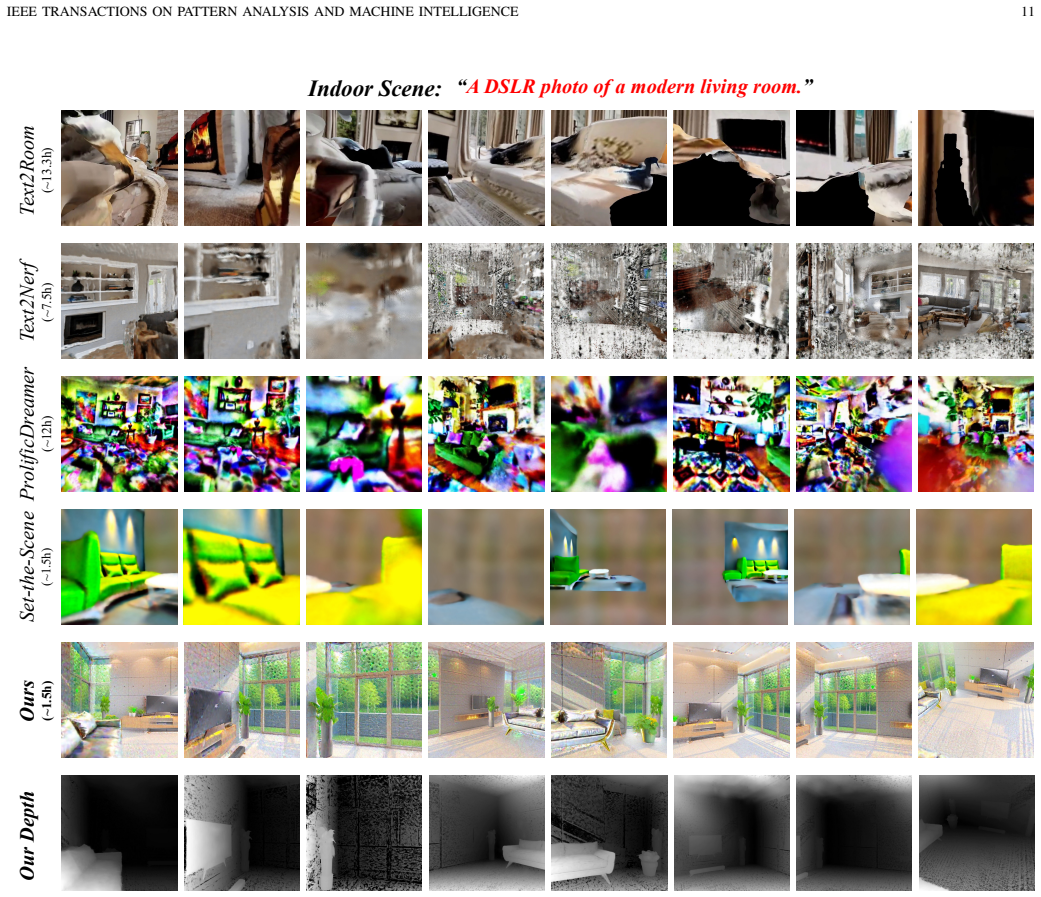
On its own terms, the contribution is a single pipeline with four linked stages. A GPT-4 agent performs scene decomposition and layout-constraint inference, producing a hybrid constraint graph with object-to-scene region anchors and object-to-object relations; the graph-based constraint placement algorithm then computes scales, rotations, and translations that are collision-free and physically plausible. Each object is generated separately with Formation Pattern Sampling, which aggregates information from multiple diffusion timesteps per optimization step (multi-timestep sampling), prunes low-contribution 3D Gaussians, and finishes textures with a fast reconstruction loss. Objects are inserted under their planned affine transforms, and a three-step progressive camera sampling strategy shapes the environment so that the final scene does not exhibit the repeated duplicated objects that plague earlier methods. The paper reports that this yields better user-study ratings than Text2Room, Text2NeRF, ProlificDreamer, and Set-the-Scene on quality, consistency, and rationality, in roughly 1.5 hours, and that the same object-level separation supports relocation, appearance editing, and temporal 4D motion.
Load-bearing premise
The load-bearing premise is that the large language model reliably infers correct object categories, real-world sizes, region anchors, and pairwise spatial relations from open-ended prompts or dialogue; if those guesses are implausible, the layout, object composition, and environment generation inherit the error and the scene becomes invalid.
Editorial extensions
If this is right
- Open-ended text or dialogue becomes a complete 3D scene in roughly 1.5 hours with no manual layout, because the planner and GCP replace hand-placed object trajectories.
- Scene-wide consistency under exploratory cameras should follow; the paper reports that the multi-head duplication artifact is largely removed by pre-positioning objects before environment generation.
- Objects remain separable after generation, so scenes can be edited by moving, adding, removing, or restyling individual components without regenerating the whole scene.
- 4D animation is available as time-dependent affine transforms on selected objects, so the same scene extends to motion and virtual-environment simulation.
- The FPS object generator alone competes with dedicated text-to-3D object methods, reaching higher R-Precision than DreamTime after the same iteration count, so the benefit is not only at scene level.
Reading between the lines
- A natural follow-up is to score the LLM's object lists, sizes, and relations on their own, independently of the final render, because planning errors would propagate into layout, environment, and editing.
- Because the MTS derivation treats the gradient as trajectory alignment, the same mechanism should transfer to other diffusion backbones or other explicit 3D representations, though the paper demonstrates it only with 3D Gaussians and one 2D diffusion model.
- The editing design suggests a conversational workflow in which each user request re-runs only the planner or appearance stage rather than the whole pipeline, which would make incremental scene revision much cheaper.
- A reader could also test the causal role of planning by replacing the LLM with fixed hand-designed layouts on the same prompts: if final quality drops, the commonsense planning is what carries the scene-level claims.
Editorial analysis
A structured set of objections, weighed in public.
Referee Report
Summary. DreamScene proposes an end-to-end text/dialogue-to-3D-scene framework built on 3D Gaussian Splatting. A GPT-4 agent parses user input into object categories, counts, sizes, appearance prompts, region anchors, and pairwise spatial relations, which are organized into a hybrid constraint graph. A graph-based constraint placement (GCP) algorithm converts these constraints into a collision-free layout. Objects are generated by Formation Pattern Sampling (FPS), which combines multi-timestep sampling (MTS), 3D Gaussian filtering, and a reconstructive generation stage. A progressive three-step camera sampling strategy then optimizes the surrounding environment, and the representation supports object relocation, appearance editing, and 4D temporal motion. Experiments compare DreamScene with Text2Room, Text2NeRF, ProlificDreamer, Set-the-Scene, and several text-to-3D baselines using qualitative comparisons, a 100-participant user study over five scenes, and CLIP R-Precision on an object-level benchmark.
Significance. If the stated claims hold, DreamScene would be a practical step toward automated, open-domain text-to-3D scene generation with editable object-level structure. The pipeline's explicit separation of planning, object generation, and composition is a sensible design, and the use of 3D Gaussians enables lightweight editing operations. The paper includes a user study, quantitative R-Precision results, ablation studies for time-window strategies and Gaussian filtering, and a public demo/code link, which are positive features. The main caveat is that the evaluation is narrow: it rests on five curated scenes and lacks statistical validation, and the GPT-4-based planner — the module that carries the automation claim — is never evaluated directly. The MTS theoretical explanation in Appendix A is also presented as a derivation but relies on an acknowledged approximation. These issues are correctable and do not, in my assessment, invalidate the core system, but they currently prevent the strong comparative claims from being fully supported.
major comments (5)
- [Sec. V-B, Tables I and II] The quantitative evidence is too thin to support the claim that DreamScene surpasses prior methods in quality, consistency, and flexibility. The user study covers five scenes, and no error bars, confidence intervals, or significance tests are reported for the mean ratings in Table I. The R-Precision evaluation in Table II is limited to an object-level comparison against DreamTime and is not a scene-level evaluation against the scene-generation baselines used in the user study. I recommend reporting per-scene results with variance measures, running significance tests, and adding a scene-level quantitative metric (or an extended R-Precision study that includes baseline scene-generation methods).
- [Sec. IV-A and Algorithm 1] The automation claim depends on the GPT-4 planner, but the paper provides no validation of that module. There are no reported metrics for JSON parse success, object-category accuracy, size plausibility, region-anchor agreement, pairwise-relation satisfaction, or collision rate. Algorithm 1 silently falls back to heuristic placement (lines 22-24) when constraints cannot be satisfied, so planner errors can propagate into object generation and environment optimization without detection. I ask for a dedicated planning evaluation, including failure-rate analysis on a broader set of prompts and dialogues, and ideally an automatic rejection or re-planning mechanism for invalid layouts.
- [Sec. V-B, Table I] The timing comparison appears to measure only DreamScene's environment-generation stage while comparing it against the full pipelines of the baseline methods. The text says 'we calculate the generation time of our environment generation stage' because the baselines cannot generate objects independently, but the headline 'Ours (~1.5h)' is then presented as a full pipeline time in Figs. 8 and 9. This is misleading. Please report end-to-end time including scene planning, object generation, composition, and environment optimization, and state clearly what portion of the 1.5 hours corresponds to each stage.
- [Appendix A, Eqs. (21)-(22)] The theoretical derivation of MTS rests on the approximation in Eq. (21), εθ(x_{t_{i+1}}, t_{i+1}, y, ∅) ≈ εθ(x_{t_i}, t_i, y, ∅), whose error is acknowledged to grow with ΔT. This makes the subsequent proportionality in Eq. (22) approximate rather than exact, and the claim that MTS is 'not a heuristic mechanism' is stronger than the derivation supports. The connection to 2D editing is also analogical. I recommend presenting this as a motivating analysis with a bound or empirical validation of the approximation, or softening the claim accordingly.
- [Sec. IV-B2, Eq. (12) and Fig. 13] The 3D Gaussian filtering criterion in Eq. (12) is introduced as a heuristic score, but the threshold and the compression ratio η used in Algorithm 2 are not specified in the implementation details. The ablation in Fig. 13 reports memory reductions but no quantitative quality metrics for the generation task, so the statement that compression causes 'no significant loss of quality' is not supported. Please provide the chosen threshold/η values and quantitative quality measurements (e.g., PSNR, SSIM, or CLIP score) for the generation and reconstruction cases.
minor comments (7)
- [Sec. IV-B] The sentence 'Details are presented in the supplementary material. Details are presented in the supplementary material.' is duplicated.
- [Sec. IV-D] In 'Appearance Modification', the phrase 'span both texture geometry refinements' appears to be missing a word; it should likely read 'texture and geometry refinements'.
- [Sec. IV-C] The typo 'sreps' should be 'steps' in the sentence 'Building on the 3D consistency achieved in earlier two sreps'.
- [Appendix B] The layout prompt template always includes the CORNER relation, while Sec. IV-A2 states that outdoor scenes exclude the corner zone. Please reconcile the template and the method description.
- [Sec. IV-A3 and Algorithm 1] The GCP algorithm does not specify a termination mechanism for cyclic or contradictory relation sets, and the fallback placement heuristics are described only as 'heuristically'. A brief description of how cycles are handled would improve reproducibility.
- [Eq. (9) and Algorithm 2] The notation T_iter^end is ambiguous; Algorithm 2 defines T_end = (1 - iter/iterm) × 1000, but the main text should state this explicitly when introducing Eq. (9).
- [Eq. (12)] The notation maxV(r_j) is not defined precisely; it should be stated whether this is the maximum volume among Gaussians on ray r_j or the maximum over all rays.
Circularity Check
No significant circularity: DreamScene's pipeline is benchmarked externally and its proposed losses are defined independently of the reported results.
full rationale
DreamScene's derivation chain is not circular. The scene-planning module uses GPT-4 as an external knowledge source, and the GCP algorithm applies the inferred anchors and relations as soft constraints rather than fitting a parameter to a target output. FPS/MTS is presented as a proposed objective, not as a quantity fitted to the evaluation: Eq. 11 defines a multi-timestep classifier-score distillation loss, and Appendix A independently connects this loss to DDIM-inversion trajectory discrepancies through standard diffusion equations; this is an explanatory link, not a restatement of the paper's conclusions. The 'theoretical explanation' does not smuggle the result into the assumptions because the derivation begins from existing DDIM inversion and denoising formulas. Similarly, the camera-sampling and editing modules are algorithmic proposals evaluated by user studies and CLIP R-Precision against external baselines, so the reported metrics are not defined in terms of the method's own outputs. The ECCV/TPAMI self-citation [24] is used to position the work as an extension while the method is fully described in the paper, so it is not load-bearing. The absence of planning-accuracy metrics for the GPT-4 module is a robustness and validation gap, not circularity.
Assumptions & free parameters
free parameters (6)
- m =
4
- T_end annealing window =
T_end = (1 - iter/iterm) * 1000
- Delta T step size =
50 to 100
- Weighting w(t_i) =
unspecified
- Gaussian filtering threshold and eta =
unspecified
- Camera sampling grid and radii =
unspecified
assumptions (5)
- standard math DDIM inversion (Eq. 10) accurately maps rendered images to the latent trajectory used for multi-timestep supervision.
- domain assumption The GPT-4 agent returns object categories, real-world sizes, and spatial relations that reflect real-world physics and user intent.
- domain assumption A pre-trained 2D text-to-image diffusion model (Stable Diffusion 2.1) provides valid gradients for optimizing 3D Gaussian geometry via the classifier score across multiple timesteps.
- ad hoc to paper The 3D Gaussian filtering score (Eq. 12), based on inverse-square distance and volume, identifies Gaussians that can be safely discarded without degrading quality.
- domain assumption The unified test camera trajectory (linear sweeps plus a circle) is an appropriate probe of scene-wide consistency and does not unfairly disadvantage baselines.
Cite this review
Pith. "Pith review of DreamScene: 3D Gaussian-based End-to-end Text-to-3D Scene Generation." pith.science (2026). https://pith.science/paper/PSDZ6KV6
@misc{pith2026250713985,
  author       = {Pith},
  title        = {Pith review of: DreamScene: 3D Gaussian-based End-to-end Text-to-3D Scene Generation},
  year         = {2026},
  howpublished = {\url{https://pith.science/paper/PSDZ6KV6}},
  note         = {Machine review of arXiv:2507.13985}
}
read the original abstract
Generating 3D scenes from natural language holds great promise for applications in gaming, film, and design. However, existing methods struggle with automation, 3D consistency, and fine-grained control. We present DreamScene, an end-to-end framework for high-quality and editable 3D scene generation from text or dialogue. DreamScene begins with a scene planning module, where a GPT-4 agent infers object semantics and spatial constraints to construct a hybrid graph. A graph-based placement algorithm then produces a structured, collision-free layout. Based on this layout, Formation Pattern Sampling (FPS) generates object geometry using multi-timestep sampling and reconstructive optimization, enabling fast and realistic synthesis. To ensure global consistent, DreamScene employs a progressive camera sampling strategy tailored to both indoor and outdoor settings. Finally, the system supports fine-grained scene editing, including object movement, appearance changes, and 4D dynamic motion. Experiments demonstrate that DreamScene surpasses prior methods in quality, consistency, and flexibility, offering a practical solution for open-domain 3D content creation. Code and demos are available at https://jahnsonblack.github.io/DreamScene-Full/.
Figures


Figures from the paper (17 more)





Forward citations
Cited by 1 Pith paper
-
GaussianGPT: Towards Autoregressive 3D Gaussian Scene Generation
A causal transformer with 3D RoPE generates vector-quantized 3D Gaussian latent grids autoregressively, enabling unconditional synthesis, completion, and open-ended outpainting of indoor scenes.
Reference graph
Works this paper leans on
-
[1]
Dreamfusion: Text- to-3d using 2d diffusion,
B. Poole, A. Jain, J. T. Barron, and B. Mildenhall, “Dreamfusion: Text- to-3d using 2d diffusion,” arXiv preprint arXiv:2209.14988 , 2022
arXiv 2022
-
[2]
Magic3d: High-resolution text-to- 3d content creation,
C.-H. Lin, J. Gao, L. Tang, T. Takikawa, X. Zeng, X. Huang, K. Kreis, S. Fidler, M.-Y . Liu, and T.-Y . Lin, “Magic3d: High-resolution text-to- 3d content creation,” in Proceedings of the IEEE/CVF Conference on Computer Vision and Pattern Recognition , 2023, pp. 300–309
work page 2023
-
[3]
Fantasia3d: Disentangling geometry and appearance for high-quality text-to-3d content creation,
R. Chen, Y . Chen, N. Jiao, and K. Jia, “Fantasia3d: Disentangling geometry and appearance for high-quality text-to-3d content creation,” arXiv preprint arXiv:2303.13873 , 2023
arXiv 2023
-
[4]
Zero-1-to-3: Zero-shot one image to 3d object,
R. Liu, R. Wu, B. Van Hoorick, P. Tokmakov, S. Zakharov, and C. V on- drick, “Zero-1-to-3: Zero-shot one image to 3d object,” in Proceedings of the IEEE/CVF International Conference on Computer Vision , 2023, pp. 9298–9309
work page 2023
-
[5]
Latent-nerf for shape-guided generation of 3d shapes and textures,
G. Metzer, E. Richardson, O. Patashnik, R. Giryes, and D. Cohen-Or, “Latent-nerf for shape-guided generation of 3d shapes and textures,” in Proceedings of the IEEE/CVF Conference on Computer Vision and Pattern Recognition, 2023, pp. 12 663–12 673
work page 2023
-
[6]
Dreamtime: An improved optimization strategy for text-to-3d content creation,
Y . Huang, J. Wang, Y . Shi, X. Qi, Z.-J. Zha, and L. Zhang, “Dreamtime: An improved optimization strategy for text-to-3d content creation,”arXiv preprint arXiv:2306.12422, 2023
arXiv 2023
-
[7]
Text-to- 3d with classifier score distillation,
X. Yu, Y .-C. Guo, Y . Li, D. Liang, S.-H. Zhang, and X. Qi, “Text-to- 3d with classifier score distillation,” arXiv preprint arXiv:2310.19415 , 2023
arXiv 2023
-
[8]
Luciddreamer: Towards high-fidelity text-to-3d generation via interval score matching,
Y . Liang, X. Yang, J. Lin, H. Li, X. Xu, and Y . Chen, “Luciddreamer: Towards high-fidelity text-to-3d generation via interval score matching,” arXiv preprint arXiv:2311.11284 , 2023
arXiv 2023
Show all 59 references
-
[9]
Dreamgaussian: Generative gaussian splatting for efficient 3d content creation,
J. Tang, J. Ren, H. Zhou, Z. Liu, and G. Zeng, “Dreamgaussian: Generative gaussian splatting for efficient 3d content creation,” arXiv preprint arXiv:2309.16653, 2023
2023 arXiv
-
[10]
Sweetdreamer: Aligning geo- metric priors in 2d diffusion for consistent text-to-3d,
W. Li, R. Chen, X. Chen, and P. Tan, “Sweetdreamer: Aligning geo- metric priors in 2d diffusion for consistent text-to-3d,” arXiv preprint arXiv:2310.02596, 2023
2023 arXiv
-
[11]
Point-e: A system for generating 3d point clouds from complex prompts,
A. Nichol, H. Jun, P. Dhariwal, P. Mishkin, and M. Chen, “Point-e: A system for generating 3d point clouds from complex prompts,” arXiv preprint arXiv:2212.08751, 2022
2022 arXiv
-
[12]
Shap-e: Generating conditional 3d implicit functions,
H. Jun and A. Nichol, “Shap-e: Generating conditional 3d implicit functions,” arXiv preprint arXiv:2305.02463 , 2023
2023 arXiv
-
[13]
Hierarchical text-conditional image generation with clip latents,
A. Ramesh, P. Dhariwal, A. Nichol, C. Chu, and M. Chen, “Hierarchical text-conditional image generation with clip latents,” arXiv preprint arXiv:2204.06125, vol. 1, no. 2, p. 3, 2022
2022 arXiv
-
[14]
High- resolution image synthesis with latent diffusion models,
R. Rombach, A. Blattmann, D. Lorenz, P. Esser, and B. Ommer, “High- resolution image synthesis with latent diffusion models,” in Proceedings of the IEEE/CVF conference on computer vision and pattern recognition, 2022, pp. 10 684–10 695
2022
-
[15]
Photorealistic text-to-image diffusion models with deep language understanding,
C. Saharia, W. Chan, S. Saxena, L. Li, J. Whang, E. L. Denton, K. Ghasemipour, R. Gontijo Lopes, B. Karagol Ayan, T. Salimans et al., “Photorealistic text-to-image diffusion models with deep language understanding,” Advances in Neural Information Processing Systems , vol. 35, ...
2022
-
[16]
Nerf: Representing scenes as neural radiance fields for view synthesis,
B. Mildenhall, P. P. Srinivasan, M. Tancik, J. T. Barron, R. Ramamoorthi, and R. Ng, “Nerf: Representing scenes as neural radiance fields for view synthesis,” Communications of the ACM , vol. 65, no. 1, pp. 99–106, 2021
2021
-
[17]
Deepsdf: Learning continuous signed distance functions for shape rep- resentation,
J. J. Park, P. Florence, J. Straub, R. Newcombe, and S. Lovegrove, “Deepsdf: Learning continuous signed distance functions for shape rep- resentation,” in Proceedings of the IEEE/CVF conference on computer vision and pattern recognition , 2019, pp. 165–174
2019
-
[18]
3d gaussian splatting for real-time radiance field rendering,
B. Kerbl, G. Kopanas, T. Leimk ¨uhler, and G. Drettakis, “3d gaussian splatting for real-time radiance field rendering,” ACM Transactions on Graphics, vol. 42, no. 4, 2023
2023
-
[19]
Instant neural graphics primitives with a multiresolution hash encoding,
T. M ¨uller, A. Evans, C. Schied, and A. Keller, “Instant neural graphics primitives with a multiresolution hash encoding,” ACM Transactions on Graphics (ToG), vol. 41, no. 4, pp. 1–15, 2022
2022
-
[20]
Deep marching tetrahedra: a hybrid representation for high-resolution 3d shape synthe- sis,
T. Shen, J. Gao, K. Yin, M.-Y . Liu, and S. Fidler, “Deep marching tetrahedra: a hybrid representation for high-resolution 3d shape synthe- sis,” Advances in Neural Information Processing Systems , vol. 34, pp. 6087–6101, 2021
2021
-
[21]
Set-the-scene: Global-local training for generating controllable nerf scenes,
D. Cohen-Bar, E. Richardson, G. Metzer, R. Giryes, and D. Cohen- Or, “Set-the-scene: Global-local training for generating controllable nerf scenes,” arXiv preprint arXiv:2303.13450 , 2023. IEEE TRANSACTIONS ON PATTERN ANALYSIS AND MACHINE INTELLIGENCE 14
2023 arXiv
-
[22]
Text2room: Extracting textured 3d meshes from 2d text-to-image models,
L. H ¨ollein, A. Cao, A. Owens, J. Johnson, and M. Nießner, “Text2room: Extracting textured 3d meshes from 2d text-to-image models,” arXiv preprint arXiv:2303.11989, 2023
2023 arXiv
-
[23]
Text2immersion: Generative immersive scene with 3d gaussians,
H. Ouyang, K. Heal, S. Lombardi, and T. Sun, “Text2immersion: Generative immersive scene with 3d gaussians,” arXiv preprint arXiv:2312.09242, 2023
2023 arXiv
-
[24]
Dreamscene: 3d gaussian-based text-to-3d scene generation via formation pattern sampling,
H. Li, H. Shi, W. Zhang, W. Wu, Y . Liao, L. Wang, L.-h. Lee, and P. Zhou, “Dreamscene: 3d gaussian-based text-to-3d scene generation via formation pattern sampling,” arXiv preprint arXiv:2404.03575, 2024
2024 arXiv
-
[25]
Text2nerf: Text-driven 3d scene generation with neural radiance fields,
J. Zhang, X. Li, Z. Wan, C. Wang, and J. Liao, “Text2nerf: Text-driven 3d scene generation with neural radiance fields,” IEEE Transactions on Visualization and Computer Graphics , 2024
2024
-
[26]
Compositional 3d scene generation using locally conditioned diffusion,
R. Po and G. Wetzstein, “Compositional 3d scene generation using locally conditioned diffusion,” arXiv preprint arXiv:2303.12218 , 2023
2023 arXiv
-
[27]
Prolific- dreamer: High-fidelity and diverse text-to-3d generation with variational score distillation,
Z. Wang, C. Lu, Y . Wang, F. Bao, C. Li, H. Su, and J. Zhu, “Prolific- dreamer: High-fidelity and diverse text-to-3d generation with variational score distillation,” Advances in Neural Information Processing Systems , vol. 36, 2024
2024
-
[28]
Scenewiz3d: Towards text-guided 3d scene composition,
Q. Zhang, C. Wang, A. Siarohin, P. Zhuang, Y . Xu, C. Yang, D. Lin, B. Zhou, S. Tulyakov, and H.-Y . Lee, “Scenewiz3d: Towards text-guided 3d scene composition,” arXiv preprint arXiv:2312.08885 , 2023
2023 arXiv
-
[29]
Componerf: Text-guided multi-object compositional nerf with editable 3d scene layout,
Y . Lin, H. Bai, S. Li, H. Lu, X. Lin, H. Xiong, and L. Wang, “Componerf: Text-guided multi-object compositional nerf with editable 3d scene layout,” arXiv preprint arXiv:2303.13843 , 2023
2023 arXiv
-
[30]
Gpt-4 technical report,
J. Achiam, S. Adler, S. Agarwal, L. Ahmad, I. Akkaya, F. L. Aleman, D. Almeida, J. Altenschmidt, S. Altman, S. Anadkat et al. , “Gpt-4 technical report,” arXiv preprint arXiv:2303.08774 , 2023
2023 arXiv
-
[31]
Denoising diffusion probabilistic models,
J. Ho, A. Jain, and P. Abbeel, “Denoising diffusion probabilistic models,” Advances in neural information processing systems , vol. 33, pp. 6840– 6851, 2020
2020
-
[32]
Gala3d: Towards text-to-3d complex scene generation via layout- guided generative gaussian splatting,
X. Zhou, X. Ran, Y . Xiong, J. He, Z. Lin, Y . Wang, D. Sun, and M.-H. Yang, “Gala3d: Towards text-to-3d complex scene generation via layout- guided generative gaussian splatting,” arXiv preprint arXiv:2402.07207, 2024
2024 arXiv
-
[33]
Cg3d: Compositional generation for text-to-3d via gaussian splatting,
A. Vilesov, P. Chari, and A. Kadambi, “Cg3d: Compositional generation for text-to-3d via gaussian splatting,” arXiv preprint arXiv:2311.17907 , 2023
2023 arXiv
-
[34]
2d-guided 3d gaussian segmentation,
K. Lan, H. Li, H. Shi, W. Wu, L. Wang, and Y . Liao, “2d-guided 3d gaussian segmentation,” in 2024 Asian Conference on Communication and Networks (ASIANComNet) . IEEE, 2024, pp. 1–5
2024
-
[35]
Mip-nerf: A multiscale representation for anti- aliasing neural radiance fields,
J. T. Barron, B. Mildenhall, M. Tancik, P. Hedman, R. Martin-Brualla, and P. P. Srinivasan, “Mip-nerf: A multiscale representation for anti- aliasing neural radiance fields,” in Proceedings of the IEEE/CVF Inter- national Conference on Computer Vision , 2021, pp. 5855–5864
2021
-
[36]
Mvdream: Multi- view diffusion for 3d generation,
Y . Shi, P. Wang, J. Ye, M. Long, K. Li, and X. Yang, “Mvdream: Multi- view diffusion for 3d generation,” arXiv preprint arXiv:2308.16512 , 2023
2023 arXiv
-
[37]
Text-to-3d generation by 2d editing,
H. Li, Y . Tian, Y . Wang, Y . Liao, L. Wang, Y . Wang, and P. Y . Zhou, “Text-to-3d generation by 2d editing,” arXiv preprint arXiv:2412.05929, 2024
2024 arXiv
-
[38]
Gaussiandreamer: Fast generation from text to 3d gaussian splatting with point cloud priors,
T. Yi, J. Fang, G. Wu, L. Xie, X. Zhang, W. Liu, Q. Tian, and X. Wang, “Gaussiandreamer: Fast generation from text to 3d gaussian splatting with point cloud priors,” arXiv preprint arXiv:2310.08529 , 2023
2023 arXiv
-
[39]
Null- text inversion for editing real images using guided diffusion models,
R. Mokady, A. Hertz, K. Aberman, Y . Pritch, and D. Cohen-Or, “Null- text inversion for editing real images using guided diffusion models,” in Proceedings of the IEEE/CVF Conference on Computer Vision and Pattern Recognition, 2023, pp. 6038–6047
2023
-
[40]
Prompt-to-prompt image editing with cross attention control,
A. Hertz, R. Mokady, J. Tenenbaum, K. Aberman, Y . Pritch, and D. Cohen-Or, “Prompt-to-prompt image editing with cross attention control,” arXiv preprint arXiv:2208.01626 , 2022
2022 arXiv
-
[41]
Layout-your-3d: Control- lable and precise 3d generation with 2d blueprint,
J. Zhou, X. Li, L. Qi, and M.-H. Yang, “Layout-your-3d: Control- lable and precise 3d generation with 2d blueprint,” arXiv preprint arXiv:2410.15391, 2024
2024 arXiv
-
[42]
Decompdreamer: Advancing structured 3d asset gen- eration with multi-object decomposition and gaussian splatting,
U. Nath, R. Goel, R. Khurana, K. Min, M. Ollila, P. Turaga, V . Jampani, and T. Gowda, “Decompdreamer: Advancing structured 3d asset gen- eration with multi-object decomposition and gaussian splatting,” arXiv preprint arXiv:2503.11981, 2025
2025
-
[43]
Cc3d: Layout-conditioned generation of com- positional 3d scenes,
S. Bahmani, J. J. Park, D. Paschalidou, X. Yan, G. Wetzstein, L. Guibas, and A. Tagliasacchi, “Cc3d: Layout-conditioned generation of com- positional 3d scenes,” in Proceedings of the IEEE/CVF International Conference on Computer Vision , 2023, pp. 7171–7181
2023
-
[44]
Berfscene: Bev-conditioned equivariant radiance fields for infinite 3d scene genera- tion,
Q. Zhang, Y . Xu, Y . Shen, B. Dai, B. Zhou, and C. Yang, “Berfscene: Bev-conditioned equivariant radiance fields for infinite 3d scene genera- tion,” in Proceedings of the IEEE/CVF Conference on Computer Vision and Pattern Recognition, 2024, pp. 6839–6849
2024
-
[45]
Atiss: Autoregressive transformers for indoor scene synthesis,
D. Paschalidou, A. Kar, M. Shugrina, K. Kreis, A. Geiger, and S. Fidler, “Atiss: Autoregressive transformers for indoor scene synthesis,” Ad- vances in Neural Information Processing Systems , vol. 34, pp. 12 013– 12 026, 2021
2021
-
[46]
Scene-llm: Extending language model for 3d visual understanding and reasoning,
R. Fu, J. Liu, X. Chen, Y . Nie, and W. Xiong, “Scene-llm: Extending language model for 3d visual understanding and reasoning,” arXiv preprint arXiv:2403.11401, 2024
2024 arXiv
-
[47]
3d-llm: Injecting the 3d world into large language models,
Y . Hong, H. Zhen, P. Chen, S. Zheng, Y . Du, Z. Chen, and C. Gan, “3d-llm: Injecting the 3d world into large language models,” Advances in Neural Information Processing Systems , vol. 36, pp. 20 482–20 494, 2023
2023
-
[48]
Root: Vlm based system for indoor scene understanding and beyond,
Y . Wang, S.-Y . Chen, Z. Zhou, S. Li, H. Li, W. Zhou, and H. Li, “Root: Vlm based system for indoor scene understanding and beyond,” arXiv preprint arXiv:2411.15714, 2024
2024 arXiv
-
[49]
Denoising diffusion implicit models,
J. Song, C. Meng, and S. Ermon, “Denoising diffusion implicit models,” arXiv preprint arXiv:2010.02502 , 2020
2010 arXiv
-
[50]
Classifier-free diffusion guidance,
J. Ho and T. Salimans, “Classifier-free diffusion guidance,” arXiv preprint arXiv:2207.12598, 2022
2022 arXiv
-
[51]
A survey on 3d gaussian splatting,
G. Chen and W. Wang, “A survey on 3d gaussian splatting,” arXiv preprint arXiv:2401.03890, 2024
2024 arXiv
-
[52]
Consistent3d: Towards consistent high-fidelity text-to-3d generation with deterministic sampling prior,
Z. Wu, P. Zhou, X. Yi, X. Yuan, and H. Zhang, “Consistent3d: Towards consistent high-fidelity text-to-3d generation with deterministic sampling prior,” in Proceedings of the IEEE/CVF Conference on Computer Vision and Pattern Recognition, 2024, pp. 9892–9902
2024
-
[53]
Prompt tuning inversion for text-driven image editing using diffusion models,
W. Dong, S. Xue, X. Duan, and S. Han, “Prompt tuning inversion for text-driven image editing using diffusion models,” in Proceedings of the IEEE/CVF International Conference on Computer Vision , 2023, pp. 7430–7440
2023
-
[54]
Lightgaussian: Unbounded 3d gaussian compression with 15x reduction and 200+ fps,
Z. Fan, K. Wang, K. Wen, Z. Zhu, D. Xu, and Z. Wang, “Lightgaussian: Unbounded 3d gaussian compression with 15x reduction and 200+ fps,” arXiv preprint arXiv:2311.17245 , 2023
2023 arXiv
-
[55]
Compact 3d gaussian representation for radiance field,
J. C. Lee, D. Rho, X. Sun, J. H. Ko, and E. Park, “Compact 3d gaussian representation for radiance field,” arXiv preprint arXiv:2311.13681 , 2023
2023 arXiv
-
[56]
Text2scene: Text-driven in- door scene stylization with part-aware details,
I. Hwang, H. Kim, and Y . M. Kim, “Text2scene: Text-driven in- door scene stylization with part-aware details,” in Proceedings of the IEEE/CVF Conference on Computer Vision and Pattern Recognition , 2023, pp. 1890–1899
2023
-
[57]
3d- goi: 3d gan omni-inversion for multifaceted and multi-object editing,
H. Li, L. Ma, H. Shi, Y . Hao, Y . Liao, L. Cheng, and P. Y . Zhou, “3d- goi: 3d gan omni-inversion for multifaceted and multi-object editing,” in European Conference on Computer Vision. Springer, 2024, pp. 390– 406
2024
-
[58]
threestudio: A unified framework for 3d content generation,
Y .-C. Guo, Y .-T. Liu, C. Wang, Z.-X. Zou, G. Luo, C.-H. Chen, Y .-P. Cao, and S.-H. Zhang, “threestudio: A unified framework for 3d content generation,” 2023. APPENDIX A THEORETICAL DERIVATION OF MULTI-TIMESTEP SAMPLING (MTS) Our Multi-timestep Sampling (MTS) strategy is gro...
2023
-
[59]
Text-guided 2D image editing aims to modify an input image according to a target text prompt
Connection to 2D Editing Next, we interpret xti − ˜xti from the perspective of 2D image editing using diffusion models. Text-guided 2D image editing aims to modify an input image according to a target text prompt. Existing diffusion- based 2D editing methods generally consist ...
Reviewed August 6, 2026 · model on record in the stance chip above.
Discussion (0). Sign in to comment.