REVIEW 5 major objections 6 minor 66 references
ScarceGAN: Discriminative Classification Framework for Rare Class Identification for Longitudinal Data with Weak Prior
T0 review · 5 major / 6 minor · reviewed 2026-08-16 · deepseek-v4-flash
Pith's one-line read ScarceGAN claims that adding an 'unknown' leeway class and splitting negatives into several classes lets a semi-supervised GAN identify extremely rare positives in weakly labeled longitudinal data, reaching over 85% recall on risky…
desk verdict ScarceGAN's leeway class is a genuinely useful trick for weak negative labels, but its recall claims rest on an unstated closed-world positive assumption and an evaluation tied to the rule engine that produced the labels. read the letter →
The pith
A machine-rendered reading of the paper's core claim, the machinery that carries it, and where it could break.
The reading
What carries the argument
The load-bearing object is the leeway class U, an extra output of the discriminator that absorbs samples the classifier cannot confidently assign to a known negative class but is sure are not positive. Around U, ScarceGAN builds three coordinated mechanisms: divided focus (splitting negatives into D, N, and H to reduce the effective imbalance), a dual cross-entropy supervised loss that mixes $\alpha$-weighted known-class loss with $(1-\alpha)$-weighted U-loss, and a complementary ('bad') generator whose low-density, feature-matched samples sharpen decision boundaries. The claimed effect is that U acts as a release valve for label noise and weak priors, letting the discriminator preserve a high-recall positive boundary without overfitting to noisy negative labels.
What would settle it
Take a longitudinal dataset with a scarce positive class and weak negative labels, deliberately hold back every sample of a newly introduced positive behavior (one that resembles known negatives in feature space), feed those samples to the model only as unlabeled real data, and measure recall on them. If ScarceGAN sends them to U or to a negative class instead of flagging them as positive, the central claim is falsified.
Extended reading notes
Core claim
On its own terms, the paper's discovery is that a semi-supervised GAN can be re-targeted from 'classify every sample into a known class' to 'classify confidently, and park the rest in a leeway class.' ScarceGAN defines five supervised outputs: three negative classes (dormant, normal, heavy), one positive class (risky), and an unknown negative class U, and it assigns every labeled negative sample a weighted loss that is partly categorical cross-entropy on its stated class and partly categorical cross-entropy on U, with weight $\alpha$ typically 0.6–0.7. The unsupervised path makes the same split between 'known' and 'unknown' for real unlabeled samples, plus a fake class for generator outputs. The generator is trained to be complementary, producing samples that sit near decision boundaries rather than mimicking the data, which forces the discriminator to refine its boundaries. Together these changes are claimed to lift positive-class precision/recall from 34%/24% on the held-out gaming set to 75.7%/72.5%, and to transfer unchanged to KDDCUP99, where ScarceGAN reports F1 = 28 for R2L (0.09% imbalance) and recall 0.99 when the 'normal' class is the target.
Load-bearing premise
The argument assumes the unlabeled pool contains no genuinely new positive (risky) behaviors: every real sample is split between known classes and the leeway class U, and U is always treated as negative, so a novel risky pattern that appears only in the unlabeled set would be absorbed into U and missed.
Editorial extensions
If this is right
- If ScarceGAN's results hold, the leeway mechanism gives a practical template for rare-class detection under weak priors: rather than more positive data, the gain comes from restructuring how negatives are scored.
- The held-out gaming evaluation implies that the same network, without re-engineering, can serve as a first-pass filter that flags roughly 1–6% of daily platform traffic while catching 85–90% of confirmed risky players.
- The KDDCUP99 result implies that ScarceGAN can beat supervised baselines on a 0.09%-imbalance attack class (R2L, F1 = 28), where conventional classifiers score in single digits.
- The ablations imply that both the leeway class and the divided negative classes are individually load-bearing: removing U drops precision to 40.5%, and collapsing to binary negatives drops recall to 60%.
- The complementary generator contributes about 10 points of precision/recall over the same architecture without it, implying that generator quality and classifier quality are not in tension here—a deliberately bad generator helps.
Reading between the lines
- Editorial inference: the leeway-class trick should transfer to any scarce-positive setting with noisy negatives—fraud, faults, medical screening—because it only requires the model to say 'not positive but unknown which negative,' which is a weaker and often more honest supervisory signal.
- Editorial inference: the paper's alpha value encodes an assumed 30–40% negative-label noise rate; a direct extension would estimate noise per class and adapt alpha, turning a hand-set hyperparameter into a measured quantity.
- Editorial inference: because U absorbs every uncertain real sample, the framework's safety depends on the closed-world assumption on positives; a practical deployment should monitor the U class for clusters, since a dense cluster of U could signal a new positive behavior the prior never saw.
- Editorial inference: the third-order Prophet features are presented as helpful but not required; an ablation feeding raw longitudinal aggregates into ScarceGAN (which the paper says is possible) would separate the value of the classifier from the value of the feature engineering, and the same comparison could be run on KDDCUP99's raw features.
Signed reviews
Editorial analysis
A structured set of objections, weighed in public.
Referee Report
Summary. ScarceGAN is a semi-supervised GAN framework for detecting a rare positive class in longitudinal telemetry data with a small, noisy label prior. The paper's main technical additions are: (i) dividing the negative class into three domain-defined subclasses (D, N, H); (ii) introducing an 'unknown' leeway class U that is treated as part of the negative space; (iii) modifying the supervised and unsupervised discriminator losses to use alpha-weighted cross-entropy between known and unknown negative assignments; and (iv) adopting a 'bad generator' objective for complementary learning. Features are constructed as ten Prophet hyperparameters over longitudinal counters. On a proprietary skill-gaming dataset, the authors report held-out precision/recall of 75.7%/72.5% versus 34%/24% for vanilla SSGAN, recall of roughly 75-91% on small sets of confirmed positives, and reduced verbosity on false-positive users. On KDDCUP99, they report R2L F1=28 and competitive results for imbalanced 'normal' class detection. The paper positions ScarceGAN as a new benchmark for rare-class identification in longitudinal settings.
Significance. If the claims hold, ScarceGAN would be a practically useful recipe: the leeway class is a simple and interpretable way to absorb noisy negative labels, the divided-negative-focus idea is well motivated by the described data, and the ablations (binary versus divided negatives, with/without leeway, with/without bad generator) directly test each design component. The authors also ship source code and evaluate on a real deployment plus a public dataset, which are strengths. The significance is bounded, however, by two issues: the model treats the unlabeled data as containing no novel positives, yet the paper's framing suggests discovery of previously unseen risky behavior; and the quantitative evidence for the headline recall is based on very small positive test sets without confidence intervals. These limitations affect the strength of the central claim rather than the plausibility of the architecture-level ideas.
major comments (5)
- [Section 3.2 and Section 3.3.2] In Section 3.2, U is explicitly defined as part of the negative class, and in Section 3.3.2 the unsupervised real-sample loss is L_US_Real_D = alpha*CCE(x|C_y in K) + (1-alpha)*CCE(x|C_y in U). Every unlabeled real sample is therefore trained toward K or U, never directly toward the positive class R, so the model has no mechanism to recover a genuinely novel positive behavior that appears only in the unlabeled set. This is load-bearing because the paper frames its contribution as identifying scarce risky players and notes in Section 1 that newer samples redefine the positive distribution; if the claim is restricted to positives resembling the labeled prior, that closed-world assumption must be stated explicitly. The evaluation does not address this risk: the confirmed positives in Sets 1-3 appear to come from the same rule-engine/business flagging pipeline that generated the training positives, so high recall there may reflect imitation of the flagging rules rather than detection of new risk patterns. The SIUs are self-identified, but they are only seven samples.
- [Section 5.2, Tables 3 and 4] The quantitative basis for the headline recall is thin. The held-out positive test set has 52 samples, and Table 3 reports mean precision/recall over six runs with no standard deviations or confidence intervals. Table 4's 'over 85% recall' claim is based on denominators of 4, 9, 11, and 7 confirmed positives in Set 1, Set 2, Set 3, and SIUs, respectively; the text also says recall is 'between 85% to 90%' while Set 1 shows 3/4 = 75%. Please report per-run values, confidence intervals, and a paired comparison with vanilla SSGAN so that the stated improvements are statistically supported.
- [Section 3.3.1] The supervised positive-class loss includes a Percent Recall term (L_S+_D = CCE + %Recall+ve), which is not differentiable and is not accompanied by any explanation of how it enters gradient-based training (for example, as a reward, a validation criterion, or a soft proxy). Without this detail, the exact objective being optimized is unspecified and the ablation results cannot be precisely attributed. Please define the full training objective and the role of the recall term.
- [Section 5.4.1, Table 5] The KDDCUP99 R2L comparison is not controlled. ScarceGAN is given 900 of 999 positive R2L samples as a labeled prior plus 30k labeled negatives, while the supervised baselines in Table 5 are presumably trained on the full KDD training labels under the standard split; the paper does not state that the baselines were re-run under the same label budget or that identical test partitions were used. The claim of a new R2L F1 benchmark (28) therefore needs a controlled comparison. The U2R row, with 52 positives in the entire training set, should not be used to draw conclusions from an F1 difference between 0 and 2 without intervals.
- [Section 3.2 and Section 5.3.2] The central new mechanism depends on free parameters that are chosen rather than derived: alpha (0.6-0.7), epsilon (0.75), the definition of the three negative classes D/N/H, and the ten Prophet hyperparameters. No sensitivity analysis is reported for any of these choices, even though alpha directly controls the K/U split and is the key design parameter. Please add sweeps over alpha and epsilon, justify the negative-class definitions with evidence of their temporal stability in the longitudinal setting, and include an ablation comparing the Prophet features with standard longitudinal aggregates inside ScarceGAN itself.
minor comments (6)
- [Section 5.3.1] The text says 'Results for Set 1, 2, 3 and unblocked, SIU's are presented in Figure 4', but these results appear in Table 4; the figure/table cross-reference should be corrected.
- [Section 3.4] The generator loss contains an undefined symbol '∦' and the second term's probability/indicator is not fully specified; please provide a clean equation with explicit expectations and the implementation used in the code.
- [Section 5.1 and Section 5.2] Section 5.1 says 'about 500 samples per negative class' while Section 5.2 describes 500 each with 350 train/150 held-out; the exact counts, and whether the 52 positive held-out samples are all confirmed risky, need to be stated consistently.
- [Introduction and Section 2] The text uses 'compliment' where 'complement' is intended; please proofread for terminology.
- [Table 3] The row 'ScarceGAN 2 class' is ambiguous; rename it consistently with Section 5.3.2 ('ScarceGAN with binary predictions') and define all abbreviations in the caption.
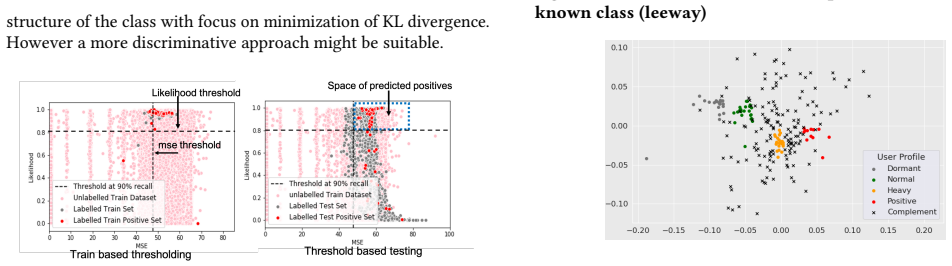
- [Figures 1 and 2] Figures 1 and 2 have very short captions; adding axis labels, legends, and a sentence describing each panel would make the qualitative motivation checks usable.
Circularity Check
No significant circularity: the central results are measured on held-out/external labels, and the U-class design is a scope assumption rather than a fitted prediction.
full rationale
Circularity walk: the claimed outputs are (a) held-out test precision/recall on fixed positives plus Set1/2/3/SIU confirmed positives, and (b) the KDDCUP99 F1 benchmark. Neither is a fitted parameter renamed as a prediction. The hyperparameters alpha and epsilon are stated as selected settings ('We find the setting between 0.7 - 0.6 ideal for alpha' and 'The confidence threshold (epsilon) is chosen to be 0.75'), but the paper does not say these were tuned on the reported test labels, and the held-out positives and SIUs were not exposed in training. The unsupervised loss L_US_Real_D = alpha*CCE(x|K) + (1-alpha)*CCE(x|U) does encode a closed-world positive assumption, since every unlabeled real sample is pushed toward K or U and never directly toward R; however, that is a correctness/scope limitation, not a reduction of the result to its inputs. The paper itself flags the evaluation ceiling: 'Beyond what was verified, we cannot comment on the precision/recall of the other samples as they were not flagged by existing rule engine and hence some of these could be actually positive samples' and 'There is no way to measure recall, as the complete ground truth is unknown.' The only self-citation of note, [51], is used as a baseline/AAE prototype in Section 5.3.1, not as a load-bearing uniqueness theorem or as support for the central claim. No equation in the paper reduces a reported prediction to a fitted value or to a self-citation chain.
Assumptions & free parameters
free parameters (4)
- alpha (leeway weight) =
0.6-0.7
- epsilon (generator confidence threshold) =
0.75
- Number and definition of negative classes (D, N, H) =
3 hand-defined classes
- Prophet feature set (10 hyper-parameters) =
First 3 harmonics, Laplace smoothing, change rate mean/std, growth rate, etc.
assumptions (4)
- domain assumption All unlabeled real samples are assumed to belong to the negative side (either known or unknown negative), so the U class in the unsupervised path never needs to represent positives.
- domain assumption The three pre-defined negative classes (D, N, H) are a meaningful decomposition of the negative distribution.
- domain assumption A bad generator that fills low-density regions improves the discriminator's decision boundaries.
- domain assumption The recall bonus term in the supervised loss (%Recall_positive) guides the discriminator toward high recall without hurting precision.
invented entities (2)
-
Leeway class U (unknown negative)
-
K/U/F split in the unsupervised path
Cite this review
Pith. "Pith review of ScarceGAN: Discriminative Classification Framework for Rare Class Identification for Longitudinal Data with Weak Prior." pith.science (2026). https://pith.science/paper/PSOWHEUK
@misc{pith2026250503811,
  author       = {Pith},
  title        = {Pith review of: ScarceGAN: Discriminative Classification Framework for Rare Class Identification for Longitudinal Data with Weak Prior},
  year         = {2026},
  howpublished = {\url{https://pith.science/paper/PSOWHEUK}},
  note         = {Machine review of arXiv:2505.03811}
}
read the original abstract
This paper introduces ScarceGAN which focuses on identification of extremely rare or scarce samples from multi-dimensional longitudinal telemetry data with small and weak label prior. We specifically address: (i) severe scarcity in positive class, stemming from both underlying organic skew in the data, as well as extremely limited labels; (ii) multi-class nature of the negative samples, with uneven density distributions and partially overlapping feature distributions; and (iii) massively unlabelled data leading to tiny and weak prior on both positive and negative classes, and possibility of unseen or unknown behavior in the unlabelled set, especially in the negative class. Although related to PU learning problems, we contend that knowledge (or lack of it) on the negative class can be leveraged to learn the compliment of it (i.e., the positive class) better in a semi-supervised manner. To this effect, ScarceGAN re-formulates semi-supervised GAN by accommodating weakly labelled multi-class negative samples and the available positive samples. It relaxes the supervised discriminator's constraint on exact differentiation between negative samples by introducing a 'leeway' term for samples with noisy prior. We propose modifications to the cost objectives of discriminator, in supervised and unsupervised path as well as that of the generator. For identifying risky players in skill gaming, this formulation in whole gives us a recall of over 85% (~60% jump over vanilla semi-supervised GAN) on our scarce class with very minimal verbosity in the unknown space. Further ScarceGAN outperforms the recall benchmarks established by recent GAN based specialized models for the positive imbalanced class identification and establishes a new benchmark in identifying one of rare attack classes (0.09%) in the intrusion dataset from the KDDCUP99 challenge.
Figures


Figures from the paper (2 more)

Reference graph
Works this paper leans on
- [1]
-
[2]
Deep Structured Energy Based Models for Anomaly Detection
2016. Deep Structured Energy Based Models for Anomaly Detection. In Proceed- ings of The 33rd International Conference on Machine Learning (Proceedings of Machine Learning Research). PMLR
work page 2016
-
[3]
Cognitive abilities, non-cognitive skills, and gambling behaviors
2019. Cognitive abilities, non-cognitive skills, and gambling behaviors. Journal of Economic Behavior & Organization (2019)
work page 2019
-
[4]
Martin Arjovsky, Soumith Chintala, and Léon Bottou. 2017. Wasserstein GAN. arXiv:1701.07875 [stat.ML]
arXiv 2017
-
[5]
Siddarth Asokan and Chandra Seelamantula. 2020. Teaching a GAN What Not to Learn. In Advances in Neural Information Processing Systems
work page 2020
-
[6]
2020.Robust Anomaly Detection in Images Using Adversarial Autoencoders
Laura Beggel, Michael Pfeiffer, and Bernd Bischl. 2020.Robust Anomaly Detection in Images Using Adversarial Autoencoders . 206–222. https://doi.org/10.1007/978- 3-030-46150-8_13
doi:10.1007/978- 2020
-
[7]
Yoshua Bengio, É ric Thibodeau-Laufer, Guillaume Alain, and Jason Yosinski
-
[8]
Julia Braverman and Howard J. Shaffer. 2010. How do gamblers start gambling: identifying behavioural markers for high-risk internet gambling. European Journal of Public Health (2010). https://doi.org/10.1093/eurpub/ckp232
Show all 66 references
-
[9]
Deniz Cemiloglu, Emily Arden-Close, Sarah Hodge, Theodoros Kostoulas, Maris Catania, and Raian Ali. 2020. Towards Ethical Requirements for Addictive Technology: The Case of Online Gambling. https://doi.org/10.1109/REthics51204. 2020.00007
2020
-
[10]
Chawla, Kevin W
Nitesh V. Chawla, Kevin W. Bowyer, Lawrence O. Hall, and W. Philip Kegelmeyer
-
[11]
Zhang Chunkai, Zhou Ying, Yingyang Chen, Yepeng Deng, Xuan Wang, Lifeng Dong, and Haoyu Wei. 2018. Over-Sampling Algorithm Based on V AE in Imbal- anced Classification. Cloud Computing - CLOUD 2018
2018
-
[12]
ScarceGAN Source Code. 2021. ScarceGAN: Discriminative Classification Frame- work for Rare Class Identification for Longitudinal Data with Weak Prior . https: //github.com/scarce-user-53/ScarceGAN
2021
-
[13]
Zihang Dai, Zhilin Yang, Fan Yang, William W Cohen, and Russ R Salakhutdinov
-
[14]
Don Dennis, Durmus Alp Emre Acar, Vikram Mandikal, Vinu Sankar Sadasivan, Venkatesh Saligrama, Harsha Vardhan Simhadri, and Prateek Jain. 2019. Shallow RNN: Accurate Time-series Classification on Resource Constrained Devices. In Advances in Neural Information Processing System...
2019
-
[15]
Abhishek Divekar, Meet Parekh, Vaibhav Savla, Rudra Mishra, and Mahesh Shirole. 2018. Benchmarking datasets for Anomaly-based Network Intrusion Detection: KDD CUP 99 alternatives. In 2018 IEEE 3rd International Conference on Computing, Communication and Security (ICCCS) . 1–8....
2018
-
[16]
Python Documentation. 2017. A Python Package for Time Series Classifica- tion. https://pyts.readthedocs.io/en/stable/auto_examples/transformation/plot_ shapelet_transform.html
2017
-
[17]
Python Documentation. 2017. WEASEL + MUSE. https://pyts.readthedocs.io/en/ stable/auto_examples/multivariate/plot_weasel_muse.html
2017
-
[18]
Marthinus Christoffel Du Plessis, Gang Niu, and Masashi Sugiyama. 2015. Convex Formulation for Learning from Positive and Unlabeled Data (ICML’15)
2015
-
[19]
Toni G. 2009. Computing and Visualizing Dynamic Time Warping Alignments in R: The dtw Package. Journal of Statistical Software (2009)
2009
-
[20]
Ian Goodfellow. 2017. NIPS 2016 Tutorial: Generative Adversarial Networks. arXiv:1701.00160 [cs.LG]
2017 arXiv
-
[21]
Goodfellow, Jean Pouget-Abadie, Mehdi Mirza, Bing Xu, David Warde- Farley, Sherjil Ozair, Aaron Courville, and Yoshua Bengio
Ian J. Goodfellow, Jean Pouget-Abadie, Mehdi Mirza, Bing Xu, David Warde- Farley, Sherjil Ozair, Aaron Courville, and Yoshua Bengio. 2014. Generative Adversarial Nets. In Proceedings of the 27th International Conference on Neural Information Processing Systems - Volume 2 (NIPS...
2014
-
[22]
Haibo He and E.A. Garcia. 2009. Learning from Imbalanced Data. Knowledge and Data Engineering, IEEE Transactions on (2009)
2009
-
[23]
G. E. Hinton and R. R. Salakhutdinov. 2006. Reducing the Dimensionality of Data with Neural Networks. (2006). https://science.sciencemag.org/content/ 313/5786/504
2006
-
[24]
S. L. Ho and M. Xie. 1998. The Use of ARIMA Models for Reliability Forecasting and Analysis. Comput. Ind. Eng. (1998)
1998
-
[25]
Ming Hou, Brahim Chaib-draa, Chao Li, and Qibin Zhao. 2018. Generative Adversarial Positive-Unlabelled Learning. In Proceedings of the Twenty-Seventh International Joint Conference on Artificial Intelligence, IJCAI-18 . International Joint Conferences on Artificial Intelligenc...
2018
-
[26]
kaggle. 2018. credit card fraud. https://www.kaggle.com/mlg-ulb/creditcardfraud
2018
-
[27]
Takuhiro Kaneko, Yoshitaka Ushiku, and Tatsuya Harada. 2019. Label-Noise Ro- bust Generative Adversarial Networks. In2019 IEEE/CVF Conference on Computer Vision and Pattern Recognition (CVPR)
2019
-
[28]
Fazle Karim, Somshubra Majumdar, Houshang Darabi, and Shun Chen. 2017. LSTM Fully Convolutional Networks for Time Series Classification. IEEE Access (09 2017). https://doi.org/10.1109/ACCESS.2017.2779939
2017
-
[29]
kddcup99. 1999. Kddcup99. https://datahub.io/machine-learning/kddcup99
1999
-
[30]
Kingma, Danilo J
Diederik P. Kingma, Danilo J. Rezende, Shakir Mohamed, and Max Welling. 2014. Semi-Supervised Learning with Deep Generative Models. arXiv:1406.5298 [cs.LG]
2014 arXiv
-
[31]
du Plessis, and Masashi Sugiyama
Ryuichi Kiryo, Gang Niu, Marthinus C. du Plessis, and Masashi Sugiyama. 2017. Positive-Unlabeled Learning with Non-Negative Risk Estimator (NIPS’17)
2017
-
[32]
Andreas Krause, Pietro Perona, and Ryan Gomes. 2010. Discriminative Clustering by Regularized Information Maximization. In Advances in Neural Information Processing Systems
2010
-
[33]
Wee Sun Lee and Bing Liu. 2003. Learning with Positive and Unlabeled Examples Using Weighted Logistic Regression (ICML’03)
2003
-
[34]
Xiaoli Li and Bing Liu. 2003. Learning to classify text using positive and unlabeled data. In In: Proceedings of the 19th international joint conference on artificial intelligence. 587–594
2003
-
[35]
Yu, and Xiaoli Li
Bing Liu, Wee Sun Lee, Philip S. Yu, and Xiaoli Li. 2002. Partially Supervised Classification of Text Documents. In Proceedings of the Nineteenth International Conference on Machine Learning (ICML ’02) . Morgan Kaufmann Publishers Inc., San Francisco, CA, USA, 387–394
2002
-
[36]
Fei Tony Liu, Kai Ming Ting, and Zhi-Hua Zhou. 2012. Isolation-Based Anomaly Detection. (2012)
2012
-
[37]
Alysha Livera, Rob Hyndman, and Ralph Snyder. 2010. Forecasting Time Series With Complex Seasonal Patterns Using Exponential Smoothing. J. Amer. Statist. Assoc. (01 2010), 1513–1527. https://doi.org/10.1198/jasa.2011.tm09771
2010 doi
-
[38]
Lars Maaløe, Casper Kaae Sønderby, Søren Kaae Sønderby, and Ole Winther
-
[39]
Lau, Zhen Wang, and Stephen Paul Smolley
Xudong Mao, Qing Li, Haoran Xie, Raymond Y.K. Lau, Zhen Wang, and Stephen Paul Smolley. 2017. Least Squares Generative Adversarial Networks. In 2017 IEEE International Conference on Computer Vision (ICCV)
2017
-
[40]
Sidneyeve Matrix. 2014. The Netflix Effect: Teens, Binge Watching, and On- Demand Digital Media Trends. Jeunesse: Young People, Texts, Cultures 6 (01 2014), 119–138. https://doi.org/10.1353/jeu.2014.0002
2014
-
[41]
Mehdi Mirza and Simon Osindero. 2014. Conditional Generative Adversarial Nets
2014
-
[42]
Ramesh N R, Pruthvi S, and Phaneendra Mallekavu. 2018. A Comparative Study on Social Media Usage and Health Status among Students Studying in Pre- University Colleges of Urban Bengaluru. Indian Journal of Community Medicine 43 (07 2018), 180–184. https://doi.org/10.4103/ijcm.I...
2018 doi
-
[43]
Augustus Odena. 2016. Semi-Supervised Learning with Generative Adversarial Networks. arXiv:1606.01583 [stat.ML]
2016 arXiv
-
[44]
Alec Radford, Luke Metz, and Soumith Chintala. 2016. Unsupervised Representa- tion Learning with Deep Convolutional Generative Adversarial Networks. CoRR abs/1511.06434 (2016)
2016 arXiv
-
[45]
Dataset Repository. 1999. KDD CUP 99 Repository and details . http://kdd.ics.uci. edu/databases/kddcup99/kddcup99.html
1999
-
[46]
Susan Rose and Arun Dhandayudham. 2014. Journal of Behavioral Addictions JBA 3, 2, 83 – 89. https://doi.org/10.1556/jba.3.2014.003
2014 doi
-
[47]
Tim Salimans, Ian Goodfellow, Wojciech Zaremba, Vicki Cheung, Alec Radford, and Xi Chen. 2016. Improved Techniques for Training GANs. arXiv:1606.03498 [cs.LG]
2016 arXiv
-
[48]
Tim Salimans, Ian Goodfellow, Wojciech Zaremba, Vicki Cheung, Alec Radford, Xi Chen, and Xi Chen. 2016. Improved Techniques for Training GANs. In Advances in Neural Information Processing Systems
2016
-
[49]
Schlegl, P
T. Schlegl, P. Seeböck, S. M. Waldstein, U. Schmidt-Erfurth, and G. Langs. 2017. Unsupervised anomaly detection with generative adversarial networks to guide marker discovery. InInternational Conference on Information Processing in Medical Imaging
2017
-
[50]
Platt, John C
Bernhard Schölkopf, John C. Platt, John C. Shawe-Taylor, Alex J. Smola, and Robert C. Williamson. 2001. Estimating the Support of a High-Dimensional Distribution. Neural Comput. (2001)
2001
-
[51]
Deepanshi Seth, Sharanya Eswaran, Tridib Mukherjee, and Mridul Sachdeva
-
[52]
Jost Springenberg. 2016. Unsupervised and Semi-supervised Learning with Categorical Generative Adversarial Networks. In 2016 International Conference on Learning Representations (ICLR)
2016
-
[53]
Jack Stokes, John Platt, Joseph Kravis, and Michael Shilman. 2011. ALADIN: Active Learning of Anomalies to Detect Intrusions, Microsoft Research. (04 2011)
2011
-
[54]
Hiroko Suzuki, Ryoko Nakamura, Aozora Inagaki, Isamu Watanabe, and Tomo- hiro Takagi. 2019. Early Detection of Problem Gambling Based on Behavioral Changes Using Shapelets. In IEEE/WIC/ACM International Conference on Web Intelligence
2019
-
[55]
Sean Taylor and Benjamin Letham. 2017. Forecasting at Scale. The American Statistician (09 2017). https://doi.org/10.1080/00031305.2017.1380080
2017 arXiv
-
[56]
Pascal Vincent, Hugo Larochelle, Yoshua Bengio, and Pierre-Antoine Manzagol
-
[57]
Linli Xu, James Neufeld, Bryce Larson, and Dale Schuurmans. 2004. Maximum Margin Clustering (NIPS’04)
2004
-
[58]
Yanwu Xu, Mingming Gong, Junxiang Chen, Tongliang Liu, Kun Zhang, and Kayhan Batmanghelich. 2020. Generative-Discriminative Complementary Learn- ing. Proceedings of the AAAI Conference on Artificial Intelligence (Apr. 2020). https://doi.org/10.1609/aaai.v34i04.6126
2020 doi
-
[59]
Houssam Zenati, Manon Romain, Chuan-Sheng Foo, Bruno Lecouat, and Vijay Chandrasekhar. 2018. Adversarially Learned Anomaly Detection. In 2018 IEEE International Conference on Data Mining (ICDM) . 727–736. https://doi.org/10. 1109/ICDM.2018.00088
2018
-
[60]
Paffenroth
Chong Zhou and Randy C. Paffenroth. 2017. Anomaly Detection with Robust Deep Autoencoders. In Proceedings of the 23rd ACM SIGKDD International Con- ference on Knowledge Discovery and Data Mining (KDD ’17)
2017
-
[2002]
SMOTE: Synthetic Minority over-Sampling Technique. J. Artif. Int. Res. (June 2002), 321–357
2002
-
[2008]
Extracting and Composing Robust Features with Denoising Autoencoders (ICML ’08)
-
[2014]
In Proceed- ings of the 31st International Conference on International Conference on Machine Learning - Volume 32 (ICML’14)
Deep Generative Stochastic Networks Trainable by Backprop. In Proceed- ings of the 31st International Conference on International Conference on Machine Learning - Volume 32 (ICML’14)
-
[2016]
In Proceedings of the 33rd Interna- tional Conference on International Conference on Machine Learning - Volume 48 (ICML’16)
Auxiliary Deep Generative Models. In Proceedings of the 33rd Interna- tional Conference on International Conference on Machine Learning - Volume 48 (ICML’16)
-
[2017]
In Advances in Neural Information Processing Systems
Good Semi-supervised Learning That Requires a Bad GAN. In Advances in Neural Information Processing Systems
-
[2020]
In 19th IEEE International Conference on Machine Learning and Applications, ICMLA 2020, Miami, FL, USA, December 14-17, 2020
A Deep Learning Framework for Ensuring Responsible Play in Skill-based Cash Gaming. In 19th IEEE International Conference on Machine Learning and Applications, ICMLA 2020, Miami, FL, USA, December 14-17, 2020
2020
Reviewed August 16, 2026 · model on record in the stance chip above.
Discussion (0). Continue with ORCID to comment.