Constraints on the Sum of Neutrino Masses from ACT DR6 and DESI DR2 Considering Isocurvature Initial Conditions
Pith reviewed 2026-06-26 23:31 UTC · model grok-4.3
The pith
Including neutrino density isocurvature modes changes the 95% upper limit on the sum of neutrino masses only from 0.052 eV to 0.057 eV in the Lambda CDM model.
A machine-rendered reading of the paper's core claim, the machinery that carries it, and where it could break.
Core claim
Within the standard Lambda CDM cosmology the 95 percent upper limit on the sum of neutrino masses is 0.052 electronvolts assuming only adiabatic initial conditions and rises only to 0.057 electronvolts when a neutrino density isocurvature component is allowed; the isocurvature amplitude is consistent with zero. In the CPL dynamical dark energy model the corresponding limits are 0.111 and 0.115 electronvolts. The analysis uses the combination of Planck 2018, ACT DR6, SPT-3G, DESI DR2, and DES Year 5 supernova data.
What carries the argument
Joint constraints on the sum of neutrino masses and the amplitude of neutrino density isocurvature perturbations using CMB, BAO and supernova observations.
Load-bearing premise
The numerical upper limits assume either a constant dark energy equation of state or the CPL parametrization together with a flat prior on the neutrino mass sum that extends down to zero.
What would settle it
A direct laboratory measurement of the neutrino mass sum exceeding 0.057 eV while cosmological data continue to prefer the lower value, or a detection of nonzero neutrino density isocurvature amplitude in future surveys.
Figures



read the original abstract
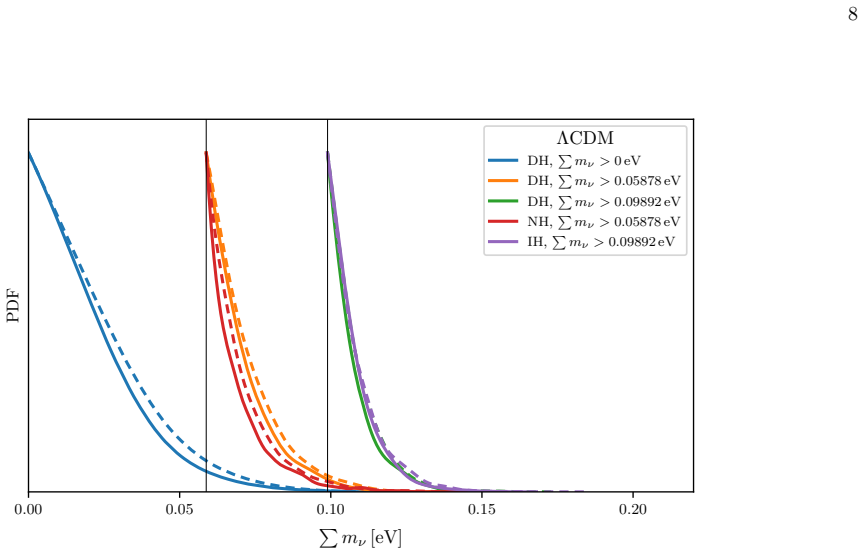
We present a robust assessment of cosmological constraints on the sum of neutrino masses ($\sum m_\nu$) when relaxing the standard assumption of purely adiabatic primordial initial conditions. Allowing for a neutrino density isocurvature (NDI) component alongside the adiabatic mode, we analyse the latest CMB-SPA combination (Planck 2018, ACT DR6, and SPT-3G), DESI DR2 baryon acoustic oscillation data, and the DES Year 5 supernova sample. Within the $\Lambda$CDM model, the 95\% upper limit weakens only marginally from $\sum m_\nu < 0.052$ eV (purely adiabatic) to $< 0.057$ eV (including NDI), with the NDI amplitude consistent with zero. In the CPL dynamical dark energy model, the adiabatic limit is $< 0.111$ eV, shifting to $< 0.115$ eV with NDI, yet the isocurvature mode remains undetected. While these limits are robust against the inclusion of isocurvature perturbations, they are highly sensitive to both the assumed dark energy equation of state and the prior lower bound on $\sum m_\nu$. Notably, the adiabatic $\Lambda$CDM limit of $0.052$ eV lies below the minimum sum required by the normal neutrino mass hierarchy ($0.05878$ eV), indicating that this bound is an artifact of the statistical prior extending to zero. Imposing a physically motivated hierarchy-informed prior raises the limit to $< 0.092$ eV. Our results demonstrate that current data show no evidence for NDI modes and that the inferred neutrino mass upper limit is robust against this extension, but a definitive, model-independent bound requires addressing prior dependencies and dark energy uncertainties. This work provides the first joint constraint on $\sum m_\nu$ and NDI using the full CMB-SPA+DESI DR2+DES dataset.
Editorial analysis
A structured set of objections, weighed in public.
Referee Report
Summary. The manuscript claims that allowing neutrino density isocurvature (NDI) modes in addition to adiabatic initial conditions produces only marginal changes to the 95% upper limits on ∑m_ν derived from Planck 2018 + ACT DR6 + SPT-3G, DESI DR2 BAO, and DES Y5 supernovae. In flat ΛCDM the limit shifts from <0.052 eV (adiabatic) to <0.057 eV (with NDI); in the CPL dark-energy model the shift is from <0.111 eV to <0.115 eV, with the NDI amplitude consistent with zero in both cases. The paper explicitly notes that the numerical values remain highly sensitive to the lower bound of the ∑m_ν prior and to the dark-energy parametrization, and shows that a hierarchy-informed prior raises the adiabatic ΛCDM limit to <0.092 eV.
Significance. If the reported robustness to NDI holds, the result strengthens the reliability of current ∑m_ν upper bounds for planning next-generation surveys, because it demonstrates that isocurvature contamination does not materially alter the constraints under the same modeling assumptions. The explicit quantification of prior and dark-energy sensitivities is a positive feature that encourages cautious interpretation of the absolute scale of the limits.
minor comments (2)
- [Abstract and results section] The construction of the hierarchy-informed prior that yields the <0.092 eV limit should be specified (functional form, lower bound, and any truncation) so that the result can be reproduced and its effect on the NDI extension quantified.
- [Throughout] Notation for the NDI amplitude parameter should be made uniform between the text, tables, and any figures showing posterior contours.
Simulated Author's Rebuttal
We thank the referee for their positive assessment of our work and recommendation for minor revision. The referee's summary accurately captures the key results regarding the robustness of ∑m_ν constraints to neutrino density isocurvature modes.
Circularity Check
No significant circularity
full rationale
The paper reports Bayesian posterior constraints on ∑m_ν and the NDI amplitude obtained by fitting an extended cosmological model to independent datasets (Planck+ACT+SPT CMB, DESI DR2 BAO, DES Y5 supernovae). The quoted 95% upper limits (0.052→0.057 eV in ΛCDM; 0.111→0.115 eV in CPL) are direct outputs of the likelihood analysis under identical priors and dark-energy assumptions; they are not obtained by algebraic reduction of one fitted quantity to another, nor by self-citation of a uniqueness theorem. No self-definitional, fitted-input-called-prediction, or ansatz-smuggled steps appear in the derivation chain. The manuscript itself flags the sensitivity to the ∑m_ν prior lower bound and to the dark-energy parametrization, confirming that the reported robustness statement is a comparative statement about two otherwise identical fits rather than a self-referential result.
Axiom & Free-Parameter Ledger
free parameters (3)
- NDI amplitude
- ∑m_ν
- w0, wa (CPL model)
axioms (2)
- standard math Linear cosmological perturbation theory on the scales probed by CMB and BAO
- domain assumption Gaussian likelihood for the combined CMB, BAO, and supernova data
Reference graph
Works this paper leans on
-
[1]
I. Esteban, M. C. Gonzalez-Garcia, M. Maltoni, I. Martinez-Soler, J. P. Pinheiro, and T. Schwetz, JHEP 12, 216 (2024), arXiv:2410.05380 [hep-ph]
Pith/arXiv arXiv 2024
-
[2]
P. F. de Salas, D. V. Forero, S. Gariazzo, P. Mart´ ınez- Mirav´ e, O. Mena, C. A. Ternes, M. T´ ortola, and J. W. F. Valle, JHEP02, 071 (2021), arXiv:2006.11237 [hep-ph]
Pith/arXiv arXiv 2021
-
[3]
Akeret al.(KATRIN), Science388, adq9592 (2025), arXiv:2406.13516 [nucl-ex]
M. Akeret al.(KATRIN), Science388, adq9592 (2025), arXiv:2406.13516 [nucl-ex]
arXiv 2025
-
[4]
S. Abeet al.(KamLAND-Zen), Phys. Rev. Lett.135, 262501 (2025), arXiv:2406.11438 [hep-ex]
arXiv 2025
-
[5]
Y. Y. Y. Wong, Ann. Rev. Nucl. Part. Sci.61, 69 (2011), arXiv:1111.1436 [astro-ph.CO]
Pith/arXiv arXiv 2011
-
[6]
J. Lesgourgues and S. Pastor, Phys. Rept.429, 307 (2006), arXiv:astro-ph/0603494. 13
Pith/arXiv arXiv 2006
-
[7]
Z.-C. Zhao, D.-M. Xia, and S. Wang, Phys. Rev. D112, 123527 (2025), arXiv:2504.09624 [astro-ph.CO]
arXiv 2025
-
[8]
X. Zhang, Phys. Rev. D93, 083011 (2016), arXiv:1511.02651 [astro-ph.CO]
Pith/arXiv arXiv 2016
-
[9]
M.-M. Zhao, Y.-H. Li, J.-F. Zhang, and X. Zhang, Mon. Not. Roy. Astron. Soc.469, 1713 (2017), arXiv:1608.01219 [astro-ph.CO]
Pith/arXiv arXiv 2017
-
[10]
X. Zhang, Sci. China Phys. Mech. Astron.60, 060431 (2017), arXiv:1703.00651 [astro-ph.CO]
Pith/arXiv arXiv 2017
-
[11]
S. Vagnozzi, S. Dhawan, M. Gerbino, K. Freese, A. Goo- bar, and O. Mena, Phys. Rev. D98, 083501 (2018), arXiv:1801.08553 [astro-ph.CO]
Pith/arXiv arXiv 2018
-
[12]
S. Roy Choudhury and S. Choubey, JCAP09, 017 (2018), arXiv:1806.10832 [astro-ph.CO]
Pith/arXiv arXiv 2018
- [13]
-
[14]
R.-Y. Guo, Y.-H. Li, J.-F. Zhang, and X. Zhang, JCAP 05, 040 (2017), arXiv:1702.04189 [astro-ph.CO]
Pith/arXiv arXiv 2017
-
[15]
Q.-G. Huang, K. Wang, and S. Wang, Eur. Phys. J. C 76, 489 (2016), arXiv:1512.05899 [astro-ph.CO]
Pith/arXiv arXiv 2016
-
[16]
S. Wang, Y.-F. Wang, and D.-M. Xia, Chin. Phys. C42, 065103 (2018), arXiv:1707.00588 [astro-ph.CO]
Pith/arXiv arXiv 2018
-
[17]
S. Wang, Y.-F. Wang, D.-M. Xia, and X. Zhang, Phys. Rev. D94, 083519 (2016), arXiv:1608.00672 [astro- ph.CO]
Pith/arXiv arXiv 2016
-
[18]
G.-H. Du, T.-N. Li, P.-J. Wu, J.-F. Zhang, and X. Zhang, (2025), arXiv:2507.16589 [astro-ph.CO]
Pith/arXiv arXiv 2025
-
[19]
N. Aghanimet al.(Planck), Astron. Astrophys.641, A6 (2020), [Erratum: Astron.Astrophys. 652, C4 (2021)], arXiv:1807.06209 [astro-ph.CO]
Pith/arXiv arXiv 2020
-
[20]
M. Abdul Karimet al.(DESI), Phys. Rev. D112, 083515 (2025), arXiv:2503.14738 [astro-ph.CO]
Pith/arXiv arXiv 2025
-
[21]
W. Elberset al., Phys. Rev. D112, 083513 (2025), arXiv:2503.14744 [astro-ph.CO]
Pith/arXiv arXiv 2025
-
[22]
M. S. Madhavacherilet al.(ACT), Astrophys. J.962, 113 (2024), arXiv:2304.05203 [astro-ph.CO]
Pith/arXiv arXiv 2024
-
[23]
Louiset al.(Atacama Cosmology Telescope), JCAP 11, 062 (2025), arXiv:2503.14452 [astro-ph.CO]
T. Louiset al.(Atacama Cosmology Telescope), JCAP 11, 062 (2025), arXiv:2503.14452 [astro-ph.CO]
Pith/arXiv arXiv 2025
-
[24]
F. Geet al.(SPT-3G), Phys. Rev. D111, 083534 (2025), arXiv:2411.06000 [astro-ph.CO]
arXiv 2025
-
[25]
E. Camphuiset al.(SPT-3G), Phys. Rev. D113, 083504 (2026), arXiv:2506.20707 [astro-ph.CO]
Pith/arXiv arXiv 2026
-
[26]
M. R. Buckley, P. Du, N. Fernandez, and M. J. Weikert, JCAP12, 006 (2025), arXiv:2502.20434 [astro-ph.CO]
arXiv 2025
-
[27]
M. Bucher, K. Moodley, and N. Turok, Phys. Rev. D 66, 023528 (2002), arXiv:astro-ph/0007360
Pith/arXiv arXiv 2002
- [28]
-
[29]
C. Gordon, D. Wands, B. A. Bassett, and R. Maartens, Phys. Rev. D63, 023506 (2000), arXiv:astro-ph/0009131
Pith/arXiv arXiv 2000
-
[30]
Finelliet al.(Euclid), (2025), arXiv:2507.15819 [astro- ph.CO]
F. Finelliet al.(Euclid), (2025), arXiv:2507.15819 [astro- ph.CO]
arXiv 2025
-
[31]
Calabreseet al.(Atacama Cosmology Telescope), JCAP11, 063 (2025), arXiv:2503.14454 [astro-ph.CO]
E. Calabreseet al.(Atacama Cosmology Telescope), JCAP11, 063 (2025), arXiv:2503.14454 [astro-ph.CO]
Pith/arXiv arXiv 2025
-
[32]
M. Abdul Karimet al.(DESI), Phys. Rev. D112, 083514 (2025), arXiv:2503.14739 [astro-ph.CO]
Pith/arXiv arXiv 2025
-
[33]
T. M. C. Abbottet al.(DES), Astrophys. J. Lett.973, L14 (2024), arXiv:2401.02929 [astro-ph.CO]
Pith/arXiv arXiv 2024
-
[34]
B. Popovicet al.(DES), Mon. Not. Roy. Astron. Soc. 548, stag632 (2026), arXiv:2511.07517 [astro-ph.CO]
Pith/arXiv arXiv 2026
-
[35]
Y. Akramiet al.(Planck), Astron. Astrophys.641, A10 (2020), arXiv:1807.06211 [astro-ph.CO]
Pith/arXiv arXiv 2020
-
[36]
K. Lodhaet al.(DESI), Phys. Rev. D112, 083511 (2025), arXiv:2503.14743 [astro-ph.CO]
Pith/arXiv arXiv 2025
-
[37]
M. Chevallier and D. Polarski, Int. J. Mod. Phys. D10, 213 (2001), arXiv:gr-qc/0009008
Pith/arXiv arXiv 2001
-
[38]
E. V. Linder, Phys. Rev. Lett.90, 091301 (2003), arXiv:astro-ph/0208512
Pith/arXiv arXiv 2003
-
[39]
W. Yang, R. C. Nunes, S. Pan, and D. F. Mota, Phys. Rev. D95, 103522 (2017), arXiv:1703.02556 [astro- ph.CO]
Pith/arXiv arXiv 2017
-
[40]
R.-Y. Guo, J.-F. Zhang, and X. Zhang, Chin. Phys. C 42, 095103 (2018), arXiv:1803.06910 [astro-ph.CO]
Pith/arXiv arXiv 2018
-
[41]
J. Carron, M. Mirmelstein, and A. Lewis, JCAP09, 039 (2022), arXiv:2206.07773 [astro-ph.CO]
Pith/arXiv arXiv 2022
-
[42]
F. J. Quet al.(ACT, SPT-3G), Phys. Rev. Lett.136, 021001 (2026), arXiv:2504.20038 [astro-ph.CO]
arXiv 2026
-
[43]
B. Audren, J. Lesgourgues, K. Benabed, and S. Prunet, JCAP02, 001 (2013), arXiv:1210.7183 [astro-ph.CO]
Pith/arXiv arXiv 2013
-
[44]
T. Brinckmann and J. Lesgourgues, Phys. Dark Univ. 24, 100260 (2019), arXiv:1804.07261 [astro-ph.CO]
Pith/arXiv arXiv 2019
-
[45]
D. Blas, J. Lesgourgues, and T. Tram, JCAP07, 034 (2011), arXiv:1104.2933 [astro-ph.CO]
Pith/arXiv arXiv 2011
-
[46]
J. Lesgourgues and T. Tram, JCAP09, 032 (2011), arXiv:1104.2935 [astro-ph.CO]
Pith/arXiv arXiv 2011
-
[47]
J. H. Chang, P. Du, S. Ghosh, and S. Kumar, JCAP02, 075 (2026), arXiv:2510.01309 [astro-ph.CO]
arXiv 2026
-
[48]
J. M. Berrymanet al., Phys. Dark Univ.42, 101267 (2023), arXiv:2203.01955 [hep-ph]
arXiv 2023
-
[49]
T. Montandon, G. Patanchon, and B. van Tent, JCAP 01, 004 (2021), arXiv:2007.05457 [astro-ph.CO]
arXiv 2021
-
[50]
Archidiaconoet al.(Euclid), Astron
M. Archidiaconoet al.(Euclid), Astron. Astrophys.693, A58 (2025), arXiv:2405.06047 [astro-ph.CO]
arXiv 2025
discussion (0)
Sign in with ORCID, Apple, or X to comment. Anyone can read and Pith papers without signing in.