REVIEW 3 major objections 7 minor 2 cited by
NeuralSVG: An Implicit Representation for Text-to-Vector Generation
T0 review · 3 major / 7 minor · reviewed 2026-08-10 · deepseek-v4-flash
Pith's one-line read NeuralSVG packs an entire SVG into one small MLP, learned from a text prompt.
desk verdict NeuralSVG is a solid, well-executed integration paper with a genuinely useful ordering mechanism; the missing random-dropout control keeps the central claim from being fully proven, but it deserves peer review. read the letter →
The pith
A machine-rendered reading of the paper's core claim, the machinery that carries it, and where it could break.
The reading
What carries the argument
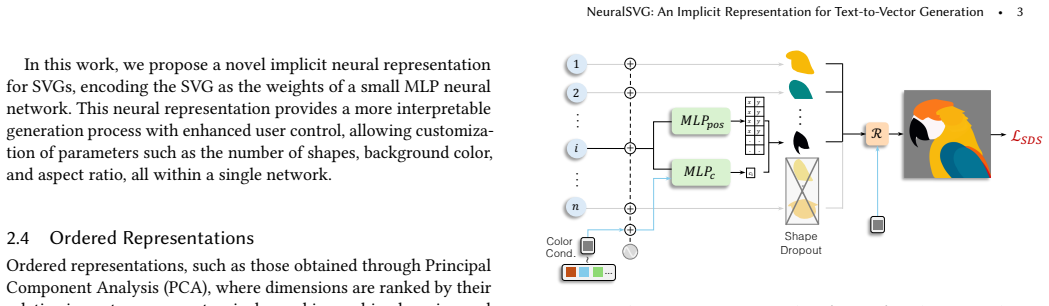
The central object is the implicit shape-index MLP: shape indices $\{1,\ldots,n\}$ pass through random Fourier features and two parallel branches that output 12 control points and an RGB color per shape, aggregated by a differentiable rasterizer. The load-bearing mechanism is nested dropout on the shape index: sampling a truncation $t_r$ and rendering only $\{p_i,c_i\}_{i<t_r}$ during training forces early shapes to encode the main content so that later shapes refine it.
What would settle it
Render only the first four shapes from a trained 16-shape NeuralSVG and ask annotators to name the subject; if early-only renders are no more identifiable than a random four-shape subset, the ordering claim fails. A second check is to take one early shape, change its color, and see whether the edit stays semantically local; if early shapes are not individually editable, the layered-structure promise is broken.
Extended reading notes
Core claim
NeuralSVG represents a vector scene as a learned mapping $f_\theta: i \mapsto (p_i, c_i)$ from a shape index to a closed cubic Bézier curve and its fill color, with the entire SVG encoded in the network weights. The mapping is trained with Score Distillation Sampling against a frozen diffusion model, so the rendered aggregation of shapes is pushed to match the prompt. To get layered structure, training uses a variant of nested dropout: at each step a random truncation index $t_r$ is sampled and shapes above it are omitted, so early shapes must carry the scene on their own. The paper shows that retaining only a few shapes still yields a recognizable render, that the learned shapes are individually more interpretable than those of baselines, and that conditioning the MLP on a background color or aspect ratio lets a single network produce multiple palettes and aspect ratios at inference.
Load-bearing premise
The claim stands on the assumption that randomly dropping later shapes during training makes the early shapes carry the main content on their own; if that transfer fails, the layered structure and the editability benefits do not follow.
Editorial extensions
If this is right
- A single trained network can render the SVG at any truncation level, so users choose the level of detail without retraining.
- The same weights support inference-time conditioning on background color and aspect ratio, giving dynamic palettes and aspect ratios from one representation.
- Because each shape is a clean closed Bézier curve, the output is more editable in vector tools than the pixel-like shapes produced by many baselines.
- The framework extends to sketch generation by rendering open strokes, with early strokes capturing the subject.
- The ordering induced by dropout makes partial renders meaningful, which prior text-to-vector methods do not guarantee.
Reading between the lines
- The same nested-dropout trick could be applied to other structured implicit representations, such as 3D scene graphs or procedural texture stacks, where a coarse-to-fine ordering is desirable.
- The paper's ordering claim is only tested through cumulative CLIP similarity; a direct test of whether early shapes are semantically identifiable (e.g., naming the object from the first four shapes) would verify the layer structure that the method promises.
- The background-color conditioning suggests a broader design space: any user-supplied scalar or categorical input can be concatenated to the Fourier features, so controls like stroke width, style, or object count are plausible extensions.
- Because the network is compact and the renderer differentiable, the representation could support interactive editing where a designer drags a control point and the network re-optimizes the rest of the scene.
Signed reviews
Editorial analysis
A structured set of objections, weighed in public.
Referee Report
Summary. NeuralSVG proposes to represent an SVG as the output of a small MLP that maps a shape index (optionally conditioned on background color or aspect ratio) to a closed Bezier shape with fill color. The network is trained by Score Distillation Sampling (SDS) from a Stable Diffusion model, using a 'nested dropout' scheme that at each iteration truncates the shape set at a random index and renders only the prefix. The paper claims that this dropout encourages an ordered, semantically meaningful layering of shapes, so that early shapes capture the main structure and later shapes add detail, and that the implicit representation enables inference-time controls such as background color and aspect ratio. The method is compared with VectorFusion, SVGDreamer, NIVeL, and Text-to-Vector using CLIP-based metrics and qualitative visuals, plus ablations and a sketch-generation extension.
Significance. The goal of producing compact, editable, layered text-to-vector output is well motivated, and the use of nested dropout to impose ordering is a creative and simple idea that could be useful beyond this setting. The paper is clearly written, and the supplementary visual results show that the method produces visually appealing SVGs and plausible sketches with an ordered progression when rendered with progressively more shapes. If the ordering claim could be rigorously established, this would be a meaningful step toward practical layered vector generation. However, the central evidence for the ordering claim is currently indirect and partially confounded with the training objective, and the quantitative comparison against high-shape-count baselines is less favorable than the text suggests. The strengths of the paper are the clean formulation, the single-stage training, and the demonstrated inference-time controls, though the latter are only shown qualitatively.
major comments (3)
- [Section 4.3, Eq. (7), Figures 10-11] The claim that the proposed dropout encourages an 'ordered' representation is not isolated from the effect of dropout in general. The ablation compares nested dropout only to no dropout. Since any dropout that randomly omits shapes during SDS training might improve the recognizability of prefixes (for example, by regularizing early shapes or by preventing overfitting to the full composition), the reported cumulative CLIP gains cannot be attributed to the ordering (prefix) structure. Add a control that drops the same number of shapes uniformly at random rather than as a prefix; if the two curves are similar, the ordering claim is unsupported. In addition, the Rippel et al. nesting guarantee for hidden-unit representations does not automatically transfer to SDS-trained shape sets, so a direct check of semantic identifiability of early shapes (e.g., human evaluation or VLM-based part labeling) is needed.
- [Section 5.2, Table 1] The statement that 'all methods achieve comparable CLIP scores' when VectorFusion uses 64 shapes and SVGDreamer uses 256 shapes is inaccurate: NeuralSVG's R-Precision is 67.18, well below 83.46 and 85.03 for these baselines, a gap of roughly 16-18 points. The text should either report these numbers accurately and emphasize that the advantage is in structure/editability rather than raw CLIP alignment, or provide a quantitative editability/structure metric (e.g., user study, number of meaningful semantic segments) to support the 'outperforms' claim.
- [Section 5.2, Figure 11] The cumulative CLIP curve is entangled with the training objective because with nested dropout every rendered prefix is exactly one of the training-time renderings. The SDS loss (Eq. 2) applied to these prefixes means the diffusion model's CLIP-derived signal directly optimizes prefix recognizability. Thus high cumulative CLIP similarity partly reflects successful optimization of the training loss, not necessarily an emergent, editable semantic order. Report at least one independent measure that does not use CLIP or the SDS signal, such as a human study of the recognizability/meaning of each prefix, or a per-shape semantic labeling with a VLM not involved in training.
minor comments (7)
- [Section 4.2, Eq. (5)] There is a typo 'ˆ𝑐𝑖𝑖' (double subscript i) in the definition of the color output.
- [Section 4.3, Eq. (7)] The notation 'S𝑡𝑟' should be 'S_{t_r}' to be consistent with the text; also clarify whether the truncation index is inclusive or exclusive (i.e., whether shape i < t_r or i ≤ t_r).
- [Appendix, Training Scheme] The sampling of the truncation index 'sampled from an exponential distribution with a temperature value of 3' is ambiguous; specify how the discrete distribution over {1,...,16} is constructed and how the 0.7 probability of using all 16 shapes interacts with it.
- [Section 5.5 and throughout] The name 'NiVEL' is sometimes spelled 'NiVEL' and sometimes 'NIVeL'; standardize the spelling.
- [Figure 24 caption] The word 'Additioanl' is a typo for 'Additional'.
- [Appendix, LoRA Fine-Tuning] The description says the adapter was pretrained on 'a dataset of vector art images' generated using 'Simple Vector Flux LoRA'; clarify the provenance and whether this is a dataset of generated images or of real vector artwork, and provide details of the prompt variations.
- [Reproducibility] The paper does not state whether the code and trained models will be released; please include an availability statement to support reproducibility.
Circularity Check
No circular derivation; the central claim is an empirical effect of an explicit training-time dropout, not an identity or a fitted prediction.
full rationale
NeuralSVG's derivation chain is self-contained. The representation is defined by the MLP mapping in Eq. (3), the optimization objective is the standard SDS loss in Eq. (2), and the ordering mechanism is an explicit training-time truncation-based dropout in Eq. (7), adapted from the external Nested Dropout work of Rippel et al. rather than from a self-citation. The cumulative CLIP curves in Figures 9 and 11 are correlated with the CLIP-based text conditioning used inside the SDS training signal, and the ablation compares nested dropout only against no dropout, so the attribution of the ordering effect specifically to the nested (prefix) structure rather than to any form of dropout is under-supported as an experimental claim. However, these are evaluation-design weaknesses, not circularity: no quantity is defined in terms of another, no fitted parameter is relabeled as a prediction, and no load-bearing premise reduces to a self-citation. The self-citations that appear (Alaluf et al. 2023 for positional encoding and ordered representations, Vinker et al. 2023 for saliency initialization) support auxiliary components and are not load-bearing for the central claim that the learned shapes are ordered and editable. The paper's central claim is therefore an empirical property of the trained representation with an independent, if imperfect, ablation, and the manuscript does not exhibit a circular derivation.
Assumptions & free parameters
free parameters (5)
- number of shapes n =
16
- shapes per SVG as four cubic Bezier curves =
12 control points per shape
- dropout keep-all probability =
0.7
- dropout exponential temperature =
3
- LoRA rank =
4
assumptions (5)
- domain assumption A pretrained text-to-image diffusion model (Stable Diffusion 2.1) provides a valid score for optimizing SVG scenes via SDS.
- domain assumption Nested dropout on shape indices yields semantically meaningful early shapes in the learned SVG.
- domain assumption A set of sixteen closed shapes, each with four cubic Bezier curves, can faithfully represent the prompted scene.
- domain assumption Saliency-based initialization from a generated raster image provides a good start for the shape parameters.
- domain assumption The LoRA adapter trained on 1,600 generated vector-art images improves SVG style without biasing content away from the prompt.
Cite this review
Pith. "Pith review of NeuralSVG: An Implicit Representation for Text-to-Vector Generation." pith.science (2026). https://pith.science/paper/PTW5JHME
@misc{pith2026250103992,
  author       = {Pith},
  title        = {Pith review of: NeuralSVG: An Implicit Representation for Text-to-Vector Generation},
  year         = {2026},
  howpublished = {\url{https://pith.science/paper/PTW5JHME}},
  note         = {Machine review of arXiv:2501.03992}
}
read the original abstract
Vector graphics are essential in design, providing artists with a versatile medium for creating resolution-independent and highly editable visual content. Recent advancements in vision-language and diffusion models have fueled interest in text-to-vector graphics generation. However, existing approaches often suffer from over-parameterized outputs or treat the layered structure - a core feature of vector graphics - as a secondary goal, diminishing their practical use. Recognizing the importance of layered SVG representations, we propose NeuralSVG, an implicit neural representation for generating vector graphics from text prompts. Inspired by Neural Radiance Fields (NeRFs), NeuralSVG encodes the entire scene into the weights of a small MLP network, optimized using Score Distillation Sampling (SDS). To encourage a layered structure in the generated SVG, we introduce a dropout-based regularization technique that strengthens the standalone meaning of each shape. We additionally demonstrate that utilizing a neural representation provides an added benefit of inference-time control, enabling users to dynamically adapt the generated SVG based on user-provided inputs, all with a single learned representation. Through extensive qualitative and quantitative evaluations, we demonstrate that NeuralSVG outperforms existing methods in generating structured and flexible SVG.
Figures


Figures from the paper (17 more)


Forward citations
Cited by 2 Pith papers
-
Symbolic Graphics Programming with Large Language Models
Qwen-2.5-7B trained with reinforcement learning against SigLIP visual similarity scores writes SVG drawings that match text captions about as well as frontier models on several automated metrics.
-
GeoLoom: High-quality Geometric Diagram Generation from Textual Input
Natural-language geometry descriptions can be autoformalized into a custom geometry language and converted to coordinates by Monte Carlo optimization, yielding usable diagrams in seconds for about 81-85% of test problems.
Reference graph
Works this paper leans on
-
[4]
In Proceedings of the AAAI Conference on Artificial Intelligence , Vol
Clipvg: Text-guided image manipulation using differentiable vector graphics. In Proceedings of the AAAI Conference on Artificial Intelligence , Vol. 37. 2312–2320. Matthew Tancik, Pratul P. Srinivasan, Ben Mildenhall, Sara Fridovich-Keil, Nithin Raghavan, Utkarsh Singhal, Ravi Ramamoorthi, Jonathan T. Barron, and Ren Ng
-
[2018]
In International Conference on Machine Learning
Synthesizing programs for images using reinforced adversarial learning. In International Conference on Machine Learning . PMLR, 1666–1675. David Ha and Douglas Eck. 2017. A neural representation of sketch drawings. arXiv preprint arXiv:1704.03477 (2017). Amir Hertz, Kfir Aberman, and Daniel Cohen-Or. 2023. Delta denoising score. In Proceedings of the IEEE...
arXiv 2017
-
[2020]
Fourier Features Let Networks Learn High Frequency Functions in Low Dimensional Domains. arXiv:2006.10739 [cs.CV] https://arxiv.org/abs/2006.10739 Vikas Thamizharasan, Difan Liu, Matthew Fisher, Nanxuan Zhao, Evangelos Kaloger- akis, and Michal Lukac. 2024. NIVeL: Neural Implicit Vector Layers for Text-to-Vector Generation. In Proceedings of the IEEE/CVF ...
arXiv 2022
-
[2022]
High-resolution image synthesis with latent diffusion models. , 10684– 10695 pages. Chitwan Saharia, William Chan, Saurabh Saxena, Lala Li, Jay Whang, Emily L Denton, Kamyar Ghasemipour, Raphael Gontijo Lopes, Burcu Karagol Ayan, Tim Salimans, et al. 2022. Photorealistic text-to-image diffusion models with deep language under- standing. Advances in Neural...
work page 2022
-
[2023]
Dean Jackson and Craig Northway
Word-as-image for semantic typography.ACM Transactions on Graphics (TOG) 42, 4 (2023), 1–11. Dean Jackson and Craig Northway. 2005. Scalable vector graphics (svg) full 1.2 specifi- cation. World Wide Web Consortium, Working Draft WD-SVG12-20050413 2 (2005). Ajay Jain. 2021. VectorAscent: Generate vector graphics from a textual description . https: //githu...
arXiv 2023
-
[2024]
A minimalist vector art of [object], isolated on a [color] background
A Survey on Multimodal Large Language Models. arXiv:2306.13549 [cs.CV] Peiying Zhang, Nanxuan Zhao, and Jing Liao. 2024. Text-to-Vector Generation with Neural Path Representation. ACM Transactions on Graphics (TOG) 43, 4 (2024), 1–13. Ningyuan Zheng, Yifan Jiang, and Dingjiang Huang. 2018. Strokenet: A neural painting environment. In International Confere...
arXiv 2024
Reviewed August 10, 2026 · model on record in the stance chip above.
Discussion (0). Continue with ORCID to comment.