REVIEW 5 major objections 6 minor 35 references
More Reliable Pseudo-labels, Better Performance: A Generalized Approach to Single Positive Multi-label Learning
T0 review · 5 major / 6 minor · reviewed 2026-08-05 · deepseek-v4-flash
Pith's one-line read A loss that tolerates noisy pseudo-labels and re-samples them from CLIP each epoch sets the highest reported mAP in single-positive multi-label learning on all four benchmarks.
desk verdict Plausible empirical win in SPML with a shaky theory section; deserves review but needs variance reporting. read the letter →
The pith
A machine-rendered reading of the paper's core claim, the machinery that carries it, and where it could break.
The reading
What carries the argument
The load-bearing object is GPR Loss, a four-branch loss with separate confidence-weighted terms for confirmed positives, unlabeled classes, pseudo-negatives, and pseudo-positives; the weight caps λ1, λ2 keep noisy pseudo-positives from dominating. DAMP supplies the pseudo-labels by converting CLIP's global and patch-level similarity scores into positive and negative pseudo-labels via TopK and percentile thresholds. Theorem 4.1 ties the new loss to the existing GR Loss by showing GPR Loss collapses to GR Loss as the pseudo-labeler's confidence and the positive-count mismatch go to zero.
What would settle it
Take a dataset where CLIP's text embeddings are permuted so that class names no longer match visual content, then run AEVLP: if mAP does not fall to roughly the GPR+Random baseline (average 53.98), the thresholding logic is not doing the work. Alternatively, print per-class precision of DAMP's positive pseudo-labels against ground truth for VOC; classes with low CLIP scores should show precision near chance.
Extended reading notes
Core claim
Pseudo-labels become reliable supervision for SPML when the loss is built around their confidence. GPR Loss distinguishes confirmed positive, unlabeled, pseudo-negative, and pseudo-positive labels, giving pseudo-positives a capped, smoothed loss and pseudo-negatives direct negative pressure while keeping GR Loss's adaptive weighting for unlabeled classes. Theorem 4.1 shows GPR Loss reduces to GR Loss as confidence C(M) and positive-count mismatch vanish. DAMP regenerates pseudo-labels by scoring images and patched views with CLIP and thresholding TopK positives and low-percentile negatives. GPR Loss improves several pseudo-labeling strategies; together they report the highest mAP on VOC, COC
Load-bearing premise
The framework's gains rest on CLIP's zero-shot similarity scores being trustworthy enough that scores above the known positive's score mark real positives and the lowest-percentile scores mark real negatives; if CLIP is miscalibrated for a dataset's label set, the pseudo-labels become noise.
Editorial extensions
If this is right
- GPR Loss is source-agnostic: putting it under random pseudo-labels, VLPL, or LL-Ct raises mAP in every dataset tested, so future SPML methods can reuse it as a drop-in loss.
- Dynamic pseudo-labeling with random patched views raises accumulated recall of missing positives across epochs, meaning the model sees a wider set of positive associations than fixed pseudo-label vectors provide.
- The best results are reached with the smaller CLIP ViT-B/16, while VLPL depends on ViT-L/14, so the gain is not explained by a larger vision-language backbone.
- On VOC the SPML-trained model (90.46 mAP) exceeds a fully labeled BCE classifier (89.42), implying exhaustive annotation is not always necessary for that benchmark.
- Because GPR Loss generalizes GR Loss, methods that already rely on GR Loss can adopt the pseudo-label branches without losing their existing robustness.
Reading between the lines
- Editorial inference: the local trust threshold ζ_local = min(s_global_ĉ, ν) anchors pseudo-label quality to the CLIP score of the single known positive; on fine-grained or web-image label sets where that anchor is miscalibrated, per-class pseudo-label precision could be far below the dataset average, and the reported averages would hide it.
- Editorial inference: since GPR Loss is agnostic to how pseudo-labels are produced, it should transfer to zero-shot scores from other vision-language models or from ensembled prompts; a cheap test is swapping the CLIP text templates while keeping DAMP fixed.
- Editorial inference: the epoch-to-epoch variation of pseudo-labels acts like stochastic label smoothing; increasing patch overlap or augmentation strength should trade off pseudo-label coverage against precision, which the paper does not map.
Editorial analysis
A structured set of objections, weighed in public.
Referee Report
Summary. The paper addresses Single Positive Multi-Label Learning (SPML), where each training image has exactly one annotated positive label and all other labels are unknown. The authors propose a Generalized Pseudo-label Robust Loss (GPR Loss) that extends the existing GR Loss by explicitly handling pseudo-labels generated by an external method: for each image the loss treats confirmed positives, undefined assumed negatives, negative pseudo-labels, and positive pseudo-labels with different loss terms and weighting functions. They also introduce Dynamic Augmented Multi-focus Pseudo-labeling (DAMP), which uses CLIP on global and randomly augmented local views of the image, thresholded by local and global similarity scores, to generate pseudo-labels that change across training epochs. Together, GPR Loss and DAMP form the AEVLP framework. Experiments on PASCAL VOC, MS-COCO, NUS-WIDE, and CUB report state-of-the-art mAP numbers (90.46, 73.54, 50.70, 24.89), and ablations show gains attributable to each component. The paper also claims a theorem showing GPR Loss generalizes GR Loss.
Significance. If the empirical claims are reproducible, the paper offers a practical and conceptually clean contribution: a loss function that can be plugged into arbitrary pseudo-labeling strategies for SPML, plus a dynamic CLIP-based pseudo-labeler that improves recall of missing positives. The plug-in analysis in Table 2, the multi-dataset evaluation, and the component ablations are valuable assets. The authors are also honest about the Assume Negative starting point and do not overclaim theoretical novelty beyond the 'generalization' theorem. However, the central SOTA claim rests on small margins without variance estimates, and the generalization theorem is significantly weaker than advertised. The work is therefore a potentially useful empirical contribution whose current verification level is not yet sufficient for the strength of the claims.
major comments (5)
- [Sec. 4.2, Theorem 4.1 and Remark 2] The theorem states LGPR -> LGR when max(C(M), |m' - mhat|) -> 0, but the regularization term R in Eq. (4) uses m, not m'. No relation between the free parameter m and the validation-based m' is stated. If m is not equal to m', |m' - mhat| -> 0 does not imply R -> 0, so the claimed convergence is not established. If the intended reading is that m is set to m', this must be stated explicitly. More importantly, C(M) -> 0 forces ln,i = 0 for all n,i (no positive pseudo-labels), so LGPR reduces to LGR by definition in that degenerate case. The theorem therefore only covers the pseudo-labeler producing no positive pseudo-labels and gives essentially an identity, not a proof that the loss is robust to noisy pseudo-labels — which is the paper's central claim. Please state the exact relationship between m, m', and mhat, and clarify what the theorem adds beyond the constructed special case.
- [Table 1 and Sec. 6.2] All reported numbers are three-run averages with no standard deviations, per-seed values, or significance tests. The claimed SOTA margins over the strongest baselines are small: +0.37 on COCO over GR Loss, +0.63 on VOC, +1.11 on NUS, +0.87 on CUB. With three runs, a 0.37 mAP difference can easily be seed noise. The paper should provide per-seed results or standard deviations, or release code to enable independent verification. Without this, the central 'state-of-the-art' claim is not statistically supported. This is a verification gap, not a detected error, but it is load-bearing.
- [Table 2 and Sec. 6.3] The text states that 'incorporating GPR Loss consistently enhances mAP scores across all datasets for each pseudo-labeling strategy.' Table 2 contradicts this: on NUS-WIDE, GPR + LL-Ct gives 47.72 versus 48.00 for LL-Ct alone, a clear degradation. The claim of consistency should be softened to 'in most cases' or the exception should be analyzed. This matters because the paper's central narrative is that GPR Loss is robust to diverse pseudo-labels.
- [Sec. 5.2 and Table 3] DAMP's reliability depends on CLIP zero-shot similarity scores being adequately calibrated across datasets, yet the paper only reports dataset-level average precision/recall of pseudo-labels. For fine-grained CUB (312 labels) and web images in NUS-WIDE, the local threshold zeta_local = min(s_global_chat, nu) and the global threshold zeta_global could be miscalibrated for many classes. I request per-class pseudo-label precision/recall statistics or a sensitivity analysis over zeta_global and nu, not just the aggregate numbers. This would substantiate the 'reliable pseudo-labels' premise. Without it, the claim that DAMP is reliable enough to drive the reported gains remains only partially validated.
- [Theorem 4.1 proof] The proof is said to be in the supplementary materials, but no supplementary material is provided with the manuscript. Since this theorem is the only theoretical justification for the 'generalization' claim, omitting its proof from the submitted manuscript leaves the result unverifiable. Please include the proof in the main text or append it to the submission.
minor comments (6)
- [Eq. (3)] The hyperparameter q3 appears in L4 but its range and interpretation (analogous to q1, q2) are not defined in the main text. Please state its range and how it is set.
- [Sec. 6.1] Typo: 'environmental experiments' should be 'experimental experiments' or 'evaluation experiments'.
- [Sec. 4.2, Eq. (4)] The notation is confusing: the text says 'm is the expected number of positive labels per image' and defines mhat in Eq. (6), but the regularization uses (mhat - m)^2. Since m is a free parameter, its relationship to the validation estimate m' in Theorem 4.1 should be clarified (see major comment).
- [Table 4] The table is hard to read because the checkmark/cross symbols are separated from the component names. Consider using a standard ablation table with clear column headers and +/− indicators.
- [Sec. 6.2] The claim that AEVLP 'surpasses fully labeled multi-label classification on the VOC dataset' is interesting but should be contextualized: it may be due to validation-based model selection or pseudo-label regularization; a brief explanation would help.
- [Sec. 6.2] The definition of 'relative improvement of more than 15% over GR Loss' is ambiguous: 24.89 versus 21.64 is about 15% relative improvement, but this phrasing could be confused with absolute mAP gain. Please clarify.
Circularity Check
No significant circularity; Theorem 4.1 is a definitional containment statement, and the SOTA claims rest on external benchmark evaluations.
full rationale
The paper's load-bearing claims are empirical: mAP results on VOC, COCO, NUS-WIDE, and CUB (Table 1) and the consistent improvements of GPR Loss when plugged into existing pseudo-labeling strategies (Table 2). These are measured against external benchmark datasets and published baselines, with no fitted parameter renamed as a prediction. The only derivation-like statement is Theorem 4.1, which asserts that L_GPR tends to L_GR when C(M) tends to 0 and |m' - m_hat| tends to 0. Inspecting the definitions in Eq. (1) vs. Eqs. (2)-(3), the extra terms in GPR (L3, L4, v3, v4) exist only for nonzero pseudo-labels; when the pseudo-labeling method produces no pseudo-labels, those terms vanish by construction and the remaining loss is exactly L_GR with the regularization term vanishing. This is a consistency/contaiment property of the definition, not a circular derivation: the paper does not use the theorem to explain its state-of-the-art results, and the theorem's proof is deferred to the supplementary material, which is a verification gap rather than circularity. The method builds on GR Loss [2] and CLIP [22] with explicit acknowledgment; there is no load-bearing self-citation chain, no uniqueness theorem imported from the same authors, and no ansatz smuggled in through citation. Hyperparameters are selected on a held-out validation split following the standard SPML protocol. The absence of error bars/code and the NUS-WIDE degradation for GPR+LL-Ct in Table 2 are statistical/correctness concerns, not circularity. Overall, the central empirical claim is self-contained against external benchmarks, so no circular step is identified.
Assumptions & free parameters
free parameters (9)
- m (expected positive labels per image) =
per-dataset, not stated in main text
- alpha = [sigma, mu] =
scheduled linearly over epochs; values in supplementary
- q1, q2 =
hyperparameters, not stated in main text
- q3 =
hyperparameter, not stated in main text
- eta =
hyperparameter, not stated in main text
- lambda1, lambda2 =
hyperparameters, not stated in main text
- nu (local threshold) and zeta_global (global threshold) =
hyperparameters, not stated in main text
- k (TopK count) and Delta_neg (negative percentile) =
Delta_neg best around 20-30%; k not stated
- grid size g and overlap ratio r =
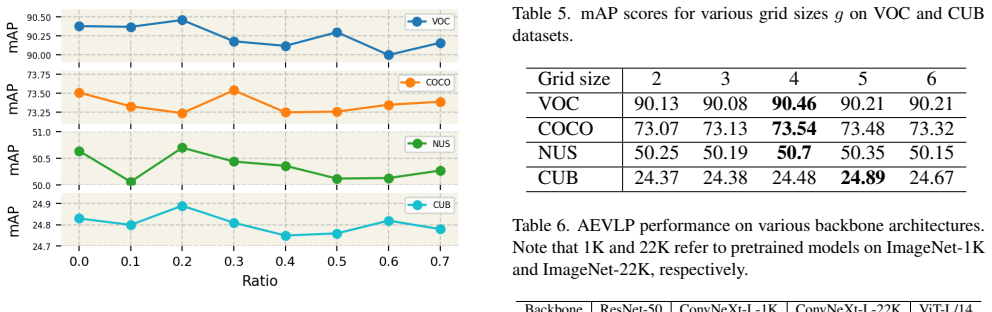
g=4 best on VOC/COCO/NUS, g=5 on CUB; r not stated
assumptions (5)
- domain assumption Assume Negative: all unobserved labels are treated as negative (Sec 3).
- domain assumption The external pseudo-label method M produces labels with a well-defined conditional distribution P(l|x, M), and this distribution is used to define C(M) in Theorem 4.1.
- domain assumption CLIP zero-shot similarity scores are calibrated indicators of label presence for each dataset's label set, so thresholding S_final with zeta_global and gating local scores with zeta_local yields informative pseudo-labels.
- domain assumption Frozen GCN label-correlation noise on CLIP text embeddings improves pseudo-label quality without introducing systematic bias.
- standard math Standard probability and limit arguments used in Theorem 4.1.
Cite this review
Pith. "Pith review of More Reliable Pseudo-labels, Better Performance: A Generalized Approach to Single Positive Multi-label Learning." pith.science (2026). https://pith.science/paper/PVO7EVDW
@misc{pith2026250820381,
  author       = {Pith},
  title        = {Pith review of: More Reliable Pseudo-labels, Better Performance: A Generalized Approach to Single Positive Multi-label Learning},
  year         = {2026},
  howpublished = {\url{https://pith.science/paper/PVO7EVDW}},
  note         = {Machine review of arXiv:2508.20381}
}
read the original abstract
Multi-label learning is a challenging computer vision task that requires assigning multiple categories to each image. However, fully annotating large-scale datasets is often impractical due to high costs and effort, motivating the study of learning from partially annotated data. In the extreme case of Single Positive Multi-Label Learning (SPML), each image is provided with only one positive label, while all other labels remain unannotated. Traditional SPML methods that treat missing labels as unknown or negative tend to yield inaccuracies and false negatives, and integrating various pseudo-labeling strategies can introduce additional noise. To address these challenges, we propose the Generalized Pseudo-Label Robust Loss (GPR Loss), a novel loss function that effectively learns from diverse pseudo-labels while mitigating noise. Complementing this, we introduce a simple yet effective Dynamic Augmented Multi-focus Pseudo-labeling (DAMP) technique. Together, these contributions form the Adaptive and Efficient Vision-Language Pseudo-Labeling (AEVLP) framework. Extensive experiments on four benchmark datasets demonstrate that our framework significantly advances multi-label classification, achieving state-of-the-art results.
Figures


Reference graph
Works this paper leans on
-
[1]
Cdul: Clip-driven unsupervised learning for multi-label image classification
Rabab Abdelfattah, Qing Guo, Xiaoguang Li, Xiaofeng Wang, and Song Wang. Cdul: Clip-driven unsupervised learning for multi-label image classification. In Proceedings of the IEEE/CVF International Conference on Computer Vi- sion, pages 1348–1357, 2023. 1, 2, 5
work page 2023
-
[2]
Boosting single positive multi-label classifica- tion with generalized robust loss
Yanxi Chen, Chunxiao Li, Xinyang Dai, Jinhuan Li, Weiyu Sun, Yiming Wang, Renyuan Zhang, Tinghe Zhang, and Bo Wang. Boosting single positive multi-label classifica- tion with generalized robust loss. In Proceedings of the Thirty-Third International Joint Conference on Artificial In- telligence, IJCAI-24 , pages 3825–3833. International Joint Conferences o...
work page 2024
-
[3]
Multi-label image recognition with graph convolu- tional networks
Zhao-Min Chen, Xiu-Shen Wei, Peng Wang, and Yanwen Guo. Multi-label image recognition with graph convolu- tional networks. In Proceedings of the IEEE/CVF conference on computer vision and pattern recognition , pages 5177– 5186, 2019. 4
work page 2019
-
[4]
Nus-wide: a real-world web im- age database from national university of singapore
Tat-Seng Chua, Jinhui Tang, Richang Hong, Haojie Li, Zhip- ing Luo, and Yantao Zheng. Nus-wide: a real-world web im- age database from national university of singapore. In Pro- ceedings of the ACM international conference on image and video retrieval, pages 1–9, 2009. 5
work page 2009
-
[5]
Multi-label learning from single positive labels
Elijah Cole, Oisin Mac Aodha, Titouan Lorieul, Pietro Per- ona, Dan Morris, and Nebojsa Jojic. Multi-label learning from single positive labels. In CVPR-21, 2021. 1, 2, 4, 5, 6, 7
work page 2021
-
[6]
Imagenet: A large-scale hierarchical image database
Jia Deng, Wei Dong, Richard Socher, Li-Jia Li, Kai Li, and Li Fei-Fei. Imagenet: A large-scale hierarchical image database. In 2009 IEEE conference on computer vision and pattern recognition, pages 248–255. Ieee, 2009. 5
2009
-
[7]
Scalable multi-label annotation
Jia Deng, Olga Russakovsky, Jonathan Krause, Michael S Bernstein, Alex Berg, and Li Fei-Fei. Scalable multi-label annotation. In Proceedings of the SIGCHI Conference on Human Factors in Computing Systems , pages 3099–3102,
-
[8]
Explor- ing structured semantic prior for multi label recognition with incomplete labels
Zixuan Ding, Ao Wang, Hui Chen, Qiang Zhang, Pengzhang Liu, Yongjun Bao, Weipeng Yan, and Jungong Han. Explor- ing structured semantic prior for multi label recognition with incomplete labels. In Proceedings of the IEEE/CVF Con- ference on Computer Vision and Pattern Recognition, pages 3398–3407, 2023. 1, 2, 4
work page 2023
Show all 35 references
-
[9]
An image is worth 16x16 words: Transformers for image recognition at scale
Alexey Dosovitskiy, Lucas Beyer, Alexander Kolesnikov, Dirk Weissenborn, Xiaohua Zhai, Thomas Unterthiner, Mostafa Dehghani, Matthias Minderer, Georg Heigold, Syl- vain Gelly, Jakob Uszkoreit, and Neil Houlsby. An image is worth 16x16 words: Transformers for image recognition ...
2021
-
[10]
The pascal visual object classes (voc) challenge
Mark Everingham, Luc Van Gool, Christopher KI Williams, John Winn, and Andrew Zisserman. The pascal visual object classes (voc) challenge. International journal of computer vision, 88:303–338, 2010. 5
2010
-
[11]
Deep residual learning for image recognition
Kaiming He, Xiangyu Zhang, Shaoqing Ren, and Jian Sun. Deep residual learning for image recognition. In Proceed- ings of the IEEE conference on computer vision and pattern recognition, pages 770–778, 2016. 5
2016
-
[12]
Bar- toldson, Bhavya Kailkhura, Avi Schwarzschild, Aniruddha Saha, Micah Goldblum, Jonas Geiping, and Tom Goldstein
Neel Jain, Ping-yeh Chiang, Yuxin Wen, John Kirchen- bauer, Hong-Min Chu, Gowthami Somepalli, Brian R. Bar- toldson, Bhavya Kailkhura, Avi Schwarzschild, Aniruddha Saha, Micah Goldblum, Jonas Geiping, and Tom Goldstein. Neftune: Noisy embeddings improve instruction finetuning....
2023 arXiv
-
[13]
Large loss matters in weakly supervised multi- label classification
Youngwook Kim, Jae Myung Kim, Zeynep Akata, and Jung- woo Lee. Large loss matters in weakly supervised multi- label classification. In Proceedings of the IEEE/CVF Con- ference on Computer Vision and Pattern Recognition, pages 14156–14165, 2022. 2, 5, 6
2022
-
[14]
Bridging the gap between model explanations in partially annotated multi- label classification
Youngwook Kim, Jae Myung Kim, Jieun Jeong, Cordelia Schmid, Zeynep Akata, and Jungwoo Lee. Bridging the gap between model explanations in partially annotated multi- label classification. In Proceedings of the IEEE/CVF Con- ference on Computer Vision and Pattern Recognition, pa...
2023
-
[15]
Kingma and Jimmy Ba
Diederik P. Kingma and Jimmy Ba. Adam: A method for stochastic optimization. In 3rd International Conference on Learning Representations, ICLR 2015, San Diego, CA, USA, May 7-9, 2015, Conference Track Proceedings, 2015. 5
2015
-
[16]
Kipf and Max Welling
Thomas N. Kipf and Max Welling. Semi-supervised classi- fication with graph convolutional networks. In International Conference on Learning Representations, 2017. 2
2017
-
[17]
Robust optimization as data augmentation for large-scale graphs
Kezhi Kong, Guohao Li, Mucong Ding, Zuxuan Wu, Chen Zhu, Bernard Ghanem, Gavin Taylor, and Tom Goldstein. Robust optimization as data augmentation for large-scale graphs. In Proceedings of the IEEE/CVF conference on com- puter vision and pattern recognition, pages 60–69, 2022. 4
2022
-
[18]
Microsoft coco: Common objects in context
Tsung-Yi Lin, Michael Maire, Serge Belongie, James Hays, Pietro Perona, Deva Ramanan, Piotr Doll´ar, and C Lawrence Zitnick. Microsoft coco: Common objects in context. In Computer Vision–ECCV 2014: 13th European Conference, Zurich, Switzerland, September 6-12, 2014, Proceeding...
2014
-
[19]
Revisiting pseudo-label for single-positive multi-label learning
Biao Liu, Ning Xu, Jiaqi Lv, and Xin Geng. Revisiting pseudo-label for single-positive multi-label learning. In In- ternational Conference on Machine Learning, pages 22249– 22265. PMLR, 2023. 1, 2, 6
2023
-
[20]
The emerging trends of multi-label learning
Weiwei Liu, Haobo Wang, Xiaobo Shen, and Ivor W Tsang. The emerging trends of multi-label learning. IEEE transac- tions on pattern analysis and machine intelligence , 44(11): 7955–7974, 2021. 1
2021
-
[21]
A convnet for the 2020s
Zhuang Liu, Hanzi Mao, Chao-Yuan Wu, Christoph Feicht- enhofer, Trevor Darrell, and Saining Xie. A convnet for the 2020s. In Proceedings of the IEEE/CVF conference on com- puter vision and pattern recognition , pages 11976–11986,
-
[22]
Learning transferable visual models from natural language supervi- sion
Alec Radford, Jong Wook Kim, Chris Hallacy, Aditya Ramesh, Gabriel Goh, Sandhini Agarwal, Girish Sastry, Amanda Askell, Pamela Mishkin, Jack Clark, et al. Learning transferable visual models from natural language supervi- sion. In International conference on machine learning, ...
2021
-
[23]
Multi-label classifica- tion with missing labels using label correlation and robust structural learning
Reshma Rastogi and Sayed Mortaza. Multi-label classifica- tion with missing labels using label correlation and robust structural learning. Knowledge-Based Systems, 229:107336,
-
[24]
The caltech-ucsd birds-200-2011 dataset
Catherine Wah, Steve Branson, Peter Welinder, Pietro Per- ona, and Serge Belongie. The caltech-ucsd birds-200-2011 dataset. 2011. 5
2011
-
[25]
Multi-label learning with missing labels
Baoyuan Wu, Zhilei Liu, Shangfei Wang, Bao-Gang Hu, and Qiang Ji. Multi-label learning with missing labels. In 2014 22nd International Conference on Pattern Recognition, pages 1964–1968, 2014. 1
2014
-
[26]
Ml-mg: Multi-label learning with missing labels using a mixed graph
Baoyuan Wu, Siwei Lyu, and Bernard Ghanem. Ml-mg: Multi-label learning with missing labels using a mixed graph. In Proceedings of the IEEE international conference on computer vision, pages 4157–4165, 2015. 1
2015
-
[27]
Vision-language pseudo- labels for single-positive multi-label learning
Xin Xing, Zhexiao Xiong, Abby Stylianou, Srikumar Sastry, Liyu Gong, and Nathan Jacobs. Vision-language pseudo- labels for single-positive multi-label learning. In Proceed- ings of the IEEE/CVF Conference on Computer Vision and Pattern Recognition, pages 7799–7808, 2024. 1, 2, 3, 5, 6
2024
-
[28]
One positive label is sufficient: Single-positive multi- label learning with label enhancement
Ning Xu, Congyu Qiao, Jiaqi Lv, Xin Geng, and Min-Ling Zhang. One positive label is sufficient: Single-positive multi- label learning with label enhancement. Advances in Neural Information Processing Systems, 35:21765–21776, 2022. 1, 2, 6
2022
-
[29]
Large-scale multi-label learning with missing la- bels
Hsiang-Fu Yu, Prateek Jain, Purushottam Kar, and Inderjit Dhillon. Large-scale multi-label learning with missing la- bels. In International conference on machine learning, pages 593–601. PMLR, 2014. 1
2014
-
[30]
Vision-language models for vision tasks: A survey
Jingyi Zhang, Jiaxing Huang, Sheng Jin, and Shijian Lu. Vision-language models for vision tasks: A survey. IEEE Transactions on Pattern Analysis and Machine Intelligence,
-
[31]
A review on multi-label learning algorithms
Min-Ling Zhang and Zhi-Hua Zhou. A review on multi-label learning algorithms. IEEE transactions on knowledge and data engineering, 26(8):1819–1837, 2013. 1
2013
-
[32]
Learning in im- perfect environment: Multi-label classification with long- tailed distribution and partial labels
Wenqiao Zhang, Changshuo Liu, Lingze Zeng, Bengchin Ooi, Siliang Tang, and Yueting Zhuang. Learning in im- perfect environment: Multi-label classification with long- tailed distribution and partial labels. In Proceedings of the IEEE/CVF International Conference on Computer Vis...
2023
-
[33]
Simple and robust loss design for multi-label learning with missing labels
Youcai Zhang, Yuhao Cheng, Xinyu Huang, Fei Wen, Rui Feng, Yaqian Li, and Yandong Guo. Simple and robust loss design for multi-label learning with missing labels. arXiv preprint arXiv:2112.07368, 2021. 1
2021 arXiv
-
[34]
Acknowledging the unknown for multi-label learning with single positive labels
Donghao Zhou, Pengfei Chen, Qiong Wang, Guangyong Chen, and Pheng-Ann Heng. Acknowledging the unknown for multi-label learning with single positive labels. In Eu- ropean Conference on Computer Vision , pages 423–440. Springer, 2022. 1, 2, 5, 6
2022
-
[35]
Freelb: Enhanced adversarial training for natural language understanding
Chen Zhu, Yu Cheng, Zhe Gan, Siqi Sun, Tom Goldstein, and Jingjing Liu. Freelb: Enhanced adversarial training for natural language understanding. In 8th International Confer- ence on Learning Representations, ICLR 2020, Addis Ababa, Ethiopia, April 26-30, 2020. OpenReview.net, 2020. 4
2020
Reviewed August 5, 2026 · model on record in the stance chip above.
Discussion (0). Continue with ORCID to comment.