An introduction to Hammer v2: Helicity Amplitude Module for Matrix Element Reweighting
Pith reviewed 2026-07-03 19:10 UTC · model grok-4.3
The pith
Hammer v2 changes reweighting of b-hadron decay simulations from quartic to near-linear scaling in tensor rank and size.
A machine-rendered reading of the paper's core claim, the machinery that carries it, and where it could break.
Core claim
Hammer v2 provides fast reweighting of simulated semileptonic b-hadron decays to arbitrary BSM theories or form-factor parametrizations through a helicity amplitude module. The decisive advance is an optimized tensor library whose complexity now scales almost linearly with amplitude tensor rank times size instead of quartically, allowing reweighting into very high-dimensional parameter spaces such as the product of Wilson coefficient and form-factor spaces without loss of Monte Carlo statistics.
What carries the argument
The optimized internal tensor library inside the helicity amplitude module, which carries out the matrix-element reweighting operations.
If this is right
- Experimental analyses can recover true physical parameters through forward-folding fits that do not depend on the original simulation model.
- Theory systematic uncertainties can be evaluated by reweighting the same dataset to multiple alternative models after detector simulation.
- Reweighting becomes practical for combined spaces of multiple BSM Wilson coefficients and hadronic form-factor parameters.
- Monte Carlo samples keep their full statistical power when mapped to new theoretical descriptions.
Where Pith is reading between the lines
- The speed gain may allow repeated reweighting steps inside iterative parameter scans or global fits that combine many observables.
- The same tensor optimization pattern could be applied to reweighting tools for other decay classes that use helicity amplitudes.
- Preservation of Monte Carlo uncertainties supports direct propagation of statistical errors into final parameter constraints.
Load-bearing premise
The helicity-amplitude reweighting procedure maps any target BSM theory or form-factor parametrization onto the original simulated sample without introducing biases or losing Monte Carlo statistics.
What would settle it
Generate an independent Monte Carlo sample directly in a high-dimensional BSM model, reweight an existing lower-dimensional sample with Hammer v2 to the same model, and check whether the resulting distributions and uncertainties agree within statistical fluctuations.
Figures
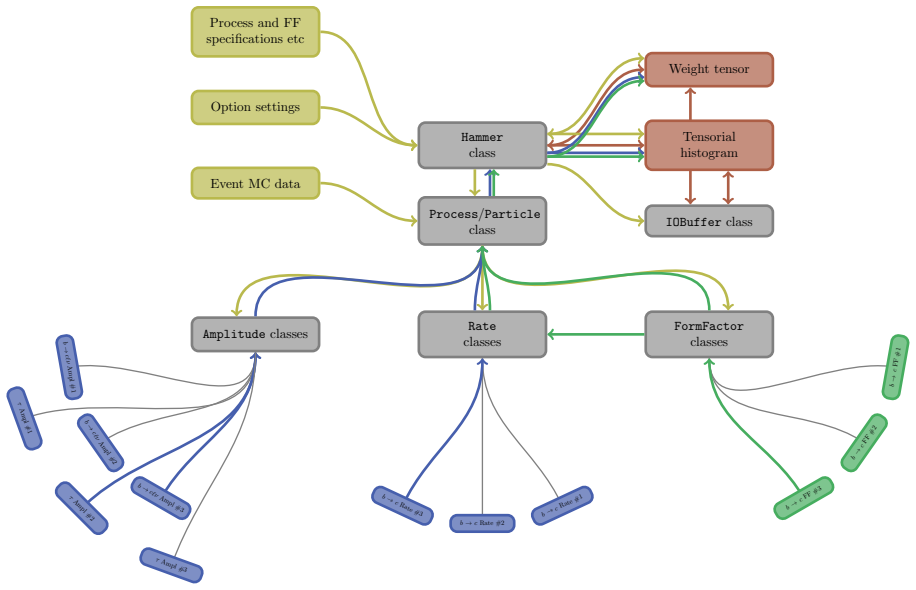
read the original abstract
The Hammer software library provides fast and efficient reweighting of large simulated datasets containing semileptonic $b$-hadron decays to any beyond Standard Model (BSM) theory, or to any form-factor description of the hadronic matrix elements. By enabling reweighting to a different underlying theoretical model after the computationally-expensive detector simulation step has already been completed, Hammer permits experimental analyses to employ forward-folding fitting strategies to recover underlying physical parameters without biases, or to properly characterize theory systematic uncertainties. This publication details upgrades to Hammer functionalities and its application programming interface (API) for version 2.x, and also provides associated documentation of the library's structure, syntactical conventions, and code flow. Substantial optimization of Hammer's internal tensor library now enables computational complexity to generically scale almost linearly with amplitude tensor rank times size rather than as a quartic, enabling reweighting into very high dimension spaces, such as the product of BSM Wilson coefficient and form factor parameter linear spaces, while also retaining Monte Carlo uncertainties. Updated Python bindings are implemented with bijective correspondence to the C++ interface, allowing full access to library functionalities.
Editorial analysis
A structured set of objections, weighed in public.
Referee Report
Summary. The manuscript introduces Hammer v2, a software library for reweighting large Monte Carlo simulated datasets of semileptonic b-hadron decays to arbitrary BSM theories or form-factor parametrizations after detector simulation. It documents the updated API, library structure, code flow, and a key internal optimization to the tensor library that reduces computational complexity from quartic to nearly linear scaling with amplitude tensor rank and size. This change is stated to enable reweighting in high-dimensional spaces such as the product of BSM Wilson coefficients and form-factor parameters while retaining Monte Carlo uncertainties. Bijective Python bindings to the C++ interface are also described.
Significance. If the stated scaling improvement is validated, the work enables forward-folding fits over combined BSM and hadronic parameter spaces without bias from post-simulation reweighting, which is valuable for precision flavor physics analyses. The detailed documentation of code structure and syntactical conventions, together with the bijective Python bindings, supports usability and reproducibility for the community.
major comments (1)
- [Abstract] Abstract: the central performance claim that 'computational complexity to generically scale almost linearly with amplitude tensor rank times size rather than as a quartic' is load-bearing for the assertion that reweighting into very high dimension spaces is now feasible, yet the manuscript supplies no benchmarks, timing tables, or derivation of the tensor algorithm to support this change.
minor comments (1)
- The manuscript would benefit from explicit cross-references between the described code flow and the new API functions to improve readability for users implementing the reweighting procedure.
Simulated Author's Rebuttal
We thank the referee for their thoughtful review and for highlighting the importance of substantiating the performance claims. We address the single major comment below and agree that additional material is warranted to support the central assertion regarding the tensor library optimization.
read point-by-point responses
-
Referee: [Abstract] Abstract: the central performance claim that 'computational complexity to generically scale almost linearly with amplitude tensor rank times size rather than as a quartic' is load-bearing for the assertion that reweighting into very high dimension spaces is now feasible, yet the manuscript supplies no benchmarks, timing tables, or derivation of the tensor algorithm to support this change.
Authors: We agree that the scaling claim is central to the paper's significance and that the current manuscript lacks the supporting evidence the referee correctly identifies. In the revised version we will add a dedicated section (or appendix) that (i) derives the complexity of the optimized tensor contraction algorithm, showing the reduction from O(n^4) to near-linear scaling in rank and size, and (ii) presents timing benchmarks on representative high-dimensional amplitude tensors, comparing the v1 and v2 implementations. These additions will directly validate the feasibility of reweighting in combined BSM and form-factor spaces while retaining Monte Carlo uncertainties. revision: yes
Circularity Check
No significant circularity; software description paper with no derivations or self-referential predictions
full rationale
The manuscript is a software description and API documentation for Hammer v2. It details code structure, Python bindings, and an internal tensor library optimization that changes complexity scaling, but presents no mathematical derivations, fitted parameters, predictions, or first-principles results. The reweighting procedure and its assumptions are inherited from v1 without modification or self-referential justification in this work. No load-bearing steps reduce to inputs by construction, self-citation chains, or ansatz smuggling. This is the expected outcome for a pure software paper.
Axiom & Free-Parameter Ledger
Reference graph
Works this paper leans on
-
[1]
Scheme1"or
Adding A histogram is declared byHammer::addHistogram, which takes as arguments a name string and either: a vector of dimensions, a bool for under/overflow and a vector of ranges; or a vector of bin edges and a bool for under/overflow. The methodaddHistogramdoes not create a single histogram, but rather ahistogram set: A separate histogram is created for ...
-
[2]
q2VsEmu", {4., 0.5}); fills the appropriate bin element for the
Filling Filling of histograms for a specific event is performed byHammer::fillEventHistogram, which takes the histogram name and the values of the observables corresponding to each 6 Because of histogram compression functionality discussed in Sec. IIIM3 below, histograms are in practice indexed by aevent ID group, which is a set of event IDs: Without comp...
-
[3]
Computing and storing only the latter compressed form permits both speed gains and space savings
Compression In many use cases, the entire histogram set is not required, but rather its direct sum. Computing and storing only the latter compressed form permits both speed gains and space savings. The methodHammer::collapseProcessesInHistogramtakes a name of a histogram, and causes all members of the histogram set containing the same tensor structures to...
-
[4]
q2VsEmu",
(Partial) specialization A declared WC specialization (see Sec. IIIK) may be applied to a particular histogram viaHammer::applyWCSpecializationInHistogram, which takes the name of the histogram and the name of the specialization as arguments. For example, ham.applyWCSpecializationInHistogram("q2VsEmu", "JM"); This method should be applied beforeinitRun, a...
-
[5]
BtoCTauNu
Retrieval Once all events or histograms have been processed (or reloaded from a file, see Sec. IV) the user may retrieve a specific histogram via the methodHammer::getHistogram, which takes a histogram name and a FF scheme name. NP choices must be specified first via setWilsonCoefficients, as must FF uncertainties viasetFFEigenvectorsif a parametrization ...
-
[6]
Histos: {KeepErrors: true}
Uncertainties Computation of the weight-squared uncertainties (accessed from theBinContentsstruct viasumWi2) is off by default. This may be enabled globally via the options setting ham.setOptions("Histos: {KeepErrors: true}"). However, for computational speed and/or memory efficiency, it may be instead enabled or disabled for individual histograms via Ham...
-
[7]
q2VsEmuVsM2miss
Projection On occasion, it may be useful to project a pre-computedn-dimensional histogram onto a lower-dimensional one. This can be achieved via the methodcreateProjectedHistogram, which takes the name of the originaln-dimensional histogram, the name of the new histogram to be created, and a set of the index positions to be summed over or collapsed. For i...
-
[8]
For example, 36 outFile << ham.saveRunHeader(); writes the declared run header, with all its settings, into anIOBufferand passes it as a record into the buffer
Headers, events and rates The methodsHammer::save...return aIOBuffer, which can be stored as a sequential record in the stream via an insertion (<<) operator. For example, 36 outFile << ham.saveRunHeader(); writes the declared run header, with all its settings, into anIOBufferand passes it as a record into the buffer. The available record types are labell...
-
[9]
q2VsEmu"); saves all the unique
Histograms The methodsaveHistogram, when taking only a histogram name as an argument, saves the entire specified histogram set. The return value is the containerHammer::IOBuffers. An operator <<overload forIOBuffersallows to save all its entries at once (each histogram in a histogram set occupies an individual buffer record). For example, outFile << ham.s...
-
[10]
/DemoSave.dat
ROOT Saving a buffer inROOTformat is achieved by passing theIOBufferoutput of thesave... methods into aRootIOBuffer, which may then be stored in aROOTTTree. Explicit implemen- tations of this functionality are provided in variousdemo...root.ccexample programs. B. (Re)loading BufferrecordsmaybeloadedfromadeclaredifstreaminfileintoanIOBufferviaanistream ope...
-
[11]
The NP couplings to the quark and lepton currents are denoted byχi j andλ i j, respectively, and may in general be complex numbers
NP operator basis A complete basis for the four-Fermi operators mediatingb→c¯ℓνdecay, including right- handed neutrinos, is shown in Table VII. The NP couplings to the quark and lepton currents are denoted byχi j andλ i j, respectively, and may in general be complex numbers. The lower index ofλdenotes theνhelicity and the lower index ofχis that of thebqua...
-
[12]
Lorentz signs For all amplitudes encoded intoHammer, we use a trace−2metric, and the Lorentz sign conventions Tr[γµγνγσγργ5] =−4iϵ µνρσ , ϵ 0123 = +1.(A2) These choices fully specify all other possible ambiguous signs, for example theγ5 trace choice is equivalent toσµνγ5 ≡+ i 2 ϵµνρσ σρσ, withσ µν = i 2[γµ, γν]
-
[13]
Form factor definitions a. B→D The B→Dform factor tensor has ordered components FFD = n fS, f 0, f +, f T o ,(A3) which are defined via D ¯c b B ≡f S ,(A4a) D ¯cγµb B ≡f +(pB +p D)µ + [f0 −f +] m2 B −m 2 D q2 qµ ,(A4b) D ¯cσµνb B ≡if T h (pB +p D)µqν −(p B +p D)νqµ i .(A4c) These definitions map to the conventional dimensionless form factor sethS, h+, h−,...
-
[14]
delta_a0
Form factor variations At present, e.g. theBGLVarparametrization permits viasetFFEigenvectorsfunctionality (see Sec. IIII) direct manipulation of thea i,b i,c i andd i parameters forB→D ∗ (also denoteda g i,a f i,a F1 i anda P1 i , respectively, in some notational conventions). That is, the covariance matrix is set to the identity, and the basis of variat...
-
[15]
These (somewhat arbitrary) lineshape models typically factorize from the decay amplitudes themselves, and are generically invariant under reweighting
Resonance lineshapes EvtGenincludes additional momentum and angular momentum dependent models for resonance lineshapes, which can be numerically non-negligible for broad resonances such as theD ∗∗. These (somewhat arbitrary) lineshape models typically factorize from the decay amplitudes themselves, and are generically invariant under reweighting. They are...
-
[16]
Das ist der HAMMER: Consistent new physics interpretations of semileptonic decays,
F. U. Bernlochneret al., “Das ist der HAMMER: Consistent new physics interpretations of semileptonic decays,” Eur. Phys. J. C80, 9, 883 (2020), [arXiv:2002.00020]
-
[17]
Hammer - helicity amplitude module for matrix element reweighting,
F. U. Bernlochneret al., “Hammer - helicity amplitude module for matrix element reweighting,” (2026), Ver. 2.0.0, URLhttps://doi.org/10.5281/zenodo.20716678
-
[18]
Hammer - helicity amplitude module for matrix element reweighting,
F. U. Bernlochneret al., “Hammer - helicity amplitude module for matrix element reweighting,” (2024), Ver. 1.4.1, URLhttps://doi.org/10.5281/zenodo.11245573
-
[19]
Hammer - helicity amplitude module for matrix element reweighting,
F. U. Bernlochneret al., “Hammer - helicity amplitude module for matrix element reweighting,” (2022), Ver. 1.3.0, URLhttps://doi.org/10.5281/zenodo.7007837
-
[20]
Hammer - helicity amplitude module for matrix element reweighting,
F. U. Bernlochneret al., “Hammer - helicity amplitude module for matrix element reweighting,” (2022), Ver. 1.2.1, URLhttps://doi.org/10.5281/zenodo.5828435
-
[21]
Hammer - helicity amplitude module for matrix element reweighting,
F. U. Bernlochneret al., “Hammer - helicity amplitude module for matrix element reweighting,” (2020), Ver. 1.1.0, URLhttps://doi.org/10.5281/zenodo.3993770
-
[22]
Hammer - helicity amplitude module for matrix element reweighting,
F. U. Bernlochneret al., “Hammer - helicity amplitude module for matrix element reweighting,” (2020), Ver. 1.0.0, URLhttps://doi.org/10.5281/zenodo.3722682
-
[23]
Strongly Coupled Charged Scalar in B and t Decays,
P. Krawczyk and S. Pokorski, “Strongly Coupled Charged Scalar in B and t Decays,” Phys. Rev. Lett.60, 182 (1988)
1988
-
[24]
Semileptonic Decays ofBMesons intoτ ντ,
P. Heiliger and L. M. Sehgal, “Semileptonic Decays ofBMesons intoτ ντ,” Phys. Lett.B229, 409 (1989)
1989
-
[25]
Semileptonic Decays ofBMesons intoτ ντ in a Two Higgs Doublet Model,
J. Kalinowski, “Semileptonic Decays ofBMesons intoτ ντ in a Two Higgs Doublet Model,” Phys. Lett.B245, 201 (1990)
1990
-
[26]
Solutions to the B meson semileptonic branching ratio puzzle within two Higgs doublet models,
B. Grzadkowski and W.-S. Hou, “Solutions to the B meson semileptonic branching ratio puzzle within two Higgs doublet models,” Phys. Lett.B272, 383 (1991)
1991
-
[27]
The Inclusive $\bar B\to \tau \bar\nu X$ Decay in Two Higgs Doublet Models
Y. Grossman and Z. Ligeti, “The Inclusive¯B→τ¯νXdecay in two Higgs doublet models,” Phys. Lett.B332, 373 (1994), [hep-ph/9403376]
work page internal anchor Pith review Pith/arXiv arXiv 1994
-
[28]
Charged Higgs Effects on Exclusive Semi-tauonic $\bbox{B}$ Decays
M. Tanaka, “Charged Higgs effects on exclusive semitauonicBdecays,” Z. Phys.C67, 321 (1995), [hep-ph/9411405]
work page internal anchor Pith review Pith/arXiv arXiv 1995
-
[29]
Semileptonic B decays as a probe of new physics,
W. D. Goldberger, “Semileptonic B decays as a probe of new physics,” (1999), [hep- ph/9902311]
-
[30]
Measurement of theb→τ −¯νXbranching ratio,
D. Buskulicet al.(ALEPH Collaboration), “Measurement of theb→τ −¯νXbranching ratio,” Phys. Lett.B298, 479 (1993)
1993
-
[31]
Averages of $b$-hadron, $c$-hadron, and $\tau$-lepton properties as of 2023
S. Banerjeeet al.(Heavy Flavor Averaging Group (HFLAV)), “Averages of b-hadron, c-hadron, andτ-lepton properties as of 2023,” Phys. Rev. D113, 1, 012008 (2026), [arXiv:2411.18639]
work page internal anchor Pith review Pith/arXiv arXiv 2023
-
[32]
Review of Particle Physics,
F. Takahashiet al.(Particle Data Group), “Review of Particle Physics,” Int. J. Mod. Phys. A 41, 2630011 (2026)
2026
-
[33]
Measurement of an Excess of B -> D(*) Tau Nu Decays and Implications for Charged Higgs Bosons
J. P. Leeset al.(BaBar Collaboration), “Measurement of an Excess of ¯B→D (∗)τ −¯ντ Decays and Implications for Charged Higgs Bosons,” Phys. Rev.D88, 7, 072012 (2013), 51 [arXiv:1303.0571]
work page internal anchor Pith review Pith/arXiv arXiv 2013
-
[34]
Measurement of the ratio of branching fractionsB(¯B0 → D∗+τ −¯ντ)/B( ¯B0 →D ∗+µ−¯νµ),
R. Aaijet al.(LHCb Collaboration), “Measurement of the ratio of branching fractionsB(¯B0 → D∗+τ −¯ντ)/B( ¯B0 →D ∗+µ−¯νµ),” Phys. Rev. Lett.115, 11, 111803 (2015), [Addendum: Phys. Rev. Lett. 115, no.15, 159901 (2015)], [arXiv:1506.08614]
-
[35]
M. Huschleet al.(Belle Collaboration), “Measurement of the branching ratio of¯B→D (∗)τ −¯ντ relative to ¯B→D (∗)ℓ−¯νℓ decays with hadronic tagging at Belle,” Phys. Rev.D92, 7, 072014 (2015), [arXiv:1507.03233]
work page internal anchor Pith review Pith/arXiv arXiv 2015
-
[36]
Model-Independent Extraction of $|V_{cb}|$ from $\bar{B}\rightarrow D^* \ell \overline{\nu}$
B. Grinstein and A. Kobach, “Model-Independent Extraction of|Vcb|from ¯B→D ∗ℓν,” Phys. Lett.B771, 359 (2017), [arXiv:1703.08170]
work page internal anchor Pith review Pith/arXiv arXiv 2017
-
[37]
Model-Independent Determinations of B -> D l nu , D* l nu Form Factors
C. G. Boyd, B. Grinstein and R. F. Lebed, “Model independent determinations of ¯B→ Dl¯ν, D∗l¯νform-factors,” Nucl. Phys.B461, 493 (1996), [hep-ph/9508211]
work page internal anchor Pith review Pith/arXiv arXiv 1996
-
[38]
Precision Corrections to Dispersive Bounds on Form Factors
C. G. Boyd, B. Grinstein and R. F. Lebed, “Precision corrections to dispersive bounds on form-factors,” Phys. Rev.D56, 6895 (1997), [hep-ph/9705252]
work page internal anchor Pith review Pith/arXiv arXiv 1997
-
[39]
RooHammerModel: interfacing the HAMMER software tool with HistFactory and RooFit,
J. García Pardiñaset al., “RooHammerModel: interfacing the HAMMER software tool with HistFactory and RooFit,” JINST17, 04, T04006 (2022), [arXiv:2007.12605]
-
[40]
Redist, a python tool for model-agnostics binned-likelihood fits in high en- ergy physics,
M. Colonnaet al., “Redist, a python tool for model-agnostics binned-likelihood fits in high en- ergy physics,” Python in Science Conference, 2025 (2025), URLhttps://doi.org/10.25080/ ppgk2467
2025
-
[41]
Semileptonic Meson Decays in the Quark Model: An Update
D. Scora and N. Isgur, “Semileptonic meson decays in the quark model: An update,” Phys. Rev.D52, 2783 (1995), [hep-ph/9503486]
work page internal anchor Pith review Pith/arXiv arXiv 1995
-
[42]
Semileptonic B and D Decays in the Quark Model,
N. Isguret al., “Semileptonic B and D Decays in the Quark Model,” Phys. Rev.D39, 799 (1989)
1989
-
[43]
Dispersive Bounds on the Shape of B -> D^(*) l nu Form Factors
I. Caprini, L. Lellouch and M. Neubert, “Dispersive bounds on the shape of¯B→D (∗)ℓ¯ν form-factors,” Nucl. Phys.B530, 153 (1998), [hep-ph/9712417]
work page internal anchor Pith review Pith/arXiv arXiv 1998
-
[44]
F. U. Bernlochneret al., “Combined analysis of semileptonicBdecays toDandD ∗:R(D (∗)), |Vcb|, and new physics,” Phys. Rev.D95, 11, 115008 (2017), [arXiv:1703.05330]
work page internal anchor Pith review Pith/arXiv arXiv 2017
-
[45]
Constrained second-order power corrections in HQET:R(D(∗)),|V cb|, and new physics,
F. U. Bernlochneret al., “Constrained second-order power corrections in HQET:R(D(∗)),|V cb|, and new physics,” (2022), [arXiv:2206.11281]
-
[46]
Semileptonic B decays to excited charmed mesons
A. K. Leibovichet al., “Semileptonic B decays to excited charmed mesons,” Phys. Rev.D57, 308 (1998), [hep-ph/9705467]
work page internal anchor Pith review Pith/arXiv arXiv 1998
-
[47]
A. K. Leibovichet al., “Model independent results forB→D1(2420)ℓ¯νandB→D ∗ 2(2460)ℓ¯ν at orderΛ QCD/mc,b,” Phys. Rev. Lett.78, 3995 (1997), [hep-ph/9703213]
work page internal anchor Pith review Pith/arXiv arXiv 1997
-
[48]
Model independent analysis of semileptonic $B$ decays to $D^{**}$ for arbitrary new physics
F. U. Bernlochner, Z. Ligeti and D. J. Robinson, “Model independent analysis of semileptonic Bdecays toD ∗∗ for arbitrary new physics,” (2017), [arXiv:1711.03110]
work page internal anchor Pith review Pith/arXiv arXiv 2017
-
[49]
F. U. Bernlochner and Z. Ligeti, “SemileptonicB(s) decays to excited charmed mesons with e, µ, τand searching for new physics withR(D ∗∗),” Phys. Rev.D95, 1, 014022 (2017), [arXiv:1606.09300]
work page internal anchor Pith review Pith/arXiv arXiv 2017
-
[50]
$B\to V\ell^+\ell^-$ in the Standard Model from Light-Cone Sum Rules
A.Bharucha, D.M.StraubandR.Zwicky, “B→V ℓ +ℓ− intheStandardModelfromlight-cone 52 sum rules,” JHEP08, 098 (2016), [arXiv:1503.05534]
work page internal anchor Pith review Pith/arXiv arXiv 2016
-
[51]
Semileptonic Decays of Heavy Lambda Baryons in a Quark Model
M. Pervin, W. Roberts and S. Capstick, “Semileptonic decays of heavy lambda baryons in a quark model,” Phys. Rev.C72, 035201 (2005), [arXiv:nucl-th/0503030]
work page internal anchor Pith review Pith/arXiv arXiv 2005
-
[52]
Precise predictions for $\Lambda_b \to \Lambda_c$ semileptonic decays
F. U. Bernlochneret al., “Precise predictions forΛb →Λ c semileptonic decays,” Phys. Rev. D99, 5, 055008 (2019), [arXiv:1812.07593]
work page internal anchor Pith review Pith/arXiv arXiv 2019
-
[53]
New predictions for $\Lambda_b\to\Lambda_c$ semileptonic decays and tests of heavy quark symmetry
F. U. Bernlochneret al., “New predictions forΛb →Λ c semileptonic decays and tests of heavy quark symmetry,” Phys. Rev. Lett.121, 20, 202001 (2018), [arXiv:1808.09464]
work page internal anchor Pith review Pith/arXiv arXiv 2018
-
[54]
Appraising constrained second-order power corrections in HQET withΛb →Λ clν,
F. U. Bernlochner, M. Papucci and D. J. Robinson, “Appraising constrained second-order power corrections in HQET withΛb →Λ clν,” (2023), [arXiv:2312.07758]
-
[55]
Semileptonic Lambda_b decay to excited Lambda_c baryons at order Lambda_{QCD}/m_Q
A. K. Leibovich and I. W. Stewart, “Semileptonic Lambda(b) decay to excited Lambda(c) baryons at order Lambda(QCD) / m(Q),” Phys. Rev.D57, 5620 (1998), [hep-ph/9711257]
work page internal anchor Pith review Pith/arXiv arXiv 1998
-
[56]
Form Factor Counting and HQET Matching for New Physics inΛ b →Λ ∗ clν,
M. Papucci and D. J. Robinson, “Form Factor Counting and HQET Matching for New Physics inΛ b →Λ ∗ clν,” (2021), [arXiv:2105.09330]
-
[57]
Exclusive decays and lifetime ofBc meson in QCD sum rules,
V. Kiselev, “Exclusive decays and lifetime ofBc meson in QCD sum rules,” (2002), [hep- ph/0211021]
-
[58]
Weak decays of the B_c meson to charmonium and D mesons in the relativistic quark model
D. Ebert, R. Faustov and V. Galkin, “Weak decays of theBc meson to charmonium andD mesons in the relativistic quark model,” Phys. Rev. D68, 094020 (2003), [hep-ph/0306306]
work page internal anchor Pith review Pith/arXiv arXiv 2003
-
[59]
Precision Model-Independent Bounds from Global Analysis ofb→cℓνForm Factors,
T. D. Cohen, H. Lamm and R. F. Lebed, “Precision Model-Independent Bounds from Global Analysis ofb→cℓνForm Factors,” Phys. Rev. D100, 9, 094503 (2019), [arXiv:1909.10691]
-
[60]
$|V_{ub}|$ from $B\to\pi\ell\nu$ decays and (2+1)-flavor lattice QCD
J. A. Baileyet al.(Fermilab Lattice, MILC), “|Vub|fromB→πℓνdecays and (2+1)-flavor lattice QCD,” Phys. Rev. D92, 1, 014024 (2015), [arXiv:1503.07839]
work page internal anchor Pith review Pith/arXiv arXiv 2015
-
[61]
N. Gubernari, A. Kokulu and D. van Dyk, “B→PandB→VForm Factors fromB-Meson Light-Cone Sum Rules beyond Leading Twist,” JHEP01, 150 (2019), [arXiv:1811.00983]
-
[62]
Y. Aokiet al.(Flavour Lattice Averaging Group (FLAG)), “FLAG Review 2021,” Eur. Phys. J. C82, 10, 869 (2022), [arXiv:2111.09849]
-
[63]
E. McLeanet al., “Bs →D sℓνForm Factors for the fullq2 range from Lattice QCD with non- perturbatively normalized currents,” Phys. Rev. D101, 7, 074513 (2020), [arXiv:1906.00701]
-
[64]
Structure functions in tau decays,
J. H. Kuhn and E. Mirkes, “Structure functions in tau decays,” Z. Phys.C56, 661 (1992), [Erratum: Z. Phys.C67,364(1995)]
1992
-
[65]
Resonance chiral Lagrangian currents and tau decay Monte Carlo
O. Shekhovtsovaet al., “Resonance chiral Lagrangian currents andτdecay Monte Carlo,” Phys. Rev.D86, 113008 (2012), [arXiv:1203.3955]
work page internal anchor Pith review Pith/arXiv arXiv 2012
-
[66]
I. M. Nugentet al., “Resonance chiral Lagrangian currents and experimental data forτ− → π−π−π+ντ,” Phys. Rev.D88, 093012 (2013), [arXiv:1310.1053]
work page internal anchor Pith review Pith/arXiv arXiv 2013
-
[67]
Photos — a universal monte carlo for qed radiative corrections in decays,
E. Barberio, B. van Eijk and Z. W¸ as, “Photos — a universal monte carlo for qed radiative corrections in decays,” Computer Physics Communications66, 1, 115 (1991), ISSN 0010-4655, URLhttp://www.sciencedirect.com/science/article/pii/001046559190012A
-
[68]
New Physics in the Visible Final States of $B\to D^{(*)}\tau\nu$
Z. Ligeti, M. Papucci and D. J. Robinson, “New Physics in the Visible Final States ofB→ D(∗)τ ν,” JHEP01, 083 (2017), [arXiv:1610.02045]. 53
work page internal anchor Pith review Pith/arXiv arXiv 2017
-
[69]
Second Order Power Corrections in the Heavy Quark Effective Theory II. Baryon Form Factors
A. F. Falk and M. Neubert, “Second order power corrections in the heavy quark effective theory. 2. Baryon form-factors,” Phys. Rev.D47, 2982 (1993), [hep-ph/9209269]
work page internal anchor Pith review Pith/arXiv arXiv 1993
-
[70]
Phenomenology of Heavy Meson Chiral Lagrangians
R. Casalbuoniet al., “Phenomenology of heavy meson chiral Lagrangians,” Phys. Rept.281, 145 (1997), [hep-ph/9605342]
work page internal anchor Pith review Pith/arXiv arXiv 1997
-
[71]
Excited charmed mesons in chiral perturbation theory,
U. Kilian, J. G. Korner and D. Pirjol, “Excited charmed mesons in chiral perturbation theory,” Phys. Lett. B288, 360 (1992)
1992
-
[72]
Heavy quark symmetry and D1 (2420) —> D* pi decay,
M. Lu, M. B. Wise and N. Isgur, “Heavy quark symmetry and D1 (2420) —> D* pi decay,” Phys. Rev. D45, 1553 (1992)
1992
-
[73]
EvtGen: A Monte Carlo Generator for B-Physics,
A. Rydet al., “EvtGen: A Monte Carlo Generator for B-Physics,” (2005). 54
2005
discussion (0)
Sign in with ORCID, Apple, or X to comment. Anyone can read and Pith papers without signing in.