REVIEW 3 major objections 5 minor 66 references
Morphology of Relativistically Broadened Line Emission from Axisymmetric Equatorial Accretion Disks
T0 review · 3 major / 5 minor · reviewed 2026-08-12 · deepseek-v4-flash
Pith's one-line read Under the standard thin disk model, every edge and kink of a broadened emission line sits at a local extremum of the redshift factor, so the line's shape encodes the black hole's spin, the viewing angle, and the disk's inner and outer…
desk verdict A genuinely useful topological map of relativistic line profiles, with a proof gap in the exhaustiveness claim that a good referee should push on. read the letter →
The pith
A machine-rendered reading of the paper's core claim, the machinery that carries it, and where it could break.
The reading
What carries the argument
The load-bearing object is the redshift factor $g(\mathbf{x})$ on the observer's screen and its local extrema over the flux-contributing region (FCR). For a fixed source radius $r_s$, the constant-$g$ contour is a double cover between the extremal values $g_{s-}(r_s)$ and $g_{s+}(r_s)$; the boundary extrema $g_{\rm in\pm}=g_{s\pm}(r_{\rm in})$ and $g_{\rm out\pm}=g_{s\pm}(r_{\rm out})$, together with the interior finite-flux point $g_\bullet$ when present, form the full critical set. The paper encodes the topology of constant-redshift contours between critical values with a four-symbol notation ($\bigcirc$, $\cap$, $\cup$, and $|\,|$: closed curves, open curves attached to the inner edge, open curves attached to the outer edge, and pairs of open curves connecting the two edges), and the ordered string of symbols—the redshift factor configuration—determines the piecewise functional form of the line profile, its number of kinks, and the steepness or fall-off near each kink.
What would settle it
Ray-trace a line profile from a disk whose velocity field makes $g_{s-}(r_s)$ non-monotonic (for example, a flow with a strong radial-infall zone between two circular zones); if a kink appears at a redshift outside $\{g_{\rm in\pm}, g_{\rm out\pm}, g_\bullet\}$, the exhaustive classification is falsified. Observationally, a well-resolved iron line whose sharp features cannot be matched by any single standard-model $(a,\theta_o,r_{\rm in},r_{\rm out})$ would indicate either missing disk physics or an incomplete taxonomy.
Extended reading notes
Core claim
The paper's central discovery is that the morphology of a relativistically broadened line from an axisymmetric equatorial disk is controlled entirely by the critical values of the redshift factor $g$ on the flux-contributing region of the observer's screen. The maximum observable redshift and blueshift, $g_{\rm MOR}=\min g(\mathbf{x})$ and $g_{\rm MOB}=\max g(\mathbf{x})$, set the line's edges, and every kink occurs at an interior local extremum of $g$. For the standard disk the critical set is exactly $\{g_{\rm in\pm}, g_{\rm out\pm}\}$ together with, when it lies inside the disk, the finite-flux point $g_\bullet$ where the Jacobian of the screen-to-$(g, r_s)$ map is singular; the ordering of these values fixes the topology of constant-redshift contours and hence the piecewise form of the line. The paper enumerates the resulting configurations—Types I, II, and III with finite-disk and FFP-inclusive/exclusive subcases—and shows that the extremal values $g_{\rm MOR}$ and $g_{\rm MOB}$ map one-to-one to spin and inclination for a maximally extended disk, while the kink values locate the disk's edges. It further shows that these features are independent of the emissivity profile's functional form, and that deviations from circular Keplerian motion shift and reorder the critical values, so standard-model inference is systematically biased when the true flow is sub- or super-Keplerian or plunges inside the ISCO.
Load-bearing premise
The classification assumes that for each disk model the smallest redshift at a fixed disk radius changes monotonically with radius and the largest redshift at a fixed radius has at most one interior peak, so the complete set of line-shape transitions is exactly $\{g_{\rm in\pm}, g_{\rm out\pm}, g_\bullet\}$; if either property fails, additional kinks appear outside the taxonomy.
Editorial extensions
If this is right
- For any disk model with the assumed monotone redshift structure, the edges and kinks of the line profile can be predicted from the local extrema of $g$ alone, without ray-tracing the full emissivity.
- Measuring the maximum redshift and blueshift of a well-resolved line constrains black hole spin and inclination: for a disk that reaches the ISCO and extends far, the pair $(g_{\rm MOR}, g_{\rm MOB})$ uniquely determines $(a,\sin\theta_o)$ within the model.
- The kink positions $g_{\rm in\pm}$ and $g_{\rm out\pm}$ locate the inner and outer radii on which the line emission has support, independent of the emissivity profile; the emissivity only shapes the line between kinks, so disk-radius and emissivity fits can be separated from spin and inclination fits.
- Line-profile morphology is a dynamical diagnostic: changing the disk velocity field (adding a plunging region or making the flow sub- or super-Keplerian) moves the critical values and can change the configuration type, so mis-specifying the disk model produces systematic biases in spin and inclination estimates.
- The classification is exhaustive for the standard disk: every allowed ordering of $\{g_{\rm in\pm}, g_{\rm out\pm}, g_\bullet\}$ falls into one of the listed Types I-III configurations, so a resolved line's morphology tells the observer which configuration is present and which parameters are tightly constrained.
Reading between the lines
- If a realistic disk violates the monotonicity assumption on $g_{s-}(r_s)$—for example a finite-thickness or magnetically supported flow—additional kinks would appear at redshifts not in the paper's list; the general principle that kinks sit at redshift extrema should survive, but the taxonomy would need enlarging.
- The emissivity-independence of kink locations suggests that fitting only the positions of sharp spectral features, rather than full template line profiles, may be more robust to continuum-subtraction errors in real X-ray data; this strategy is implicit but not developed in the paper.
- The analytic large-radius approximation for the finite-flux point given in the appendix could serve as a fast initial guess for spin and inclination in fitting pipelines, before expensive ray-tracing, though the paper does not pursue this application.
- The same critical-value reasoning should transfer to other axisymmetric flows, such as warped or tilted disks, and to other spectral features like absorption edges, provided the redshift factor retains the assumed extremal structure.
Editorial analysis
A structured set of objections, weighed in public.
Referee Report
Summary. This paper studies the morphology of relativistically broadened line emission from axisymmetric equatorial accretion disks in Kerr spacetime. The authors argue that, under the standard thin disk model, the line profile is piecewise smooth and that its edges and kinks occur exactly at the local extrema of the redshift factor over the flux-contributing region. They classify all possible profiles into Types I–III, with FFP-inclusive and FFP-exclusive variants, and summarize the possible redshift-contour configurations in Table II. They then propose a procedure for identifying the configuration from the number, order, and left-right steepness of kinks, and use this to map morphological features to black hole spin, inclination, and disk inner and outer radii. The last part of the paper relaxes the standard assumptions: it adds the plunging region (Cunningham model) and parametrically modifies the orbital angular momentum through a Keplerianity parameter ξ, showing that the sharp features are model-dependent and can shift or reorder, potentially biasing parameter inference.
Significance. If the central structural assumptions are supplied, the paper provides a genuinely useful unified explanation of line-profile morphology and a systematic classification that goes beyond earlier work. Its strengths include the public ray-tracing code (LineAART), the many explicit numerical examples, the emissivity-independence of the sharp features, and the explicit inversion-style mapping from MOR/MOB and kinks to parameters rather than a black-box fit. The classification is falsifiable: for any parameter point, the predicted number and order of kinks can be checked numerically. However, the exhaustiveness of the classification and the reliability of the parameter mapping rest on monotonicity properties of the redshift extrema gs± that are asserted rather than proven, and the derivation of the kink/discontinuity behavior contains a garbled passage. The significance is therefore conditional on fixing these load-bearing points.
major comments (3)
- [§III, Eqs. (9)–(12); §IV, Table II] The exhaustive classification of line-profile morphologies depends on two structural properties of the redshift factor: (i) gs−(rs) is monotonic in the source radius, so the MOR is always sourced by the inner edge and no interior minimum introduces an additional kink, and (ii) gs+(rs) has at most one interior maximum, the FFP. Footnote 5 merely states that these properties are “generically true” for flows with monotonic velocity profiles, and no proof or systematic numerical verification is given. Moreover, the sentence immediately after Eq. (10), “gs− is monotonically decreasing with radius; thus, the MOR is always sourced by the disk’s inner radius,” is internally inconsistent: a decreasing gs− would place the minimum at the outer edge. If gs− were non-monotonic in any Kerr parameter region, the FCR would contain an interior extremum, producing a critical value outside the set {gin±, gout±, g•} and a kink not captured by any configuration in Table II. This would invalidate the configuration-identification procedure of Sec. VA and the parameter mapping of Sec. VB. Please provide a precise statement with the correct monotonic direction, together with a proof or a documented numerical scan over (a, xo, rin, rout) establishing the monotonicity of gs− and the single-maximum property of gs+ for the Standard model and for the ξ-deformed flows of Sec. VI.
- [§III, Eqs. (7)–(8)] The derivation of the kink behavior is garbled. The text reads “Fg(gc± i ) = Fg(gc± i ) = 0” and then “|Fg(gc± i )| < 0”, which is self-contradictory. As written, Eqs. (7) and (8) are not established by the surrounding argument, yet the sign of the jump in the line profile and its derivative (D1, D2 in Table III) is used as a diagnostic for configuration discrimination in Sec. VA. Please rewrite this passage with correct one-sided limits and derivative statements, and either justify the sign rules analytically or state explicitly that they are empirical observations verified numerically.
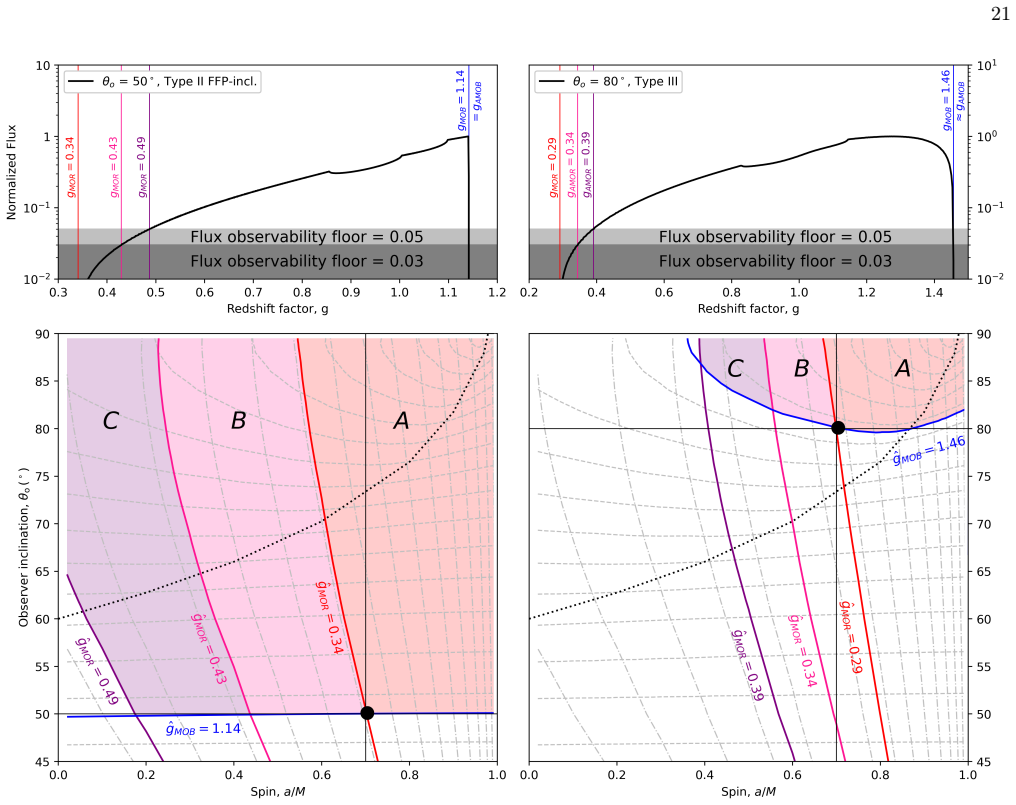
- [§V B] The spin-inclination inference in Sec. VB relies on the claim that (gs−(rISCO), gs+(rISCO)) is one-to-one with (a, xo), and that the MOR/MOB of a non-maximally extended disk bound the maximally extended values as in Eq. (17). These properties are asserted rather than demonstrated. Since they are load-bearing for the claimed uniqueness of the parameter constraints, please provide a proof or a systematic numerical verification, and state the exact parameter region in which the one-to-one map holds. The contour plots in Figs. 6 and 7 are suggestive but do not by themselves establish injectivity of the joint map.
minor comments (5)
- [Fig. 4 caption and §IV C] The Fig. 4 caption states “For spins a < ã ≃ 0.9788M, there is an FFP at all inclinations,” while Sec. IV C states that for these spins an FFP exists only for inclinations xo < x̃(a, rISCO). Please reconcile the caption with the body text and with the shaded/white regions in the figure.
- [§V B, paragraph after Eq. (16)] The phrase “Type III FFP-inclusive configurations” is inconsistent with the definition of Type III in Sec. IV, which excludes an FFP or has r• ≤ rin. The intended configuration appears to be Type II FFP-inclusive; please correct the terminology.
- [Fig. 8 caption] In the bottom-row caption, “the MOB constrains (a, θo) to the region above ˆCMOR(gMOR)” should presumably read “above ˆCMOB(gMOB)”; please check the notation throughout the caption.
- [Fig. 11 caption and §V D] The caption writes “gMOB−gMOB” and “MOR-AMOB difference” where the quantities are evidently gMOB − gAMOB and gAMOR − gMOR. Please correct the notation.
- [§V C, paragraph after Eq. (22)] The configurations referred to as “III •inc A, B, C” and “III •inc D and E” should be “II •inc A, B, C” and “II •inc D and E”; Type III configurations do not contain an FFP.
Circularity Check
No circular reduction: the morphology classification and parameter map are forward-model inversions, not fits; the one self-citation (Ref. [35]) is independent and non-load-bearing.
full rationale
The paper's central derivation computes line profiles by integrating the redshift-factor-weighted emissivity over the observer's screen (Eqs. 2-4), then argues that sharp features occur at local extrema of g(x) and identifies those extrema with gin±, gout±, and g•. This is an analytic forward-model explanation, not a prediction forced by a fitted input: no parameter is fit to a subset of data and then renamed a prediction. The MOR/MOB-to-(a,xo) mapping in Sec. VB is an inversion of the forward Kerr-disk map, and the paper explicitly tests it against numerically ray-traced line profiles (Figs. 6-8), so the derivation is self-contained. Ref. [35] supplies the FFP/MOB values and the g=√3 limit; although it shares an author, it is a parameter-free published derivation with stated Kerr-geometry assumptions, not an input fitted to the present paper's outputs, so under the review rules it is independent support and does not create circularity. The unproved monotonicity of gs± assumed in Sec. III (footnote 5 says it is 'generically true') is a rigor/correctness gap that could admit additional kinks outside the classification; the literal sentence 'gs− is monotonically decreasing with radius; thus, the MOR is always sourced by the disk's inner radius' is also internally inconsistent as written. However, this is an explicit assumption about the forward model, not a circular re-use of the conclusion, and therefore belongs to correctness risk rather than to the circularity score.
Assumptions & free parameters
free parameters (2)
- xi (Keplerianity parameter) =
varied around unity, e.g., 0.95, 1.05, 0.98, 1.02
- Emissivity power-law index q =
3 in most examples; 2.5 and 3.5 in Fig. 9
assumptions (6)
- domain assumption The spacetime is Kerr, described by mass M and spin a, with the observer at asymptotic infinity on a zero-angular-momentum worldline.
- domain assumption The disk is axisymmetric, equatorial, geometrically thin and optically thick, with emissivity that is positive and continuous on a connected flux-contributing region between the inner and outer radius contours.
- domain assumption Only the direct (primary) image of the disk contributes to the line profile; higher-order lensed images are neglected because their flux is argued to be small.
- domain assumption For the accretion flows studied, at fixed observer, the minimum redshift at a given radius gs-(rs) decreases monotonically with radius and the maximum gs+(rs) has at most one interior maximum (the FFP).
- standard math The specific intensity transforms via Liouville's theorem and the observed flux is obtained by integrating over the observer's screen, Eq. (2).
- domain assumption The disk emission is treated as optically thin single-line emission with no radiative transfer through the disk material.
Cite this review
Pith. "Pith review of Morphology of Relativistically Broadened Line Emission from Axisymmetric Equatorial Accretion Disks." pith.science (2026). https://pith.science/paper/PYL7JZ3F
@misc{pith2026241114338,
  author       = {Pith},
  title        = {Pith review of: Morphology of Relativistically Broadened Line Emission from Axisymmetric Equatorial Accretion Disks},
  year         = {2026},
  howpublished = {\url{https://pith.science/paper/PYL7JZ3F}},
  note         = {Machine review of arXiv:2411.14338}
}
read the original abstract
Single-frequency emission from an accretion disk around a black hole is broadened into a line profile due to gravitational redshift and the motion of the disk's particles relative to the observer. The ensemble of relativistically broadened emission frequencies from the disk elements forms the spectrum viewed by an observer. Over the past decades, the broadened spectra of accreting systems have been used to constrain the spin of the black hole, the observer's inclination, and the astrophysical model parameters of the system. These inferences are usually made under the assumption that the accretion disk consists of particles orbiting around the black hole on stable circular orbits in the equatorial plane. Under this Standard disk model, in this work, we revisit line profile morphology, i.e., its extent, kinks, and fall-off. We provide a unified analytical explanation for these line profile morphological features, which encode the black hole spin, viewing inclination, and locations of the disk's inner and outer edges. We then show that these features, however, are model-dependent, by parametrically relaxing some of the astrophysical assumptions. In particular, we explore how allowing the disk particles to deviate from stable circular orbits rapidly degenerates the characteristic features of the line profile under the Standard disk model. Our results further demonstrate how sensitive our understanding of black hole and system properties can be to assumptions we make when interpreting these types of measurements.
Figures


Figures from the paper (12 more)




Reference graph
Works this paper leans on
-
[1]
We perform these integra- tions using the Adaptive Analytical Ray-Tracing (AART) code [28]
Line Profile in Radially Compactified Polar Screen Coordinates In our line profile implementation, we analytically ray trace photons arriving at a distant observer with zero angular momentum, at screen locationsx, from an equa- torial disk around a Kerr BH. We perform these integra- tions using the Adaptive Analytical Ray-Tracing (AART) code [28]. We disc...
-
[2]
The Standard Disk Model In the Standard disk model, particles travel on circular orbits. For prograde orbits, the conserved energy and angular momentum are given by [29, 62] ◦ E = m r3/2 − 2M √r + a √ M σ(r) , (C2a) ◦ λ = √ M r2 + a2 − 2a √ M r r3/2 − 2M √r + a √ M , (C2b) with σ = p r3 − 3M r2 + 2a √ M r3/2. Circular orbits are stable for radii at and ab...
-
[3]
Cunningham’s Disk Model In the Cunningham disk model, particles at radii above the ISCO rs ≥ rISCOstill travel on stable circular or- bits; but emission from particles plunging from the ISCO r < rISCOis assumed to be negligible. Cunningham prescribes that particles interior to the ISCO travel on geodesics while maintaining the conserved quantities as- soc...
-
[4]
Non-Keplerian Orbiters As in Refs. [27, 28], non-Keplerian orbits can be phe- nomenologically introduced by multiplying the Keplerian specific angular momentum (Eq. C2b) with a “Keplerian- ity” parameter ξ. When this parameter is less (greater) than unity, the particles will move on non-geodesic, time- like, equatorial sub(super)-Keplerian orbits, with an...
-
[5]
New horizons for fundamental physics with LISA,
LISA Collaboration, K. G. Arunet al., “New horizons for fundamental physics with LISA,”Living Rev. Rel. 25 no. 1, (2022) 4,arXiv:2205.01597 [gr-qc]
arXiv 2022
-
[6]
Can we measure individual black-hole spins from gravitational-wave observations?,
M. Pürrer, M. Hannam, and F. Ohme, “Can we measure individual black-hole spins from gravitational-wave observations?,” Phys. Rev. D 93 no. 8, (2016) 084042,arXiv:1512.04955 [gr-qc]
arXiv 2016
-
[7]
LIGO Scientific, Virgo Collaboration, R. Abbottet al., “Population Properties of Compact Objects from the Second LIGO-Virgo Gravitational-Wave Transient Catalog,” Astrophys. J. Lett. 913 no. 1, (2021) L7, arXiv:2010.14533 [astro-ph.HE]
arXiv 2021
-
[8]
Population of Merging Compact 31 Binaries Inferred Using Gravitational Waves through GWTC-3,
KAGRA, VIRGO, LIGO Scientific Collaboration, R. Abbott et al., “Population of Merging Compact 31 Binaries Inferred Using Gravitational Waves through GWTC-3,” Phys. Rev. X 13 no. 1, (2023) 011048, arXiv:2111.03634 [astro-ph.HE]
arXiv 2023
Show all 66 references
-
[9]
First M87 Event Horizon Telescope Results. V. Physical Origin of the Asymmetric Ring,
Event Horizon Telescope Collaboration, K. Akiyama et al., “First M87 Event Horizon Telescope Results. V. Physical Origin of the Asymmetric Ring,”Astrophys. J. Lett.875 no. 1, (2019) L5,arXiv:1906.11242 [astro-ph.GA]
2019 arXiv
-
[10]
The Spin of M87*,
R. Nemmen, “The Spin of M87*,”Astrophys. J. Lett. 880 no. 2, (2019) L26,arXiv:1905.02143 [astro-ph.HE]
2019 arXiv
-
[11]
First Sagittarius A* Event Horizon Telescope Results. IV. Variability, Morphology, and Black Hole Mass,
Event Horizon Telescope Collaboration, K. Akiyama et al., “First Sagittarius A* Event Horizon Telescope Results. IV. Variability, Morphology, and Black Hole Mass,” Astrophys. J. Lett. 930 no. 2, (2022) L15, arXiv:2311.08697 [astro-ph.HE]
2022 arXiv
-
[12]
The Black Hole Explorer: motivation and vision,
M. D. Johnsonet al., “The Black Hole Explorer: motivation and vision,”Proc. SPIE Int. Soc. Opt. Eng. 13092 (2024) 130922D, arXiv:2406.12917 [astro-ph.IM]
2024 arXiv
-
[13]
The Black Hole Explorer: photon ring science, detection, and shape measurement,
A. Lupsasca, A. Cárdenas-Avendaño, D. C. M. Palumbo, M. D. Johnson, S. E. Gralla, D. P. Marrone, P. Galison, P. Tiede, and L. Keeble, “The Black Hole Explorer: photon ring science, detection, and shape measurement,” Proc. SPIE Int. Soc. Opt. Eng. 13092 (2024) 130926Q, arXiv:24...
2024 arXiv
-
[14]
Black hole spin in X-ray binaries: Observational consequences,
S. N. Zhang, W. Cui, and W. Chen, “Black hole spin in X-ray binaries: Observational consequences,”Astrophys. J. Lett. 482 (1997) L155, arXiv:astro-ph/9704072
1997 arXiv
-
[15]
Broad iron lines in active galactic nuclei,
A. C. Fabian, K. Iwasawa, C. S. Reynolds, and A. J. Young, “Broad iron lines in active galactic nuclei,”Publ. Astron. Soc. Pac. 112 (2000) 1145, arXiv:astro-ph/0004366
2000 arXiv
-
[16]
Measuring Supermassive Black Hole Spins in Active Galactic Nuclei,
L. Brenneman, “Measuring Supermassive Black Hole Spins in Active Galactic Nuclei,”arXiv:1309.6334 [astro-ph.HE]
-
[17]
Observing black holes spin,
C. S. Reynolds, “Observing black holes spin,”Nature Astronomy3 (Jan., 2019) 41–47,arXiv:1903.11704 [astro-ph.HE]
2019 arXiv
-
[18]
Observational Constraints on Black Hole Spin,
C. S. Reynolds, “Observational Constraints on Black Hole Spin,” Ann. Rev. Astron. Astrophys. 59 (2021) 117–154, arXiv:2011.08948 [astro-ph.HE]
2021 arXiv
-
[19]
X-ray fluorescence from the inner disc in Cygnus X-1,
A. C. Fabian, M. J. Rees, L. Stella, and N. E. White, “X-ray fluorescence from the inner disc in Cygnus X-1,” Mon. Not. Roy. Astron. Soc. 238 (1989) 729–736
1989
-
[20]
Gravitationally Redshifted Emission Implying an Accretion Disk and Massive Black Hole in the Active Galaxy MCG:-6-30-15,
Y. Tanakaet al., “Gravitationally Redshifted Emission Implying an Accretion Disk and Massive Black Hole in the Active Galaxy MCG:-6-30-15,”Nature375 (1995) 659
1995
-
[21]
Where is the inner edge of an accretion disk around a black hole?,
J. H. Krolik and J. F. Hawley, “Where is the inner edge of an accretion disk around a black hole?,”Astrophys. J. 573 (2002) 754, arXiv:astro-ph/0203289
2002 arXiv
-
[23]
Black Hole Spin Measurements in LMC X-1 and Cyg X-1 Are Highly Model Dependent,
A. A. Zdziarski, S. Banerjee, S. Chand, G. Dewangan, R. Misra, M. Szanecki, and A. Niedzwiecki, “Black Hole Spin Measurements in LMC X-1 and Cyg X-1 Are Highly Model Dependent,” Astrophys. J. 962 no. 2, (2024) 101, arXiv:2308.06167 [astro-ph.HE]
2024 arXiv
-
[24]
Astrophysics of black holes.,
I. D. Novikov and K. S. Thorne, “Astrophysics of black holes.,” in Black Holes (Les Astres Occlus) , pp. 343–450. Jan., 1973
1973
-
[25]
The stress at the ISCO of black-hole accretion discs is not a free parameter,
J.-P. Lasota and M. Abramowicz, “The stress at the ISCO of black-hole accretion discs is not a free parameter,” arXiv:2410.06200 [astro-ph.HE]
-
[26]
The Variable iron k emission line in MCG-6-30-15,
K. Iwasawaet al., “The Variable iron k emission line in MCG-6-30-15,” Mon. Not. Roy. Astron. Soc. 282 (1996) 1038–1048, arXiv:astro-ph/9606103
1996 arXiv
-
[27]
Constraining Black Hole Spin via X-Ray Spectroscopy,
L. W. Brenneman and C. S. Reynolds, “Constraining Black Hole Spin via X-Ray Spectroscopy,” Astrophys. J. 652 no. 2, (Dec., 2006) 1028–1043, arXiv:astro-ph/0608502 [astro-ph]
2006 arXiv
-
[28]
Slim Accretion Disks,
M. A. Abramowicz, B. Czerny, J. P. Lasota, and E. Szuszkiewicz, “Slim Accretion Disks,” Astrophys. J. 332 (Sept., 1988) 646
1988
-
[29]
Slim Disks Around Kerr Black Holes Revisited,
A. Sadowski, “Slim Disks Around Kerr Black Holes Revisited,” Astrophys. J. Suppl.183 no. 2, (Aug., 2009) 171–178, arXiv:0906.0355 [astro-ph.HE]
2009 arXiv
-
[30]
Testing the Kerr black hole hypothesis using X-ray reflection spectroscopy and a thin disk model with finite thickness,
A. B. Abdikamalov, D. Ayzenberg, C. Bambi, T. Dauser, J. A. Garcia, S. Nampalliwar, A. Tripathi, and M. Zhou, “Testing the Kerr black hole hypothesis using X-ray reflection spectroscopy and a thin disk model with finite thickness,”Astrophys. J. 899 no. 1, (2020) 80, arXiv:2003...
2020 arXiv
-
[31]
A new equilibrium torus solution and GRMHD initial conditions,
R. F. Penna, A. Kulkarni, and R. Narayan, “A new equilibrium torus solution and GRMHD initial conditions,” Astron. Astrophys. 559 (2013) A116, arXiv:1309.3680 [astro-ph.HE]
2013 arXiv
-
[32]
Adaptive analytical ray tracing of black hole photon rings,
A. Cárdenas-Avendaño, A. Lupsasca, and H. Zhu, “Adaptive analytical ray tracing of black hole photon rings,” Phys. Rev. D 107 no. 4, (2023) 043030, arXiv:2211.07469 [gr-qc]
2023 arXiv
-
[33]
The effects of redshifts and focusing on the spectrum of an accretion disk around a Kerr black hole.,
C. T. Cunningham, “The effects of redshifts and focusing on the spectrum of an accretion disk around a Kerr black hole.,” Astrophys. J.202 (Dec., 1975) 788–802
1975
-
[34]
The enhanced X-ray Timing and Polarimetry mission—eXTP,
eXTP Collaboration, S.-N. Zhanget al., “The enhanced X-ray Timing and Polarimetry mission—eXTP,”Sci. China Phys. Mech. Astron. 62 no. 2, (2019) 29502, arXiv:1812.04020 [astro-ph.IM]
2019 arXiv
-
[35]
The Athena X-ray Integral Field Unit (X-IFU),
D. Barret et al., “The Athena X-ray Integral Field Unit (X-IFU),” Proc. SPIE Int. Soc. Opt. Eng. 9905 (2016) 99052F, arXiv:1608.08105 [astro-ph.IM]
2016 arXiv
-
[36]
Status of x-ray imaging and spectroscopy mission (XRISM),
M. Tashiroet al., “Status of x-ray imaging and spectroscopy mission (XRISM),” inSpace Telescopes and Instrumentation 2020: Ultraviolet to Gamma Ray , J.-W. A. den Herder, S. Nikzad, and K. Nakazawa, eds., vol. 11444 ofSociety of Photo-Optical Instrumentation Engineers (SPIE) C...
2020
-
[37]
Overview of the advanced x-ray imaging satellite (AXIS),
C. S. Reynoldset al., “Overview of the advanced x-ray imaging satellite (AXIS),”Proc. SPIE Int. Soc. Opt. Eng. 12678 (2023) 126781E, arXiv:2311.00780 [astro-ph.IM]
2023 arXiv
-
[38]
Bambi,Testing Gravity with Black Hole X-Ray Data , pp
C. Bambi,Testing Gravity with Black Hole X-Ray Data , pp. 149–182. Springer Nature Singapore, Singapore,
-
[39]
Relativistic iron lines in accretion disks: the contribution of higher order images in the strong deflection limit,
G. F. Aldi and V. Bozza, “Relativistic iron lines in accretion disks: the contribution of higher order images in the strong deflection limit,”JCAP 02 (2017) 033, arXiv:1607.05365 [astro-ph.HE]
2017 arXiv
-
[40]
Maximum observable blueshift from circular equatorial Kerr orbiters,
D. E. A. Gates, S. Hadar, and A. Lupsasca, “Maximum observable blueshift from circular equatorial Kerr orbiters,” Phys. Rev. D102 no. 10, (Nov., 2020) 104041, arXiv:2009.03310 [gr-qc]
2020 arXiv
-
[41]
Truncation of the Inner Accretion Disk Around a Black Hole at Low 32 Luminosity,
J. A. Tomsick, K. Yamaoka, S. Corbel, P. Kaaret, E. Kalemci, and S. Migliari, “Truncation of the Inner Accretion Disk Around a Black Hole at Low 32 Luminosity,” Astrophys. J. Lett.707 no. 1, (Dec., 2009) L87–L91, arXiv:0911.2240 [astro-ph.HE]
2009 arXiv
-
[42]
Leaving the innermost stable circular orbit: the inner edge of a black-hole accretion disk at various luminosities,
M. A. Abramowicz, M. Jaroszyński, S. Kato, J. P. Lasota, A. Różańska, and A. Sądowski, “Leaving the innermost stable circular orbit: the inner edge of a black-hole accretion disk at various luminosities,” A&A 521 (Oct., 2010) A15,arXiv:1003.3887 [astro-ph.HE]
2010 arXiv
-
[43]
On the determination of the spin and disc truncation of accreting black holes using X-ray reflection,
A. C. Fabian, M. L. Parker, D. R. Wilkins, J. M. Miller, E. Kara, C. S. Reynolds, and T. Dauser, “On the determination of the spin and disc truncation of accreting black holes using X-ray reflection,”Mon. Not. Roy. Astron. Soc. 439 no. 3, (2014) 2307–2313, arXiv:1401.1615 [ast...
2014 arXiv
-
[44]
Irradiation of an Accretion Disc by a Jet: General Properties and Implications for Spin Measurements of Black Holes,
T. Dauser, J. Garcia, J. Wilms, M. Bock, L. W. Brenneman, M. Falanga, K. Fukumura, and C. S. Reynolds, “Irradiation of an Accretion Disc by a Jet: General Properties and Implications for Spin Measurements of Black Holes,”Mon. Not. Roy. Astron. Soc.430 (2013) 1694, arXiv:1301.4...
2013 arXiv
-
[45]
Broad iron K-alpha emission lines as a diagnostic of black hole spin,
C. S. Reynolds and A. C. Fabian, “Broad iron K-alpha emission lines as a diagnostic of black hole spin,” Astrophys. J. 675 (2008) 1048, arXiv:0711.4158 [astro-ph]
2008 arXiv
-
[46]
Measuring Black Hole Spin using X-ray Reflection Spectroscopy,
C. S. Reynolds, “Measuring Black Hole Spin using X-ray Reflection Spectroscopy,” Space Sci. Rev. 183 no. 1-4, (2014) 277–294, arXiv:1302.3260 [astro-ph.HE]
2014 arXiv
-
[47]
Towards Precision Measurements of Accreting Black Holes Using X-Ray Reflection Spectroscopy,
C. Bambiet al., “Towards Precision Measurements of Accreting Black Holes Using X-Ray Reflection Spectroscopy,” Space Sci. Rev. 217 no. 5, (2021) 65, arXiv:2011.04792 [astro-ph.HE]
2021 arXiv
-
[48]
Understanding X-ray reflection emissivity profiles in AGN: Locating the X-ray source,
D. R. Wilkins and A. C. Fabian, “Understanding X-ray reflection emissivity profiles in AGN: Locating the X-ray source,” Mon. Not. Roy. Astron. Soc. 424 (2012) 1284, arXiv:1205.3179 [astro-ph.HE]
2012 arXiv
-
[49]
Systematically Revisiting All NuSTAR Spins of Black Holes in X-Ray Binaries,
P. A. Draghis, J. M. Miller, E. Costantini, L. C. Gallo, M. Reynolds, J. A. Tomsick, and A. Zoghbi, “Systematically Revisiting All NuSTAR Spins of Black Holes in X-Ray Binaries,”Astrophys. J. 969 no. 1, (2024) 40, arXiv:2311.16225 [astro-ph.HE]
2024 arXiv
-
[50]
Probing the geometry and motion of AGN coronae through accretion disc emissivity profiles,
A. G. Gonzalez, D. R. Wilkins, and L. C. Gallo, “Probing the geometry and motion of AGN coronae through accretion disc emissivity profiles,”Mon. Not. Roy. Astron. Soc. 472 no. 2, (2017) 1932–1945, arXiv:1708.03205 [astro-ph.HE]
2017 arXiv
-
[51]
Inferring the iron K emissivity profiles of accretion discs irradiated by extended coronae,
W. Zhang, M. Dovčiak, M. Bursa, J. Svoboda, and V. Karas, “Inferring the iron K emissivity profiles of accretion discs irradiated by extended coronae,”Mon. Not. Roy. Astron. Soc. 532 no. 4, (2024) 3786–3796, arXiv:2407.08336 [astro-ph.HE]
2024 arXiv
-
[52]
Iron Line Profiles from Relativistic Thick Accretion Disk,
S.-M. Wu and T.-G. Wang, “Iron Line Profiles from Relativistic Thick Accretion Disk,”ASP Conf. Ser. 373 (2007) 119–120, arXiv:0704.2460 [astro-ph]
2007 arXiv
-
[53]
A Systematic View of Ten New Black Hole Spins,
P. A. Draghis, J. M. Miller, A. Zoghbi, M. Reynolds, E. Costantini, L. C. Gallo, and J. A. Tomsick, “A Systematic View of Ten New Black Hole Spins,” Astrophys. J. 946 no. 1, (2023) 19,arXiv:2210.02479 [astro-ph.HE]
2023 arXiv
-
[54]
Iron fluorescence from within the innermost stable orbit of black hole accretion disks,
C. S. Reynolds and M. C. Begelman, “Iron fluorescence from within the innermost stable orbit of black hole accretion disks,” Astrophys. J. 488 (1997) 109, arXiv:astro-ph/9705136
1997 arXiv
-
[55]
Continuum emission from within the plunging region of black hole discs,
A. Mummery, A. Ingram, S. Davis, and A. Fabian, “Continuum emission from within the plunging region of black hole discs,”Mon. Not. Roy. Astron. Soc. 531 no. 1, (2024) 366–386,arXiv:2405.09175 [astro-ph.HE]
2024 arXiv
-
[56]
An Extended scheme for fitting x-ray data with accretion disk spectra in the strong gravity regime,
M. Dovciak, V. Karas, and T. Yaqoob, “An Extended scheme for fitting x-ray data with accretion disk spectra in the strong gravity regime,”Astrophys. J. Suppl. 153 (2003) 205–221, arXiv:astro-ph/0403541
2003 arXiv
-
[57]
Venturing beyond the ISCO: Detecting X-ray emission from the plunging regions around black holes,
D. R. Wilkins, C. S. Reynolds, and A. C. Fabian, “Venturing beyond the ISCO: Detecting X-ray emission from the plunging regions around black holes,”Mon. Not. Roy. Astron. Soc. 493 no. 4, (2020) 5532–5550, arXiv:2003.00019 [astro-ph.HE]
2020 arXiv
-
[58]
Modeling uncertainties in X-ray reflection spectroscopy measurements II: Impact of the radiation from the plunging region,
A. Cardenas-Avendano, M. Zhou, and C. Bambi, “Modeling uncertainties in X-ray reflection spectroscopy measurements II: Impact of the radiation from the plunging region,” Phys. Rev. D 101 no. 12, (2020) 123014, arXiv:2005.06719 [astro-ph.HE]
2020 arXiv
-
[59]
Experimental Relativity with Accretion Disk Observations,
A. Cardenas-Avendano, J. Godfrey, N. Yunes, and A. Lohfink, “Experimental Relativity with Accretion Disk Observations,” Phys. Rev. D 100 no. 2, (2019) 024039, arXiv:1903.04356 [gr-qc]
2019 arXiv
-
[60]
Iron line profiles including emission from within the innermost stable orbit of a black hole accretion disc,
A. J. Young, R. R. Ross, and A. C. Fabian, “Iron line profiles including emission from within the innermost stable orbit of a black hole accretion disc,”Mon. Not. Roy. Astron. Soc. 300 (1998) 11, arXiv:astro-ph/9808089
1998 arXiv
-
[61]
X-ray reflected spectra from accretion disk models. III. A complete grid of ionized reflection calculations,
J. Garcia, T. Dauser, C. S. Reynolds, T. R. Kallman, J. E. McClintock, J. Wilms, and W. Eikmann, “X-ray reflected spectra from accretion disk models. III. A complete grid of ionized reflection calculations,” Astrophys. J. 768 (2013) 146, arXiv:1303.2112 [astro-ph.HE]
2013 arXiv
-
[62]
X-ray Reflection from the Plunging Region of Black Hole Accretion Disks,
J. Dong, G. Mastroserio, J. A. Garcıa, A. Ingram, E. Nathan, and R. Connors, “X-ray Reflection from the Plunging Region of Black Hole Accretion Disks,” arXiv:2312.09210 [astro-ph.HE]
-
[63]
Testing the Kerr black hole hypothesis using X-ray reflection spectroscopy,
C. Bambi, A. Cardenas-Avendano, T. Dauser, J. A. Garcia, and S. Nampalliwar, “Testing the Kerr black hole hypothesis using X-ray reflection spectroscopy,” Astrophys. J. 842 no. 2, (2017) 76,arXiv:1607.00596 [gr-qc]
2017 arXiv
-
[65]
Spherical Accretion in Alternative Theories of Gravity,
A. M. Bauer, A. Cárdenas-Avendaño, C. F. Gammie, and N. Yunes, “Spherical Accretion in Alternative Theories of Gravity,”Astrophys. J. 925 no. 2, (2022) 119, arXiv:2111.02178 [gr-qc]
2022 arXiv
-
[66]
https://github.com/iAART/LineAART
-
[67]
Timelike and null geodesics in the Kerr metric.,
J. M. Bardeen, “Timelike and null geodesics in the Kerr metric.,” in Black Holes (Les Astres Occlus) , C. Dewitt and B. S. Dewitt, eds., pp. 215–239. Gordon and Breach Science Publishers, Jan, 1973
1973
-
[2024]
https://doi.org/10.1007/978-981-97-2871-8_5
arXiv:2210.05322 [gr-qc] . https://doi.org/10.1007/978-981-97-2871-8_5
Reviewed August 12, 2026 · model on record in the stance chip above.
Discussion (0). Continue with ORCID to comment.