REVIEW 2 major objections 5 minor 22 references
verdi: retrieval is not transfer for continual world model optimization
T0 review · 2 major / 5 minor · reviewed 2026-08-11 · deepseek-v4-flash
Pith's one-line read This paper establishes that a repair validated on one world model is only an optimization hypothesis for another, and that target-side verification under a frozen evaluator is what converts a retrieved strategy into transferable knowledge.
desk verdict A serious framework paper with a sensible principle and unusually honest ablations, but the headline negative-transfer number is undefined and the evaluation is not independently checkable as written. read the letter →
The pith
A machine-rendered reading of the paper's core claim, the machinery that carries it, and where it could break.
The reading
What carries the argument
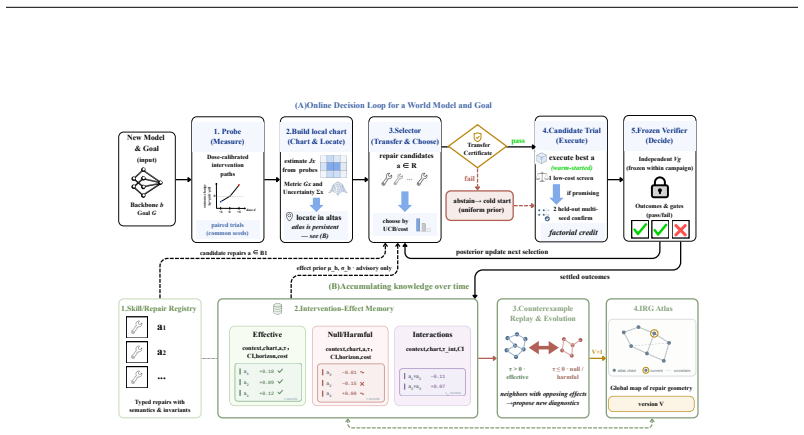
The central object is the Optimization Fingerprint $φ_x = (J_x, G_x, Σ_x)$, where $J_x$ is the paired finite-difference response Jacobian of the world model under shared inference-time probes, $G_x$ is the induced weighted repair metric, and $Σ_x$ is bootstrap uncertainty. The Interventional Repair Geometry (IRG) is the map of these fingerprints with an uncertainty-weighted distance $d_{IRG}$; the transfer-prioritization certificate (a product of six binary checks: compilability, support overlap, evidence sufficiency, response alignment, sign agreement, and lower-bounded gain over cold start) decides only whether a candidate may be tested, never that it transfers. Counterexample-driven probe evolution completes the loop by adding new probe directions only when IRG collisions show the current basis aliases distinct repair states and only when nested replay shows the addition reduces selection regret.
What would settle it
Find two world models whose IRG distance is below the certificate's neighbor threshold yet for which a validated skill has opposite signed effects on the target after confirmation; a systematic collection of such collisions at a rate well above the certificate's stated 0.06 negative transfer, on held-out backbones not used to build the archive, would show that fingerprint proximity does not license the transfer claim.
Extended reading notes
Core claim
The paper's central discovery is the dissociation between retrieval and transfer. VERDI characterizes each world model by a fingerprint built from paired, dose-calibrated, inference-only probe responses (a response Jacobian, a weighted metric, and bootstrap uncertainty). Retrieval ranks candidate repairs by distance in the Interventional Repair Geometry (IRG), but every candidate must pass a six-term compatibility certificate and then be validated under the target's frozen verifier before it is written into memory; positive, null, harmful, and interaction outcomes are all stored. The system also treats failed transfers as evidence that the probe basis is underspecified: when two nearby fingerprints yield opposing validated effects for the same repair, that collision triggers a regret-gated probe evolution that refines the geometry itself. The claim is therefore not just that verification prevents harm, but that the diagnostic representation is learnable and improves across campaigns.
Load-bearing premise
The argument rests on the premise that two world models which respond similarly to a fixed set of inference-time probes will also respond similarly to optimization repairs; if the probe basis misses a transfer-relevant distinction, retrieval becomes actively misleading.
Editorial extensions
If this is right
- World-model optimization can accumulate: a single verified repair, with its boundary annotations, becomes reusable evidence for future models without rediscovery.
- Negative transfer is filterable: the certificate can cut harmful reuse by more than fivefold while keeping the speed of unconditional reuse.
- Failures are productive: every IRG collision is a work order for a new diagnostic probe, so the system's representation of model behavior improves with experience.
- Effect records are paired change vectors, not scores: a repair that improves one metric while violating a protected coordinate is stored as a boundary, so trade-offs are visible before any transfer decision.
- Transfer is licensed, not assumed: retrieved strategies only change candidate order; the frozen target-side verifier remains the sole authority for accepting a claim.
Reading between the lines
- If IRG distance is treated as a metric over optimization behavior, the same machinery could rank not just repairs but whole optimization goals, letting one campaign decide which objectives are safe to pursue jointly.
- The fingerprint's dependence on a fixed probe library suggests a natural stress test: repeatedly re-learning probes from scratch and comparing convergence would reveal whether the representation self-improves or merely grows.
- Collision-driven probe evolution is analogous to active learning on the geometry; one could make the regret gate adaptive per campaign rather than global.
- The 0.83 sign agreement predicts transfer sign on held-out pairs; a natural extension would be calibrated probabilities, so abstention rates can be set by a user's tolerance for harmful transfers.
Signed reviews
Editorial analysis
A structured set of objections, weighed in public.
Referee Report
Summary. The paper proposes VERDI, a continual framework for world-model optimization whose central principle is 'retrieval is not transfer': prior optimization strategies retrieved from an archive are treated only as target-side hypotheses, and they become reusable knowledge only after experimental validation under a frozen verifier. The framework couples an Optimization Fingerprint (a probe-based response Jacobian), an Interventional Repair Geometry (IRG) over those fingerprints, a compatibility certificate that licenses transfer-prioritized trials, and a continual evidence memory. Experiments cover within-backbone repairs on Ctrl-World, Cosmos, and RoboCoin, plus a leave-one-backbone-out transfer study in which certified reuse is claimed to reach the first strict-gate positive in 3.6 trials and 96 GPU-hours versus 11.2 trials and 312 GPU-hours for cold start, and to reduce negative transfer from 0.34 to 0.06 while achieving 0.83 sign agreement. The appendices provide extensive ablations, including certificate leave-one-term-out, planted-fault audits, screening recall, and a selector-source ablation that honestly reports that the selector is not the source of the gains.
Significance. If the empirical claims hold, the paper makes a useful contribution to autonomous research-agent evaluation: it replaces opportunistic reuse with an evidence-licensed reuse protocol, and it makes several design choices that raise the credibility of the evaluation. Particularly strong points are the frozen verifier per campaign, paired trials with common seeds, the frozen per-fold archive in the leave-one-backbone-out protocol, the explicit reporting of null and harmful results, and the control-plane audits under planted faults. The explicit negative result that the online selector is not the source of the gains, and the finding that ungated probe growth does not help, are valuable calibration signals for the community. The central quantitative claim, however, depends on a metric, the negative-transfer rate, that is never defined in the manuscript; until that is fixed and per-fold data are reported, the headline reduction from 0.34 to 0.06 cannot be independently checked.
major comments (2)
- [§4.5, Table 4] The negative-transfer rate is never defined. Section 4.1 defines trials, C_first+, and overhead, but no formula, numerator, denominator, or counting rule is given for the 'Neg. transfer' column in Table 4 or for the same column in Tables 7 and 14. The abstract's headline claim ('negative transfer from 0.34 to 0.06') is exactly this undefined quantity, so the central empirical claim is unverifiable as written. This is not a cosmetic omission: the unconditional-reuse and certified-reuse rows may be measuring different populations, since certified reuse screens every candidate before admitting it while unconditional reuse does not. Please define the rate precisely (per campaign? per trial? per admitted trial? how are abstentions counted?), report per-fold and per-seed counts, and give confidence intervals or raw seed-level values. With only a few LOBO folds and three seeds, a single fold can dominate the aggregate, and the current point estimates do not allow the reader to assess that risk.
- [§4.5, LOBO protocol] The leave-one-backbone-out procedure is underspecified at the level needed to audit the central transfer result. The text says Table 4 'aggregates the rotated held-out folds with fresh target IDs' and that 'the two named source backbones are representative, not exhaustive,' but it never lists the folds or reports per-fold trials, GPU-hours, and negative-transfer values. Appendix Table 5 inventories shared prior archives, but it does not give the fold structure. Because the speedup claim (3.6 vs. 11.2 trials, 96 vs. 312 GPU-h) is the paper's principal quantitative evidence for the 'retrieval is not transfer' principle, the reader needs to know exactly which backbones were held out in each fold and whether the result is stable across folds. Please include a fold-by-fold table and state how source campaigns were selected for each fold.
minor comments (5)
- [§2, Related Work] The related-work section contains duplicated text: the sentence about SWE-agent and Agent Laboratory appears twice, and the sentence beginning 'Benchmarks such as CORE-Bench and PaperBench also expose...' also appears twice. Please deduplicate.
- [Abstract / front matter] After the abstract, the text contains the fragment 'Reflect/Continue to the next step' followed by unrelated strings such as '销售财务市场营销HR0'. This appears to be a formatting artifact and should be removed before resubmission.
- [§3.3 and §A.4] The compatibility certificate is stated twice, as Eq. (7) and as Eq. (15), with identical content. Please keep one formal definition and cross-reference the other, or state explicitly that the second is a restatement for the appendix.
- [Throughout] The system name is rendered inconsistently as 'VERDI', 'Verdi', and 'VerdiWM'. Please use a single convention throughout the text and figures.
- [§4.1, Settings and metrics] The phrase 'as their diversity increases' is grammatically awkward and appears to be an editing remnant; please revise.
Circularity Check
No significant circularity: VERDI's central claims are empirical, held-out, and not reduced to inputs by construction.
full rationale
The paper's derivation chain is empirical rather than definitional. Fingerprints are constructed from paired inference-time probe responses (Eq. 3) that do not include the repair effects being predicted; IRG distance (Eq. 14) is computed from these fingerprints and used only to rank hypotheses. The certificate (Eq. 7) is calibrated on pre-target source campaigns and excludes target records from the LOBO archive, and target-side effects are measured under a frozen verifier before being admitted as evidence. The headline result 'retrieval is not transfer' is presented as a design principle, not as a theorem derived from the equations, and the experiments could in principle falsify it (e.g., if unconditional reuse had matched certified reuse). The ablations, certificate leave-one-term-out, progressive-fidelity screening, and collision-driven probe evolution are evaluated on held-out domains, and the paper explicitly states that H/I/E single-axis controls do not establish causal identification. The skeptic's concern that the negative-transfer rate in Table 4 is never defined is a reporting and verifiability gap, not a circularity of the kind that would raise the circularity score; per the reviewing rules, such measurement concerns belong under correctness risk rather than a finding of circular derivation.
Assumptions & free parameters
free parameters (6)
- Transfer certificate thresholds (rho_min, n_min, epsilon_align, gamma, delta_G) =
not reported
- Validity-gate tolerance tau =
1.5x seed-level SD (default)
- Probe dose delta for finite differences =
not reported
- IRG neighbor threshold tau_q and collision confidence alpha_c =
tau_q = 7.5; alpha_c not reported
- IRG distance weights W_dist and outcome weights W_q =
not reported
- Selector exploration coefficient beta_t =
not reported
assumptions (5)
- domain assumption A shared library of reversible, inference-only probes with the same behavioral contract can characterize optimization-relevant behavior across heterogeneous world models.
- domain assumption The frozen verifier V_t correctly measures the user objective and all protected constraints.
- domain assumption Prior metric correlation structures can be encoded as gate thresholds that prevent silent trade-offs.
- domain assumption Paired local repair effects estimated with common seeds and contexts are stable enough to transfer under matched support.
- standard math Bootstrap uncertainty estimates and one-sided lower confidence bounds are valid.
invented entities (3)
-
Optimization Fingerprint (phi = (J, G, Sigma))
-
Interventional Repair Geometry (IRG)
-
IRG collision
Cite this review
Pith. "Pith review of verdi: retrieval is not transfer for continual world model optimization." pith.science (2026). https://pith.science/paper/PYVH2H23
@misc{pith2026260809537,
  author       = {Pith},
  title        = {Pith review of: verdi: retrieval is not transfer for continual world model optimization},
  year         = {2026},
  howpublished = {\url{https://pith.science/paper/PYVH2H23}},
  note         = {Machine review of arXiv:2608.09537}
}
read the original abstract
Foundation world models have made remarkable progress in planning, simulation, and embodied intelligence. However, optimizing a pretrained world model toward a user-specified objective remains difficult: each campaign typically rediscovers optimization strategies from scratch, and the resulting knowledge rarely transfers to the next model. Existing research agents automate the optimization loop but treat successful strategies as directly reusable recipes, without principled safeguards for when transfer is appropriate. We argue instead that retrieval is not transfer: a strategy validated on one model is at best an optimization hypothesis for another, and becomes transferable knowledge only after target-side experimental valida- tion. Guided by this principle, we propose VERDI , a continual framework for evidence-licensed world model optimization. VERDI characterizes each world model through shared inference-time probes to construct an Optimization Fin- gerprint, retrieves relevant prior experience as ranked hypotheses, and validates every candidate under a frozen target-side verifier before admitting it as reusable evidence; contradictions among nearby fingerprints further trigger probe evolution, continually refining the diagnostic representation itself. Experiments on Ctrl-World, the Cosmos family, and RoboCoin show that VERDI reduces search cost by 68%, GPU cost by 69%, and negative transfer from 0.34 to 0.06, while predicting transfer outcomes with 83% sign accuracy.
Figures


Figures from the paper (11 more)


Reference graph
Works this paper leans on
-
[2]
Yanjiang Guo, Lucy Xiaoyang Shi, Jianyu Chen, and Chelsea Finn. Ctrl-world: A controllable generative world model for robot manipulation.arXiv preprint arXiv:2510.10125,
-
[3]
World models.arXiv preprint arXiv:1803.10122,
David Ha and Jürgen Schmidhuber. World models.arXiv preprint arXiv:1803.10122,
-
[4]
doi: 10.1038/s41586-025-08744-2. Yuci Han and Alper Yilmaz. Enhancing policy learning with world-action model.arXiv preprint arXiv:2603.28955,
-
[6]
LaMo: Self-Supervised Latent Motion Priors for Physical Realism in Video Generation
Bo Jiang, Depu Meng, Yihan Hu, Yichen Xie, Tianshuo Xu, and Wei Zhan. Lamo: Self-supervised latent motion priors for physical realism in video generation.arXiv preprint arXiv:2605.23878,
-
[8]
Chris Lu, Cong Lu, Robert Tjarko Lange, Jakob Foerster, Jeff Clune, and David Ha. The ai scientist: Towards fully automated open-ended scientific discovery.arXiv preprint arXiv:2408.06292,
-
[9]
Random Matrix Theory for Deep Learning: Beyond Eigenvalues of Linear Models
11 Alexander Novikov et al. Alphaevolve: A coding agent for scientific and algorithmic discovery.arXiv preprint arXiv:2506.13139,
-
[10]
Cosmos world foundation model platform for physical ai.arXiv preprint arXiv:2501.03575,
NVIDIA, Niket Agarwal, Arslan Ali, Maciej Bala, Yogesh Balaji, et al. Cosmos world foundation model platform for physical ai.arXiv preprint arXiv:2501.03575,
-
[11]
Agent laboratory: Using llm agents as research assistants.arXiv preprint arXiv:2501.04227,
Samuel Schmidgall, Yusheng Su, Ze Wang, Ximeng Sun, Jialian Wu, Xiaodong Yu, Jiang Liu, Michael Moor, Zicheng Liu, and Emad Barsoum. Agent laboratory: Using llm agents as research assistants.arXiv preprint arXiv:2501.04227,
Show all 22 references
-
[12]
Worldarena: A unified benchmark for evaluating perception and functional utility of embodied world models.arXiv preprint arXiv:2602.08971, 2026a
Yuqing Shang, Zonghao Li, Yuchen Ma, Weijie Su, Xiaobo Jin, Zan Wang, Li Jin, Xin Zhang, Yansong Tang, Hao Su, et al. Worldarena: A unified benchmark for evaluating perception and functional utility of embodied world models.arXiv preprint arXiv:2602.08971, 2026a. Yuqing Shang ...
-
[13]
Paperbench: Evaluating ai’s ability to replicate ai research.arXiv preprint arXiv:2504.01848,
Giulio Starace, Oliver Jaffe, Dane Sherburn, James Aung, Jun Shern Chan, Leon Maksin, Rachel Dias, Evan Mays, Benjamin Kinsella, Wyatt Thompson, Johannes Heidecke, Amelia Glaese, and Tejal Patwardhan. Paperbench: Evaluating ai’s ability to replicate ai research.arXiv preprint ...
-
[14]
Bridgedata v2: A dataset for robot learning at scale.arXiv preprint arXiv:2308.12952,
Homer Walke, Kevin Black, Abraham Lee, Moo Jin Kim, Max Du, Chongyi Zheng, Tony Zhao, Philippe Hansen-Estruch, Quan Vuong, Andre He, Vivek Myers, Kuan Fang, Chelsea Finn, and Sergey Levine. Bridgedata v2: A dataset for robot learning at scale.arXiv preprint arXiv:2308.12952,
-
[16]
Jimenez, Alexander Wettig, Kilian Lieret, Shunyu Yao, Karthik Narasimhan, and Ofir Press
John Yang, Carlos E. Jimenez, Alexander Wettig, Kilian Lieret, Shunyu Yao, Karthik Narasimhan, and Ofir Press. Swe-agent: Agent-computer interfaces enable automated software engineering. arXiv preprint arXiv:2405.15793,
-
[17]
Ewmbench: Evaluating scene, motion, and semantic quality in embodied world models.arXiv preprint arXiv:2505.09694,
Shijie Yue et al. Ewmbench: Evaluating scene, motion, and semantic quality in embodied world models.arXiv preprint arXiv:2505.09694,
-
[18]
Darwin-gödel machine: Open-ended self-improving agents.arXiv preprint arXiv:2505.22954,
Jenny Zhang, Shengran Hu, Cong Lu, Jeff Clune, and Robert Tjarko Lange. Darwin-gödel machine: Open-ended self-improving agents.arXiv preprint arXiv:2505.22954,
-
[19]
Irasim: Learning interactive real-robot action simulators.arXiv preprint, 2025a
Fangyuan Zhu et al. Irasim: Learning interactive real-robot action simulators.arXiv preprint, 2025a. Minjun Zhu, Qiujie Xie, Yixuan Weng, Jian Wu, Zhen Lin, Linyi Yang, and Yue Zhang. Ai scientists fail without strong implementation capability.arXiv preprint arXiv:2506.01372, ...
-
[20]
receives a LaMo (Jiang et al., 2026)-style latent-motion prior for insufficient physical consistency; Cosmos- Predict 2 (NVIDIA et al.,
2026
-
[21]
put the lid on
uses an automatically constructed data and action-conditioning adapter. We report standard video metrics (PSNR, SSIM, LPIPS, and FID), WorldArena-style semantic, depth, flow, smoothness, and consistency metrics, and rollout diagnostics appropriate to each claim. Action-conditi...
2024
-
[22]
place the fork in the pot
context group, so the retained claim is restricted to structural coordinates and the static-background failure is recorded as a boundary of the REP entry. 24 G r o u n d T r u t h C O S M O S - P r e d i c t 2 V e r d i t = 0 t = 2 t = 4 t = 6 t = 8 T i m e S t e p G r o u n d...
2024
-
[2023]
Robocoin: An open-sourced bimanual robotic data collection for integrated manipulation.arXiv preprint arXiv:2511.17441,
Shihan Wu, Xuecheng Liu, Shaoxuan Xie, Pengwei Wang, Xinghang Li, et al. Robocoin: An open-sourced bimanual robotic data collection for integrated manipulation.arXiv preprint arXiv:2511.17441,
-
[2024]
Roboclaw: An agentic framework for scalable long-horizon robotic tasks.arXiv preprint arXiv:2603.11558,
Ruiying Li, Yunlang Zhou, YuYao Zhu, Kylin Chen, Jingyuan Wang, Sukai Wang, Kongtao Hu, Minhui Yu, Bowen Jiang, Zhan Su, Jiayao Ma, Xin He, Yongjian Shen, Yang Yang, Guanghui Ren, Maoqing Yao, Wenhao Wang, and Yao Mu. Roboclaw: An agentic framework for scalable long-horizon ro...
-
[2025]
Jun Shern Chan, Neil Chowdhury, Oliver Jaffe, James Aung, Dane Sherburn, Evan Mays, Giulio Starace, Kevin Liu, Leon Maksin, Tejal Patwardhan, Lilian Weng, and Aleksander M ˛ adry
doi: 10.1145/3769733.376974. Jun Shern Chan, Neil Chowdhury, Oliver Jaffe, James Aung, Dane Sherburn, Evan Mays, Giulio Starace, Kevin Liu, Leon Maksin, Tejal Patwardhan, Lilian Weng, and Aleksander M ˛ adry. Mle- bench: Evaluating machine learning agents on machine learning e...
-
[2026]
Mlagentbench: Evaluating language agents on machine learning experimentation.arXiv preprint arXiv:2310.03302,
Qian Huang, Jian V ora, Percy Liang, and Jure Leskovec. Mlagentbench: Evaluating language agents on machine learning experimentation.arXiv preprint arXiv:2310.03302,
Reviewed August 11, 2026 · model on record in the stance chip above.
Discussion (0). Continue with ORCID to comment.