REVIEW 3 major objections 4 minor 47 references
Entanglement signatures of topological phase transitions in a dirty Weyl semimetal
T0 review · 3 major / 4 minor · reviewed 2026-08-01 · deepseek-v4-flash
Pith's one-line read Entanglement spectra tell the two ways a Weyl semimetal dies apart
desk verdict Useful new EDOS diagnostic with a plausible but unproven distinction between the two transition mechanisms; needs finite-size and quantitative-peak checks before I'd lean on it. read the letter →
The pith
A machine-rendered reading of the paper's core claim, the machinery that carries it, and where it could break.
The reading
What carries the argument
The entanglement density of states (EDOS), denoted ν_S(ξ), is the central object: the disorder-ensemble distribution of eigenvalues ξ of the reduced single-particle correlation matrix for a real-space bipartition. In the clean limit, topological Fermi arcs manifest as ξ=1/2 eigenvalues (maximal entanglement). Disorder replaces this delta-function with a broadened peak, and the shape of the EDOS—whether it melts into the background (disorder-driven transition) or loses spectral weight (node-annihilation transition)—is the diagnostic that distinguishes the two topological phase transitions.
What would settle it
A finite-size scaling study of the EDOS at L=10, 12, 14 for the same model would settle the issue: if the 'melting' of the ξ≈1/2 peak at W_c is mostly a small-system artifact, the peak width would decrease (or the peak would sharpen) with increasing L, rather than broaden. Alternatively, if the peak is dominated by bulk states, its center would shift away from 1/2 or its weight would scale differently with L.
Extended reading notes
Core claim
The central claim is that in a three-dimensional Weyl semimetal with a single pair of Weyl nodes, the topological Fermi arcs leave a sharp imprint on the entanglement spectrum: a locus of eigenvalues pinned exactly at ξ=1/2 in the reduced correlation matrix. This paper shows that for any finite disorder these eigenvalues are no longer pinned, but are replaced by a finite-width distribution centered at 1/2. The evolution of this distribution—tracked via the entanglement density of states—is qualitatively different for the two topological transitions: increasing disorder strength past W_c≈3.75t causes the peak to broaden and dissolve into the background, while tuning the mass parameter across
Load-bearing premise
The main load-bearing premise is that at the small system size L=10, the ξ≈1/2 peak in the entanglement spectrum is dominated by topological Fermi-arc states and not by bulk states that happen to have eigenvalues near 1/2; without a finite-size scaling check, this identification is unverified.
Editorial extensions
If this is right
- If the EDOS behavior is confirmed, entanglement measurements in cold-atom or photonic simulators of Weyl semimetals could be used to identify which mechanism destroys the topology.
- The result implies that even when the Weyl nodes remain stable against weak disorder, their entanglement signature already becomes non-universal, with a disorder-dependent width.
- The breakdown of the naive W² scaling of Rényi entropies near W_c provides a scalar, disorder-averaged marker for the onset of the diffusive-metal phase.
- The distinction between 'melting' and 'spectral-weight loss' suggests that the entanglement spectrum can serve as a probe of whether a transition is driven by quasiparticle destruction or by gap closing.
- The qualitative difference between the two EDOS evolutions adds a new observable to the study of dirty Weyl semimetals, complementing the more common density-of-states and transport diagnostics.
Reading between the lines
- A quantitative measure of the EDOS peak (e.g., its width and weight) would allow a finite-size scaling analysis that could confirm whether the melting at W_c is sharp or smeared by rare-region (avoided-criticality) effects. The paper notes the rare-region scenario but does not test it with its L=10 data.
- The paper's clean-limit identification of the ξ=1/2 locus with Fermi arcs rests on the known correspondence between the entanglement spectrum and surface states; an extension would be to check whether the broadened EDOS peak can be directly related to the dissolution of arc states seen in local-density calculations.
- The claim that the EDOS can distinguish the two transitions suggests a testable extension: study a Weyl semimetal with multiple pairs of nodes and track whether the EDOS shows multiple peaks or a single broadened one, which would reveal whether each pair contributes independently.
- If the entropies' W² scaling breakdown is tied to the emergence of rare regions, then higher-order Rényi entropies (i>10, which the paper also computes) might show a sharper anomaly at W_c than the low-order ones. This could be checked by the authors' own data.
- The paper uses a single disorder realization in Fig. 1(c); an ensemble-resolved view of individual spectra (not just the averaged EDOS) could clarify whether the peak broadening is due to a gradual spread of each realization's eigenvalues or to a mixture of pinned and unpinned states.
Editorial analysis
A structured set of objections, weighed in public.
Referee Report
Summary. The paper studies a minimal two-band lattice model of a Weyl semimetal with on-site disorder, focusing on how topology is destroyed in two distinct ways: by increasing disorder strength W (WSM to diffusive metal, DM) and by tuning the mass parameter m at finite disorder (WSM to normal insulator, NI). The authors compute the disorder-averaged distribution of single-particle entanglement-spectrum eigenvalues, which they call the entanglement density of states (EDOS), and Rényi entropies. In the clean limit they recover the known locus of ξ=1/2 eigenvalues mirroring Fermi arcs. With disorder, this locus broadens into a finite-width peak; the central claim is that across the WSM-DM transition the peak 'melts into the background' near W_c≈3.75t, whereas across the WSM-NI transition it disappears by gradual spectral-weight loss near m≈-1.2t at W=2.0t. They also report ΔS_i ∝ W^2 for weak disorder, breaking down near W_c, with explicit caveats about higher Rényi orders and the nonanalytic entropy kernel.
Significance. If the central claim holds, the EDOS provides a single entanglement-based observable that distinguishes quasiparticle destruction (disorder-driven transition) from node annihilation (band-parameter-driven transition) in a gapless topological phase. The numerical study is conscientious: 10,000 disorder realizations per parameter point, an independently computed KPM phase diagram, and explicit warnings about higher-Rényi deviations and the nonanalytic kernel. The novelty is moderate and fits the journal scope. However, the key qualitative distinction is currently supported by visual inspection of EDOS at one small system size (L=10) without quantitative measures or finite-size scaling, so the strength of the claim is not yet commensurate with the abstract's generality.
major comments (3)
- [§III.B, Figs. 2 and 4] The central distinction between 'melting' (W scan at m=0) and 'spectral-weight loss' (m scan at W=2.0t) is established only by visual inspection of ν_S(ξ) at L=10. No quantitative metric is reported — e.g., integrated weight in |ξ−1/2|<δ, peak width, or peak height above a fitted background — and no finite-size scaling (L=12,14) is given. At L=10 the clean signal is a small set of ξ=1/2 arc eigenvalues; once disorder is added, the dense bulk spectrum can contribute a broad hump near 1/2. The apparent difference between the two scans might then merely track the known single-particle DOS at E=0 (finite in the DM, zero in the NI) rather than a distinct entanglement signature. Please add a quantitative peak measure and finite-size dependence, and ideally a control with the arc/trivial contributions separated.
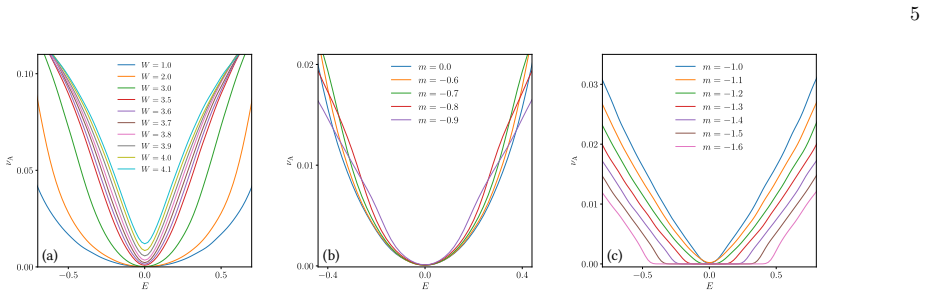
- [§II / §III.B, Fig. 1(a)] W_c≈3.75t is obtained from KPM DOS on L=100 lattices, but the EDOS and entropy data are computed at L=10. The text uses W_c as a sharp reference for the L=10 data without discussing finite-size mismatch. This is load-bearing because the cited rare-region scenario (refs. [34–36]) predicts that for three-dimensional Dirac/Weyl systems the DOS at E=0 may be nonzero for all W in the thermodynamic limit, making the 'onset of metallicity' scale-dependent. Please show W-dependence of ν_A(0) or the typical DOS at several L values and state whether the L=10 'melting' is controlled by the L→∞ critical point or by a finite-size crossover.
- [§III.B, Fig. 3(b)] The statement that ΔS_i is consistent with a leading-order W² correction is supported only by the local exponent α_i staying near 2 for W up to about 3t. No explicit perturbative calculation of the disorder-averaged correlation matrix or entropy is given, and a local logarithmic derivative can be close to 2 over a finite interval for unrelated reasons. Since this is a secondary claim, it need not block acceptance, but a brief derivation or a nontopological control would materially strengthen the interpretation.
minor comments (4)
- [§II (text near Eq. (2))] Typo: 'qudratically vanishing DOS' should be 'quadratically vanishing DOS'.
- [Figs. 2 and 4] Please specify the EDOS normalization and histogram binning, and add axes/color-scale labels. Without these, the qualitative 'melting' vs 'spectral-weight loss' distinction is difficult to reproduce or compare across figures.
- [§III.B, Fig. 3] The numerical differentiation used to define α_i(W)=d ln ΔS_i / d ln W is not described. Please specify the finite-difference or smoothing procedure and provide error estimates, particularly near W=0 and in the DM where the curves are noisy.
- [References] Ref. [42] is cited as an arXiv preprint from 2014; if it has been published, please update the reference. Also check the typesetting of author names and accents throughout the reference list.
Circularity Check
No significant circularity: the entanglement observables are checked against an independently computed DOS phase diagram; W_c and the NI boundary are reference labels, not fits to the EDOS data, and the weak-disorder scaling law is derived from the zero-mean disorder distribution before comparison.
full rationale
The paper's central results are numerical observations cross-checked against an independent phase diagram, not reductions to inputs. (1) The reference boundaries are external anchors: Sec. III.B states “we set m=0, for which the analysis of DOS indicates W_c/t≈3.75±0.1”, with the phase diagram computed separately by KPM DOS at L=100 (Appendix A, Fig. 1a), while the EDOS is obtained from exact diagonalization of the reduced correlation matrix at L=10 with 10,000 disorder realizations per parameter point. The “melting” of the ξ=1/2 peak (“until at W≈W_c the peak fully loses coherence and disappears into the background”, Sec. III.B, Fig. 2) and the spectral-weight loss (“disappears at the transition point m≈−1.2t”, Sec. III.B, Fig. 4) are visual judgments compared to these independently computed DOS boundaries; no entanglement-derived quantity was fitted to define W_c or m_c. (2) The α≈2 scaling is an a priori perturbation argument, not a fitted prediction: “As the distribution of the onsite potential V has vanishing mean, the leading disorder-averaged correction is proportional to W²” (Sec. III.B); the data in Fig. 3(b) are then checked against this prediction. (3) The identification of the ξ=1/2 locus with Fermi arcs is cited to external prior work [10,11] and independently reproduced in the clean-limit calculation of Fig. 1(b); the reference list contains no self-citations by the present authors, so no self-citation chain is load-bearing. (4) Per the review rule I flag the manuscript's own limitation passages: the text warns “caution is advertised upon interpreting such scaling, as the kernel in Eq. (4) is nonanalytic at ξ=0,1” (Sec. III.B), and Appendix A assigns conservative error bars of one full ΔW step. The absence of finite-size scaling (L=12,14) and the qualitative visual classification of melting versus weight loss at L=10 are genuine robustness/correctness risks — the distinction could in principle merely track the single-particle DOS at E=0 — but they do not constitute circularity: no observable is defined in terms of the quantity it predicts, and no fitted parameter is renamed as an output. The derivation chain is self-contained, so the honest circularity finding is 0.
Assumptions & free parameters
free parameters (2)
- W_c (critical disorder strength at m=0) =
≈3.75t (±0.1t)
- m_c (WSM-NI phase boundary at W=2.0t) =
≈-1.2t
assumptions (5)
- domain assumption The non-interacting two-orbital tight-binding Hamiltonian (Eq. 1) with μ=0 is a faithful WSM model and the ground state is a Slater determinant whose entanglement is fully captured by the single-particle correlation matrix C_ij (Peschel formalism, refs. [46,47]).
- domain assumption In the clean limit, ξ=1/2 eigenvalues of the reduced correlation matrix mirror the topological Fermi arcs (refs. [10,11]).
- domain assumption KPM DOS at L=100 with 1000 Chebyshev moments correctly classifies phases (ν∼E² WSM, gap NI, finite constant DM) with error bars of one ΔW step.
- domain assumption Averaging over 10,000 disorder realizations faithfully approximates the disorder-ensemble EDOS and averaged entropies.
- ad hoc to paper The disorder-driven WSM-DM transition occurs at a sharp W_c≈3.75t rather than being replaced by rare-region-induced avoided criticality (refs. [34-36]).
invented entities (1)
-
Entanglement density of states (EDOS), ν_S(ξ)
independent evidence
Cite this review
Pith. "Pith review of Entanglement signatures of topological phase transitions in a dirty Weyl semimetal." pith.science (2026). https://pith.science/paper/Q2DRMZML
@misc{pith2026260726660,
  author       = {Pith},
  title        = {Pith review of: Entanglement signatures of topological phase transitions in a dirty Weyl semimetal},
  year         = {2026},
  howpublished = {\url{https://pith.science/paper/Q2DRMZML}},
  note         = {Machine review of arXiv:2607.26660}
}
abstract
Three-dimensional Weyl semimetals (WSMs) constitute paradigmatic gapless topological phases whose nodal structure is stable against weak perturbations, including disorder. Two distinct ways to destroy the topology of the Weyl nodes are through pairwise annihilation in momentum space or by sufficiently strong disorder that eliminates the quasiparticle pole, driving the system into a non-Fermi-liquid diffusive-metallic state. In this work, we study the evolution of entanglement spectrum and entanglement entropy of a dirty WSM as it undergoes these two topological transitions. In the clean limit, the WSM topology is reflected by a locus of $\xi=1/2$ eigenvalues of the reduced correlation matrix mirroring the structure of Fermi arcs. We show that disorder broadens this feature into a finite-width distribution, which disappears either through a gradual loss of spectral weight upon node annihilation or by melting into the background at the onset of metallicity. When tuning across the disorder-driven transition, the scaling of the R\'enyi entropies observed for weak disorder gradually breaks down as the system approaches the critical disorder strength.
Figures


Figures from the paper (3 more)


Reference graph
Works this paper leans on
-
[1]
Yan and C
B. Yan and C. Felser, Topological materials: Weyl semimetals, Annual Review of Condensed Matter Physics 8, 337–354 (2017)
2017
-
[2]
M. Z. Hasan, S.-Y. Xu, I. Belopolski, and S.-M. Huang, Discovery of Weyl fermion semimetals and topological Fermi arc states, Annual Review of Condensed Matter Physics8, 289–309 (2017)
2017
-
[3]
N. P. Armitage, E. J. Mele, and A. Vishwanath, Weyl and Dirac semimetals in three-dimensional solids, Rev. Mod. Phys.90, 015001 (2018)
2018
-
[4]
Kitaev and J
A. Kitaev and J. Preskill, Topological entanglement en- tropy, Phys. Rev. Lett.96, 110404 (2006)
2006
-
[5]
Li and F
H. Li and F. D. M. Haldane, Entanglement spectrum as a generalization of entanglement entropy: Identification of topological order in non-Abelian fractional quantum Hall effect states, Phys. Rev. Lett.101, 010504 (2008)
2008
-
[6]
Fidkowski, Entanglement spectrum of topological in- sulators and superconductors, Phys
L. Fidkowski, Entanglement spectrum of topological in- sulators and superconductors, Phys. Rev. Lett.104, 130502 (2010)
2010
-
[7]
A. M. Turner, Y. Zhang, and A. Vishwanath, Entangle- ment and invariants of topological insulators, Phys. Rev. B82, 241102 (2010)
2010
-
[8]
T. L. Hughes, E. Prodan, and B. A. Bernevig, Inversion- symmetric topological insulators, Phys. Rev. B83, 245132 (2011)
2011
Show all 47 references
-
[9]
Alexandradinata, T
A. Alexandradinata, T. L. Hughes, and B. A. Bernevig, Trace index and spectral flow in the entanglement spec- trum of topological insulators, Phys. Rev. B84, 195103 (2011)
2011
-
[10]
H. Wang, R. Wang, Y. Pan, L. Sheng, B. G. Wang, and D. Y. Xing, Entanglement spectrum of topological Weyl semimetal, EPL (Europhysics Letters)107, 40007 (2014)
2014
-
[11]
Zhou and P
Y. Zhou and P. Ye, Entanglement signature of hinge arcs, Fermi arcs, and crystalline symmetry protection in higher-order Weyl semimetals, Phys. Rev. B107, 085108 (2023)
2023
-
[12]
Kumar, B
M. Kumar, B. Vedula, S. Gangadharaiah, and A. Sharma, Entanglement entropy as a probe of topo- logical phase transitions, Journal of Physics: Condensed Matter38, 145601 (2026)
2026
-
[13]
Prodan, T
E. Prodan, T. L. Hughes, and B. A. Bernevig, Entangle- ment spectrum of a disordered topological Chern insula- tor, Phys. Rev. Lett.105, 115501 (2010)
2010
-
[14]
M. J. Gilbert, B. A. Bernevig, and T. L. Hughes, Signa- ture of phase transitions in the disordered quantum spin Hall state from the entanglement spectrum, Phys. Rev. B86, 041401(R) (2012)
2012
-
[15]
Sbierski, G
B. Sbierski, G. Pohl, E. J. Bergholtz, and P. W. Brouwer, Quantum transport of disordered Weyl semimetals at the nodal point, Phys. Rev. Lett.113, 026602 (2014)
2014
-
[16]
C.-Z. Chen, J. Song, H. Jiang, Q.-f. Sun, Z. Wang, and X. C. Xie, Disorder and metal-insulator transitions in Weyl semimetals, Phys. Rev. Lett.115, 246603 (2015). 6
2015
-
[17]
S. V. Syzranov, L. Radzihovsky, and V. Gurarie, Crit- ical transport in weakly disordered semiconductors and semimetals, Phys. Rev. Lett.114, 166601 (2015)
2015
-
[18]
Louvet, D
T. Louvet, D. Carpentier, and A. A. Fedorenko, On the disorder-driven quantum transition in three-dimensional relativistic metals, Phys. Rev. B94, 220201(R) (2016)
2016
-
[19]
Roy, R.-J
B. Roy, R.-J. Slager, and V. Juriˇ ci´ c, Global phase dia- gram of a dirty Weyl liquid and emergent superuniver- sality, Phys. Rev. X8, 031076 (2018)
2018
-
[20]
Shapourian and T
H. Shapourian and T. L. Hughes, Phase diagrams of disordered Weyl semimetals, Phys. Rev. B93, 075108 (2016)
2016
-
[21]
Kobayashi, M
K. Kobayashi, M. Wada, and T. Ohtsuki, Ballistic trans- port in disordered Dirac and Weyl semimetals, Phys. Rev. Res.2, 022061 (2020)
2020
-
[22]
Slager, V
R.-J. Slager, V. Juriˇ ci´ c, and B. Roy, Dissolution of topo- logical Fermi arcs in a dirty Weyl semimetal, Phys. Rev. B96, 201401 (2017)
2017
-
[23]
Fradkin, Critical behavior of disordered degenerate semiconductors
E. Fradkin, Critical behavior of disordered degenerate semiconductors. II. spectrum and transport properties in mean-field theory, Phys. Rev. B33, 3263 (1986)
1986
-
[24]
Ominato and M
Y. Ominato and M. Koshino, Quantum transport in a three-dimensional Weyl electron system, Physical Review B89, 10.1103/physrevb.89.054202 (2014)
2014 doi
-
[25]
Altland and D
A. Altland and D. Bagrets, Effective field theory of the disordered Weyl semimetal, Phys. Rev. Lett.114, 257201 (2015)
2015
-
[26]
Sbierski, E
B. Sbierski, E. J. Bergholtz, and P. W. Brouwer, Quan- tum critical exponents for a disordered three-dimensional Weyl node, Phys. Rev. B92, 115145 (2015)
2015
-
[27]
B. Roy, V. Juriˇ ci´ c, and S. Das Sarma, Universal optical conductivity of a disordered Weyl semimetal, Scientific Reports6, 10.1038/srep32446 (2016)
2016 doi
-
[28]
X. Luo, B. Xu, T. Ohtsuki, and R. Shindou, Quan- tum multicriticality in disordered Weyl semimetals, Phys. Rev. B97, 045129 (2018)
2018
-
[29]
S. V. Syzranov, P. M. Ostrovsky, V. Gurarie, and L. Radzihovsky, Critical exponents at the unconventional disorder-driven transition in a Weyl semimetal, Phys. Rev. B93, 155113 (2016)
2016
-
[30]
Kobayashi, T
K. Kobayashi, T. Ohtsuki, K.-I. Imura, and I. F. Herbut, Density of states scaling at the semimetal to metal tran- sition in three dimensional topological insulators, Phys. Rev. Lett.112, 016402 (2014)
2014
-
[31]
J. H. Pixley, P. Goswami, and S. Das Sarma, Disorder- driven itinerant quantum criticality of three-dimensional massless Dirac fermions, Phys. Rev. B93, 085103 (2016)
2016
-
[32]
S. Bera, J. D. Sau, and B. Roy, Dirty Weyl semimetals: Stability, phase transition, and quantum criticality, Phys. Rev. B93, 201302(R) (2016)
2016
-
[33]
B. Fu, W. Zhu, Q. Shi, Q. Li, J. Yang, and Z. Zhang, Accurate determination of the quasiparticle and scaling properties surrounding the quantum critical point of dis- ordered three-dimensional Dirac semimetals, Phys. Rev. Lett.118, 146401 (2017)
2017
-
[34]
Nandkishore, D
R. Nandkishore, D. A. Huse, and S. L. Sondhi, Rare region effects dominate weakly disordered three- dimensional Dirac points, Phys. Rev. B89, 245110 (2014)
2014
-
[35]
J. H. Pixley, D. A. Huse, and S. Das Sarma, Rare-region- induced avoided quantum criticality in disordered three- dimensional Dirac and Weyl semimetals, Phys. Rev. X6, 021042 (2016)
2016
-
[36]
Pixley and J
J. Pixley and J. H. Wilson, Rare regions and avoided quantum criticality in disordered Weyl semimetals and superconductors, Annals of Physics435, 168455 (2021)
2021
-
[37]
J. H. Pixley, P. Goswami, and S. Das Sarma, Anderson localization and the quantum phase diagram of three di- mensional disordered Dirac semimetals, Phys. Rev. Lett. 115, 076601 (2015)
2015
-
[38]
J. H. Pixley, D. A. Huse, and S. Das Sarma, Uncovering the hidden quantum critical point in disordered massless Dirac and Weyl semimetals, Phys. Rev. B94, 121107(R) (2016)
2016
-
[39]
W. Li, L. Ding, R. Yu, T. Roscilde, and S. Haas, Scaling behavior of entanglement in two- and three-dimensional free-fermion systems, Phys. Rev. B74, 073103 (2006)
2006
-
[40]
Barthel, M.-C
T. Barthel, M.-C. Chung, and U. Schollw¨ ock, Entangle- ment scaling in critical two-dimensional fermionic and bosonic systems, Phys. Rev. A74, 022329 (2006)
2006
-
[41]
Swingle, Entanglement entropy and the Fermi surface, Phys
B. Swingle, Entanglement entropy and the Fermi surface, Phys. Rev. Lett.105, 050502 (2010)
2010
-
[42]
A. C. Potter, Boundary-law scaling of entanglement en- tropy in diffusive metals (2014), arXiv:1408.1094 [cond- mat.str-el]
2014 arXiv
-
[43]
S. Liu, T. Ohtsuki, and R. Shindou, Effect of disorder in a three-dimensional layered Chern insulator, Phys. Rev. Lett.116, 066401 (2016)
2016
-
[44]
Klier, I
J. Klier, I. V. Gornyi, and A. D. Mirlin, From weak to strong disorder in Weyl semimetals: Self-consistent Born approximation, Phys. Rev. B100, 125160 (2019)
2019
-
[45]
Weiße, G
A. Weiße, G. Wellein, A. Alvermann, and H. Fehske, The kernel polynomial method, Rev. Mod. Phys.78, 275 (2006)
2006
-
[46]
Peschel, Calculation of reduced density matrices from correlation functions, J
I. Peschel, Calculation of reduced density matrices from correlation functions, J. Phys. A: Math. Gen.36, L205 (2003)
2003
-
[47]
Peschel, On the entanglement entropy for an XY spin chain, J
I. Peschel, On the entanglement entropy for an XY spin chain, J. Stat. Mech.: Theory Exp.2004(12), P12005
2004
Reviewed August 1, 2026 · model on record in the stance chip above.
Discussion (0). Continue with ORCID to comment.