REVIEW 4 major objections 5 minor 98 references
First-place Solution for Streetscape Shop Sign Recognition Competition
T0 review · 4 major / 5 minor · reviewed 2026-08-10 · deepseek-v4-flash
Pith's one-line read A four-stage pipeline combining signboard detection, graph-based text grouping, and self-supervised pretrained recognition won first place in the shop-sign recognition competition with an F-score of 0.6672.
desk verdict A first-place competition score that's externally grounded but an ablation table with no baseline, protocol, or error bars; treat as a technical report, not a research paper. read the letter →
The pith
A machine-rendered reading of the paper's core claim, the machinery that carries it, and where it could break.
The reading
What carries the argument
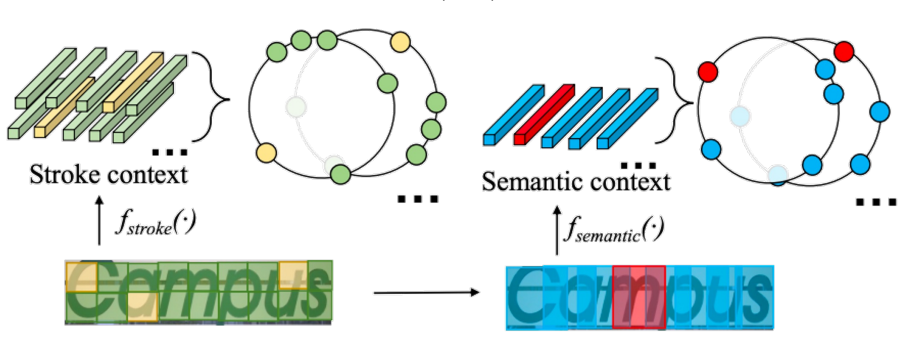
The key machinery is the joint text detection and key information extraction network, which fuses positional and image embeddings of detected text boxes and passes them through a graph neural network to decide which text belongs to a store signboard. This stage is trained end-to-end from a two-stage text detector, following the feature-sampling-and-grouping paradigm the paper cites as [73]. Supporting machinery includes the signboard detector (Mask-RCNN with deformable convolutions, four-vertex keypoint regression branches, and copy-and-paste plus perspective augmentation), perspective rectification that transforms the minimum enclosing quadrilateral into a corrected rectangular region, and a text recognizer pre-trained with sequential contrastive learning and with stroke-and-semantic masked image modeling based on MAE.
What would settle it
Re-run the pipeline on the same competition test set, removing one technique at a time with a fixed random seed and reporting standard deviations; if removing self-supervised pre-training does not lower the F-score by roughly 3.2 points, or if any of the seven listed gains reverse sign, the causal attribution in the paper's results table is refuted.
Extended reading notes
Core claim
The paper's central claim is that a multi-stage system, rather than a single end-to-end model, is the winning design for street-view shop sign recognition. The authors report that their system won first place among 14 teams on the competition's evaluation set, with a store-sign recognition F-score of 0.6672. They attribute the margin to seven quantified gains: deformable convolutions (+0.6%), BoxDQN reinforcement-learning box adjustment (+1.6%), a ViT backbone (+2.5%), self-supervised pre-training (+3.2%), multimodal modeling with a graph neural network (+2.9%), perspective text rectification (+2.6%), and Center Loss for text recognition (+0.8%). The pipeline proceeds by detecting signboard quadrilaterals with instance segmentation, detecting text and simultaneously deciding which text belongs to a store signboard, recognizing the text with horizontal and vertical models trained under two self-supervised objectives, and merging text blocks into store names using reading-order heuristics without a learned model.
Load-bearing premise
The load-bearing premise is that the reported improvements from each added technique are real and caused by that technique, since the paper gives no controlled comparisons or uncertainty estimates.
Editorial extensions
If this is right
- A modular four-stage pipeline can outperform end-to-end single-model approaches on a real street-view OCR benchmark, at least on the competition's evaluation set.
- Self-supervised pre-training is the largest single contributor in this system, worth a claimed +3.2% F-score gain, so investing in unlabeled text-image pre-training may pay off more than architecture changes.
- Perspective rectification of the signboard quadrilateral before recognition contributes +2.6%, meaning geometric correction is a meaningful part of the accuracy budget.
- The graph neural network for assigning text to signboards contributes +2.9%, supporting the paper's claim that joint text detection and key information extraction share useful features.
- The authors state that the framework can be quickly implemented and applied in industry for tasks such as rebuilding realistic maps.
Reading between the lines
- The paper does not provide code, checkpoints, or an ablation protocol, so the only way to confirm that the Table 1 gains are causal is to re-run the pipeline on the same data with controlled removals.
- Because no separate validation split is described, the evaluation set may have been used for model selection; if so, the reported gains could be optimistically biased relative to a fresh test set.
- The same four-stage recipe could transfer to other text-in-the-wild tasks such as license plate recognition or document photo OCR, but transfer performance is not reported.
- A learned sequence model or vision-language model could plausibly improve on the rule-based reading-order merging stage for complex multi-block signboards, a direction the paper leaves implicit.
Editorial analysis
A structured set of objections, weighed in public.
Referee Report
Summary. The paper reports a first-place solution for a streetscape shop sign recognition competition. The method is a multi-stage pipeline: (1) signboard detection using Mask R-CNN enhanced with deformable convolutions, keypoint regression on quadrilateral vertices, and data augmentation; (2) joint text detection and key information extraction via a two-stage detector, graph neural network, and a reinforcement-learning-based BoxDQN component; (3) text recognition using a SAR-based model upgraded with a ViT backbone, bidirectional LSTMs, self-supervised pre-training, and Center Loss; and (4) heuristic reading-sequence prediction. The authors report an F-score of 0.6672 and first place among 14 teams, and Table 1 lists per-method gains for seven components. The central claim is that comprehensive experiments validate the effectiveness of these methods.
Significance. If the competition result is accurate, the paper documents a competitive end-to-end system for a practical OCR task, and the external first-place score is a meaningful existence proof. However, the scientific value beyond that score is currently weak: the ablation table (Table 1) lacks a baseline, protocol, error bars, and dataset split information, so the per-method attributions are not verifiable. No code or data is provided. The paper's contribution as a research article therefore rests almost entirely on an unreproducible competition score and a list of known techniques applied in a pipeline.
major comments (4)
- [Section 2.5, Table 1] Table 1 reports seven 'Gain (%' values (0.6, 1.6, 2.5, 3.2, 2.9, 2.6, 0.8) with no stated baseline, no definition of what configuration or metric the gains are measured on, no indication of whether each component is toggled individually or added cumulatively, and no error bars or number of runs. If these are F-score percentage-point increments on the competition metric and are additive, the implied baseline is about 0.525, but no baseline score appears anywhere in the paper. Without this protocol information, the abstract's claim that 'comprehensive experiments have validated the effectiveness of these methods' is unsupported.
- [Section 3.2 and Section 1.3.1] The evaluation set contains only about 500 images, and the paper does not state whether the gains in Table 1 were computed on that test set or on a held-out validation split. Since the described pipeline was developed for the competition, it is likely that the test set was used for model selection, making the per-method gains post-hoc attributions rather than blind predictions. The authors should clarify the evaluation protocol, and if the test set was used, they should provide a controlled validation protocol or cross-validation to support causal claims.
- [Section 2.3] The text recognition baseline is referenced as 'SAR [ ? ]' with a missing citation, and the self-supervised pre-training methods are described only at a high level (Sequential Contrast Learning and stroke/semantic masked image modeling) without specifying the pre-training data, training epochs, or how these methods are adapted to the Chinese shop-sign setting. The BoxDQN integration is also described in one sentence. These omissions make the method impossible to reproduce or compare against prior work.
- [Sections 2.1-2.4] Several components are underspecified: the graph neural network construction and multimodal feature grouping in Section 2.2, the 'copy-and-paste' and random perspective augmentation details in Section 2.1, and the reading-sequence heuristics in Section 2.4. For a methods-focused paper, this level of detail is insufficient for a reader to reimplement the pipeline or to attribute performance to specific design choices.
minor comments (5)
- [Table 1] There is a typo: 'Mutli-modal' should be 'Multi-modal'.
- [Section 2.3] The phrase 'the mural information and textual information' appears to be a typo; 'mural' is likely intended to be 'visual'.
- [References] The reference list contains many entries that are never cited in the body (e.g., [3], [4], [11], [13], [27], [29], [30], [48]-[53], and others), and reference [1] is empty. The missing citation for SAR also needs to be supplied.
- [Section 3.1] The evaluation metric description does not specify the matching criterion for a correct detection (e.g., IoU threshold) or the exact text matching rule (e.g., exact string match, handling of Chinese characters). This makes the reported F-score difficult to interpret.
- [Title and Abstract] The paper does not name the competition (e.g., year or organizing body) in the title or abstract, which makes the context of the claimed first-place result less clear to readers.
Circularity Check
No circularity found: the first-place competition result is externally grounded, and the undocumented per-method gains are a reproducibility gap rather than a self-referential reduction.
full rationale
The paper's central quantitative claim is the external competition outcome: "our team won first place among 14 teams with an F-score of 0.6672, an oral defense score of 92.86, and a combined score of 97.11" (Section 3.2). This is an external benchmark result, not a prediction derived from fitted inputs, so it cannot be circular. The component gains in Table 1 are asserted without stating the baseline configuration, ablation protocol, number of repeats, or evaluation split; this makes the causal attributions unverifiable, but no quoted text or equation shows that a gain is definitionally equal to its own input or that a fitted parameter was renamed as a prediction. The citation [74] is a self-citation because Bin Wang is a co-author, but it is used only to identify the competition and dataset in the background, not to justify a derived result. No uniqueness theorem, no ansatz smuggled via citation, and no renaming of a known result as a new contribution appears. The missing reference for the SAR baseline and the absence of an experiments section are reporting and reproducibility defects, not circularity. Therefore no circular step can be exhibited under the required standard.
Assumptions & free parameters
assumptions (2)
- domain assumption The competition's F-score is an accurate measure of store sign recognition performance.
- ad hoc to paper The ablation gains in Table 1 were measured on the competition test set with a consistent protocol.
Cite this review
Pith. "Pith review of First-place Solution for Streetscape Shop Sign Recognition Competition." pith.science (2026). https://pith.science/paper/Q42RHVJO
@misc{pith2026250102811,
  author       = {Pith},
  title        = {Pith review of: First-place Solution for Streetscape Shop Sign Recognition Competition},
  year         = {2026},
  howpublished = {\url{https://pith.science/paper/Q42RHVJO}},
  note         = {Machine review of arXiv:2501.02811}
}
read the original abstract
Text recognition technology applied to street-view storefront signs is increasingly utilized across various practical domains, including map navigation, smart city planning analysis, and business value assessments in commercial districts. This technology holds significant research and commercial potential. Nevertheless, it faces numerous challenges. Street view images often contain signboards with complex designs and diverse text styles, complicating the text recognition process. A notable advancement in this field was introduced by our team in a recent competition. We developed a novel multistage approach that integrates multimodal feature fusion, extensive self-supervised training, and a Transformer-based large model. Furthermore, innovative techniques such as BoxDQN, which relies on reinforcement learning, and text rectification methods were employed, leading to impressive outcomes. Comprehensive experiments have validated the effectiveness of these methods, showcasing our potential to enhance text recognition capabilities in complex urban environments.
Figures


Figures from the paper (5 more)



Reference graph
Works this paper leans on
-
[2]
Sequence-to-sequence contrastive learning for text recognition
Aviad Aberdam, Ron Litman, Shahar Tsiper, Oron Anschel, Ron Slossberg, Shai Mazor, R Manmatha, and Pietro Perona. Sequence-to-sequence contrastive learning for text recognition. In Proceedings of the IEEE/CVF Conference on Computer Vision and Pattern Recognition , pages 15302–15312, 2021
2021
-
[3]
Jy61 imu sensor external validity: A framework for advanced pedometer algorithm personalisation
Boris Baˇ ci´ c, Chengwei Feng, and Weihua Li. Jy61 imu sensor external validity: A framework for advanced pedometer algorithm personalisation. ISBS Proceedings Archive, 42(1):60, 2024
2024
-
[4]
Boris Baˇ ci´ c, Claudiu Vasile, Chengwei Feng, and Marian G Ciuc˘ a. Towards nation- wide analytical healthcare infrastructures: A privacy-preserving augmented knee rehabilitation case study. arXiv preprint arXiv:2412.20733 , 2024
arXiv 2024
-
[5]
Qwen-vl: A frontier large vision-language model with versatile abilities
Jinze Bai, Shuai Bai, Shusheng Yang, Shijie Wang, Sinan Tan, Peng Wang, Junyang Lin, Chang Zhou, and Jingren Zhou. Qwen-vl: A frontier large vision-language model with versatile abilities. arXiv preprint arXiv:2308.12966 , 2023
arXiv 2023
-
[6]
Decoding by contrasting knowledge: Enhancing llms’ confidence on edited facts
Baolong Bi, Shenghua Liu, Lingrui Mei, Yiwei Wang, Pengliang Ji, and Xueqi Cheng. Decoding by contrasting knowledge: Enhancing llms’ confidence on edited facts. CoRR, abs/2405.11613, 2024. doi: 10.48550/ARXIV.2405.11613. URL https://doi.org/10.48550/arXiv.2405.11613. 9
-
[7]
Make Continual Learning Stronger via C-Flat
Ang Bian, Wei Li, Hangjie Yuan, Chengrong Yu, Zixiang Zhao, Mang Wang, Aojun Lu, Pengliang Ji, and Tao Feng. Make continual learning stronger via c-flat. arXiv preprint arXiv:2404.00986, 2024
work page Pith review arXiv 2024
-
[8]
Gmn: Generative multi-modal network for practical document information extraction
Haoyu Cao, Jiefeng Ma, Antai Guo, Yiqing Hu, Hao Liu, Deqiang Jiang, Yinsong Liu, and Bo Ren. Gmn: Generative multi-modal network for practical document information extraction. In Proceedings of the 2022 Conference of the North Amer- ican Chapter of the Association for Computational Linguistics: Human Language Technologies, pages 3768–3778, 2022
2022
-
[9]
Attention where it matters: Rethinking visual document understanding with selective region concentration
Haoyu Cao, Changcun Bao, Chaohu Liu, Huang Chen, Kun Yin, Hao Liu, Yinsong Liu, Deqiang Jiang, and Xing Sun. Attention where it matters: Rethinking visual document understanding with selective region concentration. In Proceedings of the IEEE/CVF International Conference on Computer Vision , pages 19517–19527, 2023
2023
Show all 98 references
-
[10]
Deformable convolutional networks
Jifeng Dai, Haozhi Qi, Yuwen Xiong, Yi Li, Guodong Zhang, Han Hu, and Yichen Wei. Deformable convolutional networks. In Proc. ICCV, pages 764–773, 2017
2017
-
[11]
Han-Cheng Dan, Zhetao Huang, Bingjie Lu, and Mengyu Li. Image-driven predic- tion system: Automatic extraction of aggregate gradation of pavement core samples integrating deep learning and interactive image processing framework.Construction and Building Materials , 453:139056, 2024
2024
-
[12]
Evaluation of asphalt pavement texture using multiview stereo reconstruction based on deep learning
Han-Cheng Dan, Bingjie Lu, and Mengyu Li. Evaluation of asphalt pavement texture using multiview stereo reconstruction based on deep learning. Construction and Building Materials , 412:134837, 2024
2024
-
[13]
Multiple distresses detection for asphalt pavement using improved you only look once algo- rithm based on convolutional neural network
Han-Cheng Dan, Peng Yan, Jiawei Tan, Yinchao Zhou, and Bingjie Lu. Multiple distresses detection for asphalt pavement using improved you only look once algo- rithm based on convolutional neural network. International Journal of Pavement Engineering, 25(1):2308169, 2024
2024
-
[14]
An image is worth 16x16 words: Transformers for image recog- nition at scale
Alexey Dosovitskiy. An image is worth 16x16 words: Transformers for image recog- nition at scale. arXiv preprint arXiv:2010.11929 , 2020
2010 arXiv
-
[15]
Unidoc: A universal large multimodal model for simultaneous text detection, recognition, spotting and understanding, 2023
Hao Feng, Zijian Wang, Jingqun Tang, Jinghui Lu, Wengang Zhou, Houqiang Li, and Can Huang. Unidoc: A universal large multimodal model for simultaneous text detection, recognition, spotting and understanding, 2023. URL https://arxiv. org/abs/2308.11592
2023 arXiv
-
[16]
Docpedia: Unleashing the power of large multimodal model in the frequency domain for versatile document understanding
Hao Feng, Qi Liu, Hao Liu, Jingqun Tang, Wengang Zhou, Houqiang Li, and Can Huang. Docpedia: Unleashing the power of large multimodal model in the frequency domain for versatile document understanding. SCIENCE CHINA Information Sci- ences, 2024
2024
-
[17]
Mask r-cnn
Kaiming He, Georgia Gkioxari, Piotr Doll´ ar, and Ross Girshick. Mask r-cnn. In Proc. ICCV, pages 2961–2969, 2017
2017
-
[18]
Masked autoencoders are scalable vision learners
Kaiming He, Xinlei Chen, Saining Xie, Yanghao Li, Piotr Doll´ ar, and Ross Girshick. Masked autoencoders are scalable vision learners. In Proceedings of the IEEE/CVF Conference on Computer Vision and Pattern Recognition, pages 16000–16009, 2022. 10
2022
-
[19]
Mars: Mixture of auto- regressive models for fine-grained text-to-image synthesis
Wanggui He, Siming Fu, Mushui Liu, Xierui Wang, Wenyi Xiao, Fangxun Shu, Yi Wang, Lei Zhang, Zhelun Yu, Haoyuan Li, et al. Mars: Mixture of auto- regressive models for fine-grained text-to-image synthesis. In AAAI, 2025
2025
-
[20]
Ddpm-moco: Advancing industrial surface defect generation and detection with generative and contrastive learning
Yangfan He, Xinyan Wang, and Tianyu Shi. Ddpm-moco: Advancing industrial surface defect generation and detection with generative and contrastive learning. In International Joint Conference on Artificial Intelligence , pages 34–49. Springer, 2024
2024
-
[21]
Long short-term memory
Sepp Hochreiter and J¨ urgen Schmidhuber. Long short-term memory. Neural com- putation, 9(8):1735–1780, 1997
1997
-
[22]
Jittor: a novel deep learning framework with meta-operators and unified graph execution
Shi-Min Hu, Dun Liang, Guo-Ye Yang, Guo-Wei Yang, and Wen-Yang Zhou. Jittor: a novel deep learning framework with meta-operators and unified graph execution. Science China Information Sciences , 63(222103):1–21, 2020
2020
-
[23]
Composition vision-language understanding via segment and depth anything model
Mingxiao Huo, Pengliang Ji, Haotian Lin, Junchen Liu, Yixiao Wang, and Yijun Chen. Composition vision-language understanding via segment and depth anything model. CoRR, abs/2406.18591, 2024. doi: 10.48550/ARXIV.2406.18591. URL https://doi.org/10.48550/arXiv.2406.18591
-
[24]
Imc-net: Learning implicit field with corner attention network for 3d shape reconstruction
Jiongchao Jin, Huanqiang Xu, Pengliang Ji, and Biao Leng. Imc-net: Learning implicit field with corner attention network for 3d shape reconstruction. In IEEE International Conference on Image Processing (ICIP) , pages 1591–1595, 2022. doi: 10.1109/ICIP46576.2022.9897709. URL h...
2022
-
[25]
Icdar 2013 robust reading competition
Dimosthenis Karatzas, Faisal Shafait, Seiichi Uchida, Masakazu Iwamura, Lluis Gomez i Bigorda, Sergi Robles Mestre, Joan Mas, David Fernandez Mota, Jon Almazan Almazan, and Lluis Pere De Las Heras. Icdar 2013 robust reading competition. In Proc. ICDAR, pages 1484–1493, 2013
2013
-
[26]
Icdar 2015 competition on robust reading
Dimosthenis Karatzas, Lluis Gomez-Bigorda, Anguelos Nicolaou, Suman Ghosh, Andrew Bagdanov, Masakazu Iwamura, Jiri Matas, Lukas Neumann, Vijay Ra- maseshan Chandrasekhar, Shijian Lu, et al. Icdar 2015 competition on robust reading. In ICDAR, pages 1156–1160, 2015
2015
-
[27]
Frame order matters: A temporal sequence-aware model for few-shot action recognition
Bozheng Li, Mushui Liu, Gaoang Wang, and Yunlong Yu. Frame order matters: A temporal sequence-aware model for few-shot action recognition. In AAAI, 2025
2025
-
[28]
Enhancing visual document under- standing with contrastive learning in large visual-language models
Xin Li, Yunfei Wu, Xinghua Jiang, Zhihao Guo, Mingming Gong, Haoyu Cao, Yinsong Liu, Deqiang Jiang, and Xing Sun. Enhancing visual document under- standing with contrastive learning in large visual-language models. In Proceedings of the IEEE/CVF Conference on Computer Vision a...
2024
-
[29]
Real-time idling vehicles detection using combined audio-visual deep learning
Xiwen Li, Tristalee Mangin, Surojit Saha, Rehman Mohammed, Evan Blanchard, Dillon Tang, Henry Poppe, Ouk Choi, Kerry Kelly, and Ross Whitaker. Real-time idling vehicles detection using combined audio-visual deep learning. In Emerg- ing Cutting-Edge Developments in Intelligent ...
2024
-
[30]
Joint audio-visual idling vehicle detection with streamlined input dependencies
Xiwen Li, Rehman Mohammed, Tristalee Mangin, Surojit Saha, Ross T Whitaker, Kerry E Kelly, and Tolga Tasdizen. Joint audio-visual idling vehicle detection with streamlined input dependencies. arXiv preprint arXiv:2410.21170 , 2024
-
[31]
Real-time scene text detection with differentiable binarization
Minghui Liao, Zhaoyi Wan, Cong Yao, Kai Chen, and Xiang Bai. Real-time scene text detection with differentiable binarization. In Proc. AAAI, pages 11474–11481, 2020
2020
-
[32]
Hrvda: High-resolution visual document assistant
Chaohu Liu, Kun Yin, Haoyu Cao, Xinghua Jiang, Xin Li, Yinsong Liu, Deqiang Jiang, Xing Sun, and Linli Xu. Hrvda: High-resolution visual document assistant. In Proceedings of the IEEE/CVF Conference on Computer Vision and Pattern Recognition, pages 15534–15545, 2024
2024
-
[33]
Imperceptible transfer attack and defense on 3d point cloud classification
Daizong Liu and Wei Hu. Imperceptible transfer attack and defense on 3d point cloud classification. IEEE transactions on pattern analysis and machine intelli- gence, 45(4):4727–4746, 2022
2022
-
[34]
Saanet: Siamese action-units attention network for improving dynamic facial ex- pression recognition
Daizong Liu, Xi Ouyang, Shuangjie Xu, Pan Zhou, Kun He, and Shiping Wen. Saanet: Siamese action-units attention network for improving dynamic facial ex- pression recognition. Neurocomputing, 413:145–157, 2020
2020
-
[35]
Jointly cross-and self-modal graph attention network for query-based moment localization
Daizong Liu, Xiaoye Qu, Xiao-Yang Liu, Jianfeng Dong, Pan Zhou, and Zichuan Xu. Jointly cross-and self-modal graph attention network for query-based moment localization. In Proceedings of the 28th ACM International Conference on Multi- media, pages 4070–4078, 2020
2020
-
[36]
Adaptive proposal generation network for temporal sentence localization in videos
Daizong Liu, Xiaoye Qu, Jianfeng Dong, and Pan Zhou. Adaptive proposal generation network for temporal sentence localization in videos. arXiv preprint arXiv:2109.06398, 2021
2021 arXiv
-
[37]
Context-aware biaffine localizing network for temporal sentence grounding
Daizong Liu, Xiaoye Qu, Jianfeng Dong, Pan Zhou, Yu Cheng, Wei Wei, Zichuan Xu, and Yulai Xie. Context-aware biaffine localizing network for temporal sentence grounding. In Proceedings of the IEEE/CVF Conference on Computer Vision and Pattern Recognition, pages 11235–11244, 2021
2021
-
[38]
Spatiotemporal graph neural network based mask reconstruction for video object segmentation
Daizong Liu, Shuangjie Xu, Xiao-Yang Liu, Zichuan Xu, Wei Wei, and Pan Zhou. Spatiotemporal graph neural network based mask reconstruction for video object segmentation. In Proceedings of the AAAI Conference on Artificial Intelligence , volume 35, pages 2100–2108, 2021
2021
-
[39]
Memory- guided semantic learning network for temporal sentence grounding
Daizong Liu, Xiaoye Qu, Xing Di, Yu Cheng, Zichuan Xu, and Pan Zhou. Memory- guided semantic learning network for temporal sentence grounding. In Proceedings of the AAAI Conference on Artificial Intelligence , volume 36, pages 1665–1673, 2022
2022
-
[40]
Unsupervised temporal video grounding with deep semantic cluster- ing
Daizong Liu, Xiaoye Qu, Yinzhen Wang, Xing Di, Kai Zou, Yu Cheng, Zichuan Xu, and Pan Zhou. Unsupervised temporal video grounding with deep semantic cluster- ing. In Proceedings of the AAAI Conference on Artificial Intelligence , volume 36, pages 1683–1691, 2022
2022
-
[41]
Few-shot temporal sentence grounding via memory-guided semantic learning
Daizong Liu, Pan Zhou, Zichuan Xu, Haozhao Wang, and Ruixuan Li. Few-shot temporal sentence grounding via memory-guided semantic learning. IEEE Trans- actions on Circuits and Systems for Video Technology , 33(5):2491–2505, 2022. 12
2022
-
[42]
Hy- potheses tree building for one-shot temporal sentence localization
Daizong Liu, Xiang Fang, Pan Zhou, Xing Di, Weining Lu, and Yu Cheng. Hy- potheses tree building for one-shot temporal sentence localization. In Proceedings of the AAAI Conference on Artificial Intelligence , volume 37, pages 1640–1648, 2023
2023
-
[43]
Point cloud attacks in graph spectral domain: When 3d geometry meets graph signal processing
Daizong Liu, Wei Hu, and Xin Li. Point cloud attacks in graph spectral domain: When 3d geometry meets graph signal processing. IEEE Transactions on Pattern Analysis and Machine Intelligence , 2023
2023
-
[44]
A survey on text-guided 3d visual grounding: Elements, recent advances, and future directions
Daizong Liu, Yang Liu, Wencan Huang, and Wei Hu. A survey on text-guided 3d visual grounding: Elements, recent advances, and future directions. arXiv preprint arXiv:2406.05785, 2024
2024 arXiv
-
[45]
A survey of attacks on large vision-language models: Resources, advances, and future trends
Daizong Liu, Mingyu Yang, Xiaoye Qu, Pan Zhou, Yu Cheng, and Wei Hu. A survey of attacks on large vision-language models: Resources, advances, and future trends. arXiv preprint arXiv:2407.07403 , 2024
2024 arXiv
-
[46]
Pandora’s box: Towards building universal attackers against real-world large vision-language models
Daizong Liu, Mingyu Yang, Xiaoye Qu, Pan Zhou, Xiang Fang, Keke Tang, Yao Wan, and Lichao Sun. Pandora’s box: Towards building universal attackers against real-world large vision-language models. In The Thirty-eighth Annual Conference on Neural Information Processing Systems , 2024
2024
-
[47]
Nom- mer: Nominate synergistic context in vision transformer for visual recognition
Hao Liu, Xinghua Jiang, Xin Li, Zhimin Bao, Deqiang Jiang, and Bo Ren. Nom- mer: Nominate synergistic context in vision transformer for visual recognition. In Proceedings of the IEEE/CVF Conference on Computer Vision and Pattern Recog- nition, pages 12073–12082, 2022
2022
-
[48]
Lightweight mimo-wnet for single image deblurring
Mushui Liu, Yunlong Yu, Yingming Li, Zhong Ji, Wen Chen, and Yang Peng. Lightweight mimo-wnet for single image deblurring. Neurocomputing, 2023
2023
-
[49]
Cm-unet: Hybrid cnn-mamba unet for remote sensing image semantic segmentation
Mushui Liu, Jun Dan, Ziqian Lu, Yunlong Yu, Yingming Li, and Xi Li. Cm-unet: Hybrid cnn-mamba unet for remote sensing image semantic segmentation. arXiv preprint arXiv:2405.10530, 2024
2024 arXiv
-
[50]
Omniclip: Adapting clip for video recognition with spatial-temporal omni-scale feature learning
Mushui Liu, Bozheng Li, and Yunlong Yu. Omniclip: Adapting clip for video recognition with spatial-temporal omni-scale feature learning. ECAI, 2024
2024
-
[51]
Tolerant self-distillation for image classification
Mushui Liu, Yunlong Yu, Zhong Ji, Jungong Han, and Zhongfei Zhang. Tolerant self-distillation for image classification. Neural Networks, 2024
2024
-
[52]
Llm4gen: Leveraging semantic representation of llms for text-to-image generation
Mushui Liu, Yuhang Ma, Yang Zhen, Jun Dan, Yunlong Yu, Zeng Zhao, Zhipeng Hu, Bai Liu, and Changjie Fan. Llm4gen: Leveraging semantic representation of llms for text-to-image generation. In AAAI, 2025
2025
-
[53]
Envision- ing class entity reasoning by large language models for few-shot learning
Mushui Liu, Fangtai Wu, Bozheng Li, Ziqian Lu, Yunlong Yu, and Xi Li. Envision- ing class entity reasoning by large language models for few-shot learning. In AAAI, 2025
2025
-
[54]
Y. Liu, H. Chen, C. Shen, T. He, and L. Wang. Abcnet: Real-time scene text spotting with adaptive bezier-curve network. In 2020 IEEE/CVF Conference on Computer Vision and Pattern Recognition (CVPR) , 2020. 13
2020
-
[55]
Spts v2: single- point scene text spotting
Yuliang Liu, Jiaxin Zhang, Dezhi Peng, Mingxin Huang, Xinyu Wang, Jingqun Tang, Can Huang, Dahua Lin, Chunhua Shen, Xiang Bai, et al. Spts v2: single- point scene text spotting. IEEE Transactions on Pattern Analysis and Machine Intelligence, 2023
2023
-
[56]
A bounding box is worth one token: Interleaving layout and text in a large language model for document understanding, 2024
Jinghui Lu, Haiyang Yu, Yanjie Wang, Yongjie Ye, Jingqun Tang, Ziwei Yang, Binghong Wu, Qi Liu, Hao Feng, Han Wang, Hao Liu, and Can Huang. A bounding box is worth one token: Interleaving layout and text in a large language model for document understanding, 2024. URL https://a...
2024 arXiv
-
[57]
Improving zero-shot generalization for clip with variational adapter
Ziqian Lu, Fengli Shen, Mushui Liu, Yunlong Yu, and Xi Li. Improving zero-shot generalization for clip with variational adapter. ECCV, 2024
2024
-
[60]
Changing idling behavior through dynamic air quality and idle detection messaging
Tristalee Mangin, Kerry Kelly, Xiwen Li, Saba Mahmoudi, Rehman Mohammed, Ross Whitaker, Greg Madden, Pierre-Emmanuel Gaillardon, Evan Blanchard, Nathan Page, et al. Changing idling behavior through dynamic air quality and idle detection messaging. In 2024 AIChE Annual Meeting ...
2024
-
[61]
Icdar2019 robust reading challenge on multi-lingual scene text detec- tion and recognition—rrc-mlt-2019
Nibal Nayef, Yash Patel, Michal Busta, Pinaki Nath Chowdhury, Dimosthenis Karatzas, Wafa Khlif, Jiri Matas, Umapada Pal, Jean-Christophe Burie, Cheng-lin Liu, et al. Icdar2019 robust reading challenge on multi-lingual scene text detec- tion and recognition—rrc-mlt-2019. In 201...
2019
-
[62]
Faster r-cnn: towards real-time object detection with region proposal networks
Shaoqing Ren, Kaiming He, Ross Girshick, and Jian Sun. Faster r-cnn: towards real-time object detection with region proposal networks. IEEE transactions on pattern analysis and machine intelligence , 39(6):1137–1149, 2016
2016
-
[63]
Mctbench: Multimodal cognition towards text- rich visual scenes benchmark, 2024
Bin Shan, Xiang Fei, Wei Shi, An-Lan Wang, Guozhi Tang, Lei Liao, Jingqun Tang, Xiang Bai, and Can Huang. Mctbench: Multimodal cognition towards text- rich visual scenes benchmark, 2024. URL https://arxiv.org/abs/2410.11538
2024 arXiv
-
[64]
Imagpose: A unified conditional framework for pose- guided person generation
Fei Shen and Jinhui Tang. Imagpose: A unified conditional framework for pose- guided person generation. In The Thirty-eighth Annual Conference on Neural In- formation Processing Systems, 2024. 14
2024
-
[65]
Advancing pose-guided image synthesis with progressive conditional diffusion models
Fei Shen, Hu Ye, Jun Zhang, Cong Wang, Xiao Han, and Yang Wei. Advancing pose-guided image synthesis with progressive conditional diffusion models. In The Twelfth International Conference on Learning Representations
-
[66]
Imagdressing-v1: Customizable virtual dressing
Fei Shen, Xin Jiang, Xin He, Hu Ye, Cong Wang, Xiaoyu Du, Zechao Li, and Jinhui Tang. Imagdressing-v1: Customizable virtual dressing. arXiv preprint arXiv:2407.12705, 2024
2024 arXiv
-
[67]
Boosting consistency in story visualization with rich-contextual conditional diffu- sion models
Fei Shen, Hu Ye, Sibo Liu, Jun Zhang, Cong Wang, Xiao Han, and Wei Yang. Boosting consistency in story visualization with rich-contextual conditional diffu- sion models. arXiv preprint arXiv:2407.02482 , 2024
2024 arXiv
-
[68]
B. Shi, B. Xiang, and Y. Cong. An end-to-end trainable neural network for image- based sequence recognition and its application to scene text recognition. IEEE Transactions on Pattern Analysis & Machine Intelligence , 39(11):2298–2304, 2016
2016
-
[69]
Attentive eraser: Unleashing diffusion model’s object removal potential via self-attention redirection guidance, 2024
Wenhao Sun, Benlei Cui, Xue-Mei Dong, and Jingqun Tang. Attentive eraser: Unleashing diffusion model’s object removal potential via self-attention redirection guidance, 2024. URL https://arxiv.org/abs/2412.12974
2024
-
[70]
Attentive eraser: Unleashing diffusion model’s object removal potential via self-attention redirection guidance
Wenhao Sun, Xue-Mei Dong, Benlei Cui, and Jingqun Tang. Attentive eraser: Unleashing diffusion model’s object removal potential via self-attention redirection guidance. In Proceedings of the AAAI Conference on Artificial Intelligence , vol- ume 39, pages 20734–20742, 2025
2025
-
[71]
Optimal boxes: boosting end-to-end scene text recognition by adjusting annotated bounding boxes via reinforcement learning
Jingqun Tang, Wenming Qian, Luchuan Song, Xiena Dong, Lan Li, and Xiang Bai. Optimal boxes: boosting end-to-end scene text recognition by adjusting annotated bounding boxes via reinforcement learning. In European Conference on Computer Vision, pages 233–248. Springer, 2022
2022
-
[72]
You can even annotate text with voice: Transcription-only-supervised text spotting
Jingqun Tang, Su Qiao, Benlei Cui, Yuhang Ma, Sheng Zhang, and Dimitrios Kanoulas. You can even annotate text with voice: Transcription-only-supervised text spotting. In Proceedings of the 30th ACM International Conference on Mul- timedia, MM ’22, page 4154–4163, New York, NY,...
2022
-
[73]
Few could be better than all: Feature sampling and grouping for scene text detection
Jingqun Tang, Wenqing Zhang, Hongye Liu, MingKun Yang, Bo Jiang, Guanglong Hu, and Xiang Bai. Few could be better than all: Feature sampling and grouping for scene text detection. In Proceedings of the IEEE/CVF Conference on Computer Vision and Pattern Recognition , pages 4563...
2022
-
[74]
Character recognition competition for street view shop signs
Jingqun Tang, Weidong Du, Bin Wang, Wenyang Zhou, Shuqi Mei, Tao Xue, Xing Xu, and Hai Zhang. Character recognition competition for street view shop signs. National Science Review , 10(6):nwad141, 2023
2023
-
[75]
Textsquare: Scaling up text-centric visual instruction tuning
Jingqun Tang, Chunhui Lin, Zhen Zhao, Shu Wei, Binghong Wu, Qi Liu, Hao Feng, Yang Li, Siqi Wang, Lei Liao, et al. Textsquare: Scaling up text-centric visual instruction tuning. arXiv preprint arXiv:2404.12803 , 2024. 15
2024 arXiv
-
[76]
Pargo: Bridging vision-language with partial and global views
An-Lan Wang, Bin Shan, Wei Shi, Kun-Yu Lin, Xiang Fei, Guozhi Tang, Lei Liao, Jingqun Tang, Can Huang, and Wei-Shi Zheng. Pargo: Bridging vision-language with partial and global views. In Proceedings of the AAAI Conference on Artificial Intelligence, volume 39, pages 7491–7499, 2025
2025
-
[77]
Shape robust text detection with progressive scale expansion network
Wenhai Wang, Enze Xie, Xiang Li, Wenbo Hou, Tong Lu, Gang Yu, and Shuai Shao. Shape robust text detection with progressive scale expansion network. In Proc. CVPR, pages 9336–9345, 2019
2019
-
[78]
Sparse diffusion policy: A sparse, reusable, and flexible policy for robot learning
Yixiao Wang, Yifei Zhang, Mingxiao Huo, Ran Tian, Xiang Zhang, Yichen Xie, Chenfeng Xu, Pengliang Ji, Wei Zhan, Mingyu Ding, and Masayoshi Tomizuka. Sparse diffusion policy: A sparse, reusable, and flexible policy for robot learning. CoRR, abs/2407.01531, 2024. doi: 10.48550/A...
-
[79]
Dopra: Decoding over-accumulation penalization and re-allocation in specific weighting layer.arXiv preprint arXiv:2407.15130, 2024
Jinfeng Wei and Xiaofeng Zhang. Dopra: Decoding over-accumulation penalization and re-allocation in specific weighting layer.arXiv preprint arXiv:2407.15130, 2024
2024 arXiv
-
[80]
Are people located in the places they mention in their tweets? a multimodal approach
Zhaomin Xiao and Eduardo Blanco. Are people located in the places they mention in their tweets? a multimodal approach. In Nicoletta Calzolari, Chu-Ren Huang, Hansaem Kim, James Pustejovsky, Leo Wanner, Key-Sun Choi, Pum-Mo Ryu, Hsin-Hsi Chen, Lucia Donatelli, Heng Ji, Sadao Ku...
2022
-
[81]
Context helps determine spa- tial knowledge from tweets
Zhaomin Xiao, Yan Huang, and Eduardo Blanco. Context helps determine spa- tial knowledge from tweets. In Jong C. Park, Yuki Arase, Baotian Hu, Wei Lu, Derry Wijaya, Ayu Purwarianti, and Adila Alfa Krisnadhi, editors, Findings of the Association for Computational Linguistics: I...
2023 doi
-
[82]
Corporate event predictions using large language models
Zhaomin Xiao, Zhelu Mai, Zhuoer Xu, Yachen Cui, and Jiancheng Li. Corporate event predictions using large language models. In 2023 10th International Con- ference on Soft Computing & Machine Intelligence (ISCMI) , pages 193–197, 2023. doi: 10.1109/ISCMI59957.2023.10458651
2023
-
[83]
Corporate event prediction using earning call transcripts
Zhaomin Xiao, Yachen Cui, Zhelu Mai, Zhuoer Xu, and Jiancheng Li. Corporate event prediction using earning call transcripts. In Juan Antonio Lossio-Ventura, Eduardo Ceh-Varela, Genoveva Vargas-Solar, Ricardo Marcacini, Claude Tadonki, Hiram Calvo, and Hugo Alatrista-Salas, edi...
2024
-
[84]
Analyzing large language models’ capability in location prediction
Zhaomin Xiao, Yan Huang, and Eduardo Blanco. Analyzing large language models’ capability in location prediction. In Nicoletta Calzolari, Min-Yen Kan, Veronique Hoste, Alessandro Lenci, Sakriani Sakti, and Nianwen Xue, editors, Proceedings of 16 the 2024 Joint International Con...
2024
-
[85]
Short interest trend prediction with large language models
Zhaomin Xiao, Zhelu Mai, Yachen Cui, Zhuoer Xu, and Jiancheng Li. Short interest trend prediction with large language models. In Proceedings of the 2024 International Conference on Innovation in Artificial Intelligence , ICIAI ’24, page 1, New York, NY, USA, 2024. Association ...
2024
-
[86]
Short interest trend prediction
Zhaomin Xiao, Zhelu Mai, Zhuoer Xu, Youngkwang Kwon, and Jiancheng Li. Short interest trend prediction. In 2024 6th International Conference on Natural Lan- guage Processing (ICNLP), pages 352–356, 2024. doi: 10.1109/ICNLP60986.2024. 10692439
2024
-
[87]
Llmcbench: Benchmarking large language model compression for efficient deployment
Ge Yang, Changyi He, Jinyang Guo, Jianyu Wu, Yifu Ding, Aishan Liu, Hao- tong Qin, Pengliang Ji, and Xianglong Liu. Llmcbench: Benchmarking large language model compression for efficient deployment. CoRR, abs/2410.21352,
-
[88]
Score: Story coherence and retrieval enhancement for ai narratives
Qiang Yi, Yangfan He, Jianhui Wang, Xinyuan Song, Shiyao Qian, Miao Zhang, Li Sun, and Tianyu Shi. Score: Story coherence and retrieval enhancement for ai narratives. arXiv preprint arXiv:2503.23512 , 2025
2025
-
[89]
Is llama 3 good at identifying emotion? a comprehensive study
Jinran Zhang, Zhelu Mai, Zhuoer Xu, and Zhaomin Xiao. Is llama 3 good at identifying emotion? a comprehensive study. In Proceedings of the 2024 7th In- ternational Conference on Machine Learning and Machine Intelligence (MLMI) , MLMI ’24, page 128–132, New York, NY, USA, 2024....
2024
-
[90]
Exponential calibration for correlation coefficient with additive distortion measurement errors
Jun Zhang and Zhuoer Xu. Exponential calibration for correlation coefficient with additive distortion measurement errors. Statistical Analysis and Data Mining: The ASA Data Science Journal, 14(3):271–289, 2021. doi: https://doi.org/10.1002/sam. 11509. URL https://onlinelibrary...
2021 doi
-
[91]
Seeing clearly by layer two: Enhancing attention heads to alleviate hallucination in lvlms.arXiv preprint arXiv:2411.09968, 2024
Xiaofeng Zhang, Yihao Quan, Chaochen Gu, Chen Shen, Xiaosong Yuan, Shaotian Yan, Hao Cheng, Kaijie Wu, and Jieping Ye. Seeing clearly by layer two: Enhancing attention heads to alleviate hallucination in lvlms.arXiv preprint arXiv:2411.09968, 2024
2024 arXiv
-
[92]
From redundancy to relevance: Enhancing explainability in multimodal large language models
Xiaofeng Zhang, Chen Shen, Xiaosong Yuan, Shaotian Yan, Liang Xie, Wenxiao Wang, Chaochen Gu, Hao Tang, and Jieping Ye. From redundancy to relevance: Enhancing explainability in multimodal large language models. arXiv preprint arXiv:2406.06579, 2024
2024 arXiv
-
[93]
Simignore: Exploring and enhancing multimodal large model complex reasoning via similarity computation
Xiaofeng Zhang, Fanshuo Zeng, and Chaochen Gu. Simignore: Exploring and enhancing multimodal large model complex reasoning via similarity computation. Neural Networks, page 107059, 2024. 17
2024
-
[94]
Enhanc- ing multimodal large language models complex reason via similarity computation
Xiaofeng Zhang, Fanshuo Zeng, Yihao Quan, Zheng Hui, and Jiawei Yao. Enhanc- ing multimodal large language models complex reason via similarity computation. AAAI, 2025
2025
-
[95]
Yi Zhang, Pengliang Ji, Angtian Wang, Jieru Mei, Adam Kortylewski, and Alan L. Yuille. 3d-aware neural body fitting for occlusion robust 3d human pose estimation. In IEEE/CVF International Conference on Computer Vision (ICCV) , pages 9365– 9376, 2023. doi: 10.1109/ICCV51070.20...
2023
-
[96]
TabPedia: Towards Comprehensive Vi- sual Table Understanding with Concept Synergy
Weichao Zhao, Hao Feng, Qi Liu, Jingqun Tang, Shu Wei, Binghong Wu, Lei Liao, Yongjie Ye, Hao Liu, Houqiang Li, et al. TabPedia: Towards Comprehensive Vi- sual Table Understanding with Concept Synergy. arXiv preprint arXiv:2406.01326, 2024
2024 arXiv
-
[97]
Metric from human: Zero-shot monocular metric depth estimation via test-time adaptation
Yizhou Zhao, Hengwei Bian, Kaihua Chen, Pengliang Ji, Liao Qu, Shao-yu Lin, Weichen Yu, Haoran Li, Hao Chen, Jun Shen, et al. Metric from human: Zero-shot monocular metric depth estimation via test-time adaptation. In The Thirty-eighth Annual Conference on Neural Information P...
2024
-
[98]
Multi-modal in-context learning makes an ego-evolving scene text recognizer
Zhen Zhao, Jingqun Tang, Chunhui Lin, Binghong Wu, Can Huang, Hao Liu, Xin Tan, Zhizhong Zhang, and Yuan Xie. Multi-modal in-context learning makes an ego-evolving scene text recognizer. In Proceedings of the IEEE/CVF Conference on Computer Vision and Pattern Recognition , pag...
2024
-
[99]
Harmonizing visual text com- prehension and generation
Zhen Zhao, Jingqun Tang, Binghong Wu, Chunhui Lin, Shu Wei, Hao Liu, Xin Tan, Zhizhong Zhang, Can Huang, and Yuan Xie. Harmonizing visual text com- prehension and generation. arXiv preprint arXiv:2407.16364 , 2024
2024 arXiv
-
[100]
Fourier contour embedding for arbitrary-shaped text detection
Yiqin Zhu, Jianyong Chen, Lingyu Liang, Zhanghui Kuang, Lianwen Jin, and Wayne Zhang. Fourier contour embedding for arbitrary-shaped text detection. In Computer Vision and Pattern Recognition , 2021. 18
2021
- [2024]
Reviewed August 10, 2026 · model on record in the stance chip above.
Discussion (0). Continue with ORCID to comment.