REVIEW 3 major objections 6 minor 33 references
HyPER-GAN: Hybrid Patch-Based Image-to-Image Translation for Real-Time Photorealism Enhancement in Game Engines
T0 review · 3 major / 6 minor · reviewed 2026-07-14 · grok-4.5
Pith's one-line read A lightweight hybrid GAN turns game-engine renders into photoreal images at real-time speed without wrecking scene content.
desk verdict Solid real-time engineering paper: compact U-Net + hybrid real-patch adversarial batches give a clear ~6× 1080p FPS win and modest quality/semantic gains over FastCUT/REGEN and paired-only training, with public code. read the letter →
The pith
A machine-rendered reading of the paper's core claim, the machinery that carries it, and where it could break.
The reading
What carries the argument
Hybrid patch training: four non-overlapping 196×196 patches are taken from each generated image; their nearest real-world neighbors (VGG-16 features, FAISS L2) are mixed with the corresponding teacher patches so the PatchGAN discriminator must accept both domains, forcing the generator away from teacher artifacts.
What would settle it
Train the identical U-Net solely on the paired synthetic–EPE images (HyPER-GAN-EO) versus the hybrid objective; if hybrid training does not measurably lower KID to the real datasets and raise Mask2Former mIoU on the same test split, the hybrid claim fails.
Extended reading notes
Core claim
HyPER-GAN shows that a lightweight U-Net generator, trained with a hybrid adversarial objective that mixes paired photorealism-enhanced images and FAISS-matched real-world patches, can raise the visual realism of synthetic game-engine frames to real-time rates (≈34 FPS at 1080p) while preserving semantic content better than existing lightweight paired translators and better than the same architecture trained only on the paired images.
Load-bearing premise
The method assumes that nearest-neighbor real patches found by VGG-16 features are clean enough teachers that the compact network will learn real appearance without simply absorbing the artifacts already present in the photorealism-enhanced pairs.
Editorial analysis
A structured set of objections, weighed in public.
Referee Report
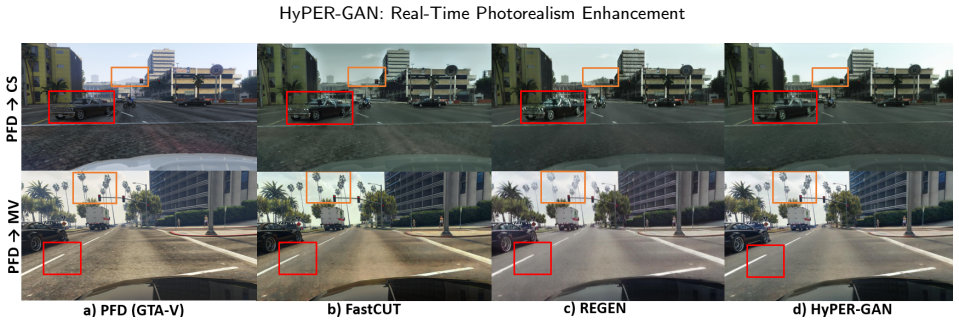
Summary. The paper proposes HyPER-GAN, a lightweight U-Net-style paired image-to-image translator for real-time photorealism enhancement of synthetic game/simulator images. It is trained on synthetic–EPE proxy pairs and a hybrid PatchGAN objective that mixes EPE target patches with FAISS-matched real-world patches (VGG-16 block-4 features, 196×196 non-overlapping patches). On GTA-V/PFD→CS/MV, the method reports ~6× higher FPS at 1080p than FastCUT/REGEN (Table 1: 33.7 vs 5.5 FPS on RTX 4070 Super), lower KID and higher Mask2Former mIoU than those baselines and than a paired-only ablation (HyPER-GAN-EO; Table 2), qualitative reduction of EPE-style artifacts (Figs. 3–4), better KID/mAP than REGEN and COSMOS Transfer1 on PFB (Table 3), and competitive cross-engine transfer to CARLA-UE5 (Table 4). Code and models are released.
Significance. If the results hold, the work is a useful systems contribution for synthetic-data pipelines and game-engine post-processing: a compact feed-forward generator that reaches real-time 1080p on mid-range GPUs while improving KID and semantic metrics over recent lightweight paired baselines, without G-buffers at inference. Strengths include public code/models, multi-metric evaluation (latency/VRAM, KID, Mask2Former mIoU, YOLO mAP), an explicit paired-only ablation, and cross-engine/diffusion comparisons. The hybrid real-patch idea is a practical way to reuse unpaired real data when only teacher-generated pairs exist. Significance is incremental rather than foundational—it depends on EPE-style teachers and modest hybrid gains—but the speed–quality tradeoff is relevant to sim2real and real-time rendering communities.
major comments (3)
- §2.2–2.3 and Eq. (5)–(6): The central content-protection claim is that FAISS L2 nearest neighbors of VGG-16 block-4 features on 196×196 patches, mixed into the PatchGAN real set with EPE targets, prevent the generator from inheriting teacher artifacts while the L1 term still pulls toward EPE. Match quality is never measured (class agreement, retrieval rank, fraction of true content neighbors vs texture-only matches), nor is residual EPE artifact rate in the paired targets quantified. Table 2 hybrid gains over EO are modest (CS KID 3.41 vs 4.06; mIoU 48.79% vs 47.04%), and Fig. 3 is qualitative. Without a match-quality or artifact-inheritance analysis, the mechanism that is said to deliver superior semantic robustness remains under-supported; the speed claim can stand, but quality superiority over lightweight paired methods needs stronger evidence that hybrid supervision is doing the clai
- §3.1 and Table 2: Semantic robustness is measured by applying Mask2Former models pretrained on CS/MV to generated images and comparing mIoU to PFD ground truth (19 CS classes). This is a reasonable proxy, but it does not isolate content preservation from domain shift of the segmenter itself, and incompatibilities with PFD labels are handled by collapsing classes to background without reporting per-class IoU or failure modes. Given that hybrid gains over EO and REGEN are small in absolute mIoU, the paper should either report per-class breakdowns / qualitative failure cases or add a content-consistency metric less dependent on a real-domain segmenter (e.g., synthetic-label agreement under a fixed synthetic-trained segmenter, or LPIPS/feature distance to the synthetic input under a content mask). Otherwise the claim of “without significantly compromising semantic consistency” rests on a sin
- Appendix B / Table 4 and abstract claim of improved cross-engine robustness: HyPER-GAN is trained on PFD (GTA-V) while REGEN/EPE baselines for CARLA-UE5 were trained on CARLA-UE4; training set sizes also differ (9,549 vs 15,011). The abstract states that hybrid training “increases the robustness in cross-engine evaluations” relative to paired-only training, but Table 4 does not report HyPER-GAN-EO on CARLA-UE5, so that specific claim is not evidenced. Either add the EO cross-engine numbers or narrow the abstract/conclusion wording to what is actually measured (competitive transfer of the hybrid model vs REGEN/EPE under mismatched training domains).
minor comments (6)
- Abstract vs body: the abstract claims temporal consistency is maintained, but the main experimental section does not report a temporal metric (e.g., warping error or flicker on PFB sequences); only Appendix A uses video inputs for COSMOS. Add a short quantitative temporal check or qualify the claim.
- §2.1 preprocessing: images are resized to 512×512 for training while evaluation is at native/1080p; briefly state whether the generator is fully convolutional and how resolution is handled at inference to avoid ambiguity.
- Eq. (3) decoder: skip connections are written as concatenations with e2/e1, but the first decoder stage has no skip from e3; a one-line architecture diagram or channel table would make the U-Net layout easier to reproduce.
- Table 1 reports mean±std over 100 images without specifying warm-up, batching, or precision (FP32/FP16); a short note would improve reproducibility of the 6× FPS claim.
- Author-block contact lines appear swapped (pstefanos vs nnik emails); fix for the camera-ready version.
- Related-work framing of REGEN and EPE is clear, but a short note on why other real-time style-transfer / G-buffer methods (beyond the two paired baselines) are out of scope would help readers place the contribution.
Circularity Check
No circular derivation: empirical Im2Im method with external KID/mIoU evaluation; self-citations are baselines/data, not load-bearing premises.
full rationale
HyPER-GAN is an engineering/empirical CV paper, not a first-principles derivation. The generator (lightweight U-Net, Eqs. 1–3), PatchGAN discriminator (Eq. 4), LSGAN+L1 objectives (Eq. 6), and FAISS/VGG-16 patch matching (Eq. 5, following EPE) are standard design choices whose success is measured by external benchmarks: KID against real CS/MV, mIoU from independently pretrained Mask2Former, FPS/VRAM on fixed hardware, and cross-engine transfer to CARLA-UE5. Training on EPE proxy pairs is teacher-dependent distillation, not circularity—the paper does not claim to predict EPE outputs or redefine photorealism as the training loss; it reports lower KID and higher mIoU than FastCUT/REGEN/EO on held-out real-domain metrics, and qualitatively fewer EPE artifacts. Self-citations (REGEN as baseline and conceptual predecessor; CARLA2Real/CARLA-UE5 for evaluation assets) supply comparison methods and datasets, not uniqueness theorems or fitted parameters renamed as predictions. No step reduces a claimed result to its inputs by construction. Score 0 with empty steps is the correct finding.
Assumptions & free parameters
free parameters (5)
- L1 reconstruction weight λ =
10
- Generator/discriminator learning rate and Adam betas =
2e-4; (0.5, 0.999)
- Training epochs / batch size =
20 epochs, bs=1 (HyPER-GAN)
- Patch size and count for matching =
4 × 196×196
- U-Net channel widths and residual depth =
64-128-256; 4 ResBlocks
assumptions (4)
- domain assumption LSGAN adversarial training plus L1 to a teacher-enhanced target yields a generator that improves photorealism while preserving structure.
- domain assumption VGG-16 block-4 conv features with L2 nearest neighbors identify semantically corresponding real patches useful as additional real adversarial targets.
- domain assumption KID to CS/MV and mIoU/mAP of real-pretrained segmenters/detectors are adequate proxies for visual realism and semantic consistency of enhanced frames.
- ad hoc to paper EPE outputs are usable paired proxy targets for the real domain despite known artifacts.
invented entities (1)
-
HyPER-GAN hybrid training objective (paired EPE patches + matched real patches in PatchGAN batches)
Cite this review
Pith. "Pith review of HyPER-GAN: Hybrid Patch-Based Image-to-Image Translation for Real-Time Photorealism Enhancement in Game Engines." pith.science (2026). https://pith.science/paper/Q6OY6CXX
@misc{pith2026260310604,
  author       = {Pith},
  title        = {Pith review of: HyPER-GAN: Hybrid Patch-Based Image-to-Image Translation for Real-Time Photorealism Enhancement in Game Engines},
  year         = {2026},
  howpublished = {\url{https://pith.science/paper/Q6OY6CXX}},
  note         = {Machine review of arXiv:2603.10604}
}
read the original abstract
Generative models are increasingly used in video game engines to enhance the photorealism of rendered images for visual synthetic data generation and simulation applications. However, they often introduce artifacts that alter the content of the original rendered scenes and require high computational resources, which limit their utilization for the photorealism enhancement of training and evaluation data, as well as their integration in the rendering pipelines of game engines. In this paper, we propose Hybrid Patch Enhanced Realism Generative Adversarial Network (HyPER-GAN), a hybrid image-to-image translation framework that is based on a lightweight U-Net-style generator capable of performing real-time inference. The framework is trained using paired rendered and photorealism-enhanced images, complemented by a novel hybrid training strategy that incorporates matched patches from unpaired real-world images to improve content preservation and further enhance the visual realism that can be achieved by the lightweight generator. Experimental results demonstrate that HyPER-GAN achieves a 6x increase in frames per second at 1080p in comparison with state-of-the-art lightweight paired image-to-image translation methods, while also increasing, in both within- and cross-engine evaluations, the photorealism of the rendered images without significantly compromising semantic consistency. Moreover, it is illustrated that HyPER-GAN maintains temporal consistency and that the proposed hybrid training strategy improves content preservation and visual realism in within-engine and increases the robustness in cross-engine evaluations compared to training the framework solely with paired rendered and photorealism-enhanced images. Code and pretrained models are publicly available at: https://github.com/stefanos50/HyPER-GAN
Figures


Figures from the paper (1 more)

Reference graph
Works this paper leans on
-
[1]
Cosmos-transfer1: Conditional world generation with adaptive multimodal control.arXiv:2503.14492
Alhaija, H.A., et al., 2025. Cosmos-transfer1: Conditional world generation with adaptive multimodal control.arXiv:2503.14492. S. Pasios et al.:Preprint submitted to ElsevierPage 6 of 7 HyPER-GAN: Real-Time Photorealism Enhancement Figure 5:Comparison of images generated by (b) COSMOS Transfer1 and (c) HyPER-GAN, given as input an image (a) from the PFB dataset
arXiv 2025
-
[2]
Hdd-unet: A unet-based architecture for low-light image enhancement
Batziou, E., Ioannidis, K., Patras, I., Vrochidis, S., Kompatsiaris, I., 2026. Hdd-unet: A unet-based architecture for low-light image enhancement. ImageandVisionComputing167,105889. doi:https: //doi.org/10.1016/j.imavis.2025.105889
-
[3]
De- mystifying mmd gans.arXiv:1801.01401
Bińkowski, M., Sutherland, D.J., Arbel, M., Gretton, A., 2021. De- mystifying mmd gans.arXiv:1801.01401
arXiv 2021
-
[4]
Cheng, B., Misra, I., Schwing, A.G., Kirillov, A., Girdhar, R., 2022. Masked-attention mask transformer for universal image segmenta- tion,in:2022IEEE/CVFConferenceonComputerVisionandPattern Recognition (CVPR), pp. 1280–1289. doi:10.1109/CVPR52688.2022. 00135
-
[5]
Cordts,M.,Omran,M.,Ramos,S.,Rehfeld,T.,Enzweiler,M.,Benen- son,R.,Franke,U.,Roth,S.,Schiele,B.,2016. Thecityscapesdataset forsemanticurbansceneunderstanding,in:2016IEEEConferenceon Computer Vision and Pattern Recognition (CVPR), pp. 3213–3223. doi:10.1109/CVPR.2016.350
-
[6]
Carla: An open urban driving simulator.arXiv:1711.03938
Dosovitskiy, A., Ros, G., Codevilla, F., Lopez, A., Koltun, V., 2017. Carla: An open urban driving simulator.arXiv:1711.03938
arXiv 2017
-
[7]
The faiss li- brary.IEEETransactionsonBigData,1–17doi:10.1109/TBDATA.2025
Douze, M., Guzhva, A., Deng, C., Johnson, J., Szilvasy, G., Mazaré, P.E., Lomeli, M., Hosseini, L., Jégou, H., 2025. The faiss li- brary.IEEETransactionsonBigData,1–17doi:10.1109/TBDATA.2025. 3618474
-
[8]
Eskandar, G., Guo, D., Guirguis, K., Yang, B., 2023. Towards pragmatic semantic image synthesis for urban scenes, in: 2023 IEEE Intelligent Vehicles Symposium (IV), pp. 1–8. doi:10.1109/IV55152. 2023.10186767
doi:10.1109/iv55152 2023
Show all 33 references
-
[9]
Dual contrastive learning for unsupervised image-to-image translation, in: 2021IEEE/CVFConferenceonComputerVisionandPatternRecog- nition Workshops (CVPRW), pp
Han, J., Shoeiby, M., Petersson, L., Armin, M.A., 2021. Dual contrastive learning for unsupervised image-to-image translation, in: 2021IEEE/CVFConferenceonComputerVisionandPatternRecog- nition Workshops (CVPRW), pp. 746–755. doi:10.1109/CVPRW53098. 2021.00084
2021 doi
-
[10]
Hoyez, H., Schockaert, C., Rambach, J., Mirbach, B., Stricker, D.,
-
[11]
Unsupervised image-to-image translation: A review. Sensors
-
[12]
doi:10.3390/s22218540
-
[13]
Toward real-time g-buffer-guided style transfer in computer games
Ioannou, E., Maddock, S., 2025. Toward real-time g-buffer-guided style transfer in computer games. IEEE Transactions on Games 17, 613–621. doi:10.1109/TG.2024.3372829
2025 doi
-
[14]
Very deep convolutional neural network based image classification using small training sample size, in: 2015 3rd IAPR Asian Conference on Pattern Recognition (ACPR), pp
Liu, S., Deng, W., 2015. Very deep convolutional neural network based image classification using small training sample size, in: 2015 3rd IAPR Asian Conference on Pattern Recognition (ACPR), pp. 730–734. doi:10.1109/ACPR.2015.7486599
2015 doi
-
[15]
Least squares generative adversarial networks, in: 2017 IEEE Inter- national Conference on Computer Vision (ICCV), pp
Mao, X., Li, Q., Xie, H., Lau, R.Y., Wang, Z., Smolley, S.P., 2017. Least squares generative adversarial networks, in: 2017 IEEE Inter- national Conference on Computer Vision (ICCV), pp. 2813–2821. doi:10.1109/ICCV.2017.304
2017 doi
-
[16]
The mapillary vistas dataset for semantic understanding of street scenes, in:2017IEEEInternationalConferenceonComputerVision(ICCV), pp
Neuhold, G., Ollmann, T., Bulò, S.R., Kontschieder, P., 2017. The mapillary vistas dataset for semantic understanding of street scenes, in:2017IEEEInternationalConferenceonComputerVision(ICCV), pp. 5000–5009. doi:10.1109/ICCV.2017.534
2017 doi
-
[17]
Effects of sim2realimagetranslationviadclganonlanekeepingassistsystemin carla simulator
Pahk, J., Shim, J., Baek, M., Lim, Y., Choi, G., 2023. Effects of sim2realimagetranslationviadclganonlanekeepingassistsystemin carla simulator. IEEE Access 11, 33915–33927. doi:10.1109/ACCESS. 2023.3262991
2023 doi
-
[18]
Contrastivelearning for unpaired image-to-image translation.arXiv:2007.15651
Park,T.,Efros,A.A.,Zhang,R.,Zhu,J.Y.,2020. Contrastivelearning for unpaired image-to-image translation.arXiv:2007.15651
2020 arXiv
-
[19]
Photorealistic synthetic crowds simulation in indoor environments (pscs-i): a novel synthetic dataset for realistic simulation of crowd panic and violence behaviors
Pasios, S., Gkountakos, K., Ioannidis, K., Tsikrika, T., Vrochidis, S., Kompatsiaris, I., 2025. Photorealistic synthetic crowds simulation in indoor environments (pscs-i): a novel synthetic dataset for realistic simulation of crowd panic and violence behaviors. IEEE Access , 1...
2025 doi
-
[20]
Carla2real: A tool for reducing the sim2real appearance gap in carla simulator
Pasios, S., Nikolaidis, N., 2025a. Carla2real: A tool for reducing the sim2real appearance gap in carla simulator. IEEE Transactions on Intelligent Transportation Systems 26, 18747–18761. doi:10.1109/ TITS.2025.3597010
2025
-
[21]
Enhancing photorealism in carla autonomous driving simulator, in: 2025 33rd European Signal Processing Conference (EUSIPCO), pp
Pasios, S., Nikolaidis, N., 2025b. Enhancing photorealism in carla autonomous driving simulator, in: 2025 33rd European Signal Processing Conference (EUSIPCO), pp. 671–675. doi:10.23919/ EUSIPCO63237.2025.11226280
2025
-
[22]
Regen: Real-time photorealism en- hancement in games via a dual-stage generative network framework
Pasios, S., Nikolaidis, N., 2026. Regen: Real-time photorealism en- hancement in games via a dual-stage generative network framework. IEEE Transactions on Games , 1–8doi:10.1109/TG.2026.3661622
2026 doi
-
[23]
Enhancing photoreal- ism enhancement
Richter, S.R., Alhaija, H.A., Koltun, V., 2023. Enhancing photoreal- ism enhancement. IEEE Transactions on Pattern Analysis and Ma- chine Intelligence 45, 1700–1715. doi:10.1109/TPAMI.2022.3166687
2023 doi
-
[24]
Playing for benchmarks, in: IEEE International Conference on Computer Vision, ICCV 2017, Venice,Italy,October22-29,2017,pp.2232–2241.doi:10.1109/ICCV
Richter, S.R., Hayder, Z., Koltun, V., 2017. Playing for benchmarks, in: IEEE International Conference on Computer Vision, ICCV 2017, Venice,Italy,October22-29,2017,pp.2232–2241.doi:10.1109/ICCV. 2017.243
2017 doi
-
[25]
Playingfordata: Ground truth from computer games.arXiv:1608.02192
Richter,S.R.,Vineet,V.,Roth,S.,Koltun,V.,2016. Playingfordata: Ground truth from computer games.arXiv:1608.02192
2016 arXiv
-
[26]
U-net: Convolutional networksforbiomedicalimagesegmentation,in:Navab,N.,Horneg- ger, J., Wells, W.M., Frangi, A.F
Ronneberger, O., Fischer, P., Brox, T., 2015. U-net: Convolutional networksforbiomedicalimagesegmentation,in:Navab,N.,Horneg- ger, J., Wells, W.M., Frangi, A.F. (Eds.), Medical Image Computing andComputer-AssistedIntervention–MICCAI2015,SpringerInter- national Publishing, Cham...
2015
-
[27]
Shaham, T.R., Gharbi, M., Zhang, R., Shechtman, E., Michaeli, T.,
-
[28]
Spatially-adaptive pixelwise networks for fast image transla- tion,in:2021IEEE/CVFConferenceonComputerVisionandPattern Recognition(CVPR),pp.14877–14886.doi:10.1109/CVPR46437.2021. 01464
2021 doi
-
[29]
Unpaired image translation via vector symbolic architectures, in: European Conference on Computer Vision
Theiss, J.D., Leverett, J., Kim, D., Prakash, A., 2022. Unpaired image translation via vector symbolic architectures, in: European Conference on Computer Vision
2022
-
[30]
Yolov12: Attention-centric real-time object detectors
Tian, Y., Ye, Q., Doermann, D., 2025. Yolov12: Attention-centric real-time object detectors. arXiv preprint arXiv:2502.12524
2025 arXiv
-
[31]
Wang, T.C., Liu, M.Y., Zhu, J.Y., Tao, A., Kautz, J., Catanzaro, B.,
-
[32]
8798–8807
High-resolution image synthesis and semantic manipulation with conditional gans, in: 2018 IEEE/CVF Conference on Computer Vision and Pattern Recognition, pp. 8798–8807. doi:10.1109/CVPR. 2018.00917
2018 doi
-
[33]
Adding conditional control to text-to-image diffusion models, in: 2023 IEEE/CVF International Conference on Computer Vision (ICCV), pp
Zhang, L., Rao, A., Agrawala, M., 2023. Adding conditional control to text-to-image diffusion models, in: 2023 IEEE/CVF International Conference on Computer Vision (ICCV), pp. 3813–3824. doi:10. 1109/ICCV51070.2023.00355. S. Pasios et al.:Preprint submitted to ElsevierPage 7 of 7
2023
Reviewed July 14, 2026 · model on record in the stance chip above.
Discussion (0). Continue with ORCID to comment.