Laser-induced demagnetization in a MAX phase (Cr0.5Mn0.5)2GaC
Pith reviewed 2026-05-12 05:18 UTC · model grok-4.3
The pith
Laser pulses trigger two-step type-II demagnetization in the MAX phase (Cr0.5Mn0.5)2GaC, a signature of its two-dimensional magnetic order.
A machine-rendered reading of the paper's core claim, the machinery that carries it, and where it could break.
Core claim
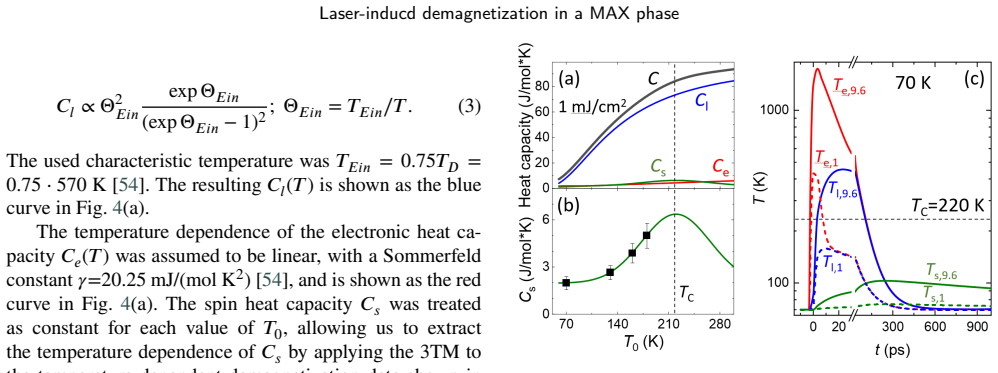
Ultrafast demagnetization in (Cr0.5Mn0.5)2GaC proceeds via a two-step type-II process characteristic of two-dimensional magnets, with the fast stage remaining small at low temperature and fluence but growing at higher excitation, while the second stage dominates with a time constant near 100 ps; the three-temperature model applied to the transients extracts coupling constants whose reconstructed spin heat capacity shows only weak temperature dependence, thereby accounting for the absence of pronounced slowing of demagnetization at elevated temperatures and fluences.
What carries the argument
Three-temperature model fitted to time-resolved magneto-optical Kerr effect transients, used to separate electron, lattice, and spin subsystems and extract their mutual coupling constants along with the spin heat capacity.
If this is right
- Optical pulses can switch the magnetization of this MAX phase on picosecond timescales with little sensitivity to operating temperature.
- The nanolaminated structure supports two-dimensional magnetic behavior that persists in a 40-nm film.
- Electron-spin and spin-lattice coupling values extracted here can serve as design parameters for other magnetic MAX phases.
- Absence of strong fluence-induced slowing allows consistent demagnetization performance across a range of excitation strengths.
- MAX phases become experimentally accessible platforms for light-controlled spintronics that combine ceramic stability with metallic conductivity.
Where Pith is reading between the lines
- The layered atomic arrangement in MAX phases likely enforces the two-dimensional character even when the film thickness exceeds a few unit cells.
- Similar two-step dynamics may appear in other Cr- or Mn-based MAX phases once their magnetic ordering temperatures are reached.
- The weak temperature dependence of the spin heat capacity could be tested by varying the Cr/Mn ratio to tune the magnetic moment density.
- Integration with existing thin-film processing routes for MAX phases could lead to hybrid devices that exploit both mechanical robustness and optical magnetic control.
Load-bearing premise
The two-step transients are taken as a direct indicator of two-dimensional magnetism and the three-temperature model is assumed to capture all relevant relaxation channels without material-specific corrections.
What would settle it
Recording single-step demagnetization transients or a strong temperature-dependent slowdown of the 100-ps stage in the same film under comparable laser conditions would falsify the central claim.
Figures


read the original abstract
Magnetic MAX phases are nanolaminated metals that combine ceramic-like thermal and mechanical stability with peculiar magnetic ordering, making them attractive for thin-film optoelectronics and spintronics. However, laser-induced magnetization dynamics in MAX phases remains largely unexplored. Here, we investigate laser-induced ultrafast demagnetization in a 40-nm-thick epitaxial film of the magnetic MAX phase (Cr0.5Mn0.5)2GaC, which magnetically orders below ~220 K, using time-resolved magneto-optical Kerr effect spectroscopy. We reveal, that the demagnetization transients exhibit a two-step type-II demagnetization, common for two-dimensional magnetic systems. The second stage dominates the process and has a characteristic time of approximately 100 ps. Applying the three-temperature model, we extract the electron-lattice, spin-lattice, and electron-spin coupling constants. The reconstructed spin heat capacity exhibits a weak temperature dependence, accounting for only a subtle slowing down of demagnetization at elevated temperatures and fluences.
Editorial analysis
A structured set of objections, weighed in public.
Referee Report
Summary. The manuscript reports time-resolved magneto-optical Kerr effect measurements on a 40-nm epitaxial film of the magnetic MAX phase (Cr0.5Mn0.5)2GaC, which orders below ~250 K. It claims that the laser-induced demagnetization transients exhibit a two-step type-II process, interpreted as a signature of two-dimensional magnetism, with the fast component small at low T/fluence and the slow (~100 ps) stage dominant. Application of the three-temperature model yields electron-lattice, spin-lattice, and electron-spin coupling constants; the reconstructed spin heat capacity shows weak temperature dependence, which is said to explain the lack of significant slowing of demagnetization at elevated temperatures and fluences.
Significance. If the central interpretation holds, the work provides the first experimental window into ultrafast magnetization dynamics in MAX phases, a class combining metallic conductivity with ceramic stability. The reported two-step transients and the derived weak C_s(T) dependence would distinguish this system from conventional 3D magnets and support optical control strategies for 2D spintronics. The experimental transients themselves are independent of the model, which is a positive feature.
major comments (3)
- [Abstract and §3] Abstract and §3 (demagnetization transients): the assertion that the observed two-step form is 'a signature of two-dimensional magnetic systems' is load-bearing for the headline claim but rests on an untested uniqueness assumption. The 40 nm thickness corresponds to dozens of M2X layers; no controls, thickness series, or comparisons to 3D-ordered analogs are presented to exclude inhomogeneous heating, multi-domain relaxation, or magnon-phonon channels that could produce similar fast-then-slow profiles in a layered but still 3D-ordered material below 250 K.
- [§4] §4 (three-temperature model fits): the reconstruction of C_s(T) and the conclusion of its weak temperature dependence are central to explaining the absence of fluence/temperature slowing, yet no raw transients, error bars, specific fluence values, or fit-quality metrics (e.g., reduced χ² or parameter covariance) are shown. Without these, it is impossible to assess whether the extracted G_es, G_sl, and C_s are uniquely constrained or affected by fitting degeneracy between C_s and the spin-lattice coupling.
- [§4] §4, Eq. (model equations): the three-temperature model is applied without material-specific corrections for the nanolaminated structure or possible additional relaxation channels. The paper does not demonstrate that the fitted parameters remain stable under reasonable variations in the assumed functional forms for C_e(T) or C_l(T), which directly impacts the claimed weak C_s(T) dependence.
minor comments (2)
- [Figures and §3] Figure captions and text should explicitly state the laser fluences used for each transient and the temperature range over which the two-step behavior is observed.
- [§4] Notation for the coupling constants (G_es, G_sl, G_el) should be defined once in the main text rather than only in the model section, and consistent symbols should be used throughout.
Simulated Author's Rebuttal
We thank the referee for the careful and constructive review of our manuscript. We address each major comment point by point below, indicating where revisions will be made to improve clarity and rigor without altering the core experimental findings.
read point-by-point responses
-
Referee: [Abstract and §3] Abstract and §3 (demagnetization transients): the assertion that the observed two-step form is 'a signature of two-dimensional magnetic systems' is load-bearing for the headline claim but rests on an untested uniqueness assumption. The 40 nm thickness corresponds to dozens of M2X layers; no controls, thickness series, or comparisons to 3D-ordered analogs are presented to exclude inhomogeneous heating, multi-domain relaxation, or magnon-phonon channels that could produce similar fast-then-slow profiles in a layered but still 3D-ordered material below 250 K.
Authors: We agree that the 40 nm film thickness corresponds to multiple M2X layers and that no thickness series or direct 3D-analog comparisons are included, so uniqueness to strictly 2D magnetism cannot be rigorously proven from the present data alone. The interpretation draws from the established association of two-step type-II transients with reduced-dimensional magnetism in the literature, but we will revise the abstract and §3 to describe the behavior as 'consistent with' or 'reminiscent of' two-dimensional systems rather than a definitive signature. We will also add a dedicated paragraph discussing possible alternative mechanisms, including inhomogeneous heating, multi-domain relaxation, and magnon-phonon channels, while noting that the epitaxial quality and sharp magnetic ordering below 250 K make such effects less likely to dominate. This addresses the concern without requiring new experiments. revision: partial
-
Referee: [§4] §4 (three-temperature model fits): the reconstruction of C_s(T) and the conclusion of its weak temperature dependence are central to explaining the absence of fluence/temperature slowing, yet no raw transients, error bars, specific fluence values, or fit-quality metrics (e.g., reduced χ² or parameter covariance) are shown. Without these, it is impossible to assess whether the extracted G_es, G_sl, and C_s are uniquely constrained or affected by fitting degeneracy between C_s and the spin-lattice coupling.
Authors: We acknowledge that additional details on the fitting procedure are needed for full assessment. In the revised manuscript we will move the raw demagnetization transients to the supplementary information, explicitly list the fluences employed, include error bars on the extracted parameters, and report fit-quality metrics including reduced χ² values and covariance matrices. We will also add a short discussion of parameter degeneracy, explaining how the weak C_s(T) dependence remains robust when G_sl is varied within physically reasonable bounds. revision: yes
-
Referee: [§4] §4, Eq. (model equations): the three-temperature model is applied without material-specific corrections for the nanolaminated structure or possible additional relaxation channels. The paper does not demonstrate that the fitted parameters remain stable under reasonable variations in the assumed functional forms for C_e(T) or C_l(T), which directly impacts the claimed weak C_s(T) dependence.
Authors: The three-temperature model is applied in its standard phenomenological form, which has been successfully used for other metallic layered magnets. To address the referee's point, the revised §4 will include a sensitivity analysis demonstrating that the extracted weak temperature dependence of C_s(T) persists when the functional forms of C_e(T) and C_l(T) are varied within literature ranges for similar metals. We will also add a brief discussion of why nanolamination-specific corrections or extra channels are not required to describe the data, based on the quality of the fits and the absence of additional features in the transients. revision: partial
- A full thickness series or direct experimental comparisons to 3D-ordered MAX-phase analogs would require fabrication and measurement of additional samples, which cannot be completed within the revision timeline.
Circularity Check
No significant circularity in derivation chain
full rationale
The demagnetization transients are measured independently via TR-MOKE spectroscopy on the epitaxial film. The two-step type-II behavior is observed in data and interpreted as a 2D signature; the 3TM is then applied to fit coupling constants (G_es, G_sl, etc.) and reconstruct Cs(T) as a model output. No equations reduce the claimed 2D attribution or weak Cs(T) dependence to prior fitted quantities by construction, and no load-bearing self-citations or ansatzes are invoked that would make results equivalent to inputs. The derivation is self-contained against the experimental benchmarks.
Axiom & Free-Parameter Ledger
free parameters (1)
- electron-lattice, spin-lattice, and electron-spin coupling constants
axioms (2)
- domain assumption Three-temperature model accurately describes the coupled electron, lattice, and spin subsystems in this MAX phase
- domain assumption Two-step type-II demagnetization transients are a signature of two-dimensional magnetic systems
Lean theorems connected to this paper
-
IndisputableMonolith/Cost/FunctionalEquation.leanwashburn_uniqueness_aczel unclear?
unclearRelation between the paper passage and the cited Recognition theorem.
Applying the three-temperature model, we extract the electron-lattice, spin-lattice, and electron-spin coupling constants. The reconstructed spin heat capacity exhibits a weak temperature dependence...
-
IndisputableMonolith/Foundation/AlexanderDuality.leanalexander_duality_circle_linking unclear?
unclearRelation between the paper passage and the cited Recognition theorem.
two-step type-II demagnetization – a signature of two-dimensional magnetic systems
What do these tags mean?
- matches
- The paper's claim is directly supported by a theorem in the formal canon.
- supports
- The theorem supports part of the paper's argument, but the paper may add assumptions or extra steps.
- extends
- The paper goes beyond the formal theorem; the theorem is a base layer rather than the whole result.
- uses
- The paper appears to rely on the theorem as machinery.
- contradicts
- The paper's claim conflicts with a theorem or certificate in the canon.
- unclear
- Pith found a possible connection, but the passage is too broad, indirect, or ambiguous to say the theorem truly supports the claim.
discussion (0)
Sign in with ORCID, Apple, or X to comment. Anyone can read and Pith papers without signing in.