REVIEW 5 major objections 6 minor 29 references
RouteWinFormer: A Route-Window Transformer for Middle-range Attention in Image Restoration
T0 review · 5 major / 6 minor · reviewed 2026-08-16 · deepseek-v4-flash
Pith's one-line read Use mid-range attention, not global, for image restoration
desk verdict A plausible restoration architecture with a wide experimental net, but the 'SOTA on 9 datasets' headline is contradicted by its own tables on Rain100H and NH-HAZE. read the letter →
The pith
A machine-rendered reading of the paper's core claim, the machinery that carries it, and where it could break.
The reading
What carries the argument
The load-bearing component is the Route-Windows Attention Module (RW AM). It averages query and key tensors within each window to form window description vectors, computes a regional similarity matrix between the central window's description and the descriptions of nearby candidate windows, applies a Softmax, and then uses TopK to keep only the $r_i$ most relevant windows. Absolute positions of those windows are recovered with a gather from an index table, relative position biases are gathered from a bias table, and the selected windows' keys and values are concatenated with the central window's before softmax attention. Two regional similarity shapes, cross-shaped and rectangle-shaped, are alternated across blocks to match stripe-like and block-like degradation patterns. A second component, Multi-Scale Structure Regularization (MSR), builds a loss term that gives each sub-scale a down-up-sampled clean target and asks the sub-scale to predict the structure residual, steering the sub-scales toward texture and structure learning.
What would settle it
Take a trained global-attention restoration model, compute its average attention distance on each of the nine datasets with an explicit normalization rule, and compare with the 0.3 threshold; if any dataset exceeds 0.3, or if increasing RouteWinFormer's top-$k$ to include farther windows improves PSNR on images with large-scale degradation, the central claim is contradicted.
Extended reading notes
Core claim
The central claim is that middle-range attention is sufficient for image restoration, and that a transformer built around dynamically selected nearby windows can outperform both fixed-window and global-attention models. The paper computes normalized average attention distance over degradation datasets and finds all values below 0.3, concluding that long-range modeling is not a practical necessity. RouteWinFormer realizes this by partitioning the feature map into non-overlapping windows, having a router score nearby candidate windows by regional similarity (cross-shaped and rectangle-shaped regions, alternated across blocks), selecting the top-$k$ most relevant windows, gathering their keys and values, and running multi-head attention over the merged set plus the central window. This cuts the attention cost from $O(h^2w^2c)$ to $O(r_i k^2 h w c)$. Training adds Multi-Scale Structure Regularization, which compares each sub-scale output with a down-up-sampled clean image and asks the sub-scale to predict the structure residual, so sub-scales learn textures and structure while the original scale learns degradation patterns. The paper reports that this design achieves the best published numbers on nine restoration benchmarks.
Load-bearing premise
The claim that middle-range attention is enough rests entirely on Figure 1's normalized average attention distance, which is reported without stating which network produced the attention maps, which images were used, or how normalization was applied; if that measurement is not representative of trained restoration models, the motivation for restricting attention to nearby windows is not established.
Editorial extensions
If this is right
- Window-based restoration transformers can drop global attention without sacrificing accuracy, reducing memory and compute on high-resolution images.
- Because window selection is content-adaptive, the effective receptive field can shrink or grow per region, unlike fixed shifted-window schemes.
- The Multi-Scale Structure Regularization term is model-agnostic and can be added to any U-shaped restoration network to improve structure fidelity.
- A single architecture with one set of hyperparameters transfers across defocus deblurring, desnowing, dehazing, and deraining, suggesting middle-range context is a shared property of these degradations.
- The complexity reduction from $O(h^2w^2c)$ to $O(r_i k^2 h w c)$ makes mid-range attention practical for high-resolution restoration inputs.
Reading between the lines
- If the attention-distance measurement is repeated with a fixed protocol (one trained model, per-dataset statistics, disclosed normalization), the 0.3 threshold could become a design rule: restore with a receptive field covering roughly the top third of the image rather than the whole image.
- The router's top-$k$ selection could be made input-adaptive in a stronger sense, for example by choosing more windows for images with large-scale degradation, which would test whether the middle-range finding holds across degradation scales.
- The structure residual predicted by MSR is close to a high-frequency detail map; a natural extension is to condition the sub-scales explicitly on edge or gradient maps of the clean image rather than only through the loss.
- The same routing idea could transfer to video restoration, where relevant context is likely found in nearby frames and neighboring spatial windows rather than across an entire frame.
Signed reviews
Editorial analysis
A structured set of objections, weighed in public.
Referee Report
Summary. The paper proposes RouteWinFormer, a U-shaped window-based Transformer for image restoration. It introduces the Route-Windows Attention Module (RW AM), which dynamically selects the top-k most relevant nearby windows on the basis of cross-shaped or rectangle-shaped regional similarity, and a Multi-Scale Structure Regularization (MSR) term that supervises sub-scale residual predictions against down/upsampled clean images. The paper reports PSNR/SSIM results on defocus deblurring (DPDD), desnowing (CSD, SRRS), dehazing (Haze4K, NH-HAZE), and deraining (Rain100H, Rain100L, Test1200), claiming state-of-the-art performance across nine datasets.
Significance. If the reported results are reproducible, the paper makes a plausible contribution: it offers a dynamic middle-range attention mechanism with a reduced complexity compared with global attention, and a model-agnostic structural regularization that is shown in the ablations to give consistent PSNR gains. The ablation studies in Tables 6 and 7 support the value of the two main components. However, the manuscript currently lacks code, model weights, dataset splits, and error bars, and several key definitions and hyperparameters are missing. More importantly, the headline claim that RouteWinFormer outperforms state-of-the-art methods across all datasets is contradicted by the paper's own tables. The core ideas are interesting, but the empirical claims need substantial correction and additional documentation before the contribution can be assessed reliably.
major comments (5)
- [Abstract and §4.2, Tables 4–5] The central claim that RouteWinFormer "outperforms state-of-the-art methods across 9 datasets" is contradicted by the paper's own tables. In Table 5, RWF-S on Rain100H reaches PSNR 31.49 / SSIM 0.904, below FSNet's 31.77 / 0.906; the text only claims superiority over ConvIR on that dataset. In Table 4, on NH-HAZE RWF-S has SSIM 0.69 versus FSNet's 0.81 and ConvIR's 0.80, a substantial structural-similarity regression despite a PSNR gain. The abstract and the start of Section 4 state "9 datasets," but the tables enumerate eight (DPDD, CSD, SRRS, Haze4K, NH-HAZE, Rain100H, Rain100L, Test1200). These inconsistencies must be resolved and the state-of-the-art claim must be made consistent with the reported numbers.
- [§1, Figure 1] The motivating measurement in Figure 1 is not reproducible as presented: the paper does not state which model produced the attention maps, which datasets and how many images were used, how the attention distance was normalized, or whether the same pretrained model was applied to all degradation types. Since average attention distance is architecture- and training-dependent, Figure 1 does not establish that long-range attention is unnecessary for image restoration. Please provide the complete measurement protocol, or soften the motivation to a qualitative observation that does not rely on an unreported experiment.
- [§3.3, Eqs. (9)–(10)] The Multi-Scale Structure Regularization is not fully specified. Equation (9) uses R_i, described as "the predicted residual image at i-th scale," but the manuscript does not define the network head or projection that produces R_i from the sub-scale features. The loss weight λ in Eq. (10) is introduced but never given a value. In addition, Eq. (11) states that α is "empirically default set to 0.1, respectively," without an ablation or reference. Please define R_i and λ explicitly and provide evidence for the choice of α.
- [§3.2, Eqs. (4)–(8) and Table 2] Several architectural hyperparameters are undefined or under-specified: the window size k, the number of candidate windows rn, and the top-k count ri do not appear in Table 2. The implementation details only say that the default ri is [1, 1, 1, 1]. Without these values, the complexity claim O(ri k^2 h w c) and the reported FLOPs cannot be verified. Please report k, rn, and ri for each model variant, and clarify how the top-k selection is performed relative to these values.
- [§4.1, Tables 1–7] The experimental evaluation is not independently checkable as reported: no code, trained models, or random seeds are provided; no error bars or confidence intervals are given; and dataset split/partition details are absent (e.g., which DPDD indoor/outdoor images are used and how NH-HAZE is evaluated). For a paper whose central claim is empirical superiority, this level of reporting is insufficient. Please release code and checkpoints, and include error bars or at least standard deviations over multiple runs.
minor comments (6)
- [Abstract] The phrase "Route-Windows Attnetion" contains a typo; it should be "Attention."
- [§4.2, Image Dehazing] The text says RouteWinFormer achieves a 0.9 dB gain over OKNet on NH-HAZE, but OKNet is not listed in Table 4; please add the comparison or correct the sentence.
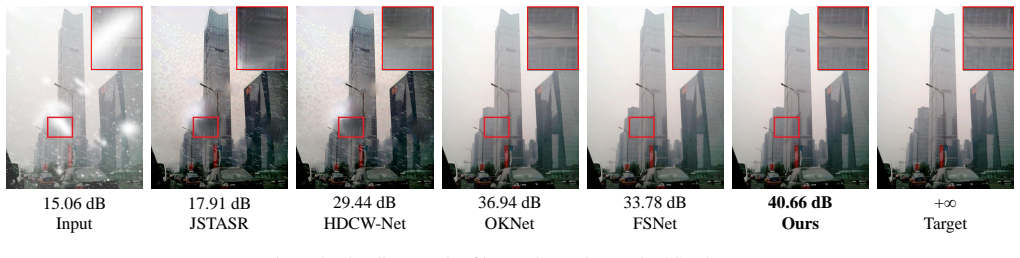
- [Figures 3–6] The PSNR labels in the qualitative figures are confusing because "Input PSNR Target" appears as a single line and the per-method values are not clearly aligned with their images; please reformat and verify the values, for example the ordering in Figure 3 is ambiguous.
- [§3.1, Eq. (2)] The notation in Eq. (2) reuses X for both the intermediate and output of the FFN, which makes the expression GELU(DWConv(Xt)) * Xb ambiguous; please introduce distinct variable names.
- [References] References [He et al., 2010a] and [He et al., 2010b] are duplicates of the same paper; merge them.
- [Table 7] The abbreviations "w MSR" and "wo MSR" are inconsistent with the "with/without MSR" phrasing used in the text; please make them uniform.
Circularity Check
No significant circularity: RouteWinFormer's central performance claims are empirical evaluations against external benchmarks, with no fit-to-prediction or self-citation chain.
full rationale
The paper's core claims are architectural: a Route-Windows Attention Module that dynamically selects top-k nearby windows and a Multi-Scale Structure Regularization term added to the training loss. Each component is defined by equations (Eqs. 3-8 for the router and attention, Eqs. 9-13 for the losses) whose terms are the input features, ground-truth images, and standard L1 and FFT losses; none of these equations is fitted to the reported PSNR/SSIM values, and no component is defined in terms of the evaluation datasets or the claimed superiority. The reported results in Tables 1, 3, 4, and 5 are comparisons against external methods on public benchmarks; the paper contains no self-citation that carries a load-bearing argument, no imported uniqueness theorem, and no renamed known result. The underspecified attention-distance measurement in Figure 1 is a motivating observation rather than a derivation of the architecture's performance; at most it is a reporting weakness, not circularity. The abstract's '9 datasets' claim, which conflicts with the eight datasets actually tabulated, and the table entries where RWF-S trails FSNet on Rain100H or has lower SSIM on NH-HAZE than ConvIR and FSNet are correctness and consistency concerns, not circular dependency. Because the paper's construction does not reduce by definition or by fitted parameters to the quantities it predicts, the appropriate finding is no significant circularity.
Assumptions & free parameters
free parameters (5)
- MSR loss weight lambda
- FFT loss weight alpha =
0.1
- Number of routed windows ri =
[1, 1, 1, 1]
- Candidate window count rn
- Window size k
assumptions (4)
- domain assumption Normalized average attention distance below 0.3 across degradation datasets implies long-range attention is not a practical necessity.
- domain assumption Local degradation and context are adequately captured by cross-shaped and rectangle-shaped nearby regions.
- domain assumption A downsampled and upsampled clean image is a valid texture-damaged target whose residual can be learned as a structure prior at sub-scales.
- ad hoc to paper Top-k selection by averaged window descriptor similarity retains the informative keys and values for attention.
Cite this review
Pith. "Pith review of RouteWinFormer: A Route-Window Transformer for Middle-range Attention in Image Restoration." pith.science (2026). https://pith.science/paper/QBWLQLKO
@misc{pith2026250416637,
  author       = {Pith},
  title        = {Pith review of: RouteWinFormer: A Route-Window Transformer for Middle-range Attention in Image Restoration},
  year         = {2026},
  howpublished = {\url{https://pith.science/paper/QBWLQLKO}},
  note         = {Machine review of arXiv:2504.16637}
}
read the original abstract
Transformer models have recently garnered significant attention in image restoration due to their ability to capture long-range pixel dependencies. However, long-range attention often results in computational overhead without practical necessity, as degradation and context are typically localized. Normalized average attention distance across various degradation datasets shows that middle-range attention is enough for image restoration. Building on this insight, we propose RouteWinFormer, a novel window-based Transformer that models middle-range context for image restoration. RouteWinFormer incorporates Route-Windows Attnetion Module, which dynamically selects relevant nearby windows based on regional similarity for attention aggregation, extending the receptive field to a mid-range size efficiently. In addition, we introduce Multi-Scale Structure Regularization during training, enabling the sub-scale of the U-shaped network to focus on structural information, while the original-scale learns degradation patterns based on generalized image structure priors. Extensive experiments demonstrate that RouteWinFormer outperforms state-of-the-art methods across 9 datasets in various image restoration tasks.
Figures


Figures from the paper (4 more)


Reference graph
Works this paper leans on
-
[1]
Defocus deblurring using dual-pixel data
[Abuolaim and Brown, 2020] Abdullah Abuolaim and Michael S Brown. Defocus deblurring using dual-pixel data. In European Conference on Computer Vision (ECCV), pages 111–126. Springer,
work page 2020
-
[5]
[Chen et al., 2021] Wei-Ting Chen, Hao-Yu Fang, Cheng- Lin Hsieh, Cheng-Che Tsai, I Chen, Jian-Jiun Ding, Sy-Yen Kuo, et al. All snow removed: Single image desnowing algorithm using hierarchical dual-tree complex wavelet representation and contradict channel loss. InPro- ceedings of the IEEE/CVF International Conference on Computer Vision (ICCV), pages 4196–4205,
work page 2021
-
[7]
Improving image restoration by revis- iting global information aggregation
[Chu et al., 2022] Xiaojie Chu, Liangyu Chen, Chengpeng Chen, and Xin Lu. Improving image restoration by revis- iting global information aggregation. In European Confer- ence on Computer Vision (ECCV), pages 53–71. Springer,
work page 2022
-
[10]
An image is worth 16x16 words: Trans- formers for image recognition at scale
[Dosovitskiy et al., 2021] Alexey Dosovitskiy, Lucas Beyer, Alexander Kolesnikov, Dirk Weissenborn, Xiaohua Zhai, Thomas Unterthiner, Mostafa Dehghani, Matthias Min- derer, Georg Heigold, Sylvain Gelly, Jakob Uszkoreit, and Neil Houlsby. An image is worth 16x16 words: Trans- formers for image recognition at scale. In International Conference on Learning R...
work page 2021
-
[12]
Efficient frequency domain-based transformers for high-quality image deblur- ring
[Kong et al., 2023] Lingshun Kong, Jiangxin Dong, Jianjun Ge, Mingqiang Li, and Jinshan Pan. Efficient frequency domain-based transformers for high-quality image deblur- ring. In Proceedings of the IEEE/CVF Conference on Computer Vision and Pattern Recognition (CVPR), pages 5886–5895,
work page 2023
-
[13]
Efficient and explicit modelling of image hi- erarchies for image restoration
[Li et al., 2023] Yawei Li, Yuchen Fan, Xiaoyu Xiang, De- nis Demandolx, Rakesh Ranjan, Radu Timofte, and Luc Van Gool. Efficient and explicit modelling of image hi- erarchies for image restoration. In Proceedings of the IEEE/CVF Conference on Computer Vision and Pattern Recognition (CVPR), pages 18278–18289, June
work page 2023
-
[14]
SwinIR: Image restoration using swin transformer
[Liang et al., 2021] Jingyun Liang, Jiezhang Cao, Guolei Sun, Kai Zhang, Luc Van Gool, and Radu Timofte. SwinIR: Image restoration using swin transformer. In 2021 IEEE/CVF International Conference on Computer Vision Workshops (ICCVW), pages 1833–1844,
work page 2021
-
[16]
[Liu et al., 2018] Yun-Fu Liu, Da-Wei Jaw, Shih-Chia Huang, and Jenq-Neng Hwang. Desnownet: Context- aware deep network for snow removal.IEEE Transactions on Image Processing (TIP), 27(6):3064–3073,
work page 2018
Show all 29 references
-
[17]
Swin Transformer: Hierarchical vision transformer using shifted windows
[Liu et al., 2021b] Ze Liu, Yutong Lin, Yue Cao, Han Hu, Yixuan Wei, Zheng Zhang, Stephen Lin, and Baining Guo. Swin Transformer: Hierarchical vision transformer using shifted windows. In 2021 IEEE/CVF International Con- ference on Computer Vision (ICCV) , pages 9992–10002,
2021
-
[18]
SGDR: Stochastic gradient descent with warm restarts
[Loshchilov and Hutter, 2016] Ilya Loshchilov and Frank Hutter. SGDR: Stochastic gradient descent with warm restarts. arXiv preprint arXiv:1608.03983,
2016 arXiv
-
[19]
Spatially- adaptive image restoration using distortion-guided networks
[Purohit et al., 2021] Kuldeep Purohit, Maitreya Suin, AN Rajagopalan, and Vishnu Naresh Boddeti. Spatially- adaptive image restoration using distortion-guided networks. In Proceedings of the IEEE/CVF Interna- tional Conference on Computer Vision (ICCV) , pages 2309–2319,
2021
-
[20]
Re- store anything with masks: Leveraging mask image mod- eling for blind all-in-one image restoration
[Qin et al., 2025] Chu-Jie Qin, Rui-Qi Wu, Zikun Liu, Xin Lin, Chun-Le Guo, Hyun Hee Park, and Chongyi Li. Re- store anything with masks: Leveraging mask image mod- eling for blind all-in-one image restoration. In European Conference on Computer Vision (ECCV), pages 364–380, Cham,
2025
-
[23]
Aitken, Rob Bishop, Daniel Rueckert, and Zehan Wang
[Shi et al., 2016] Wenzhe Shi, Jose Caballero, Ferenc Husz´ar, Johannes Totz, Andrew P. Aitken, Rob Bishop, Daniel Rueckert, and Zehan Wang. Real-time single im- age and video super-resolution using an efficient sub-pixel convolutional neural network. In 2016 IEEE Conference o...
2016
-
[24]
Gomez, Łukasz Kaiser, and Illia Polosukhin
[Vaswani et al., 2017] Ashish Vaswani, Noam Shazeer, Niki Parmar, Jakob Uszkoreit, Llion Jones, Aidan N. Gomez, Łukasz Kaiser, and Illia Polosukhin. Attention is all you need. In Proceedings of International Conference on Neu- ral Information Processing Systems (NeurIPS) , NIP...
2017
-
[26]
Perceiving and modeling density is all you need for image dehazing
[Ye et al., 2021] T Ye, M Jiang, Y Zhang, L Chen, E Chen, P Chen, and Z Lu. Perceiving and modeling density is all you need for image dehazing. arXiv preprint arXiv:2111.09733,
2021 arXiv
-
[27]
Multi-stage progres- sive image restoration
[Zamir et al., 2021] Syed Waqas Zamir, Aditya Arora, Salman Khan, Munawar Hayat, Fahad Shahbaz Khan, Ming-Hsuan Yang, and Ling Shao. Multi-stage progres- sive image restoration. In Proceedings of the IEEE/CVF Conference on Computer Vision and Pattern Recognition (CVPR), pages ...
2021
-
[28]
Restormer: Efficient transformer for high-resolution image restoration
[Zamir et al., 2022] Syed Waqas Zamir, Aditya Arora, Salman Khan, Munawar Hayat, Fahad Shahbaz Khan, and Ming–Hsuan Yang. Restormer: Efficient transformer for high-resolution image restoration. In 2022 IEEE/CVF Conference on Computer Vision and Pattern Recognition (CVPR), page...
2022
-
[29]
The impact of adverse weather conditions on au- tonomous vehicles: How rain, snow, fog, and hail affect the performance of a self-driving car
[Zang et al., 2019] Shizhe Zang, Ming Ding, David Smith, Paul Tyler, Thierry Rakotoarivelo, and Mohamed Ali Kaa- far. The impact of adverse weather conditions on au- tonomous vehicles: How rain, snow, fog, and hail affect the performance of a self-driving car. IEEE Vehicular T...
2019
-
[2010]
Multi-scale progressive fusion network for sin- gle image deraining
[Jiang et al., 2020] Kui Jiang, Zhongyuan Wang, Peng Yi, Chen Chen, Baojin Huang, Yimin Luo, Jiayi Ma, and Jun- jun Jiang. Multi-scale progressive fusion network for sin- gle image deraining. In Proceedings of the IEEE/CVF Conference on Computer Vision and Pattern Recognition ...
2020
-
[2011]
Multi-scale boosted dehazing network with dense feature fusion
[Dong et al., 2020] Hang Dong, Jinshan Pan, Lei Xiang, Zhe Hu, Xinyi Zhang, Fei Wang, and Ming-Hsuan Yang. Multi-scale boosted dehazing network with dense feature fusion. In Proceedings of the IEEE/CVF Conference on Computer Vision and Pattern Recognition (CVPR), pages 2157–2167,
2020
-
[2016]
JSTASR: Joint size and transparency-aware snow removal algorithm based on modified partial convolution and veiling effect removal
[Chen et al., 2020] Wei-Ting Chen, Hao-Yu Fang, Jian-Jiun Ding, Cheng-Che Tsai, and Sy-Yen Kuo. JSTASR: Joint size and transparency-aware snow removal algorithm based on modified partial convolution and veiling effect removal. In European Conference on Computer Vision (ECCV), ...
2020
-
[2017]
[Yang et al., 2020] Wenhan Yang, Robby T Tan, Shiqi Wang, Yuming Fang, and Jiaying Liu
Curran As- sociates Inc. [Yang et al., 2020] Wenhan Yang, Robby T Tan, Shiqi Wang, Yuming Fang, and Jiaying Liu. Single image derain- ing: From model-based to data-driven and beyond. IEEE Transactions on Pattern Analysis and Machine Intelli- gence (TPAMI), 43(11):4059–4077,
2020
-
[2019]
Dehazenet: An end-to-end system for single image haze removal
[Cai et al., 2016] Bolun Cai, Xiangmin Xu, Kui Jia, Chun- mei Qing, and Dacheng Tao. Dehazenet: An end-to-end system for single image haze removal. IEEE Transactions on Image Processing (TIP), 25(11):5187–5198,
2016
-
[2020]
Ancuti, Cosmin Ancuti, Mateu Sbert, and Radu Timofte
[Ancuti et al., 2019] Codruta O. Ancuti, Cosmin Ancuti, Mateu Sbert, and Radu Timofte. Dense-Haze: A bench- mark for image dehazing with dense-haze and haze-free images. In 2019 IEEE International Conference on Image Processing (ICIP), pages 1014–1018,
2019
-
[2021]
De- blurring for spiral real-time mri using convolutional neural networks
[Lim et al., 2020] Yongwan Lim, Yannick Bliesener, Shrikanth Narayanan, and Krishna S Nayak. De- blurring for spiral real-time mri using convolutional neural networks. Magnetic Resonance In Medicine , 84(6):3438–3452,
2020
-
[2022]
Progressive image de- raining networks: A better and simpler baseline
[Ren et al., 2019] Dongwei Ren, Wangmeng Zuo, Qinghua Hu, Pengfei Zhu, and Deyu Meng. Progressive image de- raining networks: A better and simpler baseline. In Pro- ceedings of the IEEE/CVF conference on Computer Vision and Pattern Recognition (CVPR), pages 3937–3946,
2019
-
[2023]
MSP-Former: Multi-scale projection transformer for single image desnowing
[Chen et al., 2023b] Sixiang Chen, Tian Ye, Yun Liu, Taodong Liao, Jingxia Jiang, Erkang Chen, and Peng Chen. MSP-Former: Multi-scale projection transformer for single image desnowing. In ICASSP 2023 - 2023 IEEE International Conference on Acoustics, Speech and Signal Processi...
2023
-
[2024]
Image deblurring and super- resolution by adaptive sparse domain selection and adap- tive regularization
[Dong et al., 2011] Weisheng Dong, Lei Zhang, Guangming Shi, and Xiaolin Wu. Image deblurring and super- resolution by adaptive sparse domain selection and adap- tive regularization. IEEE Transactions on Image Process- ing (TIP), 20(7):1838–1857,
2011
-
[2025]
[Rasti et al., 2022] Behnood Rasti, Yi Chang, Emanuele Dalsasso, Loic Denis, and Pedram Ghamisi
Springer Nature Switzerland. [Rasti et al., 2022] Behnood Rasti, Yi Chang, Emanuele Dalsasso, Loic Denis, and Pedram Ghamisi. Image restoration for remote sensing: Overview and tool- box. IEEE Geoscience and Remote Sensing Magazine , 10(2):201–230,
2022
Reviewed August 16, 2026 · model on record in the stance chip above.
Discussion (0). Continue with ORCID to comment.