Model-independent H0 from GWTC-4 standard sirens and TDCOSMO 2025 strong lensing time delays
Pith reviewed 2026-06-28 08:35 UTC · model grok-4.3
The pith
Combining 142 GW standard sirens with TDCOSMO2025 lensing data constrains model-independent H0 to 83.78 km s^{-1} Mpc^{-1} at 13.58% precision.
A machine-rendered reading of the paper's core claim, the machinery that carries it, and where it could break.
Core claim
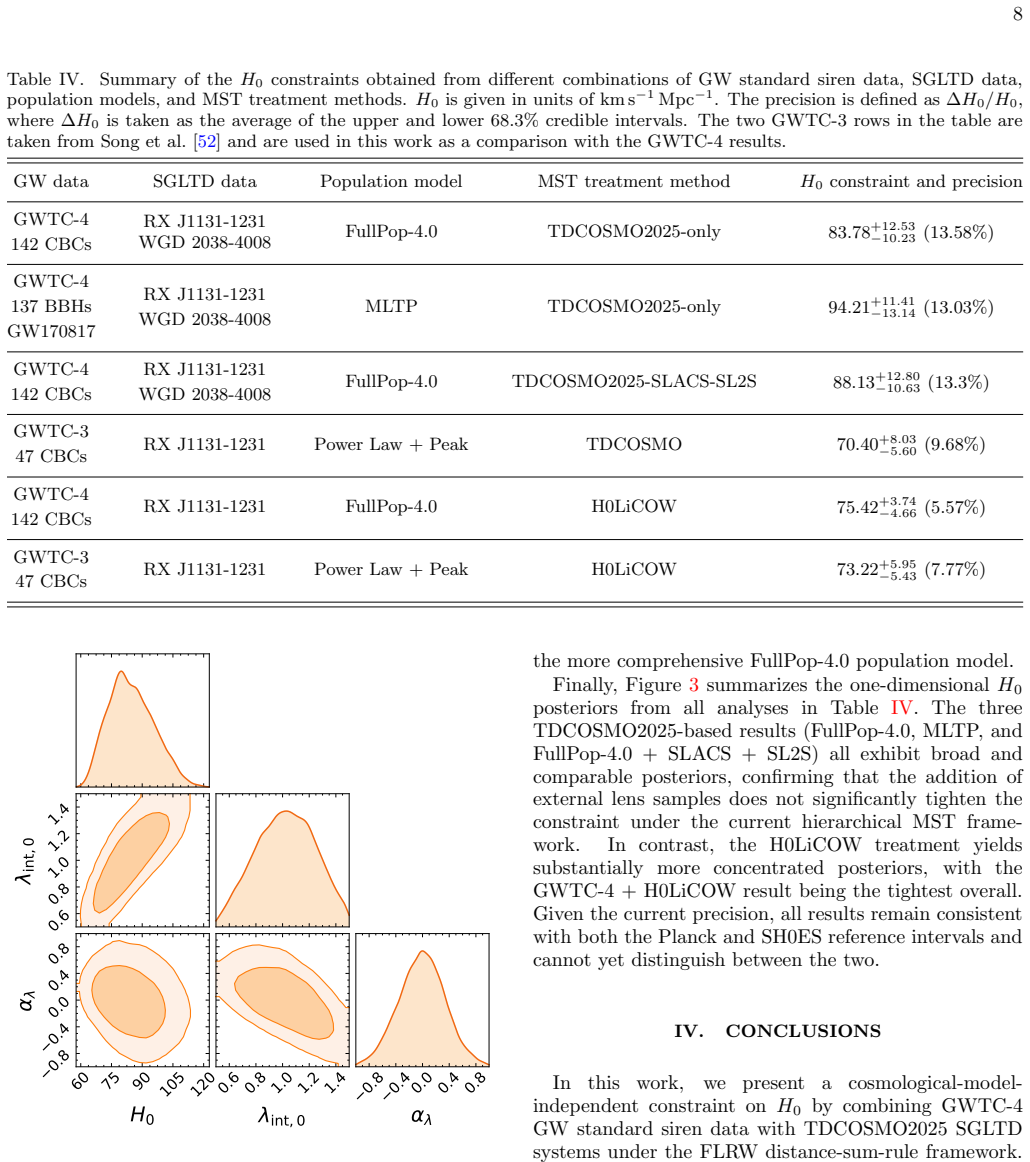
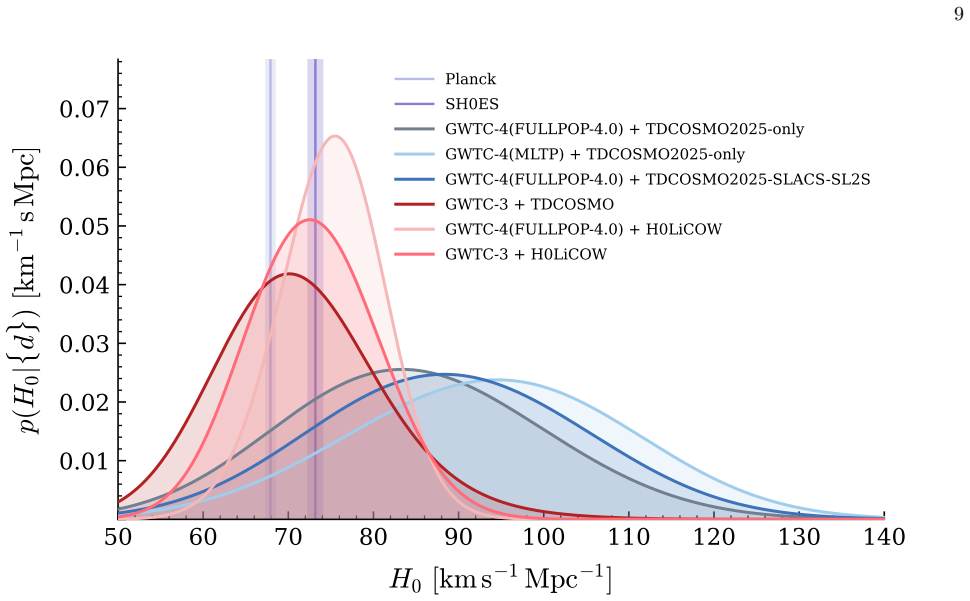
In this work, 142 gravitational-wave standard siren events from GWTC-4 are combined with the latest TDCOSMO2025 time-delay strong lensing data to constrain H0 using a cosmological-model-independent framework based on the distance sum rule. With the FullPop-4.0 population model and TDCOSMO2025-only lensing configuration, H0 is measured as 83.78^{+12.53}_{-10.23} km s^{-1} Mpc^{-1} at 13.58% relative precision. The precision depends primarily on the mass-sheet transformation treatment, and switching to the H0LiCOW method yields a tighter constraint of 75.42^{+3.74}_{-4.66} km s^{-1} Mpc^{-1} at 5.57% precision. All results remain consistent with both Planck and SH0ES values at the current leve
What carries the argument
The distance sum rule, which enables the combination of luminosity distances from gravitational waves and angular diameter distances from strong lensing time delays to infer H0 without assuming a specific cosmological model.
If this is right
- Results are consistent with both Planck and SH0ES at current precision.
- Changing the lensing analysis method from TDCOSMO2025 hierarchical to H0LiCOW changes the central value and tightens the uncertainty significantly.
- More high-redshift dark siren events and additional time-delay lens systems will improve the precision of this model-independent H0 measurement.
Where Pith is reading between the lines
- This combination method could provide an independent check on the Hubble tension if future data increases precision enough to separate the early and late universe values.
- The sensitivity to lensing analysis choices suggests that standardizing mass-sheet transformation treatments across studies is key for reliable model-independent results.
- Extending this to higher redshifts might reveal if any tension is due to model assumptions or new physics.
Load-bearing premise
The specific treatment of the mass-sheet transformation in the strong-lensing analysis does not introduce significant systematic errors in the inferred distances.
What would settle it
Obtaining additional gravitational wave events or lensing systems that shift the combined H0 value outside the reported error bars while using the same analysis framework would falsify the current constraint.
Figures
read the original abstract
The significant discrepancy between early- and late-Universe measurements of the Hubble constant, known as the Hubble tension, remains one of the most pressing open questions in cosmology. Since both sides of the tension rely on model-dependent assumptions or multi-rung calibration chains, a cosmological-model-independent measurement of $H_0$ is essential to arbitrate this discrepancy. In this work, we combine 142 gravitational-wave standard siren events from the Fourth Gravitational-Wave Transient Catalog with the latest TDCOSMO2025 time-delay strong lensing data to constrain $H_0$ in a cosmological-model-independent framework based on the distance sum rule. Under the FullPop-4.0 population model with the TDCOSMO2025-only lensing configuration, we obtain $H_0 = 83.78^{+12.53}_{-10.23}\ {\rm km\,s^{-1}\,Mpc^{-1}}$, with a relative precision of $13.58\%$. We find that the $H_0$ precision is governed primarily by the mass-sheet transformation treatment on the strong-lensing side: replacing the conservative TDCOSMO2025 hierarchical framework with the H0LiCOW method tightens the constraint to $H_0 = 75.42^{+3.74}_{-4.66}\ {\rm km\,s^{-1}\,Mpc^{-1}}$, with a relative precision of $5.57\%$. At the current precision, all results are consistent with both the Planck and SH0ES values, and future improvements from more high-redshift dark siren events and more time-delay lens systems are expected to strengthen this model-independent approach.
Editorial analysis
A structured set of objections, weighed in public.
Referee Report
Summary. The manuscript combines 142 gravitational-wave standard siren events from GWTC-4 with TDCOSMO2025 strong-lensing time-delay data to constrain H0 via the distance sum rule in a cosmological-model-independent framework. Under the FullPop-4.0 population model and the TDCOSMO2025-only lensing configuration, the central result is H0 = 83.78^{+12.53}_{-10.23} km s^{-1} Mpc^{-1} (13.58% relative precision). The abstract also reports that replacing the TDCOSMO2025 hierarchical mass-sheet treatment with the H0LiCOW method shifts the result to H0 = 75.42^{+3.74}_{-4.66} km s^{-1} Mpc^{-1} (5.57% precision). All quoted values remain consistent with both Planck and SH0ES within current uncertainties.
Significance. If the central claim is robust to the lensing analysis choices, the work provides a useful model-independent cross-check on H0 that avoids both early-Universe assumptions and late-Universe distance-ladder calibrations. The use of the distance sum rule and the large GW sample are strengths. However, the reported precision is shown to be governed by the mass-sheet transformation treatment, which limits the immediate impact on the Hubble tension until that systematic is better controlled or marginalized.
major comments (1)
- [Abstract] Abstract: The primary quoted result (H0 = 83.78^{+12.53}_{-10.23}, 13.58% precision) is conditional on the TDCOSMO2025 hierarchical mass-sheet framework. The manuscript itself demonstrates that adopting the H0LiCOW treatment instead produces a substantially different central value and tighter uncertainty (75.42^{+3.74}_{-4.66}, 5.57%). Because the distance-sum-rule combination inherits the lensing distance posteriors directly, this choice is load-bearing for both the reported precision and the interpretation of consistency with Planck/SH0ES; the paper should either adopt a single justified framework with explicit justification or propagate the difference as a systematic uncertainty on the main result.
Simulated Author's Rebuttal
We thank the referee for their careful reading of the manuscript and for highlighting an important point regarding the presentation of our results. We address the major comment below.
read point-by-point responses
-
Referee: [Abstract] Abstract: The primary quoted result (H0 = 83.78^{+12.53}_{-10.23}, 13.58% precision) is conditional on the TDCOSMO2025 hierarchical mass-sheet framework. The manuscript itself demonstrates that adopting the H0LiCOW treatment instead produces a substantially different central value and tighter uncertainty (75.42^{+3.74}_{-4.66}, 5.57%). Because the distance-sum-rule combination inherits the lensing distance posteriors directly, this choice is load-bearing for both the reported precision and the interpretation of consistency with Planck/SH0ES; the paper should either adopt a single justified framework with explicit justification or propagate the difference as a systematic uncertainty on the main result.
Authors: We agree that the mass-sheet transformation treatment is load-bearing for the reported precision and central value, as the manuscript already demonstrates by presenting both results. We selected the TDCOSMO2025 hierarchical framework as the primary quoted result because it constitutes the latest analysis from the TDCOSMO collaboration and employs a hierarchical Bayesian treatment that more conservatively marginalizes over the mass-sheet degeneracy. The H0LiCOW result is shown explicitly to illustrate the impact of this choice. To address the referee's concern, we will revise the abstract to provide a clearer justification for adopting TDCOSMO2025 as the baseline and to frame the H0LiCOW result as the key systematic variation. We do not believe full propagation as an additional systematic uncertainty is required at this stage, given that both frameworks are already reported side-by-side with their respective posteriors. revision: partial
Circularity Check
No significant circularity; derivation combines independent datasets via geometric sum rule
full rationale
The paper derives H0 by combining GW standard-siren luminosity distances (from GWTC-4 events under the external FullPop-4.0 population model) with TDCOSMO2025 time-delay distances via the distance sum rule, a purely geometric relation independent of any cosmological model or the target H0. The text explicitly contrasts two lensing treatments (TDCOSMO2025 hierarchical vs. H0LiCOW) and reports how each shifts the posterior, demonstrating transparency rather than concealment. No equation or section shows a fitted parameter being relabeled as a prediction, a self-citation supplying a uniqueness theorem, or an ansatz smuggled in; the central claim therefore remains non-circular and externally falsifiable against Planck/SH0ES.
Axiom & Free-Parameter Ledger
free parameters (1)
- FullPop-4.0 population model parameters
axioms (2)
- domain assumption Distance sum rule relates luminosity distances and time-delay distances without requiring a specific expansion history
- domain assumption TDCOSMO2025 time-delay measurements and GWTC-4 events are statistically independent
Forward citations
Cited by 1 Pith paper
-
Synergy between CSST and future gravitational-wave detectors: Probing primordial black holes by cross-correlating dark sirens with galaxies
Cross-correlating CSST galaxies with mock GW catalogs from ET2CE and BDET2CE networks can detect PBH merger fractions above ~40% and ~20% respectively via clustering bias differences.
Reference graph
Works this paper leans on
-
[1]
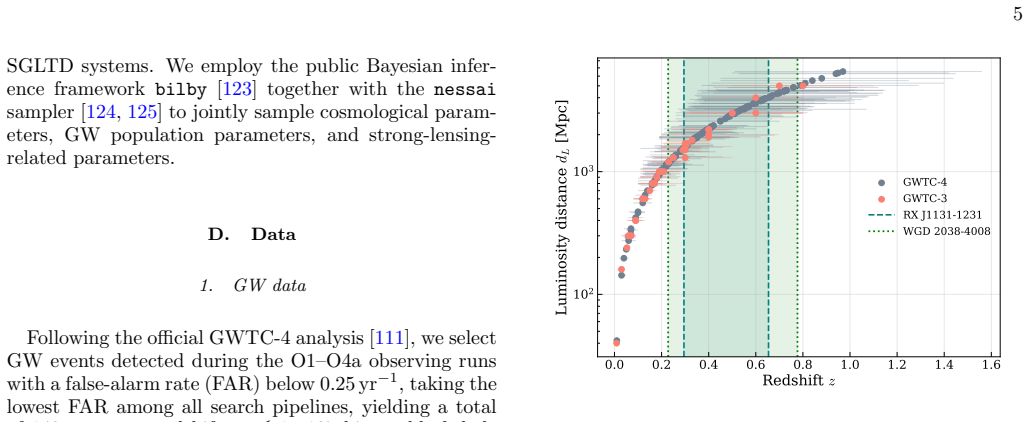
GW data Following the official GWTC-4 analysis [111], we select GW events detected during the O1–O4a observing runs with a false-alarm rate (FAR) below 0.25 yr−1, taking the lowest FAR among all search pipelines, yielding a total of 142 events at redshiftsz≲1: 137 binary black hole (BBH) mergers, 3 neutron star-black hole (NSBH) merg- ers, and 2 binary ne...
-
[2]
Figure 1 shows the distribution of the GW standard siren samples and the selected strong lensing systems in the redshift-luminosity-distance plane
Strong lensing data We use two SGLTD systems from the latest TD- COSMO2025 lens sample: RX J1131-1231 [116, 117] and WGD 2038-4008 [129]. Figure 1 shows the distribution of the GW standard siren samples and the selected strong lensing systems in the redshift-luminosity-distance plane. The spectroscopic redshifts of both the lens galaxies and the backgroun...
2038
-
[3]
N. Aghanimet al.(Planck), Astron. Astrophys.641, A6 (2020), [Erratum: Astron.Astrophys. 652, C4 (2021)], arXiv:1807.06209 [astro-ph.CO]
Pith/arXiv arXiv 2020
-
[4]
A. G. Riesset al., Astrophys. J. Lett.992, L34 (2025), arXiv:2509.01667 [astro-ph.CO]
arXiv 2025
-
[5]
L. Verde, T. Treu, and A. G. Riess, Nature Astron.3, 891 (2019), arXiv:1907.10625 [astro-ph.CO]
Pith/arXiv arXiv 2019
-
[6]
L. Knox and M. Millea, Phys. Rev. D101, 043533 (2020), arXiv:1908.03663 [astro-ph.CO]
arXiv 2020
-
[7]
A. G. Riesset al., Astrophys. J. Lett.934, L7 (2022), arXiv:2112.04510 [astro-ph.CO]
Pith/arXiv arXiv 2022
-
[8]
Abdallaet al., JHEAp34, 49 (2022), arXiv:2203.06142 [astro-ph.CO]
E. Abdallaet al., JHEAp34, 49 (2022), arXiv:2203.06142 [astro-ph.CO]
Pith/arXiv arXiv 2022
-
[9]
E. Di Valentino, O. Mena, S. Pan, L. Visinelli, W. Yang, A. Melchiorri, D. F. Mota, A. G. Riess, and J. Silk, Class. Quant. Grav.38, 153001 (2021), arXiv:2103.01183 [astro-ph.CO]
Pith/arXiv arXiv 2021
-
[10]
L. Perivolaropoulos and F. Skara, New Astron. Rev.95, 101659 (2022), arXiv:2105.05208 [astro-ph.CO]
Pith/arXiv arXiv 2022
-
[11]
N. Sch¨ oneberg, G. Franco Abell´ an, A. P´ erez S´ anchez, S. J. Witte, V. Poulin, and J. Lesgourgues, Phys. Rept. 984, 1 (2022), arXiv:2107.10291 [astro-ph.CO]
arXiv 2022
-
[12]
M. Kamionkowski and A. G. Riess, Ann. Rev. Nucl. Part. Sci.73, 153 (2023), arXiv:2211.04492 [astro- ph.CO]
Pith/arXiv arXiv 2023
-
[13]
R.-Y. Guo, J.-F. Zhang, and X. Zhang, JCAP02, 054 (2019), arXiv:1809.02340 [astro-ph.CO]
Pith/arXiv arXiv 2019
- [14]
- [15]
-
[16]
Y.-H. Pang, X. Zhang, and Q.-G. Huang, Sci. China Phys. Mech. Astron.68, 280410 (2025), arXiv:2503.21600 [astro-ph.CO]
arXiv 2025
- [17]
- [18]
-
[19]
L. Feng, T.-N. Li, G.-H. Du, J.-F. Zhang, and X. Zhang, Phys. Dark Univ.48, 101935 (2025), arXiv:2503.10423 [astro-ph.CO]
arXiv 2025
- [20]
- [21]
-
[22]
G.-H. Du, T.-N. Li, P.-J. Wu, J.-F. Zhang, and X. Zhang, (2025), arXiv:2507.16589 [astro-ph.CO]
Pith/arXiv arXiv 2025
- [23]
- [24]
-
[25]
Y.-M. Zhang, T.-N. Li, G.-H. Du, S.-H. Zhou, L.- Y. Gao, J.-F. Zhang, and X. Zhang, (2025), arXiv:2510.12627 [astro-ph.CO]
Pith/arXiv arXiv 2025
- [26]
-
[27]
Y. Cai, X. Ren, T. Qiu, M. Li, and X. Zhang, (2025), 10.1093/nsr/nwag115, arXiv:2505.24732 [astro-ph.CO]
work page internal anchor Pith review Pith/arXiv arXiv doi:10.1093/nsr/nwag115 2025
- [28]
-
[29]
L.-F. Wang, J.-H. Zhang, D.-Z. He, J.-F. Zhang, and X. Zhang, Mon. Not. Roy. Astron. Soc.514, 1433 (2022), arXiv:2102.09331 [astro-ph.CO]
arXiv 2022
-
[30]
Z.-W. Zhao, L.-F. Wang, J.-G. Zhang, J.-F. Zhang, and X. Zhang, JCAP04, 022 (2023), arXiv:2210.07162 [astro-ph.CO]
arXiv 2023
-
[31]
Y.-Z. Ma and X. Zhang, Phys. Lett. B661, 239 (2008), arXiv:0709.1517 [astro-ph]
Pith/arXiv arXiv 2008
-
[32]
R.-Y. Guo, J.-F. Zhang, and X. Zhang, Chin. Phys. C 42, 095103 (2018), arXiv:1803.06910 [astro-ph.CO]
Pith/arXiv arXiv 2018
-
[33]
L. Feng, D.-Z. He, H.-L. Li, J.-F. Zhang, and X. Zhang, Sci. China Phys. Mech. Astron.63, 290404 (2020), arXiv:1910.03872 [astro-ph.CO]
arXiv 2020
-
[34]
C. Gong, T. Zhu, R. Niu, Q. Wu, J.-L. Cui, X. Zhang, W. Zhao, and A. Wang, Phys. Rev. D105, 044034 (2022), arXiv:2112.06446 [gr-qc]
arXiv 2022
-
[35]
J.-F. Zhang, J.-J. Geng, and X. Zhang, JCAP10, 044 (2014), arXiv:1408.0481 [astro-ph.CO]
Pith/arXiv arXiv 2014
- [36]
-
[37]
S. Wang, Y.-F. Wang, D.-M. Xia, and X. Zhang, Phys. Rev. D94, 083519 (2016), arXiv:1608.00672 [astro- ph.CO]
Pith/arXiv arXiv 2016
-
[38]
R.-Y. Guo and X. Zhang, Eur. Phys. J. C76, 163 (2016), arXiv:1512.07703 [astro-ph.CO]
Pith/arXiv arXiv 2016
-
[39]
J.-F. Zhang, Y.-H. Li, and X. Zhang, Eur. Phys. J. C 74, 2954 (2014), arXiv:1404.3598 [astro-ph.CO]
Pith/arXiv arXiv 2014
- [40]
-
[41]
J.-L. Cui, L. Zhang, J.-F. Zhang, and X. Zhang, Chin. Phys. B19, 019802 (2010), arXiv:0902.0716 [astro- ph.CO]
Pith/arXiv arXiv 2010
-
[42]
L. Feng, J.-F. Zhang, and X. Zhang, Eur. Phys. J. C 77, 418 (2017), arXiv:1703.04884 [astro-ph.CO]
Pith/arXiv arXiv 2017
-
[43]
T.-F. Fu, J.-F. Zhang, J.-Q. Chen, and X. Zhang, Eur. Phys. J. C72, 1932 (2012), arXiv:1112.2350 [astro- ph.CO]
Pith/arXiv arXiv 1932
-
[44]
L. Feng, J.-F. Zhang, and X. Zhang, Phys. Dark Univ. 23, 100261 (2019), arXiv:1712.03148 [astro-ph.CO]
Pith/arXiv arXiv 2019
-
[45]
A. G. Adameet al.(DESI), JCAP02, 021 (2025), arXiv:2404.03002 [astro-ph.CO]
Pith/arXiv arXiv 2025
-
[46]
M. Abdul Karimet al.(DESI), Phys. Rev. D112, 083515 (2025), arXiv:2503.14738 [astro-ph.CO]. 11
Pith/arXiv arXiv 2025
- [47]
-
[48]
T. Collett, F. Montanari, and S. Rasanen, Phys. Rev. Lett.123, 231101 (2019), arXiv:1905.09781 [astro- ph.CO]
arXiv 2019
-
[49]
Refsdal, Mon
S. Refsdal, Mon. Not. Roy. Astron. Soc.128, 307 (1964)
1964
-
[50]
S. H. Suyu, P. J. Marshall, M. W. Auger, S. Hilbert, R. D. Blandford, L. V. E. Koopmans, C. D. Fass- nacht, and T. Treu, Astrophys. J.711, 201 (2010), arXiv:0910.2773 [astro-ph.CO]
Pith/arXiv arXiv 2010
-
[51]
S. R¨ as¨ anen, K. Bolejko, and A. Finoguenov, Phys. Rev. Lett.115, 101301 (2015), arXiv:1412.4976 [astro- ph.CO]
Pith/arXiv arXiv 2015
- [52]
-
[53]
M.-D. Cao, J. Zheng, J.-Z. Qi, X. Zhang, and Z.-H. Zhu, Astrophys. J.934, 108 (2022), arXiv:2112.14564 [astro-ph.CO]
arXiv 2022
-
[54]
J.-Y. Song, J.-Z. Qi, J.-F. Zhang, and X. Zhang, Astro- phys. J. Lett.985, L44 (2025), arXiv:2503.10346 [astro- ph.CO]
arXiv 2025
- [55]
- [56]
-
[57]
J.-Z. Qi, Y. Cui, W.-H. Hu, J.-F. Zhang, J.-L. Cui, and X. Zhang, Phys. Rev. D106, 023520 (2022), arXiv:2202.01396 [astro-ph.CO]
arXiv 2022
-
[58]
B. F. Schutz, Nature323, 310 (1986)
1986
-
[59]
D. E. Holz and S. A. Hughes, Astrophys. J.629, 15 (2005), arXiv:astro-ph/0504616
Pith/arXiv arXiv 2005
-
[60]
H.-Y. Chen, M. Fishbach, and D. E. Holz, Nature562, 545 (2018), arXiv:1712.06531 [astro-ph.CO]
Pith/arXiv arXiv 2018
-
[61]
Z.-W. Zhao, Z.-X. Li, J.-Z. Qi, H. Gao, J.-F. Zhang, and X. Zhang, Astrophys. J.903, 83 (2020), arXiv:2006.01450 [astro-ph.CO]
arXiv 2020
-
[62]
L.-F. Wang, X.-N. Zhang, J.-F. Zhang, and X. Zhang, Phys. Lett. B782, 87 (2018), arXiv:1802.04720 [astro- ph.CO]
Pith/arXiv arXiv 2018
-
[63]
X.-N. Zhang, L.-F. Wang, J.-F. Zhang, and X. Zhang, Phys. Rev. D99, 063510 (2019), arXiv:1804.08379 [astro-ph.CO]
Pith/arXiv arXiv 2019
-
[64]
X. Zhang, Sci. China Phys. Mech. Astron.62, 110431 (2019), arXiv:1905.11122 [astro-ph.CO]
arXiv 2019
- [65]
-
[66]
L.-F. Wang, Z.-W. Zhao, J.-F. Zhang, and X. Zhang, JCAP11, 012 (2020), arXiv:1907.01838 [astro-ph.CO]
arXiv 2020
- [67]
- [68]
- [69]
-
[70]
L.-F. Wang, S.-J. Jin, J.-F. Zhang, and X. Zhang, Sci. China Phys. Mech. Astron.65, 210411 (2022), arXiv:2101.11882 [gr-qc]
arXiv 2022
-
[71]
P.-J. Wu, Y. Shao, S.-J. Jin, and X. Zhang, JCAP06, 052 (2023), arXiv:2202.09726 [astro-ph.CO]
arXiv 2023
- [72]
- [73]
-
[74]
L.-F. Wang, Y. Shao, S.-R. Xiao, J.-F. Zhang, and X. Zhang, JCAP05, 095 (2025), arXiv:2201.00607 [astro-ph.CO]
arXiv 2025
- [75]
-
[76]
J. Yu, Z. Liu, X. Yang, Y. Wang, P. Zhang, X. Zhang, and W. Zhao, Astrophys. J. Suppl.270, 24 (2024), arXiv:2311.11588 [astro-ph.HE]
arXiv 2024
- [77]
- [78]
- [79]
-
[80]
L. Feng, T. Han, J.-F. Zhang, and X. Zhang, Com- mun. Theor. Phys.77, 065403 (2025), arXiv:2409.04453 [astro-ph.HE]
arXiv 2025
discussion (0)
Sign in with ORCID, Apple, or X to comment. Anyone can read and Pith papers without signing in.