REVIEW 3 major objections 5 minor 1 cited by
You Shall Not Pass! The propagation of low/moderate powered jets through a turbulent interstellar medium
T0 review · 3 major / 5 minor · reviewed 2026-08-10 · deepseek-v4-flash
Pith's one-line read Low-power jets can be stalled within the central kiloparsec by a turbulent interstellar medium.
desk verdict Clean, honest simulation study showing low-power jets can stall in a turbulent filamentary ISM, with a useful analytic scaling; the main caveat is the warm-phase-only ISM setup, which the authors themselves flag. read the letter →
The pith
A machine-rendered reading of the paper's core claim, the machinery that carries it, and where it could break.
The reading
What carries the argument
The carrying mechanism is the ram-pressure balance between a collimated jet and a log-normal turbulent medium. For a jet of power $L_{\mathrm{jet}}$, density $\rho_{\mathrm{jet}}$, and cross-section $A$, the momentum flux is $p_{\mathrm{jet}}=(\rho_{\mathrm{jet}}^{1/2}L_{\mathrm{jet}}/A)^{2/3}$. In an isothermal, driven-turbulent ISM, dense filaments exert an opposing typical momentum flux $p_{\mathrm{ISM}}\approx(1+bM)M^2\bar\rho c_s^2$, where $M$ is the Mach number, $b\approx0.5$ is a driving-mix parameter, and $\bar\rho$ is the mean density. Setting $p_{\mathrm{jet}}=p_{\mathrm{ISM}}$ yields the minimum jet luminosity needed to break out, $L_{\mathrm{jet,min}}=\bar\rho^{3/2}c_s^3(1+bM)^{3/2}M^3 A\rho_{\mathrm{jet}}^{-1/2}$. In the simulations this balance plays out as a 'walls and cavities' map: the jet advances where cavities offer low resistance and is stopped or deflected where filaments present a ram-pressure wall, while lateral expansion lets jet material fill cavities even when the head cannot advance.
What would settle it
Run the same jet-launching setup in a box that allows cooling below $10^4$ K, includes a simple galactic gravitational potential, or seeds clumpy instead of filamentary density structure: if a $10^{40}$ erg s$^{-1}$ jet then reaches beyond the central kiloparsec, the stalling claim is falsified. Observationally, finding a population of FR0-class galaxies with measured central densities near $20$ cm$^{-3}$ whose jets at $10^{38}$–$10^{40}$ erg s$^{-1}$ are clearly resolved beyond 1 kpc would also contradict the paper's central conclusion.
Extended reading notes
Core claim
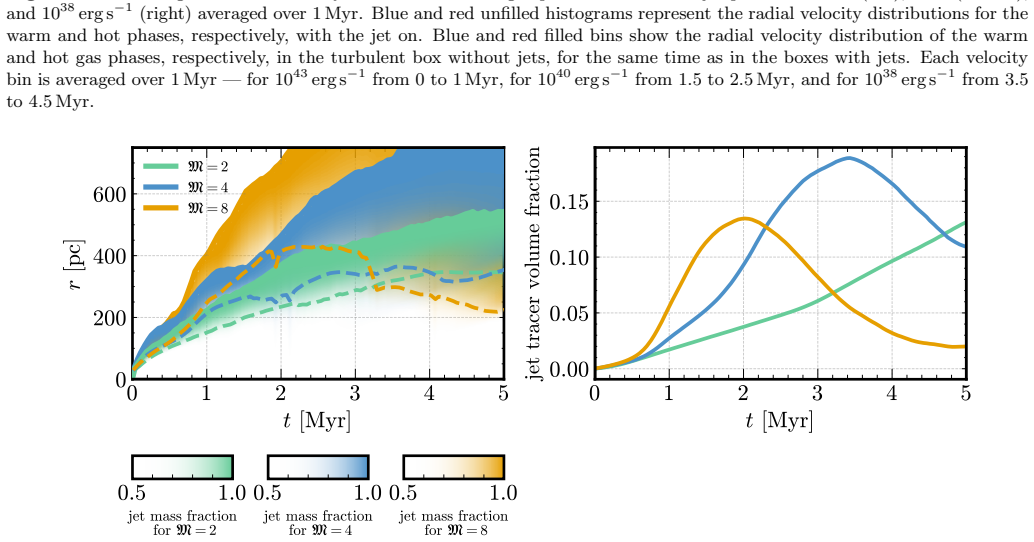
The paper's central claim is that for low- and moderate-power jets the turbulent interstellar medium, not the jet, controls how far the jet goes. In a $(2\,\mathrm{kpc})^3$ periodic box with continuously driven turbulence, radiative cooling, mean density $20\,\mathrm{cm}^{-3}$, and Mach number $M=4$, a $10^{38}$ erg s$^{-1}$ jet is completely stopped and a $10^{40}$ erg s$^{-1}$ jet is bent and redirected, filling a pre-existing cavity while most of its mass remains within the central kiloparsec; a $10^{43}$ erg s$^{-1}$ jet escapes regardless of the medium. The authors reproduce this with a ram-pressure condition: when the jet's momentum flux falls below the typical momentum flux of the filaments, $p_{\mathrm{ISM}}\approx(1+bM)M^2\bar\rho c_s^2$, the jet cannot push through. Equating the two fluxes gives a minimum breakout luminosity for the fiducial medium of $L_{\mathrm{jet,min}}\approx2\times10^{41}$ erg s$^{-1}$. Stalled jets are not inert: they heat gas and drive hot-phase outflows (up to $\sim750$ km s$^{-1}$ for intermediate power) and, in some conditions, warm outflows up to a few hundred km s$^{-1}$.
Load-bearing premise
The load-bearing premise is that the simulated box—continuously driven turbulence, a $10^4$ K temperature floor, no gravity, no cold molecular gas, and no magnetic fields—produces the same filament-wall structure that a real low-power jet would meet in a galactic center; if a real ISM is clumpier, colder, or stratified by gravity, low-power jets may propagate more easily than this paper finds.
Editorial extensions
If this is right
- Jets at FR0-like powers ($10^{38}$–$10^{40}$ erg s$^{-1}$) will be confined to the central kiloparsec of a galaxy like the one simulated, so their radio emission is expected to be unresolved at kpc scales regardless of source age.
- Intermediate-power jets do not have enough ram pressure to restructure the turbulent ISM; instead they fill pre-existing low-density cavities, which naturally produces bent, bubble-like, and asymmetric jet morphologies.
- A sharp breakout threshold exists near $L_{\mathrm{jet,min}}\simeq2\times10^{41}$ erg s$^{-1}$ for the fiducial medium: jets below it stall, and jets at or above it escape the central kiloparsec.
- Stalled jets still deposit energy and drive outflows: hot-phase outflows up to about $750$ km s$^{-1}$ for a $10^{40}$ erg s$^{-1}$ jet, and warm-phase outflows up to a few hundred km s$^{-1}$ under the right conditions, so observed outflows do not require that the jet itself escapes.
Reading between the lines
- My inference: the ram-pressure threshold is sharp enough that observed compact-jet samples should show a dichotomy—most low-power sources either confined within ~1 kpc or clearly extended beyond it—rather than a smooth distribution of sizes.
- My inference: the same wall-versus-cavity logic should apply to other momentum-driven outflows in turbulent galaxies, not only jets, so weak nuclear winds may also be channeled, bent, and delayed by the same filamentary structures.
- My inference: if the $10^4$ K floor is replaced by a colder, clumpier ISM, the minimum breakout luminosity could shift upward or downward depending on how the ram-pressure walls change, so the model's most direct next test is to vary the cooling floor and the driving geometry while keeping everything else fixed.
Editorial analysis
A structured set of objections, weighed in public.
Referee Report
Summary. This paper uses Arepo simulations to study how low- and intermediate-power jets (10^38–10^43 erg/s) propagate through a turbulent, cooling ISM on ~kpc scales. A (2 kpc)^3 periodic box with driven solenoidal turbulence, a 10^4 K temperature floor, and mean density 20 cm^-3 is evolved to a steady state, then jets are injected along the x-axis. The simulations are grouped into three regimes: powerful jets break out of the central kiloparsec, 10^40 erg/s jets are strongly redirected and mostly fill pre-existing cavities with only some material escaping, and 10^38 erg/s jets are fully stalled. A simple ram-pressure model yields a breakout luminosity Ljet,min ~ 2×10^41 erg/s for the fiducial M = 4 box. Radial-velocity histograms at 400–500 pc show hot-phase outflows for the higher powers and warm-phase outflows in some cases. The authors connect these results to FR0 galaxies and to subgrid AGN feedback prescriptions, and they explicitly list limitations: no cold molecular phase, no gravity, no magnetic fields, and no cosmic rays.
Significance. If the central claim holds, the paper provides a physically motivated explanation for the compactness of FR0 jets and for why low-power jets may deposit their energy within the central kiloparsec of their host galaxy. The numerical work is carefully documented: resolution convergence is tested in Appendix A, metallicity sensitivity in Appendix B, stochasticity across five realizations in Appendix D, and uniform-medium controls are used throughout. The three propagation regimes are clearly demonstrated with projection maps and quantitative mass-fraction diagnostics. The main limitation is that the simulated ISM is a warm, filamentary, continuously driven medium without a cold molecular phase or gravitational stratification; as the authors themselves note in Sec. 4.3, allowing gas to cool below 10^4 K would make the medium more clumpy and likely easier for jets to penetrate. The significance for real galaxies is therefore conditional pending additional tests or a substantial reframing of the conclusions.
major comments (3)
- [Sec. 4.3 and Sec. 5 (Conclusions)] The load-bearing claim that low-power jets (<=10^40 erg/s) are stalled within the central kiloparsec by a turbulent medium is not robust to the paper's own stated limitations. The stalling mechanism identified in Sec. 3.2 is ram-pressure balance against connected dense filament walls, and those walls arise from the 10^4 K temperature floor and continuous solenoidal driving described in Sec. 2.1. In Sec. 4.3 the authors write that if gas can cool below 10^4 K the medium will become less filamentary and more clumpy, and that jets are expected to propagate more easily. Because the real multiphase ISM that motivates the FR0 comparison contains cold molecular gas, the unqualified conclusion in Sec. 5 overstates what has been demonstrated. I request either (i) an additional simulation with a colder temperature floor or a clumpy/cloudy initial condition, or (ii) an explicit restriction of the stalling claim to warm, filamentary, continuously driven ISM, with the FR0-related implications reworded accordingly.
- [Sec. 3.3, Eqs. (4)-(6)] The breakout luminosity Ljet,min is not actually evaluable from the information given. The expression depends on the jet cross-sectional area A through pjet = (rho_jet^1/2 Ljet/A)^(2/3), but A is never defined numerically and is not listed in Table 2; the text simply states that evaluating for the typical ISM parameters gives Ljet,min = 2×10^41 erg/s. Since the claimed rough agreement with the simulations is used to support interpreting the 10^40 erg/s run as sub-breakout, the value of A must be specified (or shown to cancel out of the comparison), and the sensitivity of the inferred threshold to A and b should be quantified.
- [Sec. 2.1 and Sec. 4.3] The absence of gravity means the simulated density field has no vertical stratification and no confining potential, so the 'central kiloparsec' is not a galaxy center in a dynamical sense. The authors acknowledge this and note that existing galactic-potential simulations struggle to reach equilibrium, but the effect of stratification on wall lifetimes, cavity geometry, and the eventual fate of stalled jets is not tested. At minimum, the discussion should avoid implying that the conclusions apply directly to real galactic centers without further work; a simple test with an external potential or a stratified initial density would materially strengthen the claim.
minor comments (5)
- [Abstract and Sec. 2.1] The abstract says jets are launched within a '~kpc-scale periodic box'; the box is actually (2 kpc)^3 and the analysis focuses on the central (1 kpc)^3. This is clear in Sec. 2.1 but the abstract would be more precise with '(2 kpc)^3 periodic box'.
- [Sec. 5 (Conclusions)] There is a typo: 'Warm ouflows can be detected' should read 'Warm outflows can be detected'.
- [Fig. 5] The y-axis label 'M_sun / km s^-1 of cells with r_cell in [400; 500] pc' is ambiguous; please clarify that this is mass per radial-velocity bin, and ensure the same convention is used in Figs. 5 and 8.
- [Table 2] The table lists jet density and the smoothing length but not the inner jet injection radius (30 pc) or the jet cross-sectional area A; these are given only in the text. Adding them to Table 2 would improve reproducibility.
- [Sec. 4.2] The comparison with previous clumpy-ISM simulations would be more quantitative if the filament-wall topology were characterized (e.g., volume filling factor, typical wall spacing, or density contrast), rather than only described qualitatively.
Circularity Check
No significant circularity: the stalling result is a direct simulation outcome, and the Eq. 6 breakout criterion is an uncalibrated consistency check using literature values.
full rationale
The paper's headline claim that low-power jets (Ljet <= 1e40 erg/s) are stalled within the central kiloparsec by a turbulent ISM is a direct simulation result from the Arepo runs with a fixed turbulent box and jet-launching prescription; it is not derived from a fitted model. The analytical model in Sec. 3.3 (Eqs. 4-6) is an independent consistency check: Ljet,min = 2e41 erg/s follows from literature values for log-normal density contrast (b = 0.5, Federrath et al. 2008), the simulated mean density (20 cm^-3), driving sound speed (20 km/s), Mach number, and fixed jet density; no parameter was fit to the simulation outcomes. The comparison with the runs is described honestly by the authors as 'rough agreement', and the caveat 'more careful calibration is required' confirms it is not presented as a forced derivation. The ram-pressure diagnostic (Eq. 3) and the analytical model share a physical concept, but sharing a mechanism is not circular: the diagnostic measures where jets stop, while the model predicts using external inputs. Self-citations (Weinberger et al. 2017a, 2023 for the jet injection prescription) are method citations, not load-bearing evidence for the ISM-stalling claim. The limitations in Sec. 4.3 (10^4 K floor, no cold phase, no gravity, no magnetic fields) are validity concerns for real galaxies, not circularity: they do not make the simulation output equivalent to its inputs. Consequently, no circular step is present.
Assumptions & free parameters
free parameters (5)
- Turbulence driving amplitude alpha =
0.3 (M=2), 1.0 (M=4), 10.0 (M=8)
- Jet mass density rho_jet =
1e-26 g cm^-3
- Turbulence driving mix parameter b =
0.5
- Hot/warm phase temperature threshold =
log T = 4.4
- Jet cross-sectional area A =
implicit (injection radius r = 30 pc)
assumptions (5)
- domain assumption A driven periodic box with solenoidal turbulence and radiative cooling produces an ISM structure representative of real galactic centers (filaments and cavities at 10^4 K).
- domain assumption The kinetic jet injection of Weinberger et al. (2017a, 2023), with a thermal floor and zero opening angle, produces a realistic low-power AGN jet.
- standard math The ISM density PDF is log-normal and the typical high density is (1 + bM) * rho_bar with b = 0.5.
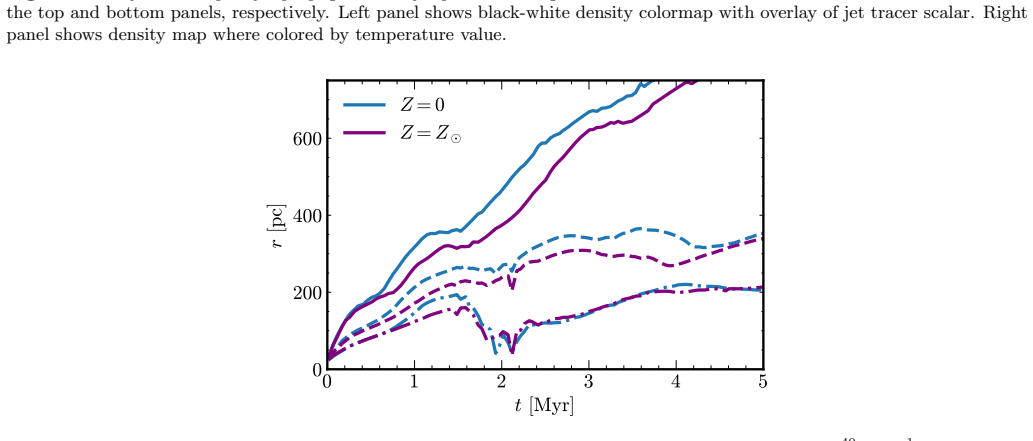
- domain assumption Primordial-abundance radiative cooling with a 10^4 K floor captures the thermodynamics; metal cooling does not change conclusions.
- standard math Euler equations with gamma = 5/3 solved by the Arepo moving-mesh scheme are adequate for jet-ISM interaction.
Cite this review
Pith. "Pith review of You Shall Not Pass! The propagation of low/moderate powered jets through a turbulent interstellar medium." pith.science (2026). https://pith.science/paper/QEAGRW5E
@misc{pith2026250114062,
  author       = {Pith},
  title        = {Pith review of: You Shall Not Pass! The propagation of low/moderate powered jets through a turbulent interstellar medium},
  year         = {2026},
  howpublished = {\url{https://pith.science/paper/QEAGRW5E}},
  note         = {Machine review of arXiv:2501.14062}
}
abstract
Feedback from black hole-powered jets has been invoked in many cosmological simulations to regulate star formation and quench galaxies. Despite this, observational evidence of how jets might be able to affect their hosts remains scarce, especially for low power jets in halos smaller than clusters. Recent observations of outflows around FR0 galaxies, that host compact radio-loud sources, imply that lower-power jetted active galactic nuclei (AGN) may have a significant impact on their hosts through jet interactions with the interstellar medium (ISM). Using the Arepo code, we launch jets of low and intermediate power (10$^{38}$ - 10$^{43}$ erg s$^{-1}$) within a ~kpc-scale periodic box with driven turbulence to study how the jets propagate through a turbulent ISM. Our simulation results broadly fit into three different scenarios $\unicode{x2013}$ jets penetrating easily through the ISM, becoming completely stalled, or the interesting intermediate stage, when jets are highly disturbed and redirected. We suggest that intermediate power jets do not have enough ram pressure to affect the turbulent structure of the ISM, and so only fill pre-existing cavities. Low-power jets are able to drive outflows in a hot phase ($>10^{4.4}$ K). However, warm (~$10^4$ K) ionized gas outflows appear under certain conditions. This work is part of the ''Learning the Universe'' collaboration, aiming to build next-generation cosmological simulations that incorporate a new prescription for AGN feedback.
Figures


Figures from the paper (11 more)






Forward citations
Cited by 1 Pith paper
-
Jet--ISM Interactions in Gaseous Disks: Simulating Kinetic Feedback in the Radio Galaxy 3C 326 N
Jet–ISM coupling in multi-scale cloudy disks produces asymmetric lobes and kinematics that match the JWST-observed bubble in 3C 326 N for a 10^45 erg s^{-1} jet.
Reference graph
Works this paper leans on
-
[1]
Baldi, R. D. 2023, A&A Rv, 31, 3, doi: 10.1007/s00159-023-00148-3
-
[2]
D., Capetti, A., & Giovannini, G
Baldi, R. D., Capetti, A., & Giovannini, G. 2015, A&A, 576, A38, doi: 10.1051/0004-6361/201425426 —. 2016, Astronomische Nachrichten, 337, 114, doi: 10.1002/asna.201512275
-
[3]
Baldi, R. D., Capetti, A., & Massaro, F. 2018, A&A, 609, A1, doi: 10.1051/0004-6361/201731333
-
[5]
Begelman, M. C., Blandford, R. D., & Rees, M. J. 1984, Reviews of Modern Physics, 56, 255, doi: 10.1103/RevModPhys.56.255
-
[6]
1995, MNRAS, 276, 663, doi: 10.1093/mnras/276.2.663
Binney, J., & Tabor, G. 1995, MNRAS, 276, 663, doi: 10.1093/mnras/276.2.663
-
[7]
2019, ARA&A, 57, 467, doi: 10.1146/annurev-astro-081817-051948
Blandford, R., Meier, D., & Readhead, A. 2019, ARA&A, 57, 467, doi: 10.1146/annurev-astro-081817-051948
-
[8]
Blandford, R. D., & Payne, D. G. 1982, MNRAS, 199, 883, doi: 10.1093/mnras/199.4.883
-
[9]
Bourne, M. A., & Sijacki, D. 2017, MNRAS, 472, 4707, doi: 10.1093/mnras/stx2269
Show all 68 references
-
[10]
A., & Yang, H.-Y
Bourne, M. A., & Yang, H.-Y. K. 2023, Galaxies, 11, 73, doi: 10.3390/galaxies11030073
2023 doi
-
[11]
2016, Nature, 533, 504, doi: 10.1038/nature18006
Cheung, E., Bundy, K., Cappellari, M., et al. 2016, Nature, 533, 504, doi: 10.1038/nature18006
2016 doi
-
[12]
2005, MNRAS, 363, L91, doi: 10.1111/j.1745-3933.2005.00093.x
Churazov, E., Sazonov, S., Sunyaev, R., et al. 2005, MNRAS, 363, L91, doi: 10.1111/j.1745-3933.2005.00093.x
2005
-
[13]
Cielo, S., Antonuccio-Delogu, V., Silk, J., & Romeo, A. D. 2017, MNRAS, 467, 4526, doi: 10.1093/mnras/stx403
2017 doi
-
[14]
Y., & Dubois, Y
Cielo, S., Bieri, R., Volonteri, M., Wagner, A. Y., & Dubois, Y. 2018, MNRAS, 477, 1336, doi: 10.1093/mnras/sty708
2018 doi
-
[15]
J., Springel, V., White, S
Croton, D. J., Springel, V., White, S. D. M., et al. 2006, MNRAS, 365, 11, doi: 10.1111/j.1365-2966.2005.09675.x Dav´ e, R., Angl´ es-Alc´ azar, D., Narayanan, D., et al. 2019, MNRAS, 486, 2827, doi: 10.1093/mnras/stz937
2006
-
[16]
P., Forman, W., & Jones, C
David, L. P., Forman, W., & Jones, C. 1991, ApJ, 369, 121, doi: 10.1086/169743
1991 doi
-
[17]
W., & Tchekhovskoy, A
Davis, S. W., & Tchekhovskoy, A. 2020, ARA&A, 58, 407, doi: 10.1146/annurev-astro-081817-051905 Di Matteo, T., Springel, V., & Hernquist, L. 2005, Nature, 433, 604, doi: 10.1038/nature03335
2020 doi
-
[18]
K., Ciurlo, A., Morris, M
Dinh, C. K., Ciurlo, A., Morris, M. R., et al. 2024, AJ, 167, 41, doi: 10.3847/1538-3881/ad10a5
2024 doi
-
[19]
2008, A&A, 477, 79, doi: 10.1051/0004-6361:20078326 14
Dubois, Y., & Teyssier, R. 2008, A&A, 477, 79, doi: 10.1051/0004-6361:20078326 14
2008 doi
-
[20]
C., & Stone, J
Dutta, R., Sharma, P., Sarkar, K. C., & Stone, J. M. 2024, ApJ, 973, 148, doi: 10.3847/1538-4357/ad67d7
2024 doi
-
[21]
2022, ApJ, 938, 105, doi: 10.3847/1538-4357/ac8ff8
Fabbiano, G., Paggi, A., Morganti, R., et al. 2022, ApJ, 938, 105, doi: 10.3847/1538-4357/ac8ff8
2022 doi
-
[22]
Fabian, A. C. 2012, ARA&A, 50, 455, doi: 10.1146/annurev-astro-081811-125521
2012 doi
-
[23]
L., & Riley, J
Fanaroff, B. L., & Riley, J. M. 1974, MNRAS, 167, 31P, doi: 10.1093/mnras/167.1.31P
1974 doi
-
[24]
S., & Schmidt, W
Federrath, C., Klessen, R. S., & Schmidt, W. 2008, ApJL, 688, L79, doi: 10.1086/595280
2008 doi
-
[25]
Feng, Y., Croft, R. A. C., Di Matteo, T., et al. 2011, Gaepsi: Gadget Visualization Toolkit, Astrophysics Source Code Library, record ascl:1108.005
2011
-
[26]
2012, MNRAS, 425, 438, doi: 10.1111/j.1365-2966.2012.21479.x
Gaibler, V., Khochfar, S., Krause, M., & Silk, J. 2012, MNRAS, 425, 438, doi: 10.1111/j.1365-2966.2012.21479.x
2012
-
[27]
2018, MNRAS, 474, 3976, doi: 10.1093/mnras/stx3078
Genel, S., Nelson, D., Pillepich, A., et al. 2018, MNRAS, 474, 3976, doi: 10.1093/mnras/stx3078
2018 doi
-
[28]
2023, A&A, 672, A104, doi: 10.1051/0004-6361/202245395
Lico, R. 2023, A&A, 672, A104, doi: 10.1051/0004-6361/202245395
2023 doi
-
[29]
M., Costa, T., Tadhunter, C
Harrison, C. M., Costa, T., Tadhunter, C. N., et al. 2018, Nature Astronomy, 2, 198, doi: 10.1038/s41550-018-0403-6
2018 doi
-
[30]
M., & Best, P
Heckman, T. M., & Best, P. N. 2014, ARA&A, 52, 589, doi: 10.1146/annurev-astro-081913-035722
2014 doi
-
[31]
D., Longmore, S
Henshaw, J. D., Longmore, S. N., Kruijssen, J. M. D., et al. 2016, MNRAS, 457, 2675, doi: 10.1093/mnras/stw121
2016 doi
-
[32]
2022, ApJ, 925, 165, doi: 10.3847/1538-4357/ac449a Hitomi Collaboration, Aharonian, F., Akamatsu, H., et al
Heywood, I., Rammala, I., Camilo, F., et al. 2022, ApJ, 925, 165, doi: 10.3847/1538-4357/ac449a Hitomi Collaboration, Aharonian, F., Akamatsu, H., et al. 2016, Nature, 535, 117, doi: 10.1038/nature18627
2022 doi
-
[33]
2022, in Handbook of X-ray and Gamma-ray Astrophysics, 5, doi: 10.1007/978-981-16-4544-0 122-1
Hlavacek-Larrondo, J., Li, Y., & Churazov, E. 2022, in Handbook of X-ray and Gamma-ray Astrophysics, 5, doi: 10.1007/978-981-16-4544-0 122-1
2022 doi
-
[34]
2018, A&A, 618, A6, doi: 10.1051/0004-6361/201832790
Kakkad, D., Groves, B., Dopita, M., et al. 2018, A&A, 618, A6, doi: 10.1051/0004-6361/201832790
2018 doi
-
[35]
H., & Hernquist, L
Katz, N., Weinberg, D. H., & Hernquist, L. 1996, ApJS, 105, 19, doi: 10.1086/192305
1996 doi
-
[36]
I., Sramek, R., Schmidt, M., Shaffer, D
Kellermann, K. I., Sramek, R., Schmidt, M., Shaffer, D. B., & Green, R. 1989, AJ, 98, 1195, doi: 10.1086/115207
1989 doi
-
[37]
2021, ApJ, 919, 108, doi: 10.3847/1538-4357/ac0c82
Kharb, P., Subramanian, S., Das, M., Vaddi, S., & Paragi, Z. 2021, ApJ, 919, 108, doi: 10.3847/1538-4357/ac0c82
2021 doi
-
[38]
2019, ApJ, 871, 249, doi: 10.3847/1538-4357/aafad7
Kharb, P., Vaddi, S., Sebastian, B., et al. 2019, ApJ, 871, 249, doi: 10.3847/1538-4357/aafad7
2019 doi
-
[39]
2015, ARA&A, 53, 115, doi: 10.1146/annurev-astro-082214-122316
King, A., & Pounds, K. 2015, ARA&A, 53, 115, doi: 10.1146/annurev-astro-082214-122316
2015 doi
-
[40]
2022, MNRAS, 516, 4194, doi: 10.1093/mnras/stac2240
Koutsouridou, I., & Cattaneo, A. 2022, MNRAS, 516, 4194, doi: 10.1093/mnras/stac2240
2022 doi
-
[41]
2023, ApJL, 944, L19, doi: 10.3847/2041-8213/aca973
Liu, D., Schinnerer, E., Cao, Y., et al. 2023, ApJL, 944, L19, doi: 10.3847/2041-8213/aca973
2023 doi
-
[42]
2018, Nature Astronomy, 2, 695, doi: 10.1038/s41550-018-0558-1
Man, A., & Belli, S. 2018, Nature Astronomy, 2, 695, doi: 10.1038/s41550-018-0558-1
2018 doi
-
[43]
R., & Nulsen, P
McNamara, B. R., & Nulsen, P. E. J. 2012, New Journal of Physics, 14, 055023, doi: 10.1088/1367-2630/14/5/055023
2012 doi
-
[44]
Y., et al
Meenakshi, M., Mukherjee, D., Wagner, A. Y., et al. 2022, MNRAS, 516, 766, doi: 10.1093/mnras/stac2251
2022 doi
-
[45]
2018, MNRAS, 480, 3916, doi: 10.1093/mnras/sty1976
Mocz, P., & Burkhart, B. 2018, MNRAS, 480, 3916, doi: 10.1093/mnras/sty1976
2018 doi
-
[46]
V., Sutherland, R., & Wagner, A
Mukherjee, D., Bicknell, G. V., Sutherland, R., & Wagner, A. 2016, MNRAS, 461, 967, doi: 10.1093/mnras/stw1368
2016 doi
-
[47]
Y., Bicknell, G
Mukherjee, D., Wagner, A. Y., Bicknell, G. V., et al. 2018, MNRAS, 476, 80, doi: 10.1093/mnras/sty067
2018 doi
-
[48]
2018, MNRAS, 475, 624, doi: 10.1093/mnras/stx3040 —
Nelson, D., Pillepich, A., Springel, V., et al. 2018, MNRAS, 475, 624, doi: 10.1093/mnras/stx3040 —. 2019, MNRAS, 490, 3234, doi: 10.1093/mnras/stz2306
2018 doi
-
[49]
Padoan, P., Nordlund, A., & Jones, B. J. T. 1997, MNRAS, 288, 145, doi: 10.1093/mnras/288.1.145
1997 doi
-
[50]
2018, MNRAS, 475, 648, doi: 10.1093/mnras/stx3112
Pillepich, A., Nelson, D., Hernquist, L., et al. 2018, MNRAS, 475, 648, doi: 10.1093/mnras/stx3112
2018 doi
-
[51]
2019, MNRAS, 490, 3196, doi: 10.1093/mnras/stz2338
Pillepich, A., Nelson, D., Springel, V., et al. 2019, MNRAS, 490, 3196, doi: 10.1093/mnras/stz2338
2019 doi
- [52]
-
[53]
V., Kharb, P., Rubinur, K., et al
Rao, V. V., Kharb, P., Rubinur, K., et al. 2023, MNRAS, 524, 1615, doi: 10.1093/mnras/stad1901
2023 doi
-
[54]
2021, ApJ, 922, 230, doi: 10.3847/1538-4357/ac24a0
Roy, N., Moravec, E., Bundy, K., et al. 2021, ApJ, 922, 230, doi: 10.3847/1538-4357/ac24a0
2021 doi
- [55]
-
[56]
A., Bower, R
Schaye, J., Crain, R. A., Bower, R. G., et al. 2015, MNRAS, 446, 521, doi: 10.1093/mnras/stu2058
2015 doi
-
[57]
2007, MNRAS, 380, 877, doi: 10.1111/j.1365-2966.2007.12153.x
Sijacki, D., Springel, V., Di Matteo, T., & Hernquist, L. 2007, MNRAS, 380, 877, doi: 10.1111/j.1365-2966.2007.12153.x
2007
- [58]
-
[59]
2010, MNRAS, 401, 791, doi: 10.1111/j.1365-2966.2009.15715.x
Springel, V. 2010, MNRAS, 401, 791, doi: 10.1111/j.1365-2966.2009.15715.x
2010
-
[60]
2003, MNRAS, 339, 289, doi: 10.1046/j.1365-8711.2003.06206.x
Springel, V., & Hernquist, L. 2003, MNRAS, 339, 289, doi: 10.1046/j.1365-8711.2003.06206.x
2003
-
[61]
F., Hayward, C
Su, K.-Y., Hopkins, P. F., Hayward, C. C., et al. 2019, MNRAS, 487, 4393, doi: 10.1093/mnras/stz1494
2019 doi
-
[62]
F., Bryan, G
Su, K.-Y., Hopkins, P. F., Bryan, G. L., et al. 2021, MNRAS, 507, 175, doi: 10.1093/mnras/stab2021
2021 doi
-
[63]
S., & Bicknell, G
Sutherland, R. S., & Bicknell, G. V. 2007, ApJS, 173, 37, doi: 10.1086/520640
2007 doi
-
[64]
Y., Sijacki, D., & Bourne, M
Talbot, R. Y., Sijacki, D., & Bourne, M. A. 2022, MNRAS, 514, 4535, doi: 10.1093/mnras/stac1566 15
2022 doi
-
[65]
Y., Bicknell, G
Wagner, A. Y., Bicknell, G. V., & Umemura, M. 2012, ApJ, 757, 136, doi: 10.1088/0004-637X/757/2/136
2012 doi
-
[66]
2017a, MNRAS, 470, 4530, doi: 10.1093/mnras/stx1409
Springel, V. 2017a, MNRAS, 470, 4530, doi: 10.1093/mnras/stx1409
-
[67]
2017b, MNRAS, 465, 3291, doi: 10.1093/mnras/stw2944
Weinberger, R., Springel, V., Hernquist, L., et al. 2017b, MNRAS, 465, 3291, doi: 10.1093/mnras/stw2944
-
[68]
2018, MNRAS, 479, 4056, doi: 10.1093/mnras/sty1733
Weinberger, R., Springel, V., Pakmor, R., et al. 2018, MNRAS, 479, 4056, doi: 10.1093/mnras/sty1733
2018 doi
-
[69]
2023, MNRAS, 523, 1104, doi: 10.1093/mnras/stad1396 16 APPENDIX A
Weinberger, R., Su, K.-Y., Ehlert, K., et al. 2023, MNRAS, 523, 1104, doi: 10.1093/mnras/stad1396 16 APPENDIX A. TEST WITH HIGHER RESOLUTION Due to computational complexity, we limit the reso- lution of the simulations used throughout this paper to have a number of cells N = 2...
2023 doi
Reviewed August 10, 2026 · model on record in the stance chip above.
Discussion (0). Continue with ORCID to comment.