REVIEW 4 major objections 6 minor 1 cited by
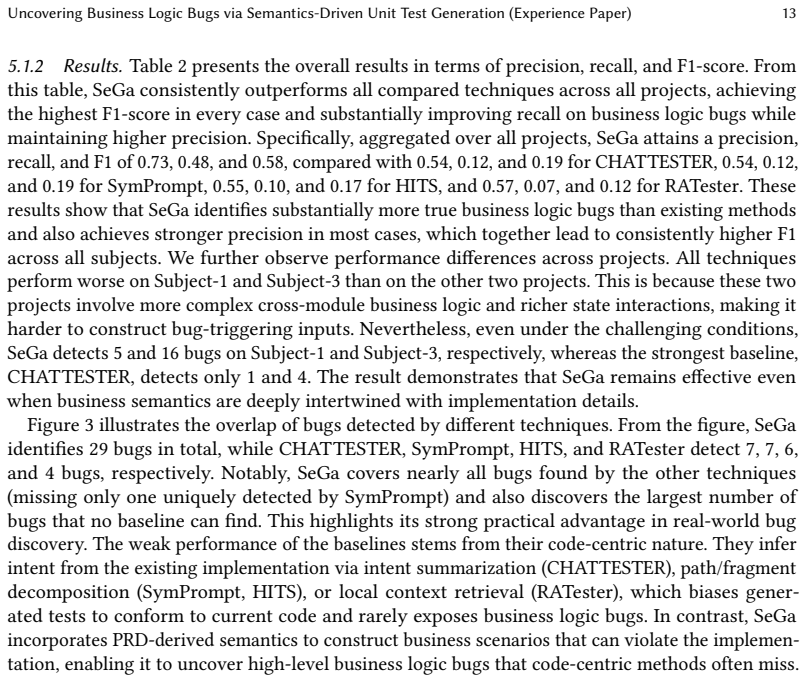
Testing against documented intent catches 29 real business-logic bugs that code-centric tests miss.
Reviewed by Pith at T0; open to challenge. T0 means a machine referee read the full paper against a public rubric. the ladder, T0–T4 →
T0 review · deepseek-v4-flash
2026-08-04 05:21 UTC pith:QF4TRV3L
load-bearing objection Likely real effect, but the headline numbers sit on a table inconsistency and an unreleased dataset—worth refereeing, not yet citable as settled. the 4 major comments →
Uncovering Business Logic Bugs via Semantics-Driven Unit Test Generation
The pith
A machine-rendered reading of the paper's core claim, the machinery that carries it, and where it could break.
Core claim
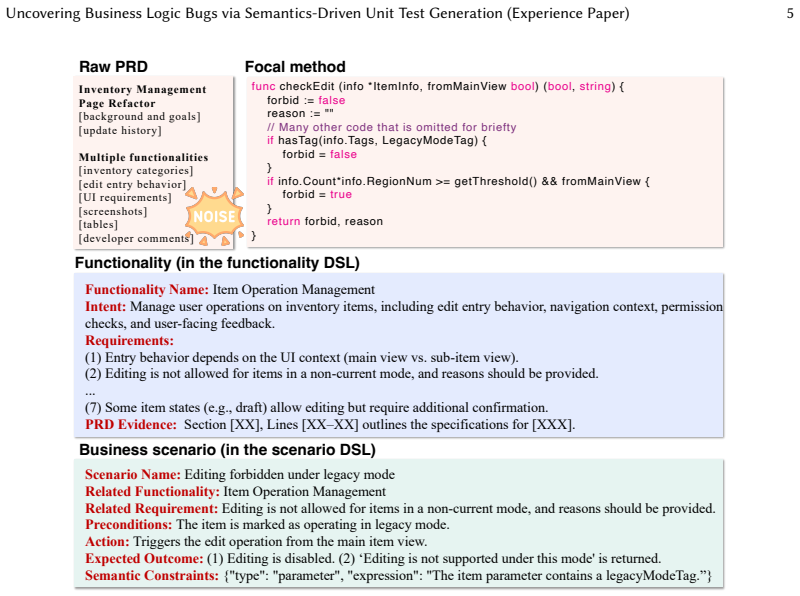
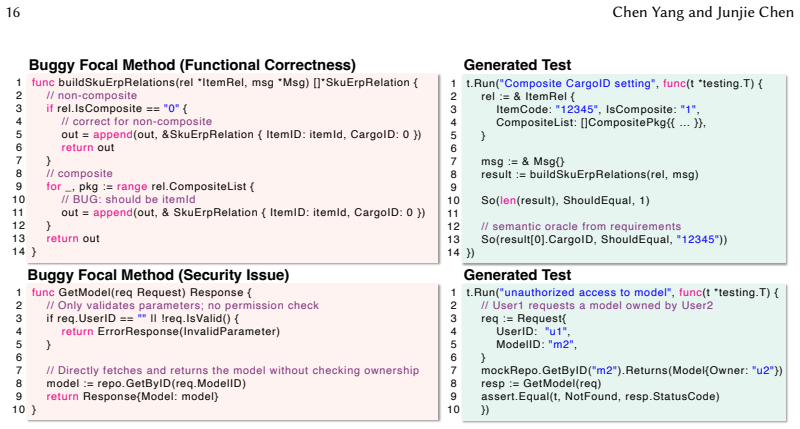
SeGa's central claim is that the mismatch between implemented code and documented business semantics is discoverable at the unit level if the test generator is given the right slice of the requirements. The paper shows that raw PRDs are too noisy to use directly, but a two-level structured representation — functionality entries grouping related requirements, refined into concrete business scenarios with preconditions, triggering actions, expected outcomes, and semantic constraints — provides an actionable oracle. Using these scenarios, SeGa generated tests that exposed 29 of 60 real-world business logic bugs, compared to 4–7 for code-centric LLM generators, and during deployment uncovered 16
What carries the argument
The carrying mechanism is the business-scenario DSL: each scenario isolates one requirement from a retrieved functionality and states it as preconditions, a triggering action, expected outcomes, and structured semantic constraints. This turns a natural-language requirement into an executable oracle that can disagree with the implementation. Around it sits the functionality DSL knowledge base (which groups requirements under a business intent), an agent that summarizes a focal method's intent to retrieve relevant functionalities, and a standalone compilation-repair component that keeps generated tests executable.
Load-bearing premise
The load-bearing premise is that the product requirement documents are a complete, current, and unambiguous description of intended behavior; if a requirement is missing, stale, or open to multiple readings, SeGa's tests will assert the wrong behavior.
What would settle it
Take two sets of real business-logic bugs matched in complexity — one whose requirements are fully and unambiguously documented in the PRD, one whose requirements are undocumented or ambiguous. If SeGa's detection rate on the undocumented set falls to the level of the code-centric baselines, the advantage is an artifact of documentation quality, not of the semantic machinery.
If this is right
- If requirements are available, unit tests can be generated against intended behavior rather than implemented behavior, exposing a bug class that coverage-driven tools miss.
- Retrieving only the requirements relevant to a focal method matters more than feeding the generator more semantic context.
- A structured, scenario-level representation of requirements (preconditions, actions, outcomes, constraints) is what makes the oracle actionable for LLM-based test generation.
- Standalone compilation repair improves the executability of LLM-generated tests without distracting the generation agent.
- Deploying semantics-driven test generation in CI/CD can find business-logic bugs before merge, in code that already passes existing tests.
Where Pith is reading between the lines
- SeGa's effectiveness is bounded by PRD quality; the same machinery could be repurposed to flag ambiguous, incomplete, or drifting requirements as a documentation-quality check.
- The retrieval-plus-scenario pattern could generalize to other specification artifacts (API docs, regulatory rules) and other languages, provided a similar structured oracle can be built.
- A natural extension is a feedback loop that uses developer accept/reject decisions on reported bugs to prune or correct future scenarios, reducing the documented false positives from oracle hallucination.
- Comparing SeGa on bugs whose requirements are fully documented versus undocumented would isolate how much of the advantage comes from semantics versus test construction quality.
Editorial analysis
A structured set of objections, weighed in public.
Referee Report
Summary. SeGa is a semantics-driven unit-test generation technique for business logic bugs. It constructs a structured DSL knowledge base of "functionality entries" from product requirement documents (PRDs), uses an LLM-based semantic reasoning agent to retrieve the functionalities relevant to each focal method, refines them into business scenarios with explicit preconditions, actions, expected outcomes, and semantic constraints, and generates executable unit tests with a separate compilation-repair component. The evaluation on four industrial Go projects containing 60 real-world bugs reports that SeGa detects 29 bugs versus 7, 7, 6, and 4 for CHATTESTER, SymPrompt, HITS, and RATester, with aggregate precision 0.73 versus 0.54-0.57, plus an ablation study and a deployment on 6 production repositories that found 16 previously unknown bugs confirmed and fixed by developers. The paper also reports lessons learned about relevance, false positives, PRD completeness, oracle hallucination, and deployment in CI/CD.
Significance. If the quantitative claims hold, this is a valuable industrial experience paper for a practically important but under-served bug class. The design is not circular: the oracles come from external PRDs and the benchmark uses independently maintained bug annotations, and the paper includes direct comparisons, a component ablation, and a deployment study with developer confirmation. Those are real strengths. However, the headline numbers currently rest on an inconsistent subject table and on non-released proprietary data, so the central 29-vs-7/7/6/4 result is not yet independently verifiable from the manuscript. The paper's honest analysis of false-positive causes and its lessons learned are additional strengths, but the load-bearing evaluation data need to be made transparent before the result can be fully accepted.
major comments (4)
- [§4.1 / Table 1 / Table 2] Section 4.1 states that Subject-1..4 contain 12/9/37/2 bugs, while Table 1's Bugs column reads 37/9/2/12. These cannot both be correct. Cross-checking Table 2 with §5.1.2: SeGa has recall 0.42 on Subject-1 and is said to detect 5 bugs there, implying a denominator of 12, not 37; on Subject-3, recall 0.43 and 16 detected bugs imply a denominator of 37, not 2. Thus Table 1 appears to swap Subject-1 and Subject-4 bug counts. Please correct Table 1 and provide per-subject TP/FP/FN counts (ideally a confusion matrix) so that the aggregate 29 bugs and precision 0.73 can be recomputed. This is material because all reported numbers are small integers and the headline advantage over baselines is only 22-25 bugs.
- [§4.3.1 / §5.1.2] The TP/FP labels in RQ1 are assigned by "manual inspection" comparing failures with annotated bug ranges, but the paper does not say who performed the matching, whether they were blind to the technique, whether there was independent verification, or what inter-rater agreement was. In an industrial study with proprietary data, this creates a risk of labeling bias favoring the proposed method. Please report the labeling protocol, inter-rater reliability (or at least a second annotator's agreement), and per-subject confusion matrices. Without these, the precision comparison (0.73 versus 0.54-0.57) cannot be independently validated.
- [§4.2 / §4.4 / §7] CHATTESTER, SymPrompt, and HITS are adapted from Java/Python to Go, and RATester's local LLM calls are replaced; no adapted prompts, implementations, or artifacts are released. The statement that the authors "strictly followed" the original papers is not sufficient to rule out adaptation bias, especially because the weakness of the baselines is the central result. Please release the adapted code/prompts and report per-technique compilation success rates, numbers of generated and executed tests, and how the one-test-file-per-method configuration interacts with each baseline's intended workflow. Otherwise the 22-25 bug advantage may partly reflect weaker baseline configurations.
- [§5.1.2 / §6 / §7] The paper honestly documents that false positives arise from ambiguous, incomplete, or outdated PRDs and from "oracle hallucination," but it does not quantify how sensitive the central result is to PRD completeness. A failure analysis of the 31 missed bugs is needed: how many were missed because the PRD lacked or obscured the relevant requirement, versus failures in retrieval, scenario derivation, test generation, or execution? Such an analysis would clarify the scope of the claimed advantage and directly inform the lessons in Section 6.
minor comments (6)
- [Abstract / §1 / §9] The claim that precision improves by 26.9%-34.3% does not match the rounded aggregate values in Table 2: relative improvements are about 28.1%, 32.7%, and 35.2% against 0.57, 0.55, and 0.54, and the absolute improvement is 18-19 percentage points. Please state whether the percentages are relative or absolute and recompute them consistently.
- [Figure 3] The overlap diagram is hard to read: the repeated zero labels and ambiguous intersections make it difficult to verify the 29/7/7/6/4 counts. Please replace or supplement it with a table of per-technique detected-bug IDs or a standard Venn-diagram data table.
- [Table 1] The subject identifiers in Table 1 use inconsistent capitalization (subject-1 vs Subject-1) and the Bugs column is inconsistent with Section 4.1. Also, the "Requirements" column (e.g., 106 requirements for a 115,048-token PRD) seems surprisingly coarse; clarify the granularity of a "requirement" in this table.
- [§7] Typo: "realatively" should be "relatively" in the overhead discussion.
- [References [18] and [42]] References [18] and [42] are cited as prior work for designing the functionality DSL, but the cited titles appear to concern binary lifting and FFT semantics lifting, which seem unrelated to requirements engineering DSLs. Please verify and replace these citations.
- [§5.3.2] The statement that buggy code changes involve "91.35 lines on average" is overly precise for a small sample; report the median and range as well, or round to a meaningful precision.
Circularity Check
No significant circularity: SeGa's oracle comes from external PRDs and the evaluation uses independently annotated, developer-confirmed bugs.
full rationale
SeGa's central claim (29 detected bugs vs 7/7/6/4 for baselines; precision 0.73) is not circular. The oracles are external: functionality entries and business scenarios are derived from product requirement documents (Sections 3.1 and 3.2.2), and the motivating example explicitly shows the PRD overriding the implemented behavior. The ground truth is independent: Section 4.1 states each bug is 'precisely annotated' and reviewed by developers, and RQ3 counts only issues 'confirmed and subsequently fixed by the developers' (Section 5.3). No parameter is fitted to the benchmark, and the compared techniques are not derived from SeGa's outputs. The only mild concern is that Section 3.2.2 says scenario derivation 'jointly analyzes the focal method's code context together with the retrieved functionality,' so an LLM could in principle leak implemented behavior into expected outcomes; however, no specific reduction is demonstrated, the paper's example shows the PRD side overriding the implementation, and Section 6 candidly lists oracle hallucination and PRD ambiguity as false-positive sources rather than using them to manufacture success. The inconsistent bug counts between Section 4.1 and Table 1 are a serious reporting/correctness issue, but they do not constitute circularity. Self-citations appear only in related work and implementation conventions and are not load-bearing.
Axiom & Free-Parameter Ledger
free parameters (4)
- Agent interaction budget =
50
- Compilation repair attempts =
3
- LLM temperature =
0
- Test files per focal method =
1
axioms (4)
- domain assumption PRDs contain and accurately express the intended business semantics required for detecting business logic bugs.
- domain assumption A generated test failure is a true business-logic bug only if human matching maps it to an annotated ground-truth bug.
- domain assumption The adapted Go implementations of CHATTESTER, SymPrompt, and HITS faithfully represent the original techniques.
- domain assumption The proprietary repositories used in the study are not present in the LLM's training data.
read the original abstract
Business logic bugs violate intended business semantics and are particularly prevalent in enterprise software. Yet most existing unit test generation techniques are code-centric, making such bugs difficult to expose. We present SeGa, a semantics-driven unit test generation technique for uncovering business logic bugs. SeGa constructs a semantic knowledge base from product requirement documents, represented as a set of functionality entries that group related requirements under a common business intent. Given a focal method, SeGa retrieves the relevant functionality entries and derives fine-grained business scenarios with explicit preconditions, triggering actions, expected outcomes, and semantic constraints to guide LLM-based test generation. We evaluate SeGa on four industrial Go projects containing 60 real-world business logic bugs. SeGa detects 22-25 more bugs than four state-of-the-art LLM-based techniques and improves precision by 26.9%-34.3%. Deployment across 6 production repositories further uncovers 16 previously unknown business logic bugs that were confirmed and fixed by developers. From our industrial study, we summarize a series of lessons and suggestions for practical use and future research.
Figures

Forward citations
Cited by 1 Pith paper
-
Context Matters: Improving the Practical Reliability of LLM-Based Unit Test Generation
CATGen improves LLM unit-test reliability by combining structured project-context retrieval, deterministic test-class skeletons, and static-analysis repair, beating six baselines on compilation success, coverage, and cost.
Reference graph
Works this paper leans on
-
[1]
LangChain
2026. LangChain. https://www.langchain.com/
2026
-
[2]
Shreya Bhatia, Tarushi Gandhi, Dhruv Kumar, and Pankaj Jalote. 2024. System test case design from requirements specifications: Insights and challenges of using chatgpt.arXiv preprint arXiv:2412.03693(2024)
Pith/arXiv arXiv 2024
-
[3]
Xiang Cheng, Fan Sang, Yizhuo Zhai, Xiaokuan Zhang, and Taesoo Kim. 2025. RUG: Turbo LLM for Rust Unit Test Generation. In2025 IEEE/ACM 47th International Conference on Software Engineering (ICSE). IEEE Computer Society, 634–634
2025
-
[4]
Bei Chu, Yang Feng, Kui Liu, Hange Shi, Zifan Nan, Zhaoqiang Guo, and Baowen Xu. 2025. Synergizing Program Analysis and LLMs to Enhance Rust Unit Test Coverage. (2025)
2025
-
[5]
Elizabeth Dinella, Gabriel Ryan, Todd Mytkowicz, and Shuvendu K Lahiri. 2022. Toga: A neural method for test oracle generation. InProceedings of the 44th International Conference on Software Engineering. 2130–2141
2022
-
[6]
FRET Tool Documentation. 2026. Formal Requirements Elicitation Tool (FRET). https://en.wikipedia.org/wiki/FRET_ (software)
2026
-
[7]
Gordon Fraser and Andrea Arcuri. 2011. Evosuite: automatic test suite generation for object-oriented software. InProceedings of the 19th ACM SIGSOFT symposium and the 13th European conference on Foundations of software engineering. 416–419
2011
-
[8]
Sujin Jang, Yeonhee Ryou, Heewon Lee, and Kihong Heo. 2025. UnitCon: Synthesizing Targeted Unit Tests for Java Runtime Exceptions.Proceedings of the ACM on Software Engineering2, FSE (2025), 2053–2074
2025
-
[9]
René Just, Darioush Jalali, and Michael D Ernst. 2014. Defects4J: A database of existing faults to enable controlled testing studies for Java programs. InProceedings of the 2014 international symposium on software testing and analysis. 437–440
2014
-
[10]
Caroline Lemieux, Jeevana Priya Inala, Shuvendu K Lahiri, and Siddhartha Sen. 2023. Codamosa: Escaping coverage plateaus in test generation with pre-trained large language models. In2023 IEEE/ACM 45th International Conference on Software Engineering (ICSE). IEEE, 919–931
2023
-
[11]
Dianshu Liao, Xin Yin, Shidong Pan, Chao Ni, Zhenchang Xing, and Xiaoyu Sun. 2025. Navigating the Labyrinth: Path-Sensitive Unit Test Generation with Large Language Models. (2025)
2025
-
[12]
Yun Lin, You Sheng Ong, Jun Sun, Gordon Fraser, and Jin Song Dong. 2021. Graph-based seed object synthesis for search-based unit testing. InProceedings of the 29th ACM Joint Meeting on European Software Engineering Conference and Symposium on the Foundations of Software Engineering. 1068–1080
2021
-
[13]
Jinwei Liu, Chao Li, Rui Chen, Shaofeng Li, Bin Gu, and Mengfei Yang. 2025. STRUT: Structured Seed Case Guided Unit Test Generation for C Programs using LLMs.Proceedings of the ACM on Software Engineering2, ISSTA (2025), 2113–2135
2025
-
[14]
Andrea Lops, Fedelucio Narducci, Azzurra Ragone, and Michelantonio Trizio. 2024. AgoneTest: Automated creation and assessment of Unit tests leveraging Large Language Models. InProceedings of the 39th IEEE/ACM International Conference on Automated Software Engineering. 2440–2441
2024
-
[15]
Stephan Lukasczyk and Gordon Fraser. 2022. Pynguin: Automated unit test generation for python. InProceedings of the ACM/IEEE 44th International Conference on Software Engineering: Companion Proceedings. 168–172
2022
-
[16]
Nikitha Medeshetty, Ahmad Nauman Ghazi, Sadi Alawadi, and Fahed Alkhabbas. 2025. From Requirements to Test Cases: An NLP-Based Approach for High-Performance ECU Test Case Automation.arXiv preprint arXiv:2505.00547 (2025)
Pith/arXiv arXiv 2025
-
[17]
Zifan Nan, Zhaoqiang Guo, Kui Liu, and Xin Xia. 2025. Test intention guided llm-based unit test generation. In2025 IEEE/ACM 47th International Conference on Software Engineering (ICSE). IEEE Computer Society, 779–779
2025
-
[18]
Nico Naus, Freek Verbeek, Sagar Atla, and Binoy Ravindran. 2024. Poster: Formally Verified Binary Lifting to P-Code. InProceedings of the 2024 on ACM SIGSAC Conference on Computer and Communications Security. 4973–4975
2024
-
[19]
Carlos Pacheco and Michael D Ernst. 2007. Randoop: feedback-directed random testing for Java. InCompanion to the 22nd ACM SIGPLAN conference on Object-oriented programming systems and applications companion. 815–816
2007
-
[20]
Lilly Raamesh and GV Uma. 2010. Reliable mining of automatically generated test cases from software requirements specification (SRS).arXiv preprint arXiv:1002.1199(2010)
Pith/arXiv arXiv 2010
-
[21]
Sanjai Rayadurgam and Mats Per Erik Heimdahl. 2001. Test-sequence generation from formal requirement models. InProceedings Sixth IEEE International Symposium on High Assurance Systems Engineering. Special Topic: Impact of Networking. IEEE, 23–31
2001
-
[22]
Gabriel Ryan, Siddhartha Jain, Mingyue Shang, Shiqi Wang, Xiaofei Ma, Murali Krishna Ramanathan, and Baishakhi Ray
-
[23]
ByteDance Seed, Yuyu Zhang, Jing Su, Yifan Sun, Chenguang Xi, Xia Xiao, Shen Zheng, Anxiang Zhang, Kaibo Liu, Daoguang Zan, et al. 2025. Seed-coder: Let the code model curate data for itself.arXiv preprint arXiv:2506.03524(2025). , Vol. 1, No. 1, Article . Publication date: April 2026. Uncovering Business Logic Bugs via Semantics-Driven Unit Test Generati...
Pith/arXiv arXiv 2025
-
[24]
Richa Sharma and KK Biswas. 2014. Automated generation of test cases from logical specification of software requirements. In2014 9th International Conference on Evaluation of Novel Approaches to Software Engineering (ENASE). IEEE, 1–8
2014
-
[25]
Jiho Shin, Sepehr Hashtroudi, Hadi Hemmati, and Song Wang. 2024. Domain adaptation for code model-based unit test case generation. InProceedings of the 33rd ACM SIGSOFT International Symposium on Software Testing and Analysis. 1211–1222
2024
-
[26]
Phil Stocks and David Carrington. 1993. Test template framework: A specification-based testing case study. In Proceedings of the 1993 ACM SIGSOFT international symposium on Software testing and analysis. 11–18
1993
-
[27]
Chunhui Wang, Fabrizio Pastore, Arda Goknil, and Lionel C Briand. 2020. Automatic generation of acceptance test cases from use case specifications: an nlp-based approach.IEEE Transactions on Software Engineering48, 2 (2020), 585–616
2020
-
[28]
Zejun Wang, Kaibo Liu, Ge Li, and Zhi Jin. 2024. HITS: High-coverage LLM-based Unit Test Generation via Method Slicing.arXiv preprint arXiv:2408.11324(2024)
Pith/arXiv arXiv 2024
-
[29]
Ratnadira Widyasari, Sheng Qin Sim, Camellia Lok, Haodi Qi, Jack Phan, Qijin Tay, Constance Tan, Fiona Wee, Jodie Ethelda Tan, Yuheng Yieh, et al . 2020. Bugsinpy: a database of existing bugs in python programs to enable controlled testing and debugging studies. InProceedings of the 28th ACM joint meeting on european software engineering conference and sy...
2020
-
[30]
Chunqiu Steven Xia, Matteo Paltenghi, Jia Le Tian, Michael Pradel, and Lingming Zhang. 2024. Fuzz4all: Univer- sal fuzzing with large language models. InProceedings of the IEEE/ACM 46th International Conference on Software Engineering. 1–13
2024
-
[31]
Zhuokui Xie, Yinghao Chen, Chen Zhi, Shuiguang Deng, and Jianwei Yin. 2023. ChatUniTest: a ChatGPT-based automated unit test generation tool.arXiv preprint arXiv:2305.04764(2023)
Pith/arXiv arXiv 2023
-
[32]
Chen Yang, Junjie Chen, Bin Lin, Ziqi Wang, and Jianyi Zhou. 2024. Advancing Code Coverage: Incorporating Program Analysis with Large Language Models.ACM Transactions on Software Engineering and Methodology(2024)
2024
-
[33]
Chen Yang, Ziqi Wang, Yanjie Jiang, Lin Yang, Yuteng Zheng, Jianyi Zhou, and Junjie Chen. 2025. Reflective Unit Test Generation for Precise Type Error Detection with Large Language Models. InProceedings of the 40th IEEE/ACM International Conference on Automated Software Engineering
2025
-
[34]
Chen Yang, Ziqi Wang, Lin Yang, Dong Wang, Shutao Gao, Yanjie Jiang, and Junjie Chen. 2026. WiseUT: An Intelligent Framework for Unit Test Generation. In2026 IEEE/ACM 48th International Conference on Software Engineering: Companion Proceedings (ICSE-Companion)
2026
-
[35]
Chen Yang, Lin Yang, Ziqi Wang, Dong Wang, Jianyi Zhou, and Junjie Chen. 2025. Clarifying Semantics of In-Context Examples for Unit Test Generation. InProceedings of the 40th IEEE/ACM International Conference on Automated Software Engineering
2025
-
[36]
Lin Yang, Chen Yang, Shutao Gao, Weijing Wang, Bo Wang, Qihao Zhu, Xiao Chu, Jianyi Zhou, Guangtai Liang, Qianxiang Wang, et al. 2024. On the evaluation of large language models in unit test generation. InProceedings of the 39th IEEE/ACM International Conference on Automated Software Engineering. 1607–1619
2024
-
[37]
Zhenzhen Yang, Rubing Huang, Chenhui Cui, Nan Niu, and Dave Towey. 2025. Requirements-based test generation: A comprehensive survey.ACM Transactions on Software Engineering and Methodology(2025)
2025
-
[38]
Xin Yin, Chao Ni, Xinrui Li, Liushan Chen, Guojun Ma, and Xiaohu Yang. 2025. Enhancing LLM’s Ability to Generate More Repository-Aware Unit Tests Through Precise Contextual Information Injection.arXiv preprint arXiv:2501.07425 (2025)
Pith/arXiv arXiv 2025
-
[39]
Xin Yin, Chao Ni, Xiaodan Xu, and Xiaohu Yang. 2024. What you see is what you get: Attention-based self-guided automatic unit test generation.arXiv preprint arXiv:2412.00828(2024)
Pith/arXiv arXiv 2024
-
[40]
Zhiqiang Yuan, Yiling Lou, Mingwei Liu, Shiji Ding, Kaixin Wang, Yixuan Chen, and Xin Peng. 2023. No more manual tests? evaluating and improving chatgpt for unit test generation.arXiv preprint arXiv:2305.04207(2023)
Pith/arXiv arXiv 2023
-
[41]
Junwei Zhang, Xing Hu, Shan Gao, Xin Xia, David Lo, and Shanping Li. 2025. Less is More: On the Importance of Data Quality for Unit Test Generation.arXiv preprint arXiv:2502.14212(2025)
Pith/arXiv arXiv 2025
-
[42]
Naifeng Zhang, Sanil Rao, Mike Franusich, and Franz Franchetti. 2025. Towards Semantics Lifting for Scientific Computing: A Case Study on FFT.arXiv preprint arXiv:2501.09201(2025). , Vol. 1, No. 1, Article . Publication date: April 2026
Pith/arXiv arXiv 2025
-
[2024]
Code-aware prompting: A study of coverage-guided test generation in regression setting using llm.Proceedings of the ACM on Software Engineering1, FSE (2024), 951–971
2024
discussion (0)
Sign in with ORCID, Apple, or X to comment. Anyone can read and Pith papers without signing in.