Refined Sensitivity Estimates for Single-Molecule Magnet Dark Matter Detectors
Pith reviewed 2026-07-03 11:03 UTC · model grok-4.3
The pith
Accounting for stochastic spin relaxation lowers the energy threshold for avalanche formation in single-molecule magnet dark matter detectors.
A machine-rendered reading of the paper's core claim, the machinery that carries it, and where it could break.
Core claim
The central claim is that the stochastic nature of spin relaxation means a non-zero fraction of spins relax and release Zeeman energy even when diffusion is fast; this energy contributes to local heating and thereby lowers the threshold for avalanche formation relative to the strict time-comparison criterion used before.
What carries the argument
The refined analytic estimate for the relaxing spin fraction and the local heating it produces through Zeeman energy release.
If this is right
- The energy threshold for avalanche formation drops substantially compared with prior conservative estimates.
- Sensitivity to low-mass dark matter improves because lower-energy deposits can now initiate the avalanche.
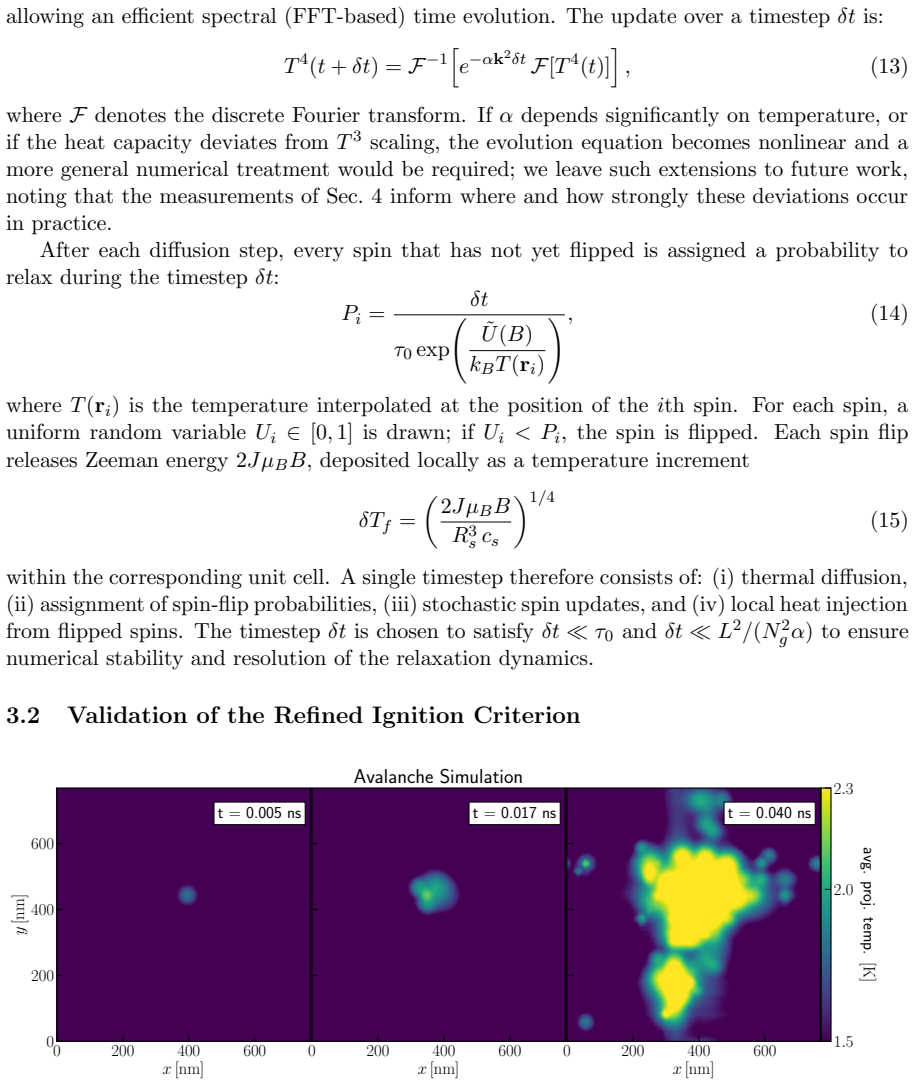
- Simulation results verify that the stochastic fraction produces measurable extra local heating.
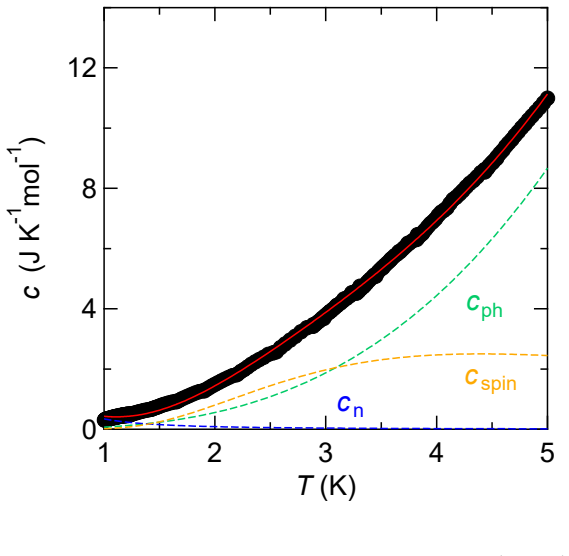
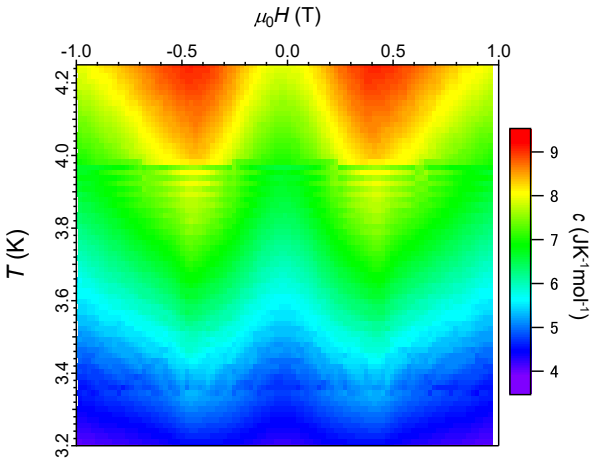
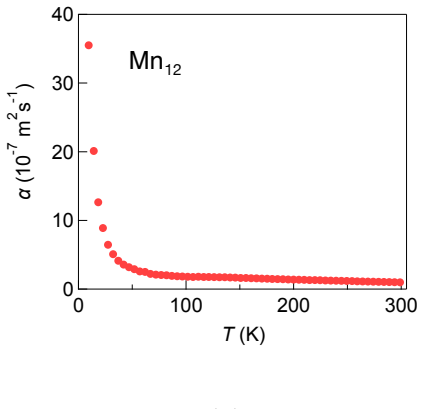
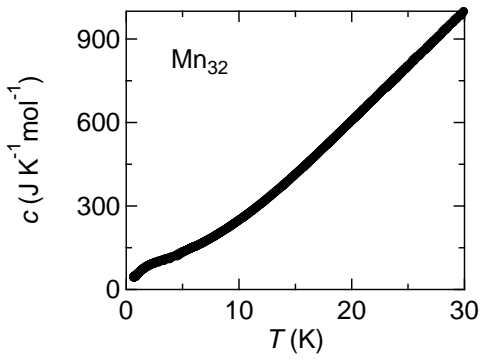
- Experimental data on Mn12-acetate and Mn32 support applying the measured thermal properties to the metastable state.
Where Pith is reading between the lines
- Crystal size or doping levels could be tuned to control diffusion rates and thereby amplify the stochastic heating contribution.
- The same relaxation-fraction logic might apply to other metastable spin systems used for particle detection.
- Varying temperature or magnetic field in controlled tests could map how the relaxing fraction scales and further constrain the model.
Load-bearing premise
The stochastic spin-relaxation model correctly predicts the relaxing fraction and its heating contribution independently of the crystal environment, and the measured low-temperature thermal properties apply directly to the metastable detector state.
What would settle it
A direct measurement of the minimum energy deposition needed to trigger an avalanche in Mn12-acetate that lies well above the refined analytic prediction would falsify the lowered-threshold claim.
Figures
read the original abstract
We revisit the sensitivity of Single Molecule Magnet (SMM) crystals as detectors for low-mass dark matter. In previous work, we established the concept of the ``magnetic bubble chamber'', where energy deposited by dark matter triggers a magnetic avalanche in a metastable crystal. The original sensitivity estimates relied on a conservative criterion requiring the spin relaxation time to be strictly shorter than the thermal diffusion time. Here, we demonstrate that this criterion effectively ignores the stochastic nature of spin relaxation. We derive a refined analytic estimate which accounts for the fraction of spins that relax even when diffusion is fast. We show that the Zeeman energy released by this fraction contributes to local heating, significantly lowering the energy threshold for avalanche formation. We present simulation results confirming this effect and report on experimental verification of the assumed low-temperature thermal properties of two representative SMM crystals, Mn$_{12}$-acetate and Mn$_{32}$. Together, these efforts extend this pathfinder program toward the realization of SMM-based detectors with controlled material properties and enhanced dark matter sensitivity.
Editorial analysis
A structured set of objections, weighed in public.
Referee Report
Summary. The paper revisits sensitivity estimates for single-molecule magnet (SMM) crystals as low-mass dark matter detectors in the magnetic bubble chamber concept. It derives a refined analytic threshold that incorporates the stochastic nature of spin relaxation, showing that a non-zero fraction of spins relax even under fast diffusion, releasing Zeeman energy that contributes to local heating and lowers the avalanche threshold relative to the prior conservative criterion. The work includes simulations confirming the effect and experimental measurements of low-temperature specific heat and thermal conductivity for Mn12-acetate and Mn32.
Significance. If the refined threshold is robust, the result materially improves projected reach for SMM-based detectors by relaxing an overly stringent criterion while remaining grounded in the stochastic relaxation model. Credit is due for the combination of analytic derivation, direct simulation validation of the relaxing fraction, and experimental checks on the thermal properties of the two representative crystals; these elements together support a more realistic sensitivity estimate without introducing free parameters.
minor comments (3)
- [§3] §3 (analytic derivation): the expression for the relaxing fraction should explicitly state its dependence on the ratio of relaxation to diffusion timescales to allow direct comparison with the original conservative criterion.
- [Table 1] Table 1 (thermal properties): the reported values for Mn32 conductivity at 0.1 K lack quoted uncertainties; adding these would strengthen the claim that the measured properties apply to the metastable detector state.
- [Figure 4] Figure 4 (simulation results): the avalanche probability curves would benefit from an overlay of the original conservative threshold for visual quantification of the improvement.
Simulated Author's Rebuttal
We thank the referee for their supportive summary of our manuscript and for recommending minor revision. No specific major comments were raised in the report.
Circularity Check
No significant circularity; derivation is self-contained
full rationale
The paper's central refinement derives an analytic estimate for avalanche threshold by incorporating the stochastic fraction of relaxing spins (even under fast diffusion) and their Zeeman-energy contribution to local heating. This step is presented as following from the stochastic relaxation model, with confirmation via independent simulations and direct experimental measurements of low-temperature specific heat and conductivity on Mn12-acetate and Mn32. Prior work is cited only to establish the original conservative criterion and the magnetic-bubble-chamber concept; the new estimate does not reduce to those inputs by construction, nor does any load-bearing step rely on self-citation chains or fitted parameters renamed as predictions. The derivation therefore remains externally falsifiable and independent of its own outputs.
Axiom & Free-Parameter Ledger
axioms (1)
- domain assumption Spin relaxation is a stochastic process allowing a non-zero fraction to relax even when thermal diffusion time is short.
Reference graph
Works this paper leans on
-
[1]
Direct Detection of Sub-GeV Dark Matter
R. Essig, J. Mardon and T. Volansky, “Direct Detection of Sub-GeV Dark Matter,” Phys. Rev. D85, 076007 (2012) [arXiv:1108.5383 [hep-ph]]
work page internal anchor Pith review Pith/arXiv arXiv 2012
-
[2]
Direct Detection of sub-GeV Dark Matter with Semiconductor Targets
R. Essig, M. Fern´ andez-Serra, J. Mardon, A. Soto, T. Volansky and T.-T. Yu, “Direct Detection of sub-GeV Dark Matter with Semiconductor Targets,” JHEP2016(05), 046 [arXiv:1509.01598 [hep-ph]]
work page internal anchor Pith review Pith/arXiv arXiv
-
[3]
Semiconductor Probes of Light Dark Matter
P. W. Graham, D. E. Kaplan, S. Rajendran and M. T. Walters, “Semiconductor Probes of Light Dark Matter,” Phys. Dark Univ.1, 32 (2012) [arXiv:1203.2531 [hep-ph]]. 11
work page internal anchor Pith review Pith/arXiv arXiv 2012
-
[4]
SENSEI: Direct-Detection Results on sub-GeV Dark Matter from a New Skipper-CCD,
L. Baraket al.[SENSEI], “SENSEI: Direct-Detection Results on sub-GeV Dark Matter from a New Skipper-CCD,” Phys. Rev. Lett.125(2020) no.17, 171802 doi:10.1103/PhysRevLett.125.171802 [arXiv:2004.11378 [astro-ph.CO]]
-
[5]
R. Agneseet al.[SuperCDMS], Phys. Rev. Lett.121(2018) no.5, 051301 [erra- tum: Phys. Rev. Lett.122(2019) no.6, 069901] doi:10.1103/PhysRevLett.121.051301 [arXiv:1804.10697 [hep-ex]]
-
[6]
Dark-Photon Search using Data from CRESST-II Phase 2
G. Angloheret al.[CRESST], “Dark-Photon Search using Data from CRESST-II Phase 2,” Eur. Phys. J. C77(2017) no.5, 299 doi:10.1140/epjc/s10052-017-4878-6 [arXiv:1612.07662 [hep-ex]]
work page internal anchor Pith review Pith/arXiv arXiv doi:10.1140/epjc/s10052-017-4878-6 2017
-
[7]
Q. Arnaudet al.(EDELWEISS Collaboration), “First germanium-based constraints on sub-MeV Dark Matter with the EDELWEISS experiment,” Phys. Rev. Lett.125, 141301 (2020) [arXiv:2003.01046 [astro-ph.GA]]
-
[8]
Characterization of the background spec- trum in DAMIC at SNOLAB,
A. Aguilar-Arevaloet al.[DAMIC], “Characterization of the background spec- trum in DAMIC at SNOLAB,” Phys. Rev. D105(2022) no.6, 062003 doi:10.1103/PhysRevD.105.062003 [arXiv:2110.13133 [hep-ex]]
-
[9]
EXCESS work- shop: Descriptions of rising low-energy spectra,
A. Fuss, M. Kaznacheeva, F. Reindl, F. Wagner, P. Adari, A. A. Aguilar-Arevalo, D. Amidei, G. Angloher, E. Armengaud and C. Augier,et al.“EXCESS work- shop: Descriptions of rising low-energy spectra,” SciPost Phys. Proc.9(2022), 001 doi:10.21468/SciPostPhysProc.9.001 [arXiv:2202.05097 [astro-ph.IM]]
-
[10]
Magnetic Bubble Chambers and Sub-GeV Dark Matter Direct Detection
P. C. Bunting, G. Gratta, T. Melia and S. Rajendran, “Magnetic Bubble Cham- bers and Sub-GeV Dark Matter Direct Detection,” Phys. Rev. D95, 095001 (2017) [arXiv:1701.06566 [hep-ph]]
work page internal anchor Pith review Pith/arXiv arXiv 2017
-
[11]
Quantum Detection using Magnetic Avalanches in Single-Molecule Magnets,
H. Chen, R. Mahapatra, G. Agnolet, M. Nippe, M. Lu, P. C. Bunting, T. Melia, S. Ra- jendran, G. Gratta and J. R. Long, “Quantum Detection using Magnetic Avalanches in Single-Molecule Magnets,” arXiv:2002.09409 [physics.ins-det]
-
[12]
Lis, T. Preparation, structure, and magnetic properties of a dodecanuclear mixed- valence manganese carboxylate.Acta Crystallographica Section B.36, 2042-2046 (1980), https://onlinelibrary.wiley.com/doi/abs/10.1107/S0567740880007893
-
[13]
Particle Detection Using Magnetic Avalanches in Single-Molecule Magnet Crystals
B. Kohnet al., “Particle Detection Using Magnetic Avalanches in Single-Molecule Magnet Crystals,” arXiv:2508.02467 [hep-ex]
work page internal anchor Pith review Pith/arXiv arXiv
-
[14]
A [Mn 32] Double-Decker Wheel,
M. Manoli, R. Inglis, M. J. Manos, V. Nastopoulos, W. Wernsdorfer, E. K. Brechin, and A. J. Tasiopoulos, “A [Mn 32] Double-Decker Wheel,” Angew. Chem. Int. Ed.50, 4441 (2011)
2011
-
[15]
Thermodynamic evidence for a field-angle-dependent Majorana gap in a Kitaev spin liquid,
O. Tanaka, Y. Mizukami, R. Harasawa, K. Hashimoto, K. Hwang, N. Kurita, H. Tanaka, S. Fujimoto, Y. Matsuda, E.-G. Moon, and T. Shibauchi, “Thermodynamic evidence for a field-angle-dependent Majorana gap in a Kitaev spin liquid,” Nat. Phys.18, 429 (2022)
2022
-
[16]
Mizukami, Y., Haze, M., Tanaka, O., Matsuura, K., Sano, D., B¨ oker, J., Eremin, I., Kasahara, S., Matsuda, Y. & Shibauchi, T. Unusual crossover from Bardeen-Cooper- Schrieffer to Bose-Einstein-condensate superconductivity in iron chalcogenides.Commu- nications Physics.6, 183 (2023,7), https://doi.org/10.1038/s42005-023-01289-8
-
[17]
Ryu, M., Takamizawa, S. & Morikawa, J. Thermal diffusivity of organosuperelastic soft crystals during stress-induced phase transition.Applied Physics Letters.119, 251902 (2021,12), https://doi.org/10.1063/5.0055707 12
-
[18]
Takehara, R., Kubo, N., Ryu, M., Kitani, S., Imajo, S., Shoji, Y., Kawaji, H., Morikawa, J. & Fukushima, T. Insights into Thermal Transport through Molecu- larπ-Stacking.Journal Of The American Chemical Society.145, 22115-22121 (2023), https://doi.org/10.1021/jacs.3c07921, PMID: 37756122
-
[19]
Takehara, R., Fukui, T., Tano, T., Ryu, M., Kitani, S., Kawaji, H., Morikawa, J. & Fukushima, T. Covalent Bonds versus van der Waals Forces: A Picture in Thermal Conduc- tion of Organic Materials.Journal Of The American Chemical Society.146, 30548-30552 (2024), https://doi.org/10.1021/jacs.4c11849, PMID: 39446563
-
[20]
Ryu, M., Takehara, R., Kamegaki, S., Yokoyama, H., Kajitani, T., Morikawa, J. & Fukushima, T. Control of Heat Flow in a Soft Matter: Anisotropic Heat Transport in a Discotic Columnar Liquid Crystal Capable of Reversible Align- ment Switching.The Journal Of Physical Chemistry Letters.16, 3460-3464 (2025), https://doi.org/10.1021/acs.jpclett.5c00354, PMID: 40155355
-
[21]
Magnetic properties of a Mn cluster organic compound,
M. A. Novak, R. Sessoli, A. Caneschi, and D. Gatteschi, “Magnetic properties of a Mn cluster organic compound,” J. Magn. Magn. Mater.146, 211 (1995)
1995
-
[22]
Evangelisti, M., Candini, A., Affronte, M., Pasca, E., Jongh, L., Scott, R. & Brechin, E. Magnetocaloric effect in spin-degenerated molecular nanomagnets.Phys. Rev. B.79, 104414 (2009,3), https://link.aps.org/doi/10.1103/PhysRevB.79.104414 13
discussion (0)
Sign in with ORCID, Apple, or X to comment. Anyone can read and Pith papers without signing in.